The Blitz
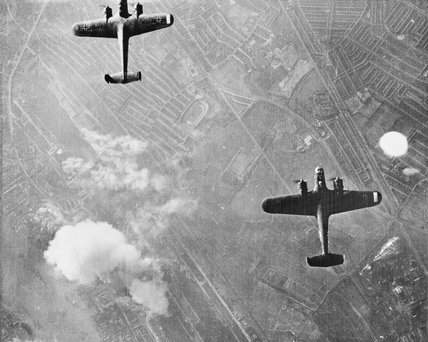
The Bombing of England: The London Blitz begins. September 7, 1940 was the first of 57 consecutive nights that the Luftwaffe bombed the British capitol. The Blitz began when the Luftwaffe shifted its focus from bombing British airfields and aircraft factories to conducting terror raids on London and other major cities in response to British bombing of Berlin. This proved to be a mistake, as it would give RAF Fighter Command much-needed time to regroup.
Ignoring the RAF airfields, German bombers instead attacked London, England, United Kingdom as the new Operation Loge commenced; Göring rode his personal train Asia to Pas-de-Calais, France in a freshly made uniform to personally oversee the first night of the operation. At 1600 hours, 300 bombers and 200 Bf 110 fighter-bombers escorted by 600 Bf 109 fighters. British fighters expected the attacking force to split up to attack airfields, thus were unprepared when they flew straight for East End, London. By the time the British fighters arrived, the bombers had already unloaded their bombs. However, as the Bf 109 fighters had already left due to low fuel levels, German bombers became easy prey. During the day, 53 German bombers were shot down, as were 21 Bf 109 fighters; the British lost 27 fighters. Overnight, German bombers continued to attack East End, which saw 490 killed and 1,200 wounded on this day. This would mark the first of 57 consecutive nights of German bombings on the British capital.
The first bombs drop on the southern side of the Thames, around the entrance to London’s dockland and the docks near Woolwich Arsenal. Bombing accuracy is good, as the weather is fine and the RAF fighters are elsewhere. The Harland & Wolff shipbuilding factory, a munitions factory at Woolwich, the Queen Victoria docks, the King George V docks, the Royal Albert Docks, the Millwall docks, the Wapping docks, the St. Katherine’s Docks, and the entire surrounding area is hit with devastating effect. The Woolwich Arsenal blows up after its stored gunpowder ignites. Several ships in port are hit, with several sinking and almost two dozen damaged. The entire area is dry due to the late-summer heat, and soon everything is on fire. The fires rage close to London Bridge, but it is spared.
“We got on patrol and drifted up and down the sky. Then suddenly: “Hullo, Ganer leader; Hullo, Ganer leader, bandits on your right, over”. And there sure enough was a tiny slanting black line which we knew were bombers. We turned towards them. I turned the gun button to “Fire” and looked to see that the reflector sight was working O K. I opened the hood, and immediately I could see 50 per cent better, although it is 50 per cent colder. I saw that the rapidly closing bombers were surrounded by black dots, which I knew to be Me 109s. So we were in for it this time! Before we knew where we were, we were doing a beam attack on the Dornier 215s. All I remember is trying to avoid hitting anyone else as we attacked, and being conscious of Me 109s coming down to attack us. I had a long burst at one section of Dorniers and as I broke away noticed at least two lagging behind and streaming glycol or white smoke. Those weren’t necessarily the ones I had fired at…. The odds today have been unbelievable (and we are all really very shaken!). There are bombs and things falling around tonight and a terrific gun barrage. Has a blitz begun? The Wing-Commander’s coolness is amazing and he does a lot to keep up our morale — very necessary tonight.”
- George Barclay, 249 Squadron, 7 September 1940.
“It was burning all down the river. It was a horrid sight. But I looked down and said ‘Thank God for that’, because I knew that the Nazis had switched their attack from the fighter stations thinking that they were knocked out. They weren’t, but they were pretty groggy”
- Air Vice Marshal Keith Park AOC 11 Group on the switch to attack London.
“…..All we could see was row upon row of German raiders, all heading for London. I have never seen so many aircraft in the air all at the same time…. The escorting fighters saw us at once and came down like a ton of bricks, when the squadron split up and the sky became a seething cauldron of aeroplanes, swooping and swerving in and out of the vapor trails and tracer smoke. A Hurricane on fire spun out of control ahead of me while, above to my right, a 110 flashed across my vision and disappeared into the fog of battle before I could draw a bead on it. Everyone was shouting at once and the earphones became filled with a meaningless cacophony of jumbled noises. Everything became a maelstrom of jumbled impression — a Dornier spinning wildly with part of its port mainplane missing; black streaks of tracer ahead, then I instinctively put my arm up to shield my face; taking a breather when the haze absorbed me for a moment …”
- Squadron Leader ‘Sandy’ Johnstone, 602 Squadron, 7 September 1940.
“This moment is a historic one. As a result of the provocative British attacks on Berlin on recent nights the Führer has decided to order a mighty blow to be struck in revenge against the British capital of the British Empire. I personally have assumed the leadership of this attack and today I have heard above me the roaring of the victorious German squadrons.”
- Hermann Göring September 7th 1940
Weather over Great Britain: High cloud early giving way to light cloud but remaining fine throughout the south. Channel areas can expect early morning haze which should quickly disappear, leaving clear skies. Temperatures were expected to be normal. The north could expect mid to high level cloud with good visibility.
The British government has issued the code word “Cromwell” to all of its commands. This means that an invasion is expected on short notice. All local British forces are placed on high alert. At the main base of Scapa Flow, the fleet is brought to 1-hour’s notice, and the crews of the destroyers are kept at action stations throughout the night. HMS Repulse leads a patrol out of Scapa Flow headed for Iceland.
The day previous was a day when extreme pressure was brought upon Fighter Command. Six of the seven sector airfields had suffered considerable damage, and five of the advanced air bases along the Kent coast feared no better. Losses of aircraft again exceeded production and pilot strength was now down to about seven hundred in all.
The Luftwaffe had pounded and pounded at the RAF, and now it appeared that victory was now within their grasp. It had taken the German war machine much longer than they had anticipated, mainly due to their own mistakes, but slowly they were grinding away at Fighter Command, and slowly Fighter Command was weakening. Even on September 6th, the heads at the War Office were ready to implement the order of ‘Invasion Alert No.1’ It had already been served as a warning only to all RAF Commands, but as yet had not been released as ‘official’ to the public.
ACM Hugh Dowding knew the situation, he knew that if the RAF was at all to gain the upper hand, then his pilots would have to shoot down the German planes at a rate of three to one, a task which at this stage when his airfields were almost nonoperational, and his pilots were tired and many were near to exhaustion. Dowding said in his office at Bentley Priory, “……all we can do now is to pray to God, because only a miracle can save us now.”
What was to happen on September 7th 1940, goes back to the night of August 24th / 25th when German bombers targeted a number of British cities and towns. Birmingham had about four raids in as many hours, Liverpool came under a Red Alert when it was bombed as was Hull and Sheffield. But it was the German bombers that were supposed to drop their bombs on Thameshaven and Rochester, but dropped them in the heart of London instead, the Luftwaffe crew claiming that they had lost their bearings. The British War Cabinet sanctioned, as retaliation, an attack on Berlin on the following night of August 25th/26th. About 50 British bombers made up of Wellington’s and Hampdens were to carry out the attack. But according to Bomber Command, heavy cloud covered the German capital and only half of the bombers dropped their bombs, but most fell wide of the city doing little damage. The only bombs to fall within the city limits damaged a summer house in the Berlin suburb of Rosenthal and only two people were injured and no deaths were recorded.
But a different picture was painted by William L.Shirer who was in Berlin at the time of the raid. He was due to make his evening broadcast to America at the time of the raid. Today his diary reads:
“Today the bombing is the one topic of conversation among Berliners. Its especially amusing therefore to see that Goebbels has permitted the local newspapers to publish only a six-line communiqué about it, to the effect that enemy planes flew over the capital, dropped a few incendiary bombs on two suburbs, and damaged one wooden hut in a garden. There is not a line about the explosive bombs which we all plainly heard. Nor is there a word about the three streets in Berlin which have been roped off all day today to prevent the curious from seeing what a bomb can do to a house. It will be interesting to watch the reaction of the Berliners to the efforts of the authorities to hush up the extent of the raid.”
- Berlin Diary William L. Shirer 1940
Interesting to note that Bomber Command reported only the garden shed in the suburbs and no mention of the dropping of any high explosive bombs in Berlin itself. The next raid on Berlin according to RAF Bomber Command was on the night of August 28th / 29th and stated that Berlin would now be bombed on regular routine missions into Germany. Yet William Shirer states in his diary that Berlin was again bombed the following night after the first initial raid.
So it was on the night of September 4th 1940, that Hitler, in his speech at the Berlin Sportpalast stated amongst the cheers of the partisan audience, “…the people in Britain ask, but why doesn’t he come?” and Hitler gave his reply “Calm yourselves, be calm, for he is coming! He is coming!” At the meeting on August 30th with Göring Hitler stated then that he had decided that he would withdraw his ban on the bombing of London and showed that he was now keen on regular attacks on the British capital in retaliation for the consistent attacks on Berlin by the RAF.
As mentioned earlier, that on September 3rd Göring called a meeting at the Hague with two of his commanders, Kesselring and Sperle. Kesselring agreed that the attacks should be switched from fighter airfields to the city of London, but Sperle did not agree stating that the RAF had more reserves than they were led to believe. From Berlin, Adolph Hitler gave the order that plans for attacks on London should begin immediately. He was now firm in his beliefs that by concentrating on an all-out bombing campaign on the British capital would bring Britain to its knees, and that the bombing should continue until Britain submits under the strain. In between missions to England by day and by night during September 5th and the 6th, the Luftwaffe was busy in its preparations of strengthening all bomber units and moving Bf 110 and Bf 109 units to specific locations close to the French coast. An all-out bombing campaign on London was to commence on September 7th 1940.
The question here is, did ACM Hugh Dowding or AVM Keith Park have any idea that the German tactics were about to change. Ever since the attacks commenced on the aerodromes of 11 Group, both men believed that the assault would continue until most airfields were virtually nonoperational. They firmly believed that the German plan was to strike a severe a blow on the sector organization as soon as possible, and both men knew, that as August drew on and went into September, they were succeeding. My belief is that the answer was yes, they did know. Fighter Command had the advantage of ‘Ultra’ and the ‘Y’ Service (RAF Radio Intelligence). Between these two intelligence sources Fighter Command could listen in on the German communications system, and not only be forewarned of any impeding attacks or strategic tactics ordered by the German High Command. Prior to the Battle of Britain, a listening station was situated at Hawkinge where German linguists of the RAF could translate messages and forward these to Fighter Command HQ. Later, this task was given to selected members of the WAAF who worked on six hour shifts.
Because of the importance of Hawkinge and its vulnerability to attack, more suitable premises was located at Hollywood Manor at Kingsdowne near Wrotham in Kent, and this became the official operations center for radio-telephony monitoring of German messages and instructions for the duration of the war. All messages received, were sent to RAF commands as well as to the navy and the army. Len Deighton makes mention of this when the Luftwaffe was preparing for Adlertag on August 11th 1940:
“The RAF also had access to the reports from men eavesdropping on German frequencies. The German weather reconnaissance units were not asked simply for general information but for weather conditions at the intended targets. As an added risk to security such aircraft sent radio reports while still over Britain. This, and any other Luftwaffe radio traffic, was correlated by a secret unit known as the ‘Y” service. And as each German aeroplane was prepared for an operational flight, its radio was tested. Monitoring of these test signals provided intelligence with a fairly accurate guess at the number of aircraft to be used in the following 24-hour period. As Eagle Day approached, the listening service was able to tell Dowding that he was about to be attacked on a scale far exceeding all previous attacks.”
- Len Deighton Fighter Pluriform 1993 p158
At this point certain threads came together, as they often do at critical moments. The bombs which fell on London on the night of August 24/25 had immediate repercussions; 81 aircraft of Bomber Command attacked Berlin the following night. This was an act which deeply pleased the Prime Minister, the Government, the Press and the overwhelming majority of a public which was displaying unexpected reserves of belligerency. The Air Staff was less pleased; it had little faith in the effectiveness of pure reprisals, and still firmly believed that its slender bomber forces could do real damage to military targets. How much damage Bomber Command actually did to Berlin on August 25/26 is uncertain; that it caused considerable annoyance to Hitler and Göring, who had boasted that such a thing would never happen, is obvious. And some damage was certainly done by attacks on other targets in Germany. Thus Hitler had more than one motive for rescinding his prohibition of deliberate attacks on the British capital, and Göring now ordered the matter to be put in hand with immediate effect. On September 5 the “Y” Service intercepted his order for an attack by over 300 bombers with massive fighter cover on the London docks on the afternoon of September 7.
“Thanks to Ultra, Göring’s signal was in the hands of the Prime Minister and of Dowding within minutes of its dispatch.”
- John Terraine Right of the Line Hodder & Stoughton 1985 p207
A number of sources state how Dowding and Park were prepared for other attacks especially during September and the initial raid on September 7th 1940 was no exception. Dowding and Park had received knowledge of an impending raid that was to be targeted at East London on September 5th. They knew that it was to take place within a few days, and calculating the time that it would take to bring the number of units forward and organize such a large raid, it was estimated that the attack on London would be either September 7th or the 8th. According to John Terraine the Air Ministry had also informed them of Invasion Alert No.1 signifying “an attack is imminent:”.
The position was grim in the extreme as from August 24th to September 6th. 295 fighters had been totally destroyed and 171 badly damaged, against a total output of 269 new and repaired Spitfires and Hurricanes. Worst of all, during the fortnight 103 pilots were killed or missing and 128 were wounded, which represented a total wastage of 120 pilots per week out of a fighting strength of just under 1,000.
Experienced pilots were like gold dust, and each one lost had to be replaced by an untried man who for some time would be vulnerable, until he acquired battle know-how. Fresh squadrons, moved in to replace tired units, very often lost more aircraft and pilots than the formations they replaced. For instance, 616 Squadron lost twelve aircraft and five pilots between August 25th and September 2nd and had to be retired to Coltishall in No.12 Group.
No. 603 Squadron, newly arrived in 11 Group on August 28th, had by September 6th lost sixteen aircraft and twelve pilots, while 253 Squadron at Kenley lost thirteen Hurricanes and nine pilots in the seven days they were in battle, from August 30th.
0830 Hours: A strange deadly quiet was experienced by all the radar stations along the south coast. The CRTs were all blank, not a sign of the enemy. For the first time the WAAFs could have breakfast in peace, and there were more calls for another ‘cuppa’ than usual. Some took advantage of the mild balmy early morning to stroll outside, something that had not been done for weeks. But it was at Wittering that the first contact had been made with the enemy. A single blip had been detected and 266 Squadron that had just been transferred to Wittering for a rest after being in the battle zone was sent to intercept. Three Spitfires took off and made for their vectored position at twenty-eight thousand. All three aircraft were at full boost trying to catch the enemy aircraft, and one of them had to turn back because the engine started to become erratic. The enemy aircraft was a Dornier 215 and it was not until they were well out over the North Sea close to the Dutch border that they managed to make their first attack. Their shots went wide and they came under some accurate gunfire from the German aircraft. A second attack was more successful with the Dornier exploding in a ball of flame.
1030 Hours: Across the Channel. Göring, commander of II Fliegerkorps Bruno Loerzer and Albert Kesselring drive through the French countryside towards the township of St Omer. Göring, who had now pronounced himself as the leader of the Luftwaffe operations wanted to see for himself the beginning of the final stage of the battle, and had invited Loerzer and Kesselring along. They were to position themselves at the closest point of the French mainland to the English coast, as it would be from here that they could witness what they thought would be the greatest onslaught that Britain would ever endure.
Along the way they found time to have breakfast, and called in to some of the Luftwaffe fighter stations one of them being the Lehrgeschwader of Bf 109s based at Calais-Marck, where a midday banquet was held. Here, Göring in his open heavy leather coat that displayed all his war medals talked and chatted with the many pilots. He spoke of his days as a fighter pilot when air combat was fought with open cockpit biplanes. He was in a sort of jovial, yet somewhat cocky mood.
After lunch, the procession of three Mercedes escorted by motorcycle police made their way to the high picnic grounds at Cape Blanc Nez, where a team of noncommissioned officers with almost a precision like mentality set out tables and white table linen, and hastily set out the sandwiches, biscuits and champagne. There was a war on, the British were lazily sitting around almost bored with themselves, the German pilots were preparing to deploy themselves on the greatest attack yet, and Göring was going to have a picnic.
1155 Hours: The radar at Dover and Pevensey picks up the first blips of the day, a small formation just off the coast. They appear to be content on staying just within striking distance of the English coastline but made sure that they would not cross the coast. 66 Squadron Kenley (Spitfires) who were on a routine patrol were sent to intercept. It was a small formation of Bf 109s possibly trying to draw the British fighters out, just as they had done during the early Channel attacks in July. Being as the enemy was content in staying out there, Fighter Command decided that as long as they kept their distance from the coast, no other squadrons would be sent to intercept.
66 Squadron engaged combat, but after two of its aircraft had to return to base, decided to break off the action. One of the Spitfires did not make it back to Kenley, instead the pilot P/O C.A.W.Bodie decided to crash land the aircraft close to Hawkinge when he was losing height rapidly. The other Spitfire is believed to have made it back to Kenley and also made a crash landing.
1300 Hours: On the other side of the Channel, it was a different story. German ground personnel were busy putting the finishing touches to new airfields that were positioned very near to the French coast. Many new gun emplacements were being constructed, and word broke through to British intelligence that heavy bombers were being moved into readiness. More amphibious landing craft were still arriving at the Channel ports.
The British War Office and Air Ministry were advised that after consultation with the meteorological office that the tides and moon favored a date between the 8th and 10th of September for the commencement of the invasion. A meeting that was called by the British Chiefs of Staff and was to commence that day at 5.30pm to discuss whether or not the “Alert No.1” should be issued. At this stage, Dowding and Park had no idea as to the change in tactics that the Luftwaffe was to implement later this day.
AVM Keith Park issues the statement to all his controllers and squadron commanders to obey the orders from Group Operations “exactly, and without any modification”. This instruction was made because squadrons were often too high to successfully make an interception of enemy bombers without engaging combat with the escorting fighters. The instruction also ordered that two squadrons were to operate together, and that because of their better high altitude performance, the Spitfires should engage the escorting fighters while the Hurricanes make contact with the bombers. “We must harass and destroy they as many bombers as possible” he said.
1400 Hours: Across the Channel, Göring and his party of invited guests started to take their positions on the cliff edge. Everyone is relaxed, talking and smiling with a sort of waiting in anticipation. It looked like a picnic day for the rich. Suddenly, in the distance the dull drone of engines could be heard, it was coming from the south. Shortly, the same sounds could be heard to the north, an eerie sort of sound yet you could not see anything. After about ten minutes, one of the Major’s called and pointed to the south. The first of the huge formations could just barely be seen coming over the high ground behind them. All eyes were at straining point, some members of the party were on tip toes stretching their necks to get the first glimpses of the great armada of bombers that were soon to fill the sky.
1420 Hours: As hundreds of bombers formed a sheet of black cross like figures in the sky above, the smile on Göring’s face went from cheek to cheek, he excitedly placed his hands on a Major’s shoulder and shook it, and pointing towards the mass of aircraft high above. The noise was deafening.
Göring stood up from his collapsible seat, settling his binoculars on the first spearhead of the Heinkels and Dorniers which were now circling some ten miles away before forming up with the twin-engined fighter screen on each flank and, almost invisible above, the little 109s — some from the airfield that they had recently inspected. As the bombers and their escort groaned deafeningly overhead, gaining altitude, to these senior officers it was as if the frustrating weeks of struggle in the air, with its distressing casualties, and the Phoenix-like reappearance of the Hurricanes and Spitfires when none should have survived, had been wiped clean. Now the real battle was about to begin — and surely nothing on earth, or in the air, could prevail against this massive destructing power……….
Other formations, again Heinkels, Dorniers and intermixed with Bf 110s came in from the east, and as the main formation passed over the French coastline high above Göring’s head, more formations could be seen way back over the mainland to the west. The total blanket of bombers and fighters now covered an area that was at least 800 square miles, and still the excitable Göring could hardly control himself as the huge formation of droning bombers headed towards the English coast.
1540 Hours: The coastal radar stations, that had been extra quiet all day, suddenly could not believe their eyes. At first, it was just a few blips off the French coast that slowly appeared to join and increase in size like a formidable cancer. The radar station at Foreness was the first to detect the appearance of the enemy on the CRT screen. A WAAF corporal could not explain the size of the formation and she called for one of her superior officers. Within moments, Dover had also picked the giant build up as did Rye. Those that had been relaxing outside in the late afternoon sun were called in, cigarettes were stubbed in the already full ashtrays as everybody’s attention was turned to the armada that was crossing the Channel and coming towards them.
1550 Hours: All personnel at Bentley Priory were in the relaxed mood as they had been all day. It had been a day that had been a blessing to all as everyone took advantage of the peace and quiet of this late September day. The Officer-in-Charge even strolled about casually on the mezzanine level of the Operations Room known as the “Balcony”, the WAAFs below sat casually round an empty map table as they had done since daybreak. Some sat sipping cups of tea, some were reading newspapers or just casually chatting to one of the others. One could be forgiven in thinking that this was the nerve center of Fighter Command. Even though most were indulging in this relaxed mood, many of the WAAFs maintained their headsets on ‘just in case’. Little did they know then, that within a couple of minutes the “Hole” as the Operations Room at headquarters was known, would take on a sudden transformation.
1554 Hours: The message came through from the radar stations. The Filter Room at ‘the hole’ was the first to receive such messages and one of the Tellers there passed the initial position sighted of the enemy to the plotters at the large map table below the balcony. One of the Plotters reached for her long rake that had a battery powered magnetic tip, then reached into the tray at the edge of the table picking up one of the colored arrows and placing it on the small plaque that were placed a letter, either “H” for hostile, “X” for an unidentified aircraft, “F” for fighter aircraft or “C” for Coastal Command aircraft. A number was placed beside the letter which indicated the number of aircraft in the formation. Another number was placed below this to indicate the height of the enemy.
On the balcony, seated in a prominent position would be seated the C-in-C, his aides and his guests if any. On both sides of him would be the Tellers. These fellows would have to look down on the huge map below and be able to “read” the action and operations. This called for good eyesight as they had to read the figures that were on the plaques being pushed across the map by the plotters. On the filter room wall was a color coded clock with its face divided into five minute segments by the aid of colors. Each five minutes from the hour the color was different, starting with red, then yellow and then blue, and then the sequence was repeated over again.
One of the Plotters commenced placing a plaque just off the French coast, then just alongside another Plotter placed another plaque. At first, until confirmation of its identity could be made, the letter “X” was placed on the plaque together with the number of aircraft. An arrow would also be placed giving the direction of flight as well as the grid letter and the grid position.
1600 Hours: The plots on the large map show that the buildup of enemy aircraft is increasing and covering a wider area. The information was passed on to Group HQ, but at this stage no reports of squadrons being scrambled are recorded. The usual procedure of the Luftwaffe attacks was after the Channel crossing, the formations would split up upon reaching the English coast, and it was presumed that this would be no different.
1615 Hours: The huge armada of German aircraft were now over the coast and within the range of the Observer Corps posts. They report in to the Maidstone HQ that “Enemy sighted, 100 plus, 20,000,” within moments, they would lift the telephone again, “Further to my last report…..make that 200 plus,” and so it continued. In reality, a total of some 1,100 aircraft were crossing the English coastline consisting of 300 medium-heavy bombers, 200 Bf 110s with bomb loads and about 600 Bf 109s flying as escorts.
1 Sqn Northolt — 1620hrs
303 Sqn Northolt — 1620hrs
504 Sqn Hendon — 1620hrs
501 Sqn Gravesend — 1620hrs
249 Sqn North Weald — 1625hrs
253 Sqn Kenley — 1625hrs
73 Sqn North Weald — 1630hrs
43 Sqn Tangmere — 1640hrs
253 Sqn Biggin Hill — 1640hrs
111 Sqn Croydon — 1640hrs
603 Sqn Hornchurch — 1645hrs
66 Sqn Kenley — 1645hrs
19 Sqn Fowlmere * — 1645hrs
242 Sqn Duxford * — 1645hrs
310 Sqn Duxford * — 1645hrs
609 Sqn Mid Wallop — 1645hrs
602 Sqn Tangmere — 1700hrs
1RCAF Sqn Croydon — 1700hrs
72 Sqn Croydon — 1700hrs
46 Sqn Stapleford — 1700hrs
257 Sqn Debden — 1700hrs
234 Sqn Middle Wallop — 1700hrs
1 Sqn Northolt — 1800hrs
- Combined as a “Big Wing” —
With Park not at Group HQ at Uxbridge he was not able to control squadron and fighter units, but in his absence this task was left to his senior controller John Willoughby de Broke with whom Keith Park had every confidence. Quite often he would let his controllers make the early decisions and he would act on these making the final decisions later based on his natural instinct. Immediately orders eleven squadrons to scramble, he is of the belief that once and for all the Luftwaffe are intent on completely destroying his airfields. Seeing the size of the approaching formation, he orders every squadron covering London into the air. The dispersal’s at Northolt, Kenley, Croydon, Hendon, North Weald and Hornchurch all become an immediate hub of activity.
By 1620hrs, 1 Squadron Northolt (Hurricanes) completes its scramble, as does 303 Squadron Northolt (Hurricanes), 504 Squadron Hendon (Hurricanes), 501 Squadron Gravesend (Hurricanes). The table opposite gives the full scramble times for the initial order given by FCHQ.
Expecting the assault to be directed at the sector airfields, all squadrons are ordered into positions to that would provide protection for the important sector stations and such installations as the oil refinery at Thameshaven.
43 Squadron Tangmere (Hurricanes) were ordered by their controller in a variety of directions but keeping the south coast within sight. Eventually they see a formation of Dorniers 1,500 feet below. The leader orders the bulk of his squadron to attack the escorting Bf 109s while he and another section leader move in on the Dorniers. They open fire on the bombers for all they are worth until their ammunition is nearly exhausted, then turn sharply in front of descending Bf 109s. Both Hurricanes are shot down, one pilot is trapped in his diving plane, while the other manages to bail out, but his parachute fails to open.
Once over the Kent coast, the huge armada of German bombers and their escorts break into separate groups with each one seemingly heading for a different target.
Fighter Command becomes bewildered as the change in direction sees many of the bombers heading away from the sector airfields and away from patrolling RAF fighters.
One large formation starts to head towards west of London, while another turns to the north-east as if to go up the east coast of Essex and Suffolk. Although Willoughby de Broke was to direct and vector the squadrons to their respective areas, he would have been in communication with Keith Park at FCHQ. Instructions would have been given to de Broke as to where to place the various squadrons and also to notify Duxford that their assistance would be required and the area that they were to cover. Keith Park knew that his senior controller could control operations from there, and what was to happen in the next couple of hours, de Broke was well capable of taking control of.
1620 Hours: Four squadrons had initially been scrambled. 1 Squadron Northolt (Hurricanes), the Poles that so far had more than proved themselves with 303 Squadron Northolt (Hurricanes), 504 Squadron Hendon (Hurricanes) and 501 Squadron Gravesend (Hurricanes). The station controller was still undecided as to which were really the targets, but the general feeling was that the fighter station surrounding London would be the first targets. It was of no surprise when the first squadrons scrambled were directed to give cover to the all-important airfields.
1700 Hours: Within thirty minutes, Fighter Command had twenty three squadrons in the air, (see table above) most had been vectored to cover the aerodromes around London while others had been vectored towards the Thames Estuary to meet the phalanx of aircraft, one and a half miles high and covering nearly 800 square miles sky.
It took Duxford’s “Big Wing” twenty minutes to gain formation. Douglas Bader was leading 242 Squadron, the other two squadrons being 310 and 19. This had been the first time that the “Big Wing” had officially been involved in large scale operational combat with 11 Group. It was Bader’s plan, that his wing of 36 fighter planes should be scrambled early and meet the enemy in advance of the Maidstone area, with the purpose of disrupting the enemy bombers. Once the bombers had been forced to scatter, it would then make it easier for the fighters of 11 Group to attack.
The length of time that it took the “Big Wing” to gain formation, was again by far too long. Bader’s 242 Squadron took off first with 310 squadron close behind, then they had to throttle back, losing valuable time while waiting for 19 Squadron to catch up. Then they had to climb to a height of 20,000 feet to put them in an advantageous position. The outcome was, was that they were attacked by Bf 109s while still climbing, and because of this, they could not make contact with the enemy bombers at their vectored position near Maidstone. They did however manage to make contact with an enemy formation over the Thames Estuary and again their results were more than favorable.
As the numerous German formations spread-eagled their way over Britain, it now became apparent that they were after something other than the airfields of Fighter Command. One group, that headed west of London, had bypassed the airfields of Biggin Hill and Kenley. It was reported that between Brooklands and Windsor there were over 200 bombers in this group. This group was sighted by Flight Lieutenant James McArthur of 609 Squadron.
German bombers and their Bf 109 escorts began forming over inland France from 1500 hours onwards. Slowly, as other groups took off, they joined forces with other formations, with each formation flying at a different altitude, and flying some minutes either above or below the formation in front.
From the French coast, they flew in a direct line across the Channel towards the Kent coast, just as they had done on previous occasions. The flight pattern used was also the same as had been done previously, and it was this that had Fighter Command fooled as they were to believe that the airfields were again to be attacked.
But on reaching the English coastline, many formations broke into smaller groups, and at their varying altitudes changed direction crisscrossing the flight paths of the formations below them. One group, flew almost north-west, then once over the Guildford area turned north flying over Windsor and Maidenhead, then making a circle around the city of London and headed towards their target of the dock area and industrial borough of West Ham.
Two other groups, once over the coast near Beachy Head turned north as if to make towards the coast of Essex, but once over the Thames close to the Isle of Sheppy, turned west following the River Thames until they reached the London docks and West Ham. Another group took the direct line and from the coast of Kent flew direct towards the east end of London. For the Luftwaffe, a well thought out plan. They succeeded in confusing Fighter Command who had no idea that the Luftwaffe target was London’s dockland area and the industrial and heavily populated east end.
By 1630hrs, all twenty one squadrons around London were in the air or taking off. The sight that they encountered east of Sheppy astounded them: a formation one and a half miles high, covering 800 square miles of sky.
“…..Ray looked eastward downstream towards the estuary. Never had he seen such a terrifying sight; the sky was dotted with a mass of specks which seemed quite motionless. Then he realized they were approaching, he recognized them as Heinkels and Dorniers, flanked by escorts of Messerschmitt 109s and 110s. The boys could not imagine there could be so many at once. In fact the Luftwaffe had amassed nearly four hundred bombers and more than six hundred fighters — over a thousand aircraft — for this all-out attack.”
- Peter Townsend — Duel in the Dark Harrap 1986
“Watchers far below could see the occasional glint of a wing in the sun as the enemy raiders swept in. But there were no British fighters to intercept them, except on the fringes of their flight path, where a few dogfights developed. As news of the developing massive attack was flashed to Britain’s ground defenses, antiaircraft fire opened up along the banks of the Thames and steadily increased in intensity. But the planes were too high, and the white puff balls of smoke as the ack ack shells burst proved to be more of a salute to the raiders than a threat. The German airplanes came in like a neat and inexorable procession; at fixed points on their flight path, a signal would be given by the leaders and the bombs would be released.”
- Leonard Molsey — Battle of Britain Time Life 1977
“Many of the defending squadrons had been ordered to patrol above the airfields. Day after day, these had been the primary target for high level, low level, glide- and dive bombing attacks, and no one airborne that afternoon made any other target assumption. The sector controllers, too, felt no reason to believe that the Luftwaffe’s strategy had made a sudden and dramatic departure from the pattern prevailing for a full month.”
- Richard Hough & Denis Richards — Battle of Britain The Jubilee History H&S 1989
Keith Park watched the action developing with Dowding in the ops room at Bentley Priory. There was little that they could do, except watch the huge map below as their fighters tried to penetrate the fighter escorts and disrupt the bombers. 501 Squadron Gravesend (Hurricanes) and 249 Squadron North Weald (Hurricanes) made some inroads to the north of Rochester, but the first load of bombs had already been unleashed on the oil storage tanks at Thameshaven which was still burning from the raid the previous day. There was little chance that they could get near to the bombers as they were outnumbered by ten to one by the Bf 109 escorts.
Park wanted to know where the Duxford wing had got to, he remarked that they should have intercepted the enemy bombers in the vicinity of Rochford and Maidstone, where the addition of thirty-six fighters could have assisted 501 and 249 Squadrons and made more of an impact on splitting up the bomber formation. There was no way now that Park could offer assistance 501 and 249, the map board below showed him that another formation was approaching the east end from the north and that another formation coming up from the south was already almost at the target area.
Over 300 Heinkels and Dorniers with an escort of some 600 Bf 109s and Bf 110s continued the path along the Thames although many of the escorts had previously had to turn back because of their fuel situation, some of the bombers had turned back after unleashing their bombes on Thameshaven, but as many as 230 continued on towards London with no British fighters there to infiltrate or stop their progress.
With the Spitfires and Hurricanes kept busy on the fringes of their flight path, the German bombers flew at a much higher altitude than normal escaping the bursting shells from the anti-aircraft fire down below. The bombers flew towards London as if in a great procession, with different formations flying at different levels. Sightseers on the ground had never seen such an armada of aircraft before, never had such an onslaught been aimed at the British capital.
While this huge formation continues its course along the Thames, the other large formation that is approaching from the south is intercepted by 609 Squadron Middle Wallop (Spitfires) over Dartford in Kent and slightly to the south-east of London. The mixture of Dorniers and Heinkels is again protected by their Bf 109 escorts. The 609 squadron leader positions his squadron in a positioned to attack when suddenly the bombers change direction ready for their attack on the dockland area of London. The coordinated attack by 609 is now off guard, so Squadron Leader J.Curchin instructs his men to make individual attacks. Many manage to out maneuver some of the 109s and line up one of the bombers in their sights.
Churchin, leader of Green section 609 Squadron, breaks through the protecting escorts, a few rounds were aimed at them as he passed, but none of the Bf 109s were hit. Churchin, lines up one of the Dorniers, approaches very quickly and fires a short burst before pushing the stick forwards and flying underneath the enemy bomber. He is quickly clear of the formation, so he turns his Spitfire and makes a return run. Two Dornier Do 17s come within his sights, he picks out the leading one, then at the required range again fires a four second burst. Closing in, he fires another short burst while at the same time pushing the stick to the left where the second of the Dorniers peels away and starts to go in a steep dive.
Churchin thinks about coming in for a second attack when he spots a Bf 109 slightly ahead and below him. He goes after the 109, who is now aware that he has a Spitfire on his tail. The German escort flies into the safety of the billowing thick black smoke that is coming from the burning oil tanks at Thameshaven. The Spitfire follows him through and out at the other side, Churchin is closing in, he fires a short volley, the 109 suddenly heaves and quivers, he has been hit, the at about 50 yards he fires with the 109 squarely in his gunsight. Pieces of the Bf 109 fly off before he starts to make that final dive and into the waters of the Thames Estuary.
It appeared that Fighter Command were not going to gain the upper hand. There were just far too many bombers and escorts. 609 Squadron managed to destroy 2 Dorniers, 2 Bf 110s and a Bf 109 and surprisingly without loss to themselves. An impressive victory to 609, but against 200+ bombers it was not even the skin off of the custard.
The greatest success came from the combined efforts of 603 Squadron Hornchurch (Spitfires), 1 Squadron Northolt and 303 Squadron (Polish) who manages to destroy a total of 11 Dorniers. One of the pilots of 603 Squadron said, that these Poles went in with great determination and ferocity and screamed idle chit chat in their own native tongue, but who cares, they were there to rip into the Germans and destroy them, and that’s just what they went and done.
1730 Hours: A vast mixture of Dornier Do 17s, Heinkel He 111s and Junkers Ju 88s first dropped their bombs with great accuracy on Woolwich Arsenal on the south side of the River Thames and the entrance to London’s dockland. The huge factory of Harland and Woolfe suffered almost total destruction, and the munitions factory at Woolwich was also hit. Here the shells for the Army were manufactured, and just one hit and the gunpowder storage bins erupted causing great sheets of flame to rise hundreds of feet into the air.
Another wave of bombers rained their bomb loads down on the Royal docks at North Woolwich. Queen Victoria dock, King George V dock, Royal Albert dock and many backwaters blazed from end to end. Large ships that had brought in supplies were hit and themselves were on fire. Other important docks at Millwall, Wapping right up to St Katherine’s dock near Tower Bridge were ablaze. Some forty miles of warehouses along the Thames had been hit and were a blazing fury.
But it was not just the docks themselves that suffered this unforeseen onslaught. The heavily populated area of London’s east end was regarded as the poorer side of the city. These were the battling workers, the slums, a different class of people that resided to the south and to the west of London. West Ham, Silvertown, Canning Town, East Ham, Poplar, Stratford, Wapping and Whitechapel all became enveloped in a blazing fury. Factories and terraced houses were destroyed. The fire brigades in all the suburbs were fighting a losing battle that was to continue on for another four hours as wave after wave of German bombers came over and dropped, instantaneous, incendiaries, 2 — 4 hour delayed action bombs.
“This first day of bombing was most dreadful. Most of us thought ‘…my God, what on earth is happening, this is it….we are finished’, but of course, this was really only the beginning.
“Explosions were everywhere, there just was not a break, bang after bang after bang. The clang of bells from fire service vehicles and ambulances were drowned out by these bombs. You would here a whistle as a stick of bombs came down then a loud explosion as they hit factories and houses, the ground shook. Then as soon as that explosion happened, another whistle and another explosion. God, this seemed to go on for hours.”
- George Turnbull — A Home Guard member on the bombing in Limehouse
If it was to be any advantage to Fighter Command, while the bombers were over the east end of London, their Bf 109 escorts had long since made the return trip back to their bases because of the fuel situation. This was to be the one of the longest and busiest days so far for the pilots. Time and time again the had to return back to base for refueling and rearming. Two, three, four even maybe five sorties in one day. But as the bombers turned back and headed for home, the Spitfires and Hurricanes tore into the defenseless and unescorted bombers.
Ironically, Hornchurch, some forty miles away from the docks, was practically closed down because of the drifting smoke from the blazing east end enveloped the airfield. Leigh-Mallory’s “Big Wing” that had missed the interception of the incoming bombers, managed to attack the first wave after they had dropped their bombload and headed for home. All squadrons were still airborne even as light started to fade and eventually Fighter Command had to be content in letting the bombers return unmolested in the dark.
But all was not finished. At 2022hrs, as many of the attacking bombers were returning home, another wave was crossing the Kent coast at Beachy Head. They could hardly be seen against the night sky, and what a target they would have been if Fighter Command had an effective night fighter squadron available, as this formation did not have the protection of a Bf 109 escort. Two planes of 213 Squadron Tangmere (Hurricanes) were sent up, but were ordered not to intercept. It had been a formidable day for Fighter Command, their defenses had been stretched to the limit. Just about every squadron in 11 Group had been called upon as well as reinforcements from 10 Group and 12 Group.
As the evening wore on, the German bomber made up from Gruppes from Hugo Sperle’s Luftflotte 3, most of the daytime bombers had landed. The commanders made out their reports which were more than favorable. The result were immediately posted to Göring, who for once felt satisfied when he learnt of the devastation that his bombers had done, and that most of London was ablaze with the report also that the east end had been totally destroyed.
So pleased with himself, that Göring immediately telegraphed his wife Emmy and told her that “….the English have had enough”. He also broadcast on German radio to the German people, that this being the first blow while he had been in charge of the battle, over half of London now lay in ruins and that he had struck a serious blow…straight at the enemy’s heart.
As the first light of September 8th 1940 started to break through, the picture of the experiences of the late afternoon bombing and the continued onslaught throughout the night began to emerge. The East End probably suffered the worst, but serious damage was done to areas south of the River Thames as well as the outer city areas between Aldgate and Ludgate Hill.
Fires were still raging in bond stores and the dock areas around North Woolwich, nothing escaped the tons of bombs and incendiaries that were dropped. The Royal Albert Dock, Queen Victoria Dock and King George V Dock were burning infernos, ships were damaged and the industrial areas of Custom House, Silvertown and Canning Town were still burning fiercely as raw materials added fuel to the timbers and structure of the many buildings. Places like John Knights (Soapworks), Tate and Lyles (Sugar refiners) and Silvertown Rubber Works were among the factories badly hit. Others included an ink factory, a tarpaulin company and a fuel depot. On the other side of the road, now called Silvertown Way that separates the industrial factories from the residential areas, homes were demolished and others so badly damaged that they became uninhabitable. The damage went as far inland as Barking, East Ham, West Ham and Bethnal Green, areas that were highly populated and classed as residential.
South of the Thames, the situation was almost as bad, and what made this worse, was the fact that most of the south side was residential until reaching Deptford. Again, as north of the Thames, houses were demolished, others became unrecognizable as walls and roofs lie in shambles in back gardens and in roadways.
“We got the red alert as was often the case when an impending raid was approaching from the Thames Estuary. But the usual practice was for the bomber formations to split up near the Isle of Sheppy and they then set course for the RAF aerodromes north and south of the Thames then we would revert back to a yellow. But in this case we was under a ‘red’ for longer than usual and messages started to come in that the bombers were seen coming up the Thames. Well, I went up and I have never seen anything like it. A thick blanket of black bombers which must have been two miles wide following the Thames.
“Our station was almost at the road junction that now goes down to the Woolwich ferry and we had an excellent view of what was going to happen. I think the first bombs were dropped just before the dock areas and the right side of the formation would pass right over us. We could do nothing but get back to our posts and pray like mad. The sound was deafening, the building shook and dust from walls and ceilings started to envelope our desks, we could do nothing while the raid was on although a few phone calls came through, ‘this street got it’ and ‘so and so building has got a direct hit. Then silence, slowly the phones died, lines had been cut and we knew that once it was all over we would have to rely on messengers.”
- William ‘Bill’ Thompson Civil Defence Woolwich
The huge pall of smoke bellowing from the warehouses and docks could be seen for miles. Fires raged right up to London’s Tower Bridge where the St. Katherine’s Dock which lies almost adjacent was engulfed in flame. The area of Wapping where hundreds of bond stores and shipwright stores are built on top of each other separated only by a network of narrow streets. Firemen and ambulance men had a terrible time in this area as many of the streets had been blocked by fallen brick walls and burst water mains.
After a sleepless night, while their Anderson shelters rocked with the explosion of bombs and the crash of guns, the people of East London carried on to-day with their usual amazing spirit. Several hundred began their search for new homes as soon as the “all clear” sounded. Whole streets had been destroyed and many other houses demolished. But people gathered their possessions together and piled them into perambulators. With children in their arms, they started their walk to friends or relatives.
“Their morale was astonishing. As they were walking to their new homes many were laughing and joking among themselves. Some families took care of children whose parents were dead or injured, and made long journeys across London to escort them to the homes of relatives. Women went on preparing the Sunday dinner, even though they had no water or gas. They borrowed water from more fortunate neighbors and lit fires to roast the joints. One of them, Mrs. W. Johnson, who had spent the night in a shelter, was preparing her meal in a house where the dividing wall between dining-room and drawing-room lay in chunks across the floors.
“In a dockland tavern, where every window had been blown out by a bomb which fell across the road, they were collecting for a Spitfire fund. The licensee of a hotel gave up his saloon bar for housing people whose houses were no longer tenable. In several streets neighbors were making a whip-round for those who had lost their belongings.
““It was an experience far worse than the Silvertown explosion in the last war,” Mrs. Cook, who with her husband and five children escaped injury, said to me. “The heat from the fires was terrific. We do not intend moving from the district, despite this ghastly raid.” The morale of the people was summed up in the words of one Mayor, who said: “They have taken it on the chin.”
“Tulip Street between Custom House and Silvertown, was a street that housed the typical working family. Most were regarded as poor and lived from one day to the next. The houses could only be regarded as slums, being with earshot and sight of the industrial dockland area. A number of houses had been hit during the earlier raids in late August, but this September day was the last that was to be heard of Tulip Street. The long rows of terraced houses stood as nothing but empty shells, roofs had disappeared leaving a wall standing alone with a broken staircase rising leading to nowhere. Upstairs floors were dangling in space being only fastened to one of the half demolished walls. Beds and bedroom furniture hung precariously waiting for the floor to give way, up the street bedroom furniture and long tin baths littered the roadway amongst the rubble and debris. Not one house was left standing and soon Tulip Street would be gone forever, never to be rebuilt.
““On the Saturday afternoon, the Luftwaffe decided to come to London and bomb. We had been called to the top of Pepys Road and were putting incendiaries out that had fallen on houses. We had finished and were walking by the side of our appliances shouting Any incendiaries to put out?’
“Quite a number of the elderly people, mainly women, had lost budgies or canaries and we had done our best to console them. They were very shaken.
“We got back to 40Y and were just in time for tea. I can remember having a piece of egg and bacon when the bells went and my appliance, a heavy unit, was called to Surrey Docks. It must have been about 5.30pm. We arrived at the docks and had to put out about four large stacks of burning timber. It was useless because every time we put them out and went to another stack, the first came alight again.
“The most amazing thing I saw was the roadway. The roads were lined with tarry wooden blocks. and these were floating on top of the water which we had put thereabout, some 12” deep, all in formation as they had been in the road.”’
- Bill Ward AFS Fireman London
“Saturday September 7th was sunny with a light westerly breeze. At 4pm, we on our Emergency Fireboat were ordered down to Tilbury. As we approached Tower Bridge we saw vast volumes of smoke on its eastward side rising white into the sunlight. We passed under Tower Bridge and soon were on the edge of an inferno. Everything was alight tugs and barges were flaming and sinking in the river. All the timber of Surrey Commercial Docks was blazing furiously.
“The sun had disappeared and darkness was as of night. A strong wind was whipped up by the great fire heat which caused small flaming planks of wood to be blown about like matchsticks, and the river itself was as turbulent as a whipped-up small sea. Small crowds of people were here and there at the water’s edge crying out for rescue. Warehouses and all sorts of buildings were burning on both sides of the river. Not until we were near Greenwich did we see the sun again and then only as a pale disc through the great ceiling of smoke. There I saw a gasometer alight. To my surprise it did not explode but went as one great blue flame, like an enormous gas jet lasting only a minute.”
- George Wilkins AFS Fireman London
There would be thousands of stories to come out of London on the first day of intense bombing. Stories of courage, and stories of hardship. Some would tell of bravery while others could only mention despair. What wonderful deeds and acts of courage were performed by members of the Civil Defense, the Ambulance Service which then came under the London County Council, the Auxiliary Fire Brigade and the London Fire Brigade. But courage and determination was also shown by those in the air. The pilots of Fighter Command.
“It had been an easy flight up from the Thames Estuary and along the Thames. There was no opposition and we felt that we had the whole sky to ourselves, we were at 5,000 feet. The docks at Woolwich stood out almost as if beckoning for us to release our bombload. Through the glass canopy I could see tall cranes and the long square shape of the three main docks, I lined them up carefully, and as I pressed the release button I looked elsewhere at the huge mass of buildings and warehouses below then just caught a glimpse of the sticks of bombs as they kinked from side to side as they fell towards earth.”
- Helmut Staal, of the leading fight of bombers of II KG/76
Squadron Leader A.V.R (Sandy) Johnstone who was flying out of Tangmere with 602 Squadron was one of those brought up from the south coast to give protection to London. He had the surprise of his life when he first saw the vast armada of bombers heading for the capital:
“All we could see was row upon row of German raiders, all heading for London. I have never seen so many aircraft in the air all at the same time. . . . The escorting fighters saw us at once and came down like a ton of bricks, when the squadron split up and the sky became a seething cauldron of aeroplanes, swooping and swerving in and out of the vapour trails and tracer smoke. A Hurricane on fire spun out of control ahead of me while, above to my right, a 110 flashed across my vision and disappeared into the fog of battle before I could draw a bead on it. Everyone was shouting at once and the earphones became filled with a meaningless cacophony of jumbled noises. Everything became a maelstrom of jumbled impression — a Dornier spinning wildly with part of its port mainplane missing; black streaks of tracer ahead, when I instinctively put my arm up to shield my face; taking a breather when the haze absorbed me for a moment .”
- Squadron Leader A.V.R (Sandy) Johnstone, 602 Squadron, Sept 7th 1940.
All day, Squadron Leader D.R.S. “Douglas” Bader had waited for action as he had done on many occasions before. But it looked like that on this bright sunny Saturday he was not to see much action at all. Like most other squadrons scattered around southern England, he had resigned himself to the fact that the Saturday was to be a ‘no contest’.
On 7 September, following Hitler’s declaration that London would suffer as reprisals for Bomber Command raids against Berlin, Goring switched his bombers from RAF sector stations, and other airfields, to London and its sprawling docks. Towards five o’clock on that evening, more than three hundred bombers, and many hundreds of fighters, arose from their airfields across the Channel, swarmed into a dozen formations and, without feint or decoy, crossed the straits in two broad waves and headed for the capital. Because of their height, above 20,000 feet, and a stiff headwind, the bombers took a long time to reach London, but although RAF controllers found it easier than usual to intercept, the enemy fighter escorts seemed bigger than ever.
“There were so many enemy fighters, layered up to 30,000 feet, that a Spitfire pilot said it was like looking up the escalator at Piccadilly Circus. ‘Near Cambridge the Duxford Wing of two Hurricane and one Spitfire squadrons had been at readiness all day and Bader, anxious to lead thirty-six fighters into action for the first time, had been agitating for hours about getting into the air. At last they were scrambled…”
- Pilot Officer J.E.”Johnnie” Johnson 616 Squadron from his book Full Circle
It was at 1655 hours that the Op’s room telephone rang at Coltishall. “Scramble” came a voice out of the window and a body of pilots ran towards their waiting Hurricanes including S/L Douglas Bader. The aircraft thundered across the grassy airfield and as they pulled their sticks back the noses of the Hurricanes started to point skywards and the Duxford station commander Wing Commander A.B.Woodhall called over the radio “Hello Douglas. There’s some trade coming in over the coast. Orbit North Weald. Angels ten, and if they come your way, go for them.” . Bader thought that 10,000 was a little too low and disobeyed Woodhall’s instructions and made 15,000 feet as “100 bandits to your 10 o’clock” message came through. The enemy was coming from the River Thames and heading north at about 5,000 feet higher and Bader instructed the ‘wing’ to gain height at full throttle then requested permission to engage the enemy. There was a mixture of Do 17s and Bf 110s in a mixed formation with Bf 109s at higher altitude waiting to pounce.
Squadron Leader B.J.E.Lane led 19 Squadron towards North Weald where anti-aircraft gunfire indicated enemy action was evident. Soon, the Spitfires of 19 squadron were weaving and twisting amongst a number of Bf 110s.
“A 110 dived in front of me and I led ‘A’ Flight after it. Two Hurricanes were also attacking it. I fired a short burst as well as the other aircraft. Two bailed out, one parachute failing to open. Enemy aircraft crashed one mile east of Hornchurch and one crewman landed nearby and was taken prisoner of war.”
- Squadron Leader B.J.E.Lane, 19 Squadron, Sept 7th 1940
The ‘Wing” was trying in vain to gain height, most of the Spitfires were lagging a little behind as they did not climb as well as the Hurricanes. Only Sub-Lieutenant R ‘Dickie’ Cork was up front, and this is what happened as soon as they closed in on the enemy formation:
“Attacking in a straggle from below with the 109’s on top. No chance to break them up. No time for tactics. He closed fast and the flanks of the Dorniers were darting by. A quick burst, but the Dornier had only flashed across his sights. Turning under the tails of the rear section, streams of tracer were streaking at him from the rear gunners. Cork was with him — then ”Crow” — the others well back. He lifted his nose and a 110 floated in his sights. A quick squirt. He fired again and his eyes caught the yellow spinner of a 109 in his mirror. A second to spare for one more quick burst at the 110 — triumph as smoke streamed from it, and then a horrible jarring shock as cannon shells slammed into the Hurricane and jolted it like a pneumatic drill. Instinctively he broke hard left as fear stabbed him, horrible paralysing fright like an ice-block in the chest. Crashes and chaos and the cockpit suddenly full of reeking smoke. For a moment he was frozen rigid, then thought and movement switched on — he was on fire and going down! His hands shot up, grabbed the twin handles of the cockpit hood and hauled it back. Must get out! Straps first! He yanked the pin of his straps and suddenly the cockpit was clear of smoke — sucked out by the noisy slip-stream. No fire. Must have been only cordite smoke. No panic now. He was all right, but furious at having been frightened he slammed the hood shut and looked back, hunted and sweating. No Messerschmitt behind.
“The Hurricane was in a screaming diving turn and he eased her out. A 110 was sliding below and he peeled off in chase. It seemed to move towards him as he overhauled it and fired three sharp bursts. The 110 fell away on one wing, nosed straight down, and seconds later dived into a field by a railway line and exploded.”
- Paul Brickhill Reach for the Sky Collins 1954 p210
When Bader met Leigh-Mallory the next day he stated that “…it didn’t come off yesterday” even though between them they claimed eleven enemy aircraft, he explained that they were too low. “Again” he told Leigh-Mallory “we got the call too late, if we had got the call earlier we would have had time to get the bombers while the Spitfires covered us from the 109s.” Bader told his CO that it was no good, that they have to be scrambled when the enemy bombers are first detected over the French coast and not after they had passed the south coast of England. But Leigh-Mallory informed Bader that the call was by 11 Group, they make the decision and they think that we should wait until the Germans begin to move in.
The bombing continued well into the night, in fact, the total bombing lasted for seven hours. The weather, which had been a glorious late summer’s day, and it seemed only right, that it should end with a ‘most beautiful sunset’, until it was realised that the sun was setting in the wrong direction, the red glow that they saw was the reflection in the evening sky of the burning East End. In all, over three hundred tons of bombs were dropped, and by midnight, the whole of London’s East End was engulfed in flames. 490 London civilians were killed, 1,200 more were injured and to add fuel to the fire, a report comes in that Germans have landed on the South Coast of England.
Deadly as the day has been, it is the beginning of the RAF’s recovery, much like a cancer patient receiving his or her first chemotherapy. It also is the first day of the rot that begins eating away at the Luftwaffe’s substance.
The signal for this alert is “Cromwell”, a code name that was used only by the Army. And one of those Army battalions that were alerted was the 18th Australian Infantry that was based at Amesbury Abbey. The report came through at about 9.30 PM. The 18th Infantry Brigade was at this time, only at about half strength because half of the brigade was on leave, many of them now trapped in London because of the bombing. But was hard to keep such a secret, church bells started to peel, road blocks were set up and even plans were put in place for the blowing up of some of the bridges.
For those that were on duty, they were told to stand by for an immediate move. By midnight, no further information or orders had been received so the men were allowed to return to their billets, but were to be prepared to move at one hour’s notice should the invasion be confirmed.
RAF Casualties:
1205 Hours: Catterick. Spitfire P9560. 54 Squadron Catterick
F/O D.J. Saunders killed. (Crashed during low altitude training practice flight)
1430 Hours: Flamborough. Spitfire R6901. 54 Squadron Catterick
P/O W. Krepski listed as missing. (Believed crashed into sea during operational flight)
1550 Hours: Rainham. Blenheim L6684. 600 Squadron Hornchurch
Sgt A.F.C. Saunders killed.
Sgt J.W. Davies killed. (Crashed due to engine failure during landing approach)
1645hrs: South London. Hurricane V6641. 43 Squadron Tangmere
S/L C.B. Hull killed. (Shot down in combat with Bf 109 and crashed in grounds of Purley High School)
1645 Hours: Blackheath. Hurricane V7257. 43 Squadron Tangmere
Fl/L R.C. Reynell killed. (Bailed out after being shot down by Bf 109. Died on landing)
1700 Hours: Maidstone. Hurricane R4114. 249 Squadron North Weald
P/O R.D.S. Fleming killed. (Shot down by Bf 109s during combat operations)
1700 Hours: Billericay. Hurricane P3234. 73 Squadron Debden
Fl/L R.E. Lovvett killed. (Shot down by enemy aircraft during combat operations)
1700 Hours: Thames Estuary. Hurricane L1615. 504 Squadron Hendon
F/O K.V. Wendell died of injuries. (Shot down over Estuary but crashed in flames at Faversham)
1730 Hours: Thames Estuary. Hurricane P3049. 257 Squadron Debden
Fl/L H.R.A. Beresford killed. (A/C crashed on Isle of Sheppey. Pilots remains unearthed)
1730 Hours: Biggin Hill. Spitfire N3198. 602 Squadron Westhampnett
F/O W.H. Coverley died of injuries. (Shot down by E/A and crashed in flames. Pilot Bailed out with severe burns)
1730 Hours: Thames Estuary. Hurricane V7254. 257 Squadron Debden
F/O L.R.G. Mitchell listed as missing. (Last seen in action in combat. Believed crashed into sea)
1730 Hours: Biggin Hill. Spitfire X4256. 602 Squadron Westhampnett
P/O H.W. Moodey listed as missing. (Failed to return to base after combat operation)
1825 Hours: St Mary Cray. Spitfire P9466. 234 Squadron Middle Wallop
S/L J.S. O’Brien killed. (Shot down by enemy aircraft and crashed near Biggin Hill)
1830 Hours: Bessels Green. Spitfire X4009. 234 Squadron Middle Wallop
Fl/L P.C. Hughes killed. (Believed crashed into Do 17 wreckage after he shot it during combat)
THE FOLLOWING AIRCRAFT CRASHED or DAMAGED BUT PILOTS WERE DECLARED SAFE:
1230 Hours: P/O C.A.W. Bodie 66 Squadron Kenley. Forced landing at Hawkinge after combat. (U)
1235 Hours: P/O I.J.A. Cruikshanks 66 Squadron Kenley. Forced landed after combat operations. (U)
1615 Hours: P/O G.H. Bennions 41 Squadron Hornchurch. Undercarriage collapsed Rochford after combat (U)
1700 Hours: S/L D.R.S. Bader 242 Squadron Coltishall. Seriously damaged in combat over Thames Estuary. (U)
1700 Hours: Fl/L R.J. Cork 242 Squadron Coltishall. Landed at Duxford badly damaged in combat. (Inj/Sl)
1700 Hours: P/O J. Daszewski 303 Squadron Northolt. Shot down by Bf 109s. Thames Estuary. (B/O:Sv/W)
1700 Hours: Fl/L A.S. Forbes 303 Squadron Northolt. Returned to base. Damaged by Do 17. 
1700 Hours: F/O Z. Henneberg 303 Squadron Northolt. Damaged by Bf 109s. Returned to base. (U)
1700 Hours: Sgt R. Smithson 249 Squadron North Weald. Shot down by Bf 109 over Maidstone. Crashed.
1705 Hours: P/O R.G.A. Barclay 249 Squadron North Weald. Crash landed from gunfire He 111 Maidstone. (U)
1705 Hours: Sgt F.W. Killingback 249 Squadron North Weald. Shot down by Bf 109 over Maidstone. (B/O:W)
1705 Hours: F/O M. Pisarek 303 Squadron Northolt. Crashed into back garded at Loughton. B/O:U)
1710 Hours: Sgt B.M. Bush 504 Squadron Hendon. Damaged by Bf 109. Forced landed Eastchurch. (Sev Bu)
1720 Hours: Sgt A.E. Marshall 73 Squadron Debden. Damaged by Bf 110 Forced landing Burnham. (Inj/Sl)
1720 Hours: P/O A.P. Pease 603 Squadron Hornchurch. Damaged over London. Crash landed at base. (U)
1720 Hours: F/O P.H.V. Wells 249 Squadron North Weald. Caught fire during attack on He 111. (B/O:W)
1725 Hours: P/O D.W. Cowley-Milling 242 Squadron Coltishall. Forced landing at Stow-St-Maries. (U)
1730 Hours: P/O E.W. Aries 602 Squadron Westhampnett. Crash landed Wrotham Damaged by Do 17. (U)
1730 Hours: S/L D.L. Denholm 603 Squadron Hornchurch. Damaged over S London. Forced landed at base. (U)
1730 Hours: P/O O.V. Hanbury 600 Squadron Hornchurch. Returned to base. Damaged by Do 17 Sth London. (U)
1730 Hours: Sgt A.R. Sarre 603 Squadron Hornchurch. Shot down over Thames during combat (B/O:W)
1730 Hours: P/O B.G. Stapleton 603 Squadron Hornchurch. Damaged by Bf 109s S London. Force landed (U)
1745 Hours: Sgt R.C. Ford 41 Squadron Hornchurch. Forced landing Werst Hanningfield Essex (U)
1745 Hours: P/O A.K. Ogilvie 609 Squadron Warmwell. Damaged over S London. Returned to base. (U)
1745 Hours: P/O D.W.A. Stones 79 Squadron Biggin Hill. A/C damaged by Bf 109 over base. (Sl/W)
1745 Hours: F/O B. Van Mentz 222 Squadron Hornchurch. Cooling system damaged in combat Rochester (U)
1750 Hours: P/O J.D. Bisdee 609 Squadron Warmwell. Damaged over S London. Returned to base. (U)
1800 Hours: P/O N.leC. Agazarian 609 Squadron Warmwell. Dam by He 111. Forced landed White Waltham. (U)
1800 Hours: Sgt J.M.B. Beard 249 Squadron North Weald. Shot down by friendly AA gunfire. B/O:U)
1808 Hours: Sgt J. McAdam 41 Squadron Hornchurch. Crashed on farm after combat operations. (U)
1810 Hours: Sgt J. Koukal 310 Squadron Duxford. Crashed at Harty Marshes after combat over Estuary. B/O:Bu)
1815 Hours: Sgt J. White 72 Squadron Croydon. Forced landed after combat over Thames Estuary. (Inj/Sl)
1820 Hours: F/O T.A.F. Elsdon 72 Squadron Croydon. Crash landed at Biggin Hill after combat. (Inj/Ser)
1820 Hours: P/O V. Goth 310 Squadron Duxford. Damaged by Bf 110 Southend. Forced landed Purleigh. (U)
1820 Hours: P/O O.B. Morrough-Ryan 41 Squadron Hornchurch. Forced landing Great Wakering. (U)
1825 Hours: Sgt J.H.H. Burgess 222 Squadron Hornchurch. Damaged over Maidstone and force landed. (U)
1830 Hours: Sgt P.T. Robinson 257 Squadron Debden. Aircraft damaged in combat Over Thames Estuary. (U)
1830 Hours: Sgt T.Y. Wallace 111 Squadron Croydon. Shot down by Bf 109 over Ashford. (B/O:U)
1835 Hours: Sgt D.J. Hulbert 257 Squadron Debden. Forced landed at Sittingbourne. Damaged by Bf 109. (U)
B/O=Bailed Out. Bu=Burned. Inj/Sl=Slightly Injured. Inj/Ser=Seriously Injured. Sl/W=Slightly wounded.
Sv/W=Severely wounded. Sev Bu=Severely burned. U=Unhurt. W=Wounded.
Douglas Bader shot down two German Bf 110 heavy fighters; his Hurricane fighters was heavily damaged in a subsequent encounter by a Bf 109 fighter, but was able to return to base despite the damage.
RAF Bomber Command dispatches 6 Blenheims on an uneventful daylight sea sweep.
RAF Bomber Command dispatches 92 aircraft of all Bomber Command types (including Battles on regular operations now) dispatched, most of the effort devoted to invasion barges being assembled in Channel coast ports. 3 O.T.U. sorties. There were no losses in any of these operations.
At Malta, there is a large raid on Grand Harbour at 12:30 that is very accurate. It targets Vittoriosa and the dock area nearby. The raid is conducted by 11 SM 79 bombers escorted by 24 CR 42 biplane fighters. There are four civilian deaths, a mother and her three young children of ages 1-5. The Italians lose one or two bombers, with two defending Hurricanes damaged.
A bomb sinks the tug HMT Hellespont at Surgery Wharf, Sheer Bastion, but is salvageable. Other vessels also are badly damaged. Some civilian workers dig an unexploded bomb out of the Dockyard canteen at great risk to themselves and carry it away from the area, which it would have destroyed. Overall, it is one of the most effective Italian raids to date.
The warning for an imminent invasion — “CROMWELL” — is given to British forces.
Édouard Daladier, Paul Reynaud and Maurice Gamelin were arrested without charge and interned in the Château de Chazeron.
Herschel Grynszpan, the young Polish Jew who assassinated a Nazi diplomat and touched off Germany’s unprecedented November, 1938, persecutions of Jews, has been delivered into the hands of the Gestapo [secret police] by the government of Marshal Henri Philippe Petain and Pierre Laval.
Not everybody in the German government wishes to invade England, and that includes many in the uppermost echelons of power. Deputy Fuhrer Rudolf Hess, who knows Hitler’s thinking on the matter, has a conversation about this with his Geopolitik “guru” Karl Ernst Haushofer. He rhetorically asks:
The Fuehrer never wanted to batter the empire to pieces, nor does he want to now. Is there nobody in Britain willing to make peace?
At the moment, no, there is nobody in Britain interested in peace while Hitler remains in power and Germany occupies France and Poland. This conversation foreshadows later developments with Hess. It also suggests that Hitler himself still fervently hopes to make some kind of deal with Great Britain.
For his part, Haushofer has a (half) Jewish wife and (as presumed under the Nuremberg Laws) Jewish children, but he is a committed German or at least a loyal servant to the state. Hess confers special protections upon Haushofer’s family due to their friendship and Haushofer’s services to the Reich (which include promoting a military alliance with Japan). Haushofer is one of those shadowy “behind the scenes” movers and shakers who are absent from most history texts but make an impact.
The prototype Blohm and Voss Bv 222 V1 six-engined flying boat makes its maiden flight, with pilot Flugkapitaen Helmut Rodig at the stick. It can carry up to 92 passengers at 239 mph (385 km/hr), the largest load in the Luftwaffe at the time.
The Treaty of Craiova between Rumania and Bulgaria was signed at Craiova, Bulgaria in which Rumania ceded southern Dobruja to Bulgaria. The treaty was a result of pressure by Germany on Rumania. Under this treaty, Rumania cedes the southern part of Dobruja (“the Quadrilateral”) and the two countries agree on a population exchange. All of the major powers on both sides approve the treaty. This treaty forces 110,000 Rumanians to move from Southern to Northern Dobruja and other parts of Bulgaria. Meanwhile, 65,000 Bulgarians leave Northern Dobruja for Southern Dobruja. This “corrects” the territorial adjustments made after World War I and makes both parts of Dobruja more ethnically cohesive — ethnic diversity is not seen as a positive at this time and place.
Former King Carol II makes good his escape from Rumania as Iron Guard members take potshots at his train. He heads through Yugoslavia for his ultimate destination, Switzerland, where his fortune (the national treasury) is at his sole disposal.
As a speed-up measure in the program of eliminating Jews from Slovak economic and social life, the Slovakian Parliament has given the government almost complete authority to issue “Aryanization” decrees at will.
It is a bad day for the British at sea. The Germans try out new wolfpack tactics that pay quick dividends.
U-47, commanded by Kapitänleutnant Günther Prien, in attacks on convoy SC.2 sank British steamers Neptunian (5,155grt) in 58-27N, 17-17W, Jose De Larringa (5,303grt) and the Norwegian Gro (4,211grt) in 58-30N, 16-10W. U-boat U-65 (Kapitänleutnant Hans-Gerrit von Stockhausen), having alerted U-47 (Kapitänleutnant Günther Prien) to the location of Convoy SC 2 about 80 miles west of Malin Head in the Outer Hebrides, gets to watch as Kplt Prien works his magic. Beginning in the early morning hours, he insinuates U-47 within the convoy on the surface and then has his pick of targets. This tactic, extremely bold, negates the advantage that the British escorts have with their ASDIC (sonar) equipment. Of course, it also leaves the submarine vulnerable to surface fire, but in the massive confusion caused by his attack, Prien is able to make a clean getaway.
At 0404 hours the Neptunian (Master Alexander Thomas Campbell) in convoy SC-2 was hit by one torpedo from U-47 northwest of Rockall and sank capsizing after seven minutes. The ship had been missed by one torpedo at 0336 and 0345 hours. The master, 34 crew members and one gunner were lost. The 5,303-ton Neptunian was carrying sugar and was headed for Liverpool, England.
At 0515 hours the José de Larrinaga (Master Arthur Townshend Gass) in convoy SC-2 was hit by a stern torpedo from U-47 northwest of Rockall. The ship broke in two and sank after eleven minutes. The master, 38 crew members and one gunner were lost. The 5,303-ton José de Larrinaga was carrying steel and linseed oil and was headed for Newport, England.
At 0533 hours U-47 attacked the convoy SC-2 for the third time, after sinking the Neptunian and José de Larrinaga. The ships in the convoy were now zig-zagging, but Prien hit the Gro (Master Paul Brun) in station #83 with a torpedo on the port side amidships. Her boilers exploded and hot steam gushed out. The vessel broke in two and sank within ten minutes. 21 survivors, including the master, had left the ship in the port lifeboat (the starboard boat was destroyed by the explosion). Eleven men were missing, eight who had been in the engine room. Just before Gro had broken in two, the men in the boat had seen two shadows move below the lower bridge, but could do nothing to investigate when the ship sank shortly thereafter. After a while two lights were seen on the water, but in the gale force wind and high seas they were unable to row in that direction and the lights soon disappeared. At dawn the survivors set sail in an easterly direction and were picked up by the British steam merchant Burdwan in 56°25N/09°35W in the evening of 10 September. But as this ship was en route to Capetown, the survivors were transferred to HMS Arabis (K 73) one day later and landed at Liverpool on 13 September. On 27 September, HMS Periwinkle (K 55) found a raft from the lower bridge of Gro with two bodies tied to it. The dead men were the second mate and possibly the mess boy or the third mate. The 4,211 ton-Gro was carrying wheat and was headed for Manchester, England.
At 0048, cruisers and destroyers at Scapa Flow were brought to one hour’s notice. The destroyers were kept at one half hour’s notice during dark hours.
Battlecruiser HMS Repulse, heavy cruisers HMS Norfolk and HMS Berwick, with destroyers HMS Zulu, HMS Sikh, HMS Kashmir, and HMS Kipling departed Scapa Flow at 1300 to sweep off the east coast of Iceland. They arrived back after an uneventful patrol at 2130/10th.
Destroyers HMS Duncan and HMS Maori escorting submarine depot ship HMS Titania departed Lough Foyle at 1030 for Rosyth.
Destroyer HMS Douglas departed Portsmouth at 1900 to join the 12th Destroyer Flotilla operating at Scapa Flow. She arrived at 1730/9th, but was found to have faulty boiler tubes and secured alongside depot ship HMS Greenwich for repairs.
Destroyers HMS Atherstone, HMS Beagle, HMS Bulldog, and HMS Saladin at sea on patrol were ordered to attack German motor torpedo boats off Calais. They were ordered to be west of Dungeness by dawn and no contact was made.
Minesweeping trawler HMS Abronia (Temporary Skipper H. Kerrison RNR) foundered in the Thames. Five ratings were lost.
German trawler Niendorf (257grt) was sunk on a mine off Calais. (Seekrieg — by Norwegian MTB 6, British MTBs 15 and 17 off Calais.).
Trawler Salacon (211grt) was sunk on a mine 5.3 miles 114° from Spurn Light House. Eight crew were lost.
The German Luftwaffe launched heavy air attacks on the Port of London, with 300 aircraft dropping 337 tons of bombs. Tug Beckton (45grt) was sunk at the Beckton Gas Works, London River, but there were no casualties. Many ships were damaged — British steamers Baronesa (8663grt), Gothland (1286grt), Bennevis (5264grt), Umgeni (8180grt), Glenstrae (9460grt), Knitsley (2272grt), Umtali (8162grt, attacked again on the 11th), Inanda (5985grt, attacked again on the 8th and 9th), Inkosi (6618grt, attacked again on 8th and 9th), Frumenton (6675grt, attacked again on 8th and 9th), Hetton (2714grt), Eastwood (1551grt), William Cash (1186grt), and Otaio (10,298grt), Dutch steamers Prins Frederik Hendrik (1288grt), Schie (1967grt), Abbekerk (7906grt), Moena (9286grt), Antje (157grt), Reiger (155grt), and Prins Maurits (1287grt), Belgian steamer Sambre (683grt, attacked again on the 11th), and Estonian steamers Lake Hallwil (3165grt) and Elna (3195grt). Steamer Inanda at the Albert Docks was outfitting as an ocean boarding vessel, but because of the damage, conversion was abandoned.
German motor torpedo boat S.33 in attacks on convoy FS.273 sank Dutch steamer Stad Alkmaar (5750grt) in 52-25N, 02-02E east of Lowestoft, but the entire crew was rescued. S.36 also participated in the attack.
Armed yacht HMS Rhodora (687grt) was sunk in an accidental collision with steamer Ngatira (525grt) off Cardiff in the Bristol Channel.
Anti-aircraft cruiser HMS Coventry departed Alexandria and proceeded to Port Tewfik in the Red Sea. She sailed at once with destroyers HMS Kandahar and HMS Kimberley to escort convoy BS.4 to Aden arriving on the 12th.
Heavy cruiser HMS Cumberland departed Freetown to intercept reported German steamer Ostmark, supposedly en route to Dakar. On 8 September, the heavy cruiser reported Vichy French light cruiser Primauguet, two destroyers, and an oiler in 18-27N, 17-40W on a course of 180°. The light cruiser, sloops La Surprise and Gazelle, and oiler Tarn had departed Casablanca on the 4th and arrived at Dakar on the 9th.
The House of Representatives passed the Burke-Wadsworth peacetime conscription bill tonight, but with a provision that the actual draft be deferred for 60 days to permit further trial of the voluntary enlistment system. The vote on final passage was 263 to 149. A vote of 207 to 200 reaffirmed the earlier, tentative decision to defer the actual drafting of men. This provision is not contained in the Senate bill and it, with other changes, raised the possibility of delay in getting the two houses to agree on the final form on the measure. The House measure would require all men between 21 and 44 inclusive to register and make them liable to the draft, while the Senate bill fixed the age limits at 21 to 30 inclusive.
Secretary of the Navy Frank Knox today scored opponents of immediate conscription as political saboteurs and predicted that Britain now had better than an even chance of victory over Germany.
Lingering differences between the Treasury and the National Defense Advisory Commission over the amortization features of the Excess Profits Tax Bill became so acute today that the Senate Finance Committee was compelled to suspend consideration of the measure until Monday and plans for reporting it to the Senate at that time had to be revised. While the committee continued redrafting the bill to liberalize and simplify it, Treasury officials renewed their insistence that it include provision for some form of government control over final peacetime disposition of new defense plant facilities, the cost of which might be amortized out of tax-free earnings under the amortization allowances.
Maine votes Monday in the nation’s first general state election of 1940 and the results may accurately forecast the outcome of the presidential election in November and again substantiate the adage “as Maine goes so goes the nation.” In eight of the last 11 presidential years, the party that elected Maine’s governor in September also elected the nation’s president in November. Only thrice since 1806 has this ‘”barometer” election proved false. In 1912 the presidential election was complicated by a third party; in 1916 Woodrow Wilson won by a slim margin over Charles Evans Hughes; in 1936 only Maine and Vermont were carried by the Republicans.
Wendell L. Willkie, Republican nominee for president, declared in a speech at an open air meeting in Rushville, Indiana, tonight that “I shall never lead this country into any European war and when I say that I mean it.” Willkie spoke to an audience gathered for showing of motion pictures made by the Republican national committee.
Edward J. Flynn, Democratic National Chairman, made public yesterday a letter from Chase S. Osborn, former Republican Governor of Michigan and a 1936 Republican Presidential delegate at large, bitterly assailing Wendell L. Wilkie and announcing his support of President Roosevelt.
Henry A. Wallace, concluding a campaign tour of Illinois tonight, asserted that he had found people “more completely awake to the necessity of preparedness” than he had anticipated.
White House contradiction was given today to dispatches from Buenos Aires quoting Dr. Leopold Melo as having indicated that the Senate of the United States soon would ratify a pending sanitary convention to permit import into this country of Argentine beef and mutton.
The War Department awarded today to the Savage Arms Corporation of Utica a $17,600,000 contract for equipping some of the company’s buildings for quantity production of machine guns.
U.S. Army officers indicated today that 229 rusty but still trusty World War tanks at Fort George Meade in Maryland were slated for transfer to Canada for training purposes.
USN Cruiser Division 7 (Rear Admiral Andrew C. Pickens) sails to establish patrol off the eastern seaboard between Newport, Rhode Island, and Norfolk, Virginia. Heavy cruisers USS Quincy and USS Vincennes depart first, USS San Francisco (flagship) and USS Tuscaloosa follow. The ships, burning running lights, are to observe and report the movements of foreign men-of-war, and, as required, render prompt assistance to ships or planes encountered.
The International League awards the MVP to 35–year-old hurler Mike Ryba, recently recalled by the Red Sox.
Major League Baseball:
The skidding Indians were beaten for the sixth straight time today and lost all but 2 percentage points of their rapidly fading American League lead. The White Sox, who had dropped fifteen of nineteen previous contests with Cleveland, squeezed out a 5–4 victory. The Sox score four in the fourth to take a 5–1 lead and chase Mel Harder.
The Tigers trip the Browns 5–4, scoring three runs in the 9th inning to win. Hank Greenberg hits his 29th homer of the year, 2nd best in the American League, while Brownie star Rip Radcliff is hitless. Radcliff (.345) leads Ted Williams .341) in hitting. With the White Sox handing the Indians their 6th loss in a row, Cleveland now leads the American League by just .011 percentage points.
The Yankees defeated the Boston Red Sox, 4–3, aided by Joe DiMaggio’s 29th homer of the season. Marius Russo (13–5) gets the win for New York. But the Yankees lose rightfielder Tommy Henrich for the rest of the year to a knee injury,
Johnny Babich’s pitching and five Washington errors helped the Philadelphia Athletics to an 8–5 victory over the Senators today. Babich, pitching the full game, allowed six hits, while Philadelphia made sixteen off three pitchers.
In Chicago, the first-place Reds overcome a 4th inning grand slam by Bill Nicholson, and edge the Cubs, 7–6. Ival Goodman hits a ninth innning homer to break a 6–6 tie and give Cincinnati the victory. Gene Thompson earns the win with five innings of relief work, allowing just 3 hits.
Frankie Frisch’s Pirates were trailing by six runs and the tail-end of their batting order was leading off in the eighth inning today. Pittsburgh rallies to score 8 runs in the 8th and 3 more in the 9th to beat the Cardinals, 14–9. Three homers are hit, by Arky Vaughan, Terry Moore, and Vince DiMaggio.
The Giants beat the Dodgers, 4–1, when Babe Young clouts a fifth-inning grand slam off Randy Gumpert. Young is the first Giants rookie to hit two grand slams in a season. Daryl Spencer will match it this century. The Dodgers score comes on a homer by Jimmy Wasdell.
The Bees sting the Phillies twice, sweeping a doubleheader in Philadelphia, 3–2 in ten innings, and 3–1. Bill Posedel won the opener with a complete game. Max West’s two-run homer paced Boston in the nightcap.
New York Yankees 4, Boston Red Sox 3
Cincinnati Reds 7, Chicago Cubs 6
Chicago White Sox 5, Cleveland Indians 4
St. Louis Browns 4, Detroit Tigers 5
Brooklyn Dodgers 1, New York Giants 4
Boston Bees 3, Philadelphia Phillies 2
Boston Bees 3, Philadelphia Phillies 1
Pittsburgh Pirates 14, St. Louis Cardinals 9
Philadelphia Athletics 8, Washington Senators 5
Canadian and United States sailors worked side by side under the United States flag today putting the finishing battle touches on the first group of the over-age U.S. Navy destroyers before the ships leave Canada for active service with the British.
U.S. passenger liner SS Santa Paula is hailed by an unidentified RN cruiser 30 miles off Curaçao, Netherlands West Indies, and ordered to stop; after a delay of 20 minutes, SS Santa Paula is allowed to proceed.
U.S. tanker SS I.C. White is challenged by unidentified cruiser 15 miles off Baranquilla, Colombia, but is allowed to proceed without further hindrance.
After President Marshal Jose Felix Estigarribia perishes in a plane crash during a tour of the Paraguayan interior, he is succeeded by Colonel Higinio Morínigo.
Chiang Kai-shek, in an interview today, urged closer cooperation between the Chinese and United States Governments “so that a common security on the Pacific will be soon restored and maintained by your country and mine.”
The slow progress of the German Blitzkrieg and the rapid development of British-American relations are throwing Japanese ideas about the war into ferment. The immediate effect is a decrease in speculation and a tendency to see world events in a colder light. For the last month almost every editor and columnist has been telling readers that the downfall of Britain was only a matter of days. Now that Adolf Hitler is talking of five years of war those predictions are thrown into the discard and the leaders of public opinion find it difficult to adapt themselves to the new situation.
Fighting on the Chinese border of Indo-China between French defense detachments and troops of Generalissimo Chiang Kai-shek was reported in a dispatch from Hanoi, Indo-China, published by the French press in Vichy tonight.
Dow Jones Industrial Average: 132.78 (-0.34)
Born:
Abdurrahman Wahid, 4th President of Indonesia, in Jombang, East Java, Dutch East Indies (d. 2009).
Dario Argento, Italian director (“Creepers”, “Deep Red”, “Tenebrae”), in Rome, Italy.
Naval Construction:
The Royal Canadian Navy Flower-class corvette HMCS Dawson (K 104) is laid down by the Victoria Machinery Depot Co. Ltd. (Victoria. British Columbia, Canada).
The Royal Navy British Power Boat 70 foot-class motor anti-submarine boat HMS MA/SB 14 is commissioned.
The Royal Navy British Power Boat 70 foot-class (ex-French) motor anti-submarine boat HMS MA/SB 58 is commissioned.
 History Diaries