The Germans bombed Grantham, the headquarters of No. 5 Group RAF. Grantham would be bombed eleven more times through the end of the year and for a while had the distinction of being the most frequently bombed town in all of England.
At 0900, 1300, and 1800 hours, German bombers flew up the Thames Estuary and bombed RAF airfields at Heston, Kenley, and Biggin Hill, as well as the Hawker factories at Brooklands (only minor damage) and the oil storage tanks at Thameshaven (caused large fires). The Germans lost 37 fighters and 7 bombers on this day, while the British lost 22 fighters.
Weather over Great Britain: The fine weather of the previous days was expected to continue with the cloud in the north dispersing overnight and bringing fine weather to all areas. Temperatures could be a little lower, but still slightly above average.
The success of Bomber Command on the previous night would no doubt raise anger in the German halls of officialdom. Hugh Dowding and Keith Park knew by instinct that the overnight raids on Berlin especially, would bring about instant retaliation.
0300 Hours: During the early morning darkness, a German aircraft drops a parachutist in Nottinghamshire. No one hears or sees the aircraft or notices the parachute silently gliding earthwards.
0800 Hours: Radar and observation detected a number of single Bf 109s over factories and industrial areas.
Park requests that Air Vice Marshal Brand of 10 Group to cover the number of factories at Weybridge and the upper reaches of the River Thames with a squadron of fighters. Brand gives this task to 609 Squadron Warmwell (Spitfires). 609 patrol the area, without incident but while they return to refuel, a formation of Bf 110s get through and manage an attack on Brooklands. This time their aim is accurate and the Hawker factory it hit but only minor damage is caused.
0845 Hours: Thameshaven, still ablaze from the previous days bombing is again the target for another attack, but although 73 Squadron Debden (Hurricanes) intercepts, they are engaged by the escorting Bf 109s with P/O H.W.Eliot being hit by gunfire from one of the Bf 109s and he is forced to bail out leaving some of the bombers add fuel to an already burning Thameshaven.
0910 Hours: A number of squadrons had now been dispatched into combat areas in the south. 1 Squadron Northolt (Hurricanes), 73 Squadron Debden (Hurricanes) were busy over the north Kent coast and the Thames Estuary. 111 Squadron Croydon (Hurricanes), 303 Squadron Northolt (Hurricanes) and 501 Squadron Gravesend (Hurricanes) were kept busy in engagements over the aerodromes of Kenley and Biggin Hill, while 249 Squadron North Weald (Hurricanes) and 601 Squadron Tangmere (Hurricanes) were kept busy over Maidstone, Tunbridge Wells and Rochester.
Dover is also hit once again, and fifteen Bf 110s escorted by twenty-five Bf 109s are intercepted by 234 Squadron Middle Wallop (Spitfires). Sgt M.C.Boddington comes in astern of a Bf 109 and gives chase, and it is not until over Ashford that the Bf 109 is brought down by Sgt Boddington. F/L Pat Hughes tags onto a weaving Bf 109 that had been escorting a damaged Bf 110 and fires a short burst. The 109 still banks and weaves trying to escape from the Australian but Hughes sticks to him like glue. Smoke emits from the enemy fighter over Beachy Head as Pat Hughes next burst finds its target, but Hughes is forced to disengage as he himself comes under fire from other Bf 109s. P/O J.Zurakowski takes over and it is uncertain if he managed to hit the Messerschmitt but it crashed in flames near Old Romney.
British troops were quick to get to the burning Bf 109 finding the pilot still in the blazing cockpit. The heat was so intense that there was no way that they could get at the German pilot and pull him clear. Instead, they pulled their rifles and shot the pilot as an act of humanity so as to stop any undue suffering.
There is a grave at the New Folkestone Cemetery marked “Unknown German Airman” This is probably the remains of that pilot who was shot by British troops. Research has discovered that the burnt remains were taken to the New Folkestone Cemetery, but as the German authorities claim that only two pilots did not return that day who were on operations in that area with the unit. They were Gefr Karl Bieker and Gefr Peter Holzapel, although the latter in German records state that his death occurred on January 7th 1941. So it is still not certain as to who lies in the grave dedicated to an “Unknown German Airman” at Folkestone.
During the early afternoon, another large attack, almost as large as the previous one around the same area. It no doubt includes many of the planes from the previous attack. This raid has less success, but Debden, Hornchurch and Biggin Hill receive damage. There are major dogfights during this raid, with elite Luftwaffe squadron JG 26 clearing the path for the bombers.
A third attack develops around 18:00, but this is much smaller than the previous two. The fifty aircraft cross the coastline at Maidstone but don’t do much damage after being intercepted by RAF Nos. 111 and 222 Squadrons.
By day’s end, RAF airfields at Lympne, Manston, and Biggin Hill are to one degree or another out of operation. Other airfields in the southeast are badly damaged. A few more weeks of similar attacks conceivably could force a general retreat of RAF forces to west and north of London, opening the way to invasion along the southern coast. The radar stations are taking a beating, and the Achilles heel of the RAF fighter network — ground communications — is coming apart as errant bombs around airfields hit underground communications cables, severing contact between stations. More ominously, the RAF is being shot out of the sky, with losses far outpacing production and experienced fighter pilots killed in action very difficult to replace.
A close study of changing RAF tactics by the Luftwaffe high command would reveal this pattern. Operations are much easier than they were early in the battle. However, the Luftwaffe intelligence staff (like the rest of the Wehrmacht) is wildly over-confident and draws extreme conclusions that are completely unwarranted. They look at the evidence of fewer RAF interceptions against the Freie Jagds and draw the conclusion that the RAF is completely beaten — rather than that the RAF has changed its tactics for self-preservation. The Luftwaffe staff conclude that the priority given to RAF installations can be reduced just at the moment when the RAF infrastructure is at its most vulnerable. In fact, the RAF is just hunkering down to protect its assets for the long haul, sort of like blood in a freezing person’s body leaving the extremities to protect the heart and vital organs. The RAF is far from beaten, as assumed by the Luftwaffe.
Hugh Dowding felt that now the situation was critical and called for Park and Leigh-Mallory. He informed them of the situation to which it was of no surprise that they were fully aware of that. But Dowding said that we are now at a stage where we have squadrons who are tired, others are just about out to it, while we have others up north who could relieve many of these exhausted pilots.
He explained that he must now categorize all squadrons. “A” will consist of all those squadrons in the front line of defense which would include all squadrons in 11 Group plus those in 10 and 12 Groups that would most likely find themselves also in the front line. “B” would be those squadrons that were not in the front line but were prepared and ready to be transferred to a front line airfield, and “C” would be all those squadrons that have reached exhaustion or have not yet reached the level required for operations in the front line.
“We have squadrons that have been involved in combat from first light right through until dusk, they have operated like this for days on end,” said Dowding, “and that includes many of our experienced squadrons. These men are not immortal, they are human beings, day after day of prolonged combat has made them tired and they are exhausted.” He went on to say that these men must be replaced by men who are fresh. We cannot win if we have pilots who cannot even stand up.
By now, the British commanders were at their lowest ebb, exhausted pilots and squadrons, Spitfires and Hurricanes were still being lost at a far greater rate than they were being replaced. In just two weeks Fighter Command had lost 295 planes with 171 badly damaged. 103 pilots had been killed while 128 had been wounded. Squadrons were now weakened by only having 16 pilots attached instead of the normal 26. As far as the airfields were concerned, Lympne and Manston were out of action while Biggin Hill which had suffered immensely could only operate one squadron at a time. Radar stations were being patched up the best that they can, and communications was only at 75% efficiency.
They knew that once they stopped intercepting the German formations, Göring would immediately know that he had achieved his first objective, that he had destroyed the RAF and that there was no stopping now, the cities could be bombed and the invasion could commence.
As the Group leaders left, Dowding said quietly, “…we must pull together…..we must win”.
That night, from the office of the War Ministry, the Home Forces HQ issued its preliminary Alert No.3, “Invasion probable within three days”.
RAF Casualties:
0900 Hours: Ashford. Hurricane V6612. 501 Squadron Gravesend
P/O H.C. Adams killed. (Shot down during combat and crashed at Eltham)
0900 Hours: Ashford. Hurricane V6646. 501 Squadron Gravesend
Sgt O.V. Houghton killed. (Shot down during combat and crashed at Charing)
0900 Hours: Ashford. Hurricane P3516. 501 Squadron Gravesend
Sgt G.W. Pearson killed. (Shot down in combat and crashed at Hothfield. Originally unidentified. Crash site now certified)
0910 Hours: Hadlow Down (Kent). Spitfire X4036. 234 Squadron Middle Wallop
P/O W.H.G. Gordon killed. (Shot down by Bf 109 and crashed on farm at Hadlow Down)
0915 Hours: Kingsnorth (Kent). Hurricane P3032. 253 Squadron Kenley
S/L W.P. Cambridge killed. (Circumstances unknown. Bailed out of aircraft but dead when found)
0930 Hours: Tunbridge Wells. Hurricane P3363. 601 Squadron Tangmere
F/L C.R. Davis killed. (Shot down by Bf 109. Crashed and burnt out in back garden of cottage)
0930 Hours: Tunbridge Wells. Hurricane P8818. 601 Squadron Tangmere
F/L W.H. Rhodes-Moorehouse killed. (Crashed at Southborough after combat with Bf 109s.)
1330 Hours: Calais. Spitfire X4260. 603 Squadron Hornchurch
P/O J.R. Caister Captured and made PoW. (Shot down by Bf 109. Force landed behind Calais)
The Luftwaffe superiority is shown by all the aces padding their totals against reduced opposition. Major Werner Mölders, Kommodore of Stab,/JG 51, gets his thirty-third victory, a Spitfire over Folkestone. Major Adolf Galland, commander of JG 26, gets his twenty-ninth victory, a Hurricane over Tonbridge. Oblt. Helmut Wick of 6,/JG 2 gets his twenty-fourth kill. Many other aces also get victories.
Uffz. Hans-Georg Schulte of 7,/JG 53 lands his Bf-109 at Hawkinge after staying too long over England and running out of fuel. He becomes a POW, and his plane is added to the RAF’s “Ratwaffe.”
Against all odds, the Luftwaffe is winning the Battle of Britain. In terms of Germany actually winning the battle, this is the high point.
And now comes the fatal error…
Reichsmarschall Hermann Göring, operating from his command train Asia parked near Cap Gris Nez, announces that he is taking personal command of Luftwaffe operations against England. He makes a radio broadcast during the evening stating this and adds, and not in a shy way, that it is a “historic” moment. This is because Hitler has decided to retaliate against the attacks on Berlin with a “mighty blow” against London. Göring, of course, wants to be seen as being in charge of this “mighty blow.”
At a railroad siding between Calais and Boulogne, in his special train, Göring gave a banquet for his air fleet commanders. He offered them the choicest of French wines and they ate the finest of French table food. He told his guests, that from this day, he would be taking personal command of the battle, and that he would settle for nothing less than victory. We will find out next, that on the 7th September, Göring will stand on the forward observation post at Cape Gris-Nez and watch as wave upon wave of German bombers roar across the English Channel……..their destination……London.
One must assume that Göring makes such a big show of taking command today because he assumes the Battle of Britain is all but won. All that remains is the Luftwaffe’s destruction of English cities against diminishing RAF operation — he would never act so boldly and publicly if he thought the Luftwaffe was in any danger of losing the battle.
In fact, the decision to bomb London that he announces a few breaths later assures the Luftwaffe’s ultimate defeat. This is a major turning point in World War II.
Dowding cannot know it, but today, 6 September 1940, is the Luftwaffe’s peak in the Battle of Britain.
Overnight, German bombers attacked London.
RAF Bomber Command dispatches 5 Blenheims on daylight cloud-cover flights to Germany; again turned back because of lack of cover.
RAF Bomber Command dispatches 68 Blenheims, Hampdens, Wellingtons and Whitleys overnight to many targets, 1 Hampden and 1 Whitley lost. Targets include a Berlin power station. Other targets include oil installations in Salzhof, Austria, railway installations in Krefeld, Hamm, Soest, Mannheim, and Ehrang, and the Black Forest again. Bombers attack the large German coastal guns at Pas de Calais without success.
British carrier HMS Argus delivers 30 Hurricane fighters to Takoradi in the Gold Coast, from where they will fly to RAF Abu Sueir northeast of Cairo in Egypt. With the RAF under serious pressure in England, this is a gutsy move authorized by Prime Minister Churchill.
At Malta, a full day is spent disarming a German 500kg SD Spreng Dickenwand armor-piercing bomb at Kalafrana. Two RAF officers inspect the bomb, and then the authorities blow it up where it lays — effectively doing the Italian bombers’ job for them. It creates a crater 12-feet deep and 25 feet in diameter.
The Italians raid Haifa, but, as with many of their raids on Malta, accomplish nothing but be annoying.
King Carol abdicated the Rumanian throne in favor of his son Prince Michael. King Carol II formally abdicates, and his 19-year-old son Michael ascends to the throne (as he had once previously) as Michael II. The ministers prepare a royal decree for Michael to sign which confers virtually unlimited powers on new Prime Minister Ion Antonescu and relegates the monarchy to a ceremonial role. The decree makes Antonescu “Conducător,” which is comparable to Fuehrer in Germany or dictator in the rest of the world.
Former King Carol and his mistress Elena Lupescu wisely go into exile. Antonescu orders the royal train protected when the fascist Iron Guard attacks it.
Ion Antonescu became the leader of Rumania. On September 14 he would take for himself the title of Conducător.
It is easy to bemoan the fall of the monarchy and the horrible things done to the former king. However, it is widely believed that the regime of King Carol was one of the most corrupt in Europe. Carol can be characterized as escaping with — stealing — a large part of the nation’s treasury. It is all deposited in numbered accounts in Switzerland. The Antonescu government tries to retrieve this money, to no avail. The lack of a treasury is a serious problem for Antonescu.
The Germans are thrilled. Via Ambassador Fabricius, they immediately endorse the change and laud Antonescu’s working relationship with Horia Sima, the leader of the Iron Guard. No longer needing the title of Prime Minister, Antonescu has the king dissolve parliament. He rules as a dictator. The entire government is about to be restructured along dictatorial lines, with the Iron Guard effectively the only political party. However, it is not an ideal situation, as Antonescu — a member of the elite with a sense of fiscal responsibility and an intention to govern in a rational way — and the Iron Guard to not agree on everything. While fascist, there is a strong undercurrent of socialism in the Iron Guard, but you need money to be socialist.
King Michael, meanwhile, retreats to his new ceremonial role. Antonescu largely ignores him from this point forward. Michael is useful in this role, serving as a royal representative of Romania to Germany. He also retains an aura of legitimacy, something that Antonescu, widely viewed as an usurper, never will have.
Small but bloody clashes between retreating Rumanian soldiers and the advancing Hungarian army of occupation occurred on the north Transylvania border, it was officially announced today. The chief executive official of Cluj said a number of deaths had occurred. But, he declared, the skirmishes were isolated, and the withdrawal was in general orderly.
The British Home Forces Headquarters under General Sir Alan Brooke on 6 September 1940 issues preliminary Alert No. 3. It cautions that an invasion is probable within three days.
Former French Commander-in-Chief Army General Maurice Gamelin and other military leaders arrested for their malfeasance and “war guilt”. The authorities under Pierre Laval arrest General Maurice Gamelin under accusations of treason. Basically, the Vichy regime is charging all the leaders associated with the fall of France with treason — with the exception, of course, of Vichy France figurehead leader Henri Petain.
General Huntziger, who signed the peace treaties with Germany and Italy, becomes Minister of War.
All French colonies supporting General de Gaulle had the British naval blockade lifted.
Erich Raeder met with Adolf Hitler in regards to the invasion of Britain. Hitler meets with Grand Admiral Erich Raeder to discuss Operation SEA LION. Raeder throws cold water on the whole idea, which he was the first to bring up months ago. Instead, he proposes a “peripheral campaign” against the British that targets Gibraltar, the Suez Canal, the Vichy French base at Dakar, Azores, Canary Islands, and Cape Verde Islands.
Rudolf von Schmettow was made the military governor of the Channel Islands, succeeding Albrecht Lanz.
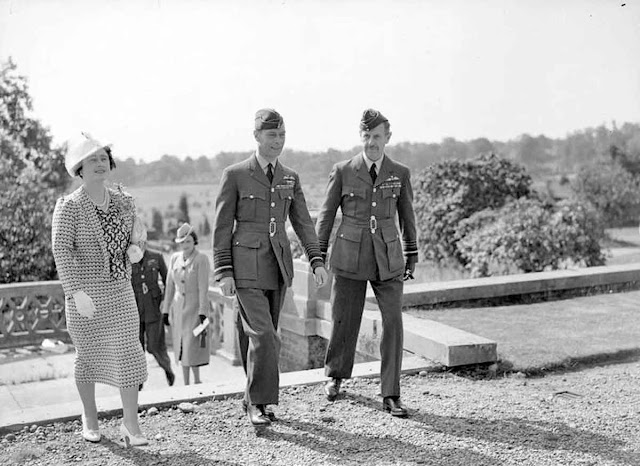
King George and Queen Elizabeth travel to Bentley Priory, Stanmore in Middlesex to inspect RAF Fighter Command headquarters.
At 03:00, a Luftwaffe Dornier bomber drops a spy dressed in civilian clothes at Yardley, Hastings. He has a radio, is armed and has both Swedish and British identity cards. The only reason he is caught by a farmer around 17:20 — found sleeping in a ditch, heck he was up all night dropping into England — is because he injured himself during his parachute drop (landing on his radio). The man is Gösta Caroli, a Swede trained by Admiral Canaris’ Abwehr to spy on British airfields. He is brought to London for interrogation, where he provides quite useful information, including the news that there is another spy like himself in England. Caroli was transferred to Camp 020 that was run by MI5 and recruited into the Double-Cross system under cover name SUMMER.
The Royal Navy attempts to cut the undersea cable between Syracuse and Tripoli across the Sicilian Narrows, but fails.
British aircraft carrier HMS Ark Royal, battleship HMS Barham, battleship HMS Resolution, and 10 destroyers departed Gibraltar for Dakar.
Under pressure, Helsinki grants the Soviets transit rights to their base at Hango, won during the Winter War. In practical terms, this means that Soviet soldiers will now be allowed to take the train from Vyborg to Hango.
A representative of General de Gaulle, Commandant Robert, arrives on Malta. After conferring with Governor Dobbie, he sends a telegram to the Spears Mission at Whitehall in which he suggests that some French in Tunis might be open to joining the Free French movement. However, he cautions that this might just lead to Italian intervention to support the Vichy commanders in Tunisia, which could lead to a large battle over the key territory. He further suggests that propaganda to Algeria and Morocco could pay dividends.
Corvette HMS Godetia (Lt Cdr G. V. Legassick RNR), which had been escorting convoy OA.207, was sunk in an accidental collision with steamer Marsa (4405grt), a straggler from convoy OA.209, three miles off Altacarry Head off Northern Ireland in 55-18N, 5-57W. Probationary Temporary Surgeon Lt A G. Bellamy MRCS, LRCP RNVR, Acting S/Lt P. D. Hincks RCNVR, Acting S/Lt F. S. Ker RCNVR, and eleven ratings were killed, and eighteen ratings were missing with the corvette. Leggasick, Probationary Temporary S/Lt D. M. Edwards DSC RNR, and about fifteen ratings were rescued. Godetia is the first of the Flower-class corvettes to be lost.
Aircraft carrier HMS Furious, battleship HMS Nelson, anti-aircraft cruisers HMS Naiad and HMS Bonaventure, and destroyers HMS Somali, HMS Tartar, HMS Bedouin, HMS Punjabi, HMS Ashanti, HMS Eskimo, and HMS Matabele departed Scapa Flow at 0900 on Operation DF to raid shipping off Trondheim. At 0500/7th in 62-00N, 00-50E, HMS Furious flew off nine Skuas of 801 Squadron and twelve Swordfish of 816 and 825 Squadrons. Two ships were sighted and one was reported sunk between Sognefjord and Grip Light, but no confirmation exists for this claim. The aircraft returned directly to Hatston, and the force arrived back at Scapa Flow at 2000/7th.
Destroyers HMS Jackal and HMS Jaguar departed Rosyth at 1800 escorting submarine depot ship HMS Forth and submarine HMS Tuna to the Clyde, and safely arrived at 0600/9th.
Submarine HMS Tribune, returning from patrol west of the Hebrides, attacked the German U-boat U-56 in 57-58N, 08-13W off the Butt of Lewis. All torpedoes missed.
Australian heavy cruiser HMAS Australia departed the Clyde for Freetown to replace light cruiser HMS Fiji in the MENACE operation. On 8 September, U-56 unsuccessfully attacked Australia, which arrived at Freetown on the 14th.
In German air attacks on convoy SL.44A, 15 miles east of Aberdeen, steamer St Glen (4647grt) was sunk in 57-25N, 01-38W. Three crewmen were lost, and sloop HMS Sandwich rescued the survivors. Steamer Gannet (1336grt) was damaged in 57-25N, 01-45W and towed to Peterhead.
Trawler Iwate (314grt) was damaged by German bombing in 53-30N, 14-00W.
Trawler Ilfracombe (165grt) was damaged by German bombing in 51-20N, 11-22W.
German minelayers Togo, Kaiser and torpedo boats Greif, Falke, Iltis, and Jaguar of the 5th Flotilla, escorted by torpedo boats T.1, T.2, and T.3 of the 1st Torpedo Boat Flotilla, laid minefield SW 0 in the southwest North Sea. Escort was provided by destroyer Galster and torpedo boat Kondor, and the force arrived at Rotterdam on the 8th.
Force H units, aircraft carrier HMS Ark Royal, battleships HMS Barham and HMS Resolution, with destroyers HMS Faulknor, HMS Foresight, HMS Forester, HMS Fortune, HMS Fury, HMS Greyhound, HMS Eclipse, HMS Escapade, and HMS Inglefield, departed Gibraltar on MENACE. Destroyer HMS Echo with defects was able to depart the next day and joined the force at sea.
The Italian reaction to this sortie, which was viewed as an incursion into the Mediterranean was the sortie of battleships Veneto, Littorio, Cesare, and Duilo, with six heavy cruisers, and eighteen destroyers.
Force H joined the MENACE “MP” convoy at sea on the 13th. In addition, Heavy cruisers HMS Devonshire, with the convoy, and heavy cruiser HMS Cumberland, which joined at sea, travelled in company with Force H and the convoy.
Submarines HMS Triad and HMS Truant arrived from Home Waters at Gibraltar escorted by destroyer HMS Wrestler, which departed Gibraltar on the 5th to join, for duty with the 8th Submarine Flotilla to operate from Gibraltar.
Light cruiser HMS Delhi arrived off Pointe Noire, French Congo, but two of the three Vichy steamers there had departed prior to her arrival. Vichy French steamer Jean Laborde (11,591grt) departed during the night of 5/6 September and arrived at Dakar on the 8th. Steamer Toureg (5135grt) departed on the 5th and was later intercepted by light cruiser Delhi on the 16th. Steamer Cap Padaran (8009grt) departed on the 9th for Dakar, via Tabu, but was forced to put into Conakry on the 23rd to avoid contact with British forces.
Heavy cruiser HMS Hawkins departed Montevideo on patrol and arrived back later that day.
Heavy cruiser HMS Cumberland arrived at Freetown.
HMS Argus launched 30 Hurricane fighters for Takoradi in the British Colony of the Gold Coast. They would later be flown to RAF Abu Sueir in Egypt to participate in the Desert War against the Italians.
Light cruiser HMS Leander, escorting convoy BN.4 with Sloop HMS Auckland, was unsuccessfully attacked by Italian bombers north of Jebal at Tair. Two Italian aircraft were shot down.
British troop ship Dunera arrived in Australia with 200 Italian prisoners of war, 251 German prisoners of war, 55 British Nazi sympathizers, and 2,036 civilians from Germany (mostly Jewish refugees). They were robbed and abused by British guards in the past 57 days, and those who committed the abuse were later court-martialed. These “enemy aliens”, as they were categorized, were to be trained to the town of Hay, New South Wales, Australia.
New Zealand Division light cruiser HMS Achilles departed Auckland with staff officers of the New Zealand Government for government conferences in Tahiti, arriving on the 10th. She departed on the 15th for further talks at Raratonga, arrived on the 17th and returned to Auckland on the 23rd.
Italian submarine Guglielmotti sank Greek tanker Atlas (4008grt), a straggler from convoy BN.4, at 15-10N, 41-50E, 14 miles north of Jebel Tier. The crew was landed at Aden.
The first group of U.S. ships involved in the destroyers-for-bases transfer to Great Britain arrived at Halifax, Nova Scotia. Royal Navy crews assigned to the destroyers arrived simultaneously, “By the long arm of coincidence,” as British Prime Minister Churchill puts it. This group included the USS Aaron Ward, USS Buchanan, USS Crowninshield, USS Hale, USS Abel P. Upshur, USS Welborn C. Wood, USS Herndon, and USS Welles.
Convoy OA.210 departed Methil escorted by escort ship HMS Jason.
Convoy FN.274 departed Southend, escorted by destroyers HMS Valorous, HMS Westminster and patrol sloop HMS Puffin, and arrived in the Tyne on the 8th. There were no convoys FN.275 and FN.276.
Convoy MT.162 departed Methil, and arrived in the Tyne later that day. There was no convoy MT.163.
Convoy FS.274 departed the Tyne, escorted by destroyers HMS Verdun and HMS Wallace, and arrived at Southend on the 7th. There was no convoy FS.275.
Convoy SC.2, which had departed St Johns on 25 August, was escorted by Canadian destroyer HMCS Skeena, destroyer HMS Westcott, sloops HMS Lowestoft, HMS Scarborough, corvette HMS Periwinkle, plus anti-submarine trawlers HMS St Apollo (580grt) and HMS Berkshire (466grt) when it was attacked by U-65. U-47 arrived that night, followed on the 9th by U-28 and U-99, which made attacks. In all five merchant ships were sunk.
President Roosevelt today in Washington nominated NLRB General Counsel Charles Fahy to be Assistant Solicitor General of the United States and appointed Donald H. Connolly, Civil Aeronautics Administrator, to the National Advisory Committee for Aeronautics. At his press conference the President urged Congress to speed the conscription bill.
The Senate completed Congressional action on the $5,246,000,000 Defense Appropriation Bill, confirmed the nomination of Frank C. Walker as Postmaster General and considered a conference report on the Wheeler-Lea Transportation Bill. It recessed at 4:51 PM until noon Monday.
The House debated the conscription bill, adopting an amendment forbidding the calling up of those selected until housing, clothing and medical care are available, and received the Kramer resolution urging the acquisition of air and naval bases in Lower California, Mexico. It adjourned at 6:12 PM until 11 AM tomorrow.
The House of Representatives declined today to alter the age limits of 21 to 45 which the Military Affairs Committee recommended for the Burke-Wadsworth Selective Service Bill. Representative Anderson, Missouri Democrat, offered an amendment to limit the registration and possible draft to men between 21 and 31, the brackets approved by the Senate, but was voted down, 161 to 47. A later attempt by Mr. Anderson to amend the bill to permit registration of men between 21 and 45 but limit actual service to men between 21 and 31 was defeated by a voice vote without debate. Representative Rayburn, majority leader, explained that the higher age limit was intended to permit induction of older men as non-commissioned officers, mechanics and technicians. Arguments were offered on one side that men older than 31 cannot stand the strain of modern training for warfare. Proponents of the committee age range opposed a change which would exclude World War veterans, many of whom were represented as anxious to be of service in the present emergency.
The U.S. Senate Finance Committee today began the intricate task of revising the house-approved excess profits tax-plant amortization bill to bring it in line with recommendations of fiscal and defense advisers. Following all-day deliberations, the committee was reported to have junked a much-criticized provision which would have boosted normal income taxes of some corporations by 4.1 per cent. To compensate for the loss of revenue from this and other deleted provisions, the committee, it was understood, wrote in a three percent increase in the normal tax rate in each of the graduated brackets.
A complete embargo on the export of steel scrap appeared likely tonight when it was revealed that the National Advisory Defense Commission soon would recommend such an embargo to the President. Officials said the Defense Commission, which has been studying the matter, had decided that all steel scrap was necessary for the domestic armaments program. Although some reports had it that the commission had acted upon the request of the State Department, officials denied this and said that the matter had to be ruled upon finally by diplomatic officials. A licensing system for the export of steel and iron scrap was put into effect several months ago when the defense program first got under way, but this has not proved sufficient, official sources said.
Japan, it is understood, will be one of the chief sufferers from a complete embargo on scrap such as that now applied to aviation gasoline. In 1939 the United States shipped to Japan steel and iron scrap valued at $32,592,500, or 91.01 percent of all that Japan imported. With only limited sources of such material at her own disposal, Japan is virtually dependent upon the United States for her supply because other major manufacturing nations require theirs for war purposes. Japan must have such scrap for her war machine, experts say. For some time those most vigorously opposed to Japan’s expansionist policy in China have advocated an embargo on shipments to Japan. Under diplomatic usage, Japan could not legitimately object to a general embargo applying to all nations, diplomats said today.
Congress completed and sent to the White House this afternoon the “Total Defense” bill, bill, carrying $5,246,000,000 in appropriations and authorizations for raising and equipping an army of 1,200,000, for more than 18,000 airplanes for the Army and Navy and for a real start toward construction of a two-ocean fleet. The largest of the defense measures sought at this session by President Roosevelt, the bill raised to above $11,000,000,000 the total amount appropriated and authorized this year for national military preparedness. Congressional action was completed when the Senate and House approved a conference report composing the differences in their versions of the measure. The bill now has only to be formally engrossed before being sent to the White House for the President’s signature.
The Senate finished Congressional action today on a bill to increase from 2,400 to 7,200 the number of students in the Naval Reserve Officers Training Corps.
On the House side the Merchant Marine Committee approved a bill to permit private shipyards to suspend requirements for an eight-hour day on construction and repairs to vessels for the Maritime Commission. The measure would be effective during the national emergency period proclaimed by the President a year ago. A similar measure affecting naval construction has been enacted into law, and, like it, the proposed bill would require payment of time and one-half for overtime.
The Senate Military Affairs Committee approved two bills which would make World War sabotage and debt moratorium acts applicable in the existing emergency. Fines of $10,000 and ten-year prison terms could be imposed for attempts to injure national defense materials, premises or utilities under the terms of one measure. The other bill would suspend temporarily, in some cases, enforcement of civil liabilities against all members of the nation’s armed forces.
Wendell L. Willkie issued a new charge of “dictatorship” against President Roosevelt today and outlined a broad federal program to aid farmers, including expenditure of additional federal funds for cheaper power in rural areas. The G.O.P. presidential nominee emphasized that the most important objective of his program to aid the farmer would be the stimulation of productive private enterprise in order to provide jobs for unemployed, taking them off relief rolls and providing customers for farm products. He outlined his agricultural policies to approximately 90 farm editors and radio commentators from 13 states. He opened his talk with a new attack on Mr. Roosevelt for having failed to submit to congress for approval the deal in which the United States transferred 50 destroyers to Great Britain in exchange for naval and air bases.
U.S. Secretary of the Navy William “Frank” Knox and Rear Admiral Arthur B. Cook, the Commander Aircraft, Scouting Force arrived at Pearl Harbor, Territory of Hawaii in a XPB2Y-2 patrol bomber. Knox was visiting the fleet as it carried out operations in Hawaiian waters.
The first production Douglas SBDs aka the “Dauntless” are delivered to US Navy units.
The U.S. Army issued contracts for the construction of B-29 and B-32 prototype bombers. These are originally intended to defend the United States by bombing hostile ships at sea, not operate on offensive missions.
A Vultee Model 48C Vanguard (P-66) aircraft, the first of the batch ordered by Sweden, took flight.
Major League Baseball:
Johnny Rigney pitched the White Sox to a four-hit, 6–3 victory over the Browns today in the final game of the series. Duplicating Eddie Smith’s four-hitter last night, Rigney blanked the Browns in every inning except the fourth. In that inning singles by Rip Radcliff, Wally Judnich and Harlond Clift, a pass and one of three White Sox errors gave St. Louis all its runs.
Detroit’s Bobo Newsom wins his 18th and hands Cleveland its 5th straight loss, topping the Tribe 10–5. The Indians now lead the American League by a single game. Billy Sullivan and Hank Greenberg homered for the Tigers.
Kendall Chase out-duels Charlie Ruffing and the Senators down the Yankees, 3–1. Gee Walker hits two homers for Washington, both into the left field stands, to pace the Senators.
In Philadelphia, Brooklyn’s Freddie Fitzsimmons shuts out the Phils, 3–0, in the opener of a doubleheader. He’ll shut out the Pirates in his next start and will finish at 16–2 in his 18 starts. The Dodgers explode for a 14–3 win in game 2 as Joe Medwick hits a grand slam in the 8th off Max Wilson.
Clyde Shoun, making his forty-ninth appearance of the season for the Cardinals, seemed overworked today when he pitched in his third consecutive game, but St. Louis won, 6–4. A bases-loaded 3-run double by Pepper Martin and Terry Moore’s homer were the big blows for St. Louis.
St. Louis Browns 3, Chicago White Sox 6
Cleveland Indians 5, Detroit Tigers 10
Brooklyn Dodgers 3, Philadelphia Phillies 0
Brooklyn Dodgers 14, Philadelphia Phillies 3
Chicago Cubs 4, St. Louis Cardinals 6
New York Yankees 1, Washington Senators 3
HMS Duchess arrives in Halifax, bringing the members of the Tizard Mission and a black metal box containing, amongst other things, six examples of the cavity magnetron. This would later be described as “the most important cargo to reach our (North American) shores”.
The first tranche of U.S. destroyers heading to England pursuant to the “Destroyers for Bases” deal arrives at Halifax, Nova Scotia. They are met there by Royal Navy seamen. This group of destroyers includes USS Aaron Ward, USS Buchanan, USS Crowninshield, USS Hale, USS Abel P. Upshur, USS Welborn C. Wood, USS Herndon, and USS Welles.
The warm generosity with which the U.S. meets the British request for ships contrasts markedly with the cold response to the Uruguayan government’s request to purchase three destroyers. U.S. Minister to Uruguay Edwin C. Wilson recounts (2 October) an interview with “a leading Uruguayan” who complains: “Having been exhorted to cooperate in continental defense, we want to build up our pitifully non-existent Navy, and we ask you to let us have two or three old destroyers that have been lying useless in your ports since the last war. You handed over fifty of these destroyers to Great Britain, and we see pictures reproduced in the papers of quantities of these ships tied up in your ports, looking like so many toy vessels in a shop window. Yet, you tell us that you find it impossible to let us have even a single one of these.” Secretary of State Hull confidentially informs Minister Wilson (13 September) that the Navy Department believes “that the strategic situation in the North Atlantic does not permit the disposal of any destroyers to Uruguay at the present time, the more so as this would inevitably lead to similar requests from other American republics for [the] purchase of destroyers.”
The U.S. Navy heavy cruisers USS Wichita, under command of Rear Admiral Andrew C. Pickens, and USS Quincy reached Rio de Janeiro, Brazil. This was the last stop on cruise where these ships were visiting South America “to furnish a reminder of the strength and the range of action of the armed forces of the United States.”
A Nationalist Chinese brigade was wiped out by Communist Chinese forces near Yingxi, Jiangsu Province, China.
The key Ministers of Japan were represented tonight as having decided to reject the official representations of the United States and Britain that stressed the interest of these powers in seeing French Indo-China untouched.
British troopship Dunera arrives in Australia after a 57-day journey from Great Britain that began in early July. It carries 200 Italian prisoners of war, 251 German POWs, 55 British sympathizers of the Reich, and 2036 German citizens caught in Great Britain at the outbreak of the war. The British guards on the lengthy sea journey have engaged in vicious tactics against their charges, made all the worse in that many of the civilians are Jewish refugees fleeing Hitler. These war crimes lead to a series of courts-martial and convictions. The passengers are sent by train to a camp in Hay, New South Wales.
Dow Jones Industrial Average: 133.12 (-0.98)The Kriegsmarine (German navy) submarines U-134 and U-406 are laid down.
Born:
Tom Janik, AFL-NFL safety and cornerback (AFL All-Star, 1965, 1967; Denver Broncos, Buffalo Bills, Boston-New England Patriots), in Poth, Texas (d. 2009).
Andy Rice, AFL-NFL defensive tackle (AFL Champions-Chiefs, 1966 [lost Super Bowl I]; Kansas City Chiefs, Houston Oilers, Cincinnati Bengals, San Diego Chargers, Chicago Bears), in Hallettsville, Texas (d. 2018).
Brian Smith, Canadian NHL and WHA left wing (Los Angeles Kings, Minnesota North Stars; Houston Aeros), in Ottawa, Ontario, Canada.
John Michael Hayes, American oceanographer, in Seattle, Washington.
Elizabeth Murray, American abstract expressionist painter, and printmaker known for her use of shaped canvases, in Chicago, Illinois (d. 2007).
Jackie Trent, English singer-songwriter (“Neighbours” theme) and actress, in Newcastle-under-Lyme, England, United Kingdom (d. 2015).
Naval Construction:
The Royal Navy Dance-class ASW trawler HMS Tarantella (T 142) is laid down by the Smith’s Dock Co., Ltd. (South Bank-on-Tees, U.K.).
The U.S. Navy Barnegat-class small seaplane tenders USS Humboldt (AVP-21) and USS Matagorda (AVP-22) are laid down by the Boston Navy Yard (Boston, Massachusetts, U.S.A.).
The Royal Navy Bangor-class (Turbine-engined) minesweeper HMS Ardrossan (J 131) is laid down by the Blyth Shipbuilding & Drydock Co. Ltd. (Blyth, U.K.); completed by Whites M.E.
The Kriegsmarine (German Navy) Type VIIC U-boat U-134 is laid down by Bremer Vulkan-Vegesacker Werft, Bremen-Vegesack (werk 13).
The Kriegsmarine (German Navy) Type VIIC U-boat U-406 is laid down by Danziger Werft AG, Danzig (werk 107).
The Royal Navy Flower-class corvette HMS Campanula (K 18) is commissioned. Her first commander is Lieutenant Commander Richard Vere Essex Case, DSC, RNR.
The Royal Canadian Navy “D”-class destroyer HMCS Margaree (D 49, former Royal Navy destroyer HMS Diana) is commissioned into the Royal Canadian Navy at Londonderry, Northern Ireland. Her first and only commander with the RCN is Commander Joseph Wilton Rouer Roy, RCN.
The U.S. Navy Benson-class destroyer USS Hilary P. Jones (DD-427) is commissioned. Her first commander is Lieutenant Commander Sherman Rockwell Clark, USN.
 History Diaries