Oil storage tanks at Thameshaven were among the day’s targets of German bombers. Fires broke out at Thameshaven that could be seen from London.
In the morning, German bombers attacked RAF airfields at Eastchurch, Lympne, North Weald, Kenley, and Biggin Hill in England, United Kingdom; in the afternoon, German bombers attacked RAF airfields at Detling and Biggin Hill, as well as the Hawker factories at Brooklands and oil storage tanks at Thameshaven. Eastchurch and Biggin Hill were placed out of action after sustaining heavy damage, while the fires at Thameshaven could be seen from London. When Churchill spoke to the House of Commons on this day, he promised compensation for families who had lost homes due to German attacks. On this day, 23 German aircraft were lost, as were 20 RAF fighters.
Weather over Great Britain: After a clear night, the morning period all over Britain should be clear with good to excellent visibility and temperatures slightly above average. Cloud was expected to increase over the eastern coast north of East Anglia during the afternoon. The north of England and Scotland should have six tenths cloud cover and was expected to increase during the afternoon although this was to be high cloud with no rain expected. The Channel areas were expected to remain clear and fine for most of the day.
The day proved to be an ideal day for combat, the weather was clear with only a slight breeze. Conditions for flying were ideal, although Fighter Command were praying for rain and inclement weather. Dowding wanted some breathing space, some respite for the fighter airfields, especially those of 11 Group. Just a few days would relieve the pressure on the British pilots.
Although the directive had gone out that the Luftwaffe were to bomb the British cities, it was no doubt that this day, arrangements were already being made for the annihilation of London and the industrial centers of the Midlands. But in the meantime, the Luftwaffe were resting many of their heavy bombers and quite a number had been moved from airfields further south to more strategic airfields closer to the French coast. For the time being, the Luftwaffe would continue its attacks of RAF airfields and aircraft factories in an effort to wear down Fighter Command.
1000 Hours: German bombers are detected approaching at two points, one wave crosses the coast between Dover and Folkestone while the other comes in from the Thames Estuary, both formations are from Kesselrings Luftflotte 2. It is estimated that the whole attack is represented by no less that twenty separate small formations.
41 Squadron Hornchurch (Spitfires) which had spent a considerable amount of time at Catterick had now been moved down to Hornchurch and they were immediately sent to the satellite station at Manston and were dispatched to intercept the enemy over the Thames Estuary. 111 Squadron Croydon (Hurricanes) had an early “scramble” and were directed to intercept at Dover. 253 Squadron Kenley (Hurricanes) were also dispatched as was 501 Squadron Gravesend (Hurricanes) and 603 Squadron Hornchurch (Spitfires).
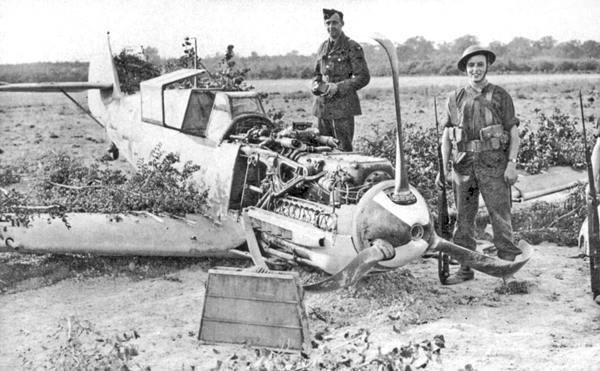
The Manston based 41 Squadron immediately make their presence felt. F/L J.T.Webster comes hard down on a Bf 109 over South London who was about to engage one of the Hurricanes. A couple of short bursts miss, the Bf 109 takes evasive action but F/L Webster weaves and sways keeping the 109 in his gunsight. Another short burst and smoke trails from the Messerschmitt and it glides down finally making a forced landing just outside the village of Adlington Kent. F/L J.T. Webster is also thought to have shot down another Bf 109 while over the South London area. The Bf 109 (6+) withdrew and losing height and finally made a forced landing near Faversham in Kent. The Bf 109 of Oberlt Franz von Werra Gruppe Adjutant of Staab II/JG3 was shot down over Marden in Kent by P/O B.G. Stapleton of 603 Squadron Hornchurch, although it is believed that the Bf 109 sustained original damage after being hit by gunfire from the Spitfire of P/O G.H. Bennions of 41 Squadron Hornchurch.
Oberlt Franz von Werrra was captured and taken to the authorities and finally transferred to a prisoner of war camp in Canada. He made good his escape by making his way to the USA and finally by boat to Europe, where he rejoined his unit and flew again against Fighter Command.
This man is believed by many to be the German ace, Oblt Franz von Werra. The bravado von Werra displayed as a fighter ace among his comrades remained with him as a POW. He proved difficult to hold and made numerous escape attempts.
With other prisoners, he was transferred to Canada. In Nova Scotia the prisoners were transported by rail from Halifax to their new camp and en route von Werra forced open a window and jumped from the moving train. This time he was not recaptured and made good his escape by crossing the nearby border into the United States which was still neutral.
He was the only German aviator to escape from British custody and return to fight for his country again.
Concerning the combat which resulted in von Werra’s fall into British hands, there is confusion. That he crash landed on 5th September at Winchet Hill is not disputed but other circumstances surrounding the incident are open to question.
After returning to Germany, von Werra eventually became commanding officer of 1/JG 53 on the Russian front. He shot down 13 Russian planes to bring his tally to 21 but on 25 October 1941 the engine of his Bf 109 failed and it plunged into the sea near Vlissingen. He was drowned.
1030 Hours: Croydon was attacked, as was Biggin Hill, Eastchurch, Lympne and North Weald. More damage is sustained, but only Biggin Hill again gives cause for concern. 79 Squadron (Hurricanes) is the only squadron operating from Biggin, 72 Squadron Biggin Hill (Spitfires) is told to remain at Croydon for the time being.
A formation of Do 17s and Bf 109 escorts come in from the Thames Estuary and head in the direction of South London. Too far to the south to be targeting London, for some reason the target is again that of… Biggin Hill. 79 Squadron is scrambled and with some miraculous flying breaks up the Dorniers and they drop their bombs well off target.
Most of the morning’s raids were confined to the north Kent coast, the aerodromes of Biggin Hill and Croydon with Hornchurch and scattered raids across Essex as far as Harwich. Other areas that came under attack were targets of no importance across mid Kent where it is believed that German bombers dropped their bombloads at random on the return journey. Biggin Hill is again a shambles and Group Captain Grice states that he now has only one hangar left standing, and even that is nothing but a burnt out shell and the commander issues orders to place explosive charges in it and destroy it at the next raid.
1225 Hours: Another huge formation is detected, again coming in from the Thames Estuary. They are at high altitude, some 20,000 feet, and quite a number of formations were so high that they were undetected by both radar and the Observer Corps.
1300 Hours: One of the formations is intercepted by 72 Squadron Croydon (Spitfires) it is found that the formation consists of about 50 plus Ju 88s and Heinkel 111s escorted by about 100 Bf 109s as escorts. The main target is the oil storage tanks at Thameshaven causing serious damage. Giant palls of thick arid black smoke can be seen for miles. 72 Squadron Croydon (Spitfires) is joined by 73 Squadron Debden (Hurricanes), and both squadrons are attacked by a recently arrived formation of Bf 109s. Some of the Hurricanes are jumped on by surprise and four of them are shot down with one of the pilots killed. 43 Squadron Tangmere (Hurricanes) operating out of Kenley also mixes it with the Bf 109s with only one Bf 109 being shot down.
1400 Hours: Many of the bomber formations manage to get through Fighter Commands defenses although a number of Bf 109s were casualties of the afternoon battle. Many of the airfields and towns along the Thames were still cleaning up after the mornings raids when now, almost mid-afternoon they were witnessing German bombers making their way to their targets and the telltale spirals of fighter dogfighting high above.
1500 Hours: The afternoon raid was almost a couple of hours old and still damage was being recorded and aircraft were being shot down, but this last hour of the battle was the most active of the afternoon. Most squadrons were either only recently arrived replacing those that had returned to their bases to refuel and rearm or had been recalled back into the skirmish. 41 Squadron Manston (Spitfires) were now back into the affray, as was 66 Squadron Kenley (Spitfires) that had been called in to relieve squadrons returning to base. One of the squadrons that had been in the thick of the action since just after midday was 72 Squadron Croydon (Spitfires) and they were just about to return to base to refuel and rearm, 73 Squadron Debden (Hurricanes) were dispatched to the Essex coast after a formation of Ju 88s had been detected, 111 Squadron Croydon and 253 Squadron Kenley, both equipped with Hurricanes became involved in combat over the Thames Estuary.
In the meantime, S/L Zdzislaw Krasnodebski’s 303 Squadron Northolt (Hurricanes) was in action over the south coast even though the squadrons actions was deemed ‘questionable’ even by AVM Keith Park since they had commenced an impressive record from August 30th when the squadron had made their first claim.
Even the Northolt Commander Group Captain Vincent was a little wary of the number of claims being made by the Poles, and told the base intelligence officer to ‘treat the Poles claims very carefully and go through them with a fine tooth comb.’ Vincent was beginning to believe that each of the Poles were organizing false and fake claims, and when the squadron was dispatched to Tilbury and Thameshaven he decided that he, along with S/L Ronald Kellett who had assisted in the formation of the squadron, go up and see the Poles in action for themselves.
What Vincent saw, at 21,000 feet over Thameshaven, astern of the Poles and 1,000 feet below, was a sight he would remember till he died — tier upon tier of glinting, well-drilled Dorniers, two Hurricanes, poised 1,000 feet above, suddenly crash diving into space with near-suicidal impetus, a sudden ripple of agitation running through the mighty horde as the leading Dorniers, foreseeing head-on collision, turned and broke. This was the spearhead. As the bombers scattered, Pole after Pole was diving — holding their fire until twenty yards distant, accepting the awful risk that the last great explosion would destroy them, too. Amazed, Vincent saw planes and parachutes fluttering like charred paper through the sky. Kellett, an Me 109 and Sergeant Kazimierz Wunsche fought only 100 yards apart, the sergeant closing to sixty yards to save Kellett’s life. Flying Officer Waclaw Lapkowski Bailed out with a broken arm. Polish fighters angrily nosed Vincent’s Hurricane aside, grudging him so much as one chance shot at a crippled bomber. Back at Northolt, fevered with excitement, Vincent sent for the intelligence officer: My God, they are doing it; it isn’t just imagination.’
1600 Hours: As the German bombers made their way home, Staffels of Bf 109s came out across the Channel to provide escort on a day that although it may have seemed impressive, was not all that claimed to be by the Luftwaffe. Thameshaven was the only target which they claimed was a success, and just about the last nail had been hammered home in Biggin Hill’s coffin, but other than that any damage done was not to have any effect on Fighter Command. The Hawker factory at Brooklands was hit, but damage was only slight and the casualties were few. Maidstone was hit and demolished a part of one street and the attacks on Detling and Eastchurch were by no means going to affect Fighter Command. For those that were keeping score, it was 23 German planes down for 20 RAF fighters, a fairly even scoresheet in reality.
Hitler had ordered “crush” the RAF, it was evident that the RAF was so far uncrushable. Bomber Command was attacking Berlin and lashing out nightly against the German invasion fleet — to the discomfort of the Kriegsmarine which Hitler counted on to transport his invasion troops to England’s shores.
“Will not the British ever learn. Their bombers come and kill innocent German people, and I have given them fair warning. We have told you before, that the nights when the British bombers do not attack our capital, our glorious Luftwaffe has forcibly stopped the British bombers in their tracks and they have had to turn for home. But now, the time is right, the British air force is down to its last reserves, they cry for pity, and I will give them pity for I will wipe London from the face of the earth. I want fire everywhere, thousands of them and then they will unite in one gigantic area of conflagration.”
- Adolph Hitler September 1940 on deciding that London should be bombed.
The statement of the High Command obviously forced upon it by Hitler himself–he often takes a hand in writing the official army communiques deliberately perpetrates the lie that Germany has only decided to bomb London as a result of the British first bombing Berlin. And the German people will fall for this, as they fall for almost everything they’re told nowadays. Certainly never before in modern times — since the press, and later the radio, made it theoretically possible for the mass of mankind to learn what was going on in the world — have a great people been so misled, so unscrupulously lied to, as the Germans under this regime.
“And so tonight the High Command, which all good Germans believe tells only the gospel truth, issued a special communique saying that as reprisal for the British raids on Berlin, London was attacked with strong forces for the first time today As a result of this reprisal attack, it says, “one great cloud of smoke tonight stretches from the middle of London to the mouth of the Thames.”
“To give American radio listeners an idea of the kind of propaganda (though I couldn’t label it as such) which the German people are being subjected to now, I read in my broadcast tonight the following quotation from today’s Berlin newspaper, the Biirsen Zeitung: “While the attack of the German air force is made on purely military objectives this fact is recognized by both the British press and radio — the RAF knows nothing better to do than continually attack non-military objectives in Germany. A perfect example of this was the criminal attack on the middle of Berlin last night. In this attack only lodging-houses were hit; not a single military objective.”
“The German people have no inkling — because the Nazi press and radio have carefully suppressed the story — that in August alone more than one thousand English civilians were killed by the Luftwaffe’s attacks on British ‘military objectives’.”
- William L.Shirer The Rise of the Third Reich 1940-41 p214
As the darkness of night closes in on the evening of September 5th, British radar tracks a large formation of bombers heading towards the city of London. The night fighters of the RAF are not up to the task of attacking the bombers, the British are not experienced in night fighting. Hundreds of searchlights light up the night sky and the bombers are lit up like small white specks. Anti-aircraft fire follows but the bombers maintain their course.
Other formations attack Manchester and Liverpool causing damage, but all cities receive only the one air raid to which by now, most of the residents are getting used to the hit and run tactics of the night attacks. Numerous other towns were placed under a Red Alert and scattered attacks were made by German bomber formations.
But RAF Bomber Command are busy too. On one mission 85 bombers spent two hours over Berlin causing considerable damage, which I daresay did not please the German High Command one bit. Other targets for Bomber Command were the oil refinery at Stettin, and although they were inconvenienced by some very accurate anti-aircraft fire, the mission was a success.
Because of the attacks being made on the aircraft factories and assembly lines, Keith Park was to take the necessary steps to provide cover for these establishments. Following a recommendation from AVM Hugh Dowding, Park was to give maximum protection possible to the Hawker factories at Kingston and Brooklands, and to the Supermarine works at Southampton. 12 Group was informed, that if 11 Group was to provide additional cover for Weybridge and Brooklands, he would need the support of 12 Group and that they would be called upon at short notice. The same was passed on to 10 Group, that they provide patrols from Brooklands to Croydon whenever there was heavy enemy activity in the area, although Park new that 12 Group was fairly heavily committed by having to cover the Essex and Norfolk coasts where a number of enemy formations had recently been keeping 12 Group busy.
Knowing that 12 Group would hastily respond to his request, AVM Quintin-Brand made available four extra squadrons that could cover the Southampton-Portsmouth area as soon as heavy raids had been detected. Park also brought down 504 Squadron who had been resting at Catterick and posted them to Hendon.
RAF Casualties:
1015 Hours: Birling Kent. Spitfire P9432. 19 Squadron Duxford
S/L P.C. Pinkham killed. (Shot down by Bf 109 while in combat over Channel. Pilot went down with Aircraft)
1425 Hours: Eltham. Spitfire N3093. 72 Squadron Croydon
Sgt M. Gray killed. (Crashed after combat with Bf 109s. Aircraft seen to crash into Eltham Park Wood)
1425 Hours: Eltham. Spitfire X4013. 72 Squadron Croydon
P/O D.C. Winter killed. (Shot down by Bf 109 and tried to abandon aircraft at too low an altitude)
1525 Hours: Thames Estuary. Spitfire R6635. 41 Squadron Hornchurch (based at Manston)
F/L J.T. Webster killed. (Collided with P9428. Pilot Bailed out but killed. Aircraft crashed at Laindon Essex)
1525 Hours: Thames Estuary. Spitfire P9428. 41 Squadron Hornchurch (based at Manston)
S/L H.R.L. Hood listed as missing. (Collided with R6635. Aircraft disintegrated over Wickford)
1530 Hours: Burnham Essex. Hurricane P3234. 73 Squadron Debden
Sgt A.L. McNey listed as missing. (Shot down by enemy aircraft and crashed at Nth Fambridge)
Crash site has been excavated and although portions of pilots harness and remains of parachute silk were discovered in aircraft remains there was no evidence of a human remains at crash site.
1600 Hours: Rochester. Spitfire R6885. 66 Squadron Kenley
F/O P.J.C. King killed. (Shot down by Bf 109s. Pilot Bailed out but parachute failed to open)
Overnight, London, Manchester, and Liverpool were bombed by German bombers.
James Lacey shot down two German Bf 109 fighters over Britain.
The score for the day is fairly even, with 23 German planes lost to 20 for the RAF. However, the Germans do not cause much significant damage, as their repeated attacks on RAF Biggin Hill are not really improving their position much. Bombing accuracy is particularly bad today, though stray bombs cause a lot of damage, too.
RAF Bomber Command dispatches 6 Blenheims on a daylight sea sweep, 1 lost.
RAF Bomber Command dispatches 82 Blenheims, Hampdens, Wellingtons and Whitleys overnight to many targets from Turin to Stettin. 3 Hampdens and 1 Wellington lost. RAF Bomber Command continues bombing German forests in hopes of starting a forest fire. The pretext is that there are military objectives hidden under the tree canopy. Elsewhere, they hit the normal targets of airfields in northwest Europe, oil installations at Stettin, Kiel, Hamburg and Regensburg, warehouses at Hamm and Soest, and the Emden docks. The Fiat works at Turin are bombed again. Other raids are launched on Boulogne, Calais, and the nearby coastal guns at Cap Gris Nez.
The Italian air force attacks Suez, Sollum, and Matruh, but cause little damage. Italian bombers so far in the war tend to act very timidly and often dump their bombs out at sea rather than risk anti-aircraft fire and fighter patrols. However, the Italians are soon to get some help.
For the first time, the Luftwaffe appears over Malta. There are several air raid alerts at Malta during the day. In the morning, a large force of bombers escorted by fighters approaches the island, but anti-aircraft fire and Hurricane fighters chase them off. Around 18:00, an unusual raid of Junkers Ju 87 Stukas bombs several points on the island (including Marsaxlokk and Kalafrana), with the attackers losing at least two bombers and an escorting Italian CR 42 fighter. After dark, there are reports of Italian torpedo boats (MAS) operating offshore.
This first appearance of the Luftwaffe in the Mediterranean is an omen of things to come.
6 Blenheim IV bombers and 6 Hurricane fighters arrived in crates at Takoradi at the British Colony of the Gold Coast. These aircraft would soon be assembled and flown to RAF Abu Sueir, Egypt near the Suez Canal for the war against Italy in North Africa.
In Rumania, King Carol II reluctantly agreed to give full powers to Ion Antonescu, but the mood of the country remained volatile. With gunfire ringing out near the Royal Palace, Antonescu visited Carol again that evening and demanded that the king abdicate. King Carol suspended the 1938 Constitution of Rumania and the Rumanian parliament was dissolved. Later in the evening, King Carol of Romania abdicates in favor of his son, Prince Michael and leaves the country after passing part of his royal powers to Ion Antonescu. Hitler is said to have forced the king’s abdication.
Antonescu acts immediately to consolidate his position, forcing King Carol to abdicate in favor of his son Michael due to rumors of monarchist officers planning a coup. He also relieves Bucharest Garrison commander Gheorghe Argeșanu and replaces him with the more reliable Dumitru Coroamă. There are widespread divisions within Romania that Antonescu has to quell quickly, as some monarchists are quite ready to go to war with the Iron Guard. Gunfire from Iron Guard agitators can be heard in the palace from the streets outside.
In Berlin, Rumanian Prince Michael Sturdza meets with Admiral Canaris and Ribbentrop.
Hungarian troops entered Northern Transylvania, territory that German and Italy forced Rumania to cede to Hungary. Shortly after sunrise today Hungarian troops, accompanied by mechanized equipment, crossed the former Rumanian frontier into that part of Transylvania awarded to this country by the Vienna agreement. An area of about 4,000 square miles from Nagy-Leta to the Russian border was occupied. Airplanes circled overhead reconnoitering the territory just evacuated by the Rumanian Army. Simultaneously the advance units marched into the province which has belonged to this country off and on for more than ten centuries. At 11 AM Admiral Nicholas Horthy, the 72-year-old regent, mounted a white horse and rode through the town of Satu Mare dressed in the uniform of an admiral in the navy of the former Austro-Hungarian Empire. According to information given out by official Hungarian sources no incidents marred the initial entry into Transylvania.
Adolf Hitler meets again with Vidkun Quisling, who at this point is living quietly as a radio commentator.
The Tirana newspaper Tomori, Fascist mouthpiece in Albania, yesterday renewed its attacks on Greece after five days’ abstention in which it was engaged in attacking Yugoslavia.
Slovakia promulgates more anti-Semitic laws seizing Jewish property and closing higher education to Jews.
The Italian Navy (Regia Marina) lays mines off Valletta, Malta.
The Indian 5th Infantry Division arrives in Sudan. The forces include the 9th and 10th Infantry Brigades.
Submarine HMS Tuna fired five torpedoes in two attacks at 0301 at a German submarine 65 miles 077° from May Island in 56-26N, 0-43W, and was attacked herself. Destroyers HMS Jackal and HMS Vortigern were sent to investigate.
Destroyers HMS Versatile and HMS Vimy departed the Clyde at 2000 as additional escort for convoy BAS.3, four ships for Reykavik. They left the convoy during the afternoon of the 8th and returned to Scapa Flow.
Light cruisers HMS Aurora, HMS Galatea, and HMS Cardiff departed Humber for Sheerness and were joined at sea off the Humber Light Vessel by destroyers HMS Wild Swan and HMS Wivern. The ships arrived at Sheerness on the 6th.
Minelayers HMS Southern Prince, HMS Menestheus, and HMS Port Quebec laid mines south of the Faroes, escorted by destroyers HMS Zulu, HMS Sikh, HMS Kipling, and HMS Kashmir, and given anti-aircraft protection by anti-aircraft cruiser HMS Cairo.
Escort vessel HMS Gleaner experienced boiler defects requiring immediate repair.
Steamer Melbourne Star (12,806grt) was damaged by German bombing 53-27N, 15-12W.
Greek steamer Aegeon (5285grt) was damaged by German bombing 30 miles southwest of Holyhead.
German torpedo boats T.5, T.6, T.7, and T.8 of the 2nd Torpedo Boat Flotilla laid minefield WALTER in the Straits of Dover.
Matrosenobergefreiter Heinrich Mantyk fell overboard from German U-boat U-47 300 miles northwest of Ireland while operating the deck gun. He was lost.
German auxiliary patrol boat Vp.403 (trawler Deutschland: 432grt) was sunk on a mine off Westerschelde.
German auxiliary patrol boat Vp.201 (trawler Gebruder Kahler:460grt) was sunk on a mine at Dunkirk Roads.
Italian Torpedo Boat Division 12, torpedo boats Altair, Aldebaran, Antares, and Andromeda (Seekrieg — Altair, Alcione, Ariel and Aretusa) laid mines off Valletta, Malta. Thirty five more minelays were made in Maltese waters by Italian naval units during the war and these claimed destroyers HMS Jersey and HMS Southwold, Polish destroyer ORP Kujiwiak, and submarine HMS Olympus.
Australian light cruiser HMAS Hobart, escorting convoy BS.3 at 15-25N, 41-46E, was unsuccessfully attacked eight times by Italian bombers. Italian torpedo boats Manin, Battisti and Sauro searched the Red Sea trying to find BS.3.
Aircraft carrier HMS Argus arrived at Takoradi with 30 Hurricanes to be flown overland to Khartoum. They left Argus on the 6th.
Heavy cruiser HMS Dorsetshire arrived at Durban for repairs.
Light cruiser HMS Neptune departed Durban on patrol to examine anchorages in Southern Madagascar.
Light cruiser HMS Sheffield departed Gibraltar and arrived in the Clyde on the 8th.
A London flying boat of 200 Group force landed 100 miles to the west of Cape Spartel. Destroyer HMS Forester located the aircraft, taking it in tow and returning to Gibraltar.
German armed merchant cruiser Komet completed its voyage across the Northern Sea Route along the Northern coast of Russia and entered the Pacific Ocean via the Bering Strait.
Convoy FN.273 departed Southend, escorted by destroyers HMS Vega and HMS Vimiera and patrol sloop HMS Sheldrake. The convoy arrived in the Tyne on the 7th.
Convoy MT.161 departed Methil. The convoy arrived in the Tyne later that day.
Convoy FS.273 departed the Tyne, escorted by destroyers HMS Vanity and HMS Wolsey. The convoy arrived at Southend on the 7th.
Convoy OG.42 with 51 ships departed Liverpool escorted by destroyers HMS Antelope and HMS Amazon from 5 to 8 September, and destroyers HMS Sabre and HMS Mackay with corvette HMS Geranium from 5 to 7 September. Sloop HMS Leith escorted the convoy from 5 to 16 September when it arrived at Gibraltar.
Convoy HX.71 departed Halifax escorted by Canadian destroyers HMCS Assiniboine and HMCS Saguenay at 1850. The ocean escort, armed merchant cruiser HMS Ranpura was met and Assiniboine detached at 2020 and Saguenay at 2000 the next day.
Convoy BHX.71 departed Bermuda on the 4th escorted by ocean escort armed merchant cruiser HMS Rajputana. The convoy rendezvoused with HX.71 on the 9th and the armed merchant cruiser was detached. Sloop HMS Fleetwood and corvettes HMS Bluebell and HMS Gloxinia joined on the 16th, corvette HMS Gladiolus on the 17th, and destroyer HMS Winchelsea on the 18th. The convoy arrived at Liverpool on the 20th.
Convoy BS.4 departed Suez, escorted by sloops HMS Clive and HMS Grimsby. The sloops were detached on the 8th when the convoy was joined by light cruiser HMS Leander, anti-aircraft cruiser HMS Carlisle, destroyer HMS Kingston, plus sloops HMS Auckland and HMAS Parramatta. The convoy dispersed on the 13th.
In Washington, President Roosevelt conferred with Senator Bankhead, Representative Vinson, Governor Stark of Missouri, Mayor La Guardia and others, witnessed the swearing in of Claude R. Wickard as Secretary and Paul Appleby as Under-Secretary of Agriculture, and sent to the Senate the nomination of Frank C. Walker to be Postmaster General.
The Senate continued consideration of the Wheeler-Lea Transportation Bill, confirmed the nomination of Carroll Wilson as assistant director of the Bureau of Foreign and Domestic Commerce, received the McCarran resolution for an investigation of the plane crash at Lovettsville, Va., and recessed at 4:16 PM until noon tomorrow. The Finance Committee continued hearings on the Excess-Profits Tax Bill, the Military Affairs Committee heard Mayor La Guardia on the bill to permit States to establish defense units, the Commerce Committee approved a resolution to permit Jesse Jones to be Secretary of Commerce and also Federal Loan Administrator, and a Judiciary Committee continued hearings on the Burke amendment limiting the Presidency to a six-year term.
The House continued debate on the Burke-Wadsworth bill, adopting in Committee of the Whole an amendment to postpone the draft for sixty days; adopted the conference report on the $5,246,000,000 supplemental defense appropriation bill and adjourned at 5:56 PM until 11 AM tomorrow. The Public Buildings and Grounds Committee reported a $150,000,000 defense housing bill.
The House of Representatives, overriding pleas of Administration spokesmen, voted in committee of the whole today to defer operation of the selective military service plan for sixty days to give time for an intensified Army drive for volunteer enlistments. The vote, taken on an amendment to the Burke-Wadsworth bill, was tentative in that it may be upset by a roll-call vote if one is demanded in later proceedings in the House. The amendment proposes that for sixty days after the signature of the Burke-Wadsworth bill by President Roosevelt the recruiting drive would be pushed under the stimulus of a Presidential proclamation. If this drive failed to produce as volunteers the 400,000 men whom the Army wants as the first increment under its training program, the government would proceed to make up the deficiency by the selection process which the Burke-Wadsworth legislation would provide. The total of 400,000 would be allotted to the various states in quotas in proportion to their populations, and volunteers from each State would be credited against this quota in case selection became necessary.
More than forty representatives of American business, spokesmen for individual and organized industries, poured upward of 200,000 words of criticism of the House-approved Excess Profits Tax and Amortization Bill into the record of the Senate Finance Committee today as leaders sought to rush the measure to the floor by Monday. With a record practically void of any favorable recommendation for the bill, the Senate group will meet in executive session tomorrow to consider proposed alterations. Followers of tax legislation regarded it as almost a certainty that large changes would be made in the House draft, designed primarily to make its excess-profits features a tax on excess defense profits in fact, and to take from the measure the elements of profit limitation and corporate reform which, many witnesses contended, had crept into what they termed a hodge-podge measure. Another purpose of amendment, as advanced by some Senators, was to separate the excess profits levies as far as possible from those designed primarily to raise new revenue.
Presidential Nominee Wendell L. Willkie said today his position on the Russell-Overton industry conscription Amendment had been misunderstood and that he would favor a bill providing emergency conscription of industry “by rule and regulation instead of by the arbitrary action of one man.” He said he favored the Burke-Wadsworth selective service bill for men, but felt that the Overton-Russell amendment, added by the senate, provided for plant seizure through “the capricious determination of one man,” He made the statement in a press conference after he had conferred with G.O.P. leaders from 22 states whom he charged with the task of piling up such a vote in November “that the pernicous doctrines that have been preached the last few years will be completely eliminated from America.”
Light cruiser USS St. Louis arrived at Hamilton, Bermuda with the Greenslade Board aboard. The Greenslade Board was a committee formed “to make a comprehensive study of the shore establishment (naval and commercial) necessary to support the Fleet in peace and war.” With the strategic requirements of the fleet in mind, the board was instructed to make recommendations for additional facilities in new locations and as to the expansion, limitation, contraction, abandonment, or conversion of existing shore facilities. The board was known by its senior member, Rear Admiral John W. Greenslade.. Embarked was the board, headed by Rear Admiral John F. Greenslade, which would evaluate base sites acquired from the British on September 5 in the destroyers-for-bases agreement.
The U.S. Army was revealed today to be “favorably considering” turning: over several hundred old tanks to Canada for training purposes. Gen. Gorge C. Marshall, chief of staff, made the disclosure shortly after Mayor Fiorello H. LaGuardia of New York, co-chairman of the Joint Canadian-United States defense board, hinted that cooperation between the two countries may include extensive shipments of military supplies to Canada.
Under the $5,256,000,000 second special defense appropriation fund on which final Congressional action is expected this week, the Army will eventually obtain 7,690 first-line combat planes and 10,957 trainers, transports, and observation planes.
The U.S. Navy approved plans today for seven schools in six naval districts to train 4,000 radiomen and signalmen in the U. S. naval reserve. The schools will include one in the twelfth naval district on the receiving ship U.S.S. Boston at San Francisco and in the thirteenth district at the naval radio station, Puget Sound, Wash. The applicants, from 17 to 35 years old, will enlist in the reserve on an active duty status with pay while undergoing four months of training. The government will pay transportation to the training.
The first production Douglass scout bomber (SBD-1 Dauntless) is delivered to the USMC. The first Marine SBD-1, BuNo 1596, made its first flight May 1, 1940. It was officially delivered to the Marines on September 6, 1940. It joined squadron MSB-234 and ditched near Pearl Harbor on 8/8/42.
U.S. Secretary of the Navy William F. “Frank” Knox and the Commander Aircraft Scouting Force departed San Francisco, California, in a XPB2Y-2 patrol bomber bound for Pearl Harbor. The Secretary was visiting the fleet as it carried out operations in Hawaiian waters.
Major League Baseball:
Lew Fonseca, promotional manager for the American League, says that an analysis of film of Bob Feller throwing faster than a racing motorcycle reveals that Feller’s pitches were over 100 mph. “We are assured that the ball is traveling at a speed of more than one hundred miles per hour.” (The Sporting News, September 5, 1940),
A seven-run Philadelphia rally was offset by the Red Sox today as they made a clean sweep of a three-game series by topping the Athletics, 9–7. Earl Johnson comes in for the Red Sox in the third inning with seven runs in, and shuts the A’s out the rest of the way for the win.
The collapsing Indians, playing like anything but potential American League champions, lost their fourth consecutive game today, this time 11–3 to Detroit, to sag within two games of the bombarding Tigers, their conquerors, and the Yankees. Rudy York and Bruce Campbell homered for the Tigers.
The Yankees swept a pair from the Senators. Stout-hearted pitching by Rookie Ernie Bonham wrenched the first engagement from Dutch Leonard, the knuckleball specialist, 2–1. In the nightcap. Atley Donald, though belted for twelve hits, miraculously won, 8–1, when the Senators came apart in the final two rounds.
Behind Eddie Smith’s four-hit pitching, the White Sox defeated the Browns, 4–2, tonight before 14,749 in the closing night game of the season in Chicago. Joe Kuhel belted a home run and a double.
Before the start of their game with the Dodgers, the Phillies honor Chuck Klein, and present The Clouting Kraut with a box of coins and a ham. The Dodgers then present the Phils with an 8–5 loss in ten innings. Vito Tamulis is the winner in relief for Brooklyn.
The never-say-die Reds gave Johnny Vander Meer a push along the comeback trail today, rallying to defeat the Pirates, 6–3, for the young fireballer’s first major league decision of the year.
Having lost seven games in a row, the Giants were emphatic in the way they returned to the winning column yesterday at the Polo Grounds when they bowled over the Bees in a double-header, 8–7 and 4–1. A four-run rally in the ninth gave them the first game and a three-run drive in the eighth broke a 1–1 tie in the nightcap. What made it all so startling to 8,111 fans was that this was the first twin killing the New Yorkers have made since June 11.
Philadelphia Athletics 7, Boston Red Sox 9
St. Louis Browns 2, Chicago White Sox 4
Pittsburgh Pirates 3, Cincinnati Reds 6
Cleveland Indians 3, Detroit Tigers 11
Boston Bees 7, New York Giants 8
Boston Bees 1, New York Giants 4
Brooklyn Dodgers 8, Philadelphia Phillies 5
New York Yankees 2, Washington Senators 1
New York Yankees 8, Washington Senators 1
Costa Rica has offered to lease Cocos Island, 400 miles off the Pacific Coast, to the United States for the establishment of air and naval bases to guard the western approaches to the Panama Canal, President Rafael A. Calderon Guardia said today.
German raider Komet successfully concludes its transit of the northern passage around the Soviet Union and emerges through the Bering Strait into the Pacific. The Komet was led through the ice-infested passage by Soviet icebreakers.
Japanese troops crossed the border into Indochina without French permission; French negotiator Maurice Martin briefly suspended all talks in protest. While Vichy France has agreed to Japanese bases in French Indochina (Vietnam), they haven’t agreed to an outright invasion by Japanese forces in southern China. However, that is what they get today.
A preliminary, basic agreement giving Japan right-of-way in French Indochina for a back-door attack on China in an effort to wind up the three-year-old war was reported tonight by authoritative neutral quarters at Hanoi, Indo-China.
Aircraft carrier Akagi, which has been supporting operations in central China, leaves Yokosuka, Japan for an overhaul. Koichi Shiozawa becomes the commanding officer of the Yokosuka Naval District.
Australian servicemen begin leaving Sydney for Vancouver in order to participate in the Empire Air Training Scheme (EATS).
Dow Jones Industrial Average: 134.1 (+1.94)
Born:
Raquel Welch [Jo Raquel Tejada], American actress (“Fantastic Voyage”; “One Million Years B.C.”; “100 Rifles”) and singer, in Chicago, Illinois (d. 2023).
Died:
Charles de Broqueville, 79, 20th Prime Minister of Belgium.
Naval Construction:
The Royal Navy Isles-class minesweeping trawler HMS Fara (T 162) is laid down by Cochrane & Sons Shipbuilders Ltd. (Selby, U.K.); completed by Amos & Smith.
The Royal Navy MMS 1-class motor minesweeper HMS MMS 9 (J 509) is launched by P.K. Harris & Sons (Appledore, England, U.K.).
The Royal Canadian Navy Bangor-class (VTE Reciprocating-engined) minesweeper HMCS Malpeque (J 148) is launched by North Vancouver Ship Repairs Ltd. (Vancouver, British Columbia, Canada).
The Royal Navy Abdiel-class minelayer HMS Manxman (M 70) is launched by A. Stephen & Sons Ltd. (Glasgow, Scotland).
The Royal Canadian Navy Flower-class corvette HMCS Kenogami (K 125) is launched by the Port Arthur Shipbuilding Co. (Port Arthur, Ontario, Canada).
The Royal Navy Flower-class corvette HMS Larkspur (K 82) is launched by Fleming & Ferguson Ltd. (Paisley, Scotland). She will be transferred to the U.S. Navy in March 1942 under reverse lend-lease, becoming the USS Fury.
The Royal Navy Flower-class corvette HMS Aubretia (K 96) is launched by George Brown & Co. (Greenock, Scotland); completed by Kincaid.
The Royal Navy Hunt-class (Type I) escort destroyer HMS Cottesmore (L 78) is launched by Yarrow Shipbuilders Ltd. (Scotstoun, Scotland).
The Svenska Marinen (Royal Swedish Navy) Göteborg-class destroyer HSwMS Norrköping (J10) is launched by Eriksbergs Mekaniska Verkstad (Gothenburg, Sweden).
The Royal Navy Flower-class corvette HMS Picotee (K 63) is commissioned. Her first commander is Lieutenant Commander Norman Carlyle Hurst Scallan, RNR.
The U.S. Navy Benson-class destroyer USS Charles F Hughes (DD-428) is commissioned. Her first commander is Lieutenant Commander George Lawrence Menocal, USN.
 History Diaries