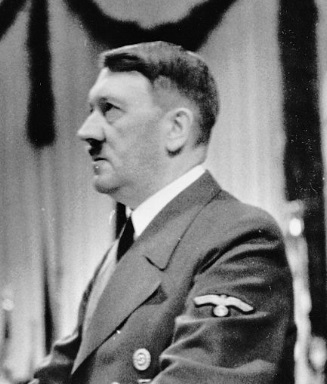
Hitler warns that if the British continue to bomb Berlin, he will have no choice but to level their cities. Adolf Hitler addresses a crowd during the opening of the annual Winter Relief Campaign at the Berlin Sportpalast. It is one of his more memorable speeches, at least to English-speaking peoples. The speech reveals the decision he made in the Hague 3 September to begin bombing London, along with various bombastic observations.
At one point, he addresses the question of when he intends to invade England, which is on everyone’s mind:
“In England they’re filled with curiosity and keep asking, ‘Why doesn’t he come? Be calm. Be calm. He’s coming!”
“It is a wonderful thing to see our nation at war, in its fully disciplined state. This is exactly what we are now experiencing at this time, as Mr Churchill is demonstrating to us the aerial night attacks which he has concocted. He is not doing this because these air raids might be particularly effective, but because his Air Force cannot fly over German territory in daylight. Whereas German aviators and German planes fly over English soil daily, there is hardly a single Englishman who comes across the North Sea in daytime.
“They therefore come during the night — and as you know, release their bombs indiscriminately and without any plan on to residential areas, farmhouses and villages. Wherever they see a sign of light, a bomb is dropped on it. For three months past, I have not ordered any answer to be given, thinking that they would stop this nonsensical behavior. Mr Churchill has taken this to be a sign of our weakness. You will understand that we shall now give a reply, night for night, and with increasing force.
“And if the British Air Force drops two, three or four thousand kilos of bombs, then we will now drop 150,000, 180,000, 230,000, 300,000 or 400,000 kilos, or more, in one night. If they declare that they will attack our cities on a large scale, we will erase theirs! We will put a stop to the game of these night-pirates, as God is our witness. The hour will come when one or the other of us will crumble, and that one will not be National Socialist Germany. I have already carried through such a struggle once in my life, up to the final consequences, and this then led to the collapse of the enemy who is now still sitting there in England on Europe’s last island.”
- Portion of Adolph Hitler’s speech at the Sportsplast September 4th 1940
“To watch Hitler make this speech to the thousands that had gathered before him, mesmerized, following every word that he spoke. And between each sentence, they would chant “Hitler, Hitler, Hitler.” and as soon as he raised his hand, they stopped, and a sudden silence came over the entire crowd who followed him, believing that it would be this man that will lead them to victory.”
William S. Shirer informs us that the audience was made up of mostly women, German female workers, nurses and social workers. He stated that Hitler made mention that while German bomber attacked England by day, the cowardly RAF comes over only at night. Yet Hitler failed to tell his audience as to the reason why. Mr Shirer went on to say that when Hitler stated that he would drop 150,000, 180,000 bombs and so on that Hitler was forced to stop because of the hysterical performance of the women.
“We will stop the handiwork of these air pirates, so help us God.” At this the young German women hopped to their feet and their breasts heaving, screamed their approval.
“The hour will come,” Hitler went on, “when one of us will break, and it will not be National Socialist Germany.” At this juncture the raving maidens kept their heads sufficiently to break their wild shouts of joy with a chorus of: “Never, Never!”
‘Though grim and dripping with hate most of the evening, Hitler had his humorous and jaunty moments. His listeners found it very funny when he said: “In England they’re filled with curiosity and keep asking: “Why doesn’t he come?’ Be calm. He’s coming! He’s coming!” And the man squeezed every ounce of humor out of his voice.’
- William L.Shirer The Rise of the Third Reich 1940-41 p213
Back on September 1st, the Luftwaffe Staff Operations IA had issued an order that listed thirty British factories that were to be destroyed. Each one of these made many vital parts for the manufacture of aircraft. RAF airfields it stated were to continually be attacked. But the German plans were still going astray. The Luftwaffe had failed to destroy the Royal Air Force in two weeks as originally planned. They had also failed to wipe the Royal Air Force from the skies in preparation for the invasion of Britain. The Battle of Britain was now in its 55th day, and it now appeared more than ever that plans were now to be made to make an attack on London itself.
The British War Cabinet was now convinced of this more than ever now. Attacks on the British capital could not be very far off. Kesselring earlier at the meeting with Göring and Sperle had mentioned that the time had come when the German Air Force should now make its attacks on London, but this was still not favored by Göring who still thought that he could crush the RAF whereas Sperle thought that caution should be implemented as the British air force had more aircraft than the Luftwaffe had been led to believe, and he was right.
Weather over Great Britain: Over the southern half of England it was expected to be fine and warm. Skies should be mainly clear with occasional cloud. The Channel areas were expected to remain fine with good visibility . The north of England and most of Scotland was expected to have rain periods with some heavy falls and strong winds could be expected.
0830 Hours: Formations of enemy aircraft were detected coming across the narrow part of the Channel between Dover and Folkestone. But again, formations were divided as another had been detected coming in over the Thames Estuary. 66 Squadron Kenley (Spitfires) were vectored to the Thames Estuary as was 72 Squadron Croydon (Spitfires) and 111 Squadron Hurricanes (Croydon). Most of the action commenced from 0900 hours onwards as the British fighters engaged a mixture of Bf 110s and Bf 109s.
0930 Hours: The Bf 109s stuck to their task well, keeping the Hurricanes and Spitfires at bay and allowing a number of the Bf 110s to get the Eastchurch where again the airfield. Fighter Command released a number of squadrons towards the Dover area but some excellent defensive action by the British fighters stopped most of the Bf 110s from getting through, although the Harbor and the barrage balloons came under fire. but most of the Damage was at Lympne where a number of bombs hit buildings and again the aerodrome was cratered. The balloons at Dover continued to be shot up. 111 Squadron, even though they forced the Bf 109s to retreat did lose two of their pilots, both over the Channel off Folkestone.Eastchurch also became a target and a number of bombs made deep craters in the runway and some stores were damaged.
1230 Hours: Radar at Dover and Rye detected a wide formation coming across the Channel for the midday attack. Some 300 enemy aircraft were detected crossing the coast in the vicinity of Folkstone and Beachy Head. This consisted of 50+ Heinkel He 111s, 30+ Dornier Do 17s and 200 Bf 109s. Again they split into groups and headed towards five different targets. A total of fourteen squadrons of Fighter Command were to be placed at readiness. More enemy aircraft are spotted coming in from the Channel close to Brighton and Worthing in Sussex.
All anticipated the the positioning of the enemy bombers meant that their plan again was the break into two separate formations as seemed the usual tactics of the Luftwaffe over the last few days. Keith Park again was to take no chances placing half his squadrons at readiness from Tangmere to Debden, and the other half on standby.
1300 Hours: 43 Squadron Tangmere (Hurricanes) were ordered up giving protection along the Sussex coast. 46 Squadron Stapleford (Hurricanes) were to patrol the Thames Estuary, 66 Squadron Kenley (Spitfires) who had already been up once that morning, 72 Squadron Croydon (Spitfires) also up for a second time, 79 Squadron Biggin Hill (Hurricanes), 222 Squadron Hornchurch (Spitfires), 249 Squadron North Weald (Hurricanes), 234 Squadron Middle Wallop (Spitfires), 253 Squadron Kenley (Hurricanes), 601 Squadron Tangmere (Hurricanes), 602 Squadron Westhampnet (Spitfires) and 603 Squadron Hornchurch (Spitfires) were all scrambled for this biggest buildup of the day. 11 Group were further reinforced by 73 Squadron (Hurricanes) who had been transferred from Church Fenton to Debden, 41 Squadron (Spitfires) came down from Catterick and found their new home at Hornchurch. With all personnel fresh and rested, it would not be long before their services were put to good use.
1315 Hours: Squadrons were divided as two separate formations came in from two different parts of the English coast. Heavy action took place over north Kent and as was usual in the Thames Estuary with the skies over Kent and Sussex were chaos, vapor trails now hung like heavy white clouds as two thirds of 11 Group battled it out at 20,000 feet. What radar did not pick up was a low flying formation of Bf 110s that were following the railway line from Hindhead to Guildford until it was too late.
This small formation of Bf 110s managed to get through the British defenses and were not intecepted until just north of the town of Guildford which is to the south-west of London. They were met by 253 Squadron Kenley (Hurricanes) who had reasonable success, although a couple of Bf 110s did get through, and although the target was the Hawker factory at Brooklands, they mistakenly hit the Vickers factory again. Six 500kg high explosive bombs fell on the machine shops at the Vickers factory killing 86 personnel and seriously injuring 630 others. Six of the Bf 110s were destroyed prior to the bombing of the Vickers factory, while another nine were destroyed as they turned for home.
1320 Hours: Park instructs that a squadron patrol the sector station to the south of London, and also a squadron was to patrol the sector station of North Weald who was still trying to repair the damage of the previous day. While all this was going on, the crack Bf 110 ErpGr 210 group crossed the coast almost unnoticed and attacked the radar station at Poling, but not before a Spitfire squadron had been instructed to intercept.
German aircraft had now crossed all along the south coast, and now Tangmere was brought into the action. Ventnor radar had picked up enemy formations coming in from the Channel:
Patrolling over Tangmere the 12 Spitfires of 234 Squadron led by Pat Hughes have spiraled up to 15,000 feet (4 600 m) by 1.20 p.m. Down below, on the airfield, the Hurricanes of 601 Squadron are taking off. At the controls of one is Clive Mayers.
Hughes spots two groups of German aircraft. About 50 Bf 110s are coming in over the coast while 15 others are already circling over Haslemere lower down. Detailing Red, Yellow and Green Sections to attack the larger formation, Hughes leads Blue section down after the others. As soon as the Spitfires are sighted the 110s form their usual defensive circle. Hughes attacks the leading Messerschmitt head-on. His aim is deadly. The 110 rears up and another short burst strikes its fuselage, causing it to erupt in flames.
Seconds later the Australian comes in directly behind another 110 and fires briefly twice. The heavy escort fighter crashes and blows up. Suddenly Hughes is surrounded by three Messerschmitts and he notices a fourth slipping in behind. Manoeuvring wildly he fires three sharp bursts to break them up and causes one to dive away. He pounces after it and empties the remainder of his ammunition, The 110 sinks and turns slowly towards the coast, it cannot get far because both engines are burning.
While all this is happening 601 Squadron intercepts bandits near Worthing. Clive Mayers goes into line astern following Red 1 who attacks a defensive circle of Bf 110s. Mayers finds a Messerschmitt slightly below him and fires briefly from above and behind. He attacks again from dead astern and sees smoke coming from both engines. He dives underneath and, as he does so, notices Red 1 attacking. He leaves his section leader to deliver the coup de grace & he last sees the Messerschmitt trailing smoke with Red 1 in dogged pursuit.
Looking around he sees another aircraft flying out to sea. It: is a Dornier bomber. Gradually he overhauls it but as he draws abreast it suddenly turns towards him. Mayers reacts quickly and charges in head-on. He presses his firing button and the bomber’s glasshouse nose shatters to pieces as he flashes past. As he hauls back on his Hurricane’s controls, the crippled German plane rolls over onto its back and dives vertically into the sea.
The German escort fighters have suffered badly and 234 Squadron alone claims a record 14 Bf 110s and one Do 17 destroyed for only one damaged Spitfire.
However, while the RAF fighters are successful in the air, a formation of bomb-carrying Bf 110s reaches Brooklands and drops 6 bombs on the Vickers works, destroying the Wellington bomber assembly sheds and inflicting 700 casualties, among them 88 dead. It is an unintended success for the Germans because they had been after the Hawker factory nearby — which escapes unscathed. Another raid reaches Rochester where the Short Bros factory producing the new four-engined Stirling bombers is damaged.
By nightfall, the Luftwaffe changed from the bombing of Fighter Commands airfields and aircraft producing factories, to the bombing of large towns and cities. Night bombing raids were made on Bristol, Cardiff , Swansea, Liverpool, Newcastle and Tilbury Docks. In South Wales, large oil storage tanks received direct hits and the red glow lit up the dark night sky that it was a wonder that they couldn’t see it from London. In all, for the day, the RAF had shot down 20 German aircraft which consisted of 6 Bf 109s, 1 Heinkel He 111 and 13 Bf 110s. Fighter Command lost fifteen valuable aircraft, 9 Spitfires and 6 Hurricanes. 6 RAF pilots were killed.
In Germany and occupied Europe, things were busy in the preparation of the pending invasion. Air Force photographs and through British intelligence reports, thousands of landing craft were ready for mobilization in many of the Harbors along the coast of northern France. Trucks carrying amphibious craft were in a nose to tail convoy along the French coastal roads.
Göring and Kesselring stated that the British Air Force was all but finished, and the recommendation was put to Hitler that the time had come that London, the inland cities and the dockland areas be attacked and bombed as a prelude to the invasion. The next day, Hitler was to issue the directive that attacks be now made on the inhabitants and air defenses of the British cities, and that directive was to include London.
RAF Casualties:
0915 Hours: Channel 5m E of Folkestone. Hurricane R4172. 111 Squadron Croydon
F/L D.C. Bruce listed as missing. (Crashed into Channel after combat with Bf 109)
0915 Hours: Channel 5m E of Folkestone. Hurricane Z2309. 111 Squadron Croydon
P/O J. Macinski listed as missing. (Shot down by Bf 109 and pilot bailed out but body was never found)
1000 Hours: Ashford. Spitfire N3048. 66 Squadron Kenley
Sgt A.D. Smith died of injuries 6.9.40 (Bailed out with serious injuries after combat with enemy aircraft)
1000 Hours: Banstead. Hurricane V6638. 253 Squadron Kenley
F/O A.A.G. Trueman killed. (Shot down over during combat action over Kenley aerodrome)
1315 Hours: Hawkwell. Hurricane P3052. 46 Squadron Stapleford
F/O R.P. Plummer died of injuries 14.9.40 (Shot down in flames by Bf 110. Pilot bailed out with serious burns)
1330 Hours: Maidstone. Spitfire X4278. 222 Squadron Hornchurch
P/O J.W. Cutts killed. (Shot down by Bf 109. and aircraft crashed at Sutton Farm)
Originally listed as missing but body fragments discovered on excavation of crash site. Now listed as KIA
1335 Hours: Yalding. Spitfire K9962. 222 Squadron Hornchurch
Sgt J.W. Ramshaw killed. (Crashed after combat with Bf 109s. Was dead on arrival at West Kent Hospital)
1340 Hours: Biggin Hill. Hurricane P3676. 79 Squadron Biggin Hill
Sgt J. Wright died of injuries 5.9.40. (Shot down by Bf 110 over base. Pilot crash landed aircraft at Surbiton)
2130 Hours: Kirton-in-Lindsay. Defiant N1628. 264 Squadron Kirton-in-Lindsay
F/O D.K.C. O’Malley killed
Sgt L.A.W. Rasmussen killed. (Aircraft crashed during night landing practice)
Unknown time: RAF Digby. Hurricane V7406. 151 Squadron Digby
P/O R. Ambrose killed. (Crashed into a crane during take off on ferry flight. A/C burnt out)
Unknown time: 25m S of Bognor. Spitfire R6909. 151 Squadron Warmwell
Sgt J.K. Barker killed. (Possibly shot down by Do 17 over Channel. Body washed up on French coast)
Nazi collaborator Anton Mussert puts the fate of Netherlands in Hitler’s hands.
Repercussions from the recent Rumanian territorial losses (to the USSR, Bulgaria, and Hungary) continue to reverberate through the kingdom. There is widespread public disgust at the government, protests, and calls for revolution. King Carol still rules as an absolute monarch, but that is about to change.
Throughout the day, King Carol still refuses to appoint Antonescu as Prime Minister despite his advisor (“courtiers”) telling him that former minister Ion Antonescu is moderate and a better choice than one of the fascists from the Iron Guard who are threatening to depose the King and take over. Finally, during the evening, Valer Pop, an advisor to the King, decides to force the issue. He visits the German ambassador, Wilhelm Fabricius, to ask for Germany’s support for Antonescu. Fabricius has had his doubts about Antonescu — who has been sympathetic to Germany since Munich more out of fear of German imperialism towards Rumania than anything else — but abruptly throws Germany’s support behind him.
Everybody, including King Carol, realizes that Germany is the only thing standing between Rumania and the newly aggressive Soviet Union, so the King capitulates and agrees to appoint Antonescu. Antonescu, however, feels emboldened, and just being Prime Minister isn’t enough for him: he now requests the full powers of a head of state. Carol agrees, granting Antonescu virtually all of his own powers as a monarch (making Antonescu “Conducător,” somewhat similar to “Fuhrer”). Carol forces the current government led by Gigurtu to resign so that he can appoint Antonescu to form a new government. It is a remarkable rise to power for someone who had been in prison only a month before. It also is the beginning of what can best be described as a royal nightmare for Rumania.
According to information available in Athens, the Italians continue to transport troops into Albania — mostly by night — and in the last twenty-four hours have considerably augmented their military strength not only along the Greek frontier but at strategic points adjoining Yugoslavia. The Italian force in Albania now is reliably said to be approaching 200,000.
The Soviet Union called youths of 18, 19 and 20 today for duty with the colors beginning the middle of September, to guard the nation at a time of “imperialist war” and “capitalist encirclement.”
Chiune Sugihara, Vice-Consul for the Empire of Japan to Lithuania, is forced to leave his post in Kaunas, Lithuania when the consulate closes. Sugihara has been writing visas for thousands of Jews (exactly how many is unknown) so they can escape the gathering clouds of war and the Holocaust (many stories are circulating about atrocities in occupied Poland). Sugihara does this right up until the last moment, even throwing some off the train as it pulls out of the station. Sugihara also arranges for the Lithuanian Jews to be able to transit on the Trans-Siberian railway (for five times the usual price). Sugihara heads to Königsberg, East Prussia, where he cannot do the same thing. This “incident” is long-remembered both by the Jews he saves, as well as the Japanese government, which dismisses him for it (allegedly) in 1947. Chiune Sugihara is considered to be in the same class as Oskar Schindler and Raoul Wallenberg, though not nearly as well known.
At Malta, the coast is buzzed again at 21:30 by an Italian torpedo boat (MAS), but it gets away. There is an air raid alert in the late afternoon, but the bombers do not cross the coastline.
Winston Churchill is pleased with the success of Operation Hats and tells the War Cabinet that he is going to send Governor Dobbie, for distribution to the island, a letter of commendation. However, at the same time, the War Office tells Dobbie that many of the anti-aircraft guns that he has requested are needed elsewhere.
RAF Bomber Command dispatches 86 Blenheims, Hampdens, Wellingtons and Whitleys overnight to Stettin, Magdeburg, Berlin and the Black Forest, and to French airfields, 1 Hampden and 1 Whitley lost.
Fairey Swordfish aircraft from the British Fleet Air Arm’s 815 and 819 Squadrons attacked the Calato and Gadurra airfields on Rhodes, Greece. They should had been accompanied by Swordfish aircraft from 813 and 824 Squadrons but these were delayed in their departure from HMS Eagle and when they arrived the Italian defences were alerted with fighters waiting for them. Four of the Swordfish aircraft were shot down. The Italians lost two aircraft destroyed and seven damaged on the ground.
The RAF bombs Italian airfields near the Egyptian border. The South African Air Force raids Javcllo, Ethiopia.
U-46, commanded by Oberleutnant zur See Engelbert Endrass, sank steamer Luimneach (1074grt) in 47-50N, 09-12W. The unescorted and neutral Luimneach (Master Eric Septimus Jones) was stopped by U-46 with two shots across her bow west-southwest of the Scilly Isles and was sunk at 2000 hours by gunfire after the crew had abandoned ship. The U-boat was returning from patrol and had no torpedoes left, when the ship was spotted. Endrass was not sure about the nationality of the vessel and the survivors thought that the U-boat had been Italian. After being stopped, the men abandoned ship in one overcrowded lifeboat without provisions. Endrass ordered them to row back to the ship to launch the second boat and handed over rations, cigarettes and rum. Three men were taken prisoner and landed at Lorient on 6 September. The master and 14 crew members were picked up by a French fishing boat, transferred to a Spanish trawler and landed at Pasajes, Spain on 13 September. The 1,074-ton Luimneach was carrying pyrites and was headed for Drogheda, Ireland.
U-47, commanded by Kapitänleutnant Günther Prien, sank steamer Titan (9035grt) in 58-14N, 15-50W and reported damaging a steamer at the same time and location, also from convoy OA.207. At 0128 and 0129 hours, U-47 fired one torpedo each at two ships in convoy OA-207 about 80 miles southwest of Rockall, saw the first ship sinking in 12 minutes after a hit amidships and a hit in the bow of the second ship without further observations. However, only the Titan (Master Walter Francis Dark) was hit and sunk. Six crew members were lost. The master and 88 crew members were picked up by HMCS St. Laurent (H 83) (Lt H.S. Rayner, RCN) and landed at Rosyth on 9 September. The master Walter Francis Dark was awarded the Lloyds War Medal for bravery at sea. The 9,035-ton Titan was carrying Ballast and was headed for Sydney, Nova Scotia.
ATTACK ON CONVOY FS.271
German motor torpedo boats of the 1st Flotilla launched a highly successful attack on FS.271 northeast of Great Yarmouth in 52-50N, 02-09E.
S.21 sank steamers Corbrook (1729grt) and New Lambton (2709grt). Corbrook went down 30 miles east of Cromer and New Lambton in 52-50N, 2-07-30E (also 52-52N, 02.40E), but both crews were rescued.
S.18 sank steamer Joseph Swan (1571grt) and the Dutch Nieuwland (1075grt). Both ships were lost between 56 and 55A Buoy, Joseph Swan with only one survivor and Nieuwland with the loss of eight crew.
S.22 sank steamer Fulham IV (1562grt) two miles north of 55A Buoy, but here entire crew was rescued.
S.54 damaged steamer Ewell (1350grt).
Tug HMS Saucy (Temporary Lt J. Cordery RNR) was mined and sunk off Inchkeith in the Firth of Forth. Temporary S/Lt F. D. Phillips RNR, Temporary S/Lt D. L. Thomas RNR, Temporary S/Lt (E) W. H. Anderson RNR, Temporary S/Lt (E) F. W. Jones, and twenty three ratings were lost.
Estonian steamer Jaak (1351grt) was damaged by German bombing off Royal Pier, Southampton.
Light cruisers HMS Manchester, HMS Southampton, and HMS Birmingham departed Rosyth at 1300 with destroyer HMS Holderness, were joined at sea by destroyers HMS Kelvin and HMS Jupiter, and proceeded to Immingham.
Destroyer HMS Javelin departed the Clyde for the Humber.
Destroyer HMS Jaguar departed the Clyde for Rosyth.
Rear Admiral Destroyers, Home Fleet transferred to destroyer depot ship HMS Greenwich at 0800.
Destroyer depot ship HMS Woolwich, escorted by destroyers HMS Maori and HMS Duncan departed Scapa Flow for Liverpool at 1700, and arrived safely at 1200/6th. Duncan and Maori then proceeded to Lough Foyle to escort submarine depot ship HMS Titania to Rosyth. They sailed from Lough Foyle at 1030/7th.
Submarine HMS Tuna made contact a German submarine in 56-26N, 1-17E, but was unable to attack.
Destroyer HMS Velox departed Gibraltar escorting steamers Baron Vernon and Fidra to within ten miles of Melilla, when they carried on to load iron ore. On the 8th, destroyer HMS Hotspur escorted Fidra back to Gibraltar.
US-BRITISH DESTROYERS FOR BASES DEAL
The first U.S. destroyers for transfer to the Royal Navy, destroyers USS Aaron Ward (DD-132), USS Hale (DD-133), and USS Abel P Upshur (DD-193), departed Boston for Halifax.
On 1 September, American destroyer depot ship USS Denebola (AD-12) had departed Norfolk, Virginia, and arrived at Halifax on the 6th to act as a depot ship for the destroyers. She remained at Halifax in this role until returning to Norfolk on 3 November.
By 6 September, all eight destroyers of Destroyer Divisions 65 and 67 had arrived at Halifax.
The British crews for these destroyers arrived at Halifax on troopship Duchess of Richmond (20,022grt).
Convoy OA.209 departed Methil escorted by sloop HMS Fowey and corvette HMS Camellia from 4 to 8 September.
Convoy OB.209 departed Liverpool escorted by corvettes HMS Clarkia and HMS Heartsease, and was joined on the 5th by destroyer HMS Winchelsea and on the 6th by destroyers HMS Ambuscade and HMS Arrow, plus anti-submarine trawlers HMS St Kenan and HMS St Loman. The Arrow detached later on the 6th, followed by Ambuscade, Winchelsea, Clarkia and Heartsease on the 8th. St Kenan and St Loman remained until the 9th.
Convoy FN.272 departed Southend with destroyer HMS Woolston, sloop HMS Fleetwood, and patrol sloop HMS Puffin, and arrived in the Tyne on the 6th.
Convoy MT.160 departed Methil, and arrived in the Tyne later that day.
Convoy FS.272 departed the Tyne, escorted by destroyer HMS Vivien and sloop HMS Londonderry. Sloop HMS Puffin joined on the 5th, and the convoy arrived at Southend on the 6th.
Convoy HG.43 departed Gibraltar with 21 ships escorted by sloop HMS Wellington and as far as Lisbon, by destroyers HMS Wishart and HMS Fortune. Wishart experienced defects and returned to Gibraltar, being replaced by destroyer HMS Vidette which sailed from Gibraltar on the 5th with troopship Royal Scotsman (3244grt) to join the convoy. Wellington escorted the convoy from the 4th to 18th. It was joined in Home Waters by destroyer HMS Warwick with corvettes HMS Coreopsis and HMS Clematis from the 14th to 18th, and by destroyer HMS Westcott and sloop HMS Rochester on the 18th. The convoy arrived at Liverpool that same day.
The America First Committee was established by Yale University law student R. Douglas Stuart, Jr., along with other students including future President Gerald Ford, Sargent Shriver and future Supreme Court justice Potter Stewart. The America First Committee was the foremost non-interventionist pressure group against the American entry into World War II. At its peak, America First may have had 800,000 members in 650 chapters, located mostly in a 300-mile radius of Chicago.
In Washington, President Roosevelt explained the deal with England for naval and airbases in exchange for over-age destroyers to Congressional leaders and discussed with them the legislative program; conferred with Edward J. Flynn, chairman of the Democratic National Committee, and presented to the Rev. Francis X. Quinn, a Congressional Medal for his part in inducing a criminal to surrender.
The Senate recessed at 12:05 PM until noon tomorrow out of respect to the late Senator Lundeen of Minnesota. The Finance Committee heard William S. Knudsen and others on the excess profits tax bill, and the Judiciary Committee began hearings on an anti-third term resolution.
The House debated the compulsory training bill, with Representative Wadsworth defending his legislation; received the Voorhis tax bill designed to finance the defense program and the War Department statement on plane purchases, and heard a debate on the transfer of destroyers for air and naval bases. The House recessed until 11 AM tomorrow, when it will consider amendments to the selective military service bill.
Democratic leaders in Congress gave enthusiastic approval today to President Roosevelt’s trade of fifty overage American destroyers for a line. of naval and air base sites in British possessions in the Atlantic Ocean. Speaker Bankhead and Senator Barkley, the majority leader, were among those complimenting Mr. Roosevelt on his program, which he discussed with them at the White House. It was also announced that out of hundreds of telegrams received at the Executive Office only a dozen were critical. Secretary Hull said at the State Department that on the whole the reaction he had observed seemed to be favorable. Only a handful of Representatives expressed opposition to the plan in Congressional comment. With this background of apparent general approval, Mr. Roosevelt prepared to go ahead at full speed in the necessary preliminaries, including surveys and definite choice of sites which must be accomplished before actual construction can be started on the chain of bases planned to keep an enemy from the front door of the United States.
Acting upon officially unconfirmed reports that Japan had issued an ultimatum to officials of French Indo-China, the United States today warned Japan that the effect upon American public opinion would be “unfortunate” if Japan did not maintain the status quo with regard to Indo-China and the Netherlands Indies. Simultaneously, Japan was informed that this country hoped that an agreement would Boon be reached by which American troops would be able to take over patrol of the Shanghai waterfront district from which British troops recently were withdrawn. Secretary of State Cordell Hull issued two written statements dealing thus with the Far Eastern situation in the form of answers to inquiries earlier made by press correspondents.
The unequivocal reiteration of the United States attitude toward Japan’s ambitions in the Far East came less than twenty-four hours after it had been officially announced here, in connection with the Anglo-American trade of destroyers for air and naval bases, that the British Government had promised not to scuttle or surrender the British fleet under any conditions.
Taut feelings over the conscription issue and a charge of “traitor” muttered by Representative Vincent, Kentucky Democrat, at Representative Sweeney, Ohio Democrat, had the two locked in a free-swinging, hardhitting fistfight on the house floor tonight. It ended in an apology to the house from Sweeney and a repetition of his charge by Vincent later withdrawn at importuning of his friends. Sweeney, 55, had just finished a speech opposing the conscription bill and accusing President Roosevelt of trying to involve the United States in the war. He also accused President Wilson of putting the United States in the World war. He was about to take a seat beside Vincent, five years his junior, when suddenly the two were swinging at each other.
The first 75,000 men to be summoned under the selective service measure which Administration leaders expect to be enacted into law within a few days will be called on November 7 for a year’s service, it was announced.
The construction in New York Harbor of a super-drydock large enough to handle the 45,000-ton battleships that are being built at the New York Navy Yard and in other Navy yards was approved as an “urgent military necessity” by President Roosevelt yesterday, it was announced by the Port of New York Authority.
The National Defense Advisory Commission in effect told Congress today that any legislative act projecting government control over private industrial facilities beyond the defense emergency period would be a serious barrier to the flow of non-government capital into the rearmament program and therefore would be a handicap to the whole effort. Conversely, the commission made known its confidence in private industry doing by far the greater share of the task of producing the necessary defense material, provided it could have assurance in advance against any form of government domination when peacetime conditions returned. Such was the import of assertions of William S. Knudsen and Leon Henderson, members of the commission, who, with John D. Biggers, chairman of the commission’s committee on taxation and finance, and Donald Nelson, coordinator of purchases, appeared before the Senate Finance Committee today to protest some Treasury-sponsored provisions in the amortization section of the Excess Profits Tax Bill.
The United States Army has fewer than 300 first-line combat planes, of which only fifty-nine are heavy bombers, according to reliable Army figures in the possession of this correspondent. Fewer than 1,500 more modern fighting planes have so far been ordered for delivery in 1940 and 1941, of which only 176 are heavy bombers. This data was obtained through official sources as Senator Byrd of Virginia insisted that the letting of contracts must be speeded in the interests of national defense. These figures do not include observation, trainer and other subsidiary planes nor combat planes considered by the War Department as no longer fit for modern aerial fighting. Chairman May of the House Military Affairs Committee inserted in the Congressional Record today a War Department memorandum stating that the Army had contracted for 2,677 airplanes of all types since June 1. Neither does this information cover the status of about 18,000 Army and Navy airplanes to be purchased under the $5,256,000,000 bill for a two-ocean Navy and increases in our armaments, on which bill the Senate and House conferees completed action today. The information covers the Army combat plane situation only as of this week.
Secretary of the Navy Frank Knox said today that negotiations were under way for new defense bases in the Pacific Ocean, particularly to protect the Panama Canal.
Britain’s pledge never to surrender or scuttle its fleet reinforced today the United States Government’s intention to keep its own fighting armada in the Pacific as a possible restraint on any Japanese expansionist tendencies. This was described as one of the motivating factors in the exchange between Secretary Hull and Lord Lothian, British Ambassador, on the possible fate of the British fleet if it were driven from home waters.
Major League Baseball:
Timely hitting in the clutch by Joe Cronin and Tommy Carey gave the Red Sox two overtime victories over the Athletics today, 6–5, in ten innings and 5–4 in eleven frames.
The Yankees’ grand road offensive stalled today, with the result that the Bronx Bombers went tumbling down to defeat before the Senators, 6–5, in the opening clash of a four-game series.
In Detroit, the Tigers get two 3–run home runs, from Campbell and Gehringer, off Bob Feller (23–8) to again top the slumping Indians, 11–3. Tommy Bridges and Al Benton combine for the win.
The pitching of Bob Harris and the hitting and fielding of the St. Louis Browns’ keystone combination — Alan Strange and Johnny Berardino — gave St. Louis the series opener with the White Sox today, 4–1.
The Dodgers’ Luke Hamlin held the Phillies to seven hits in hurling a 3–0 shutout victory over the Philadelphia Philles. Hamlin fanned seven and did not walk anyone. Jimmy Wasdell drove in the first two Brooklyn runs with a first-inning triple.
The Reds’ Bill Werber’s twelfth-inning single sent Eddie Joost in with the run that beat the Pirates, 3–2, tonight before 30,543 fans, the largest night crowd of the season in Cincinnati, and gave Fireman Joe Beggs his second relief victory in two days.
Lefty Max Lanier pitched shutout ball for seven innings tonight while his Cardinal teammates kept pecking away at the offerings of Claude Passeau to register a 4–2 decision over the Cubs.
Carl Hubbell makes a single mistake in a tight pitching duel with Richard Errickson, giving up a two-run homer in the seventh to Eddie Miller, and that’s the ball game, as the Giants bow to the Boston Bees, 2–0.
Philadelphia Athletics 5, Boston Red Sox 6
Philadelphia Athletics 4, Boston Red Sox 5
St. Louis Browns 4, Chicago White Sox 1
Pittsburgh Pirates 2, Cincinnati Reds 3
Cleveland Indians 2, Detroit Tigers 7
Boston Bees 2, New York Giants 0
Brooklyn Dodgers 3, Philadelphia Phillies 0
Chicago Cubs 2, St. Louis Cardinals 4
New York Yankees 5, Washington Senators 6
U.S. Secretary of State Cordell Hull warned the Japanese to respect the territorial integrity of French Indochina. U.S. Secretary of State Cordell Hull expresses concern about Japanese moves in French Indochina, where the Imperial Army has established bases at many key points.
French and Japanese negotiators were reported today to be in almost continuous conference in Hanoi, French Indo-China, in an effort to reach a compromise solution to Japan’s demand for the right to move troops into French Indo-China.
French Army General Maurice Martin took over Franco-Japanese negotiations for Indochina. Japanese intelligence intercepted a French cable that detailed Indochina affairs to the United States and the United Kingdom, signaling that the U.S. and the UK still had influence in Indochina politics. Japanese Army argued that force must now to be used before U.S. and UK openly asserted pressure.
Prince Nagahisa passed away in an airplane crash at Zhangjiakou in Japanese puppet state of Mengjiang in northern China.
The Tokyo press today predicted joint British-American action in the Pacific as a result of the western hemisphere bases-destroyer deal and called upon Japan to be prepared.
Toyohiko Kagawa, Japan’s best-known Christian leader and social worker, has been arrested on a charge of violating the military code. Kagawa made an apology to the Republic of China for Japan’s occupation of China, and was arrested for this act. After his release, he went back to the United States in a futile attempt to prevent war between that nation and Japan. He then returned to Japan to continue his attempts to win women’s suffrage. After Japan’s surrender, Kagawa was an adviser to the transitional Japanese government.
The Japanese government holds meetings to decide how to approach negotiations for officially joining the Axis. The question is how to carve up the world, to create “spheres of influence” dominated by each power center, with a line drawn somewhere around India. The wishes of the Soviet Union do not appear to play a major factor.
Dow Jones Industrial Average: 132.16 (+2.42)
Born:
Sonny Charles [Charles Hemphill], American soul singer (Checkmates, Ltd. — “Black Pearl”; solo -“Put It in a Magazine”; Steve Miller Band), in Blytheville, Arkansas.
Roger Strickland, NBA forward (Baltimore Bullets), in Jacksonville, Florida (d. 2011).
Died:
George William de Carteret, 70 or 71, Jersey journalist and writer.
Hans Zinsser, 61, American physician, bacteriologist and writer.
Naval Construction:
The Kriegsmarine (German Navy) Type VIIC U-boat U-656 is laid down by Howaldtswerke Hamburg AG, Hamburg (werk 805).
The Royal Navy Flower-class corvette HMS Coltsfoot (K 140) is laid down by Alexander Hall & Co. Ltd. (Aberdeen, Scotland).
The U.S. Navy Gleaves-class destroyer USS Corry (DD-463) is laid down by the Charleston Navy Yard (Charleston, South Carolina, U.S.A.).
The Royal Navy Assurance-class rescue tug HMS Restive (W 39) is launched by Cochrane & Sons Shipbuilders Ltd. (Selby, U.K.).
The Royal Navy Bangor-class (Reciprocating-engined) minesweeper HMS Bude (J 116) is launched by Lobnitz & Co. Ltd. (Renfrew, Scotland).
The Royal Navy Abdiel-class minelayer HMS Welshman (M 84) is launched by Hawthorn Leslie & Co. (Hebburn-on-Tyne, U.K.).
The U.S. Navy Gar-class submarine USS Grayling (SS-209) is launched by Portsmouth Navy Yard (Kittery, Maine, U.S.A.).
The Royal Canadian Navy Flower-class corvette HMCS Levis (K 115) is launched by George T. Davie & Sons Ltd. (Lauzon, Quebec, Canada).
The Royal Navy Flower-class corvette HMS Tulip (K 29) is launched by Smiths Dock Co., Ltd. (South Bank-on-Tees, U.K.).
The Royal Navy Flower-class corvette HMS Hydrangea (K 39) is launched by Ferguson Shipbuilders. Ltd. (Port Glasgow, Scotland).
The Royal Navy Flower-class corvette HMS Marigold (K 87) is launched by Hall, Russell & Co. Ltd. (Aberdeen, Scotland).
The Kriegsmarine (German Navy) Type IID U-boat U-142 is commissioned. Her first commander is Oberleutnant zur See Nicolai Clausen.
 History Diaries