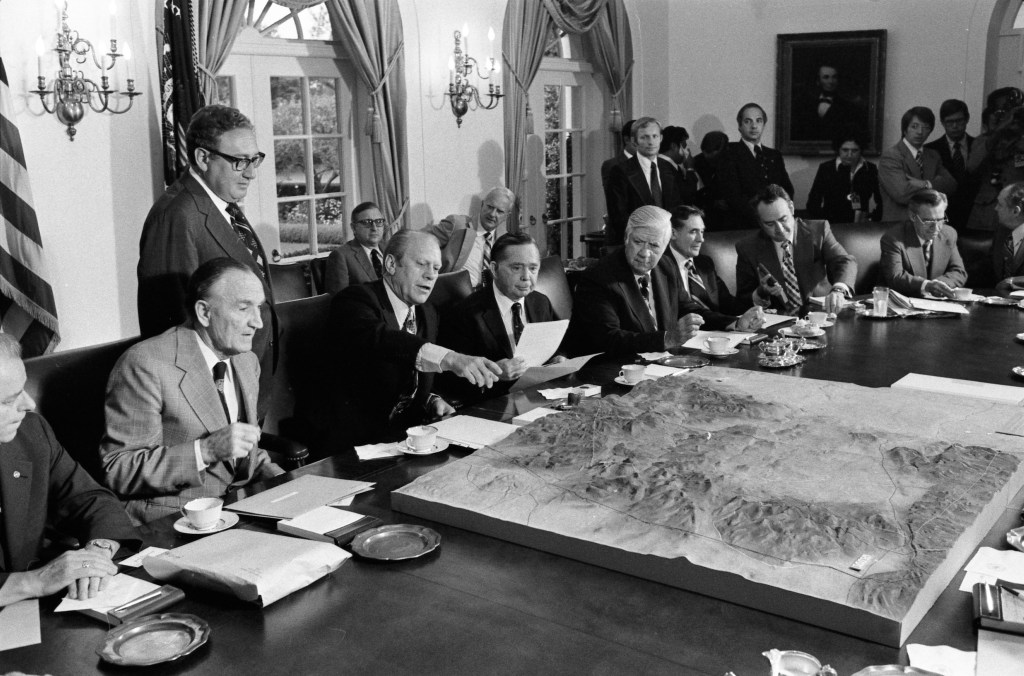
The 7,000 American tactical nuclear weapons stored in Europe are becoming a critically important issue as the Western allies prepare to resume talks with the Soviet Union on reducing the number of Soviet and American troops in Central Europe. The Western Europeans are nervous about pressure on the Ford Administration from Congress, in a post‐Vietnam mood, to take some of the warheads back home, with or without negotiations. Critics in Congress assert that it is dangerous and entangling to have so many so close to the front line between East and West. The West German Defense Ministry is especially uneasy about Secretary of State Kissinger’s recent proposal to reduce the American nuclear arsenal in Europe by a thousand warheads to try to get the talks moving after two years of deadlock. The negotiations adjourned for the summer on July 17 and are to resume in Vienna on September 26. Mr. Kissinger’s proposal is being examined by experts at the North Atlantic Treaty Organization’s headquarters in Brussels. “It is so complicated an issue,” a West German officer said, “that it looks as though it cannot be agreed on within NATO before the negotiations resume in Vienna.”
According to reliable informants in Brussels and Bonn, the United States suggested that it offer to withdraw the thousand warheads, some aircraft and surface‐to‐surface rockets and 29,000 troops from Central Europe if the Russians would withdraw an entire tank army — 1,700 armored vehicles and 68,000 men. After such a reduction, the West hopes, the Russians can be induced to withdraw proportionately more men and tanks than the United States. In defending the call for a reduction, Congressional critics of the military say that the 7,000 weapons, some of which have a yield several times greater than the bomb that destroyed Hiroshima, could never be used in case of war and that if they were used they would destroy the territory being defended. The warheads, the critics argue, are a provocation to the Soviet Union, could fall into enemy hands in an attack and could be seized in peacetime by a determined band of guerrillas. The weapons stationed there are important to the Europeans. A large reduction would be extremely disturbing since it would be taken as a sign that the United States no longer thought the defense of the Continent essential to its interests.
The Portuguese Navy was reported today to have split with the army by siding with General Vasco Gonçalves in the critical fight over the plan to shift him from the premiership to the post of Chief of Staff of the armed forces. Navy officers and men, in ar assembly yesterday, were understood to have supported General Gonçalves against those who accuse him of trying to impose a minority Communist regime on the country. The navy met under its Chief of Staff, Vice Admiral Jos Pinheiro de Azevedo, who has been designated as Premier and whose efforts to form a cabinet are being blocked by the Gonçalves controversy. An air force assembly meeting in nearby Sintra was expected to oppose General Gonçalves, following General Jose Morais da Silva, the air force Chief of Staff, who said Monday that he would not accept a dictatorship by 20 per cent over the 80 per cent.
State Department officials told Congressional leaders today that they were more hopeful about the political outlook in Portugal as a result of recent gains of more moderate forces over pro‐Communists there. This estimate was given in testimony by a Deputy Assistant Secretary for European Affairs, L. Bruce Laingen, in a closed session of the House International Relations subcommittee on political and military affairs. Emerging from the session, Representative Larry Winn Jr., Republican of Kansas, said he had the impression that Mr. Laingen and other State Department witnesses appeared to be “a bit more optimistic” about prospects in Portugal.
More than 10,000 Protestant workers staged a three-hour strike in Belfast to back demands for a British government crackdown on the mainly Roman Catholic Irish Republican Army. The shutdown came amid a growing clamor by Ulster’s Protestant majority for military action against the IRA’s Provisional wing, which has been blamed for a surge of attacks on Protestants.
German police have arrested a member of the board of the metal workers’ union on suspicion of spying for Communist-ruled East Germany, the federal prosecutor’s office said. The office said police detained Heinz Duerrbeck, 62, in his home in Frankfurt. After searching Duerrbeck’s apartment police drove him to Karlsruhe where he appeared before a federal investigating judge.
Prime Minister Anker Joergensen of Denmark met with opposition leaders in a final attempt to reach agreement on controversial economic measures and avoid the country’s third general election in less than two years. The measures, to pump about $850 million into the economy. have been proposed by Joergensen’s minority Social Democratic government as a means of reducing the 5.5% rate of unemployment.
Claims that crime among women is on the rise as a result of their new freedom were challenged by international criminologists attending a U.N. Crime Conference in Geneva. Representatives from Communist, European and developing nations said offenses by women had not increased significantly in their countries and that there was no basis for a conclusion that a freer, more active life made a woman more prone to become an offender.
The Sinai Interim Agreement was signed in Geneva by Major General Taha Magdoub for Egypt, and Major General Herzl Shafir for Israel, along with the ambassadors to Switzerland from the two nations, after having been initialed earlier in the week by Israel’s Prime Minister Yitzhak Rabin and Egypt’s President Anwar Sadat. Under the agreement, a 25 kilometer wide buffer zone was created in the Sinai Peninsula, to be patrolled by United Nations Emergency Force troops, and separating the armies of the two nations.
Representatives of Egypt and Israel, seated at separate tables, signed their new interim peace agreement in Geneva. Representatives of the Soviet Union and the United States had been expected to attend, but stayed away. The Soviet Union reportedly shunned the ceremony in resentment over having been excluded from the negotiations, and over plans to send American surveillance technicians to Sinai; American officials reportedly wanted to avoid embarrassing the Russians.
President Anwar Sadat of Egypt accused the Soviet Union of seeking to divide the Arab countries by staying away from the signing of the Egyptian-Israeli disengagement agreement in Geneva. In a bitter speech in Cairo, Mr. Sadat denounced the Soviet Union for an attitude of “flagrant incitement,” and attacked Arab critics of the accord — Syrian leaders and other Arab “brothers” — and deplored anti-Egyptian demonstrations in Damascus this morning. “I am in pain because of what happened, particularly in Syria,” Mr. Sadat said in a bitter and at times emotional speech to the National Assembly and the central committee of the Arab Socialist Union, Egypt’s only political party. The speech was televised, with a simultaneous English translation provided by the Cairo radio. “If our aim was solely the recovery of Sinai, we would have achieved far more than we did,” he declared. “The new agreement does not realize what I wanted. It is just another step on the path to peace and a breakthrough in the stalemate.”
It was clear from Mr. Sadat’s tone that the decisions of the two superpowers not to attend the Geneva signing had come as a blow to him. The Soviet Union is said to have boycotted the ceremony because it was not included in the negotiations, and over the prospect of an American presence in Sinai; an American representative changed his plans to attend, in an apparent effort to avoid embarrassing the Russians.
President Ford and Secretary of State Kissinger asked Congress to approve the stationing of Americans in Sinai within two and a half weeks, saying that quick congressional action was necessary before the Israeli-Egyptian agreement could become effective. Some 200 American technicians would monitor early-warning systems in Sinai.
A vote on a resolution asking President Ford to transfer about 1,600 Vietnamese repatriates from Guam has been scheduled for today in Guam’s legislature. The Vietnamese have staged several demonstrations in recent weeks protesting the delay in their return to South Vietnam. Legislative Speaker Joseph Ada, who introduced the resolution, suggested that the Vietnamese be moved to Wake Island.
China appears to be moving toward becoming a major oil-producing nation, and the Ford Administration has reacted to this prospect by trying to discourage American oil companies from drilling in waters that the Chinese claim. A prediction that China might rival Saudi Arabia as an oil producer by 1988 or soon after was contained in a year‐long private study, a report which was made public in Washington today. Administration officials termed the prediction highly speculative but readily acknowledged the report’s picture of behind-the-scenes government pressure on oil companies not to irritate Peking.
Immigration officials in Ottawa said they still want Đặng Văn Quang out of Canada “as quickly as possible.” but no country has yet shown willingness to accept the former South Vietnamese general. Canada ordered Quang to leave two months ago on grounds he was involved in drugs and corruption in Vietnam. He was given the option of departing voluntarily or facing deportation on an as yet undetermined date. Three weeks ago the United States refused to accept Quang as a deportee.
The Chairman of the Joint Chiefs of Staff, Gen. George S. Brown, and the Department of Defense are committed to the conclusion of a new Panama Canal treaty and fully support the Administration’s negotiating efforts in that direction, the State Department said today. The statement was the Pentagon’s first official declaration of support for a new canal treaty, an Administration official said. Ellsworth Bunker, the chief United States negotiator in the effort to work out a new treaty with Panama, is scheduled to leave Sunday for a new round] of bargaining with the Panamanian Government. Previously, unofficial comments from the Defense Department were sharply critical of the new treaty. These views were circulated by Congressional opponents of a new treaty.
Gunmen shot and wounded an Argentine executive of a Ford Motor Co. subsidiary in Cordoba, Buenos Aires police reported. The victim, hospitalized in serious condition with bullet wounds in the stomach, legs and arms, was identified as 32-year-old Leonardo Castelli, labor relations chief for Transax, a vehicle spare parts factory run by Ford. John Swint, an American executive of Transax, was shot and killed by extremists in Cordoba three years ago.
The Ford administration agreed to give the Senate Select Committee on Intelligence access to the Nixon presidential papers — a decision that sources said was forced by Secretary of State Kissinger’s secret testimony before the committee last month. Under the arrangement, lawyers for former President Richard Nixon will review pertinent portions of the 42 million items that make up the Nixon papers and produce those that deal with United States-Chilean policy in 1970 and the formulation of a domestic intelligence plan.
President Ford declared at a Republican rally in Seattle today that he and the party should be “prepared to govern, but not to dominate, the American people.” Beginning a two‐day political and official foray along the. West Coast, the President resumed an essentially conervative approach to national issues despite a plea yesterday from moderate Republican senators that he take a tack closer to theirs. “We believe a that the American people have grown weary of government’s overblown promises and overbearing controls,” Mr. Ford said to loud applause from 1,200 Republicans in the Seattle Center. Later, at a $500‐a‐plate party fund raising luncheon in the Olympic Hotel, Mr. Ford declared that this port city would be a beneficiary of his Administration’s policy of détente with China.
The Postal Service’s board of governors took action that will allow the Postal Service to increase the cost of mailing a letter from 10 to 13 cents by December. They gave final approval to the current “temporary” 10-cent rate, effective September 14. That will leave the service free to file for new rates, which could take effect 90 days after the filing date. The new rate could possibly go into effect as early as December 15, at the height of the Christmas season. The increases are needed because costs are expected to create a $1 billion deficit this year, the board said.
Louisville, Kentucky, and surrounding Jefferson County became the first major metropolitan area in the country to carry out the court-ordered cross-district busing of children between the central city and suburbs to achieve racial balance in public schools. They did it peacefully for the most part, despite a boycott by white students that helped cut opening‐day attendance to less than half of the total enrollment, and a highly charged atmosphere in which 1,500 to 2,500 opponents of busing paraded noisily through downtown Louisville for more than three hours in defiance of a Federal judge’s directive. Nine marchers were arrested after a scuffle with policemen, but there were no serious injuries.
Except for one incident, things were calm in and around the schools themselves. The exception was at Fairdale High School in southern Jefferson County, a suburban area heavily populated by working‐class whites. There, 200 demonstrators tried to block buses when they arrived this afternoon to pick up several hundred black students and return them to their neighborhoods in Louisville’s West End. At least one arrest was reported, but no injuries. At the same school this morning, members of the football team welcomed the blacks at the door.
After months of general hostility and general indifference, congressional leaders expressed mounting concern over New York City’s fiscal crisis. Their new position was based on fear of the impact of a default on the rest of the country. Henry Reuss, Democrat of Wisconsin and chairman of the Banking and Currency Committee, said in a House speech that a New York default could make it impossible for other cities to obtain loans and lead to “a chain of municipal crises.” He urged the Ford administration to act. House Speaker Carl Albert told an “emergency” meeting of the New York congressional delegation that he would support legislation to help New York.
A $1 round-trip toll on 13 East River and Harlem River bridges — the last free points of vehicular access to Manhattan Island — was ordered by the federal Environmental Protection Agency. The agency said the purpose of the toll is to discourage auto traffic into midtown in order to reduce air pollution. There is a strong possibility the order will be contested in the courts, because Governor Hugh Carey and Mayor Abraham Beame, both Democrats, have opposed the tolls for political reasons.
The Department of Health, Education and Welfare withdrew new regulations strongly opposed by doctors which would have required hospitals to police care of Medicare and Medicaid patients. HEW Secretary F. David Mathews said revised regulations were being prepared. In response, the American Medical Assn. dropped a suit that claimed the regulations were an unlawful interference with the rights of patients and physicians. HEW had been enjoined by court decisions from putting the regulations into effect. The regulations had required hospitals to review. within two days of admission, the need for hospitalization of the patient and the degree of care provided.
The United Mine Workers’ president, Arnold Miller, will travel to the coalfields of southern West Virginia for the first time during the month-old walkout. An aide to Mr. Miller said the union leader would conferi tomorrow at an undisclosed site with officials of locals in Charleston‐based District 17. The unauthorized strike by miners heated up today asi armed pickets closed down a strip mine, and Federal marshals prepared to serve court, orders on two strike leaders who rallied thousands of miners behind a “right to strike” demand. An industry source disclosed that Bruce Miller and Skip Delano, who were instrumental in the movement to have “right to strike” clause inserted into the United Mine Workers’ 1974 contract, would he ordered to appear before United States District Court Judge K. K. Hall Monday on contempt charges.
An FBI agent and a state trooper talked an armed and accused bank robber into surrendering after he held nine hostages overnight in a coffee shop a block from the New York capitol in Albany. Robert Roscoe Jr., 33, of Washington, was led away in handcuffs. One by one, the hostages filed out. The siege began when a man armed with a handgun robbed the nearby City & County Savings Bank of less than $5,000. He struck a guard over the head, wounded a policeman who drove up in his patrol car and ran into the coffee shop. The hostages said Roscoe never threatened them during the 17-hour ordeal.
The wave of teacher strikes across the nation began to ebb with scattered settlements and officials going to court to force teachers back to work. Progress was reported in the walkout that has kept half a million Chicago pupils out of classes. Settlements were reported in Connecticut, Indiana, Michigan, New York and Pennsylvania. In Rhode Island, where 70,000 students have been kept out of classes by 4,200 teachers seeking higher salaries, officials in Pawtucket turned to the court for an injunction to force them back to work. Negotiations in the Chicago dispute continued after teachers rejected an offer to extend their contract for six months to try for more state funds.
Jack and Micki Scott refused today to testify before a federal grand jury looking into the whereabouts of Patricia Hearst, and then were unexpectedly told by Federal prosecutors in Harrisburg, Pennsylvania to return to their home and await further instructions. The move came only moments after William M. Kunstler, attorney for Mr. Scott, had predicted that the 32‐year‐old writer and radical sports activist would “undoubtedly be indicted” on a charge of harboring the missing heiress and two other federal fugitives last year. The instructions surprised Mrs. Scott and Martin Miller, a student from New York City, both of whom had expected to be cited for contempt and jailed tomorrow after their refusal today to testify before the grand jury. The panel then adjourned indefinitely, The Associated Press reported.
More than half of the 250,000 residents of Trenton, New Jersey, and its suburbs continued to get a meager supply of water from the tap via a maze of 2 ½ miles of water hose hookups or by going to water tanks for a two-gallon ration. City officials said they hoped to begin restoring normal water service by noon today as engineers worked around the clock to repair broken pumps and patch up a gaping hole in the floor of the system’s only filtration plant. All schools and many industries remained closed. Governor Brendan T. Byrne urged workers from outside the area “to bring a gallon or two of water to work with them.”
A Manhattan Supreme Court Justice yesterday gave Howard R. Hughes, the billionaire-industrialist, two weeks to prove he is not dead. Justice Bernard Nadel issued an order directing Mr. Hughes to state why he should not be declared legally dead and gave the recluse until September 17 to answer. “I think we’re going to smoke him [Mr. Hughes] out,” said I. Walton Bader, the Manhattan attorney who obtained the order on behalf of Victor Kurtz, a stockholder in Air West, a California airline acquired by the Hughes business empire in 1969. Mr. Kurtz brought a $100 million class action suit against Mr. Hughes in July in state Supreme Court charging him with stock manipulation and fraud.
The Federal Trade Commission proposes to order manufacturers of protein food supplements, a multimillion-dollar business, to label their products with the statement that “Protein supplements are unnecessary for most Americans. The United States Public Health Service has determined that the daily diet of most Americans provides adequate protein.” An official of the F.T.C. said that “it is the opinion of the staff that for the vast majority of people, the purchase of these products is a total waste of money.” The proposed labeling would also carry the warning that improper use of concentrated protein supplements can result in serious illness.
Major League Baseball:
The Braves rallied for two runs in the ninth inning and defeated the Padres, 2–1, but their attendance was even worse than at the previous night’s game. Only 1,062 showed up for a new all-time Atlanta low. Willie McCovey homered for the Padres’ run in the second inning. Bruce Dal Canton (1–5) got the win for Atlanta.
A three-run outburst in the first inning that included a homer by Willie Crawford with a man on base enabled the Dodgers to defeat the Reds, 3–2. Davey Lopes led off with a single and took third on a wild pickoff throw by Clay Kirby (9–5), who made his first start for the Reds since August 5. After Lee Lacy singled to drive in Lopes, Crawford rapped his round tripper. Doug Rau (13–9) went the route for the Dodgers and held the Reds to four hits. George Foster homered in the second and the Reds’ other run counted in the sixth on singles by Pete Rose, Merv Rettenmund and Joe Morgan.
With last-out help from Randy Moffitt, John Montefusco (13–7) gained his third straight victory when the Giants edged the Astros, 2–1. The Giants got to Larry Dierker (13–14) for their initial run in the seventh inning. Gary Matthews led off with a single, advanced to third on a single by Willie Montanez and forceout by Dave Rader and scored on a sacrifice fly by Steve Ontiveros. Dierker was lifted for a pinch-hitter in the Astros’ half of the seventh and the Giants added the deciding run off Jim Crawford in the eighth on a triple by Derrel Thomas and single by Bobby Murcer. The Astros counted in the ninth on singles by Bob Watson and Ken Boswell around a walk to Jose Cruz before Moffitt came in to save the game.
Scoring two runs in the first inning, the Red Sox posted a 3–1 victory to boost their East Division lead to eight games over the Orioles. A single by Cecil Cooper, double by Carl Yastrzemski and pass to Fred Lynn loaded the bases with one out in the first. Jim Rice grounded to Brooks Robinson, who stepped on third to force Yastrzemski as Cooper scored. Robinson then threw wildly to first, trying to complete the double play. Lee May retrieved the ball and followed with a wild throw to the plate, allowing Lynn to count an unearned run. The Orioles’ run in the fifth also was unearned on an error by Rick Burleson. The Red Sox wrapped up their victory in the ninth with a triple by Carlton Fisk and a wild pitch.
Thurman Munson, who could become the first Yankee batter to drive in 100 runs since Mickey Mantle in 1964, accounted for three RBIs, raising his season’s total to 89, in an 8–1 victory over the Tigers. Munson plated a run with a single in the third inning and added two more with another single in the fifth. Rudy May (12–10) got the victory for New York.
Playing in his second game since being recalled from the minors, Joe Lis smashed a homer with two men on base and drove in another run with a sacrifice fly to lead the Indians to a 10–5 victory over the Brewers. Rico Carty was safe on an error and George Hendrick walked in the second inning before Lis hit his homer off Lafayette Currence, who was making his first major league start.
The Royals collected 15 walks, three short of the major league record, and strolled to a 7–0 victory over the White Sox behind the pitching of Paul Splittorff (8–8). Ken Kravec, making his major league debut with the White Sox, passed seven in 2 ⅓ innings. John Mayberry singled in the third inning and both Al Cowens and Harmon Killebrew walked before Dan Osborn relieved Kravec. Jim Wohiford singled to drive in two runs. After a pass to Buck Martinez, Frank White singled for another pair.
Leroy Stanton drove in five runs with a homer and double to provide the Angels with a 6–4 victory over the Rangers. The Angels were trailing, 3–0, before they began their comeback in the seventh inning when Jerry Remy singled and Stanton homered. In the next stanza, after the Angels loaded the bases, Mickey Rivers walked with two out to force in one run and Stanton followed with his double to clear the sacks. Jeff Burroughs and Joe Lovitto hit homers for the Rangers.
San Diego Padres 1, Atlanta Braves 2
Boston Red Sox 3, Baltimore Orioles 1
Texas Rangers 4, California Angels 6
Kansas City Royals 7, Chicago White Sox 0
Los Angeles Dodgers 3, Cincinnati Reds 2
New York Yankees 8, Detroit Tigers 1
San Francisco Giants 2, Houston Astros 1
Cleveland Indians 10, Milwaukee Brewers 5
Dow Jones Industrial Average: 838.31 (+6.02, +0.72%)
Born:
Mark Ronson, British-American record producer, songwriter and DJ (Uptown Funk), in London, England, United Kingdom.
Alan Letang, Canadian NHL defenseman (Dallas Stars, Calgary Flames, New York Islanders), in Renfrew, Ontario, Canada.
June Henley, NFL running back (St. Louis Rams), in Columbus, Ohio.
Matt Lytle, NFL quarterback (Seattle Seahawks, Carolina Panthers), in Wyomissing, Pennsylvania.
Died:
Walter Tetley, 60, American actor whose “perennially adolescent voice” allowed him to portray children on radio shows (The Great Gildersleeve) and in cartoons, most notably as “Sherman” on The Rocky and Bullwinkle Show.
 History Diaries