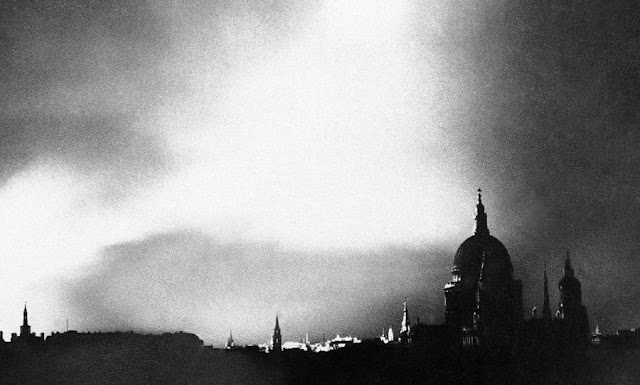
The war enters its second year today.
Biggin Hill aerodrome in Kent was heavily damaged by a German bombing raid.
This is the climax of the RAF’s famous “Bad Weekend.” Beginning on Friday, 30 August,, the “Bad Day” for the RAF, the Luftwaffe began launching major, relentless raids that have achieved unprecedented success in wearing the RAF down. However, it is often overlooked that this effort also is weakening the Luftwaffe, as on 1 September 1940 it is suffering right alongside the RAF and losing many veterans and highly valued pilots and other flight personnel over England.
The raids are incessant and continuous. The British fighters land to refuel and re-arm, and as they do more bombers come across and attack through the seams in the defense. RAF Kenley and Biggin Hill take more damage in the early afternoon, with a full Luftwaffe effort shortly before 14:00. Bf 110s sail in low over British airfields, dropping their bombs more accurately than level bombers, then help defend the vertical bombers from the RAF. While the Bf 110s are vulnerable, there is higher air cover from Bf 109s, which can come to their rescue. The Luftwaffe, having suffered many hard lessons, is using its assets efficiently for once.
The Weather over Great Britain: Most of the country could expect cloudy patches for most of the morning with sunny periods. Temperatures expected were to be a little higher than average with the cloud burning off about midday giving way to fine and sunny conditions.
Up until the final days of August, the whole of Fighter Command had been under extreme pressure. Day after day, the Luftwaffe had targeted the airfields of 11 Group, the radar stations along the south coast while at night they had now turned to heavy bombing raids on the larger cities. The last few days of August, and the first days of September were to prove of great concern for both Dowding and Park. One of these concerns was the high loss of pilots. Hugh Dowding questioned Park as to why we were losing so many pilots to the German fighters when pilots had been instructed to attack the bombers. Park stated that since most of the Bf 109 squadrons had been posted to the Pas de Calais, they are now double in number and are working in close company with the bombers. “Our fighters have first to break the fighter screen before they can get to the bombers.”.
For most of the phase [24 August — 6 September] the defending squadrons were flying and fighting singly. Only too often the units of combat were a British squadron of twelve aircraft at most and a German formation of twenty to forty bombers and up to 100 fighters. Some British squadron commanders attempted to contain the enemy escort with one flight, and with the other attack the bombers; but time after time there were sufficient German fighters to engage both British flights.
- The Air Defence of Great Britain Vol II-The Battle of Britain
Figures now started to indicate that aircraft as well as pilots had been a source of concern for Fighter Command. Prior to August, many new pilots straight from OTC units were thrown into the fray will very little flying experience and definitely no combat experience at all. Combat training for them was being thrown into action and most had to learn by their mistakes, but this was also to place additional pressure on the squadron commanders who had to carry them through their first operational sorties. But as many of these pilots were shot down, it also meant a loss of yet another aircraft for Fighter Command. Aircraft were being repaired as fast as they could, and aircraft production had been increasing slowly, but the fact remained, aircraft were being shot down as fast as the factories could produce them.
Furthermore, with the constant raids on the airfields Fighter Command had to make the necessary arrangements regarding their maintenance. Without constant and ongoing repair work being done it would be so easy for an airfield top become nonoperational. The whole structure of communications, defense, supplies and organization was of utmost priority. Things like damaged hangars could possibly wait until the more important tasks such as telephone lines and the rebuilding or relocation of ops rooms had been accomplished.
When many of the service blocks had been destroyed or damaged, it was not uncommon to see many of the ground personnel going about their duties under canvas tents, even much of the cooking had been done out of doors. But some tasks could not be fully functional in some circumstances. Biggin Hill made use of a local chemists shop a couple of miles down the road, and within a period of twelve hours had converted it into a fully functional operations room.
“Contrary to general belief and official reports, the enemy’s bombing attacks by day did extensive damage to five of our forward aerodromes and also to six of our seven sector stations. There was a critical period when the damage to sector stations and our ground organization was having a serious effect on the fighting efficiency of the squadrons, who could not be given the same good technical and administrative service as previously………The absence of many essential telephone lines, the use of scratch equipment in emergency operation rooms, and the general dislocation of ground organization, was seriously felt for about a week in the handling of squadrons by day to meet the enemy’s massed attacks, which were continued without the former occasional break of a day.”
- Report by Air Vice Marshal Keith Park — 6th September 1940
When asked later about the general situation, Park simply stated “…we are holding our own…just”.
But there seemed to be something that was brewing into a storm. For some time now, Air Vice Marshal Trafford Leigh-Mallory of 12 Group, had been pushing for multi-squadron formations, a scheme that had been instigated by one of his squadron leaders Douglas Bader and was to become known as the “Big Wing”. It was required that a number of squadrons would act as one, en masse, and that it would prove far more damaging than the present one or two squadrons that are more often than not always outnumbered. But Park was seriously against the scheme. It would mean pulling out squadrons from all important sector stations, and this would take time, time that once the enemy had been sighted they didn’t have, anyway it would leave aerodromes and London without the necessary protection.
But there was controversy, and very often there were outburst from both Keith Park and the 12 Group Commander Leigh-Mallory. Group Captain Sir Hugh Dundas tells us that Leigh-Mallory insisted in quite vocal manner that his squadrons could have been used by Park with greater and better effect. He claimed that his squadrons were being excluded from any action that was taking place within the areas where the main action was taking place. Hugh Dundas verifies this. He said that as a young Pilot Officer, that he had experience in 11 Group being stationed at Kenley, and was withdrawn to the Duxford wing after the squadron had lost quite a number of pilots. Many times, he said, we just sat there on the ground while large scale operations were taking place within 11 Group.
He also claimed that his squadrons were being called in to assist 11 Group far too late, and more often than not the squadrons of 12 Group missed making contact with the enemy. Park made the claim that the reason that Leigh-Mallory’s squadrons were coming in too late, was that they were taking far lo long to assemble the ‘Big Wing’, and further added that that was another reason that he strongly opposed it.
This is backed up by Len Deighton (Battle of Britain), who gave an example. Park once again had asked assistance from 12 Group on August 26th, while his own squadrons were involved with German raiders. Debden airfield was at this stage unprotected and obviously Park was relying on 12 Groups fighters to provide the necessary cover. When Debden was bombed with devastating results by the Luftwaffe, Leigh-Mallory’s squadrons had not arrived. When Park wanted an explanation, Leigh-Mallory claimed that he was asked too late.
The 12 Group Commander and one of his squadron commanders Douglas Bader launched an attack on the way that Dowding and Park were handling the Battle. It was claimed that no way were they going to create an advantage by sending up ridiculous small forces of fighters against the armada of massed formations of the Luftwaffe.
Bader supported Leigh-Mallory’s theory of the ‘Big Wing’, sending up possibly five squadrons of fighters. They agreed that it took time to organize, it took time for them to make formation in the air, and that on many occasions would not intercept the German aircraft until after they had dropped their bombs. But they both insisted that it was far better to shoot down German aircraft in substantial numbers on their way home after they had bombed their targets, rather than just to snap at their flanks as they approached and put valuable planes and pilots at risk.
Keith Park argued back, that Leigh-Mallory was to be reminded that these targets that were being bombed were his airfields, and at least we are scattering the enemy bombers forcing them either to make mistakes or to abort and return home. Park continued, that the ‘Big Wing’ theory was ridiculous and that how on earth could it succeed if there was no airfields for the aircraft to take off from. (It should be remembered here, that 80% of their targets were the airfields of 11 Group).
Park won the support of Dowding, who, for the time being would not allow such ‘Big Wing’ tactics to be instigated. But Leigh-Mallory was not to let the matter rest, he was later to take his theory to the Air Ministry and even direct to the Prime Minister. Was the “Big Wing’ theory worthy of being implemented? Was Leigh-Mallory still bitter about not getting command of 11 Group as he originally wanted? Was Park carrying bitter resentment because he thought that Leigh-Mallory was telling him his job? Did Leigh-Mallory carry any resentment because of Dowding’s close relationship with Park?
Although the ‘Big Wing’ was a controversial matter, It really comes down to the fact that it was a battle of two men’s personalities.
As we shall see as the month of September wears on, the ‘Big Wing’ theory does in fact win in the end.
By this period, the Luftwaffe pilots were reporting that the British fighter defense was not as intense as it had been previously. Pilots attached to 11/KG 1 on reporting after a mission over the dockland areas of East London officially placed in their report that ‘Only slight enemy fighter resistance easily countered by own escort’.
The British were suffering badly, they were losing more aircraft than were being produced, which meant that if things continued like this, the resources of Fighter Command would soon be depleted. Pilots too were becoming an even more serious issue. Since The Battle of Britain had begun, Dowding had lost some 75% of his squadron commanders, nearly 400 pilots had either been killed or seriously wounded.
Air Vice Marshal Dowding had for some time been under pressure to include the two hundred or more Czechs, Poles and a few other European pilots into operational service. But so far, Dowding had resisted. Now with the situation that could only be classed as critical, he now had to consider that anyone who could fly a fighter plane, be put into operational service. This also included drawing on pilots from both Bomber and Coastal Commands.
Now, new pilots were being attached to squadrons with as little as fifteen or twenty hours flying experience on either Spitfires or Hurricanes. This posed new problems for Dowding and Park. The new English pilots were young and enthusiastic, the Czechs and the Poles were using their native language that was to cause immense problems as far as communications were concerned and those from Bomber and Coastal Commands had to get used to a new way of fighting. But these problems also had their effects down through the chain of command. Station and squadron commanders tried to give some of the new pilots additional training, but by pushing through inexperienced men seriously weakened the effectiveness of many of the squadrons. It also put additional pressure on the more experienced who found themselves flying sortie after sortie until they could barely stand up.
“I watched as one by one our aircraft returned to base after yet another sortie. Most of the aircraft to our delight had returned unscathed, but then I saw this Hurricane coming in to land. His wings were tipping up, then down, then suddenly he hit the ground rather hard only for him to bounce right up again. Then at the second attempt, he finally kept the aircraft on the ground and taxied a short way and stopped in the center of the airfield. Casualty procedures were put into action and crash tenders and ambulances rushed towards him only to find that the pilot fast asleep, he did not even have time to switch the engine off.”
- Squadron Leaders remarks at 111 Squadron Croydon September 1940.
Hough & Richards in their book “Battle of Britain — A Jubilee History” p238 state that the pilot in question was in fact Canadian Pilot Officer J.A. (Johnny) Walker of 111 Squadron was actually leaning forward still in his Sutton harness, head on his chest and asleep with exhaustion.
“Towards the end of the Battle I had just taken about as much as I could bear. My nerves were in ribbons and I was scared stiff that one day I would pull out and avoid combat. That frightened me more than the Germans and I pleaded with my C.O. for a rest. He was sympathetic but quite adamant that until he got replacements I would have to carry on. I am glad now that he was unable to let me go. If I had been allowed to leave the squadron, feeling as I did, I am sure that I would never have flown again.”
- Sgt. J.H (Ginger) Lacey 501 Squadron Fighter Command
1015 Hours: The day held the same usual pattern as did many of the preceding days, quiet early, but at mid-morning a buildup of enemy aircraft was detected by the radar stations at Dover, Foreness and Pevensy. The Luftwaffe kept to their standard pattern of sending in a small formation of Bf 109s first as a diversionary, but as usual they are ignored by Fighter Command. These are followed by 60+ bombers that consisted of formations of Dornier Do 17s and Bf 110s with the fighter escort of Bf 109s at higher altitude.
Just prior to reaching the Kent coast, they broke up into a number of smaller formations, each designated to a different target. Again it was the airfields of Fighter Command that bore the brunt of the Luftwaffe attacks, Eastchurch, Rochford, Detling and once again Biggin Hill. A total of ten squadrons were given the order to readiness, and once again, it seemed as though 11 Group would be stretched to the limit as the German bombers were heading for four different areas at the same time.
1025 Hours: Keith Park was still cautious as he viewed the large map table below him at Group HQ, forty Bf 109s were positioned off the coast to the west, and seemed quite content at staying there, but he was more concerned with the three other formations positioned eastwards on the map table. Park, like Hugh Dowding, relied heavily on radar and had great faith in the radar operators and the Observer Corps. When the bomber formations were ‘X’ number of miles off the English coast, that’s when he would want the squadrons to scramble to intercept them. If the squadrons left too early, they would be in combat action over the waters of the Channel, Fighter Command knew that there was only a 20% recovery rate for pilots downed in the Channel. If the squadrons left too late, then they could not attain the height and position required to launch a successful attack on the incoming enemy formations. The timing had to be correct.
Fourteen squadrons were scrambled and were vectored to intercept the enemy formations as they crossed the coast from Dungeness to Margate, and as others entered the Thames Estuary and headed due west along the River Thames heading towards London.
1100 Hours: Fierce dogfights occurred over the eastern half of Kent. Most of these were in separate pockets scattered in different areas. 54 Squadron Hornchurch (Spitfires) and 72 Squadron Croydon (Spitfires) are vectored towards the Maidstone area. Here, they engage a formation of Dorniers after they had crossed the coast near Beachy Head. 72 Squadron had just arrived at the Biggin Hill sector but because of the damage sustained at Biggin Hill, the squadron were posted to Croydon and were immediately thrown into the action.
1130 Hours: As 54 Squadron intercept the Dornier formation, they are joined by 1 Squadron Northolt (Hurricanes) while 72 Squadron made their approach on the enemy from the west and as they lined up their attack, they were jumped on by Bf 109s who tore into the squadron with deadly accuracy. The dock areas of London now come under attack by enemy bombers that had managed to get through. Park order a number of squadron at Hornchurch, Biggin Hill and Kenley to be at readiness to protect the main sector station including 79 Squadron Biggin Hill (Hurricanes).
F/O Desmond Sheen watches as one of his squadron is attacked by a Bf 109 as he prepared to line up a Dornier, he calls out but gets little or no response as Sgt. M.Pocock takes a hit and dives earthwards. Soon after, Desmond Sheen is hit himself as five or six Bf 109s bear down on him. His engine bursts into flames and he is forced to bail out.
As he floats down Sheen surveys a scene that will live in his memory forever. On his right he can see explosions from bursting bombs in the Dover area with answering anti-aircraft fire from the defenses. On his left he can see bombs falling on London Docks. The air is pungent with the acrid smell of cordite and its throbs to the engines of the bombers punctuated by the whining, straining sounds of fighters as they dive, climb and turn somewhere above. Not far off a Bf 109 falls in flames. A parachute blossoms out but its harness must be faulty because the airman dangling beneath suddenly falls away to oblivion. Another 109 turns towards him but there is a Spitfire on its tail. It twists away and both planes merge into the panorama.
1330 Hours: The fighters of the morning raid had hardly returned to their bases, rearmed and refueled when they were once again placed at readiness as a large formation had been detected again coming in over Dover. It was all a carbon copy of the earlier raid and the enemy bombers again broke into smaller groups with some approaching London over Dover and Ashford while another headed north and came in following the Thames.
Again Keith Park put up as many squadrons as he could while at the same time keeping enough back at the sector stations for close protection. 1 (RCAF) Squadron Northolt (Hurricanes), 54 Squadron Hornchurch (Spitfires), 72 Squadron Croydon (Spitfires), 85 Squadron Croydon (Hurricanes), 253 Squadron Kenley (Hurricanes) and 616 Squadron Kenley (Spitfires) were among many of the squadrons scrambled to intercept.
1345 Hours: The first interceptions were made between Folkestone and Hastings and 85 Squadron made contact near Lympne. P/O G.Allard was about to make an attack when his aircraft developed a loss in oil pressure. He decided that he would make a landing at nearby Lympne airfield when the engine started to cough and splutter. As he was about to touch down, he was losing enough power that the Hurricane became hard to control but he managed to land the aircraft safely just as bombs started to fall on the airfield. P/O Allard managed to get out of the aircraft which was damaged by bomb fragments as it lay parked on the airfield.
72 Squadron Croydon (Spitfires) made their interception over Dungeness, 616 Squadron Kenley (Spitfires) followed soon after. 85 Squadron Croydon (Hurricanes) stayed with the combat but could do nothing to slow down the advance of the German bombers which had been reported as being 150 plus strong and consisted of Do 17s, Bf 110 and Bf 109s.
1400 Hours: The squadrons protecting the sector stations, including 79 Squadron Biggin Hill (Hurricanes) were scrambled as the bombers approached. This was now the sixth raid on Biggin Hill in three days. During the day, they had been trying to hold a funeral service at a cemetery just outside the airfield for the fifty or so personnel that were killed in earlier raids on the station. All the coffins were lined up next to the graves, some were draped with the flags, but many were not as there were not enough of them to go round. The service is in progress as the air raid siren sounds, and 79 Squadron (Hurricanes) is immediately put into the air once again. The airfield is hit yet once again, and Group Captain Grice, the Station Commander wonders when it is all going to stop.
Inside the airfield, everything seemed to be in disaster mode. Hangars are hit, as are mess halls, workshops and the telecommunications system. Bf 110s come in low and bomb with accuracy, Do 17s at higher altitude drop high explosive bombs. Damage is extensive.
The attack continues on to Kenley where Do 17s come in low. One of them is shot down by the Hurricanes of 85 Squadron. It tries to return towards the coast hoping that it could get back to base, but with both engines now in flames the bomber crashes near Dungeness. Three of the crew managed to bail out and were captured, but a fourth was killed when the aircraft crashed. P/O Colin Gray of 54 Squadron Hornchurch (Spitfires) managed to hit a Bf 109 which with a damaged engine had to make a forced landing in a field near Rye. The pilot was also captured. A Bf 110 after completing its bombing run on Biggin Hill, was shot down by P/O P.F.Mayhew of 79 Squadron Biggin Hill (Hurricanes) and it exploded as it hit the ground at Brasted killing both crew on board.
Another Bf 110 was attacked by the Hurricanes of 85 Squadron over Biggin Hill. Damaged by machine gun fire, it managed to keep flying and a Spitfire of 616 Squadron Kenley went in to assist. It was finally shot down by P/O C.E.English of 85 Squadron hitting the 110 in its only remaining engine and it made a forced landing at Ham Street where both of the crew were captured.
1415 Hours: But the glory experienced by 85 Squadron was to be short lived. Over the Kenley area, they were jumped on by a number of Bf 109s cutting the squadron to pieces. First to be hit was P/O A.V.Gowers who managed to bail out of his burning Hurricane and received severe burns. Next was Sgt. G.B.Booth whose aircraft caught fire after an attack by a Bf 109. The flames spread rapidly and Sgt. Booth bailed out, but his parachute pack had been burnt and he fell without an open parachute to the ground. He survived the impact, but broke his back in the process. (After five months of agonizing pain and hospitalization he died of his injuries on February 7th 1941). F/O P.P.Woods-Scawen who was leading the squadron also bailed out and his parachute failed to open as well and was killed on impact with the ground. ( His body was not discovered until six days later in scrub in Kenley Lane Kenley). The Hurricane of P/O A.G.Lewis was badly shot up over Kenley and he had to make a wheels-up landing after he suffered a jammed undercarriage. Sgt. J.H.M.Ellis was also believed to have been killed as he never returned to base. His body has never been found.
1530 Hours: In the two attacks of the day by German bomber formations, RAF fighter stations had suffered badly. Although Biggin Hill and Kenley had taken the brunt of the damage, Hornchurch, North Weald, Gravesend and Detling also took a battering. Targets at Tilbury also suffered as did the London Docks. Now, for the third time for the day, 100 plus aircraft came across the coast intent on doing further damage. Their course was the same as the two earlier raids.
This time they started to bomb targets along the way. One formation dropped bombs on Hawkinge and Lympne airfields while another formation and making their attack on Detling and Chatham. Bf 110s also decided to strafe the Dover balloon barrage along the way. A formation of Do 17 bombers headed towards South London and it was at 1730 hours that Biggin Hill realized that they were again to be the target.
1800 Hours: A direct hit on the operations rooms put them completely out of action. All telephone lines were cut and the Teleprinter Network was destroyed by a single 500lb bomb. One of the workshops was on fire and four Spitfires were destroyed on the ground and the station armoury was ablaze.
“Anyone would think that we were the only important aerodrome protecting London. Day after day, raid after raid. As soon as the bombers come over and make bloody holes in the ground, we go out and fill ’em up again. Everything is in poor shape, but Jerry hadn’t broken our spirit. Hangars continued to operate even with no roofs on. There was always a steady stream of ambulances to take the injured to hospital, in fact it got to a bloody state where they queued up waiting for the next raid. If there were heroes though, then it had to be the women. They just don’t know how to bow to defeat. Bloody marvelous they were, stuck to their posts like glue, each one deserved a medal.”
- Sgt. Gunner Ben Elswood AA Gun Battery at Biggin Hill
In fact, two of the women at Biggin Hill, for their actions that day were awarded the Military Medal. Corporal Elspeth Henderson and Sergeant Helen Turner, both members of the Womens Auxiliary Air Force (WAAF) Already the previous day when Biggin Hill was attacked, both women along with Assistant Section Officer Felicity Hanbury went along to the airwomen’s trenches at the request of the station chaplain. The trenches were close to the stores and the Guardroom and had received a direct hit. The Station Officer was already there and ordered that everybody grab a shovel and dig like mad. It’s not a pretty sight to see your first dead person, and although most of the girls were only shaken or had minor injuries, the dead had to be laid out and their bodies covered with blankets.
Now, the station was under attack again. Could it be that the girls would have to go through it all again?
Enemy bombers throbbed once more over Biggin Hill. The two women were both on duty, Elspeth in charge of a special telephone line and Helen as the switchboard operator. The bombs began falling perilously near to their building, but both of them went on with their jobs — although they knew they had only a light roof over their heads.
Then came a direct hit. Neither of them was hurt and they still carried on with their work. Elspeth said later: “There was nothing much else we could do anyway, was there?”
Then the building caught fire, and the flames spurted and spat across the room. At last they were ordered to leave. Helen said “When we did leave, we had to crawl out through the wreckage, crawling through the broken down walls to safety. I felt a bit sorry for some of the youngsters in the building at the time, because it was their first experience with bombs. I did my best to cheer them up.”
The Commanding Officer of Biggin Hill later said “These three girls have shown amazing pluck in carrying on their work under the strain of falling bombs. I am proud to have them working on this station. There is no doubt that their example during two days of bombing inspired all around them.
Biggin again is declared nonoperational temporarily. Six squadrons of RAF fighters could not stop this final attack, although 603 Squadron managed to claim one Bf 109 that crashed at Chilham and 79 Squadron is diverted to Croydon because Biggin Hill is temporarily declared nonoperational.
Work began immediately on rebuilding the operations room. Men that were normally AA gunners and fitters during the day, were instructed to assist in the cleanup and re-establishment of the airfield. Post Office engineers worked throughout the night to repair damaged and severed telephone cables. Ruptured gas and water mains made many night time repairs hazardous and many of these were delayed until first light the next morning. Work had already been undertaken on many of the telephone cables from earlier raids, one of which was the main cable that engineers worked throughout the hours of darkness, even through an air raid, but much of this work was undone with this last evening attack.
As a precaution, in case that Biggin Hill could not be repaired in time for the next day, more Post Office engineers connected telephone cables and a switchboard in one of the local village shops which was to be used as a temporary operations room until the one on the airfield was ready.
RAF Casualties:
1115 Hours: Pluckley (Kent). Spitfire P9458. 72 Squadron Croydon
F/O O.St J. Pigg killed. (Failed to bail out after his aircraft was shot down during combat with Bf 109s)
1130 Hours: Ruckinge (Kent). Hurricane P3276. 1 Squadron Northolt
F/Sgt F.G. Berry killed. (Shot down by Bf 109s during combat action over Kent)
1400 Hours: Dungeness. Hurricane P5185. 253 Squadron Kenley
P/O J.K.G. Clifton killed. (Shot down in combat with Do215 and Bf 110s and failed to bail out)
1415 Hours: Tunbridge Wells. Hurricane L2071. 85 Squadron Croydon
Sgt. G.B. Booth died of injuries 7-2-1941. (Bailed out of burning aircraft but burnt parachute failed to open)
1415 Hours: Kenley. Hurricane P2673. 85 Squadron Croydon
Sgt. J.H.M. Ellis listed as missing. (Last seen in combat with Bf 109s. Failed to return to base)
1415 Hours: Kenley. Hurricane P3150. 85 Squadron Croydon
F/O P.P. Woods-Scawen killed. (Shot down by Bf 109, Bailed out but parachute failed to open)
RAF No. 54 Squadron is put out of action. Several other squadrons, such as Nos. 111 at Croydon and No. 151 at Stapleford are down to only a handful of operational planes and/or pilots. RAF North Weald remains operational, but it has virtually no planes left to put in the air.
During the day, Adolf Galland at JG 26 gets his 27th victory, while his friend Hptm. Gerhard Schöpfel of Stab III./JG 26 also gets a victory. Oblt. Josef ‘Jupp’ Bürschgens of 7,/JG26 is shot down by a Bf 110 who mistakes his Bf 109 for a Spitfire. Jupp retires with 10 victories to see the sights and tour the grounds of a Canadian POW stockade.
Two German pilots, Oblt. Wilhelm Herget and Oblt. Hans-Joachim Jabs of 6,/ZG76, each file claims for three planes shot down — somewhat restoring the honor of the Bf 110 Zerstörers. Oblt. Gustav Rödel of 4./JG 27 files claims for two.
The total losses usually given for the day are deceptive and virtually worthless. Many accounts give the RAF a decided edge in terms of losses, but those figures don’t factor in the planes destroyed in the air and the extensive damage to RAF (and other) infrastructure. Six RAF pilots are killed or missing, and RAF losses now exceed production. Luftwaffe fighter pilots report that fighter opposition over England is diminished from mid-August, though still fierce over key points.
In short: right now, as of 1 September 1940, the Luftwaffe is winning the Battle of Britain and accomplishing its objectives. That is not an exaggeration, that is reality. Whether that is being done quickly enough to satisfy the more strategic requirements of the entire campaign, i.e. setting up Operation Sea Lion before the weather forecloses it for the year, remains to be seen. This will be decided by Adolf Hitler in the coming days. What can be said is that the Germans finally, after much trial and error, have learned how to utilize their numerical air force advantage to the best advantage. The overriding questions are whether the Germans will keep at it and whether the British can devise effective counter-measures.
RAF Bomber Command dispatches 18 Blenheims to airfields and 6 on a sea sweep during the day. Only 3 aircraft bombed airfields in Belgium. No losses.
RAF Bomber Command dispatches 131 Blenheims, Hampdens, Wellingtons and Whitleys to 10 targets in Germany, to airfields in Holland, to Turin and San Giovanni in Italy overnight. All main and many alternative targets bombed. 2 Wellingtons were lost and 8 aircraft crashed in England. Bomber Command raids the Fiat factory in Turin and other installations at San Giovanni again, and also the BMW factory and railway installations in Munich for the first time. Other targets include engine factories at Stuttgart, the docks at Emden in northwest Germany, railway installations at Mannheim and Soest, a Kassel electrical plant, munition plants at Ludwigshafen and Hanover, and oil installations in Nordenham.
The Luftwaffe Operations Staff, Section 1A, issues instructions to Luftflotten 2 and 3 in France regarding quality targets. It includes a list of 30 factories in England thought to be involved in aircraft production. In fact, this list includes some factories that have nothing to do with anything war-related — the Luftwaffe appears to be consulting guidebooks and the like.
German Army Bishop Rarkowski issues a pastoral letter this month to the armed forces saying, “The German people, who for one year now have been fighting against their detractors, have an untroubled conscience and know which nations before God and history are burdened with the responsibility for this gigantic struggle that is raging now. They also know who has wickedly provoked this war. They know that they themselves are fighting a just war, born of the necessity of national self-defense, out of the impossibility of solving peacefully a heavy and burdensome question of justice involving the very existence of the state and of correcting by other means a burning injustice inflicted upon us.” (Note: The average German soldier had no way of knowing whether Holland and Belgium had actually violated their neutrality, as alleged by the Nazi propagandists, and thus provoked the German attacks in May. Most took the word of their government and their priests.)
The coke-fired two-retort furnace in the Auschwitz Concentration Camp crematorium was put into service for the disposal of bodies.
Otto Skorzeny was promoted to the rank of Oberscharführer and was transferred to the 2nd SS Division “Das Reich”. Skorzeny is a former civil engineer who has become a promising SS officer, gaining some renown for designing ramps to load tanks on ships — a potentially very useful invention should Operation SEA LION proceed.
German naval shipping began to move from North Sea ports to ports to the south in preparation for the invasion of Britain (SEA LION).
Between September 1940 and July 1941, the property of more than 100 monasteries is confiscated by the Germans and the monks and nuns expelled from their houses.
A belt feed mechanism for the 20mm Hispano cannon is ordered into production this month.
Royal Air Force used AA rockets against Luftwaffe planes in the Battle of Britain this month.
At Malta, a Hudson on reconnaissance is spotted by aircraft from HMS Illustrious, part of Force H coming from Gibraltar. Rather than a happy meeting, the Illustrious Fairey Fulmars mistake the RAF plane for an enemy one and attack the Hudson. They force it to crash-land in Tunisia, where the Vichy French intern the crew. Malta reconnaissance planes also shadow the Italian fleet returning to Taranto. The arrival of the convoy coming from Gibraltar is expected with eagerness on the morrow.
Italian submarines have been operating off the Azores and Canary Islands for about two months with results that have underperformed expectations but still hold promise. For submarines based in Italy, these patrol stations require passage through the Straits of Gibraltar, which the British are trying to close down. Aside from the British presence, this also involves a lengthy, tiring and time-consuming transit to and from their patrol stations in the Atlantic which effectively reduces the size of the fleet. There appears to be a solution now.
To avoid the dangers of such transits and coordinate training of the under-performing Italian submarine crews, the Regia Marina Italiana now establishes a base at Bordeaux capable of holding up to 30 submarines at a time (with 1/3 of submarines in port, 1/3 in transit to or from the patrol stations, and 1/3 on patrol stations, this works out to support a fleet of up to 90 submarines, which is roughly how many the Italians have operational). This operation goes under the acronym BETASOM.
As usual with Axis joint operations, there is an involved command structure that places ultimate control over the BETASOM project in a German officer, in this case, Konteradmiral (Rear Admiral) Karl Dönitz. Doenitz now is the effective “Commander of the Submarines” (Befehlshaber der Unterseeboote) for both the German and Italian submarine fleets in the Atlantic — and the Italian fleet there potentially is even larger than the German one. This has the potential of tipping the scales of the Battle of the Atlantic decidedly in favor of the Axis. However, the effectiveness of the Italian submarines must be increased substantially for them to make a worthwhile contribution to the war effort. As part of that effort, the Italian Navy also establishes a frogmen training academy at Livorno, commanded by Lieutenant Wolk.
The Italian Navy established a frogmen training school at the Naval Academy at Livorno, Italy under the command of Lieutenant Wolk.
Horia Sima broadcasts a demand for the abdication of Rumania’s King Carol.
No good portent for the future is seen by the Turkish press in the partition of Rumania by the Axis power to Vienna. The newspaper Haber believes it will prove a prelude to an Italian move against Greece.
Vyacheslav Molotov complained that the Second Vienna Arbitration was in violation of the Molotov-Ribbentrop Pact signed in 1939. Molotov remains furious about the Second Vienna Award — suggesting that the Soviets itself had further plans for Romania. He privately remonstrates with the Germans, but can’t go public with his aggravation because his complaint is that the German interference in eastern Europe is contrary to the secret protocols of the August 1939 Ribbentrop/Molotov Pact.
Lieutenant General Ivan Vasilievich Boldin, who led the 9th Army during the occupation of Rumanian Bessarabia, is promoted to Deputy Commander in Chief, Special Western Military District.
The Italians captured Buna, Kenya.
Light cruiser HMS Fiji (Captain W G Benn), which departed Scapa Flow on 31 August, was torpedoed and badly damaged in 58-25N, 13-10W northwest of Ireland by U-32, commanded by Oberleutnant zur See Hans Jenisch, at 1725 hours. Five ratings were killed. Destroyers HMS Tartar, HMS Punjabi, HMS Javelin, and HMS Jaguar departed Scapa Flow at 1930 and joined Fiji. Destroyers HMS Bedouin and HMS Ashanti departed their escort of convoy HX.67 to join. When Fiji was found capable of steaming, she was escorted by HMS Bedouin, HMS Ashanti, HMS Volunteer and HMS Antelope. She was able to proceed under her own power at ten knots and arrived without further incident at 1930/3rd at the Clyde. Destroyers HMS Wolverine, HMS Ambuscade, HMS Javelin and HMS Jaguar were detached to join inbound convoy TC.7, while HMS Tartar and HMS Punjabi joined inbound convoy HX.67A. Fiji’s place in operation MENACE was filled by Australian heavy cruiser HMAS Australia which arrived at Greenock on the 1st, and departed the Clyde on the 6th for Freetown. HMS Fiji was repairing at Greenock through the end of January 1941.
U-101, commanded by Kapitänleutnant Fritz Frauenheim, badly damaged Greek steamer Efploia (3867grt) in 55-27N, 13-17W. At 00.55 hours the unescorted Efploia, a straggler from convoy OB.205, was hit aft by a G7e torpedo from U-101 about 130 miles northwest of Ireland. The Germans observed that the ship settled by the stern and the crew abandoned ship in two lifeboats. The survivors were picked up later that day by HMS Anthony (H 40) (LtCdr N.J.V. Thew, RN), which scuttled the wreck by gunfire in 55°43N/13°05W. The 3,867 ton Efploia was carrying ballast and was headed for Father Point, Quebec.
Royal Navy destroyer HMS Ivanhoe is scuttled by torpedo by HMS Kelvin. Ivanhoe had been crippled the previous day by a mine.
Destroyers HMS Versatile and HMS Vimy departed Rosyth at 1700 escorting minelayer HMS Manchester City to the Clyde where they arrived at 2100/3rd.
Destroyers HMS Somali, HMS Mackay, HMS Westcott and HMS Hesperus were involved in a search for a German submarine in 54-21N, 5-05W after the U-boat was reported by a civilian aircraft.
Light cruiser HMS Galatea, which was with light cruiser HMS Aurora had departed the Humber on 31 August to meet destroyers HMS Kelvin, HMS Jupiter and HMS Vortigern off Sheringham Light Vessel, struck a mine off the Humber as she returned to port. It exploded on the port side abreast B-turret causing minor damage. The two cruisers arrived in the Humber on the 1st.
While departing Grangemouth at 2130 for Rosyth, submarine HMS Sunfish sank patrol launch HMS Mesme in an accidental collision. The crew of three was all lost.
Submarine HMS Tuna unsuccessfully attacked a German submarine in 56-09N, 02-15E.
Minesweeping trawler HMS Royalo (248grt) was sunk on an aerial mine laid by German IX Air Division aircraft in Mount’s Bay, 90° from Penzance Pier. Temporary Lt I W Watt RNR, Temporary Skipper W D.Warford RNR, and five ratings were lost.
Submarine HMS Tigris, which departed Rothesay on 27 August, sank a French trawler Sancte Michael (168grt) off Brest.
Lt (A) E. W. Lockwood, Acting S/Lt (A) R. G. D. Kite, and Acting Leading Airman S. Simpson of 813 Squadron from aircraft carrier HMS Eagle crashed at sea and were made prisoners of war after eight days in a dingy.
Aircraft carrier HMS Ark Royal launched an air strike on the airfield at Cagliari in operation SMASH. On 2 September, Ark Royal was to have launched an air strike in operation GRAB for another strike on the Cagliari airfield and the Cagliari power plant, but the planes could not locate the target in poor weather.
FLEET OPERATIONS IN THE MEDITERRANEAN, INCLUDING CONVOYS MB.3 AND AS.3
Light cruiser HMS Orion and Australian light cruiser HMAS Sydney were detached at 1400 to rendezvous with escort ship/destroyer HMS Wryneck coming from Malta, and then join Force F. Destroyers HMAS Stuart, HMS Defender, HMAS Vampire, and HMAS Vendetta were detached from the Main Fleet at 2000 to proceed to Malta.
On 2 September, anti-aircraft cruisers HMS Coventry and HMS Calcutta with destroyers HMS Nubian, HMS Mohawk, HMS Janus and HMS Juno were detached to Malta.
At 0900 aircraft carrier HMS Illustrious, battleship HMS Valiant, light cruiser HMS Orion with destroyers HMS Wryneck, HMS Gallant, HMS Greyhound, HMS Griffin, and HMS Hotspur from Gibraltar were met by the Mediterranean Fleet. HMAS Vampire and HMAS Vendetta rejoined at 0930/2nd and destroyers HMS Hereward and HMS Ilex were detached to Malta to refuel. HMS Coventry and HMS Calcutta arrived at Malta at 1005, and HMAS Sydney also entered Malta. At 1010, HMS Valiant and destroyers HMS Hyperion, HMS Decoy, HMS Hasty, and HMS Wryneck were detached to Malta.
Convoy MB.3, consisting of steamer Volo (1587grt) and oiler RFA Plumleaf (5916grt), arrived safely at Malta at 1130/2nd, escorted by destroyers HMS Dainty and HMS Diamond. The third ship of the convoy, steamer Cornwall (10,605grt), which had been damaged by Italian bombing on 31 August, was brought into Malta on the 3rd by tugs Jaunty and Ancient, escorted by destroyers HMS Jervis and HMS Juno. At 1415, Janus was detached to Malta to refuel. At 1504, HMS Coventry with HMS Janus, HMS Juno, HMS Nubian, and HMS Mohawk joined the Main Fleet at sea. HMS Hereward and HMS Ilex rejoined at 1645.
Battleship HMS Malaya, aircraft carrier HMS Eagle, together with HMS Coventry and HMS Janus, HMS Juno, HMS Dainty, HMS Diamond, HMAS Vampire, and HMAS Vendetta were detached at 1657 as Force E, and heavy cruiser HMS Kent, light cruisers HMS Gloucester and HMS Liverpool with HMS Nubian and HMS Mohawk as Force A for Operation MB.3.
HMS Gallant and HMS Ilex attacked a submarine contact near the fleet at 1730.
At 1856, destroyer HMAS Voyager was detached to Malta, and at 1900, HMS Calcutta with HMS Hasty, HMS Hero, HMS Decoy, and HMS Wryneck joined the Fleet. HMAS Sydney departed Malta at 1908 to rejoin the Mediterranean Fleet. At 2200, HMS Gallant, HMS Greyhound, HMS Griffin, HMS Hotspur, and ORP Garland were detached to Malta to refuel.
Destroyers HMS Imperial with the 1st Battle Squadron and HMS Janus were unsuccessfully attacked by Italian JU-87 dive bombers near Malta on the 2nd. HMS Valiant with HMAS Stuart, HMS Hyperion, HMS Imperial and HMS Janus rejoined the Main Fleet at 2330.
At 0700/3rd, destroyer HMS Defender, which had been delayed at Malta with a damaged Asdic dome, rejoined the fleet.
Force I for Operation MB.3 was formed with battleships HMS Warspite and HMS Valiant, aircraft carrier HMS Illustrious, anti-aircraft ship HMS Calcutta, plus destroyers HMAS Stuart, HMAS Voyager, HMS Decoy, HMS Defender, HMS Hereward, HMS Imperial, HMS Hyperion, HMS Ilex, HMS Hasty, and HMS Wryneck. Stuart suffered a burst steam pipe at 2200 and was instructed to join convoy AS.3 of four steamers. At 2230, light cruisers HMS Orion and HMAS Sydney with destroyers Ilex and Decoy were detached for a dawn bombardment of Scarpanto. Force H arrived back at Gibraltar after Operation HATS on the 3rd.
Anti-aircraft ships HMS Coventry and HMS Calcutta were detached off the Island of Hydra and joined convoy AS.3 on the 4th.
Off Rhodes at 0345, HMS Illustrious launched nine torpedo bombers of the 815 (Lt Cdr R. Williamson) and 819 Squadron (Lt Cdr J. W. Hale DSO) at 0345 on the 4th to attack the airfield at Callado. The ninth Swordfish crashed on take off and observer Lt A E. Ogilvy of 815 Squadron was killed. Lt L. J. Kiggell and Leading Airman K. Allum of the crew were rescued by destroyer HMS Imperial. This accident prevented three more Swordfish for the operation from taking off. Aircraft carrier HMS Eagle launched twelve torpedo bombers of the 813 (Lt Cdr N. Kennedy DSC) and 824 Squadron (Lt Cdr A J. Debenham DSC) to attack the airfield at Maritza.
Four HMS Eagle Swordfish aircraft of 813 Squadron were shot down over Maritza. One of these Swordfish, piloted by Lt (A) R. H. Hain, with a crew of Observer Probationary S/Lt (A) V. H. Smith RNVR, and Naval Airman W. F. Taylor was able to successfully make a forced landing on Kasos Island where they were made prisoners of war. One aircraft crew of the pilot Lt (A) S. Hook and Leading Airman L. C. White was captured, but the observer Lt K. S. Bell was lost with the aircraft. Pilot Lt (A) D. N. Collins, Observer R. H. Marsh, and Petty Officer A Wilson of another aircraft were picked up by an Italian submarine and made prisoners of war. Pilot Lt (A) D. R. M. Drummond, Observer Acting S/Lt (A) A M. Todd, and Leading Airman G. E. Derwent were lost when their aircraft crashed into the sea. Todd’s body later washed ashore on the coast of Egypt weeks later.
HMS Orion with HMS Decoy and HMAS Sydney with HMS Ilex bombarded Scarpanto and Port Maltezana in Stampalia. Ilex rammed and sank Italian motor torpedo boat MAS.537. The MAS.536 was also attacked by Ilex, but was not damaged.
HMS Malaya and HMS Eagle, escorted by HMS Juno, HMS Dainty, HMS Diamond, HMAS Vampire, HMAS Vendetta, and HMS Wryneck were detached to proceed independently to Alexandria, arriving at 2100/4th. Eagle was docked on the 5th.
Battleships HMS Warspite and HMS Valiant, aircraft carrier HMS Illustrious, with destroyers HMS Hyperion, HMS Hero, HMS Hasty, HMS Hereward, HMS Imperial, HMS Janus, and HMS Defender were some forty miles to the north of the HMS Malaya group and arrived at Alexandria at 0700/5th.
Heavy cruiser HMS Kent, light cruisers HMS Gloucester and HMS Liverpool, with destroyers HMS Mohawk and HMS Nubian were detached from the Mediterranean Fleet on the 4th to the Gulf of Nauphlia to escort convoy AS.3 of four steamers to Port Said. Destroyers HMS Imperial and HMS Hereward sailed on the 5th to relieve destroyers Nubian and Mohawk.
Polish destroyer ORP Garland, returning to Gibraltar from Malta with HMS Gallant, HMS Greyhound, HMS Griffin, and HMS Hotspur of Force H, was bombed by Italian bombers between 1225 and 1430/4th. No damage was done, but Garland, with leaks in two boilers, was taken in tow by Griffin from 1715 to 1845, after which she was able to proceed on one boiler. The destroyers arrived at Gibraltar late on the 5th. After repairs, Garland departed Gibraltar on the 14th for duty in the Western Approaches.
HMS Kent, HMS Gloucester and HMS Liverpool, anti-aircraft ships HMS Coventry and HMS Calcutta, and destroyer HMAS Stuart arrived at Alexandria during the morning of 6 September while destroyers HMS Mohawk and HMS Nubian arrived in the afternoon. Convoy AS 3 and destroyers HMS Hereward and HMS Imperial arrived at Port Said on the 6th. Swedish steamer Stureborg, a straggler from the convoy, arrived at Port Said on the 8th.
Light cruiser HMS Dragon departed Durban for Simonstown.
Light cruiser HMS Despatch departed Kingston to return to England.
Light cruiser HMS Delhi departed Lagos for Manoca.
Convoy OB.207 departed Liverpool escorted by destroyer HMS Hesperus and corvette HMS Gladiolus. On 2 September, the convoy was joined by destroyers HMS Keppel and HMS Witch.
Convoy FN.269 departed Southend, escorted by destroyer HMS Verdun, sloop HMS Stork, and patrol sloop HMS Pintail. The patrol sloop was detached on the 2nd, and the convoy arrived in the Tyne on the 3rd.
Convoy MT.157 departed Methil, and arrived in the Tyne later that same day.
Convoy FS.269 departed the Tyne, escorted by destroyer HMS Woolston and sloop HMS Fleetwood, and arrived at Southend on the 3rd.
Convoy HX.70 departed Halifax escorted by Canadian destroyer HMCS Assiniboine and auxiliary patrol boat HMCS French at 1520. Convoy commodore was on steamer Hilary (7403grt). Patrol boat French was detached from the convoy at 2100 and destroyer Assiniboine stayed until 1605 on the 2nd. Ocean escort was armed merchant cruiser HMS Montclare which returned to Halifax when light cruiser HMS Emerald joined the convoy on the 5th.
Convoy BHX.70 departed Bermuda on 31 August escorted by ocean escort, light cruiser HMS Emerald. The convoy rendezvoused with HX.70 on the 5th and the light cruiser was detached. The convoy was joined by destroyers HMS Achates, HMS Active, and HMS Vanquisher, sloop HMS Weston, and corvettes HMS Erica, HMS Mallow, and HMS Primrose on the 13th and the convoy arrived at Liverpool on the 16th.
Convoy SLS.46 departed Freetown escorted by armed merchant cruiser HMS Dunnottar Castle to 13 September when the convoy was dispersed.
Convoy BS.3A departed Suez, escorted by sloop HMS Grimsby. Light cruiser HMAS Hobart with destroyers HMS Kandahar and HMS Kimberley joined on the 3rd. The convoy was dispersed on the 6th.
President Roosevelt, in a history-making peacetime executive order, today called 60,500 officers and men of the National Guard into active service for one year to provide man power for the new $10,000,000,000 defense machine. The guardsmen called will report for service on September 16. The citizen-soldiers, many of whom have just completed intensive war games, will be drawn from: New York, New Jersey, North Carolina, Tennessee, South Carolina, Georgia, Oklahoma, Arizona, New Mexico, Colorado, Washington, Idaho, Oregon, Montana, Wyoming, New Hampshire, Delaware, Illinois, Missouri, Massachusetts, Pennsylvania, California, Maine, Connecticut, Virginia, and Arkansas.
The House of Representatives passes the conscription bill, reinstating the draft once President Roosevelt signs it. There is furious grass-roots opposition to the draft in peacetime, a first in American history.
The New England hurricane reached peak intensity as it passed by Cape Hatteras, North Carolina. The storm did $4 million in damage and resulted in 7 fatalities. The Category-2 1940 New England Hurricane passes by Cape Hatteras, North Carolina headed toward the New Jersey/New York area. As communities along the Eastern seaboard from Cape May to Boston battened down tonight against a possible repetition of the disastrous hurricane of 1938, the Weather Bureau reported that the tropical storm that has been moving north off the coast for several days apparently was blowing itself harmlessly out to sea. However, the hurricane continued to intensify, and reached peak intensity as a modern-day Category 2 hurricane with maximum sustained winds of 110 mph (180 km/h) and a minimum barometric pressure of 961 mbar (961 hPa; 28.4 inHg), though these statistical peaks were achieved at different times on September 2. Afterwards, the tropical cyclone began a weakening trend as it proceeded northward, and had degenerated into a tropical storm by the time it made its first landfall on Nova Scotia later that day. The storm transitioned into an extratropical cyclone the next day while making another landfall on New Brunswick. The extratropical remnants persisted into Quebec before merging with a larger extratropical system late on September 3.
A high White House official tonight criticized Wendell L. Willkie on the grounds that, as a private citizen, he had made public sections of a confidential government document. In support of his opposition to a provision in the conscription bill permitting the government to take over plants needed for defense contracts the Republican presidential nominee released at Rushville, Ind., yesterday what he described as portions of a report by the war resources board headed by Edward R. Stettinius, now a member of the defense commission.
Wendell L. Willkie said in a Labor Day statement today if he were elected president he would “arrest the present trend toward placing labor unions under government control.” In a labor-industrial relationship he asserted, “We must rely on compulsion of the law only as a last extremity.” “I shall lend every influence” the Republican nominee continued, “to establish forthright collective bargaining between management and men upon a basis of good will, conciliation, and economic voluntarism and free from interference.”
The sale of destroyers to Great Britain would be equivalent to an outright declaration of war in the opinion of Senator Gerald P. Nye, who spoke today on the University of Chicago round-table broadcast.
Thousands of visitors jammed Chattanooga, Tennessee tonight to witness the arrival of President Roosevelt tomorrow, the climax of a celebration dedicating dams of the Tennessee Valley Authority. The president will make his first formal address at 8 a.m. (P.S.T.) since accepting the Democratic nomination for the presidency. A crowd of 100,000 is anticipated for the lake and dam dedication exercises which will be broadcast (N.B.C. and C.B.S.).
A “home defense” force to replace national guardsmen called into federal training was urged today by some members of the senate military committee. . Chairman Sheppard, Texas Democrat, said chief executives of several states, including Governors Herbert H. Lehman of New York and W. Lee O’Daniel of Texas, had asked the military committee to authorize state defense units. “I believe we will be able to agree upon something at this session,” Sheppard said. Similar views were expressed by members of the house military committee. It was indicated the necessary legislation would be handled separately, rather than as an amendment to the Burke-Wadsworth compulsory training bill. Leaders said they did not want to burden the training measure with any additional provisions, if it could be avoided. Considerable favor was manifested, however, for an amendment drafted by Representative Smith, Connecticut Democrat, which would permit employers, if they desired, to continue paying salaries to employees drafted for training.
The U.S. Marine Corps Midway Detachment of the Fleet Marine Force, consisting of 9 officers and 168 enlisted Marines and approximately one-third of the 3rd Defense Battalion’s equipment, was established.
General George C. Marshall was sworn in as Chief of Staff of the U.S. Army.
American “Dragnet” and “MAS*H” actor Harry Morgan (25) weds Eileen Detchon.
Major League Baseball:
The Dodgers, clinging to slim pennant hopes, swept a doubleheader agains the Giants, winning the opener, 4–1, and the nightcap, 7–3. Lee Grissom and Whit Wyatt were the winnning pitchers. Dixie Walker went 0-for-4 in the first game, but a sizzling 5-for-5 in the closer.
One-run margins in both games of a double-header with the Cubs gave the league-leading Reds their thirteenth twin triumph of the year today, 6–5 and 2–1. Whitey Moore beat Larry French in the pitcher’s battle nightcap.
The Boston Bees swept a twinbill from the last-place Phillies, 2–1 and 10–0. Jim Tobin yielded six hits in the opener for the win, while Manuel Salvo also gave up just six in the second game, and made it a shutout.
After scoring a 10–0 victory in the first game today behind Ken Heintzelman’s four-hitter, the Pirates battled the Cardinals to a 5–5 tie in eleven innings of the nightcap, which the Bucs played under protest because of a changed decision by Umpire Magerkurth. The game was finally suspended in accordance with the Pennsylvania Sunday law.
The Yankees sweep a doubleheader from the Senators today, by socres of 3–2 and 3–0. Charlie Ruffing got the opening game win, helped by Red Rolfe’s homer. In the nightcap, Ernie Bonham pitched a four-hit complete game shutout to lift the Yankees.
The Indians downed the White Sox, 7–4, as Bob Feller got an unusual relief assigment, pitching a socreless ninth to close out the game. Joe Dobson got the win for the tribe.
Johnny Niggeling was right today as he slowed up the Detroit pennant drive by allowing the Tigers only four hits while his St. Louis Browns’ teammates were lacing out an even dozen for an 8–2 victory.
The doubleheader between the Red Sox and Athletics at Philadelphia was rained out.
New York Giants 1, Brooklyn Dodgers 4
New York Giants 3, Brooklyn Dodgers 7
Philadelphia Phillies 1, Boston Bees 2
Philadelphia Phillies 0, Boston Bees 10
Cleveland Indians 7, Chicago White Sox 4
Chicago Cubs 5, Cincinnati Reds 6
Chicago Cubs 1, Cincinnati Reds 2
Washington Senators 2, New York Yankees 3
Washington Senators 0, New York Yankees 3
St. Louis Cardinals 0, Pittsburgh Pirates 10
St. Louis Cardinals 5, Pittsburgh Pirates 5
Detroit Tigers 2, St. Louis Browns 8
The new Ecuadorian President is Carlos Alberto Arroyo.
Born:
Annie Ernaux (née Duchesne), French writer (“Les Années” (“The Years”); Nobel Prize in Literature, 2022), in Lillebonne, Normandy, France.
Pat House, MLB pitcher (Houston Astros), in Boise, Idaho.
Died:
Lillian Wald, 73, American nurse, humanitarian and social activist who started American community nursing with the Henry Street Settlement in NYC, of a cerebral hemorrhage.
The Kriegsmarine (German Navy) Type IXC U-boat U-131 is laid down by AG Weser, Bremen (werk 994).
The Kriegsmarine (German Navy) Type 1936A (Mob) destroyer Z31 is laid down by AG Weser (Deschimag), Bremen (werk 1001).
 History Diaries