Liverpool Blitz: The first major air raid on Liverpool took place.
The Weather: Cloud was expected to clear overnight giving way to clearer conditions over most of Britain. Cloud was expected to persist over the south east corner of England and over the Channel. Most areas could expect colder conditions throughout the day as southerly winds should keep temperatures down.
Dowding and Park were hoping that the tranquility of the previous day would continue. But the day began fine, with scattered cloud, the rain and drizzle of the previous day completely gone.
Air Vice Marshall Keith Park of No. 11 Group continues to ride the whirlwind. The Luftwaffe is singling out his airfields in southeastern England for devastation, and his forces are weakening though not breaking. Some of his jealous fellow commanders (No. 11 Group is the most prestigious command in England) are secretly delighting in Park’s discomfiture (though they would never admit any such thing, would deny it to the death, and the regular history books would never even hint as such an interpretation).
“……..when the weather was fine, and conditions ideal for flying. It concerned us if the enemy decided not to launch an attack upon us. We would wonder as to what they were up to, everyone would come up with suggestions as to why it was so unusually quiet, but no one really knew”
- Air Vice-Marshal Keith Park
0845 hours: The answer came in the form of a number of German bomber formations that had been detected building up off the French coast west of Dunkirk. It was a large formation, 50 plus Do 17 bombers escorted by as many Bf 109s and Bf 110s. Fighter Command again “scrambled” 79 Squadron Biggin Hill (Hurricanes), 85 Squadron Croydon (Hurricanes), 615 Squadron Kenley (Hurricanes) and poor 264 Squadron Hornchurch (Defiants) who were using the satellite station of Manston and were preparing to disband and withdraw the squadron up north to Kirton on Lyndsay.
0900 hours: The bomber formations were again targeting the airfields of Fighter Command. This time Manston received only minor damage as did Eastchurch again mistakenly thought to be a front line Fighter Command airfield, although the bombing was regarded as being heavy with a couple of Fairy Battles destroyed, more hangars damaged and the airfield generally suffering from numerous bomb craters. Sadly, 264’s Defiants which were involved in combat over the area proved no match for the Luftwaffe fighters and three of the twelve that were originally scrambled were shot down.
If there was a bright note regarding this raid, it was with 85 Squadron Croydon (Hurricanes). The British fighters found getting through the German fighter escort quite difficult and trying to get at the bombers was proving a difficult task. But, they managed to mix it with the fighters and in this combat, 85 squadron managed to down six Bf 109s, with one of them going to the C.O. S/L Peter Townsend.
“There was only one way of getting to the bombers without getting mixed up with the fighter escort.’Stand by for head on attack and watch out for those little fellows above,’ I called. Then I brought the squadron round steadily in a wide turn, moving it into echelon as we leveled out about two miles ahead on a collision course.
“Ease the throttle to reduce the closing speed — which anyway allowed only a few seconds’ fire. Get a bead on them right away, hold it, and never mind the streams of tracer darting overhead. Just keep on pressing the button until you think you’re going to collide — then stick hard forward. Under the shock of negative G your stomach jumps into your mouth, dust and muck fly up from the cockpit floor into your eyes and your head cracks on the roof as you break away below.”
S/L P.W.Townsend 85 Squadron R.A.F.
1230 hours: A second raid some two hours later by Do 17s from 1/KG2 attacked the southern Essex airfield at Rochford for the second time that day but did little damage and the airfield remained operational. All squadrons at Rochford were made airborne and Fl/Lt Al Deere of 54 Squadron Hornchurch (Spitfires) who had been returned to Hornchurch from Rochford had been hit for the third time duringThe Battle of Britain: and again was forced to bail out.
But it was the third raid of the day that angered Keith Park. Bf 109s and 110s that were again on a supposedly decoy run over the Channel were met by seven squadrons and a combat battle, fighter to fighter combat took place. Although six Bf 109s were lost, five Spitfires and Hurricanes were shot down. Park told his Squadron Controllers in no uncertain terms that unless these enemy formations were proving a threat, they must not allow valuable fighter squadrons to be drawn into fighter to fighter combat.
But these attacks on the RAF airfields were by and large really only nuisance attacks. None of them had done any major damage and all the targets remained operational. But the real attacks came again during the hours of darkness.
During the afternoon, Winston Churchill was visiting Dover and was staying at Dover Castle. It was while he was there, the air raid siren sounded and Churchill and his entourage watched as fighters clashed with German bombers over the town. A spokesman for the War Office stated later:
“It was while we were at Dover, that we saw the approaching German bombers and just a short distance away they were met by British fighters. Mr Churchill seemed mesmerized as the air battle took place almost overhead. We saw maybe two German bombers crash into the sea and some fighters with smoke trailing from them as they spiraled away from the main dogfight.
“Later that afternoon, we had to drive to Ramsgate and on the way we saw a smoldering aircraft in a field, and Churchill asked the driver to pull off the road and get as close to the wreckage as he could. There were firemen, soldiers and ARP men standing around and I walked with the Prime Minister towards the aircraft. Even though I warned Mr Churchill about the dangers of being out in the open during an air raid, he said that he must have a look, and when he saw the tangled mess he said ‘Dear God, I hope it isn’t a British plane.’ He was reassured that it was not.”
- War Office spokesman. (Later thought to be Inspector W.Thompson, Churchill’s bodyguard)
Overnight, Birmingham, Coventry, Derby, Sheffield, Manchester, and South Yorkshire were bombed.
2200 hours: Here we saw the first of the mass night bombing raids. While most people thought that the first major bombing raids would be on London, the Germans on this night targeted the large dock areas of Liverpool and Birkenhead. But again, the Germans created a blunder in their accuracy. More bombs fell on untargeted areas than did on the actual target, in fact villages and houses were hit that were over 150 miles away from Liverpool. One stick of bombs fell on houses in the British midlands. But on Liverpool and Birkenhead themselves, most of the damage was caused in the surrounding areas as bombs feel far wide of their target. The German crews were reporting that the target areas had been hit, but German reconnaissance photographs showed that the dockland areas received only slight damage and did not back up the claims made by the crews.
This was to be the first night of bombing by the Luftwaffe for a period of five consecutive nights. Each night in excess of 100 tons of bombs would fall nightly on the Merseyside city.
“The answer, which was soon to to become abundantly clear, was yes (The question being, was the RAF interfering with their aim). 80 Wing, with its Headache, Asprin and Meacons, was sowing confusion among the Luftwaffe’s bombers where guns and fighters had failed. Many hits, the German air photos showed, fell on what was obviously a decoy fire well to the south of the docks. The British called them ‘Starfish’ sites. The ruse had been employed by the Germans themselves; now their own aircrews were being deceived in the same way.’
- S/L P.W.Townsend 85 Squadron R.A.F. — Duel in the Dark
A number of people in the Merseyside region were killed, and in past bombing raids on Britain especially in Portsmouth and Southampton hundreds of people had already been killed. Yet, it was on this night, that RAF Bomber Command again dropped bombs on the city of Berlin killing ten people. Hitler in a speech to the people called the RAF murderers, while the German press outlawed the British attacks as ‘Cowardly’ and called Bomber Command ‘British Air Pirates’. So, ten people that were killed in Berlin was a ‘Cowardly Act’ and the British were being claimed as murderers, so what do we call the Germans that had already killed over a thousand innocent people in Lufwaffe air raids on Britain in August alone.
But it did appear that a pattern was now being adopted. The German heavy bombers were coming over in large waves on night attacks on the British cities and industrial areas and docks. By day they were attacking the RAF airfields, and as we shall see, this, as time goes on, would only increase in ferocity while at night, their attention was turned to cities, docks and industrial targets.
It had been decided by Fighter Command, that due to the number of Defiants being shot down, and many others receiving severe damage, that it would be foolish to maintain these aircraft in operational front line duties, and that within the next twenty-four hours they should be withdrawn where they could be used on other duties.
RAF Casualties:
0855 hours: N of Ashford. Defiant N1574. 264 Squadron Hornchurch
P/O D. Whitley killed.
Sgt. R.C. Turner killed. (Shot down by Bf 109 during combat)
0855 hours: Thanet (Kent). Defiant L7026. 264 Squadron Hornchurch
P/O P.L. Kenner killed.
P/O C.E. Johnson killed. (Shot down by Bf 109 during combat)
0920 hours: Faversham (Kent). Defiant L7021. 264 Squadron Hornchurch
F/L R.C.V. Ash killed. (Shot down by Bf 109 and crashed in flames. Pilot Bailed out unhurt)
1645 hours: Dover. Spitfire R6751. 603 Squadron Hornchurch
F/L J.L.G. Cunningham listed as missing. (Failed to return to base. Possibly shot down into sea)
1645 hours: Dover. Spitfire L1046. 603 Squadron Hornchurch
P/O D.K. MacDonald listed as missing. (Failed to return to base. Possibly shot down into sea)
1700 hours: Dover. Spitfire P9511. 610 Squadron Biggin Hill
P/O K.H. Cox killed. (Shot down by Bf 109 and crashed into a house in village outside Dover)
2030 hours: Tenderten (Kent). Spitfire N3105. 603 Squadron Hornchurch
P/O N.J.B. Benson killed. (Shot down by Bf 109 and crashed in flames)
The day’s losses sum up to about 30 Luftwaffe losses and 20 RAF ones. There are clear signs of frustration on both sides to just get on with it and move on to the next stage, but Hitler continues to ponder a decision to resort to outright mass terror bombing.
Werner Mölders’ wingman Oberleutnant Kircheis was shot down and was captured; Oberleutnant Georg Claus took over as his new wingman.
In a weird “wrong way Corrigan” type of flight, a Luftwaffe Gotha Go 145 biplane (not a World War I plane as often claimed, these were built starting in 1935) used for communications gets seriously lost and, instead of flying east from Cherbourg to Strasbourg, somehow flies north to England. It lands at Lewes horse track and becomes an odd exhibit in the “Rafwaffe,” the RAF No. 1426 Squadron of captured enemy aircraft.
RAF Bomber Command dispatches 2 Blenheims to airfields in France and on a sea sweep during the day. No bombs dropped.
RAF Bomber Command dispatches 79 Blenheims, Hampdens, Wellingtons and Whitleys overnight to 6 targets in Germany and to French airfields, 1 Blenheim and 1 Hampden lost. Berlin was one of the German cities attacked and it would be regularly included in routine raids from now onwards; the number of aircraft sent was usually small and normal targets for this period of the war — power stations, railway stations, etc. — were chosen for attack. On this night, British bombers attacked Berlin and damaged the Görlitzer railway station, killing 8 and wounding 21.
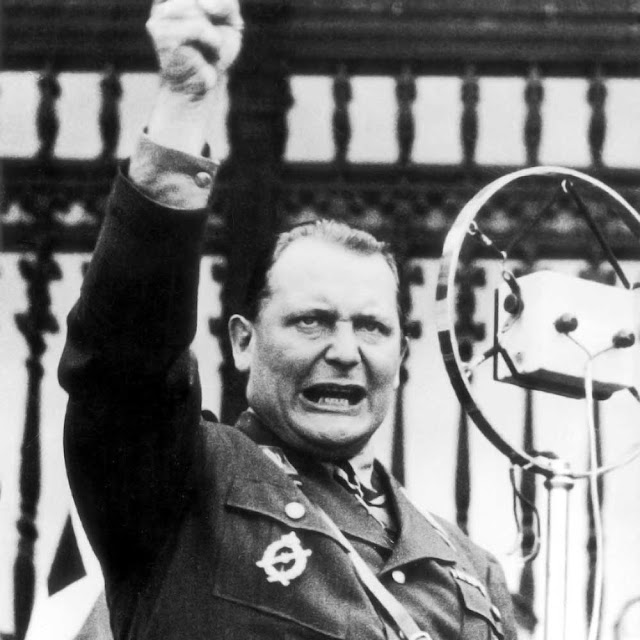
The RAF raids Berlin for the second time, killing 8-10 civilians and injuring 21-29 others. Among other things, they bomb the Görlitzer railway station. This kind of obvious damage to public infrastructure is causing the government to lose face, and Hitler is still deliberating about how to respond. People are starting to recall Luftwaffe boss Hermann Göring’s words at the start of the war in September 1939:
Wenn auch nur ein englischer Bomber die Ruhr erreicht, will ich nicht mehr Hermann Göring, sondern Hermann Meyer heißen. (If even one British bomber reaches the Ruhr, I don’t want to be called Hermann Göring any more, but rather Hermann Meyer.)
Note that, contrary to every legend about Göring, he never said anything about Berlin not being bombed. However, this statement invariably is mistranslated and bastardized to, “If the enemy ever bombs Berlin, you may call me Meyer,” which is a lot pithier. Loosely interpreted, Göring has been boasting in his usual bombastic fashion that his Luftwaffe is so powerful and almighty that he stakes his entire reputation on completely overwhelming and destroying the RAF before it can strike back and hurt Germans.
While this jest (using a common German idiom) explicitly refers to the industrial region of the Ruhr, virtually everyone in Germany interprets it as really meaning Berlin. Since Berlin is now being bombed, it becomes a catchphrase for the failures of the Luftwaffe (of which there is an increasing number). It is one of the classic ill-fated predictions of the war. This phrase will haunt Göring to the last days of the war, but among much of the public, he remains a popular figure. Despite all of his other many and varied faults, Göring is perhaps the only top German with any kind of sense of humor, which is badly needed during the dark days of World War II. People already are starting to call the ubiquitous air raid sirens “Meyer’s trumpets” with typical German sardonic wit as a way to poke fun at the fat man and his farcically bellicose rhetoric.
Italian bombers raid El Qantara and Port Said during the night.
At Malta, there are two air raid alerts, but, as is often the case, the Italian planes turn back before getting close to the coastline. In other news, Governor Dobbie and the War Office continue wrangling over additional anti-aircraft guns for the island, with the War Office dragging its feet despite hinting at big plans for upgraded air forces there.
Radio broadcast in Vichy France announced that laws protecting Jews in France had been removed. Marshal Petain has complete power and discretion over the entire government, but Pierre Laval is actually running day-to-day operations.
Adolf Hitler ordered troops to prepare for an occupation of Rumania should war break out in that country.
First flight of the Italian Camproni-Campini N.1. This is not a real jet aircraft: A piston engine drives a two-stage compressor, behind which a burner is installed.
Vienna’s claim to the position of unofficial capital of Southeast Europe today was fortified by the arrival of the German and Italian Foreign Ministers, Joachim von Ribbentrop and Count Galeazzo Ciano, to redraw Hungary’s and Rumania’s “Trianon frontier.”
Count Ciano, the Italian Foreign Minister, left Rome by air this morning for Vienna, carrying with him Italy’s hopes and determination to induce Rumania to be more lenient without necessarily granting Hungary everything she desires.
It was officially announced that at 10:15 tonight a Hungarian plane dropped six bombs and machine-gunned the civilian airport at Satu Mare near the Rumanian frontier. As the airport had been previously evacuated, there was no damage.
Four Greek freighters at Alexandria, Egypt, laden with wheat destined for Greece, are remaining in the harbor because they have received an Italian warning that when outside Egyptian waters they will risk being sunk.
In Finland, Simo Häyhä was promoted from the rank of corporal directly to the rank of second lieutenant by Field Marshal Carl Gustaf Emil Mannerheim. Häyhä is still recovering from his disfiguring wounds but improving.
Captain Leclerc, who occupied the Presidential Palace on the 27th, travels by train to Youande to accept the country’s surrender from the nominal Vichy authorities. This is a major coup for Charles de Gaulle’s “Free France” movement, which has not been accomplishing much recently.
French Congo and Ubangi-Shari joined the Free French. The small colony of Gabon was the last French possession in the region to remain pro-Vichy. At French-controlled Bangui, Governor de Saint Mart follows Captain Leclerc’s lead in Cameroon and announces for Free France also. He promises the local Vichy garrison that they will be taken to the Vichy base at Dakar if they wish.
U-28, commanded by Kapitänleutnant Günter Kuhnke, sank British steamer Kyno (3946grt) in 58-06N, 13-26W. At 2057 hours the Kyno (Master William Ansdell Thompson) in convoy HX.66 was torpedoed and sunk by U-28 about 30 miles north-northeast of Rockall. Four crew members were lost. The master and 32 crew members were picked up by the Queen Maud and landed at Methil. The 3,946- ton Kyno was carrying general cargo and was headed for Hull, England.
U-101, commanded by Kapitänleutnant Fritz Frauenheim, sank Finnish steamer Elle (3868grt) in 57-43N, 12-18W. At 0425 hours the Elle (Master Werner Öjst) in convoy SC.1 was hit amidships by one G7e torpedo from U-101. The ship had been missed with a first G7e torpedo at 0401 hours. The master and 26 crew members were picked up by HMS Leith (L 36) and landed at Greenock on 30 August. The sloop scuttled the vessel with two shots of gunfire in the morning. The 3,868-ton Elle was carrying spoolwood and was headed for Ardrossan, Scotland.
Minelayers HMS Southern Prince, HMS Menestheus, HMS Port Napier, and HMS Port Quebec escorted by destroyers HMS Tartar, HMS Ashanti, and HMS Bedouin, which had departed Liverpool on the 26th for Loch Alsh, departed Loch Alsh at 2130 for minelaying SN.14 in St Georges Channel, screened by anti-aircraft cruiser HMS Cairo. They were joined at sea by destroyer HMS Active from Scapa Flow. The minefield was laid during the night of 28/29 August. At 2145 on the 29th, destroyers Tartar, Ashanti, and Bedouin with minelayers Southern Prince, Menestheus, and Port Quebec arrived at Loch Alsh. Destroyer Active and minelayer Port Napier proceeded to the Clyde. On delivering the minelayer, destroyer Active proceeded to Scapa Flow to join the 12th Destroyer Flotilla.
Destroyers HMS Sikh and HMS Zulu arrived at Scapa Flow.
Destroyers HMS Javelin, HMS Jaguar, and HMS Antelope departed Scapa Flow at 1700 to a position 14 miles 360° from Sule Skerry. From that point, they carried out an anti-submarine sweep towards Sumburgh Head to search for a submarine sighted at 1200, ten miles 270° from Sumburgh Head, steering course 270°.There was no contact with the submarine and the destroyers returned to Scapa Flow at dawn on the 29th.
British minefield BS.36 was laid by minelayers HMS Plover and HNLMS Willem Van Der Zaan and destroyers HMS Intrepid and HMS Icarus. There were no minefields BS.37, BS.38, or BS.39.
Hunt-class destroyer HMS Eglinton was completed. She arrived at Scapa Flow on the 28th for working up with the 23rd Destroyer Division. She was transferred to Harwich arriving on 29 September for duty with the 16th Destroyer Flotilla.
British trawler Flavia (202grt) was lost in the North Sea.
Light cruiser HMS Enterprise departed Gibraltar for patrol duties from Freetown and escorting British troopship Royal Scotsman (3244grt).
Italian destroyers Pantera and Tigre operated in the Red Sea without contact during the night of 28/29 August.
Dutch light cruiser HrMs (HNMS) Sumatra arrived at Lobito from Freetown. After refueling, she proceeded later that day for Capetown, arriving on 2 September.
Convoy FN.265 departed Southend, escorted by destroyer HMS Woolston and sloop HMS Fleetwood. Patrol sloop HMS Shearwater joined on the 29th. The convoy arrived at the Tyne on the 30th.
Convoy MT.153 departed Methil. The convoy arrived in the Tyne later that day.
Convoy FS.265 departed the Tyne, escorted by destroyer HMS Vivien. The convoy arrived at Southend on the 30th.
Convoy HX.69 departed Halifax escorted by Canadian destroyer HMCS Assiniboine and auxiliary patrol boat HMCS French at 1550, which were detached on the 28th.
Convoy SHX.69 departed escorted by destroyer HMCS Saguenay and joined the convoy at sea. Patrol boat HMCS French was detached at 2100 and destroyer HMCS Assiniboine at 2010/29th turned the convoy over to the ocean escort, armed merchant cruiser HMS Alaunia.
Convoy BHX.69 departed Bermuda on the 27th escorted by ocean escort armed merchant cruiser HMS Ascania. The convoy rendezvoused with convoy HX.69 on 1 September and the armed merchant cruiser was detached. On 9 September destroyers HMS Ambuscade. HMS Arrow, and HMS Winchelsea, sloop HMS Fowey, and corvettes HMS Camellia, HMS Clarkia, and HMS Heartsease joined the convoy. Destroyers Ambuscade and Arrow were detached on 11 September. The remaining escorts and the convoy arrived at Liverpool on 12 September.
The Senate passed, 58 to 31, and sent to the House the Burke-Wadsworth Selective Service Bill after adopting the Overton-Russell amendment to take over private plants refusing to cooperate in the defense program, but adopting the Adams amendment limiting to 8 percent the net profits on Army ordnance contracts. It recessed at 8:10 PM, until noon tomorrow.
The House passed a bill increasing the number of midshipmen at the Naval Academy, adopted the conference report on the $163,500,000 Federal Road Bill and received the Fish resolution for a report on the number of Army and Navy airplanes ordered. Its Military Affairs Committee continued consideration of the Selective Service Bill, and its Ways and Means Committee approved the Excess Profits Tax Bill. It adjourned at 6:35 until noon tomorrow.
The U.S. War Department plans tentatively to begin mobilization of the National Guard, under legislation signed by President Roosevelt last night, by calling up 55,000 officers and men September 15 for a year of intensive training. The men, comprising four infantry divisions, four aircraft squadrons and numerous coast artillery units, are expected to enter camp barely two weeks after completion of the last of summer maneuvers on August 31. This would give them a brief period to settle personal affairs. Tentative war department plans also call for ordering out 175,000 more guardsmen by December 1, along with 393,000 conscript soldiers who would be drafted by December 15, should the compulsory service bill become law by that time. War Department authorities told Congress recently that guard mobilization was an essential preliminary to the compulsory training program.
The Senate passed tonight, by 58 to 31, the Burke-Wadsworth Selective Service Bill, the first peacetime draft measure in history, after about a month of debate and delay. For the bill were 50 Democrats and 8 Republicans. Against it were 17 Democrats, 10 Republicans, 2 Farmer-Laborites, 1 Progressive and 1 Independent. The final vote came at 8:05 PM after the Senate, pushing ahead all day, defeated several amendments intended to delay the draft or hamstring the selective service measure. The roll-call came with the Senate in a relatively quiet mood just after an amendment offered by Senator Maloney of Connecticut, which would have deferred conscription until next year, was defeated by 50 to 35. The House is expected to take up the measure next week and proponents in the House believe that the bill will be passed after several days’ debate by a fifty-vote margin.
Senator Hiram W. Johnson’s outstanding victory in the California primary election tonight evoked cheers in Republican camps. The silver-haired isolationist foe of military conscription and champion of a stay-at-home policy for America won not only Republican renomination for a fifth term but also captured the Democratic and Progressive senatorial nominations. The final unofficial count in 12,976 of the 13,540 precincts gave Johnson, on the Republican ticket, 578,519 votes against only 128,904 for all three of his opponents in that contest.
Presidential Nominee Wendell L, Willkie tonight urged Congress to keep politics out of military conscription exemptions and hailed the renomination of U. S. senator Hiram Johnson in the California primaries as a defeat for President Roosevelt’s political purge. Willkie told reporters Congress should amend the Burke-Wadsworth military conscription bill to vest administration in local boards so that decision as to exempting young men called to service should be both local and free of politics.
The powerful House Rules Committee today approved a stringent “gag” rule under which the House is expected to pass the controversial excess profits tax-plant amortization bill tomorrow after only two hours debate. Stirred by President Roosevelt’s charge that congress must accept responsibility for delays in the defense program because of slow action on essential legislation, the chamber is expected to accept the “gag” in order to speed the measure to the senate. Senator Harry F. Byrd, Virginia Democrat, precipitated the dispute earlier this week by charging that the rearmament drive has “bogged down” and that orders have been placed for only 343 combat planes in the last 100 days. Mr. Roosevelt said yesterday that 10,015 planes are on order for the army and navy. The president explained that most of the aircraft are trainers, and Byrd retorted that this confirmed his Byrd’s figures.
Former Secretary of Agriculture Henry A. Wallace’s aides revealed tonight he will stress national defense in accepting the Democratic vice-presidential nomination tomorrow night and said it will be the principal issue on which he expects to campaign. Other domestic affairs, including the farm problem, will be dealt with briefly in his 3,000-word acceptance speech.
Neutrality Act barriers against use of American ships to bring refugee children here from England were removed today but Germany’s attitude and the intensification of the fighting left plans for the children in doubt. The White House announced President Roosevelt had signed a measure permitting American ships to enter the European combat zone for this purpose if assurances of safe conduct were obtained from the belligerents.
President Roosevelt approved today loan contracts totaling $9,232,000 for five “defense housing” projects recommended by the United States Housing Authority to provide homes for 2,324 families of enlisted and civilian personnel in the Army and Navy, and defense industrial centers.
Archbishop Spellman of New York was entertained today at luncheon by President Roosevelt soon after the President arrived at Hyde Park for a holiday. The luncheon was private and neither the topics of conversation nor the names of other guests were made public.
The destroyers USS Biddle (DD-151) and USS Blakeley (DD-150) escorted the U.S. Army transport American Legion on the final leg of her voyage from Petsamo, Finland, to New York City. On board was Her Royal Highness Crown Princess Martha of Norway and her three children, who have been invited to come to the United States by U.S. President Franklin D. Roosevelt. The 40-millimeter Bofors gun she also carried was subsequently shipped to the Naval Proving Ground at Dahlgren, Virginia.
A request for $100,000 more to complete the work of the House Committee to Investigate un-American Activities, particularly “fifth column” activities, was renewed today by the chairman, Representative Dies of Texas.
Homestead Grays (Negro League) pitcher Ray Brown earns his 27th consecutive victory over a 2-year span when he shuts out the Baltimore Elite Giants 5 – 0 on a 3-hitter. The win raises his record to 12-0 for the season.
Major League Baseball:
On a wet day in much of the country, four major league games are rained out. The St. Louis Browns at the New York Yankees, the Detroit Tigers at the Washington Senators, the Cleveland Indians at the Philadelphia Athletics, and the Brooklyn Dodgers at the Cincinnati Reds all are cancelled.
The second division White Sox crept to within one game of the fourth-place Red Sox today, capturing the opener of a two-game series, 3–2, as Bill Dietrich triumphed. Each team collected five hits and Rookie Bill Fleming, the Pacific Coast League strike-out king, gave only three in the seven innings he worked for Boston. Joe Heving, who relieved after Fleming gave way to a pinch hitter, surrendered the other pair.
The Pirates, driving hard for a first division berth, snatched two games from the last-place Phillies today, 5–0 and 5–2, with the aid of neat pitching by Rip Sewell and Joe Bowman and heavy batting by Rookie Maurice Van Robays. In scoring his second consecutive shutout and his twelfth victory against three defeats, Sewell allowed just three singles and only one man reached second base in the opener.
The Giants snap pitcher Lon Warnecke’s eight-game winning streak and beat the Cardinals, 5–2. Cliff Melton got the win with relief help from Walter Brown. Jo-Jo Moore and Tony Cuccinello homered for the Giants and Frank Demaree added a triple.
A fifteen-hit rampage at the expense of three Chicago pitchers gave the Boton Bees an 8–3 victory today in the first of a two-game series. Dick Errickson, Bee hurler, helped with two doubles that drove in three runs. It was his tenth victory and came rather handily despite a two-run first-inning outburst by the Cubs. After that he permitted just six hits. An error helped the Cubs to their final score, in the fourth.
The Cubs recall former star pitcher Dizzy Dean from their Tulsa farm club and release shortstop Billy Rogell.
Chicago White Sox 3, Boston Red Sox 2
Boston Bees 8, Chicago Cubs 3
Philadelphia Phillies 0, Pittsburgh Pirates 5
Philadelphia Phillies 2, Pittsburgh Pirates 5
New York Giants 5, St. Louis Cardinals 2
The heavy cruisers USS Wichita (CA-45), under command of Rear Admiral Andrew C. Pickens, and USS Quincy (CA 39) departed Montevideo, Uruguay, for Buenos Aires, Argentina. These ships were visiting South America “to furnish a reminder of the strength and the range of action of the armed forces of the United States.”
The British lock up radical Burmese nationalist Ba Maw.
China today categorically announced her intention of marching into French Indo-China if Japanese armed forces enter the country “under whatever pretext and whatever conditions.”
Prince Fumimaro Konoye, the Japanese Premier, today announced basic principles of the new national structure, penetrating every aspect of national life, deisgned to give Japan the strength of totalitarian organization without the oppressive totalitarian machinery of single party rule.
Light cruiser HMS Dauntless arrived at Penang.
Dow Jones Industrial Average: 126.87 (+1.54)
Born:
William Cohen, U.S. Secretary of Defense (1997-2001); (Senator-(R)-Maine, 1979-97), in Bangor, Maine.
Roger Pingeon, French cylist (Tour de France champion, 1967), in Hauteville-Lompnes, France (d. 2017).
Willie Mitchell, AFL cornerback (AFL Champions-Chiefs, 1966 [lost Super Bowl I], 1969 [won Super Bowl IV]; Kansas City Chiefs), in San Antonio, Texas.
Tom Satriano, MLB catcher, third baseman, and first baseman (Los Angeles-California Angels, Boston Red Sox), in Pittsburgh, Pennsylvania.
Ken Jenkins, American actor (“Scrubs”), in Dayton, Ohio.
(Bhekizizwe) Joseph Shabalala, South African singer, songwriter, founder and musical director of Ladysmith Black Mambazo, in Ladysmith, South Africa (d. 2020).
Naval Construction:
The Royal Navy Hunt-class (Type II) escort destroyer HMS Grove (L 77) is laid down by Swan Hunter and Wigham Richardson Ltd. (Wallsend-on-Tyne, U.K.); completed by Wallsend.
The Regia Marina (Royal Italian Navy) light crusier Attilio Regolo, lead ship of her class of 3, is launched by Fratelli Orlando (Lovorno, Italy).
The Royal Navy Hunt-class (Type I) escort destroyer HMS Eglington (L 87) is commissioned. Her first commander is Commander Emile Frank Verlaine Dechaineux, RAN.
 History Diaries