The pro-Communist Premier of Portugal, Vasco Gonçalves, was expected to leave office by Monday in accordance with a deadline believed to have been set by officers representing most of the armed forces. But tension was unabated because it appeared that the Premier had not entirely reconciled himself to defeat, despite a clear statement by President Francisco da Costa Gomes that the cabinet’s life was a matter of days. Socialists said they believed the new government would be headed by General Carlos Fabiao, the army Chief of Staff and a political independent.
The official Soviet news agency Tass labeled as absurd suggestions by the British publication Jane’s Fighting Ships that the Soviet navy has expanded beyond the legitimate requirements of national defense. “The absurdity of (editor John) Moore’s accusations becomes particularly clear in the light of the indisputable fact that it was precisely the Soviet Union which together with other peace-loving nations was the initiator in calling the Helsinki (European security conference) summit meeting,” Tass said.
The United States and the Soviet Union formally unveiled the draft of a new international arms control treaty to prohibit all means of environmental warfare. The proposed treaty, which would ban any hostile modification of the earth’s environment that could cause “widespread, long-lasting or severe effects harmful to human welfare,” was presented to the 30-nation Geneva Disarmament Conference.
The Czech Interior Ministry charged that the helicopter used by American pilot Barry Meeker to lift East German refugees out of Czechoslovakia was armed with a machine gun and a Czech border guard was fired upon. Meeker, 33, has said the rented helicopter he used in the operation last Sunday was not armed. The official Ceteka news agency published a Czech protest note given to the West German charge d’affaires. It said the government expects West Germany “to punish the culprits” and to prevent further such actions.
A directory of 144 purged Czechoslovak historians and a protest letter from one of them have been smuggled out of their country. Delegates at the International Congress of the Historical Sciences, opening in San Francisco today, plan to distribute the documents although the president of the congress bureau is Yevgeny M. Zhukov of the Soviet Union. Many delegates have come from Eastern Eu rope, so distribution poses delicate problems.
Two men, one a Roman Catholic, the other a Protestant, were shot and killed and a third was wounded in sectarian murders heightening the wave of violence in Belfast, Northern Ireland, that began two weeks ago. The Catholic was slain near the docks while walking to work. Gunmen approached him on foot, killed him and then fled in an automobile, police said. A few hours later two men drove into a used car lot, shot and killed the Protestant owner and wounded a customer.
The University of London’s Chelsea College has been given a $1 million grant by the United Nations and the Rockefeller Foundation to establish a unique international center for research into the environment. The grants will enable the world’s leading environmental scientists to work at the college to develop means of monitoring the environment to give early warning of the possible dangers from pollution, the destruction of habitats, climatic changes and the spread of disease.
A three-truck pile up kills 10, injures 26 on a French highway.
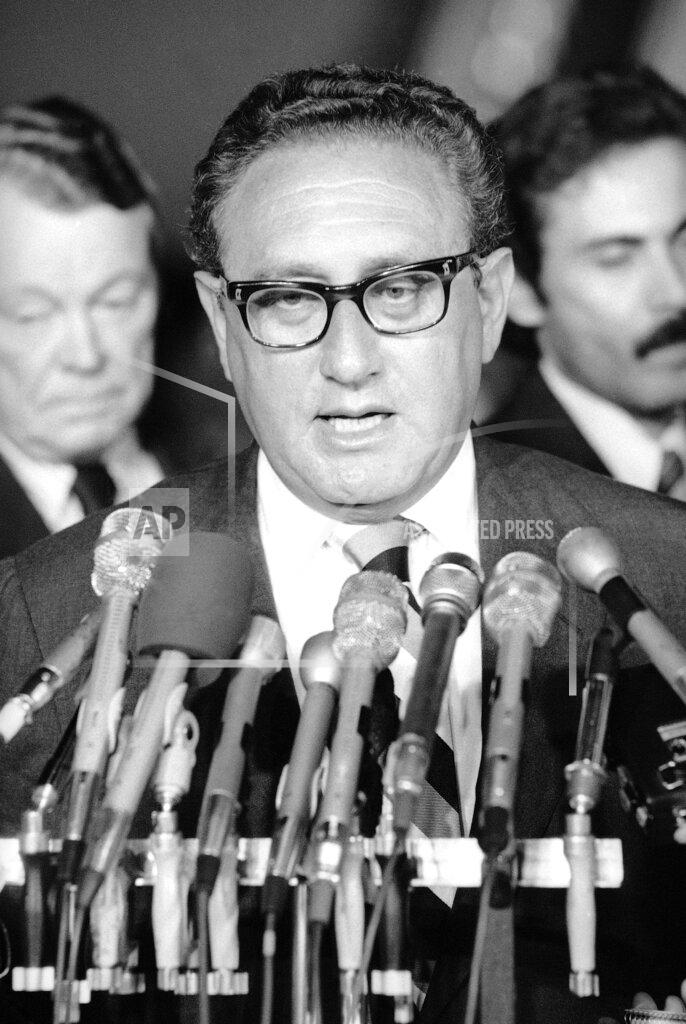
Secretary of State Kissinger arrived in Jerusalem expecting to conclude in the next 19 days an Egyptian-Israeli agreement on Sinai. There were widespread demonstrations in Israel against such an agreement and he made an emotional speech urging Israelis to continue taking “risks” for peace. He said that despite recent strains in Israeli-American relations, the United States was determined to support Israel and insure her security.
Secretary of State Kissinger comes to Alexandria, Egypt tomorrow to discuss matters of war and peace in a city at play. Alexandria, which stretches along the Mediterranean, is a haven this time of year for people from Cairo who can afford to flee the capital’s sultry summer heat. Its vast beaches are crowded and the deep‐blue water is dotted with small paddle boats and other craft. Traffic northward along the desert highway from Cairo has increased in the last few days as officials, diplomats and journalists prepare for the Kissinger visit.
James E. Akins, who has been Ambassador to Saudi Arabia for the last two years, is losing his post there as part of a high — level State Department personnel shuffle. Mr. Akins, an Arabist and career Foreign Service officer who headed the State Department’s Office of Fuels and Energy before being assigned to Saudi Arabia, said he learned of his impending change of status when a friend telephoned to read him a newspaper article in which it had been reported.
New Delhi announced that Indian news organizations need no longer submit their articles for pre-censorship, although they must continue to adhere to censorship guidelines. Journalists said the easing of the policy, in effect since the June 26 national emergency declaration, could be the start of a gradual relaxation of the strict guidelines, which forbid any reports hostile to Prime Minister Indira Gandhi.
President Khondakar Mushtaque Ahmed of Bangladesh took charge of the key Defense and Interior Ministries today as he alloted Cabinet portfolios, the Bangladesh radio reported. The new Foreign Minister is Abu Sayeed Chowdbury, who served as President of Bangladesh from 1972 to 1974, when the country had a parliamentary form of government and Sheik Mujib was Prime Minister.
Thai Prime Minister Kukrit Pramoj told Parliament that the situation in Bangkok was calm after a day of violence by students and dissident policemen, but paralyzing police strikes continued in two northern provinces. The policemen have been striking for four days in Chiengmai and Lampoon provinces to protest the release of 10 anti-government demonstrators from jail in Lampoon and the government’s responsiveness to student demonstrators.
Japanese whaling fleets in the Southern Hemisphere have had their catch quotas slashed under a provisional international agreement, the country’s Fishery Agency announced in Tokyo. During the 1975-1976 whaling season, Japan will only be allowed to catch 1,331 sei whales and 3,071 mink whales, compared with 2,392 and 3,500, respectively, for the preceding season. The quotas were reached after a week-long four-nation conference attended by South Africa, Brazil, Japan and the Soviet Union.
The United States partially lifted its embargo against Cuba, allowing the foreign subsidiaries of American companies to trade directly with the Castro regime. The United States lifted its 12-year-old ban on exports to Cuba by foreign subsidiaries of American companies, but, a State Department spokesman said, the embargo on direct trade between Cuba and the United States remained in force. A high State Department official appeared to go out of his way to avoid characterizing the action as a conciliatory gesture toward Cuba or as a prelude to other steps. It was, he explained, related to the recent removal of trade sanctions against Cuba by the Organization of American States.
The partial lifting of the United States economic blockade was welcomed by Premier Fidel Castro of Cuba, but he said it must be removed entirely before there could be serious negotiations for the restoration of normal diplomatic relations between the two countries. He said the blockade was “a dagger,” directed at the heart of Cuba.
Venezuela nationalized the oil industry there, with production facilities taken over by the state-owned company, Petróleos de Venezuela.
Heavily armed rebel commandos in Cordoba, Argentina, ambushed a police van transferring a leftist guerrilla leader to the state penitentiary, accidentally killing the prisoner, police said. Police identified the victim as Marcos Osatinsky, a leader of the Perónist guerrilla organization known as the Montoneros. Osatinsky’s death brought the casualty toll in two days of rebel violence to nine killed and at least 21 injured.
An attempt by President Isabel Martinez de Perón to deposit a check for more than $700,000 in public welfare funds into the estate of her late husband, Juan Domingo Perón, has stirred political controversy in Argentina. Mrs. Perón is the sole benefactor of her husband’s estate. The check was signed by her and deposited in the Banco de la Nacion Argentina on July 26. But it was hastily withdrawn after officials at the bank questioned the propriety of the deposit. The incident was first reported by local newspapers last week, and photocopies of the check were published and distributed among legislators. This week, the main opposition party, the Radical Civic Union, asked Congress to approve an investigation into the deposit and also to look into the management of the Social Welfare Ministry. The ministry was headed until last month by Jose Lopez Rega, the exiled former confidant of Mrs. Perón.
Consumer prices in July rose by the largest amount for any month this year, marking the second consecutive month of substantial increases, the Labor Department said. Dominated by higher prices for food, fuel and cars, the Consumer Price Index rose 1.2 percent after adjustment for normal seasonal changes in some prices. The July increase followed a rise of eight-tenths of 1 percent in June. If this rise continues, it could mean a return to last year’s “double digit” inflation. However, government economists, with considerable support from outside the government, do not expect the surge to continue.
Agriculture Secretary Earl Butz estimated that Americans will pay 1.5 percent additional for their food this year because of recent sales of 9.8 million tons of grain to the Soviet Union. The Agriculture Department’s chief economist made an accompanying statement that future grain sales to Russia, expected by President Ford and Dr. Butz, would raise food prices further.
A new round of price increases on petroleum products is underway, ranging from one-half cent to 1 cent a gallon and more on gasoline. They follow increases averaging 2½ cents announced by most oil companies early in July.
Mayor Joseph Alioto of San Francisco, using his emergency powers, imposed a compromise settlement for striking police officers and firemen after the Board of Supervisors had rejected it. “The strike is over,” the Mayor said. “San Francisco will be fully normal tomorrow.” Policemen and firemen began returning to work almost immediately. The Mayor’s actions climaxed a day of fast‐moving events in the three‐day‐old walkout that had crippled emergency services in the nation’s 14th‐largest city. Shortly before dawn today, the Mayor, who had been acting as mediator between the unions and the 11‐member board, the city’s legislature, announced a compromise pay settlement. It granted the city’s 1,935 policemen and the 1,781 firemen the full 13 percent raise they had demanded, but it will not take effect until October 15.
An affidavit by the Federal Bureau of Investigation asserts Mel Patrick Lynch admitted that, while disguised by a ski mask, he picked up the $2.3-million ransom for Samuel Bronfman 2d, after telephoning instructions that had the victim’s father driving around Queens to various points for five hours. The detailed account was made public yesterday when United States Magistrate Max, Schiffman in Brooklyn unsealed affidavits the F.B.I. had used to back up applications for four search warrants to recover the ransom money and other evidence after the 21‐year‐old heir to the Seagram liquor fortune was rescued.
The Civil Aeronautics Board ordered the nation’s airlines to stop adding a surcharge on ticket prices to cover airport security costs and instead include it in basic fares. CAB said the surcharge, an average 34 cents, sometimes was collected from a passenger several times on the same trip and accounting needed to keep track of the revenues was cumbersome. Under the new rule effective in 60 days, the one-time charge would be 41 cents in most cases.
The Environmental Protection Agency said a pesticide firm, some of whose employees are hospitalized with job-related brain damage, was doing business against the law and ordered it to stop merchandising its product. The EPA named the Life Science Products Co., Inc., of Hopewell, Virginia, the world’s sole producer of the fire ant poison kepone. Earlier this week, the Occupational Safety and Health Administration issued citations carrying $16,500 in fines against Life Science for noncompliance with health and safety laws. The company said those citations would be contested.
Charles L. (Chuckie) O’Brien, foster son of James R. Hoffa, said in a story in the Detroit News that reputed Mafia kingpin Anthony (Tony Jack) Giacalone was not involved with Hoffa’s disappearance. “I know Tony and he just did not have anything to do with this,” O’Brien was quoted as saying. The FBI has established that Hoffa was scheduled to meet Giacalone at a suburban Detroit restaurant July 30, the last day the fiery former Teamsters Union president was seen alive. Meanwhile, O’Brien’s lawyer said O’Brien would not submit to a lie detector test as Hoffa’s son, James P. Hoffa, has repeatedly demanded.
Jurors were placed under guard today in the Kent State shootings trial after the judge said that one juror had been physically assaulted. Meanwhile, the 12 jurors heard final arguments in the 95day‐old trial and were expected to begin deliberations tomorrow in the $46‐million civil damage suit. United States District Court Judge Don J. Young said that the jurors would be kept together under Federal guard because of the assault until the trial ended. Judge Young said in an interview later that he meant assaulted ‘in the sense of Ohio law — meaning an unlawful touching.” He refused to identify the juror or give further details. Court sources said the juror involved was one of six men on the jury and that he had received threats personally in three face‐to‐face confrontations. The juror was reported to have been told that he would be killed, his family harmed and his home blown up if his vote did not go a certain way.
The U.S. Tax Court has imposed penalties of $128,385, plus interest, on Anthony Russo, a reputed kingpin of organized crime in New Jersey, for fraud on his income tax returns from 1965 through 1969. The Internal Revenue Service had found that Russo underpaid his income tax by more than $250,000 during the five years. The court rejected Russo’s argument that he had not understood how much he owed. The court acknowledged, “Anthony Russo is illiterate. He reads at a first-grade level, spells at a second-grade level and scored about the second-grade level in arithmetic.”
New York Mayor Beame angrily said that he would make no further budget cuts in police, fire, sanitation and other “vital life-support services” in New York City. His anger was caused by statements from Governor Carey and others that he had failed to win investor confidence in his administration. He criticized Mr. Carey for “sermonizing” on the city’s fiscal troubles.
Top advisers to New York Governor Carey said that he had decided to prod publicly for more economies by Mayor Beame — and risk a potential party-splitting confrontation — after meetings with leading bankers and officials of the Municipal Assistance Corporation. A party leader close to Mr. Carey said “the Governor was compelled to emerge from his off-the-record activity because the Mayor refuses to take the lead in establishing the city’s credibility.”
One woman drowned and five other persons were injured when high winds and torrential rain struck the southeastern Minnesota area. Ellen Donahue, 57, of Cedar Rapids, Iowa, died when a 36-foot houseboat capsized in Lake Pepin. Her husband, John, was rescued. The storm resulted in massive power outages and extensive crop damage. It blocked highways and railroad tracks and littered the region with downed trees and branches. Winds were clocked up to 80 mph. At Pepin, Wisconsin, winds blew part of the roof off the school gymnasium and pieces were found five blocks away, but the 50 persons in the gym were not injured.
Traffic dust and emissions constitute a bigger city pollutant than factory emissions, according to a two-year study involving tests in Chicago, Philadelphia and Denver. Ronald Draftz, senior scientist at Illinois Tech’s Research Institute, concluded that industry’s share of the blame for suspended particles in the air has been “overemphasized.” Most industrial emissions, he said, “tend to go over the city, not down on it.” He cited calcite, a mineral from asphalt paving and soil, along with vehicle exhaust emissions as the major factors on city air pollution.
“If you had told me I would survive for three weeks here, I would have said, ‘No way,’” said Linda Forney after being lost in the Grand Canyon. Miss Forney’s nightmare of blazing-hot days and bone-chilling nights began August 1 when, dressed only in halter top, jeans and shoes, she started hiking down to the remote Supai Indian village at the bottom of the canyon. “I never got to the village,” the 25-year-old nurse said. “I left my pack with food along the trail. It just started getting very dark…” A ranger said she had made a wrong turn away from the village and was found 15 miles away. Her water was a trickle from a crack in the rocks and “the only thing I had to eat were buds of cactus plants. They were pretty good.” Then searchers found her and her dog Wednesday. Although her weight had dropped from 106 to 85 pounds, the hospital released her after less than a day, saying she was “in remarkably good condition.”
Major League Baseball:
Tony Conigliaro of the Boston Red Sox announces his retirement after a celebrated comeback. Conigliaro appeared on the verge of stardom in 1967, when a near-fatal beaning curtailed his career. He returned in 1969 before suffering problems with his vision, which caused him to retire for the first time.
Brothers Rick and Paul Reuschel combined on a six-hit shutout as the Cubs defeated the Dodgers, 7–0. A walk, singles by Rick Monday and Bill Madlock, an error and infield out gave the Cubs a 2–0 lead in the first. Monday whacked a two-run homer in the second after Manny Trillo had doubled and then scored on Don Kessinger’s single. Singles by Kessinger and Madlock, who raised his league-leading average to .363 with two hits, plus a double by Jose Cardenal, produced the final two tallies in the seventh. The Dodgers didn’t advance a runner past second. Davey Lopes stole second for his 34th consecutive successful theft in the sixth, but was stranded there.
Jim Kaat claimed his 18th victory when Jerry Hairston’s two-out RBI single broke a tie in the top of the ninth to give the White Sox a 2–1 decision over the Yankees. A single by Deron Johnson and Bill Melton’s infield hit set the stage for Hairston’s decisive hit. New York, losing a fifth straight game, scored their only run in the second when Chris Chambliss hit into a bases-loaded forceout. The Sox tied the score in the third on singles by Carlos May and Brian Downing, an error and Pat Kelly’s sacrifice fly.
A five-hit, four-run fourth inning boosted the Indians to a 7–3 triumph over the Royals as Frank Duffy, Duane Kuiper and Buddy Bell drove in all runs with singles. George Hendrick had homered with the bases empty in the first and singled home another marker in the third. Oscar Gamble closed out the Cleveland scoring in the fifth with a solo homer. Kansas City scored single runs in the sixth on Amos Otis’ RBI single, in the seventh when Fran Healy tripled home Al Cowens and in the ninth on a double by George Brett and single by Cowens.
Brooks Robinson, who had singled home the tying run in the top of the seventh, doubled in the 14th to chase across the deciding tally, giving the Orioles a 4–2 nod over the Rangers. Robinson scored an insurance run on Elrod Hendricks’ follow-up single. Jim Palmer, seeking his 20th victory with the O’s, left in the 12th with the score tied. He gave up the game’s first run in the fourth when Cesar Tovar singled, stole second, took third on Dave Duncan’s throwing error and scored when Jeff Burroughs singled. Baltimore tied it in the fifth on Robinson’s double and a single by Bobby Grich. Singles by Jim Sundberg and Tovar, a sacrifice by Dave Moates and an infield out gave the Rangers a 2–1 lead in the sixth.
Taking advantage of wildness by Pete Broberg, the Athletics increased their lead in the A. L. West to 6 ½ games with a 5–2 victory over the Brewers. Jim Holt singled home two decisive runs in the fourth after Broberg had walked the bases full. The winners’ final run in the seventh was the result of a walk to Bill North, a sacrifice and two successive wild pitches by Broberg. North singled home Jim Holt in the third for the A’s after Milwaukee had taken the lead in the second on Pedro Garcia’s RBI single and a sacrifice fly by Bill Sharp. Tommy Harper singled home the A’s other run in the sixth. Ken Holtzman’s route-going victory was his eighth in nine career decisions against the Brewers.
Los Angeles Dodgers 0, Chicago Cubs 7
Cleveland Indians 7, Kansas City Royals 3
Oakland Athletics 5, Milwaukee Brewers 2
Chicago White Sox 2, New York Yankees 1
Baltimore Orioles 4, Texas Rangers 2
Dow Jones Industrial Average: 791.69 (-1.57, -0.20%)
Born:
Akili Smith, NFL quarterback (Cincinnati Bengals), in San Diego, California.
Alicia Witt, American actress (“Cybill”, “Fun”), in Worcester, Massachusetts.
Died:
Sam McGee, 81, older of the country music duo The McGee Brothers, in a farming accident. A master guitarist who performed regularly at the Grand Ole Opry, McGee was cutting hay on his farm near Franklin, Tennessee, when he was run over by his tractor.
 History Diaries