“The Few”
“The gratitude of every home in our Island, in our Empire, and indeed throughout the world, except in the abodes of the guilty, goes out to the British airmen who, undaunted by odds, unwearied in their constant challenge and mortal danger, are turning the tide of the world war by their prowess and by their devotion. Never in the field of human conflict was so much owed by so many to so few.”

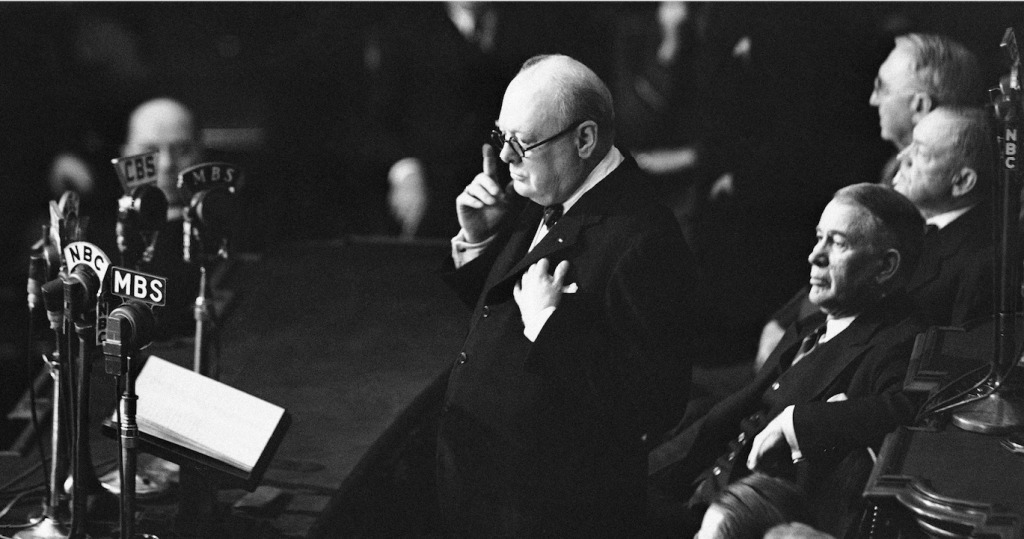
British Prime Minister Winston Churchill gave the famous “The Few” speech to the House of Commons: “Never in the field of human conflict was so much owed by so many to so few.” In the same speech Churchill declared his willingness to lease bases to the United States: “His Majesty’s Government are entirely willing, to accord defense facilities to the United States…”
The weather: Overcast and dull during the morning. Cloud base was very low in the north with rain in many places. As the morning progressed, the rain moved further south. London and the Thames Estuary remained cloudy and overcast, but the Channel area was fine with sunny periods.
The orders given by Göring in his Luftwaffe Command Orders Staff 1A were in part put into action during the night of the 19th/20th. In this document Göring mentioned that the weather conditions expected in the next few days was cloud over much of Britain, and that we (the Luftwaffe) must take full advantage of the situation.
“The cloudy conditions likely to prevail over England in the next few days must be exploited for [aircraft factories] attacks. We must succeed in seriously disrupting the material supplies of the enemy Air Force by the destruction of the relatively small number of aircraft engine and aluminum plants. These attacks on the enemy aircraft industry are of particular importance, and should also be carried out by night. . . . It would appear desirable for the purpose of night operations to allocate to units particular areas which they will come to know better during each successive raid. Within this area a list of target priorities should be drawn up, so that each sortie will produce some valuable result. . . . There can no longer be any restriction on the choice of targets. To myself I reserve only the right to order attacks on London and Liverpool.”
- Reichsmarschall Herman Göring 19th August at Karinhall
But these amounted to only small raids, between 12 and 15 He 111 bombers attacked Liverpool and the Merseyside Docks and some dropped more bombs in the Midlands on the way back. Damage was only minimal and one He 111 was shot down on the return journey over County Durham. These were some of the first bombs to be dropped on the City of Liverpool.
A Large formation of 100 plus aircraft was detected coming in from the North Sea into the Thames Estuary. They seemed content in maintaining their altitude and started to take in a circular pattern and their flight path seemed to be over Rochford, Hornchurch, North Weald and turning back along the North Kent coastline. No attempt was made to bomb any of the areas and Hurricanes from 32 Squadron Biggin Hill and 56 Squadron North Weald chased them back out to sea. It is believed that the German formation was on a reconnaissance flight.
1345 hours: 242 Squadron Coltishall (Hurricanes) were on a convoy patrol off the east coast when they attacked enemy aircraft. Very few details are available, but it is believed that they were hit by returning gunfire from Do 17s over the North Sea. One of the Hurricanes piloted by Midshipman P.J.Patterson was hit and he went into a vertical dive and crashed into the sea some miles out of Winterton on the east coast. This was one of the first young pilots that had been trained by the Royal Navy and transferred to the RAF, and had come under the command of Douglas Bader.
The most serious of the day’s actions were during the mid-afternoon.
1530 hours: Another raid was made on the airfield at Manston. Bombs were dropped and the airfield strafed. Damage was only minimal although a hangar was damaged, a couple of buildings hit by debris and a Blenheim aircraft of 600 Squadron was damaged, but there were no casualties during the incident.
65 Squadron Hornchurch (Spitfires) went in to intercept, but were attacked by the Bf 109 escorts in which one Spitfire was damaged by cannon fire and made a forced landing on Foulness Island. The pilot was unhurt although the aircraft was destroyed.
1545 hours: The oil tanks at Llanreath at Pembroke Docks which were still burning from the previous days bombing were again attacked. The 8 storage tanks at Llanreath near Pembroke Docks are still burning from the raid of the 19th, and the fire, in fact, is spreading to another two tanks, creating a massive inferno. This serves as a beacon visible for many miles, attracting more Luftwaffe attacks. Defence was by anti-aircraft gunfire that failed to hit any of the German bombers, but they did manage to hit a Blenheim of 236 Squadron St Eval, that although damaged, managed to return to base.
While the action was taking place during the afternoon, Churchill was in Parliament and it was on this day that he delivered his speech that ended with “….never, in the field of human conflict has so much been owed by so many to so few.”
Even today, no one would disagree that no truer words have been spoken, and the speech was one of those that would go down as being one of Winston Churchill’s famous speeches. But there was always the humorous side, as Pilot Officer Michael Constable-Maxwell chuckled “He must be thinking of our liquor bills.” And American Red Tobin remarked pointing to wings on his tunic, “I reckon these are on a one way ticket, pal”
RAF Casualties:
1345 hours: Off Winterton (East Coast) Hurricane. 242 Squadron Coltishall
Midshipman P.J. Patterson missing. (Crashed into sea during combat action)
Theodor Osterkamp, the commanding officer of Jagdgeschwader 51, was awarded the Knight’s Cross of the Iron Cross (Ritterkreuz). Forty-eight year old Osterkamp was one of only a handful of aviators to see combat in both World Wars. During the Great War he had been awarded both the Knight’s Cross of the Royal Hohenzollern House Order with Swords and the Pour le Mérite, and finished the war with thirty kills to his name. In 1940 he added six more victories before his superiors insisted that his further career should be chairbound.
Luftwaffe leadership ordered that no more Ju 87 Stuka aircraft were to be sent into action over Britain, after suffering unsustainable loss rates; almost 60 were shot down in the past 11 days.
RAF Bomber Command dispatches 9 Blenheims on a daylight coastal sweep. Only 2 aircraft bombed — at Ostend and Schiphol. No losses.
The day is notable because it marks the first time a Luftwaffe crew is interned in Ireland and only the second plane to crash there. It is a long-range Luftwaffe Focke Wulf FW 200C-1 Condor, coded “F8+KH” and assigned to I./KG 40. The anti-aircraft fire brought it down on Mount Brandon during a reconnaissance mission. The incident is unusual in Ireland and long-remembered – the Irish (in general) have no particular personal grudge against the Germans.
Vice Admiral James Somerville arrives in Gibraltar with his flotilla headed by aircraft carrier Ark Royal and battlecruiser HMS Renown. They have been in Great Britain for home defense. This reconstitutes Force H. Italian bombers attack Gibraltar to no effect.
At Malta, half a dozen more Blenheim bombers land at Luqa, while three others continue their journey to Egypt. The Italians naturally take an interest in all this bomber activity and decide to pay a visit as well. There are air raids on Luqa airfield which destroy several buildings and destroy one of the bombers and damage a couple of others. There also are some attacks on the Hal Far airfield which damage an RAF No. 830 Squadron Swordfish torpedo bomber.
Hermann Göring sent peace proposals to Britain via Dutch and Turkish foreign ministries, but the proposals were ignored by the British.
A group of youths today marched along the Champs Elysee in Paris and smashed the windows of seven shops said to have been owned by Jews. German soldiers photographed the scene as four of the youths were arrested by French police. Robert Hersant, leader of the newly organized Young Front, said that the demonstrations merely were a sample and beginning throughout occupied France of manifestations ‘against Jews, Masons and capitalists “who are responsible for the disorganization of the French capital and economic order.” Tuesday’s demonstrations marked the first in which there was violence. Newspapers, however, had been persistent in attacks on Jews and Masons.
Generalmajor Walter Warlimont, deputy chief in the Oberkommando der Wehrmacht (OKW), and his staff present a revised plan for Operation FELIX, the proposed invasion of Gibraltar. The plan concludes with the obvious, that everything depends upon Spanish participation, and that is far from certain. Franco wants to have it both ways, appearing to be against the whole thing while actually supporting it — but absent a declaration of war on Great Britain. Clearly, Franco does not want to enter another general war so soon after winning the Spanish Civil War.
Taking a cue from Hitler’s decision a few days ago to institute a “total blockade” of Great Britain, Italy institutes its own “total blockade” of Gibraltar, Malta, and Egypt. While it is a fanciful idea in many ways, Malta already is blockaded, and Egypt potentially could face a blockade due to the recent Italian conquest of British Somaliland. The timing of this announcement, though, reinforces the image of the Italian tail wagging on the German dog.
After four days of a gradual return of calm the Greek situation took a turn for the worse today. Late tonight it was reported Italian troops were massing in Albania on the Greek border.
Oppressed by the heat of mid-summer Nassau, the Duke and Duchess of Windsor were reported today seeking a temporary home away from official Government house and close to the seashore.
U-A, commanded by Kapitänleutnant Hans Cohausz, sank Panamanian steamer Tuira in 54-46N, 20-30W. At 0027 hours the unescorted Tuira, dispersed from convoy OB.198 on 18 August, was hit by a G7a torpedo from UA and sank after a boiler explosion within 8 minutes about 280 miles southwest of Rockall. The survivors were questioned by the Germans and they reportedly asked for the course to Norway because they did not want to go back to England. On 24 August, the 14 occupants of one lifeboat were picked up by HMS Bedouin (F 67) (Cdr J.A. McCoy, DSO, RN) in position 54°20N/17°22W and landed in Liverpool two days later. The chief officer and 15 survivors were picked up from another boat by HMS Periwinkle (K 55) (LtCdr H. Row, RNR), escorting the convoy OA.202, in position 56°00N/14°10W on 25 August. The 4,397-ton Tuira was carrying coal and was headed for Rosario, Argentina.
U-46, commanded by Oberleutnant zur See Engelbert Endrass, badly damaged Greek steamer Leonidas M. Valmas in 55-13N, 10-13W. At 2150 hours the unescorted Leonidas M. Valmas was torpedoed and badly damaged by U-46. The ship was towed to Greenock, beached in Kames Bay and declared a total loss. The wreck was broken up where it was beached. The 2,080-ton Leonidas M. Valmas was carrying timber, boards and battens and was headed for Dublin, Ireland.
German aircraft in small numbers raided Scapa Flow from 0115 to 0315. Movements of all ships larger than trawlers were prohibited due to mining. At 0945, Scapa Flow was declared clear of mines north of Barrel of Butter. The Fleet Channel was swept.
Floating dock AFD.12 departed the Tyne on the 20th under tow escorted by sloops HMS Lowestoft and HMS Egret and two trawlers. The dock arrived at Lyness on the 26th.
The first successful attack on a German submarine by British Coastal Command aircraft occurred when U-51, commanded by Kapitänleutnant Dietrich Knorr, was seriously damaged in an air attack on the 16th. U-51 was sunk, while returning to port from her fourth war patrol, in the Bay of Biscay in 47-06N, 04-51W by submarine HMS Cachalot on the 20th. All 43 hands on the German submarine were lost. During its career under Kapitänleutnant Knorr the U-51 sank 1 auxiliary warship and 5 merchant ships for a total of 26,296 tons.
Midshipman P. J. Patterson, flying a Hurricane of RAF 242 Squadron from Coltishall, was killed when his aircraft dived into the sea five miles northeast of Winterton.
British minefield BS.33 was laid by minelayers HMS Teviotbank, HMS Plover, and HNLMS Willem Van Der Zaan and destroyers HMS Icarus and HMS Impulsive.
Minesweeping trawler HMS Resparko (248grt, Temporary Skipper J. Fountain RNR) was sunk by German bombing at Falmouth. The entire crew was rescued.
Dutch tug Zwarte Zee (793grt) was damaged by German bombing at Falmouth.
British steamer Macville (666grt) was damaged by German bombing in Blacksod Bay.
British steamer Peebles (4982grt) was damaged by German bombing twenty miles east of Tuskar Rock, Irish Sea.
British trawler Our Maggie (17grt) was damaged by German bombing at Brixham.
Vice Admiral J. C. Tovey, Commander of the 7th Cruiser Squadron of the Mediterranean Fleet, became Vice Admiral Light Forces. The 3rd Cruiser Squadron became the primary Mediterranean Fleet Cruiser Squadron.
Vice Admiral Somerville arrived back at Gibraltar in battlecruiser HMS Renown. Also arriving were aircraft carrier HMS Ark Royal and destroyers HMS Hotspur, HMS Greyhound, HMS Encounter, HMS Gallant, HMS Griffin, and HMS Velox.
Vice Admiral Aircraft Carriers departed aircraft carrier HMS Ark Royal and took passage in sloop HMS Enchantress leaving that day in convoy HG.42.
Light cruiser HMS Dragon departed Durban for Capetown.
Convoy OB.201 departed Liverpool escorted by destroyer HMS Westcott and corvette HMS Gladiolus from 20 to 24 August.
Convoy FN.258 departed Southend, escorted by destroyer HMS Winchester and sloop HMS Weston. Sloop HMS Pintail was with the convoy on the 21st. The convoy arrived in the Tyne on the 22nd.
Convoy MT.146 departed Methil. The convoy arrived in the Tyne later that day.
Convoy FS.258 departed the Tyne, escorted by destroyers HMS Vivien, HMS Sikh, and HMS Zulu. The convoy arrived at Southend on the 22nd.
Convoy HG.42 with seventeen ships departed Gibraltar. Sloop HMS Enchantress and armed boarding vessel HMS Tiercel escorted the convoy from 20 August to 3 September. Destroyer HMS Wrestler escorted the convoy from 20 to 22 August. Destroyer Wrestler escorted steamer Highwear, which had collided with steamer Pollux in the convoy, to Lisbon on the 25th. Anti-submarine trawler HMS Man O’ War and anti-submarine whaler HMS Ullswater escorted the convoy from 29 August to 3 September. Destroyer HMS Viscount from convoy OB.204 and corvette HMS Clematis escorted the convoy from 30 August to 1 September. On 1 September, destroyers HMS Arrow from convoy OB.204, and HMS Active and HMS Keppel escorted the convoy. The convoy arrived at Liverpool on 3 September.
Convoy HX.67 departed Halifax escorted by Canadian destroyer HMCS Assiniboine and auxiliary patrol vessel HMCS French, but much difficulty with fog prevented the convoy from forming up until 0645 on the 21st.
Convoy SHX.67 departed escorted by destroyer HMCS Saguenay, which was detached on the 22nd. The convoy joined HX.67 at sea. At 1325, the ocean escort, armed merchant cruiser HMS LACONIA, was sighted and destroyer Assiniboine remained with the convoy until 2020. The escort was detached on the 21st.
Convoy BHX.67 departed Bermuda on the 19th escorted by ocean escort light cruiser HMS Emerald. The convoy rendezvoused with convoy HX.67 on the 24th and the light cruiser was detached. On 31 August, destroyers HMS Walker and HMS Warwick, sloop HMS Rochester, and corvettes HMS Arabis and HMS Bluebell joined the convoy. They remained with the convoy arriving at Liverpool on 4 September.
U.S. President Roosevelt declined today to accept Wendell L. Willkie’s challenge, in his acceptance speech Saturday at Elwood, Indiana, to hold a series of debates on current issues as part of the campaign for the Presidency. Mr. Roosevelt’s declination was made in response to a question at his regular press conference. He said in effect that he was too busy to indulge in campaigning. “Mr. President,” he was asked, “when are you going to meet Mr. Willkie in debates on campaign issues?” The President laughed and told the reporter that he might as well mimeograph the question, since it would be asked at all subsequent press conferences, then he added that his reply might as well be mimeographed.
Mr. Roosevelt told the Democratic national convention, on the night he accepted the nomination for a third term in a radio speech, he went on, that whether the delegates liked it or not, he happens to be President of about 130,000,000 people in the United States and its insular possessions, and things are in such shape that he cannot indulge in campaigning. With that indirect statement, he closed the subject, reminding the correspondents that they all knew how busy he was.
G.O.P. Presidential Nominee Wendell L. Willkie tonight renewed his challenge to debate President Roosevelt after the chief executive had rejected the offer because of the pressure of foreign and defense problems. Willkie suggested that Mr. Roosevelt let military experts inspect defense works and suggested that the chief executive discuss the vital issues of the campaign with him as his own contribution to democracy. Willkie made his statement to newsmen shortly after Mr. Roosevelt had announced at a press conference at his Hyde Park, N. Y. home that his tasks as president precluded Intensive campaigning. “The democratic process basically rests upon discussion and any man who seeks the office of president of the United States not only should be willing to, but is under obligation to, publicly discuss the questions before the American people,” said Willkie.
The Senate in Washington debated the Burke-Wadsworth Compulsory Military Training Bill, heard Senator Bone criticize the Administration for failing to change the course of the steamship American Legion, confirmed the nomination of Edward Dana Durand to the Tariff Commission and recessed at 5:47 PM until 11 AM tomorrow. The Military Affairs Committee approved a bill authorizing the President to promote Army officers during the present emergency.
The House considered the bill to increase the capital and lending authority of the Export-Import Bank and adjourned at 4:52 PM until noon tomorrow. The Military Affairs Committee approved revisions of the Compulsory Military Training Bill.
A broad conscription bill making men 21 to 45 years old, inclusive, liable for immediate military training was tentatively approved by the house military committee today, while the senate debated a less sweeping measure. The house bill calls for registration of men from 18 through 64. Those selected immediately for a year’s service would come from the 21-45 classifications, however. Chairman May, Kentucky Democrat, said that the committee, by an almost unanimous vote, turned down proposals that provisions of the senate bill, calling only for registration and training of men 21 to 30, inclusive, be inserted in the house measure. “It’s the opinion of the committee that these are the proper ages and we’re going to put the bill out this way,” said May. Clergymen, divinity students and conscientious objectors would be exempt, and the training of college students in their senior year would be deferred.
Sumner Welles, Acting Secretary of State, came to the defense today of William C. Bullitt, Ambassador to France, who was attacked in the Senate yesterday for his speech in Philadelphia Sunday.
President Roosevelt characterized today as just another newspaper story reports that in its new defense collaboration this country would lend destroyers to patrol Canadian waters and thereby release British craft on that patrol for service with the home fleet.
Defense of the Western Hemisphere against a well prepared enemy would require, in the belief of the General Staff, a trained army of 4,000,000 men, according to testimony made public today. This opinion, together with the statement that nothing that nothing further than the defense of the Northern half of the hemisphere and the Caribbean area is planned at present, was given to the Senate Appropriations Committee by General George C. Marshall, Chief of Staff, in testifying on the $5,000,000,000 second supplemental defense bill which the committee reported yesterday. The most that the Army can guarantee in the near future, General Marshall told the committee, is a force of 1,200,000 men which, “with an adequate air force and with the Navy able to assist, is a reasonable minimum to discourage any one from attempting to come into the Northern Hemisphere or the Caribbean area.”
Characterizing Secretary Ickes as a “Hitler in short pants” and “a common scold puffed up by high office,” Senator Bridges of New Hampshire attacked in a statement today the man whom the Administration put forward last night to answer the acceptance speech of Wendell Willkie, Republican candidate for president.
Four prominent Hollywood film personages, named as Communist sympathizers in testimony before the Dies committee, were cleared of the accusation today by Representative Martin Dies, committee chairman. “The chair has carefully considered evidence received to date, including the testimony of some of those who have been accused,” he said, “and it is of the opinion that Mr. Humphrey Bogart, Mr. Fredric March, Mr. James Cagney, and Mr. Phil Dunne are not and never been members of the Communist party.”
Production Chief William Knudsen of the national defense commission and Major General H. H. Arnold, chief of the army air corps, will start tomorrow on an extensive tour of Southern California aircraft plants. They arrived by air today from a similar inspection visit at Wichita, Kansas. General Arnold probably will inspect also the air corps training detachments at Glendale, Ontario, and Oxnard.
Louis (Lepke) Buchalter, notorious New York racketeer, today was indicted with Benjamin (Bugsie) Siegel and three others by the county grand jury for the gangland slaying last Thanksgiving eve of Harry (Big Greenie) Schachter. The jury heard testimony of a vice-president of Murder, Inc., and a triggerman for the syndicate, both brought here by District Attorney Enron Fitts from Brooklyn, N. Y., and returned the indictment naming Buchalter, Siegel, Champ Segal, Hollywood barber; Frank Carbo, Seattle and New York fight promoter, and Emanuel (Manny) Weiss, high lieutenant of Buchalter. Buchalter, alleged to have been one of the murder ring’s best customers, now is serving a 14-year sentence in Leavenworth on a narcotics conviction. After completion of that sentence he will be turned over to the State of New York where he has been convicted of racketeering in connection with trucking operations and sentenced to serve 30 years. Siegel is a Hollywood night life figure described by authorities as one of the nation’s “most dangerous gangsters.” He was arrested in his luxurious Holmby hills mansion last week when Brooklyn’s district attorney, William O’Dwyer, cooperated with California officers in linking activities of the eastern murder for profit ring with the slaying of Schachter, alias Greenberg, on a Hollywood street.
Major League Baseball:
Ken Keitner, third baseman of the league-leading Indians, went on a batting spree today to down the Red Sox, 11–6, and give Pitcher Bobby Feller his twenty-second victory of the season. Keltner’s grand slam was the big blow in a 7-run eighth inning. He also had a triple earlier for two more RBIs.
In the second of two games, Wally Moses steals home in the 10th inning to give the A’s a 4–3 victory over the White Sox. Chicago wins the opener, 6–1, witha five-run ninth-inning rally.
The Yankees swept a doubleheader with the Tigers today, winning 4–3 and 4–2. Red Ruffind and Ernie Bonham picked up the victories. George Selkirk homered in the opener for New York.
Elden Auker’s submarine balls were too much for Washington today and the Senators lost to the St. Louis Bowns, 6–3, for their fifth straight defeat. The Browns hammered the sensational rookie, Sid Hudson, for ten hits, bunching five in the third inning for three runs.
The Reds score three runs in the 9th inning – two coming home on a single by Frank McCormick – to defeat the Giants, 3–2. Bill Lohrman again faile to win his tenth for New York.
The red hot Cardinals, in marked contrast to the unusually cool St. Louis weather, downed the Dodgers in both ends of a doubleheader, 3–0 and 4–3, with Clyde Shoun hurling the shutout for Billy Southworth. This double downfall, coupled with Cincinnati’s ninth inning winning surge over the Giants, tumbled the Dodgers five and one-half games behind the league leaders.
Claude Passeau marked up his fifteenth mound victory of the season today, pitching the Cubs to a 4–0 decision over the Phillies. Only thirty Philadelphia batters faced Passeau as he yielded only three hits and issued no walks. Zeke Bonura contributed the first Cub run when he blasted a home run in the first inning.
Although yielding thirteen hits, most of them slow bounders that the infield could not handle, Southpaw Dick Lanahan today pitched Pittsburgh to a 6–3 victory over Boston, fanning six as he broke the Pirates’ four-game losing streak. Four double plays aided the hurler.
Cleveland Indians 11, Boston Red Sox 6
Philadelphia Phillies 0, Chicago Cubs 4
New York Giants 2, Cincinnati Reds 3
Detroit Tigers 3, New York Yankees 4
Detroit Tigers 2, New York Yankees 4
Chicago White Sox 6, Philadelphia Athletics 1
Chicago White Sox 3, Philadelphia Athletics 4
Boston Bees 3, Pittsburgh Pirates 6
Brooklyn Dodgers 0, St. Louis Cardinals 3
Brooklyn Dodgers 3, St. Louis Cardinals 4
St. Louis Browns 6, Washington Senators 3
Leon Trotsky, living in exile in Mexico City, was stabbed with an ice axe by a Soviet agent. Leon Trotsky, a central leader of the Bolshevik-led revolution in Russia in October 1917 in exile in Mexico City, was stabbed with an ice pick by Jacques Mornard alias Frank Jacson. Trotsky would die from his wounds the next day.
The Japanese continue their bombing campaign against Chungking. The cumulative effect of the raids is devastating to the Nationalist capital. The new Zero fighters continue escorting the “Nell” bombers, which they began doing only yesterday. High winds fanned flames from Japanese incendiary bombs into a raging conflagration tonight that left Chungking’s eight-century-old walled city area an unrecognizable mass of smoking ruins.
Chinese communist forces launched the Hundred Regiments Offensive in Hebei and Shanxi Provinces in China. The attack is focused along the railway line that separates them from the Japanese. The provinces are a major source of supply for the Japanese.
Sugehara, the Japanese Consul at Kovno in eastern Russia, begins issuing transit visas to a few Polish and Lithuanian Jews, enabling them to cross the Trans-Siberian railway to Japan. He continues to issue visas to Jews until August 31.
Broadcasting on the effect of the war on Australian economy, Assistant Treasurer H.K. Nock yesterday warned Australians to reconcile themselves to a lower living standard if the war should be long drawn out.
German armed merchant cruiser Orion sank British steamer Turakina (9691grt) on the Cook Strait-Sydney, Australia route in 38-33S, 167-12E. Thirty eight crewmen were killed and twenty one crew were made prisoners of war. The remainder of the crew was landed at Emirau Island on 21 December. New Zealand Division light cruiser HMS Achilles departed from Wellington and Australian light cruiser HMAS Perth departed Sydney, but no contact was made with the German ship. Light cruiser Achilles refueled at Auckland on the 22nd. She was raider hunting off Campbell Island on the 25th. The light cruiser returned to Wellington on the 27th. Light cruiser Perth established a patrol off Gabo Island.
Dow Jones Industrial Average: 123.17 (+1.11)
Born:
Gary Collins, NFL flanker and punter (NFL Champions-Browns, 1964; Pro Bowl, 1965, 1966; Cleveland Browns), in Williamstown, Pennsylvania.
Rubén Hinojosa, American politician (Rep.-D-Texas, 1997-2017), in Edcouch, Texas.
John Lantree, English rock bassist (The Honeycombs – “Have I the Right?”), born in Newbury, Berkshire, England, United Kingdom.
Musa Geshaev, poet, literary critic, songwriter and historian, in Grozny, Chechen-Ingush ASSR, Soviet Union (d. 2014).
Naval Construction:
The Kriegsmarine (German Navy) Type VIIC U-boat U-89 is laid down by Flender Werke AG, Lübeck (werk 293).
The Kriegsmarine (German Navy) Type IXC U-boat U-130 is laid down by AG Weser, Bremen (werk 993).
The Royal Navy Flower-class corvette HMS Zinnia (K 98) is laid down by the Smiths Dock Co., Ltd. (South Bank-on-Tees, U.K.).
The U.S. Navy 70-foot Elco patrol motor torpedo boat USS PT-10 is launched by the Electric Launch Company Ltd. (Elco), (Bayonne, New Jersey, U.S.A.).
The Royal Navy Abdiel-class minelayer HMS Latona (M 76) is launched by Thornycroft (Southampton, U.K.).
The Вое́нно-морско́й флот СССР (ВМФ) (Soviet Navy) “M” (Malyutka)-class (3rd group, Type XII) submarines M-35 and M-36 are launched by Krasnoye Sormovo (Gorkiy, U.S.S.R) / Yard 112.
The Royal Navy “U”-class (Second Group) submarine HMS Undaunted (N 55) is launched by Vickers Armstrong (Barrow-in-Furness, U.K.).
The Royal Navy Flower-class corvette HMS Fennel (K 194) is launched by Marine Industries Ltd. (Sorel, Quebec, Canada). She is transferred to the Royal Canadian Navy before completion and commissions as the HMCS Fennel (K 194).
The Royal Navy Hunt-class (Type II) escort destroyer HMS Eridge (L 68) is launched by Swan Hunter and Wigham Richardson Ltd. (Wallsend-on-Tyne, U.K.); completed by Wallsend.
The Kriegsmarine (German Navy) Type 1936A destroyer (Flotilla Leader) Z28 is launched by AG Weser (Deschimag), Bremen (werk 962).
The Royal Navy Tree-class minesweeping trawler HMS Almond (T 14) is commissioned. Her first commander is Chief Skipper Robert Buchan, RNR.
The Nihon Kaigun (Imperial Japanese Navy) Kagerō-class destroyer HIJMS Oyashio (親潮, “Father Current”) is commissioned. Her first commanding officer is Commander Arima Tokiyoshi.
 History Diaries