“Black Thursday.”
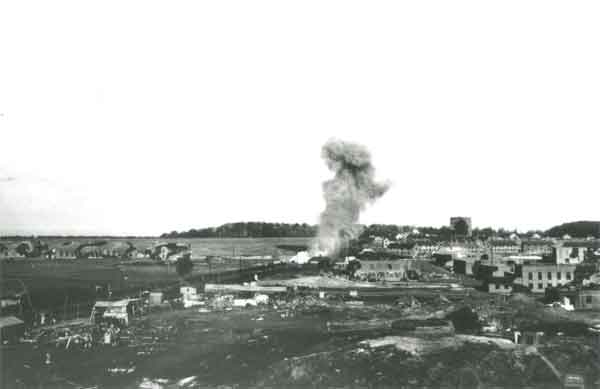
In the biggest air engagement of the Battle of Britain up to this point, the Luftwaffe attempted to overwhelm the RAF with a series of major air attacks. The Germans lost 76 aircraft to the British 34, and to the Germans the day became known as Black Thursday.
By the end of the day, a total of 190 German planes had been lost in the last three days. The British have lost 115 in the same period.
DIRECTIVE OF AUGUST 15th 1940
ISSUED BY GÖRING TO ALL LUFTWAFFE COMMANDERS
- The fighter escort defenses of our Stuka formations must be readjusted, as the enemy is concentrating his fighters against our Stuka operations. It appears necessary to allocate three fighter Gruppen to each Stuka Gruppe, one of these fighter Gruppen remains with the Stukas, and dives with them to the attack; the second flies ahead over the target at medium altitude and engages the fighter defenses; the third protects the whole attack from above. It will also be necessary to escort Stukas returning from the attack over the Channel.
- Night attacks on shipping targets are only fruitful when the night is so clear that careful aim can be taken.
- More importance must be attached to co-operation are not to be broken up except in cases of utmost urgency.
- The incident of VILGI on August 13 shows that certain unit commanders have not yet learnt the importance of clear orders.
- I have repeatedly given orders that twin-engined fighters are only to be employed where the range of other fighters is inadequate, or where it is for the purpose of assisting our single-engined aircraft to break off combat.
Our stocks of twin-engined fighters are not great, and we must use them as economically as possible.
- Until further orders, operations are to be directed exclusively against the enemy Air Force, including the targets of the enemy aircraft industry allocated to the different Luftflotten. Shipping targets, and particularly large naval vessels, are only to be attacked where circumstances are especially propitious. For the moment, other targets should be ignored. We must concentrate our efforts on the destruction of the enemy Air Forces. Our night attacks are essentially dislocation raids, made so that the enemy defences and population shall be allowed no respite. Even these, however, should where possible be directed against Air Force targets.
- My orders regarding the carrying out of attacks by single aircraft under cover of cloud conditions have apparently not been correctly understood. Where on one afternoon 50 aircrafi are despatched without adequate preparation on individual missions, it is probable that the operation will be unsuccessful and very costly. I therefore repeat that such sorties are to be undertaken only by specially selected volunteer crews, who have made a prolonged and intensive study of the target, the most suitable method of attack, and the particular navigational problems involved. By no means all our crews are qualified to undertake such tasks.
- KGr100 (bombers) is also in future to operate against the enemy Air Force and aircraft industry.
- It is doubtful if there is any point in continuing the attacks on radar sites, in view of the fact that not one of those attacked has so far been put out of operation.
- The systematic designation of alternative targets would appear frequently to lead to certain targets being attacked which have absolutely no connection with our strategic aims. It must therefore be achieved that even alternative targets are of importance in the battle against the enemy Air Force.
- The Commanders-in-Chief of the Luftflotten are to report to me on the question of the warnings to be given during enemy air penetrations over the Reich. At present, the warnings are causing a loss of output whose conse quences are far graver than those caused by the actual bomb damage. In addition, the frequent air raid warnings are leading to nervousness and strain among the population of Western Germany. On the other hand, we must take into account the risk of heavy loss of life should an attack be launched before a warning has been given.
REICHSMARSCHALL HERMANN GÖRING
KARINHALL, AUGUST 15, 1940
Reichsmarschall Hermann Göring is no fool, but he completely fails at crafting a successful aerial strategy against the British. Partly this is due to poor German military intelligence, partly to grandiose notions he has of what the Luftwaffe can accomplish, and partly to the simple fact that the Luftwaffe equipment is not up to the task before them — something that he, of course, cannot admit. A huge part of the problems, though, is that he has an uncanny knack for drawing the wrong conclusions from known facts. Point #9 above, in particular, is a disastrous error.
The Battle of Britain: Heaviest fighting of the Battle of Britain, as all three Luftflotten participate in attacks. The Luftwaffe flew almost 1,800 sorties, the greatest number they would attempt during the battle. The RAF flies 974. Seventy-five Luftwaffe aircraft were lost during the day with airfields as their main targets. There was little activity at night. The losses of Luftflotte 5, based in Scandinavia, are such that it will no longer participate in daylight attacks.
Weather: Cloud covered much of the south and south-east during the morning. This was to disperse before noon where a ridge of high pressure right across Britain would insure a fine and warm day.
Because of the fact that the weather forecast predicted poor conditions and that all operations were postponed, Göring had summoned all his top commanders for a conference at Karinhall. Albert Kesselring, Hugo Sperle, General Bruno Lorzer of Fliegerkorps II and Generalmajor Joachim Coler of Fliegerdivision XI were all included. He put it to his commanders that they were having no impact on the RAF, he wanted to know the failures that had taken place, he wanted to know why they were suffering so many casualties, he wanted the commanders to explain. “We must have bigger impact in our attacks” said Göring, “our missions must consist of more bombers, bigger formations, more escorts that will fly with greater skills than they have done before”. He also made one of his greatest mistakes when he instructed his commanders that the bombing of the radar stations was having no effect on the British, they were not being destroyed and that bombing them was not going to destroy any of their aircraft.
German High Command could not resist the break in weather conditions by mid-morning, and the order went out that planned operations be commenced. At the HQ of the 2nd Flying Corps, Oberst Paul Deichmann who was Chief of Staff of II Fliegerkorps already had 1,000 fighter planes and more than 800 bombers all ready with full compliments of bombs in their bays and fuelled up just waiting for the order to commence the operation. With no word from his superiors, he decided that the opportunity was too good to miss, and took it upon himself to launch an attack.
The planned operation was that the Ju 87s of II/StG 1 and IV (St) /LG 1 loaded with 500 and 250 kilo bombs would lead out first, Dornier bombers from the 3rd Bomber Group would head out over the Channel then turn and head in the direction of Eastchurch, and the Bf 110s of 2/ZG76 would head through the Dover Straits then turn inland and attack Manston once again. In the centre of all this, 100 plus Me 109s would provide cover for the formations to left and right of them.
Radar stations all along the south coast could not help but pick up the huge formations that were heading between Lympne and Manston. There were so many aircraft heading across the Channel that many of them were not even on the radar screens, while the different formations could not be distinguished. The Luftwaffe were coming over in force, a mass of 1,120 aircraft were coming across the Channel.
There was no doubt about the intentions of the Luftwaffe on August 15th, they would follow the path of previous missions that attacked the airfields and airfield installations of Fighter Command, but this time, by coming over in larger numbers their plan was to entice more RAF fighters into the air.
1000 hours: Luftflotte 5 in Norway release 63 Heinkel He 111 bombers from I and III/KG26 based at Stavanger and Sola. These bombers were given a 20 minute start before 25 Bf 110s of I/ZG76 based at Stavanger/Forus take off to escort the Heinkels to their targets which were the British airfields at Asworth, Dishforth, Newcastle, Sunderland and Middlesborough. The Bf 110s are equipped a 1,000 litre drop tank that will allow them to fly well beyond their normal range.
At the same time as the Bf 110s depart from Norway, 50+ Ju 88 bombers from KG30 in Denmark begin their journey north also to bomb British airfields in the north of England.
1100 hours: The RAF “scrambled” 54 Squadron Hornchurch (Spitfires) and 501 Squadron Gravesend (Hurricanes) to intercept the foreboding onslaught that was coming across the Channel. The Observer Corps had reported 60+ Ju 87 Stuka dive bombers and an undisclosed number of Bf 110 as escort. But this was a numbers game, it was going to be obvious that two squadrons were not going to be enough. The order went out from Fighter Command to Kenley and 615 Squadron (Hurricanes) was “scrambled” to join the other two squadrons already on their way towards Dover.
1210 hours: Radar stations and the Observer Corps along the far north east coast of England and southern Scotland reported that an estimated 30 enemy aircraft had been detected coming in from the North Sea. A few moments later, this was changed to 50+ aircraft. A number of squadrons in the north had already proved their worth, but generally most of the squadrons in the north were newly formed squadrons or training units. Little did the Luftwaffe know that a number of experienced fighter squadrons were at this time up north on a rest, including 72 and 79 Squadrons.
13 Group of Fighter Command scrambled 72 Squadron Acklington (Spitfires) to meet the enemy. Not too many large or frequent sightings had been made in this part of Britain as most of the action so far had taken place in the south with 11 Group, hence the radar operators were not as experienced as the radar operators in the south. The formation that they had estimated as being 30 aircraft, was in fact a formation of 65 Heinkel III bombers of KG 26 and 34 Me 110s from I/ZG 76 based in Norway (Len Deighton puts this figure at 72 He IIIs, 21 Me 110s and a decoy of Heinkel 115C Floatplanes coming in from the north) and a formation of 50 Ju 88s from KG 30 based in Denmark.
Whichever set of figures are correct, it has been verified that 13 Group did only estimate that the formation consisted of only 30 aircraft which later was corrected to 50+, which now turned out to be a mammoth task for 72 Squadron to undertake. Squadron Leader Collins headed his squadron past the estimated vector point seeing the German formation well to his left, then turned through the broken cloud towards the direction of the formation from the sun. Approaching the enemy, a voice came over the radio “Haven’t you seen them?” to which a reply was forthcoming “Of course I’ve seen the bbbbbbastards, I’m trying to wwwwwwork out wwwwhat to dddddo.” It wasn’t that the leader had a sudden touch of bad nerves, but under strain it is said he stuttered badly.
In the meantime, corrections to the original estimate had been corrected and 605 Squadron Drem (Hurricanes) and 41 Squadron Catterick (Spitfires) had been dispatched to join 72 Squadron. It was a bad start for the Luftwaffe after their long journey across the North Sea. 23 German aircraft were shot down which included 8 He 111s, 8 Bf 110s and 7 Ju 88s. It was a high price to pay for a little damage done to two airfields, although the German airman’s account below states that the airfield at Driffield had been destroyed and ‘was no more.’ Records show that a number of Whitely’s of Bomber Command at Driffield in Yorkshire were damaged. No other daylight raids on the north coast have ever been recorded.
Back down with 11 Group, 54 Squadron Hornchurch (Spitfires), 501 Squadron Gravesend (Hurricanes) and 615 Squadron Kenley (Hurricanes) were airborne and on course towards the massive formation of German bombers and fighters that were heading towards the Kent coastline.
1130 hours: The Bf 109s were successfully fending off the defending 54 and 501 squadrons while the Ju 87s of II/StG 1 dive bombed Hawkinge and Lympne airfields causing severe damage that put both of them out of action for about three days. The Ju 87s then concentrated on the radar stations at Rye, Dover and at Foreness, demolishing buildings at will, severing main power supply lines and completely obliterating the towers. All the radar stations were put out of action and the RAF were now blind, their ‘eyes’ gone, observation was now left to the Observer Corps alone which could only see as far as it was humanly possible.
1200 hours: Twelve Bf 110s manage to get through and again make a hit and run attack on Manston airfield. No bombs were reported having been dropped, but they did strafe the airfield with cannon and machine gun fire destroying two Spitfires and it is reported that 16 personnel are killed.
1415 hours: South coast radar picks up further large concentrations of aircraft forming up over Calais. But with most of the main radar stations out of action it is difficult to determine which way the German formations are heading. Urgent messages are relayed to the Observer Corps to be on the lookout for formations coming in from the Channel and off the North Sea. The whole of the south-east corner of Britain is now virtually running blind.
1500 hours: 16 Bf 110s from the EprGr 210 Group and Ju 87s with an escort of Bf 109s manage to cross the Essex coast and make an attack on Martlesham Heath which put them out of action for one day. The Stuka’s made the first attack on the signals station that had not yet been completed. The bombing was not accurate and the signals station suffered only broken windows and a damaged water supply tank. The Bf 110s targeted the administration side of the airfield and destroyed some workshops and the Officers Mess. Two hangars were seriously damaged with a Fairy Battle being destroyed. The attack ruptured the water mains and telecommunications was disrupted.
1530 hours: The large formation that had previously been detected over Calais appeared coming in from across the Straits of Dover. At the time, Fighter Command had only four squadrons patrolling the area. At Uxbridge, on receiving a report from the Observer Corps Keith Park releases another three squadrons. Observers on the coast wonder how on earth Fighter Command could hold off this huge concentration of German aircraft coming in. Eighty-eight Dornier Do 17s of KG3 and 130+ Bf 109s cross the coast near Deal while nearly 70 Bf 109s cross between Dover and Folkestone. 1 Squadron Northolt (Hurricanes), 17 Squadron Debden Hurricanes), 32 Squadron Biggin Hill (Hurricanes), 64 Squadron Kenley (Spitfires), 111 Squadron Croydon (Hurricanes), 151 Squadron North Weald (Hurricanes) and 501 Squadron Gravesend (Hurricanes) have to all that they can to drive off nearly 290 German aircraft, almost an impossibility.
The sheer number of Bf 109s managed to keep the British fighters at bay until the huge formation was over the coast near Faversham in Kent, then they broke into two distinct groups, each with a target in mind. One group headed for the airfield at Rochester where the new Short Stirling bomber is under construction. The Do 17s drop nearly 300 H.E. bombs on the airfield destroying hangars, large storage sheds, spare parts blocks and six planes nearing completion are destroyed. The Popjoy factory at the airfield is also hard hit. The other group target Eastchurch once again, and damage is severe, but one cannot wonder as to why these two targets were chosen as neither of them were associated with Fighter Command and the damage caused did nothing to setback the Battle of Britain.
1700 hours: The combat areas now switched the west. Some 60 Bf 109s and 25 Bf 110s were escorting a formation of 40 Ju 87 dive bombers and were detected to the south of Portland. 10 Group dispatches 87 Squadron Exeter (Hurricanes) and 213 Squadron Exeter (Hurricanes) to intercept. Soon after, now realizing the size of the enemy force, 234 Squadron Middle Wallop (Spitfires) were scrambled while 609 Squadron Warmwell (Spitfires) were placed at readiness in case they were needed.
The British fighters engaged the formation over the Channel well south of Portland and the notorious Solent, the graveyard for both British and German aircraft alike. The combined strength of the British fighters was about 20 aircraft, while the German force boasted a combined strength of 125. That worked out at a ratio of one RAF fighter to five Germans. F/L Ian Gleed who was commanding the five Hurricanes of 87 Squadron and in a good position to attack, instructed his flight ” Okay chaps…..let’s go and surround them!!!!!” But despite the odds against them, The RAF fighters managed to halt the progress of the raiders and a number of Bf 110s were brought down. Records show that three were shot down and crashed into the Channel, while two limped back to base, one crashing in a field in France, while the other caught fire after crash landing at its base.
With the British fighters vastly outnumbered, it was always on the cards that they would suffer casualties. 234 Squadron lost three pilots. One was shot down over Bournmouth, another was badly damaged well out to sea and headed towards France where the pilot crash landed on a beach near Cherbourg and was taken prisoner and another became a prisoner after he crashed his Spitfire off the French coast. Three of the five 87 Squadron Hurricanes were shot down. S/L Lovell-Gregg was killed as his aircraft crashed in a wood, P/O P.W.Commeley was posted as missing after he crashed into the sea south of Portland while Sgt Cowley received injuries after making a forced landing near Bridport.
1750 hours: While the dogfighting continued over Swanage and Portland, some 60 Ju 88s of LG1 with their escort of 40 Bf 110s managed to slip through and seemed to be heading towards the airfield at Middle Wallop. 609 Squadron were still at readiness on the airfield when the message came through for them to “scramble”. Just twenty miles away from the airfield, the Junkers formation split up, with one section heading for the other aerodrome at Worthy Down. The last of 609’s Spitfires are still tearing across the airfield at Middle Wallop when the Ju 88s appear overhead and start to release their bombs. With the exception of a few more craters appearing at Middle Wallop, very little damage is done compared to that of the previous day. Worthy Down was also bombed but again, no serious damage was done. Odiham was also a target, but miscalculations saw that Andover was bombed instead. 609 Squadron manage to turn the attackers around and they head out towards the open sea, but not before they manage to shoot down one Ju 88 and four Bf 109s. three Ju 88s are reported as probables.
1820 hours: It had been a long day for Fighter Command, but as evening approached it was not over yet. Without the radar that had been destroyed earlier in the day, a small formation of Do 17 bombers crossed the coast headed for Biggin Hill. Here, 610 Squadron (Spitfires) and 32 Squadron (Hurricanes) are scrambled and 610 who were dispatched first meet the German bombers about 10-12 miles to the south-east of the airfield. The tired pilots of both squadrons who had been in action most of the day managed to shoot down a couple of the Dorniers. Both squadrons turn their attention to the Bf 109 escort and in doing so allowed the bombers to continue towards their target, but instead of hitting Biggin Hill, they attacked West Malling by mistake. As the escort decides to make a turn for home, 32 Squadron decides to chase after the bombers, but as they do so, they are vectored back towards Biggin Hill, where from the high altitude the Hurricane pilots can see a huge pall of smoke from the south London area.
1850 hours: Me 110s of EprGr 210 were not detected until too late, they had come in north of the Dornier formation and as the Do 17s attacked West Malling, the Bf 110s continued towards London. Escorted by only eight Bf 109s, the German formation was flying into the low setting sun, and although their target was Kenley, they mistook the South London airfield of Croydon which was an ex-civil airport now being used by the RAF as being the target and then, coming down from 2,000 feet commenced their bombing run just as 32 Squadron Biggin Hill (Hurricanes) and 111 Squadron Croydon (Hurricanes) arrived on the scene. For some reason, at this stage, the Bf 109 escort departed and escaped with only the odd one being attacked by British fighters.
Luckily the 9 Hurricanes of 111 Squadron had taken off moments before the bombing. They claw for height and counter-attack the German fighter bombers which immediately form a defensive circle.
At the same time 32 Squadron takes on the Bf 109s. John Pain sees 6 Messerschmitts diving from 1 500 feet (450 m) above. He avoids them by breaking his Hurricane into a tight turn just as they open fire. Completing his circle he lines up the last machine and presses the button. The 109 begins to trail smoke. Closing right in to 50 yards (45m) he fires two more bursts. In the same instant he realizes that he is alone with 6 enemy fighters so he turns away to rejoin his squadron.
Down below the Bf 110s decide to make a run for it and break out of their circle into small groups to head for cloud cover. It is the chance that 111 Squadron has been waiting for and they dive to attack. Seven Bf 110s are shot down.
Rubensdorffer’s formation had spotted Croydon and began diving and unleashing a mass of bombs at the silent red brick buildings below. The suburb of Croydon shook as one by one the explosions shattered the airfield. Surrounding houses felt the full impact as blast waves tore holes in walls, hoardings and even one house had its roof shifted. The blasts were felt as far away as Woolwich on the Thames and at the Houses of Parliament in Central London. It was almost as if Croydon was handed to Rubensdorffer on a plate. Now, was Rubensdorffer aware that Croydon was a suburb of London, and that on the explicit orders of Adolph Hitler, London including its dockland area and its suburbs were not to be attacked or bombed, and anybody violating this order would be ordered to stand for a court-martial if he ever survived any such attack.
Rubensdorffer who had lead his crack 210 Bf 110s on this raid on Croydon, had been hit and was desperately trying to get his crippled plane back across the Channel. But he had had a Hurricane on his tail all the way from Croydon. Slowly the Hurricane was within striking distance over the tiny village of Crockham Hill in Kent. The Bf 110 started to catch fire as ruptured fuel tanks spread burning fuel over the wings and along the body of the aircraft. Still the Hurricane fired at Rubensdorffer who was by now losing height rapidly. A couple of more Hurricanes joined in, but decided to attack another 110 that was also trying to make it back to base, this left Rubensdorffer alone, who stayed courageously with his crippled plane that eventually crashed into trees, then as the fuel tanks burst, the whole plane was engulfed in flame killing both crewmen.
It was by a sheer miracle that 111 Squadron Croydon (Hurricanes) managed to take off under such circumstances, but by the time that they had turned and reached the required height, the damage had been done. But just as the Bf 110s broke away and began their return, ironically flying over Kenley the airfield that they originally intended bombing, 111 Squadron was reinforced by 32 Squadron Biggin Hill (Hurricanes) who had been diverted to give assistance. One by one the Bf 110s were hit as they had no time to go into their defensive circle pattern, their only means of defense against the fighter. The German fighter bombers were riddled with bullets, sparks and glowing yellow star shapes running horizontally along their long fuselages. Many tried in vain to keep altitude and head for home, others, victims to the marauding British fighters spiraled and crashed, unfortunately into the heavily populated suburbs around Croydon and Purley. One such factory that sustained a direct hit was the Bourjois perfume factory. Sixty people died and over 180 were injured in the twisted mangled remains.
The news shattered Londoners. These were the first bombs to fall on their city, and to many it brought home their worst fears, all these dead and injured in one raid at one location. They did not know it then but 60 innocent people dead and 180 badly injured because of a mistaken target by the Germans.
One by one the Bf 110s fell, they were not only engaged in combat with 111 and 32 Squadrons, but they were being held back, using up valuable fuel that was required to get them back to base. A number of them were shot down crashing into the fields of Kent and Sussex, while others struggled to make it back to their base, many of them crashing into the Channel.
Back at Fighter Command HQ, Churchill, Dowding, Lord Ismay and Lord Beaverbrook stood in silence as they watched the tangled mess of the huge map board below them unravel. They watched the wall as squadron after squadron came in to land, refuel and rearm then take off again. They stayed until they at last saw what was left of the German formations head back across the Channel. With Adler Tag not being able to commence as planned for the Luftwaffe, August 15th 1940 could be said to have been the opening phase. Another directive had been issued by Göring, this time regarding new methods of attack, but no mention yet of a definite plan of invasion. So far, this had been the largest air battle so far during the period known as “The Battle of Britain”. Combat action were seen from beyond Newcastle in the north, to Dover in the south and across to Portland in the west. The Luftwaffe had lost officially seventy-six aircraft while Fighter Command lost thirty-four. Out of the seventy-six German aircraft lost, thirty-seven were bombers, and, with four crewmen to each plane, that was one hundred and forty-eight airmen that would not take part in operations again.
Winston Churchill turned and left the room at 11 Group HQ, he was to head silently back to Chequers near Amersham to the west of London. Lord Ismay followed, as tried to talk to a concerned and upset Churchill.
“Don’t talk to me,” bellowed the Prime Minister, “Never before have I been so moved”. They sat silently as the staff car made its way to the ministerial residence, then in an emotional tone of voice, Churchill said:
“Never, never in the field of human conflict, was so much owed by so many to so few”.
It was these few words, giving praise to the courage and the esteem of the fighter pilots that fought that day, that were to become amongst the most famous words spoken by Britain’s leader.
Still the Germans were coming: Oberst Deichmann’s onslaught had reached juggernaut pitch by now. At 6.28 pm, the Spitfire pilots of 54 Squadron, slumped on the grass at Manston airfield, were dreaming wistfully of beer and supper at their home base, Hornchurch, when the telephone’s jangle sent their hopes plunging. Another seventy-plus German aircraft were in mid-Channel, surging for a landfall between Dover and Dungeness.
1930 hours: The day’s events were slowly drawing to a close with 54 Squadron engaging a large German formation near Dover on August 15th 1940 the final engagement of the day, perhaps a day that will go down in many a history book. The first daylight raid on the English mainland in north eastern England, the first fall of bombs on a London suburb, Churchill emotionally gives Dowding’s fighter pilots due credit with his now famous words, and every squadron in south east England was in operational combat at the same time, someplace, somewhere.
What had happened on August 15th 1940 could only be told as a victory for the RAF. Once again, too many blunders by the Luftwaffe had cost them dearly. Deichmann had taken his own initiative and ordered an all-out attack on Britain, much to the displeasure of Göring. Luftflotte 5 made its first open daylight raid on the north of England from bases in Norway and Denmark and considering the damage they caused, their losses were high, and further to that, any aircraft that sustained damage, the long journey back across the North Sea accounted for many of them ditching before reaching the Norwegian coast. Within the Luftwaffe, this day becomes known as “Black Thursday.”
The heavy concentrations of bombing in the south-east did cause considerable damage, and the attacks on the radar stations were probably their only claim to success, but even that was not fully accomplished as Britain had the radar back on air within a matter of days. But even so, many of the German bomber formations had lost their fighter cover transferring the advantage over to the RAF. Then came the mistaken target by Rubensdorffer that caused the first attack on a London suburb, which meant that not only had Göring’s orders been disobeyed earlier by Deitchmann, but Rubensdorffer had also disobeyed orders laid down by Hitler. If anything that could be said of the German attacks on August 15th, it was that they managed to stretch RAF Fighter Command to the limit. 11 Group showed that they could in the event of a heavy attack, they could hold their own, just. In an all-out attack, they would have to bring down support from 13 Group or 10 Group, but by doing this it would seriously weaken the defenses of these Groups leaving the west and the midlands under strength.
Douglas Bader was still in favor of ‘the big wing’, that is attacking the German formations with multiple squadrons flying as though they were one, and he was slowly bringing No.13 Group Commander Leigh-Mallory round to his way of thinking. But Keith Park commanding 11 Group would hear nothing of it. The onslaught by the Luftwaffe on August 15th making attacks the whole width of the south coast and along the east coast proved, that the ‘big wing’ on occasions such as this was just not a feasible proposition.
RAF Statistics for the day: 227 patrols were flown involving 1,320 aircraft. Luftwaffe casualties: Fighters – 61 confirmed, 11 unconfirmed, 17 damaged; Bombers – 58 confirmed, 23 unconfirmed, 23 damaged, Unknown – 34 confirmed, 21 unconfirmed, 18 damaged. 14 unknown aircraft were shot down or probably shot down by anti-aircraft for a total of 280 casualties. RAF casualties: 34 aircraft of which 18 pilots were killed or missing.
RAF Casualties:
1205 hours: Deal. Hurricane P2801. 615 Squadron Kenley
Sgt D.W. Halton Listed as missing. (Aircraft crashed and burnt out. No sign of pilot)
1500 hours: Harwich. Hurricane R4075. 1 Squadron Northolt
P/O D.O.M. Browne Listed as missing. (Last seen in combat with enemy fighters over North Sea)
1500 hours: Harwich. Hurricane P4043. 1 Squadron Northolt
Sgt M.M. Shanahan Listed as missing. (Last seen in combat with enemy fighters over North Sea)
1520 hours: Dungeness. Spitfire R6990. 64 Squadron Kenley
F/O C.J.D. Andreae Listed as missing. (Last seen in combat with Bf 109s over Channel)
1525 hours: Calais. Spitfire K9664. 64 Squadron Kenley
P/O R. Roberts Taken prisoner. (Forced landing after combat with Bf 109s over Channel)
1715 hours: Dunkirk. Spitfire N3189. 266 Squadron Hornchurch
Sgt F.B. Hawley Listed as missing. (Believed crashed into Channel after destroying He115)
1745 hours: Portland. Hurricane V7227. 213 Squadron Exeter
P/O S.M.H.C. Buchin Listed as missing. (Failed to return to base after combat over Channel)
1751 hours: Selsey Bill. Hurricane P3944. 111 Squadron Croydon
F/O B.M. Fisher Killed. (Shot down by Ju 88 and exploded. Pilot Bailed out of burning plane)
1800 hours: Portland. Hurricane P3215. 87 Squadron Exeter
S/L T.G. Lovell-Gregg Killed. (Aircraft damaged by enemy gunfire. Crashed attempting to reach Warmwell)
1805 hours: Portland. Hurricane P2872. 87 Squadron Exeter
P/O P.W. Comeley Listed as missing. (Shot down by Bf 110 off coast and crashed into the sea)
1815 hours: Cherbourg. Spitfire N3277. 234 Squadron Middle Wallop
P/O R. Hardy Taken prisoner. (Forced landed on beach after combat over Channel off Swanage)
1815 hours: Bournmouth. Spitfire R6988. 234 Squadron Middle Wallop
P/O C.H. Hight Killed. (Collapsed and died by his aircraft after being shot down and crashing)
1850 hours: Rochester (Teston). Spitfire N3168. 266 Squadron Hornchurch
P/O F.W. Cale Killed. (Bailed out over River Medway but was dead when found in the river)
1915 hours: Dymchurch. Hurricane P3941. 151 Squadron North Weald
P/O J.T. Johnstone Killed. (Shot down into Channel by Bf 109. Was dead when picked up by rescue boat)
1920 hours: Dover. Hurricane V7410. 151 Squadron North Weald
P/O M. Rozwadowski Listed as missing. (Failed to return to base after combat over Channel)
Oberstleutnant Hans Korte was named the commanding officer of the German Kampfgeschwader 55 wing.
RAF Bomber Command dispatches 6 Blenheims on sea sweep; no action, no losses.
RAF Bomber Command dispatches 83 Blenheims, Hampdens and Wellingtons to attack various targets overnight in Germany, France and the Netherlands, and 4 Whitleys to Italy. 6 O.T.U. sorties. 2 Blenheims and 1 Whitley lost.
RAF bombers attack Italian seaplane base. The RAF attacks the harbor at Bomba, Libya, and also points in Eritrea and Abyssinia. The Italians raid Alexandria.
After a long period with no raids or only light attacks, the Italians mount a major attack on Malta at 13:44. Ten bombers escorted by 25 fighters attack Hal Far airfield, destroying infrastructure and a Swordfish torpedo plane. One of the buildings hit was housing scarce supplies for the Hurricanes. The Italians lose no planes, while the RAF loses one of its precious Hurricanes, with the pilot (Sgt. R. O’Donnell) KIA.
As expected, British Prime Minister Churchill is ecstatic at the American offer of exchanging British bases for U.S. destroyers. He replies to President Roosevelt’s telegram of 13 August 1940, writing that the “moral value of this fresh aid from your Government and your people at this critical time will be very great and widely felt,” and that “the worth of every destroyer that you can spare to us is measured in rubies.”
U.S. Assistant Chief of Naval Operations Rear Admiral Robert L. Ghormley, U.S. Army Air Corps Major General Delos C. Emmons, and U.S. Army Brigadier General George V. Strong arrived in London, England, United Kingdom for an informal meeting with British officers.
Prime Minister Churchill ran into the bitterest parliamentary squabble of his Premiership tonight when he refused to answer questions in the House of Commons about Viscount Swinton’s secret spy committee. For several weeks now there has been a great deal of whispering in the lobbies, especially among the Labor members, about the work and composition of the Swinton committee, whose job is supposed to be to investigate fifth-column activities inside Britain. The Laborites did not hide their fears that Lord Swinton, Air Minister from 1935 to 1938 and self-acclaimed Tory, might use his committee to operate against Laborites and other left-wing elements in Britain.
In Germany, the German Navy ordered the construction of 86 new submarines.
Adolf Eichmann submits a memo proposing the forced deportation of European Jews to Madagascar, which is under Vichy French control. The plan is supported by Hitler and Himmler. The island is considered of no strategic importance, and almost inhabitable for Europeans.
Greece mobilized her naval forces early today after an unidentified submarine sank the Greek light cruiser Helle (Elli) in Tinos harbor and a squadron of allegedly Italian planes bombed the Greek passenger ship Frinton off Crete. Police on Tinos island cabled the Greek government that a preliminary investigation failed to establish the identity of the submarine. Premier John Metaxas, already making preparations regarded by foreign observers here as designed to set up Greek defenses against a possible Italian attack from Italian Albania, summoned his military and naval chiefs into urgent conference.
As the anti-Greek press campaign in Rome continued with unabated violence, the Italian Government was reported today to be preparing to formulate officially its claims to Greek territory.
Italian Air Force bombers attacked Greek destroyers Vasilissa Olga and Vasilevs Georgios I near the islands of Tinos and Syros.
Franco tells Mussolini Spain is preparing to enter the war. However, he is watching the Battle of Britain and other military developments very closely.
As a preliminary to Luxembourg’s ultimate incorporation into the Reich, a customs union was proclaimed.
French Foreign Minister Paul Baudoin in an interview today expressed the hope that Great Britain still would agree to relax the blockade of France since, he said, it would seriously affect the French people while not being of great importance to the Germans.
The first edition of Jewish Weekly newspaper in Amsterdam (under Nazis) is published.
The Hungarians are making an effort to speed up the RumanianHungarian negotiations. The cause seems to be a fear that a Russian attack against the Hungarian Ukraine would increase Rumanian intransigence.
British submarines HMS Pandora and Proteus set off on another supply mission to Malta.
All ice cream sales in Malta are banned.
British commander General Wavell boards his plane in London for the flight back to Alexandria.
Italian troops continued the attack at Tug Argan, British Somaliland, taking another one of the six hills overlooking the main road. Italian forces capture Observation Hill at Tug Argan and British forces begin withdrawing. Overnight, British forces withdrew towards Berbera, with African troops, Indian troops, and troops of the Scottish regiment Black Watch forming a rearguard at Barkasan.
Major General Godwin-Austen receives a reply to his 14 August request to evacuate; the request is granted. The British will now evacuate the entire country.
Eric Wilson of British Somaliland Camel Corps manned his machine gun during the Italian attack at Tug Argan Gap, British Somaliland despite being overpowered. A retreat order had already been given but it never got to him. He was captured; he was subsequently freed and joined the Long Range Desert Group. He would later win the Victoria Cross for the action at Tug Argan Gap.
U-A, commanded by Kapitänleutnant Hans Cohausz, sank Greek steamer Aspasia (4211grt) in 35N, 20W with the loss of all her crew. At 2202 hours on U-A fired two G7a torpedoes at the unescorted Aspasia, observed a hit and the fast sinking of the ship after a boiler explosion. The U-boat had spotted the ship about two hours earlier and left the sinking position because they heard screams. The 4,211-ton Aspasia was carrying manganese ore and was headed for Workington, England.
U-51, commanded by Kapitänleutnant Dietrich Knorr, sank tanker Sylvafield (5709grt), a straggler from convoy HX.62, in 56-39N, 11-16W. The Sylvafield (Master James Edmund King) was torpedoed by U-51 and sank 190 miles west-northwest of Rockall. Three crew members were lost. The master and 19 crew members were picked up by the Belgian trawler Rubens and landed at Fleetwood. 16 crew members were picked up by HMS Newland and landed at Tobermory, Isle of Mull. The 5,709-ton Sylvafield was carrying fuel oil and was headed for Glasgow, Scotland.
Destroyers HMS Hambledon and HMS Atherstone departed Switha at 2330 to be in position 60-30N, 3-30W by 0530/16th to sweep for a submarine. If no contact had been made by 0700, they were to proceed to Thorshavn to escort troopship Ulster Monarch to the Clyde. Hambledon and Atherstone arrived at Thorshavn at 1400/16th and departed with the troopship at 1800. All three ships arrived safely in the Clyde at 0630/18th.
Destroyer HMS Watchman departed Scapa Flow at 0045 to overtake convoy WN.7 and proceed with it to Methil. She then went on to the Humber en route to the Nore.
Polish destroyer ORP Blyskawica departed Portsmouth at 2100 for Scapa Flow to work up, arriving at 1630/17th. After working up, she proceeded to Portsmouth to join the 1st Destroyer Flotilla.
S/Lt (A) H. W. Begg, on loan to the RAF and flying a Hurricane of 151 Squadron, ditched in the sea near Dover. He was picked up and was not seriously wounded.
Steamer Brixton (1557grt) was sunk on a mine in 52-06N, 01-49E, but the entire crew was rescued.
The Greek cruiser Elli was sunk by the Italian submarine Delfino at the harbor of Tinos at 0825 hours. Nine petty officers and sailors were killed and 24 were wounded. The same submarine made failed attempts to torpedo the passenger ships M/V Elsi and M/V Esperos anchored in the port. The Greek government, trying to avoid a confrontation with Italy, announced that the nationality of the attacking submarine was unknown. and Italy are not at war when the Elli was at anchor off Tinos for a religious celebration.
Greek destroyers Vasilissa Olga and Vasilevs Georgios I escorting merchant ships away from Tinos back to Greek ports were attacked by Italian bombers off Syros.
Australian light cruiser HMAS Hobart at Berbera was damaged by splinters from near misses in an Italian air attack. Air attacks were conducted by Italian air units on 12, 14, 15, 16, 30 August in the Gulf of Aden and off Berbera.
Light cruiser HMS Neptune departed Suez with a battalion of troops to reinforce Berbera, but the operation was cancelled before she ever arrived.
Polish destroyer ORP Garland departed Alexandria on escort duties in the Eastern Mediterranean to and from Haifa.
Convoy OA.199 departed Methil escorted by sloop HMS Sandwich and corvette HMS Gardenia from the 15th to 19th. The escorts were detached to convoy HX.64.
Convoy FN.253 departed Southend, escorted by sloops HMS Black Swan and HMS Hastings. Patrol sloop HMS Shearwater was with the convoy on the 16th, which arrived in the Tyne on the 17th.
Convoy MT.141 departed Methil, and arrived in the Tyne later that day.
Convoy FS.253 departed the Tyne, escorted by destroyers HMS Valorous, and HMS Verdun and sloop HMS Stork, and arrived at Southend on the 17th.
Convoy SC.1 departed St Johns escorted by Canadian destroyer HMCS Ottawa and auxiliary patrol vessel HMCS Reindeer and Sloop HMS Penzance. After destroyer Ottawa was detached, Sloop Penzance continued with the convoy as the ocean escort, until her loss on the 24th. On the 27th, destroyers HMS Havelock and HMS Hurricane, sloop HMS Leith, and corvette HMS Clarkia joined the convoy. All but the sloop were detached before the convoy’s arrival at Liverpool on the 29th.
President Roosevelt conferred with Louis Johnson, former assistant secretary of war, who later said an undisclosed post in the government had been offered to him. He also conferred with Senators Lee and Pepper and with Mayor La Guardia. At a luncheon conference Secretary Wallace submitted his resignation, effective at the President’s pleasure.
The Senate debated the BurkeWadsworth Compulsory Military Training Bill, heard Senator Lee urge transfer of United States destroyers to Great Britain, confirmed the nomination of James V. Forrestal to be Under-Secretary of the Navy and recessed at 5:50 PM until 11 AM on Monday. The Military Affairs Committee heard Governor Lehman urge passage of a bill to permit States to form home guards and the Immigration Committee reported favorably a sharply revised bill for deportation of Harry Bridges.
The House approved the bill authorizing the President to mobilize the National Guard and reserves and adjourned at 4:20 PM until noon on Monday. The Ways and Means Committee approved a proposal to allow corporations to choose any three years of the 1936-39 base period on which to compute taxes under the proposed excess-profits levy.
British Prime Minister Churchill responded, encouraged and grateful, to U.S. President Franklin D. Roosevelt’s telegram of August 13, 1940: “The worth of every destroyer that you can spare to us is measured in rubies… The moral value of this fresh aid from your government and your people at this critical time will be very great and widely felt.”
Legislation to authorize the President to mobilize the National Guard and reserves for peacetime training was approved today by the House by the overwhelming vote of 342 to 33. Just before that the House decisively defeated an amendment by Representative Miller, Republican, of Connecticut, which would have restricted use of the National Guard and the reserves to the continental United States and its possessions. The teller vote was 210 to 110, with Republicans mostly voting for the amendment. At least thirty Republicans were seen to pass through the “counting house” in opposition to the amendment, however, after a speech by Representative Wadsworth of New York. This vote was generally interpreted as approval of United States policy with respect to defense of the Western Hemisphere and the implementation of its arrangements with Central and South American republics. The measure, already passed by the Senate, was amended in some particulars, which may mean that it will go to a conference between the two branches before it is sent to the White House.
Signs increased today that the Senate would pass early next week the Maloney amendment to the BurkeWadsworth Selective Service Bill, postponing conscription until January 1 unless the Administration should take a more determined stand in opposition to the changes.
Eighty-five per cent of the voters questioned in a survey of the American Institute of Public Opinion (Gallup Poll) favor the bill, passed last week in the Senate and yesterday in the House, authorizing President Roosevelt to call out the National Guard for one year’s training.
Roosevelt approved the National Defense Research Committee, which was a collection of civilian scientists working for the military.
A change in the excess profits tax bill was voted today by the Ways and Means Committee to allow corporations to choose any three of the 1936-39 base period years from which to compute excess profits credits.
Henry A. Wallace handed in his resignation as Secretary of Agriculture today, getting ready to campaign for election to the vice-presidency. He gave President Roosevelt the resignation letter, had lunch with the chief executive, and then left the White House with a broad grin and a picture of the president, autographed: “For Running Mate Henry Wallace from Running Mate Franklin D. Roosevelt.” Mr. Roosevelt has said the resignation would te effective when Wallace started active campaigning. The assumption has been this meant campaigning would begin with August 29 ceremonies in Des Moines formally notifying Wallace of his nomination. Wallace, a member of the cabinet since the inception of the Roosevelt administration, said he and the president had discussed a successor but he could say nothing at this time.
Administration strategists privately acknowledged today that there was a good chance the Senate might reject immediate conscription in favor of a compromise program deferring the start of compulsory service until January. These leaders said their drive for enactment of the Burke-Wadsworth immediate conscription bill had run into difficulties because of the statement by Brig. Gen. William E. Siierid. Assistant Chief of Staff, that the army would be unable to absorb a full quota of conscripts before December.
President Roosevelt approves the formation of the National Defense Research Committee, to oversee the activities of civilian researchers working on military projects.
Assistant Chief of Naval Operations Rear Admiral Robert L. Ghormley, Major General Delos C. Emmons (USAAC), and Brigadier General George V. Strong (USA) arrived in London for informal staff conversations with British officers.
The U.S. Army contracted with the automobile manufacturer Chrysler to build the Detroit Arsenal Tank Plant in Michigan, United States. It was to be the country’s first government-owned contractor-operated facility. A $54,500,000 contract by which the Chrysler Corporation will construct a plant and a large number of tanks for the government was announced today by the War Department and National Defense Advisory Commission.
The U.S. Navy established a Naval Air Station in Miami, Florida, United States with Commander Gerald F. Bogan in command.
Major League Baseball:
The Dodgers’ cup of woe was filled to the brim yesterday. They not only dropped the final game of the series with the Phillies, 4–2, giving the cellar champions the decision, two games to one, but lost their brilliant rookie shortstop, Peewee Reese, for the remainder of the season. Reese fractures his heel bone sliding into second base and is out for the rest of the season. Joe Marty’s homer ties it for the Phillies, and an error by Joe Medwick gives Philadelphia the deciding run.
Chicago ace Claude Passeau tosses a five-hitter and doesn’t allow a runner past first base after the 1st inning as he beats the Reds, 1–0. Paul Derringer takes the loss. Hank Lieber’s single drives in the winning run.
The New York Giants have a bad day in Boston. The Bees score five times in the first — Cliff Melton cannot retire a single man before he is replaced — and then score five more in the third on the way to a 12–1 rout.
Jimmy Foxx and Ted Williams homer and the Red Sox crush the Yankees, 11–1. Joe Heving holds the Yankees to just three hits while the Sox pound New York pitchers for 14.
The American League-leading Indians pounded Southpaw Thornton Lee for fifteen hits, including five doubles, today but failed to connect in the pinches and barely beat the White Sox, 5–4. Lou Boudreau doubled in the winning run for Cleveland.
The last-place Athletics pounded Walter Masterson in the eighth inning for four runs today to win the second game of a double-header from the Senators, 6–5. Philadelphia dropped the opener, 9–4.
The Tigers beat the Browns today, 5–2, with Louie (Buck) Newsom contributing six-hit pitching and driving a double in the sixth inning that put his teammates in the lead. It was Newsom’s day, his first good one since he broke his right thumb in Boston about a month ago. He struck out nine batters and walked four.
Philadelphia Phillies 4, Brooklyn Dodgers 2
New York Giants 1, Boston Bees 12
Cincinnati Reds 0, Chicago Cubs 1
Chicago White Sox 4, Cleveland Indians 5
St. Louis Browns 2, Detroit Tigers 5
Boston Red Sox 11, New York Yankees 1
Washington Senators 9, Philadelphia Athletics 4
Washington Senators 5, Philadelphia Athletics 6
Destroyers USS Walke and USS Wainwright arrived at Bahia, Brazil.
The apportionment of B sector, formerly held by the British forces in Shanghai, to the United States Marines, which was announced this morning, was greeted with great relief by all Americans and Europeans, for this sector includes the Shanghai downtown business, banking and hotel section. It also includes seven blocks of Bund river front from Soochow Creek to the boundary of the French Concession. This assignment of downtown Shanghai to the American forces serves to “keep the last existing wedge in the nearly closed open door in China,” in the opinion of businessmen here who point out that the seven blocks of the Bund constitute the only important commercial waterfront on China’s entire coastline not controlled by the Japanese navy and army.
The last remnants of Japan’s political party system removed themselves from the scene today when the Minseito party, Japan’s last and largest party, which gave the country many Cabinets in the past, formally dissolved itself to clear the way for the new political structure.
New Zealand Division light cruiser HMS Achilles departed Auckland and arrived at Wellington on the 16th.
Dow Jones Industrial Average: 123.04 (+0.79)
Born:
Bobby Hunt, AFL safety (AFL Champions, 1962-Texans; 1966-Chiefs [lost Super Bowl I]; AFL All-Star, 1964; Dallas Texans-Kansas City Chiefs, Cincinnati Bengals), in Lanett, Alabama.
José Santiago, Puerto Rican MLB pitcher (All-Star, 1968; Kansas City A’s, Boston Red Sox), in Juana Diaz, Puerto Rico.
Arlo Brunsberg, MLB catcher and pinch hitter (Detroit Tigers), in Fertile, Minnesota.
Gudrun Ensslin, German terrorist (Founder of Red Army Faction), in Bartholomä, Germany (d. 1977).
Rita Shane, American soprano, in The Bronx, New York, New York (d. 2014).
Died:
James P. Goodrich, 76, American politician and 29th Governor of Indiana.
Naval Construction:
The Kriegsmarine (German Navy) Type IXC/40 U-boats U-167, U-168, U-169, and U-170 are ordered from Deutsche Schiff und Maschinenbau AG, Bremen (werk 706-709).
The Kriegsmarine (German Navy) Type IXD2 U-boats U-181, U-182, U-183, U-184, U-185, U-186, U-187, and U-188 are ordered from AG Weser, Bremen (werk 1021-1028).
The Kriegsmarine (German Navy) Type VIIC U-boats U-221, U-222, U-223, U-224, U-225, and U-226 are ordered from F. Krupp Germaniawerft AG, Kiel (werk 651-656).
The Kriegsmarine (German Navy) Type VIIC U-boats U-262, U-263, U-264, U-265, U-266, and U-267 are ordered from Bremer Vulkan-Vegesacker Werft, Bremen-Vegesack (werk 27-32).
The Kriegsmarine (German Navy) Type VIIC U-boats U-335 and U-336 are ordered from Nordseewerke, Emden (werk 207 and 208).
The Kriegsmarine (German Navy) Type VIIC U-boats U-383, U-384, U-385, and U-386 are ordered from Howaldtswerke AG, Kiel (werk 14-17).
The Kriegsmarine (German Navy) Type VIIC U-boats U-413, U-414, U-415, and U-416 are ordered from Danziger Werft AG, Danzig (werk 114-117).
The Kriegsmarine (German Navy) Type XIV U-boats U-463, U-464, U-465, U-466, U-467, and U-468 are ordered from Deutsche Werke AG, Kiel (werk 294-299).
The Kriegsmarine (German Navy) Type IXC/40 U-boats U-525, U-526, U-527, U-528, U-529, U-530, U-531, and U-532 are ordered from Deutsche Werft AG, Hamburg (werk 340-347).
The Kriegsmarine (German Navy) Type VIIC U-boats U-611, U-612, U-613, U-614, U-615, U-616, U-617, U-618, U-619, U-620, U-621, U-622, U-623, U-624, U-625, U-626, U-627, U-628, U-629, U-630, U-631, U-632, U-633, and U-634 are ordered from Blohm & Voss, Hamburg (werk 587-610).
The Kriegsmarine (German Navy) Type VIIC U-boats U-663, U-664, U-665, U-666, U-667, and U-668 are ordered from Howaldtswerke Hamburg AG, Hamburg (werk 812-817).
The Kriegsmarine (German Navy) Type VIIC U-boats U-709 and U-710 are ordered from H C Stülcken Sohn, Hamburg (werk 773 and 774).
The Kriegsmarine (German Navy) Type VIIC U-boats U-763, U-764, U-765, U-766, U-767, and U-768 are ordered from Kriegsmarinewerft (KMW), Wilhelmshaven (werk 146-151).
The Kriegsmarine (German Navy) Type 1936A (Mob) destroyer Z39 is laid down by F. Krupp Germaniawerft AG, Kiel (werk 629)
The Kriegsmarine (German Navy) Type VIIC U-boat U-97 is launched by F. Krupp Germaniawerft AG, Kiel (werk 602).
The Royal Canadian Navy Flower-class corvette HMCS Agassiz (K 129) is launched by the Burrard Dry Dock Co. Ltd. (Vancouver, British Columbia, Canada).
The U.S. Navy Tambor-class submarine USS Triton (SS-201) is commissioned. Her first commanding officer is Lieutenant Commander Willis A. Lent, USN.
 History Diaries