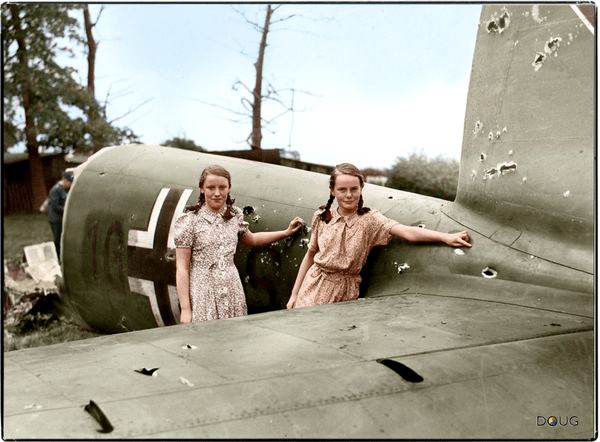
Bad weather reduces the number of German fighters attacking Britain to 500.
The Battle of Britain: About midday, the Luftwaffe conducted large large raids along the Kent coast and attacked Manston, Dover, Folkestone and Deal areas. These raids were intercepted and casualties inflicted. There was a lull until 4 p.m., when a large number of small raids crossed the coast in the region of Weymouth and Lyme Bay and proceeded to the South Wales, Gloucester and Middle Wallop areas. During the night there was very slight Luftwaffe activity.
Weather: Early morning to have low cloud with drizzle patches. Promise of clearing later with possible sunny periods. Some cloud returning during evening but clearing overnight.
What Göring and the German Luftwaffe wanted to do on the opening day of Adler Tag was seriously disrupted by the weather. Hoping that the weather would clear enough for his bomber formations to commence operations on the 14th, was again doomed to failure, the weather was almost a carbon copy of the day previous but with this uncertainty prevailing, it was impossible to launch any full scale operation with the magnitude that Göring hoped for. The day continued with just spasmodic attacks, nothing of any great scale, actions were scattered and could be more rightly termed as nuisance attacks than anything else. It appears that the real Adler Tag would have to wait another day.
The English summer continued with what could only be termed as poor weather conditions. A cloud base of only 2,000 feet meant that it would be highly improbable that the Luftwaffe would attempt any attack in huge numbers. The morning proved correct, it was quiet and most of the fighter pilots just lazed around waiting for the scramble call that never came.
0645 hours: Radar picked up a contact off the Kent coast which was later identified as a Do 17 possibly on recon mission. A flight from 151 Squadron North Weald (Hurricanes) was dispatched to intercept. One Hurricane was hit by gunfire from the Do 17 at 0700 hours with the pilot Sgt G.Atkinson baling out and being rescued from the sea.
1130 hours: The low cloud started to disperse and looked like clearing conditions. A large buildup of enemy aircraft was forming over Calais and was detected by Dover and Pevensey radar at 1140 hours. Park brought to readiness four squadrons. 32 Squadron Biggin Hill (Hurricanes), 65 Squadron Hornchurch (Spitfires), 610 Squadron Biggin Hill (Spitfires) and 615 Squadron Kenley (Hurricanes). The enemy build up seemed to change direction a number of times while over the Channel in an effort to confuse the RAF, but the plotters were kept constantly informed of the situation by the radar stations.
1150 hours: Eventually, the enemy formation straightened up and took a course that would take them just to the north of Dover. 11 Group Fighter Command HQ at Uxbridge gave the command to the sector operation rooms of Biggin Hill, Kenley and Hornchurch to scramble the squadrons and vectored them towards what was known as “Hell Corner”. Meanwhile, as the enemy formation neared the coast, the Observer Corps reported that the formation consisted of 80+ Ju 87 Stuka dive bombers from Luftflotte 2 with a heavy concentration of Bf 109 escorts in the cloud cover. At the same time, two Staffeln of Bf 110s of Rubensdorffer’s Epr. G1 210 had taken off from their base at Calais-Marck and were headed towards Dover. It was 65 Squadron that intercepted them first and as they tried to break up the Ju 87s the Bf 109s came down from the clouds. A twisting network of vapor trails started to develop as the other squadrons started to arrive with aircraft twisting and turning this way and that.
1200 hours: Most of the action is centered over the town of Dover and just out to sea. 65 Squadron that had taken off from Manston ten minutes earlier and were attracted to the Dover area by burning barrage balloons that had been shot up by the Bf 109s, were already heavily engaged in a serious dogfight. On the ground at Manston airfield, the ground crews are still barricaded in their below ground shelters refusing to come out since two days previous. Many aircrews have to refuel and rearm the fighters as a result of this.
1300 hours: While the mêlée is taking place over Dover, Rubensdorffer’s crack Erpr 210 comes in low and almost unnoticed arriving over the Manston airfield with split second timing. They have no opposition from the air, and are greeted only by the station Bofors 40mm gun manned by the Royal Artillery, and the machine guns that were manned by crew members of 600 Squadron. Manston takes a battering for the second time. Accurate bombing destroys another four hangars, three Blenheims of 600 Squadron, the dispersal huts are smashed to pieces and again numerous craters appear over the airfield.
1630 hours: In the west, a few small blips were picked up coming in from over the Channel and heading close to Southampton. Many thought it to be recon aircraft, or maybe just a few scouts. It turned out that the aircraft was 1/. a lone Ju 88 piloted by Oberst Alfred Bulowius according to Richard Collier — Eagle day Battle of Britain 2/. Three Heinkels from KG 55 according to Len Deighton — Battle of Britain, or 3/. Three dive bombing machines mentioned by Wood & Dempster Narrow Margin. Small blips were often seen on the radar on the screens in the west, usually by single aircraft used to inflict confusion to the defenses of Fighter Command.
1700 hours: As the suspected formations cross the south-western coast, 10 Group sends up a number of squadrons. At Middle Wallop, 234 Squadron (Spitfires) is placed at readiness as is 609 Squadron (Spitfires). Within half an hour, one flight of 234 Squadron and one flight of 609 Squadron are scrambled, while it is another ten minutes before ‘B’ Flight of 234 Squadron led by F/L Pat Hughes is scrambled.
1745 hours: Three He 111 bombers come in over the airfield from the south and unload their cargo of bombs. As the Spitfires of both squadrons attack the Heinkels, a second flight of 609 Squadron attempts a hairy take off dodging both bombs and exploding craters in an effort to get airborne. Just as this was happening, a Ju 88 came in from a slightly different angle, unmolested by any of the RAF fighters ready to make its attack on the airfield.
The Ju 88 went into a steep dive, its nose pointing at the business end of Middle Wallop. A few of 609 Squadrons Spitfires were still trying to get off the ground just as at 1,200 feet the bomber let its bomb glide gently from its bomb bay. The bomber then pulled out of its dive, levelled then with engines at full throttle went into a steep climb away from the blast that was just about to happen.
The bomb hit Hangar No.5 blasting out doors and the roof, sides were ripped open like a knife through a tomato. Bodies lay everywhere, both intact and in pieces.
In the meantime, Sergeant Alan Feary of 609 Squadron (Spitfires) banked sharply, his wing almost ninety degrees to the ground, then with miraculous precision, levelled off to see the climbing bomber heading for the clouds. The Spitfire had a perfect view of the bombers underbelly, then, within perfect range he hit the firing button to see a stream of tracer go straight into the whole length of the bomber. It exploded with parts flying off in all directions, its climb halted momentarily then it seemed to hang in the sky then beginning the descent in an uncontrollable manner before hitting the ground.
The Ju 88 crashed at North Charford near Romsey. The crew, Oberlt. W.Heinrici, Gefr. H.W.Stark and Gefr. F.Ahrens were all killed instantly except for Gefr.Ahrens who suffered severe injuries and died the following day. One of the Heinkels was also shot down by 609 Squadron. The other two manage to escape and return to their bases.
So far, any attempt to wipe the RAF out had been nothing but a farce. “They’re playing games at the moment” said Dowding trying to summarize the situation, “they’re not going to achieve anything by these scant and random attacks….I believe that something is building.” 11 Group Commander Keith Park agreed. “What damage they have done to the airfields has been a setback but they’re still operational.” Dowding asked him about the condition of Manston and Middle Wallop, “like I said, just a setback, I believe that Middle Wallop is at full strength and that Manston will be at 100% strength in twelve hours. In that time we will be ready for them.”
And in twelve hours Manston and Fighter Command was ready….and waiting. August 15th dawned to be overcast and gloomy. The latest forecast was sent to the German High Command who postponed any operations for that day. By mid-morning, Manston had been cleaned up and the signal went out that it was fully operational, and the peace and tranquility of the morning allowed Fighter Command to further strengthen its forces. Additional aircraft were flown in, many bases received new pilots even though they were still rather untrained. But by 1030 hours the clouds dispersed to give way to empty blue skies with not a breath of wind, it was an ideal situation for an attack…
RAF Statistics for the day: 32 patrols were flown involving 520 aircraft. Luftwaffe casualties: Fighters — 10 confirmed, 5 unconfirmed, 2 damaged; Bombers — 18 confirmed, 3 unconfirmed, 7 damaged; Unknown — 2 confirmed for a total of 47 casualties with 7 being a result of antiaircraft. RAF casualties: 8 fighters of which 4 pilots killed or missing. 3 bombers were destroyed on the ground.
RAF Casualties:
1245 hours: Dover. Hurricane P3109. 615 Squadron Kenley
F/O P. Collard Killed. (Shot down over Channel. Believed body washed ashore in France)
1250 hours: Dover. Hurricane P3160. 615 Squadron Kenley
P/O C.R. Montgomery Killed. (Failed to return to base. Believed shot down over Channel)
1730 hours: Bournmouth. Spitfire N3024. 609 Squadron Warmwell
F/O H. McD Goodwin Killed. (Shot down off coast by unknown enemy aircraft)
1915 hours: Beachy Head. Hurricane L1739. 43 Squadron Tangmere
Sgt H.F. Montgomery Killed. (Last seen in combat with He 111. Failed to return to base)
Oberst Alois Stoeckl, the commanding officer of the German Kampfgeschwader 55 wing, was killed in action.
RAF Bomber Command dispatches 30 Blenheims on a daylight sea sweep and to French airfields; most turned back because of lack of cloud cover and only 6 bombed, at Morlaix, Dinard and St-Omer; there were no losses.
RAF Bomber Command dispatches 92 Blenheims, Hampdens, Wellingtons and Whitleys to attack various targets overnight in Germany, France and the Netherlands, including raids on 3 oil refineries in France. 2 Blenheims and 2 Whitleys lost.
The RAF supposedly is trying to use wire nets called “spaghetti shells” to drop on Luftwaffe planes and destroy them, but this idea does not go very far.
There is an unusual air raid alert in Berlin around midnight, only the fourth of the war, but it appears to be a false alarm. The British in fact raid oil installations, airfields and railway targets at Bordeaux, Cologne, and other typical targets in northwestern Europe.
The British Ministry of Home Security announced that parachutes had been found in Derbyshire, Yorkshire, and Scotland, though there were no evidence of German troops on British soil.
British scientist, Sir Henry Tizard, left for the United States on the Tizard Mission, giving over to the Americans a number of top secret British technologies including the magnetron, the secret device at the heart of radar.
U.S. Navy Rear Admiral Robert L. Ghormley, Assistant Chief of Naval Operations; U.S. Army Air Corps Major General Delos C. Emmons, and U.S. Army Brigadier General G. V. Strong, arrive in London for informal staff conversations with British officers.
The final informal Royal Navy evacuations from southern France, which have been continuing clandestinely at Mediterranean ports since June, conclude. This terminates Operation Ariel. It is estimated that 191,870 people have been evacuated in Operation Ariel, which excludes the other two major evacuations, Operations Dynamo and Cycle.
On his way to ignite a coup in the Irish Republic and an uprising against Ulster, IRA Chief of Staff, Sean Russell, died aboard German U-boat U-65 of a perforated ulcer. Trained in sabotage by the Germans, he was buried at sea wrapped in a Swastika flag.
Adolf Hitler heard from Walther von Brauchitsch, who insisted that the German Army would like to attack Britain on a wide front with four or more main landing sites. The debate and confusion about Operation Sea Lion continues within the German high command. Admiral Raeder yesterday told Hitler that the Kriegsmarine cannot protect and supply any landings on a broad front. Today, army Commander-in-chief Field Marshal Heinrich Alfred Hermann Walther von Brauchitsch, who is the projected leader of the operation, has his say. Von Brauchitsch proposes just the opposite of what Raeder suggested was feasible, namely, landings on a broad front with multiple landing sites (similar to what the Allies later did on 6 June 1944). This makes perfectly good sense from an army perspective, stretching out the British defenses and creating multiple opportunities for success. However, it makes no sense whatsoever from a naval perspective because the Kriegsmarine simply doesn’t have the ships to supply and defend multiple beachheads.
This illustrates that none of the branches of the Wehrmacht have the slightest understanding of what the others need and are capable of delivering. The confusion is exacerbated by the fact that there is little communication between the German army, navy and air force and even less cooperation (the Luftwaffe, for instance, absolutely blocks the creation of a separate marine air force as an infringement on its own powers). Hitler is fine with all of this — part of his managerial style is to create warring fiefdoms within the German state, with himself as the only one who has all the information and the ability to coordinate solutions — the ultimate arbiter. It is a variant on the Shakespearean “I want around me men who are fat” dictum from “Julius Caesar,” and it enables him to maintain absolute power within the Reich (Hitler also follows the dictum to the letter with portly crony Hermann Goering).
The larger planning flaw is that nobody has anticipated being placed in this situation so quickly, with France vanquished and England the next step. The Germans are not used to or comfortable with planning major strategic naval operations — something they had difficulty with during the First World War, too. Wehrmacht staff planning is concentrated in the Heer (army) because Germany by tradition is primarily a land power (not necessarily by choice in 1940, but the restrictions of the Treaty of Versailles had eviscerated the navy). The naval staff and resources are simply inadequate for the job. In essence, the Germans have no idea what they are doing regarding a cross-channel invasion, and they are building castles in the sand with their vapid plans that are pure abstractions without any grounding in experience or reality. It is little wonder that Hitler is casting about for new victims in other directions that he can ravage on good old reliable terra firma.
Nazi Party official and Chief of the Civil Administration in Luxembourg Gustav Simon decreed the abrogation of the Constitution, the abolition of all political parties, the use of German as the only official language, and the outlawing of the name “Grand Duchy” in official documents. Luxembourg’s constitution was declared void because of the flight of the regent and government. Simon is setting a precedent for future occupations, where the occupying military authorities are relatively benign (save for Einsatzgruppen and the like), but the follow-up civil administrations enact draconian and punitive laws which quickly stoke local anger.
Dutch Premier Dirk Jan de Geer vacations in Switzerland.
The Hungarian delegation left for Turnu Severin, Rumania, tonight to discuss with King Carol’s ministers Hungary’s claims for the return of Transylvania.
The anti-Greek campaign in the Italian press continued today stronger than yesterday. Authoritative newspapers specified Italy’s claims over Greek territory, which apparently embrace the whole of Epirus, which Italians. assert was never Greek, and not only the Ciamuria region. The silence maintained by the Greek press in the face of Italian charges and Athens’ protestations of friendship for Italy are taken here as a sign of “the equivocal attitude that Greece has been displaying for months while conniving with Italy’s enemies.” There is clearly a desire to ignore Greece’s calm attitude. Dispatches from Tirana, Albania, announced that “Greek attacks against Albanians are not decreasing.”
In Malta, there are no enemy air raids. Governor-General Dobbie complains to the War Office that he has insufficient men to man his anti-aircraft artillery and requests reinforcements. The War Office, for its part, inquires about two celebrity Italian pilots, General Cagna and Prince Pallavicini, who apparently were KIA.
British Major General Godwin-Austen watches the Italians side-stepping his defenses along the coast road to Berbera in British Somaliland. With the enemy almost in a position to cut the vital road, he bows to the inevitable. He requests permission to evacuate not just from that position, but from the country altogether. General Wavell of Middle East Command does not return an immediate decision.
Evacuations from Berbera, the capital of the British government, commence. The British and Australian warships take off 5700 troops and 1500 “non-essentials” (civilians and wounded) across the gulf to Aden.
U-59, commanded by Joachim Matz, sank British steamer Betty. At 2234 hours the unescorted Betty (Master Thomas H. Sessions) was torpedoed and sunk by U-59 35 miles 260° from Tory Island. The master and 29 crew members were lost. Four crew members were picked up by the minesweeping trawler HMS Man o’ War (FY 104) (Lt A.D. White) and landed at Belfast. The 2,339-ton Betty was carrying rice and was headed for Liverpool, England.
U-60 made an unsuccessful attack on a steamer north of Tory Island.
Aircraft carrier HMS Illustrious departed the Clyde for Scapa Flow escorted by destroyers HMS Hambledon, HMS Atherstone, and HMS Eclipse. These ships arrived at Scapa Flow at 0600/15th.
At Scapa Flow during a gale, anti-aircraft cruiser HMS Naiad dragged across the bows of light cruiser HMS Ajax. Light cruiser Ajax’s bow was damaged. There was superficial damage to Naiad. Light cruiser Ajax proceeded to Liverpool for repairs.
Destroyers HMS Escapade and HMS Cattistock departed Scapa Flow at 0100 to search for a German submarine reported by aircraft in 60-47N, 2-22W at 1803. They were to be in 59-00N, 5-30W for an anti-submarine sweep. The search was unsuccessful. British aircraft bombed a contact at 0553 in 60-00N, 4-13W, on course 230. This was determined to probably be the same submarine of the earlier report. Destroyers HMS Inglefield and HMS Firedrake departed Scapa Flow at 1115 to join the search. These four destroyers were ordered to return to Harbor if no contact was made by 0800/15th. Destroyers HMS Duncan and HMS Jaguar were exercising to the west of Hoy. At 0854, on her return to Hatston, the same aircraft as had made the attack at 0553, sighted a submarine diving. Destroyers Duncan and Jaguar were sent to search in the area.
Destroyer HMS Kipling departed the Humber at 1050 after repairs and arrived at Scapa Flow at 0600/15th.
Destroyers HMS Ashanti, just arrived from Loch Alsh, and HMS Echo departed Scapa Flow at 2000 to escort British steamer Ulster Monarch (3791grt) to the Faroes. The destroyers arrived back at Scapa Flow at 1615 on the 16th.
Destroyers HMS Watchman and HMS Vortigern arrived at Scapa Flow at 1945 from convoy “ZA” escort. Destroyer Vortigern was damaged alongside an oiler in Harbor. She was repaired by depot ship Woolwich, but was unable to depart with Watchman as planned.
Lt W. A. F. Fryer, S/Lt (A) A. J. Mourilyan RNVR, Petty Officer A. T. Tyler were killed when their Swordfish of 821 Squadron crashed in 60-00N, 3-06W while on anti-submarine patrol.
Destroyers HMS Witherington and HMS Volunteer were escorting a convoy off Portland when it was unsuccessfully attacked by a German submarine.
Destroyers HMS Malcolm and HMS Verity with motor torpedo boats MTB.18, MTB.14, MTB.16 in sweep PO attacked a German convoy of six trawlers escorted by three S.boats off Texel. They claimed sinking one S.boat and one trawler. MTB.18 was damaged when it rammed a motor minesweeper, but was able to return.
Patrol sloop HMS Kingfisher and tug Carbon were damaged by German bombing in Portland Harbor.
German minelayers Tannenburg, Cobra, and Roland laid mines in the southwest North Sea in “SW.2”. The minelayers were escorted by torpedo boats T.2 and T.3 of the 1st Torpedo Boat Flotilla and Greif, Falke, Kondor, Iltis, and Jaguar of the 5th Torpedo Boat Flotilla. Destroyers Jacobi and Galster laid mines in this operation.
Heavy cruiser HMS Kent departed Colombo on the 4th and arrived Aden on the 11th. Heavy cruiser Kent arrived at Suez on the 14th to join the Mediterranean Fleet.
Battleship HMS Royal Sovereign and destroyers HMS Dainty, HMS Defender, and HMS Decoy departed Alexandria on the 11th for Port Said. They departed Suez on the 12th to depart the Mediterranean through the Red Sea. Battleship Royal Sovereign was unsuccessfully attacked in the Red Sea by Italian submarine Ferraris at 2355 on the 14th. The Destroyers were relieved on the 15th by Australian sloop HMAS Parramatta. Battleship Royal Sovereign arrived at Durban on 15 September and was repairing and refitting until 15 October. She then proceeded to Gibraltar arriving from Capetown and Freetown on 18 November. The battleship after repairing defects proceeded on 1 December to Halifax.
Destroyers HMS Hotspur, HMS Greyhound, HMS Encounter, and HMS Gallant departed Gibraltar to rendezvous with battlecruiser HMS Renown. The next day, the destroyers returned to Harbor as the battlecruiser was delayed in Home Waters.
Sloop HMS Bridgewater departed Lagos for Victoria with the Governor’s representatives and one of de Gaulle’s mission. The sloop arrived later that day. The sloop arrived back at Lagos on the 18th.
Convoy OB.198 departed Liverpool escorted by destroyers HMS Viscount and HMS Hesperus and corvette HMS CLARKIA from 14 to 17 August. The convoy was dispersed on the 18th.
Convoy FN.252 departed Southend. The convoy arrived in the Tyne on the 16th.
Convoy MT.140 departed Methil. The convoy arrived in the Tyne later that day.
Convoy FS.252 departed the Tyne, escorted by destroyer HMS Woolston and sloop HMS Fleetwood. The convoy arrived at Southend on the 16th.
In Washington, President Roosevelt conferred with John Cudahy, Ambassador to Belgium; discussed the legislative program with Congressional leaders and other government affairs with officials. The White House announced acceptance of the resignation of Edward J. Noble as Under-Secretary of Commerce.
The Senate debated the Burke-Wadsworth Compulsory Military Training Bill, accepting the Lee amendment to increase the pay of privates to $30 a month, received the Wagner bill to broaden the coverage of the Social Security Act and recessed at 5:47 PM until noon tomorrow.
The House debated the bill to empower the President to mobilize the National Guard and reserves and adjourned at 5:19 PM until noon tomorrow.
The Ways and Means Committee ended open hearings on the proposed excess profits tax, the Military Affairs Committee heard Secretary Knox advocate compulsory military training and the Banking and Currency Committee reported favorably the bill to increase the lending authority of the Export-Import Bank.
U.S. President Franklin D. Roosevelt approved Rainbow No. 4, an emergency plan to defend the entire Western Hemisphere from attack. The plan required a massive number of soldiers and would have mobilized the National Guard and Reserves as well as introduced conscription. Rainbow 4 assumes the fall of France (already done) and of the UK (still prospective) and a combined German/Italian/Japanese offensive. The initial U.S. response would be to occupy British, French, Dutch and Danish possessions in the Western Hemisphere while trying to avoid conflict in the Pacific. The U.S. fleet would be concentrated in the Caribbean, and the U.S. army would protect only North America and the most northern parts of South America.
Roosevelt approved what later became the Two-Ocean Navy Act.
Taking its first specific action during the present conscription debate, the U.S. Senate today adopted an amendment to the draft bill raising the basic army pay from $21 to $30 a month. Conscription critics repeatedly urged such an increase, arguing it would speed up enlistments and help provide volunteer army man power, with no need for conscription. However, administration forces also had endorsed the idea, so that the senate’s decision was not considered a test on the bill itself.
The proposal to separate amortization from the excess profits tax phase of the proposed Excess Profits Tax Bill came to the fore again today when members of the Ways and Means Committee admitted that the measure would run into delays because of the complex factors involved in writing such legislation.
With most of the seats on the Democratic side empty, the House adjourned today without acting upon the bill to authorize the mobilization of the National Guard and reserves for a year’s training.
The largest airplane contract under the 1941 procurement program was awarded by the War Department today. It calls for 700 training planes from the North American Aviation Corporation at an aggregate contract price of $11,335,631.
About a score of Hollywood actors, actresses, directors, dramatists and writers were named as members of the Communist party, as secret sympathizers or as heavy contributors to the party in a transcript of testimony before the Los Angeles County Grand Jury which was made public late today. The testimony identified the following as Communist members, sympathizers or contributors: Lionel Stander, actor; Jean Muir, actress; Frank Tuttle, film technician; Tania Tuttle, his wife; Frank Davis, producer; Clifford Odets, writer and scenarist; Sam Ornitz, writer; Franchot Tone, actor; Fredric March, actor; Gregory La Cava, director: Lester Cole, scenarist; James Cagney, actor: Humphrey Bogart, actor; Frank Scully, writer; Francis Lederer, actor; Herbert J. Biberman, director, and Buddy Schulberg, son of B. P. Schulberg, producer. The witness who gave the Hollywood names was John R. Leech, alleged former “chief functionary” for the Communist party in Los Angeles, who was called before the grand jury to describe Communist activities in Southern California.
Estimates of damage mounted tonight in Tucson, Arizona, as emergency crews began clearing away the mud and debris left behind by a sudden desert cloudburst that claimed at least one life and threatened the fresh water and food supply of this city of 35,000. First estimates of flood loss were placed at around $75,000 but authorities said that figure would be “doubled or trebled” when the real extent of the damage was known. The storm struck the city Tuesday night and within 45 minutes brought rainfall measuring 2.35 inches. Ten-year-old George Gomez, swimming with companions in a storm-swollen arroyo, was carried away by the swift current to become the first known flood victim. His body was recovered. The sudden downpour of water flooded the main plant of the Tucson Gas, Electric Light & Power Co., plunging the city into darkness, silencing radio stations and disrupting communications. Emergency generators, which were set into operation at noon and provided much-needed power for refrigeration units of dairies, meat storage plants, produce houses and other vital food centers, ceased operating at 6 o’clock tonight when the system short circuited and again left the city completely without power or lights. Special power lines were set up a few hours later between Tucson and nearby towns of Cortaro and Ma-rana, bringing in sufficient power to run the most essential industries. The city’s water supply was dropping rapidly. The total reserve of water this morning was 12,000,000 gallons, but by nightfall had dropped to 9,000,000 gallons.
Rampaging rivers wrought death and destruction today in four southern states. Abnormally heavy rainfall In the wake of a hurricane that battered the South Carolina-Georgia coast Sunday sent swift streams swirling out of their banks, washing out highways and bridges, destroying lowland crops and causing millions of dollars damage to industrial plants along their banks, and driving hundreds of persons from their homes. At least 16 deaths were attributed to the floods.
Major League Baseball:
The Phillies beat the Dodgers, 9–6, to salvage a split of their doubleheader. The Dodgers won the opener, 6–5. Johnny Rizzo had three homers for Philadelphia; one in the first game, and two more in the nightcap.
Pepper Martin, making a belated appearance in a parade of substitutes, worked pitcher Mace Brown for a walk with the bases loaded in the eleventh inning tonight to force in the winning run as the Cardinals shaded the Pirates, 7–6.
The Giants take game one of a doubleheader with the Bees, 1–0, in twelve innings, as Carl Hubbell goes the distance, allowing just five hits in 12 innings. But the Bees come back to capture the nightcap, 6–0, behind the pitching of Giant castoff Manuel Salvo..
The game between the Reds and Cubs at Wrigley was rained out.
Cleveland’s Al Smith pitches a one-hitter in beating the White Sox for his 13th victory. A 3rd-inning single by Jimmy Webb is the only safety. Roy Weatherly homered for the Indians.
The Red Sox touch Charley Ruffing for three solo homers — by Lou Finney, Ted Williams, and Jimmy Foxx — but the Yankees score five in the seventh to beat Boston, 8–3. Ruffing won his 11th game of the year, and the Yankees win their sixth straight.
The Tigers picked on the Browns for seven runs in a merry-go-round eighth-inning today to win a loosely played tussle, 13–7, and stop their losing streak at four games. With Schoolboy Rowe batted from the mound while trying for his twelfth victory, the Tigers lagged, 7–6, as they entered the eighth. Then twelve men batted against Roxie Lawson and Slicker Coffman, the last of five St. Louis pitchers, and a mixture of four hits, three walks and two errors brought Detroit victory.
Buddy Lewis’s triple in the ninth inning with two on bases and two out gave the Senators a 5–3 victory over the Athletics today. The blow off Nelson Potter sent Jimmy Pofahl and George Case across the plate. Then Ken Chase retired three Philadelphia batters with dispatch to hang up a seven-hit victory.
Philadelphia Phillies 5, Brooklyn Dodgers 6
Philadelphia Phillies 9, Brooklyn Dodgers 6
New York Giants 1, Boston Bees 0
New York Giants 0, Boston Bees 6
Chicago White Sox 0, Cleveland Indians 4
St. Louis Browns 7, Detroit Tigers 13
Boston Red Sox 3, New York Yankees 8
Washington Senators 5, Philadelphia Athletics 3
Pittsburgh Pirates 6, St. Louis Cardinals 7
Another person is killed and seven wounded today in continuing post-election violence in Mexico.
U.S. Navy destroyers USS Walke and USS Wainwright departed Rio de Janeiro, Brazil for Bahia, Brazil.
U.S. Navy Asiatic Fleet chief Admiral Thomas C. Hart arrived in Shanghai, China aboard USS Porpoise. Upon arrival, he transferred his flag to yacht Isabel.
The British are hurriedly fortifying the Burma border and installing anti-aircraft defenses at Lashio and other cities in the north of Burma, according to foreign travelers reaching Chungking from Rangoon. It is presumed that these activities are impelled by the fear of a Japanese invasion of Yunnan, province of China from Indo-China and a subsequent threat to Burma.
The controversy between United States and Japanese military authorities in Shanghai over control of the former British defense sectors in the International Settlement was settled today, with the United States Marines gaining jurisdiction over the central section, which includes the bund waterfront, according to authoritative sources.
Australian Prime Minister R.G. Menzies has received thousands of messages of sympathy from all over the world as a result of the airplane crash that cost the lives of four Cabinet members.
German raider Orion spent most of this day looking for her Ar 196 floatplane which had been forced to make a water landing due to mechanical issues while conducting reconnaissance on Nouméa, New Caledonia. The aircraft was found and recovered.
Dow Jones Industrial Average: 122.25 (-0.73)
Born:
(Darrell) “Dash” Crofts, American singer (Seals & Crofts — “Summer Breeze”; “Diamond Girl”), in Cisco, Texas.
Arthur Laffer, American economist (The “Laffer Curve”, member of President Reagan’s Economic Policy Advisory Board), in Youngstown, Ohio.
Galen Hall, NFL and AFL quarterback (Washington Redskins, New York Jets) and coach, in Altoona, Pennsylvania.
Eddie Wilson, AFL quarterback and punter (Dallas Texans-Kansas City Chiefs, Boston Patriots), in Redding, California.
Max Schautzer, Austrian-born German radio and television presenter, in Klagenfurt, Germany.
Tom Eyen, American Tony Award winning playwright and lyricist (“Dreamgirls”), in Cambridge, Ohio (d. 1999).
Naval Construction:
The Kriegsmarine (German Navy) Type VIIC U-boat U-207 is laid down by F. Krupp Germaniawerft AG, Kiel (werk 636).
The Royal Canadian Navy Flower-class corvettes HMCS Baddeck (K 147) and HMCS Buctouche (K 179) are laid down by the Davie Shipbuilding and Repairing Co. Ltd. (Lauzon, Quebec, Canada).
The Royal Navy Higgins 69-foot-class motor gun boat HMS MGB 68 is commissioned.
 History Diaries