Adlertag (Eagle Day)
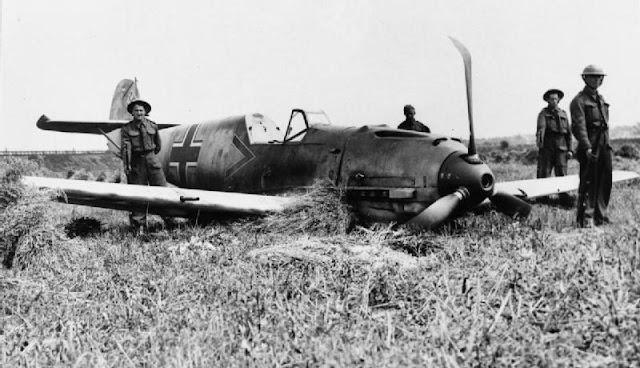
The Battle of Britain: “Adlertag” (Eagle Day) commenced, with 1,485 plane sorties against British ports and airfields. “Adlertag” was the first day of Unternehmen Adlerangriff (“Operation Eagle Attack”), which was the codename of a German military operation by the Luftwaffe and marked the beginning of the all-out Luftwaffe offensive against the RAF in order to eliminate it as an obstacle to invasion. [battleofbritain1940 web site]
Today begins a period of 34 days which are critical to the future of Great Britain, and indeed all of Europe. This period, from today through September 15, 1940, the heart of the Battle of Britain, will determine the viability of Hitler’s Operation SEALION, and of Britain’s ability to continue the war.
There is morning fog on 13 August 1940, so Reichsmarschall Hermann Göring decides at the last minute to postpone Operation Adlerangriff, which is scheduled to commence today on “Adler Tag” (Eagle Day). However, Göring waits too long and, while he stops some formations, other formations already are in the air on their way to their targets. Rather than an overpowering start, there is a confusing series of disjointed attacks on random targets.
The main effort of the Luftwaffe was directed to attacks all along the South Coast from Weymouth to the Thames Estuary. All these raids were intercepted by RAF fighters which suffered very few losses but inflicted heavy casualties. During the night there were many small raids of 1 or more aircraft were distributed over most parts of the country.
Weather: Early morning low cloud base, rain easing during morning but clearing to a fine day with lengthy sunny periods by afternoon.
“We had been briefed the day previous to Adler Tag that we would be going across the Channel in strong formations to attack England. At last, we would be concentrating in large bomber formations with a fighter escort. For so long, we had been flying our individual missions on simple operations like photographic reconnaissance or minelaying duties. Some, like us, had not even seen a British fighter or even fired a shot in anger and it hardly seemed as if a war was on at all. Now, our airfields had many bombers at the ready, many had been flown in from inland airfields, and I could see that now our great Luftwaffe would be at last attacking England.”
- Feldwebel Karl Hoffmann 1/KG30
Göring’s heralded ‘Eagle Day’ was launched in confusion on 13th August, renewed in massive strength by a staff officer’s unauthorized decision on 15 August, and thereafter continued in fierce fighting into September.
“Luftwaffe Intelligence reported absurdly inflated RAF losses and damage to airfields and vital installations, but they could not delude themselves about the alarming losses to Göring’s Air Fleets. Contrary to German belief, Fighter Command could just about tolerate its losses of aircraft by replacement from the factories, but exhaustion and death were taking a critical toll of its experienced Pilots. The British commanders’ greatest fear was that the Germans would smash the delicate defensive network by their attacks on the Sector Operations Rooms, radar stations and communications links. Some British pilots were becoming increasingly angry that they were again and again in squadron strength against huge forces of enemy aircraft. From now until the end, Dowding and Park had to resist fierce pressure to throw everything they had into the sky against the big attacks. But the essence of their brilliant handling of the struggle was that they saw so clearly that in a battle of attrition, they must be defeated. Fighter Command must achieve its victory simply by continuing to exist.”
— Len Deighton
If the Luftwaffe had learned something during the last few months it was that Britain had ‘eyes’ out there that detected their fighter and bomber formations coming across the Channel. Many of their convoy attacks had either to be aborted or they were attacked by British fighters before they had a chance to rendezvous with the target. The Germans knew of radar, in fact they had a radar system of their own, but in the late thirties when radio direction finding was in its infancy, Britain continued with experiments and made full use of the fact that electronics could warn them of any impending attack, whereas Germany decided not to follow it through.
They therefore had to destroy these seeing ‘eyes’ of Britain before any idea of a major attack on British cities could be made otherwise half of their bombers and fighter escorts would be wiped out before they could reach their targets. An alternative to this was to let their heavy bombers fly in across the Channel at low altitudes so that they flew below the radar beams. But this was a tricky method of operation and only specially trained crews could accomplish this low altitude flying. Another problem was that fighter escort was very ineffective at low altitudes so these low altitude missions meant that the bombers only means of defense was trying to remain unobserved, a very tricky situation.
But the attacks on the radar stations at Dover, Pevensey and Rye the previous day, although temporarily put out of action, emergency backup systems allowed all these stations to be ‘back on the air’ within six hours. Ventnor radar was the main problem as it had been hit hard and was the main radar in the Portsmouth/Southampton area.
The way was now clear for them to implement Adlerangriff.
0510 hours: The German bombers began to take off from various airfields and the first major assault on Britain was about to begin. Most of them were airborne and were beginning to form their respective formations, when a last minute message was sent to all units that this first assault had been postponed, and that all aircraft were to return to their bases. The message was not received by the 74 Dornier bombers of KG 2 led by Oberst Johannes Fink, and he was to be escorted by 60 Bf 110’s of ZG 26 commanded by Oberstleutnant Joachim Huth. The weather started to deteriorate further, the forecast had been for clear and fine conditions but a blanket of low cloud covered both the French and the English coasts and the order went out for Angriff beschrankin (Attack Canceled) owing to the weather, with the possibility of a resumption in the afternoon should the weather clear. This message was received by Huth, who relayed the message to the rest of his 60 fighter-bombers. However, Fink’s Dornier had a malfunction in its long-range radio that he did not know about and was therefore unaware that the operation had been canceled. To compact the situation, there was no radio communication between the Bf 110’s and the Dorniers, and as the bombers were flying in heavy cloud Fink’s Dorniers did not realize that the Me 110’s had returned to base. Approaching the English coast, the Dorniers broke up into two separate formations. One headed for Sheerness on the Isle of Sheppy, while the other headed towards the Coastal Command station at Eastchurch.
0557 hours: It does appear that the radar stations at Dover and Rye that were now back in action, had detected and followed the progress of the Dornier formation, but as to the final destination of the Dorniers no one knew or could estimate their target. The formation had taken a wide berth around the Kent coast, and then entered the Thames Estuary where a number of targets would be available to them. The Observer Corps at Bromley asked of Fighter Commands liaison officer, “Have we a large number of aircraft forming near Rochford?” The immediate reply from HQ was a definite ‘No’.
0630 hours: Radar had also picked up an enemy formation coming in from the Channel between Hastings and Bognor and Fighter Command dispatched 43 Squadron Tangmere (Hurricanes), 64 Squadron Kenley (Spitfires), 87 Squadron Exeter (Hurricanes) and 601 Squadron Tangmere (Hurricanes) . 601 Squadron head east towards their vectored position gaining height when a formation of Ju 88s who’s mission was to bomb the aerodromes at Odiham and Farnborough (Hants) are spotted on their port side.
0640 hours: P/O H.C.Mayer’s who is leading “A” Flight of 601 Squadron reports a tiered formation of Bf 109s and Bf 110s at high altitude, and orders his flight to gain position and attack the bombers.
Mayer’s starts to make his own run but he is wary as a formation of Bf 110s begins to dive. Waiting for the right instant he executes a climbing right turn into them. From almost head-on he presses his firing button and sees part of the roof and fuselage of one Messerschmitt break off. Swinging around in a tight turn he finds a Ju 88 below and dives after it. He fires a five- second burst and the bomber bursts into flames. Mayer’s is now alone and he searches the sky to locate his section. He spots 5 Ju 88s making for France and climbs up to intercept. He makes a beam attack, sweeping the whole formation from front to rear. One bomber falls behind and seeks safety in cloud cover. Mayer’s follows, manages to relocate his prey and fires off his remaining ammunition. With one engine burning, the German plane loses height. Harried by three squadrons of British fighters, the Ju 88s miss their targets, disperse into small groups and make a disorderly retreat back to France.
The Ju 88 that P/O Mayer’s shot down could possibly have been attacked by Sgt. Hallowes of 43 Squadron. The Ju 88, from 1/KG54 crashed and exploded at Treyford with the pilot’s body never being found and the other two crew members being captured after baling out of the aircraft. Another Ju 88 was shot down by both 601 and 43 Squadrons and crashed near Arundel (Sussex) while another Ju 88 which came under fire from the Hurricanes of 601 Squadron aborted the mission early after its engines began giving trouble. Two Hurricanes of 43 Squadron were shot down with F/Lt T.P. Dalton-Morgan baling out of his aircraft and being wounded and P/O C.A. Woods-Scawen escaping from his burning Hurricane after it crash landed. One of the aircrew Bailed out of a Ju 88 thinking the worst was going to happen and landed in a field in the region of Tangmere. He was captured and taken to the aerodrome.
87 Squadron Exeter (Hurricanes) was also dispatched to intercept the formation but being scrambled late arrived after the Ju 88s had decided to return to France, but they did intercept a lone Ju 88 about 0800 hours south of Chichester and in the ensuing combat, one Hurricane was hit by gunfire from the enemy bomber and crashed south of Selsey Bill. Other Hurricanes of 87 Squadron continued the combat with the Ju 88 receiving damage and crashing into the Channel.
0645 hours: 74 Squadron Hornchurch (Spitfires), under the command of “Sailor” Malan, were ordered to patrol the Thames Estuary as a precautionary measure. The radar stations at Dover and Pevensey, not being at 100% strength because of the previous days bombing could not give a definite fix only to say ‘that we are definitely picking up a signal’ and any fix could only be estimated. As the Dorniers were using the low cloud as cover, the Observer Corps had difficulty in locating any formation. At 0655hrs, enough enemy aircraft could be seen coming out of the cloud to confirm that an enemy formation was coming in from the Thames Estuary and flying in a westerly direction.
0702 hours: The call went out again from Bromley. this time with a definite report “Raid 45 is bombing the Eastchurch drome.” Park released 111 Squadron Croydon (Hurricanes) and vectored them towards Sheppy.
By this time, 74 Squadron had located the Dorniers between Whitstable and Margate and managed to dive in to attack the rearward section of the enemy formation. A number of Dorniers peeled off and tried to get back into the cloud cover. The forward section of the German formation continued and completed their bombing attack on Eastchurch believing it to be one of Fighter Commands stations. Considerable damage was done. Two hangars were severely damaged. The operations room received a direct hit, and a number of Blenheims of 35 Squadron Coastal Command were destroyed. German records state that 10 Spitfires had been destroyed that were at Eastchurch, but RAF records indicate that only one was damaged and that it was able to be repaired. (266 Squadron [Spitfires] had been using Eastchurch at the time)
0720 hours: The bombing of Eastchurch had finished, and the German bombers turned and headed for home. But the clouds had started to disperse and now they were flying with brilliant sunshine. Kenley had scrambled 111 Squadron (Hurricanes) based at Croydon to intercept the bombers, but not in time to divert the attack away from Eastchurch. 151 Squadron North Weald (Hurricanes) were also dispatched. With no fighter escort, the Dorniers were like sitting ducks. 111 squadron claimed four Dorniers, while one of the canon equipped Hurricanes of 151 Squadron damaged another. One of the Dorniers had crashed and its crew captured and taken prisoner. Fink himself made it back to his base at Arras and was fuming that he had been allowed to continue the raid without proper fighter cover, and that because of no proper communication he had five of his bombers shot down and a further five so badly damaged that three of them were beyond repair.
Oberleutnant Heinz Schlegel, flying Finks rearguard formation, had seen Eastchurch looming straight ahead but hadn’t dropped a single bomb; the Spitfires of 74 Squadron had swooped from the sun too swiftly. There was rending clatter, and the starboard spluttered and died; the Dornier was yawning violently to the left. A hot, yellow light flashed before Schlegel’s eyes, and now the port engine was in trouble too. Breaking for cloud cover, Schlegel fought to keep the Dornier airborne, steering what he hoped was due south. Then the clouds parted and his spirits rose exultantly, only to sink again as quickly; land loomed beneath them but it wasn’t familiar terrain.
Cautiously, Oberleutnant Gerhardt Oszwald, the navigator, voiced what all of them felt: ‘ I don’t think this is France. Shall we make it?’ Schlegel realized they wouldn’t so, grimly, he set the Dornier careening for the flat English pastures, seeing too late that the one unobstructed field for which he had aimed was scored by a deep trench. Swaying from side to side like a truck out of control, the bomber ripped like a juggernaut across the meadowland, then, with a sickening half swing, wrapping its starboard wing round a tree, smashed to a halt.
To the crew’s astonishment, they barely had time to crawl from the plane before ten British soldiers came storming through the grass to disarm them, whooping like Comanches on the warpath. Bewildered, Schlegel was taken to an outpost of the London Scottish Regiment, near Barham, Kent, and confined in a small office adjoining the unit canteen. At a counter, a long line of men were queuing unhurriedly to buy regimental cap-badges and tartan stocking tabs; from somewhere he heard the far keening of bagpipes. Still dazed from the shock of the forced landing, Schlegel puzzled: If England’s due to be conquered in three days, how can they take time off for this?
On returning to Arras, Fink circled the airfield then made a slow and gentle touchdown. But on alighting from his plane, he stormed towards the operations room and immediately grappled for a telephone and demanded a priority link to Kesselring’s Cap Blanc Nez HQ. It was only a few days earlier that Generalfeldmarschall Albert Kesselring had given them a lecture on Channel crossings, combat and safety. Fink felt that what had happened that day was sheer criminal negligence on the part of High Command. It was this negligence that had cost him five valuable crews, a total of twenty experienced and highly trained men, either killed or possibly taken prisoner.
He spoke to Kesselring personally, and constantly raised his voice in a manner that did not worry him that he was talking to a person of higher authority. “Where the hell were those dammed fighters then, just tell me that.” Kesselring done his best to calm down the irate Fink, but all that happened was that Fink grew even angrier.
“I do not understand this anymore, and the other thing — a major attack can just be canceled then, can it, it can be canceled at just one moment’s notice. Has anybody down there taken the trouble to estimate just how long it takes my Kampfgeschwader to get across the Channel, and all that time my bombers are under the threat of British fighter attack, and you, you cancel our operation” Kesselring later came over personally to apologize to Fink. He humbly told him, that the whole of the commencement of Adlerangriff had started rather badly. The low cloud base was not expected, the British radar was supposed to be out of action, but it wasn’t and they detected us with the usual speed and accuracy, and the co-ordination of vast aerial missions is something that the Luftwaffe must seriously plan with greater planning.
But although there was good weather in the Thames Estuary, it was not as good over the Channel and more confusion was experienced by the Luftwaffe in an effort to get Adlerangriff started.
This was just another case of errors in German intelligence. As in the raid in the Thames Estuary, Sheerness and Eastchurch were not Fighter Command airfields, neither were Odiham and Farnborough, Farnborough being an airfield of the Royal Aircraft Establishment. These errors came about because of the fact that German Intelligence relied on older ordinance survey maps of England and were trying to bring them up to date with information brought back by reconnaissance aircraft. Bad analysis of the situation and poor interpretation meant that they did not have a complete picture of the overall situation.
1140 hours: A buildup of a small formation was picked up by radar off the French coast off Cherbourg. It turns out to be 20+ Bf 110s who were to escort Ju 88s of KG54 on a raid on Portland Harbor. KG54 had received the message that the raid had been canceled and they returned to their base, but the message was not conveyed to 1/ZG2 and the Bf 110s continued their path across the Channel.
1230 hours: 238 Squadron Middle Wallop (Hurricanes) and 601 Squadron Tangmere (Hurricanes) engaged the Bf 110s and a one sided air battle commenced. 1/ZG2 lost five Bf 110s in quick succession and what was left aborted any raid on Portland and headed for the safety of the French coast. 43 Squadron had one Hurricane damaged, while 601 Squadron lost one Hurricane, that of P/O H.C.Mayers who Bailed out of his damaged aircraft with injuries to his legs. While dangling from his parachute, a Bf 110 fires a short burst at him bu misses and P/O Mayer’s lands in the Channel. Two other Hurricanes of 601 Squadron are damaged, but manage to return to base.
Word had got around to the Luftwaffe airfields that Adlerangriff had been postponed until the weather became more favorable. But this was quickly thwarted when the order went out at:
1300 hours: that Eagle Day was definitely “on” and that because of a weather improvement there would be considerable bomber and dive bomber attacks on a large scale on the British airfields across the southern portion of England. It appeared that the German plan was to make simultaneous attacks from Weymouth to Portland, Southampton and Portsmouth, and targets in north Kent.
This time, the attack is designed to open a seam in the defenses via an elaborate head-fake. A diversionary “free ride” mission by Bf 110s with no target over the south coast draws off the RAF interceptors. The twin-engine fighters lose five planes, but also mete out damage to the Spitfires. Unfortunately, the bombers arrive late — three hours late — and the RAF fighters are back in the air ready to meet them. StG 77 sends 52 Stuka Ju 87 dive bombers against Southampton, the Isle of Wight and nearby points. Despite a fighter escort from JG 53, the massive RAF fighter presence downs 5 bombers, which in any event have little success with their bombing mission due to the weather.
1500 hours: A number of formations were detected off of the French coast near Cherbourg and from the direction of the Channel Islands. The information was conveyed to Fighter Command HQ. They watched the WAAFs push and pull the enemy markers across the board with their long rakes. The command HQ at 10 Group was informed and from here a number of squadrons were brought to readiness. Park at 11 Group was also informed of the situation as his squadrons at Tangmere and Westhampnett may be called in to provide assistance should the enemy formation turn and head towards Southampton.
1510 hours: 10 Group headquarters brings the following squadrons to readiness. 152 Squadron Warmwell (Spitfires), 213 Squadron Exeter (Hurricanes), 238 Squadron Middle Wallop (Hurricanes) and 609 Squadron Middle Wallop (Spitfires). 11 Group brought 601 Squadron Tangmere (Hurricanes) to readiness. The large formation is detected heading in a straight line towards Portland, but they were still far enough out over the Channel to alter course and head for various selected targets. The squadrons of Fighter Command lie in wait.
1530 hours: The large formation is now on radar just out from the Dorset coast and was approaching to the west of the Isle of Wight. It seemed as if this was to be a massive attack, and the German formations were heading in the direction of Portsmouth and Southampton. As predicted, the formations were now broken into groups, and consisted of 120 plus Ju 88s from KG 54 and LG 1, these were escorted by 40 plus Bf 109s from V/LG 1 that were coming in from the western end of the Channel. To the east came 77 Ju 87s from II/StG 2 and StG 77 and were escorted by 50 plus Bf 109s from JG 27. Flying slightly ahead of the bomber formations were 35 Bf 109s of II/JG 53. This was a total of about 450 German aircraft that was approaching the English coast.
First to be released were 152 Squadron Warmwell (Spitfires) and 213 Squadron Exeter (Hurricanes) who were vectored to a position west of the Isle of Wight over the Solent. Soon after, one by one the other squadrons are “scrambled”. 152 Squadron are first on the scene and engage a formation of Bf 109s and within a few minutes are joined by 213 Squadron Exeter (Spitfires). Between them, they engage the full force of the Bf 109s and Bf 110s and in the ensuing combat draw the German escorts away from the Ju 88 bombers. But the Bf 109s are in that critical stage of fuel shortage, the long haul across the Channel and now in combat situation they had to conserve fuel for the return journey home.
1600 hours: With the weather improving the first of the Ju 88 bombers crossed the coast and set course for Southampton. 609 Squadron Middle Wallop (Spitfires) engaged the bombers but were swooped on by the Bf 109s who could engage combat for only a few minutes before turning back because of their fuel situation. It appears that Fighter Command were getting to realize that coming across this wider part of the Channel, the Bf 109s had restricted time to engage combat because they would only have enough fuel for the return journey back to base.
This now allowed 609 Squadron to attack the bombers. They found the Ju 88s and some Ju 87s below them and an escort of Bf 109s just above the Stukas. To the west, another group of Bf 109s were involved in a dogfight with 238 Squadron Middle Wallop (Hurricanes).
Attacked out of the sun, the Stukas made a perfect target. On the way the Spitfires dived through five Me109s, breaking them up, Pilot Officer D.M.Crook sending one spinning down into a field on fire. The whole Stuka formation broke up with nine falling in flames or with the crews dead. For once, the Spitfires had altitude, position and surprise and they used it to deadly effect. The remaining Ju 87s missed their main target, Middle Wallop and scattered their bombs over three counties. They hit Andover airfield, but this was not a fighter station and little damage was done.
1605 hours: The Ju 88s that continued managed to do considerable damage to Southampton docks and to the city itself before continuing on to Andover airfield which they mistook for Middle Wallop, where again they done a fair amount of damage. The formation was allowed to continue to Andover free of RAF fighter attacks because 609 Squadron had to return to Middle Wallop because they were low on fuel and ammunition. But, nearing base, they made contact with a formation of Ju 87s that were in fact heading for Middle Wallop as well, but with different intentions to that of 609 Squadron.
1630 hours: The Ju 88s of KG 54 that were coming in from the west made their attack on Portland, but as they were making their approach they were intercepted by 152 Squadron Warmwell (Spitfires), 213 Squadron Exeter (Hurricanes) and 601 Squadron Tangmere (Hurricanes), many of the bombers were damaged but some got through and dropped bombs on Portland causing minor damage. The bombers seemed to make for Southampton after the attack on Portland, but the RAF fighters were swarming in front of them and forced them to abandon any further attack and they headed out to the open Channel and home to base.
Although the RAF lost a number of fighters in this combat, it was obvious that the Luftwaffe had lost an even greater number, mainly due to the fact that the fighter escorts had to return back to their bases because of the fuel situation, this paved the way for the RAF fighters to attack the Stukas and the heavier bombers who were now at their mercy.
“We were at a disadvantage, and always will be on any attack made west of Selsey. In the east, our 109s have enough fuel to escort the bombers over the Channel and spend fifteen or twenty minutes over the English coast. To the west it is different, the Channel is much wider, our 109s have to travel further and by the time we are over the English coastline our pilots have to think about turning back. On the 13th August, we wondered why the RAF had not come out to meet us as they normally would, our bombers and their escorts had a clear run all the way. But the RAF had understood that we would use up valuable fuel to the English coast and only when it was nearly time for our fighter escort to turn back did the Spitfires and Hurricanes appear. For them, it meant that they could then attack our bombers without any fear of attack by our fighters.”
- Adolph Galland III/JG 26 Luftflotte 2
1700 hours: another sighting was made of a formation of enemy aircraft coming in across the Channel. This seemed to be made up of two separate formations. The larger coming across the coast near Dungeness that were identified as Ju 87s from II/StG I, while a smaller group came in over Dover, these were identified as Ju 87s of IV(St) LGI with both groups escorted by Me 109s.
56 Squadron North Weald (Hurricanes) were dispatched to intercept. No sooner had they started to disperse the Stukas, when they were suddenly attacked by the Me 109s. The Hurricanes then started to mix it with the German fighters allowing the Ju 87s to continue veering north towards the Thames Estuary. One Hurricane from 56 Squadron North Weald received damage and although managing to stay airborne, was losing height and trailing smoke. He eventually made a pancake landing at Hawkinge.
The Ju 87s were making for Rochester in north Kent. The target here was the Short Brothers aircraft factory but had difficulty in finding the target so decided to return to their base. In their plans of attack, it was the Luftwaffe intention now to hit the RAF on the ground as well as in the air, and the Ju 87s of IV/LG 1 were instructed to bomb Detling airfield just outside Rochester. Here some of the Me 109 fighter escort broke away from combat with 56 Squadron to provide cover for the Ju 87s. 56 Squadron was instructed to follow the 109s and some of the Hurricanes made attacks on Ju 87s as well as the Me 109s over the target airfield.
1716 hours: Coming in from the Thames Estuary, following the Kent coastline past the seaside towns of Margate and Whitstable, past the Isle of Sheppy then an immediate turn to port into the River Medway and and once past the unmistakable city of Rochester and Detling lies just beyond. Although not belonging to Fighter Command, Detling would present itself as an impressive target. A large expanse of open airfield.
Detling was badly damaged in the attack. The operations block was totally destroyed, most of the hangars were completely flattened and all the contents destroyed. A total of 68 airmen in the station mess hall were killed as it scored a direct hit, the fuel dump exploded in flames, the Commanding Officer of the station was killed instantly by the entrance of the HQ building, and a number of Blenheims that had been bombed up and ready for the evening’s mission exploded destroying them completely. But again, this was another blunder by Luftwaffe Intelligence who had reported Detling as a major British airfield. But Detling was only a Coastal Command airfield that was used for look-out and observation patrols for German naval vessels and the occasional air-sea rescue and was not a Fighter Command airfield. This was really a wasted effort by the Luftwaffe the only bright side to their mission was that they did not lose any aircraft in the Detling attack, but 56 Squadron (North Weald) although three pilots escaped injury and one Bailed out with severe burns, they lost four Hurricanes.
The 13th of August could only be summed up as a total disaster for the Luftwaffe. We know of three occasions where communications had broken down allowing the attackers to be hit at will by the RAF because missions were incomplete. This naturally led to the Luftwaffe sustaining a great number of casualties. And the blunder by German Intelligence regarding Detling as mentioned, was a complete waste of time, and again because of the high casualty rate was also a waste of valuable aircraft and pilots. The total for the day was that the Luftwaffe had lost some 53 aircraft (another reference states that this figure was only 34) and nearly two hundred aircrew, while although not including the 68 airmen killed at Detling, the RAF lost 15 fighter aircraft and miraculously only three pilots were killed, but it was still a day of intense fighting.
Dowding said of this day ‘….it’s a miracle’. He had been looking back on the day’s events and considered that it had been very busy all round, and that the fifteen planes that had been lost would be very easily replaced. Adlerangriff was to be an all-out attack on the RAF and its fighter bases, but as yet all the wrong targets had been hit, causing no immediate concern to Fighter Command.
2200 hours: August 13th was not finished yet. Major towns, cities, factories and the rail network became the target of the German night bombers. The Short Brothers aircraft factory in Belfast in Ireland, and at Castle Bromwich where the new Spitfire Mk II was being produced and other targets were: Aberdeen in Scotland, Liverpool in north west England and Swansea in Wales all became targets, but only reports of ‘damage sustained, but only minor’ were conveyed to the War Office.
As part of the war of nerves, the Luftwaffe drops special packages by parachute over England and Scotland. The contents of the parachute decoys, which include radios, maps and similar items of use by ground troops, are designed to suggest that the invasion already is in progress – which it, of course, is not.
The commencement of Adler Tag was, not for the Luftwaffe a successful one. A combination of poor weather conditions and a number of ‘bungles’ on their part did not even put the RAF to the test. First, the airfields that the Luftwaffe were targeting, Eastchurch, Detling, Odiham and Farnborough were not Fighter Command airfields, during the morning the German bombers lost their fighter escort and during the afternoon a fighter escort had left their French base without the bombers that they were supposed to escort. Now, Göring was under the impression that all fighter squadrons in 10, 12 and 13 Groups had been sent south to 11 Group and informed Luftflotte 5 in Norway to prepare for attacks on the English north and Scotland as the time was now right.
RAF Statistics for the day: 227 patrols were flown involving 1,320 aircraft. Luftwaffe casualties: Fighters — 36 confirmed, 30 unconfirmed, 15 damaged; Bombers — 41 confirmed, 23 unconfirmed, 16 damaged; Unknown — 4 confirmed for a total of 165 casualties. RAF casualties: 13 fighters of which 4 pilots were killed. 86 British Fleet Air Arm and 1 RAF Fighter Command aircraft were destroyed on the ground.
Overnight, German aircraft damaged aircraft factories in Belfast and Castle Bromwich.
RAF Casualties:
0800 hours: Selsey Bill. Hurricane. P3387. 87 Squadron Exeter
F/O R.L. Glyde. Missing. (Hit by gunfire from Ju 88 and crashed into the sea)
1630 hours: Portland. Hurricane P3177. 238 Squadron Middle Wallop
Sgt H.J. Marsh. Missing. (Believed shot down by Bf 109. Failed to return to base)
1650 hours: Portland. Hurricane P3348. 213 Squadron Exeter
Sgt P.P. Norris Killed. (Shot down off Portland and crashed into sea. Body washed ashore in France later)
1950 hours: Eastway. Spitfire R6766 65 Squadron Hornchurch
P/O F.S. Gregory Killed. (Night flying practice. Bailed out too low for reasons unknown)
Top RAF ace James Harry Lacey is shot down during the day by a Heinkel He 111, but survives and immediately returns to his No. 501 Squadron unit at RAF Croydon.
The graves of the crew of one of the Dornier Do 17 bombers shot down in the first raid of the morning, the one without fighter escorts, were dug in a Whitstable, Kent churchyard. The two men were buried in a standard plot, but then the crew of another bomber downed a few days later was buried directly above them in the same plot. When German war graves were transferred to a military cemetery at Staffordshire in 1962, the graves of the crew of the first bomber, buried deeper down than the later crew, were not noticed. Finally, in 2012, historians uncovered the error, and the graves were transferred. The two crewmen were Oberleutnant Horst von der Groeben and Oberleutnant Gerhard Muller, who had bailed out but whose parachutes failed to open. The plane wound up in pieces on the mudflats.
At heart, the Luftwaffe failure on Adler Tag is an intelligence failure: the Luftwaffe high command does not realize that the airfields are not the weak link of the RAF defenses, but rather the radar stations are. If the fragile radar masts can be knocked down and their control centers demolished, they will require time and effort to replace them. Simply putting craters into airfields that bulldozers can cover over in a couple of hours is not a strategic solution. The rabid and unproductive attacks against the same targets over and over and over – such as the aircraft factory at Filton near Brighton – show a clear lack of imagination and insight by the planners.
Does Adler Tag by itself decide the campaign? Absolutely not. The Luftwaffe remains ready to ramp up the attacks and the day’s losses are manageable. However… things cannot continue like this for the Luftwaffe. The ratio of their losses of both planes and experienced pilots relative to those of the RAF is becoming alarming.
RAF Bomber Command dispatches 29 Blenheims to attack airfields in France and the Netherlands during the day. 16 bombed but 12 were lost, including 11 out of the 12 aircraft from a formation provided by 82 Squadron which was caught by German fighters while attacking Hamstede airfield in Holland. This was the second time during the summer of 1940 that a formation from this squadron was almost completely destroyed. 6 Blenheims on a sea sweep and 2 Blenheims on photographic reconnaissance to the Dortmund—Ems Canal operated without loss.
RAF Bomber Command dispatches 62 Hampdens and Wellingtons to 5 widely spread targets in Germany overnight. Also 6 Blenheims are sent to airfields and a seaplane base at Brest and 2 Wellingtons to photograph Stettin and Swinemunde on the Baltic coast. 1 Hampden was lost from the force bombing Germany.
RAF Bomber Command dispatches 35 Whitleys to attack Milan and Turin overnight. This is the first raid on Italy since the end of the Battle of France. 1 Whitley returning from Italy crashed in the sea.
Malta remains a functioning RAF base which mounts missions of its own, not just defensive ones. Today, it sends nine Swordfish bombers against shipping in Augusta Harbor, Sicily. Three planes are lost.
Italian forces continue attacking Tug Argan, British Somaliland. At the Battle of Tug Argan, the Italian attacks on the hills defending the approaches to Berbera continue, with little progress. Having occupied the hills to the south of the coast road, the Italians begin to maneuver around the British blocking position to the south in an attempt to cut the British communications. The British, vastly outnumbered, can do little to prevent this.
A sinister Wehrmacht factor enters the battle today: artillery fire from France. The English Channel at its narrowest is roughly 20 miles (30 km) wide, and there is plenty of German artillery that can reach that far (any battleship main gun could do it, and the Germans actually have bigger guns in their on-land arsenal). Today, the first shells drop on Dover. They are from the Siegfried Battery at Audinghen, south of Cap Gris Nez, the Grosser Kurfürst battery at Cap Gris Nez, as well as various railway guns.
Erich Raeder met with Adolf Hitler and attempted to convince Hitler to reduce the landing front for the planned invasion of Britain as the German Navy had little means to maintain the security of a wide landing area.
Goebbels issues orders to the Gauleiters to organize memorial ceremonies for fallen soldiers in order to overcome the influence and activities of the churches in this sphere. Until now, Goebbels said, certain restraints had had to be observed. Now, after the victorious conclusion of the war with France, the offensive could again be taken
Vichy France passed a law aimed at Freemasonry by banning secret societies. The government also attempts to reassure the public that it will not pass any (more) laws directed against Jews.
Trials for war guilt open in secret session at Riom, France.
The uprising against the Italian occupation government in Albania continues, with unverified reports of hundreds of Italian deaths.
Italian spokesmen accused Greece tonight of having territorial designs on Italy’s Albanian domain and indicated that Premier Mussolini sooner or later will demand slices of both Greek and Yugoslav territory in a “general settlement” for Albania. The Italian press has been hitting at Greece since the weekend disclosure of the death of an Albanian patriot, Daut Hoggia, at the hands, the Italians said, of two Greek assassins. Italians also charged Greece is a “silent ally” of Great Britain in the war. Yugoslavia entered the Italian picture only today.
Greece, faced by Italian pressure to alienate her and Great Britain, was reported reliably tonight to have rejected an Axis “suggestion” that she formally renounce British guarantees of her independence and territorial integrity.
Malta Governor-General Dobbie proposes to Whitehall that stocks of all strategic and non-perishable items be maintained at an 8-months reserve (six months plus two months for the time it takes convoys to make it around Africa). He emphasizes that all items must be maintained at such levels:
“If the ability of this fortress to resist attack is not uniformly strong, weakness at one point will affect the whole.”
Whitehall is sympathetic, and also asks for lists of items which might improve soldier morale on the island, including such things as cigarettes and books.
U-60, commanded by Oberleutnant zur See Adalbert Schnee, sank Swedish steamer Nils Gorthon, twenty five miles north-northeast of Malin Head, in 55-45N, 7-30W. At 2147 hours the unescorted and unarmed Nils Gorthon (Master E. Kastman), a straggler from convoy HX.62 due to fog, was hit aft by one G7e torpedo from U-60 and sank within two minutes 25 miles north-northeast of Malin Head. Four crew members were lost. The survivors had no time to launch the lifeboats and abandoned ship on two rafts, which lost contact to each other in the morning of 15 August. Later that day, the eight men on one raft were picked up by the Icelandic trawler Helgafell and landed at Reykjavik on 19 August. The master and eight men on the other raft were picked up by HMS St. Kenan (FY 264) (T/Lt H.J. Beverley, RNR), escorting the convoy OA-198, after their flares were sighted at 01.15 hours on 16 August. The armed trawler searched briefly for the other raft before rejoining the convoy and later landed the survivors in Glasgow, where the chief officer died of wounds in a hospital. The 1,787N ton Nils Gorthon was carrying wood pulp and was headed for Ridham Dock, England.
Vice Admiral Somerville departed Scapa Flow at 1600 to return to Gibraltar with battlecruiser HMS Renown, escorted in the local approaches by destroyers HMS Tartar, HMS Bedouin, HMS Punjabi, and HMS Mashona. Returning to Scapa Flow, the destroyers carried out an anti-submarine sweep. Destroyers Tartar, Bedouin, Punjabi, and Mashona arrived at Scapa Flow at 0630/15th.
Light cruiser HMS Sheffield and anti-aircraft cruiser HMS Cairo arrived at Scapa Flow.
At 0440, the Home Fleet at Scapa Flow was brought to one hour’s notice. At 1031, the Admiralty advised no ship was to be taken in hand for boiler cleaning or refitting until further orders.
British minefield BS.31 was laid by minelayers HMS Plover and HNLMS Willem Van Der Zaan and destroyers HMS Intrepid and HMS Impulsive.
S/Lt (A) P. T. Eckersley, RNVR, and Naval Airman S. J. Snow were killed when their Proctor of 755 Squadron crashed near Winchester.
Minesweeping trawler Elizabeth Angela (253grt, Temporary Skipper F. A. Meggitt RNR) was sunk by German bombing in the Downs, in 51-19-57N, 1-33-03E. One crewman was killed on the trawler.
Destroyer HMS Kimberley and sloop HMS Auckland bombarded El Sheika, forty miles west of Berbera.
Swedish steamer Mongolia (2124grt) was sunk on a mine twelve to fifteen miles from land in Kiel Bay.
Nine Swordfish of 830 Squadron from Malta attacked Augusta.
Midshipman (A) D. S. Edmondson and Naval Airman R. Pearson were lost when their aircraft was shot down. Lt D. W. Waters and Naval Airman S. D. Harris were shot down and captured. A third plane, piloted by Lt Cdr A. F. Hall with Lt B. Walford and Leading Airman F. Pickles,was lost, but the crew was rescued by a British rescue boat.
The British Royal Navy cruiser HMS Carlisle shot down an Italian aircraft attacking Berbera, British Somaliland.
Convoy OA.198 departed Methil escorted by sloop HMS Deptford on the 13th and corvette HMS Bluebell and escort vessel HMS Gleaner on the 14th. The corvette and the escort vessel were detached to convoy SL.42.
Convoy FN.251 departed Southend. The convoy arrived in the Tyne on the 15th.
Convoy MT.139 departed Methil. The convoy arrived in the Tyne later that day.
Convoy FS.251 departed the Tyne, escorted by destroyer HMS Vivien and sloop HMS Fleetwood. The convoy arrived at Southend on the 15th.
In Washington today, President Roosevelt returned from Hyde Park and his tour of the New England defense areas, issued an executive order strengthening the control of the Bureau of the Budget over Federal expenditures, conferred with Sumner Welles, Under-Secretary of State, on the foreign situation, and transacted other executive business.
The Senate continued the debate on the Burke-Wadsworth Conscription Bill and recessed at 4:45 PM until noon tomorrow.
The House defeated an attempt to consider the Peterson bill to permit transfer of mortgaged farms to the government. The Military Affairs Committee opened a hearing on the Burke-Wadsworth bill, the Ways and Means Committee continued hearings on tax legislation, the Banking and Currency Committee heard Loan Administrator Jones testify on the Export-Import Bank increase bill and the Smith Committee questioned National Labor Relations Board officials.
U.S. President Franklin D. Roosevelt conferred with U.S. Secretary of the Navy William “Frank” Knox, Secretary of War Henry L. Stimson, Secretary of the Treasury Henry Morgenthau, and Undersecretary of State Sumner Welles concerning the transfer of destroyers to Britain. Consequently, Roosevelt informed British Prime Minister Churchill (in a telegram sent from Acting Secretary of State Sumner Welles to U.S. Ambassador Joseph P. Kennedy) that among other items previously sought “it may be possible to furnish to the British Government… at least 50 destroyers…” Roosevelt stated, though, that such aid could only be given provided that “the American People and the Congress frankly recognized in return…the national defense and security of the United States would be enhanced.” The President thus insisted that (1) should British waters be rendered untenable the British Fleet would be sent to other parts of the Empire (and neither turned over to the Germans nor sunk) and (2) that the British government would grant authorization to use Newfoundland, Bermuda, the Bahamas, Jamaica, St. Lucia, Trinidad and British Guiana as naval and air bases, and to acquire land there through 99-year leases to establish those bases.
Senator Wheeler, Montana Democrat, warned the senate today that passage of the pending conscription bill would “slit the throat of the last democracy still living today” while army chiefs, chafing at congressional delays, said they had been forced to postpone plans for having 900,000 troops in uniform by early fall. Delivering the day’s principal address of opposition to the draft bill, the Montana senator argued there was no foreseeable danger of an attack upon the United States, that the army was taking advantage of a crisis psychology to “saddle” the country with conscription, and that the army’s legitimate manpower could be filled by voluntary enlistments. Earlier, Senator Burke, Nebraska Democrat, finishing a speech begun yesterday, contended that voluntary enlistments were too slow to meet the necessities of the times and asserted that “this country does not want to wait until war comes, if unhappily it should ever come, before we start training our citizens.”
Conscription in the United States remains a hot topic, with fierce partisans on both sides. There is a large anti-war movement with many college students fiercely opposed to the draft.
A statement that it might be possible for the British Government to obtain deliveries of from 1,300 to 1,400 additional American airplanes a month toward the end of 1941 has been made by William S. Knudsen.
President Roosevelt today signed an executive order under Reorganization Plan No. 3 which will have a large effect on the budgetary and accounting systems of the government.
Thirteen offenses under the Hatch act, for which penalties ranging from fines of $1,000 or a year in jail to fines of $5,000 or five years’ imprisonment may be imposed upon violators, were listed in a circular sent today by Robert H. Jackson, the Attorney General, to all United States Attorneys.
Asheville and several small towns in western parts of North and South Carolina were virtually cut off by highway and rail tonight after the heaviest rains since the floods of 1914 and 1916 sent mountain streams and rivers roaring over their banks and caused numerous landslides.
Eight Los Angeles women were arrested today by police who peered through a window and saw, according to their report, an all-feminine poker game. Mrs. Anna Dicker, 73, was booked, on suspicion of conducting gambling and a $2.70 “pot” seized as evidence. Others arrested were Mrs. Bertha Ross, 46, Mrs. Esther Ross, 36, Mrs. Pf .line White, 39, Mrs, Bessie Goldberg, ,48, Mrs. Rebecca Stern, 48, Mrs. Via Friedman, 52 and Mrs. Alice Parsons, 50. The women pleaded guilty to gambling and were fined $10 or five days in Jail, but the sentences were suspended.
Major League Baseball:
The Giants bowed to the Boston Bees, 4–1. Bill Lohrman, seeking his tenth victory for the fourth time, failed again and lost his eighth. Successive singles by Mickey Witek, Tony Cuccinello and Lohrman gave the New Yorkers a 1–0 advantage in the fourth, which faded rapidly in the sixth, when the Bees scored their four runs.
The league-leading Reds spanked the ambitious, red-hot Pirates, 4–3, in ten innings today with the aid of big Frank McCormick’s bat and the wildness of Buccaneer flingers. As a result Cincinnati boosted its margin over the idle Dodgers to five games. McCormick started the rally that tied it in the ninth with a home run, than came back in the tenth with a single to move Lonny Frey to third, from where he scored on Ival Goodman’s sacrifice fly.
The Cardinals advanced to within a half game of fifth-place Chicago today when Clyde Shoun set the Cubs down with seven hits for a 5–1 victory. Shoun, a former Cub who went to the Cards two years ago in the Dizzy Dean trade, walked no batters and allowed only one damaging blow, Hank Leiber’s fifth-inning home run. The Cards combed Larry French for eleven hits and all their runs in six innings, one of the smashes being Johnny Mize’s thirty-third round tripper of the season. Charley Root and Ken Raffensberger gave up only one hit in the last three innings.
The Dodgers took a 3–0 first inning lead over the Phillies, but the game was rained out. They will make it up in a doubleheader tomorrow.
The Cleveland Indians move two games in front in the American League race by besting the Detroit Tigers again, 6 – 5. Cleveland scored as Dutch Meyer, rookie second baseman, allowed Ben Chapman’s hot smash to go through his legs. Ray Mack, who had singled and advanced on a sacrifice and another hit, trotted home with the deciding run. Cleveland will win their next two games to go up by 3.
The Yankees launched what 32,172 cheerIng onlookers fervently hoped would prove a real pennant push by crushing the Red Sox in both ends of a doubleheader at Yankee Stadium. The rain-soaked opening engagement went to the Bronx bombers, 9–1, behind a five-hit pitching performance by the youthful Marius Russo. Then Manager Joe McCarthy’s sudden revitalized juggernaut fairly annihilated Joe Cronin’s men, 19 to 8, the umpires humanely calling this one before the Yanks’ seventh inning, ostensibly because of darkness, although it seemed lighter than it had been all afternoon. Joe DiMaggio, who in the first engagement had contributed merely two singles and a double, really put on a show in the nightcap, hitting two homers to bring his season total up to twenty-five.
St. Louis Manager Fred Haney revamped the Browns’ line-up, Vern Kennedy pitched out of a couple of bad spots and seemed set for his tenth victory of the year — then the White Sox found the range, and came up with a 4–3 victory today. Taft Wright’s ninth-inning double, which drove in Luke Appling, was the deciding score, but the three-run rally of the Sox in the sixth had pulled them even.
The revamped Athletics, with Bob Johnson and Benny McCoy on the bench, pounded out thirteen hits tonight to beat Washington, 6–3, as Johnny Babich outpitched Dutch Leonard. Washington got twelve hits off Babich, but the big right-hander was supreme in the pinches to win his ninth game of the season. against ten defeats.
New York Giants 1, Boston Bees 4
St. Louis Cardinals 5, Chicago Cubs 1
Detroit Tigers 5, Cleveland Indians 6
Boston Red Sox 1, New York Yankees 9
Boston Red Sox 8, New York Yankees 19
Washington Senators 3, Philadelphia Athletics 6
Cincinnati Reds 4, Pittsburgh Pirates 3
Chicago White Sox 4, St. Louis Browns 3
Presumably in answer to an Almazanist “war of nerves,” strong contingents of peasants enrolled under the banner of General Manuel Avila Camacho, the Mexican President-elect, unless the unforeseen happens, began to arrive in Mexico City today.
The U.S. Navy heavy cruisers USS Wichita (CA-45), under command of Rear Admiral Andrew C. Pickens, and USS Quincy (CA-39) departed Pernambuco, Brazil, for Montevideo, Uruguay. These ships were visiting South America “to furnish a reminder of the strength and the range of action of the armed forces of the United States.”
The Commander in Chief Asiatic Fleet, Admiral Thomas C. Hart, shifted his flag from the heavy cruiser USS Augusta (CA-31) to the submarine USS Porpoise (SS-172) in Tsingtao (now Qingdao), China and traveled to Shanghai, arriving the next day and transferring to his flag to the yacht USS Isabel (PY-10). It was the first time a CINCAF had taken passage in a submarine in this fashion.
Admiral Jean Decoux, acting Governor General of French Indo-China, was reported today to have taken “necessary measures” to face any situation arising from concentration of Japanese troops on the IndoChinese frontier.
The Canberra air disaster killed ten people, including three ministers of the Australian Cabinet. The losses include:
— Brigadier Geoffrey Austin Street, Minister for the Army and Repatriation;
— James Valentine Fairbairn, Minister for Air and Civil Aviation;
— Sir Henry Somer Gullett, Vice-President of the Executive Council and Minister in charge of Scientific and Industrial Research;
— General Sir Cyril Brudenell Bingham White, Chief of the General Staff;
— Lieutenant Colonel Francis Thornthwaite, Staff Officer to General White.
The effects are felt within the government of Robert Menzies. The crash, which received little notice outside of Australia due to the war events of the day, is well-remembered in Australia and there are memorials at the crash location. One theory of the crash is that the pilot was unqualified and handled the throttles in such a way as to create a stall, a known problem with Hudson bombers on landing approach.
Dow Jones Industrial Average: 122.98 (-4.28)
Born:
Tony Cloninger, MLB pitcher (Milwaukee-Atlanta Braves, Cincinnati Reds, St. Louis Cardinals; hit 2 Grand Slams in one game in 1966) and coach, in Cherryville, North Carolina (d. 2018).
Bobby Ply, AFL defensive back and linebacker (AFL Champions-Texans, 1962; AFL Champions, lost Super Bowl I-Chiefs, 1966; Dallas Texans-Kansas City Chiefs, Buffalo Bills, Denver Broncos), in Mission, Texas (d. 2022).
Ann Armstrong Dailey, American founder (Children’s Hospice International), in San Francisco, California (d. 2024).
John Stokes, Irish pop bassist, harmonica player, and singer (The Bachelors — “Diane”), in Dublin, Ireland.
Dirk Sager, journalist, in Hamburg, Germany (d. 2014).
Died:
Peter Eckersley, 36, English cricketer, politician and Fleet Air Arm aviator (plane crash).
James Fairbairn, 43, Australian pastoralist, aviator and politician/
Henry Gullett, 62, Australian cabinet minister.
Geoffrey Street, 46, Australian cabinet minister.
General Sir Cyril Brudenell White, 63, Australian Army officer.
George C. Pearce, 76, American actor (“The Shadow Sinister”, “British Agent”, “Valiant”).
Naval Construction:
The Royal Navy Isles-class minesweeping trawler HMS Brora (T 99) is laid down by Cook, Welton & Gemmill (Beverley, U.K.); completed by Holmes.
The Royal Canadian Navy Bangor-class (VTE Reciprocating-engined) minesweeper HMCS Mahone (J 159) is laid down by North Vancouver Ship Repairs Ltd. (Vancouver, British Columbia, Canada).
The Royal Navy Flower-class corvette HMS Columbine (K 94) is launched by Charles Hill & Sons Ltd. (Bristol, U.K.); completed by Richardson, Westgarth & Clark.
The Royal Navy White 70-foot-class motor anti-submarine boat HMS MA/SB 47 is commissioned.
The Royal Navy Vosper 70-foot-class motor torpedo boat HMS MTB 34 is commissioned. Her first commanding officer is Lieutenant Hardress Llewellyn Lloyd, RN.
 History Diaries