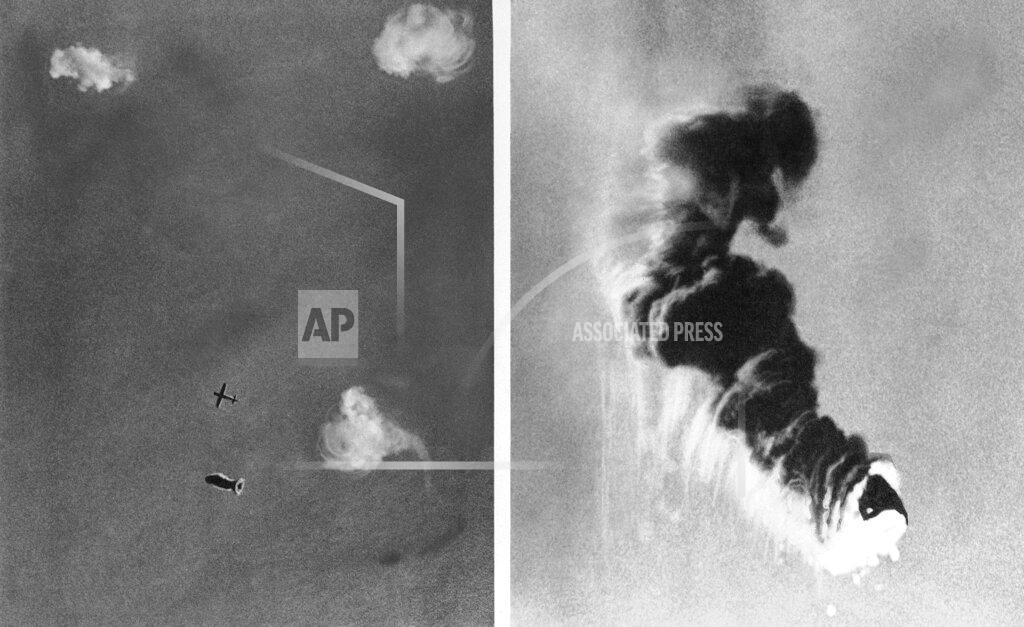
The Battle of Britain: There was very considerable activity during the day. The main features were a heavy attack on Portland, four attacks on the Dover Balloon Barrage, and attacks by large formations on convoys in the Thames Estuary and off East Anglia. Luftwaffe nighttime activity was limited to raids that were probably minelaying operations.
Weather: Fine and clear during the morning, but high cirrus cloud moving in by midday thickening during the afternoon. Dry all day.
Luftwaffe reconnaissance aircraft that were daily flying on meteorological flights out into the Atlantic Ocean, reported back on August 11th that the barometric pressure was building up in the mid-Atlantic southwest off the Spanish coast and with the wind speed and direction were very confident that fine weather would prevail over the next few days in the Channel area, and in particular over the designated target areas. Göring lamented that provided the weather was in their favor, that the Luftwaffe would destroy the RAF within fourteen days. He had nearly 2,000 serviceable aircraft at his disposal, which consisted of some 800 medium range bombers, 700 Bf 109s, 250 Ju 87 dive bombers, and 160 Bf 110 twin engine fighters plus a number of reconnaissance aircraft. His pilots were well trained with even the newer pilots going through a strenuous training program, but the events of the previous month during Kanalkampf, the battle over the Channel, had taken their toll.
After France, the Luftwaffe thought that the RAF with its morale at an all-time low, the aircraft which many they thought were antiquated and the pilots that flew them even though many may have been experienced pilots, lacked the knowledge needed for fighting in combat. But they were caught by surprise at the skill of the RAF fighter pilots and the performance of the machines that they flew, (Since returning from France, most of the Spitfires and Hurricane underwent a number of modifications that increased the maneuverability and their overall performance. It was also thought that unbeknown to the pilots the British Air Ministry instructed that Hurricanes and Spitfires use 100% high octane fuel instead of the 87% octane that both the RAF and the Luftwaffe were using at the outbreak of the war. In September 1939 the U.S Congress invoked the Neutrality Act that prohibited the supply of 100% octane fuel, but after some anxious moments, the British Government and the Roosevelt Administration had reached a compromise where the supply of this fuel could be used on a ‘dollar on the barrel-head’ basis.
In comparison, the RAF had just 650 fighter aircraft and approximately 1,250 pilots and many of these lacked the proper training, in fact many of them had to complete their training on an operational airfield due to the fact that the RAF drastically needed more pilots. But the pilots, it did not matter whether they were experienced or not, displayed great courage and determination in the July dogfights over the Channel, but in the proposed next phase of the Battle of Britain, this determination would be very much put to the test.
In the meantime, Fighter Command had rearranged its squadron allocations so as to strengthen its defenses of the southern coast. Biggin Hill had its Defiant 141 Squadron transferred to Turnhouse in Scotland and was reinforced by 501 Squadron from Kenley, Kenley was allocated a Canadian Squadron in place of 501, 266 Squadron at Wittering in the Midlands was transferred to Hornchurch, Debden received 85 Squadron from nearby North Weald and the Blenheim 604 Squadron at Northolt was transferred to Middle Wallop and 303 Squadron a new squadron since July was allocated to Northolt.
Although the weather was fine, the German Luftwaffe did not start its offensive against RAF airfields, instead mounting a carefully prepared feint. Starting at 0730 hours, Bf 109 and Bf 110 fighters bombed and strafed Dover Harbor in southern England, United Kingdom as a prelude to a larger attack on Portland Naval base and Weymouth, aiming to draw RAF fighters. Spitfire fighters of No. 64 and No. 74 Squadrons responded, but most RAF units remain on the ground per Keith Park’s strategy of sending up only enough fighters to counter the German attack and withholding the remaining in reserve.
0830 hours: The 11th of August was a Sunday, and the port of Dover in south-east Kent was just like any other Sunday morning. It was early, but many people were either getting ready to go to church or for those non-believers, were having their usual sleep in while the rest looked forwards to the usual good Sunday breakfast. That is until they heard the drone of bombers coming from the direction of the Channel. Many thought it unusual, others who had been making a study of the war so far stood in wonderment as up until now, all of Germany’s attacks had been over the sea lanes, why now were they heading towards Dover and the coast of England. It was not long before they found out, most thought that the enemy planes were on their way to the industrial centres along the Thames or even London itself. They were quite surprised when explosions started to erupt in the Harbor, tall fountains of water spouted into the air as bombs landed, and many surrounding houses fell victim to the bombing. People ran screaming and shouting and running in all directions, even though the siren had sounded when the aircraft were first heard many ignored the fact that this could well be an air raid because so far the Luftwaffe had not yet resorted to attacking land bases in Britain.
Fighter Command had been warned of the small build up that was moving in towards the coast at Dover, radar had supplied the position and direction of the enemy formation, and the Observer Corps reported the type and strength. Park was informed that the formation consisted of 30+ Bf 110 and an equal number of Bf 109s.
So the 110s from EprGr 210 and a couple of Bf 109 fighter sweeps had Dover all to themselves. Well, for a while anyway. A number of Luftwaffe Squadrons can over in quick succession and it looked as though something could be building and Park had no alternative but to allow some of his fighters from Hawkinge and Manston to “scramble”. 74 Squadron Hornchurch (Spitfires) operating out of Manston and 64 Squadron Kenley (Spitfires) were the squadrons released to cover Dover. Official records state that only a few skirmishes took place and that Dover Harbor was the prime target of the German attack. But the Luftwaffe plan was to attract as many of the British fighters into the air as possible at Dover while the main strike of the day was to be concentrated much further west near Portland, this operation being laid on in place of the mass Adler Tag assault which had been postponed.
0945 hours: But again, Keith Park was proved to be absolutely correct in his judgment, because soon after the attack at Dover had ceased, Ventnor radar detected an excessive build up across the Channel just outside of Cherbourg. Park immediately put all of his squadrons in stand-by mode. The AOC of 10 Group AVM Quintin Brand was notified and he too placed all his squadrons at standby. As time went on, it appeared that the build-up was getting bigger and bigger but it now looked as if was the biggest armada of air power yet sent across the Channel. But fortunately the only build-up was coming in from the direction of Cherbourg. This now, was not an assortment of Ju 87s or 110s, but 56 Ju 88 heavy bombers from I and III /KG 54, 20 Heinkel He 111s of KG27, 67 Bf 110s from II and III/ZG2 and about 30 Bf 109s of III/JG2. In total, about 170 German bomber aircraft were inbound.
1030 hours: Now the plots that had been tracked by Dover radar were now being picked up by Ventnor CH and detected a large formation heading towards Portland. The radar and the work of the Observation Corps informed Fighter Command that the formation consisted of He 111 and Ju 88 bombers escorted by Bf 109s and Bf 110s, in total there were 150+ enemy aircraft. Fighter Command relayed the information to the Operations Room at 10 Group and 145 Squadron Westhampnett (Hurricanes), 152 Squadron Warmwell (Spitfires), 213 Squadron Exeter (Hurricanes), 238 Squadron Middle Wallop (Hurricanes), 601 Squadron Tangmere (Hurricanes) and 609 Squadron Middle Wallop (Spitfires) were scrambled to intercept.
Off the coast, and out over the Channel, the dogfights were fierce and numerous. Spitfires in high speed chases weaving over or under other dogfights that were in progress, were either chasing Bf 109’s or being chased by them, sometimes a pilot would abort an intended attack because once within identification range he found it to be a British fighter.
“One had to very careful in mass dogfights where there would be 100+ fighters that it would take only the slightest lapse in concentration for you to shoot down one of your own.”
- Sgt J.H. (Ginger) Lacey 501 Sqn
The attack on the formation that was heading towards the Portland Naval base and Weymouth was the biggest of the day, with destruction of a number of factories, the gasworks and oil storage tanks, all others being fairly minor and were really of nuisance value more than anything else, for which, the day’s losses were high. The Luftwaffe lost a total of 38 aircraft made up of 2 Heinkel He 59s, 2 Ju 87s, 6 Ju 88s, 3 Dornier 17Zs, 10 Bf 110s and 15 Bf 109s. Further to that some 15 aircraft either made forced landings or managed to make it back to their bases with considerable sustained damage. The RAF fared no better with six Spitfires and twenty-one Hurricanes shot down, one Spitfire and five Hurricanes making forced landings and one Spitfire and nine Hurricanes damaged. This did not please Fighter Command especially Keith Park, and when they were informed that 26 RAF pilots were missing Park was ready for a confrontation.
For the squadrons too, it had been a hard day. No sooner had they landed to refuel and rearm, they were up again repeating the performance all over again. Operations Rooms had been stretched to the limit, as the casualties mounted, fresh squadrons were brought to readiness. They didn’t know it then, but with Adler Tag yet two days away, this was only the beginning.
Park complained to Dowding that the new pilots were lacking the proper training required that would prepare them for combat. They were taking too many chances, unnecessary chances that not only put their own lives in danger but the lives of all those in the squadron. He told Dowding, “…that if we can lose this many pilots in unimportant minor skirmishes, how many are we expected to lose in a major battle….and that battle is yet to come”. he started to raise his voice, “…at the moment they are only picking off convoys, soon they will be attacking our cities…..what are they going to do then”.
Hugh Dowding, in his usual soft spoken voice almost giving one the impression that he was taking everything in his stride assured Park that these young pilots are giving it all they can, and admitted that they were not spending enough time in basic training, but of all the pilots that they were producing, the four weeks that they had in training was all that they could afford. He told Park that with Göring’s planned all-out attack on England which had yet to commence, time, was the all-important factor… “time that we haven’t got. We are producing pilots and we are producing planes.”
During the early afternoon the Dorniers of 9/KG2 were sent to attack a merchant convoy off Harwich on the Essex coast and again escorted by the Bf 110s from EprGr 210. Another battle ensued as fighters from 17 Squadron Debden (Hurricanes), 74 Squadron Hornchurch (Spitfires) and 85 Squadron Debden (Hurricanes) fought in heavy combat. The convoy code named “Booty” suffered no damage but the RAF lost three aircraft just off of the East Coast while there is no record of German casualties.
Meanwhile, another buildup of enemy aircraft was forming in the Thames Estuary, this was picked up by radar, and again the Luftwaffe was heading towards another convoy. This time a medium convoy that had just left the docks in London. The formation consisted of 45 Dorniers of II and III/KG2, 10 Ju 87 Stukas, and about 15 Bf 109s. 74 Squadron Hornchurch (Spitfires) were redirected south to make an interception along with 54 Squadron Hornchurch (Spitfires) and 111 Squadron Croydon (Hurricanes). But by all accounts, the weather started to deteriorate rapidly and the mission was aborted.
RAF Statistics for the day: 165 patrols were flown involving 767. Luftwaffe casualties: Fighters – 26 confirmed, 45 unconfirmed; Bombers – 10 confirmed, 2 unconfirmed; Unknown – 34 confirmed, 21 unconfirmed, 18 damaged. 14 unknown aircraft were shot down or probably shot down by anti-aircraft for a total of 280 casualties. RAF casualties: 25 fighters were shot down.
RAF Casualties:
1030 hours: Swanage. Hurricane P2951. 145 Squadron Westhampnet (Crashed into sea)
F/O G.R. Branch Missing in action. (Believed shot down by Bf 109s off coast)
1035 hours: Swanage. Hurricane V7294. 145 Squadron Westhampnet (Aircraft crashed on Isle of Wight)
F/O A. Osterwicz Killed. (Shot down by Bf 109s off Swanage coast. Not seen to bale out)
1040 hours: Weymouth. Hurricane P2978. 238 Squadron Middle Wallop
Sgt G. Gledhill Killed. (Shot down over Channel during combat with unknown enemy aircraft)
1045 hours: Portland. Hurricane V7231. 87 Squadron Exeter (Aircraft lost at sea)
F/L R.V. Jeff Missing in action. (Last seen in combat over Channel, failed to return to base)
1045 hours: Weymouth. Hurricane R4097. 238 Squadron Middle Wallop
F/L S.C. Walch Missing in action. (Shot down in combat over Channel two miles E of Weymouth)
1045 hours: Portland. Hurricane P3885. 601 Squadron Tangmere. (Crashed into sea)
P/O J.L. Smithers Killed. (Shot down by unknown enemy aircraft. Buried at St Marie Le Havre, France)
1048 hours: Portland. Hurricane P3819. 238 Squadron Middle Wallop (Crashed into sea)
F/O M.L. Steborowski Killed. (Shot down by unknown enemy aircraft over Channel)
1050 hours: Weymouth. Hurricane P3222. 238 Squadron Middle Wallop (Crashed into sea)
P/O F.N. Cawse Killed. (Shot down in combat by Bf 109 off coast)
1050 hours: Portland. Hurricane R4092. 601 Squadron Tangmere. (Crashed into sea)
F/O R.S. Demetriadi Killed. (Shot down by enemy aircraft over Channel. Buried at Cayeuz ser Mer, France)
1050 hours: Portland. Hurricane P3783. 601 Squadron Tangmere. (Failed to return to base)
F/O J. Gillan Missing in action. (Believed shot down over Channel during combat)
1055 hours: Portland. Hurricane L2057. 601 Squadron Tangmere. (Failed to return to base)
P/O W.G. Dickie Missing in action. (Last seen in combat over the Channel)
1100 hours: Sth of Isle of Wight. Spitfire R6614. 152 Squadron Warmwell (Crashed into sea)
P/O J.S.B. Jones Killed. (Shot down by Bf 109 in mid Channel., Buried at Le Havre France)
1100 hours: Off Portland. Hurricane P2650. 213 Squadron Exeter (Crashed into sea)
F/L R.D.G. Wight Killed. (Shot down in combat with enemy aircraft. Believed buried at Cayeux sur Mer)
1100 hours: Off Portland. Hurricane P3789. 213 Squadron Exeter (Crashed into sea)
Sgt S.I. Butterfield Killed. (Shot down by unknown enemy aircraft over Channel)
1120 hours: Sandown. Hurricane P3172. 1 Squadron Northolt (Aircraft destroyed)
P/O J.A.J. Davey Killed. (Hit by gunfire after combat with Bf 110. Attempted forced landing, aircraft burnt out)
1130 hours: Calais. Spitfire R6630. 610 Squadron Biggin Hill (Failed to return to base)
Sgt W.J. Neville Missing in action. (Shot down while on patrol over French coast)
1130 hours: Calais. Spitfire R6918. 610 Squadron Biggin Hill (Failed to return to base)
F/Sgt J.H. Tanner Killed. (Shot down off French coast. Buried at Calais, France)
1150 hours: East Coast. Hurricane P3760. 17 Squadron Debden (Crashed into sea)
P/O K. Manger Missing in action. (Crashed in sea after combat with Bf 110 off Suffolk coast)
1215 hours: East Coast. Spitfire R6962. 74 Squadron Hornchurch (Crashed into sea)
P/O D.N.E. Smith Killed. (Crashed into sea 30 miles off Harwich after combat with Bf 110)
1215 hours: East Coast. Spitfire R6757. 74 Squadron Hornchurch (Crashed into sea)
P/O D.G. Cobden Killed. (Engaged combat with Bf 110 off Harwich, believed shot down)
1300 hours: East Coast. Hurricane N2667. 56 Squadron North Weald (Crashed into sea)
Sgt R.D. Baker Killed. (Mistakenly shot down by unknown Spitfire while on convoy patrol.
1420 hours: Margate. Hurricane P3105. 111 Squadron Croydon (Crashed into sea)
P/O J.H.H. Copeman Killed. (Shot down in combat with enemy aircraft over Thames Estuary)
1420 hours: Margate. Hurricane P3942. 111 Squadron Croydon (Presumed crashed into sea)
Sgt R.B. Sim Missing in action. (failed to return after combat with Bf 109 escorts)
1420 hours: Margate. Hurricane P3922. 111 Squadron Croydon (Crashed into sea)
P/O J.W. McKenzie Missing in action. (Shot down by Bf 109 over Thames Estuary)
1425 hours: Margate. Hurricane ? 111 Squadron Croydon (Crashed into sea)
P/O R.R. Wilson Missing in action. (Last seen attacking Bf 109 escorts over Thames Estuary)
Overall, it is possible to see today’s vicious actions as a step forward for the Luftwaffe in its plan to grind down the RAF. It is a good set-up for the true start of Adlerangriff. Simply reciting plane losses that appear to slightly favor the RAF completely ignores the massive damage being inflicted on British shipping and shore installations and the increasingly over-strained condition of the British defenses. It also overlooks the dozens of scarce pilots lost today. While it is normal to lose new pilots on their first missions, when you lose this many at once, you also lose very experienced men.
One final point: one of Stalin’s aphorisms is that “Quantity is its own quality.” When hundreds of planes are in action at once, any slight qualitative advantage by the RAF is nullified (and it is very unclear who actually has such an advantage). There are many hushed-up reports of “friendly fire” incidents where new, inexperienced RAF pilots shoot down other RAF planes through sheer confusion and accident as they navigate the melee. Massive air battles with no clear winner tend to fulfill the Luftwaffe’s goals.
RAF Bomber Command dispatches 23 Blenheims against airfields during the day, only 9 bombed, 1 lost. 6 Blenheims on sea sweep attacked shipping near Brest.
RAF Bomber Command dispatches 59 Hampdens, Wellingtons and Whitleys to attack six targets in the Ruhr overnight. 1 Whitley lost. 16 Hampdens minelaying and on sea reconnaissance, 1 lost. 5 O.T.U. sorties.
A sudden Italian Fascist bolt of displeasure was shot at Greece today by the official Italian news agency which charged Greeks with decapitating an Albanian nationalist and warned that such “evil crimes” will not go unanswered. Stefani, the agency, said the decapitation had occurred near the border in Albania, united with Italy under the Italian crown since flight of King Zog.
A revolt centered in the northern Miriditi district of Albania continues to spread, with the Italian occupation forces engaging in ruthless pacification practices such as burning villages.
Great Britain is prepared to take a firm stand in rejecting any attempts by the United States or other neutrals to feed the populations of the German conquered nations of Europe, authoritative British quarters said tonight.
Two British Cabinet Ministers tonight predicted that Britain soon would have supremacy over Germany in the air. Alfred Duff Cooper, Minister of Information, announcing at a meeting in South Woodford, Essex, that fifty more Nazi planes had been shot down in today’s raids, said: “Just as we retain our command of the seas so we are rapidly assuming command of the air. Every battle brings the number of our fighters and bombers nearer the enemy’s and brings nearer the day when we shall have that unquestionable superiority in the air which we already exercise over all the seas of the world.”
L. S. Amery, Secretary of State for India, who made a new appeal for unity in India, said that no matter what Chancellor Hitler did he could not protect the heart of Germany from the growing strength of Britain in the air. The day will come, he said, when Britain, “master of the sea and air, with our armies equipped and trained for a task no longer of defense but of deliverance, will seek out the dragon in his lair and put an end to this evil horror which today obsesses the world.”
Confiscation of Jewish property in Paris and surrounding areas shifts into high gear with Einsatzstab Reichsleiter Rosenberg (“ERR”), a “special” formation of the NSDAP Office of Foreign Affairs to steal paintings, sculptures and “decadent” art. In point of fact, under German law this is not theft, because such works are now considered “ownerless” and their Jewish owners “stateless.”
Cardinal Bertram issues an official protest from the German bishops concerning the Euthanasia Decree to the Reich Chancellery. Such destruction of the innocent, he wrote, not only violated the Christian moral law, but offended against the moral sense of the German people and threatened to jeopardize the reputation of Germany in the world.
Walther Funk, Reichsbank President and Economic Minister, roundly scored free trade nations, including the United States, today and declared that barter is the only salvation for world commerce.
Germany and Switzerland sign a new trade deal.
With the three Baltic States now annexed by the Soviet Union, Vyacheslav Molotov asked Germany to recall their ambassador to Lithuania, Latvia, and Estonia within the next two weeks, and to close the embassies by 1 September 1940. The Germans, meanwhile, are planning their own demands on the Soviet Union for Spring 1941.
British Commander-in-Chief Middle East Major General General Wavell was in London, England, United Kingdom to discuss the defense of British colonies in Africa and the Middle East. Seeing events in Somaliland and expecting an Italian attack on Egypt, Winston Churchill’s War Cabinet made a far-reaching decision to send tanks to defend the vital Suez Canal. Despite the ongoing threat of invasion, 150 tanks (about half the total in Britain), 48 anti-tank guns, 48 field guns, and 20 Bofors anti-aircraft guns were ordered to Egypt. This is a highly risky move, since the threat of invasion still hangs over London, and it effectively halves the armored forces in England.
It is quiet again on Malta, the first quiet Sunday in some time. Governor Dobbie has been urged to build more air raid shelters, so he requests large quantities of cement, reinforcing timber and the like from Middle East Command.
In British Somaliland, Italian ground and air forces begin attacking British positions at Tug Argan. The Battle of the Tug Argan Gap begins with probing Italian attacks against entrenched British positions defending Berbera. British Major General Reade Godwin-Austen arrives in Berbera to take command of the British forces. Of the six hills occupied by the British that overlook the main coastal road, the Italians capture one defended by the 3rd Battalion of the 15th Punjab Regiment. Attacks on two other hills are stopped with great difficulty.
British Major General Reade Godwin-Austen arrived in Berbera, British Somaliland to take over the defense. The British had maintained prepared defenses at Tug Argan on 6 hills overlooking the Hargeisa-Berbera road, knowing that this was the most likely invasion route. Italian troops attacked 3 of the hills and captured the one defended by the 3rd Battalion of the 15th Punjab Regiment.
U-38, commanded by Kapitänleutnant Heinrich Liebe, sank British steamer Llanfair in 54-48N, 13-46W. At 1519 hours the Llanfair (Master William Evans), a straggler from convoy SL.41, was hit by one torpedo from U-38 in the stern and sank after 11 minutes west of Ireland. Three crew members were lost. The master and 29 crew members were picked up by the American merchant California. The 4,966-ton Llanfair was carrying sugar and was headed for Avonmouth, England.
Battleship HMS Revenge, carrying £14.5 million pounds in gold being transferred to Canada, armed merchant cruiser HMS Asturias, steamers Empress of Australia (21,833grt), Oronsay (20,043grt), Samaria (19,597grt), Antonia (13,867grt), Duchess of York (20,021grt), and Georgic (27,759grt) departed the Clyde at 1030 escorted by destroyers HMS Ashanti, which departed Scapa Flow at 1000/9th, HMS Griffin, HMS Watchman, and HMS Vortigern. The gold transfer and convoy was designated convoy “ZA”. Steamer Orion (23,371grt) departed the Clyde at the same time as this convoy. She was joined at sea by armed merchant cruiser Asturias which escorted her to Freetown. The steamer was taken by Dutch light cruiser HNLMS Sumatra to Capetown to rejoin convoy WS.2 B.
Destroyers HMS Cossack (D.4), HMS Sikh, HMS Maori, and HMS Duncan joined Rear Admiral Minelaying on minelayer HMS Southern Prince with minelayers HMS Port Quebec, HMS Port Napier, and HMS Menestheus, which departed Loch Alsh at 0230/11th to lay minefield SN.13. Survey ship Scott laid the navigational buoys. The minefield was laid and the destroyers arrived back at Scapa Flow at 0700/13th.
Destroyer HMS Holderness, on passage north to Scapa Flow, was diverted to Rosyth to act as part of the escort for submarine depot ship Titania to Belfast.
Light cruiser HMS Arethusa and destroyer HMS Foxhound departed Scapa Flow at 0630 for repairs and refitting at Chatham. Light cruiser Arethusa was under repair from 17 August to 30 September at Chatham. Destroyer Foxhound was under repair at London until 12 October.
Destroyer HMS Windsor was damaged by German bombing off Botany Buoy in the Thames Estuary. Destroyer Windsor was taken to London for repairs, completed at the end of October.
Destroyer HMS Esk was damaged by German bombing at Harwich. She was repaired in one week.
Destroyer HMS Scimitar was damaged by near misses while in Portland Harbor. Destroyer Scimitar was repaired in four days.
While in Portland Harbor, destroyer HMS Skate was damaged by near misses which wrecked her bridge. She did not require immediate repair for the damage.
S/Lt H. W. Isherwood was killed when his Fulmar of 806 Squadron crashed near Aberdour.
British trawler Edwardian was damaged by bombing off Kent. Three crewmen were killed and three wounded. The trawler was run agroun at North Foreland to prevent sinking.
British steamer Kirnwood (3829grt) was damaged by German bombing in 52-27N, 02-10E.
British tanker Oil Trader (5550grt) was damaged by German bombing 3½ miles 071° from Shipwash Light Vessel.
Heavy cruiser HMS Dorsetshire arrived at Freetown from patrol in the northern half of the South Atlantic.
British steamers Ceramic and Testbank collided at 27-15S, 10-00E. Heavy cruiser Cumberland took steamer Ceramic in tow, but it was not successful and the tow was later slipped. Steamer British Viscount was in company. The passengers in steamer Ceramic were transferred to Viceroy of India. Tug McEwen took steamer Ceramic in tow and the heavy cruiser proceed to Simonstown for refuelling, arriving on the 17th. Steamer Testbank proceeded to Capetown with damaged bows, accompanied by steamer British Viscount. Steamer Testbank arrived at Capetown on the 15th and steamer Ceramic at Walvis Bay on the 16th.
Convoy OA.197 departed Methil. No escorts were listed.
Convoy OB.197 departed Liverpool escorted by destroyer HMS Winchelsea from 11 to 14 August, sloop HMS Scarborough from 11 to 15 August, destroyers HMS Arrow and HMS Anthony on the 12th.
Convoy FN.249 departed Southend, escorted by destroyer HMS Valorous and sloop HMS Stork. The convoy arrived in the Tyne on the 13th.
Convoy MT.137 departed Methil. The convoy arrived in the Tyne later that day.
Convoy FS.249 departed the Tyne, escorted by destroyers HMS Vimiera and HMS Wolfhound and sloop HMS Londonderry. The convoy arrived in the Tyne on the 14th.
Convoy HG.41 with 45 ships departed Gibraltar escorted by destroyer HMS Velox from 11 to 15 August. Sloop HMS Folkestone escorted the convoy from 11 to 24 August. Destroyers HMCS Restigouche and HMS Vanoc escorted the convoy from 22 to 24 August. Destroyer HMS Walker and corvette HMS Arabis from convoy OB.200 escorted the convoy from 22 August to 24 and 25 August, respectively. The convoy arrived at Liverpool on the 26th.
British convoy SL.43 departed Freetown escorted by armed merchant cruiser HMS Dunvegan Castle to 27 August and sloop HMS Milford to 13 August. Due to the lack of escorts, Convoy SLF.43 departed Freetown at the same time. The convoy was joined by light cruiser HMS Delhi, after refueling at St Vincent and departing the evening of 10 August, to 16 August, when the convoy rendezvoused with convoy SL.43. Sloop HMS Milford escorted the Polish steamer Cieszyn to Bathurst, then returned to Freetown, arriving on the 15th. Included in the convoy was steamer Staffordshire, carrying the survivors from sunken steamer Cape St George. Light cruiser Delhi arrived back at Freetown on the 20th. On 26 August, sloop HMS Fowey and corvette HMS Perwinkle joined the convoy on the 27th, destroyer HMS Winchelsea and corvette HMS Primrose joined the convoy. The convoy arrived on the 31st.
Convoy BS.2A departed Suez, escorted by sloop HMS Grimsby. Light cruiser HMS Caledon joined on 13 September. The convoy arrived at Aden on the 17th.
The South Carolina hurricane struck the coast of Georgia and South Carolina, resulting in 50 fatalities between this day and the next. A hurricane out of the tropics, with wind speeds over 75 miles per hour, severest to hit these shores since the turn of the century, appeared to have veered inland after having loosed its fury from Savannah, Georgia, to Georgetown, 60 miles up the coast from Charleston. Of all cities in the storm’s path, Charleston appeared the worst hit. Cut from communication, and without electric power, the historic city of some 75,000 population was in darkness tonight, many of its streets flooded by high tides. Power was not expected to be restored until tomorrow. The only known casualties in the storm area were two at Savannah. There a woman was struck by flying glass in the street and killed. Jesse Wallace, an industrial plant police officer, suffered a fatal heart attack when a tree crashed into his home. An unconfirmed report said two persons were electrocuted by a fallen power line at Charleston. Communication lines with Charleston failed at noon and late tonight had not been restored.
The U.S. Senate resumes its debate tomorrow on the Burke-Wadsworth compulsory selective service bill, and the indications are the measure will reach a test vote late in the week on one or more of several amendments proposed by opponents. Senator Barkley, the majority leader, said it was possible the bill itself might come to a vote before the close of the week, but said he would “not gamble on that” in view of the assertions of several Senators that they would debate the measure leisurely. The proposal of Senator Maloney of Connecticut, conceded to have more support than any of the “compromises” to be offered, would permit a draft only if the voluntary enlistment method failed to give the Army enough men for training for an emergency. One Senator said he believed the Maloney amendment would carry if a vote were taken tomorrow, but Administration supporters said they not only had enough support to defeat this amendment but to pass the bill by a good margin. Administration spokesmen scoffed at the proposal of Senator Wheeler of Montana, that the compulsory military training program bé submitted to a popular referendum. They said that not only was there no machinery set up for such a referendum, but that the idea of submitting a measure pending in Congress to a vote of the people not only was an abandonment of Congressional duties, but highly impracticable, as well.
Another fight was indicated over a proposal of foes of the draft to raise the pay of an Army private from $21 to $30 a month. They contend that the pay is too low to attract voluntary enlistments, and that by raising the compensation enough men would be attracted to the Army without resorting to conscription to raise the manpower. A third fight probably will come over a proposal to limit the draft to 1,000,000 men. Senator Burke of Nebraska, co-author of the bill, wants to expand the proposed draft to include men up to 40 years of age. The present age provision in the bill is from 21 to 31, which, Army officers say, would provide 4,500,000 men of physical fitness for military duty. The House is expected to debate the bill. already approved by the Senate, to give President Roosevelt the authority to call out the National Guard and reserves in times of peace. The House Military Affairs Committee, which is also going over the Burke-Wadsworth bill with a view to reporting it soon, has indicated it would take the National Guard mobilization bill to the floor Wednesday, with passage expected that day.
Following a survey, the National Defense Advisory Commission said today that there was no present need for compelling industry to give priority to defense orders over private or foreign buyers.
Reports reaching Capitol Hill indicate that Wendell L. Willkie might endorse military conscription in his address accepting the Republican presidential nomination gave new encouragement today to Burke-Wadsworth compulsory service bill supporters. Although Willkie has not made public his views on compulsory training, leading congressional Republicans were known to be proceeding on the premise the nominee would take a position somewhat similar to that assumed by President Roosevelt favoring conscription in principle but leaving the details to congress.
Wendell L. Willkie warned “all corporations and their officials in the country today that advertisements by them in the Democratic Campaign Book of 1940 would be in violation of the Federal Corrupt Practices Act and the Hatch Act. He promised that, if elected, he would “relentlessly prosecute” all such violations.
U.S. President Roosevelt departed Boston Navy Yard, Boston, Massachusetts, United States aboard presidential yacht Potomac, escorted by destroyer USS Mayrant, for Mattapoisett, Massachusetts, arriving later on the same day. President Roosevelt today interrupted an inspection trip to Navy and Army establishments in the New England area with a quiet cruise off the coast on the yacht Potomac.
Major League Baseball:
The Dodgers flew back home this evening without having made any progress here. They split today’s twin bill with the Bees, losing the opener, 3–2, and capturing the nightcap, 3–0, behind Vito Tamulis’ six-hit shutout for an even break in the four-game series. Bill Posedel got he win for the Bees in the opener, besting Tex Carleton.
The Cardinals ended a five-game losing streak by sweeping a double-header with the Reds today, 3–2 and 3–1. Effective hurling of Morton Cooper and Lon Warneke turned the trick that enabled the Cardinals to split a series of four encounters.
Kirby Higbe spun a five-hitter, outpitching Cliff Melton, as the Phillies won the opener of the their doubleheader with the Giants, 2–0. But the New Yorkers came back to take the nightcap, 8–2, as Babe Young hit two home runs, on agrand slam, and Hal Schumacher allowed the Phils just three hits.
Recapturing a berth in the first division, the Pirates trounced Chicago 7–3 and 5–1 in both games of a doubleheader today to give the Corsairs three of the four-game series. The Cubs commited six errors in the first game, leading to five unearned runs for the Pirates.
Joe Gordon’s 21st homer of the season in the 11th inning lifts the New York Yankess to a 7–6 victory over the visiting Athletics. Joe DiMaggio had singled to tie the game in the bottom of the ninth. Atley Donald got the win in relief.
Cleveland regained a share of the American League lead today by dividing a twin bill with the Browns, losing the nightcap, 7–6, after taking a 12–4 decision in the opener. The even break put the Indians on the same level as the Tigers. The Indians had 18 hits in the first game, as Al Milnar easily won his 15th.
White Sox slapped a double defeat on the pennant-minded Tigers today, winning both games by identical scores of 4–3 before 32,032 spectators. Chicago grabbed an early two-run lead in the second game while John Rigney handcuffed the Tigers in the early stages. But in the seventh Barney McCosky led off with a single and Hank Greenberg followed with his twenty-third homer. Rudy York then hit his twenty-first circuit blow to put the visitors ahead. Taft Wright doubled home two runs to decide it for Chicago.
Young Sid Hudson, sensational rookie from the Florida State League, set the Red Sox down with five hits today while the Senators touched Lefty Grove for eleven and a 2–1 victory. Hudson himself singled over the first run in the second inning.
Brooklyn Dodgers 2, Boston Bees 3
Brooklyn Dodgers 3, Boston Bees 0
Detroit Tigers 3, Chicago White Sox 4
Detroit Tigers 3, Chicago White Sox 4
St. Louis Cardinals 3, Cincinnati Reds 2
St. Louis Cardinals 3, Cincinnati Reds 1
Philadelphia Athletics 6, New York Yankees 7
New York Giants 0, Philadelphia Phillies 2
New York Giants 8, Philadelphia Phillies 2
Chicago Cubs 3, Pittsburgh Pirates 7
Chicago Cubs 1, Pittsburgh Pirates 5
Cleveland Indians 12, St. Louis Browns 4
Cleveland Indians 6, St. Louis Browns 7
Boston Red Sox 1, Washington Senators 2
Arnulf Fuhrmann, confessed author of the Nazi military plan for the seizure of Uruguay as a German colony, was arrested by Argentine police at Concordia in Entre Rios Province this afternoon. Concordia is across the Uruguay River from Salto, where Fuhrmann was leader of a Nazi cell.
There is a major Japanese air raid on Chungking. Ninety Japanese bombing planes dumped tons of explosives on Chungking in their twenty-fifth raid since last May. Some 50 persons were reported killed or wounded. The Soviet embassy was hit for the third time in three months a bomb demolishing one of the embassy buildings recently rebuilt after an earlier bombing. Bombs again exploded near the hotel where the Associated Press correspondent and other newspapermen have their headquarters, knocking off most of the plaster which remained after previous raids. A Chinese communique later claimed that Chinese pursuit planes shot down five and severely damaged six Japanese bombers in a 150-mile running fight which began as the raiders left here.
A handful of Chinese flying I-15 fighters cross above the Japanese bomber formation and drop time-delayed parachute bombs. This causes mass confusion among the bombers and disperses the attack, but major damage still is caused to the city.
Born:
Kip King [Jerome Kattan], American character actor (“Charlie & Company”; “The Groundlings”; “The Smurfs”), in Chicago, Illinois (d. 2010).
Died:
Guy Branch, EGM, 26, Royal Air Force fighter pilot (killed in action).
 History Diaries