Portuguese Communists fired on a crowd of hostile Roman Catholics in the northern town of Braga, wounding 20 people participating in a protest march sponsored by the local archbishop. The attack was one of the worst of a series of clashes between Communists and anti-Communists in northern Portugal. Hostility to the Communist party has spread throughout the civilian population and the armed forces, isolating the new government formed under the pro-Communist Premier, General Vasco Gonçalves.
More than 700 Turkish Cypriots were transferred from the Greek Cypriot southern zone of Cyprus to the Turkish zone in the north without incident during the weekend, it was disclosed in Nicosia. The transfers were in accordance with an agreement reached in Vienna a week ago between Turkish Cypriot leader Rauf Denktaş and his Greek Cypriot counterpart, Glafkos Clerides.
Communist Romania has been secretly looking into the possibility of buying U.S. jet fighters and other arms, according to Time magazine. The United States has never sold modern arms to a Warsaw Pact nation. Time said the subject came up recently when Romania’s deputy defense minister, Ion Coman, met in Washington with General Frederick C. Weyand, the U.S. Army chief of staff. But the magazine said the United States was reluctant to provide Romania with weapons that could fall into Soviet hands.
A group from the American House of Representatives, on an official visit to the Soviet Union, met today in Moscow with a group of Soviet Jews seeking to emigrate and some said they had been emotionally moved by the encounter. “To know the pain of those people is very different from the abstract figures and the abstract stories that we hear in the United States,” Millicent Fenwick, Republican of New Jersey, remarked after the two-hour meeting. She said that she had found it “very different” to see and listen to women “who have husbands in prison and are frightened, and men who haven’t seen their children for years.”
A U.S. Navy study has concluded that superiority of Soviet warships in firepower has been achieved by sacrificing the endurance, electronic sophistication and crew comforts emphasized in American ships. The study by the Naval Ship Engineering Center in Hyattsville, Maryland, helps provide an answer to a question that has been troubling officers and members of Congress as they have watched the Soviet fleet expand with new classes of heavily armed warships. Increasingly over the last few years, the question has been raised as to why the Soviet Union is able to build warships that appear to be smaller. faster and more heavily armed than those in the United States Navy. The characteristics of the Soviet warships, according to the study, are dictated by the mission for the Soviet fleet of “sea denial” — or denying other nations, in particular the United States, certain uses of the sea. The sea‐denial mission, it points out, requires a design emphassis on heavy firepower, a first‐strike capability against enemy shipping and high speed and good sea‐keeping capability rather than endurance.
Leonid I. Brezhnev, the Soviet Communist party chief, and Gustav Husak, the Czechoslovak President and party leader, stressed today “firm intention” of their countries to implement “all the principles of the declaration of the European security conference in Helsinki earlier this month. The pledge came after unannounced talks between the two Communist leaders near the Crimean resort of Yalta. The disclosure by Tass, the Soviet press agency, of the meeting was the first confirmation that Mr. Brezhnev was at his vacation retreat in the Crimea following his return from Helsinki eight days ago. The nonofficial travels of Soviet leaders are rarely reported, in part for security reasons.
Fellow musicians mourned the death of composer Dmitri Shostakovich but many Soviet citizens did not know that one of the world’s most famous Russians was dead. “I feel as if I have lost a dear friend,” said Leonard Bernstein, the American composer and laureate conductor of the New York Philharmonic. Twenty-four hours after Shostakovich’s death it still had not been reported by Soviet radio and television. Tass, the official news agency, carried a one-sentence announcement. Voice of America carried the news on shortwave radio.
Fires raged through the parched forests of northern Germany and six firemen died fighting one blaze when their truck was trapped by flames. A number of forest, heather and field fires also were reported in Denmark, where a record 98 degrees was recorded at Holstebro in Jutland. The continent-wide heat wave has dried up water supplies in Spain and Italy and parched grain fields across Europe.
Hundreds of thousands of West German applicants for civil service jobs are being subjected to loyalty checks, lawyers for “enemies of the state” are being jailed and other lawyers have been excluded from courtrooms where their clients are on trial. This is the official reaction to the threat of leftist “radicalism.”
As Indira Gandhi’s exercise of “emergency rule” over India continued, the Thirty-ninth Amendment of the Constitution of India took effect, prohibiting civil lawsuits or criminal charges from being brought against an incumbent Prime Minister of India. The new rule brought to an end the June decision that had threatened to bar Gandhi from public office.
While Pakistani officials have been withholding formal comment about the crackdown in India, the Pakistani press has begun denouncing it. Speaking privately, some officials voice fears that the Indian Government, beset by problems, may try to distract Indian public opinion by provoking border clashes. But there is no sign that these professed fears have accelerated such militarily important activities as discussions of Pakistani purchases of United States arms and construction of an all‐weather highway leading into Pakistan from the border of her ally, China. “We have been stunned by the turn of events in India, which seemed to us to herald a different kind of political system there,” a high‐ranking Pakistani unofficially told a traveler in this Pakistani capital this week. Yet the view of Pakistan’s Prime Minister, Zulfikar Ali Bhutto, as reaffirmed in newspapers yesterday, is that comment about the situation in India is undesirable, “for it is a domestic issue” in India.
Khmer Rouge leader Khieu Samphan has invited exiled leader Prince Norodom Sihanouk to return home to Cambodia, Sihanouk spokesmen said in Peking. There was no indication whether the prince would return. however. Prince Sihanouk presently is traveling in North Korea. He has made his home in Peking since he was ousted by Marshal Lon Nol in March, 1970.
A United States spokesman confirmed today that “we will veto” admission of North Vietnam and South Vietnam to the United Nations when their applications are considered by the Security Council tomorrow. American rejection of membership in the world organization for the two Communist states follows a breakdown in efforts to work out a package deal by which South Korea, an ally of the United States would also be given a seat. Admission of North Vietnam and South Vietnam is asked in a Soviet draft resolution that will be before the Security Council tomorrow. Moscow’s strategy of committing itself strongly in the issue is seen by Asian diplomats here as an attempt to consolidate Soviet influence in Hanoi.
Vast sections of central China are under water following torrential rainstorms during the past week, according to travelers who flew to Peking from the southern Chinese city of Canton. They said they saw “mirrorlike surfaces stretching as far as the eye could see” during almost an hour and a half of the flight. The Canton-Peking railway line has been closed since Friday.
Handbills protesting against the policies of the Chinese leadership have been found slipped into the local mail deliveries of several embassies in Peking. Some of these documents criticize the rehabilitation of former leaders who fell from power during the Cultural Revolution in the late nineteensixties. The last such person to make a public reappearance is Lo Jui‐thing, former army chief of staff. Others include Deng Xiao‐ping, the leading Deputy Premier; who was rehabilitated two years ago. It is common for protests against the Chinese leaders to be found in international mail arriving in Peking, but this has been attributed to pro-Taiwan elements in Hong Kong and elsewhere. The appearance of such documents in local mail tends to support recent reports of growing dissension and factionalism in China.
And New Zealand devalued its dollar by 15% in an attempt to boost sagging farm income and encourage exports. The devaluation brings the New Zealand dollar value down to nearly the same value as the U.S. dollar. Prime Minister Bill Rowling said the most worrying effect of the recession for New Zealand had been the strong price inflation in industrialized countries, and there needed to be a sizable transfer of income back to farming.
The imminent replacement of the controversial United States Ambassador to Managua, who over five years has become a friend and adviser of the longtime Nicaraguan dictator, General Anastasio Somoza Debayle, is both raising hopes and causing concern. Opposition groups are hoping that the withdrawal of Ambassador Turner B. Shelton will mark the end of the total identification of the United States with the regime and perhaps lead Washington to press General Somoza to liberalize his government. President Somoza, on the other hand, is reportedly so worried that the change of ambassadors could affect his relationship with Washington that he campaigned to have Mr. Shelton’s assignment extended. When this failed, according to diplomats here, he arranged for the Ambassador to remain in Managua until the last possible moment.
Argentina announced the fourth devaluation of the peso in five months. The peso for most financial operations was devalued from 35.40 per U.S. dollar to 42.50. For import-export transactions the peso was revalued from 28.08 to 33.50 per dollar while the price for purchasing dollars for travel abroad was raised from 54 pesos to 60 pesos per dollar. The National Statistics Board said the cost of living rose 34.7% in July and 177.3% since July, 1974.
An official of the Portuguese colonial capital of Luanda in Angola, which is occupied by one nationalist faction and besieged by another, said today that international help might be needed to stave off starvation in the city. Vasco Vieira de Almeida, trie Lisbon‐appointed Minister of the Economy, said that stocks of food and fuel in Luanda were dwindling and that there was little hope that fresh supplies would reach the city. Dr. de Almeida said the capital’s supplies could run out in the next few days.
Meanwhile, a military spokesman reported that about 500 soldiers of the National Front for the Liberation of Angola were pulled out of Luanda today after 10 hours of heavy fighting against the forces of the Popular Movement for the Liberation of Angola, which controls most of the capital. This still left some 450 National Front soldiers in Luanda and another several hundred holding out in an old fort overlooking the harbor.
Former President Richard Nixon has sold the rights to four 90-minute television interviews to David Frost, who said he represented an “international consortium.” He would not say how much was paid for the rights. Filming will start immediately but the interviews will not he broadcast until after the 1976 elections, Mr. Frost said. Nixon would receive $700,000. The meetings would later be the subject of the film “Frost/Nixon.”
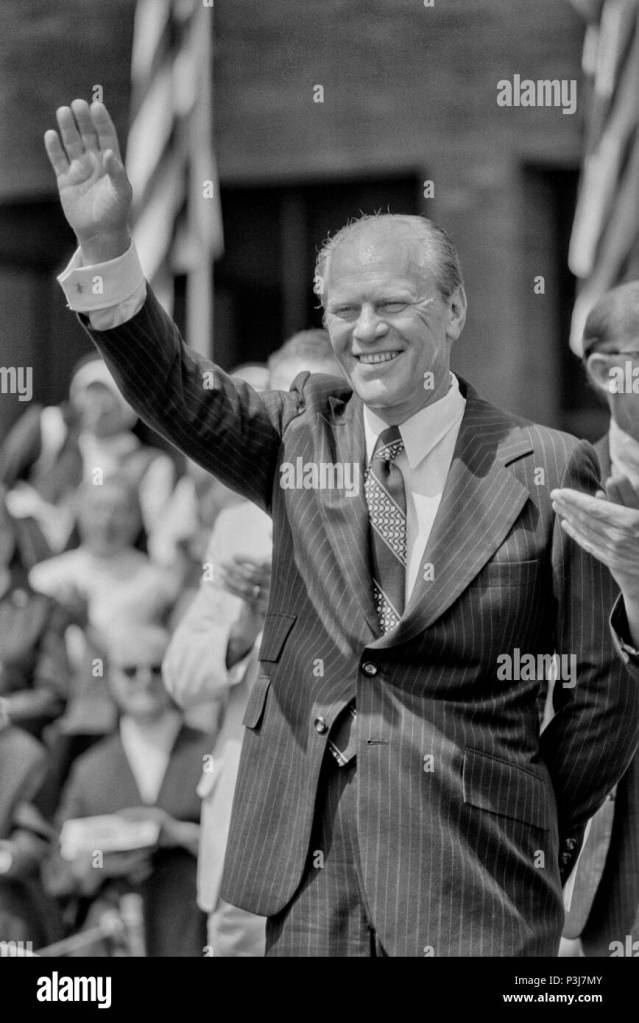
Thousands of Indochina refugees greeted President Ford with applause, waves and smiles when he visited the Fort Chaffee refugee resettlement center near Fort Smith, Arkansas, on his way to a vacation in Vail, Colorado. Officials gave Mr. Ford a briefing on the slow progress of the effort to resettle the refugees.
An interview with U.S. First Lady Betty Ford was broadcast on the popular news show 60 Minutes. Taking questions from Morley Safer, President Ford’s wife gave surprisingly candid answers, noting that she “wouldn’t be surprised” if her daughter was “having an affair” (referring to premarital sex) and that marijuana was “the type of thing young people have to experience”. In the opinion of historian Nigel Hamilton, “alcohol certainly loosened her tongue when she gave what would become a famed interview… No First Lady had ever spoken so candidly on national television, sending moralists of both parties into a tailspin.”
CIA Director William E. Colby said his agency had “very much” less power than even ordinary government departments to protect official secrets. Colby’s opinion and his recommendation for a new law against leaks of classified information were sharply disputed by Senator Alan Cranston (D-California) in a parallel interview appearing in U.S. News & World Report. Cranston said the nation had more protection of official secrets than it needed. The CIA, he said, “has too much power-and this has led to a lot of abuse.” Colby proposed a law making it illegal for present or past intelligence personnel to divulge secrets.
Senator William Proxmire, chairman of the Senate Banking Committee, who has begun investigating the Lockheed Aircraft Corporation’s overseas payments, has found that the payments ranged “from a few thousand dollars to several million dollars” and often went to officials of foreign governments who were responsible for the award of contracts to Lockheed. One foreign official, according to Senator Proxmire, apparently received $8 million from Lockheed, which has acknowledged that since 1970 it gave at least $22 million to foreign officials and political organizations.
The number of American servicemen who have lost clearances to work with nuclear weapons because of alcoholism, drug abuse (mostly marijuana) or a lack of motivation or maturity rose 35% last year, Rep. Les Aspin (D-Wisconsin) said. He said official documents showed nearly 10% of the personnel accepted in a reliability program had lost their weapons clearances for those reasons. Aspin has issued a series of charges about lax security at U.S. nuclear missile sites in Germany. He said the fact that so many GIs “have lost their clearances is compelling evidence that something is very wrong with the initial screening process of GIs to work on nuclear weapons.”
The Apollo astronauts, delayed two weeks by the effects of poisonous rocket fumes in their spaceship, finally returned home. Thomas P. Stafford, Vance D. Brand and Donald K. (Deke) Slayton were welcomed at Houston by space agency employes, Air Force personnel and residents. But the return to Houston came after their news conference and meeting with President Ford earlier. “We had a great time up there flying that mission,” Stafford said.
As a result of New York City’s financial crisis, a member of the Securities and Exchange Commission warned that the agency would consider bringing suit against municipalities that failed to disclose “unfortunate circumstances that afflict them” when they are selling bonds. Never in the agency’s 42-year history has it sought an injunction against a municipality. The commissioner, A. A. Sommer Jr., said that the agency was not contemplating action now against New York. A spokesman for Mayor Beame, after being told of Mr. Sommer’s remarks, said that since March the city had been preparing a prospectus for its bond and note issues.
Several prominent police officials from around the country agreed that the nation’s crime rate would continue to increase. But they differed on how to slow the rise. Patrick V. Murphy, director of the National Police Foundation and former New York City police commissioner, said he believed unemployment to be the source of most violent street crime. Edward M. Davis, Los Angeles police chief, said he thought the cause was “moral poverty, not material poverty. The rate of crime is higher in the suburbs than it is in my ghetto areas.” They made their remarks on NBC’s Meet the Press.
Nicholas Johnson, who dissented frequently in seven years as a member of the Federal Communications Commission, complained that the present seven commissioners agreed too much. “I am personally distressed at the absence of divergent views within the commission,” Johnson wrote to Senator John O. Pastore (D-Rhode Island), chairman of the Senate communications subcommittee.
The American Humane Association has charged film makers working in the area along the Yellowstone River with abusive treatment of animals. It is investigating the death last week of a horse named Jug, used in the movie “The Missouri Breaks.” The film’s production executive, Jack Grossberg, said the horse had died accidentally of shock while in water. Grossberg said the horse had hit a car body with one hoof and had a heart attack. But humane society representatives said the animal had drowned after being bound and dragged through the water.
Paul W. McCracken, University of Michigan economist, says the nation. is in the early stages of resumed economic expansion which could be of long duration if properly managed. Such a development, according to the former chairman of President Richard M. Nixon’s Council of Economic Advisers, would “save some energy that ought to become available for attention to more fundamental problems.” McCracken, in an article in Economic Outlook USA, a quarterly publication of the University’s Survey Research Center, added in a note of caution that the economy had some basic problems needing far more attention than they were receiving.
The Coast Guard and a private cleanup crew worked to sop up what was described as a major spill of heavy fuel oil in the outer harbor at Baltimore. No residential or recreational areas were believed threatened by the spill. A Coast Guard spokesman said about 125,000 gallons of No. 6 fuel oil — a heavy, viscous type that is a residual product of the refining process — spilled into the harbor during loading operations on a barge at the Shell Oil Co. terminal. The cause of the accident was under investigation.
An esteemed academic council charged today that Federal affirmative action programs to end discrimination in university and college faculties were confused and chaotic. “Seldom has a good cause spawned such a badly developed series of federal mechanisms,” said the report by the Carnegie Council on Policy Studies in Higher Education. “Few federal programs are now so near to self‐destruction.” The report called for major changes in both Government and campus programs to wipe out discrimination against female and minority college teachers.
Physicians in Northern Ireland have developed a lightweight portable defibrillator that cardiologists believe may be of major help in giving emergency care quickly to people who suffer heart attacks. The defibrillators help correct heart-rhythm abnormalities that kill suddenly. The portable machines weigh seven pounds, compared to the conventional ones of 35 or more pounds. Fifty of the machines will be extensively tested in the United States.
Dmitri Shostakovich, the most famous of contemporary Soviet composers, died Saturday at a hospital in Moscow that cares for top-level government figures and Soviet celebrities. The official press agency, Tass, said that the composer had died after a “grave illness.” He was 68 years old, and was recently admitted to the hospital’s heart disease section.
PGA Championship Men’s Golf, Firestone CC: Jack Nicklaus wins his 4th PGA crown by 2 shots from Australian Bruce Crampton.
Major League Baseball:
Rick Monday hit a single and two doubles and also walked in the Cubs’ support of Bill Bonham, who pitched a five hitter and beat the Braves, 9–1. Monday’s first double set up the Cubs’ initial run in the third inning. After drawing his walk and scoring in the fifth, Monday drove in three runs with his second double of the game in the eighth. Mike Lum hit a pinch-homer in the Braves’ half of the eighth for their lone run.
The Reds collected 18 hits and enjoyed a pair of four-run innings while romping over the Expos, 11–3. In the fifth, Pete Rose walked, stopped at third on a double by Ken Griffey and beat the throw home on a grounder by Joe Morgan. Larry Parrish booted a grounder by Johnny Bench, allowing Griffey to cross the plate. Tony Perez and Cesar Geronimo then hit singles for two more runs. The Reds’ other four-run burst came in the eighth on a triple by Morgan, single by Bench, double by Perez and homer by George Foster.
A homer by John Hale and run-scoring single by Steve Yeager in the fourth inning enabled the Dodgers to defeat the Mets, 2–1. After Hale led off the stanza with his circuit clout, Steve Garvey walked, stopped at second on a single by Ron Cey, advanced to third after the catch on a long fly by Willie Crawford and crossed the plate on Yeager’s hit. Don Sutton, who gained his 16th victory of the season, limited the Mets to three hits with their run counting in the fourth on a single by Rusty Staub, pass to Wayne Garrett and single by Mike Phillips.
Gary Matthews hit two homers and drove in four runs to lead the Giants’ batting in an 8–1 victory over the Phillies. Matthews started his slugging with a solo swat in the fourth and then connected for the circuit again with two men on base in the seventh. Jim Barr, who pitched the route for the Giants, had trouble in the fifth when the Phillies loaded the bases, but escaped with only one run scoring on a sacrifice fly by Garry Maddox.
A four-run outburst in the first inning started the Astros off to a 5–3 victory over the Pirates, who went down to their fifth straight defeat. With one away, Greg Gross and Cesar Cedeno singled. After both advanced following a flyout by Cliff Johnson, the Pirates passed Doug Rader intentionally to load the bases in a move that backfired. Tommy Helms also walked to force in the Astros’ first run. Skip Jutze singled for two more and the fourth run crossed the plate when Manny Sanguillen made a wild throw to third after handling the ball from the outfield. J.R. Richard, who started for the Astros, allowed only one hit but walked 10 in six innings before surrendering the mound to Mike Cosgrove.
The Cardinals, after tying the score on a homer by Ron Fairly in the seventh inning and then knotting the count again in the 10th on a homer by Ken Reitz, pushed over another run in the overtime stanza and defeated the Padres, 3–2. A passed ball by Ted Simmons let the Padres score their initial run in the seventh before Fairly rapped his round-tripper. The Padres went ahead in the 10th with a circuit clout by Tito Fuentes, but Reitz’ homer tied the score in the Cardinals’ half. Mike Tyson, pinch-hitter Bake McBride and Lou Brock then followed with singles to produce the winning run.
Held scoreless on four hits through the first eight innings, the White Sox rallied for three runs in the ninth and defeated the Orioles, 3–2. Mike Torrez, pitching for the Orioles, issued his seventh pass of the game to Bucky Dent to open the ninth before being yanked. Grant Jackson, in relief, retired Bill Stein, but Brian Downing smashed a two-run homer to tie the score. After throwing two balls to Pat Kelly, Jackson yielded the mound to Ross Grimsley, who completed walking Kelly. Jorge Orta then hit a double, driving in Kelly with the winning run.
The slump-shackled Tigers collected only four hits off Bert Blyleven and lost to the Twins, 4–0, for their 15th straight defeat. The Twins were held scoreless by Ray Bare until they broke through for two runs in the seventh inning on singles by Steve Braun and Eric Soderholm, a double by Jerry Terrell and sacrifice fly by Rod Carew. Terrell singled in the ninth and Phil Roof homered for the last two tallies.
The Angels, who got shutout pitching from Bill Singer and Mickey Scott, snapped the scoreless duel with a run in the ninth inning to edge the Yankees, 1–0. Singer pitched the first eight innings and yielded four hits. Scott took over in the ninth, retired the side in order and gained the victory when the Angels broke through for their run off Rudy May, who also gave up only four hits. Dave Collins drew a walk to start the stanza and was forced by Tommy Harper. Bobby Valentine singled, Harper stopping at second. Leroy Stanton then doubled to drive in Harper with the lone run.
Led by George Scott, who collected four hits and drove in three runs, the Brewers snapped their six-game losing streak by defeating the Rangers, 7–4. Scott hit a wasted single in the first inning but batted in runs with other singles in the third and fourth before capping his day with a homer in the sixth. Sixto Lezcano accounted for two RBIs with a double in the third inning.
John Mayberry extended his batting streak to 14 games, hitting a three-run homer for the Royals’ big blow in a 5–1 victory over the Indians. Mayberry’s circuit clout, coming after singles by Fred Patek and Al Cowens in the third inning, was his 26th of the season, equaling his previous career high with the Royals in 1973. Mayberry also accounted for a fourth RBI with an infield out that drove a run home in the ninth inning.
Two-run homers by Cecil Cooper and Jim Rice powered the Red Sox to a 5–3 victory over the Athletics. Cooper’s drive followed a single by Bernie Carbo in the first inning. Joe Rudi singled and Gene Tenace homered as the A’s tallied a pair in the fourth, but in the Red Sox half Cooper drew a walk and was on base when Rice hit for the circuit to decide the outcome of the game.
Chicago Cubs 9, Atlanta Braves 1
New York Yankees 0, California Angels 1
Baltimore Orioles 2, Chicago White Sox 3
Montreal Expos 3, Cincinnati Reds 11
Kansas City Royals 5, Cleveland Indians 1
Minnesota Twins 4, Detroit Tigers 0
Pittsburgh Pirates 3, Houston Astros 5
Texas Rangers 4, Milwaukee Brewers 7
Los Angeles Dodgers 2, New York Mets 1
Boston Red Sox 5, Oakland Athletics 3
San Francisco Giants 8, Philadelphia Phillies 1
San Diego Padres 2, St. Louis Cardinals 3
Born:
Lamar King, NFL defensive end (Seattle Seahawks), in Boston, Massachusetts.
Tony George, NFL defensive back (New England Patriots), in Cincinnati, Ohio.
 History Diaries