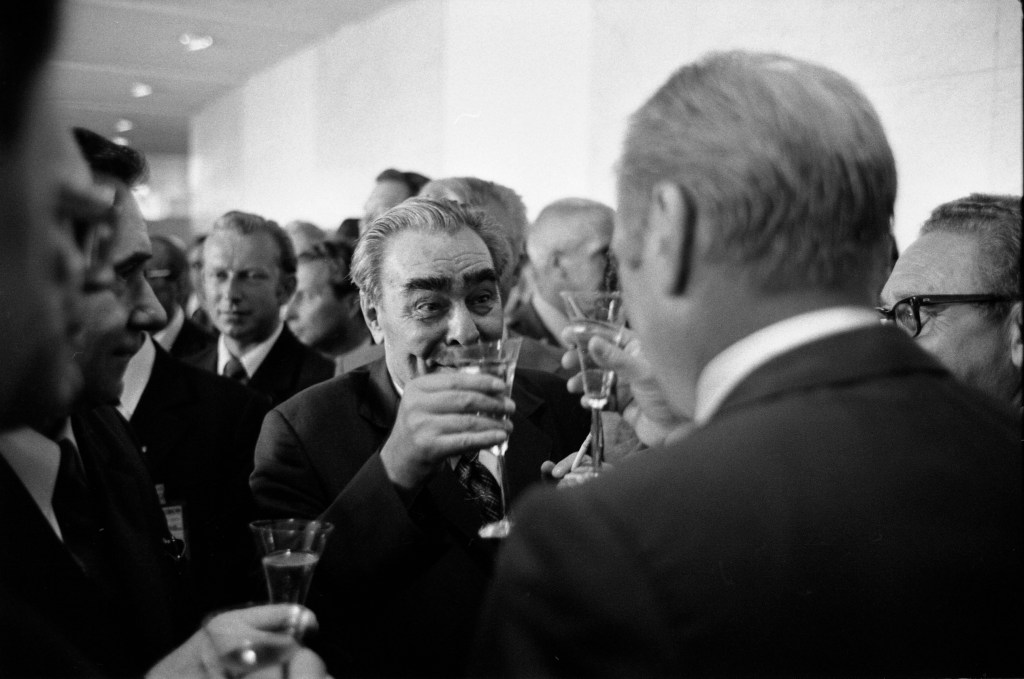
The Helsinki Accords, recognizing Europe’s national borders and respect for human rights, were signed by the leaders of 35 nations in Finland, including the 15 member states of NATO and the 7 Warsaw Pact nations. Among other things, the agreement conceded the legality of the Soviet Union’s annexation of the Baltic nations of Latvia, Lithuania and Estonia, but also provided the first mechanism for holding the Communist nations to commitments toward human rights, and was later cited by Václav Havel as a key to the success of liberating Eastern Europe in 1989. The CSCE Final Act also creates the Conference for Security and Co-operation in Europe.
President Ford, declaring that the summit meeting in Helsinki will be judged “not by the promises we make but by the promises we keep,” joined leaders of the Soviet Union and 33 other nations in affirming a broad charter for peace and humanitarian progress throughout Europe. Mr. Ford said that “every signatory” would be held to account for the charter’s promises of a freer flow of ideas, information and people across ideological frontiers. A few hours later, each of the Presidents, Prime Ministers, Chancellors, Communist party chiefs and the envoy of Pope Paul VI signed the 30,000-word charter of the Conference on Security and Cooperation in Europe.
While hopes are expressed in the West that the European security agreement will liberalize some aspects of life in the Soviet Union, there is no evidence here that the leadership intends any relaxation of its tight and pervasive control. On the contrary, there is evidence in the recent speeches of high officials that “liberalization” is still considered a euphemism for Western decadence and deceit. The Soviet public is being advised to he vigilant in rejecting Western “sabotage” in the guise of liberalization. Simultaneously, experienced Western diplomats and Soviet political dissidents agree that there has been no sign of a relaxation of internal restrictions since the European security talks began in Geneva two years ago. They say the Kremlin’s treatment of dissidents in the coming months may provide a good indication of how much change, if any, is actually in the offing.
Leaders of the opposing communities on Cyprus reached agreement in Vienna on the transfer of minorities. As explained by the Turkish Cypriot leader, Rauf Denktaş, the accord reached with the Greek Cypriot negotiator, Glafkos Clerides, would allow 9,000 Turkish Cypriots stranded in the south to move to the Turkish-held northern part of the island. About 10,000 Greek Cypriots in the Turkish-controlled north would be allowed to stay there, and 800 Greeks in the south would be allowed to join them.
William E. Colby, Director of Central Intelligence, said in a letter made public today that if the United States permanently lost its intelligence-gathering stations in Turkey, “deficiencies from such a loss could not be completely made up by any otoher means of relocation.” The comments by Mr. Colby were made known in an interview by Representative William S. Broomfield, the ranking Republican on the House International Relations Committee, who played a leading role in the unsuccessful effort to get the House of Representatives to reverse itself and lift the arms embargo against Turkey.
Although the Senate passed a new bill last night, 47 to 46, authorizing President Ford to end the embargo, Administration supporters were unable to overcome parliamentary obstacles to bring the bill to a vote in the House before it went on vacation for a month today. Representative Ray J. Madden, Democrat of Indiana and chairman of the House Rules Committee, refused to call a meeting of his committee, thereby blocking efforts to call up the bill by regular methods. And Congressmen who favored the embargo shouted down attempts by Republican leader John J. Rhodes of Arizona to get unanimous consent to force a vote.
Air superiority is the key to success in any battle in Sinai. Consequently, the possible loss to Israel of the capacity for instant air reaction as a result of withdrawal from the passes she holds in the Sinai — the key issue in the current negotiations — and the surveillance stations there causes acute anxiety to ground and air commanders. Israel’s four surveillance sites in the passes area are elements in a complex military situation that influences the Government’s negotiations with Egypt concerning a Sinai withdrawal. The overriding factor to the Israeli military is the early use in war of the air force — superior in planes and quality of pilots to any combination of Arab air forces — as the country’s first line of defense. Early warning of Egyptian attack and an immediate reaction by the Israeli Air Force would depend to a considerable degree on Israeli’s continued possession of the electronic surveillance stations.
The Arab diplomatic campaign against Israel had an unexpected setback when the Organization of African Unity, meeting in Kampala, Uganda, refused to adopt a resolution calling for the expulsion of Israel from the United Nations. Rebuffing Arab militants, the organization approved a milder version calling for moves “to reinforce the pressure exerted on Israel at the United Nations and its specialized agencies, including the possibility of eventually depriving it of its membership.”
The Satellite Instructional Television Experiment commenced in India, bringing television for the first time to 2,500 villages in six Indian states and territories, in a project conducted by the Indian Space Research Organisation (ISRO) and NASA with the ATS-6 satellite. It would operate until July 31, 1976.
The fragile coalition Thai Government won a key vote of confidence in the National Assembly early today with a preliminary approval of a record $3.13-billion 1976 annual budget. The opposition, led by Seni Pramoj, the older brother of Premier Kukrit Pramoj, had branded this the main test of confidence in the government and today even opposition politicians were conceding that the Premier’s success had strengthened his hand considerably both domestically and in foreign affairs.
The United States is advising Đặng Văn Quang, the refugee South Vietnamese general accused of heroin smuggling, that he has virtually no hope of being admitted to this country, American officials said today.
For the first time since the Chinese Army was shaken by the death in 1971 of Lin Piao, the former Defense Minister, the entire high command appeared publicly at a banquet last night to commenmorate the founding of the Chinese Communist armed forces. At the same time, in a further apparent attempt to reflect a return to the normal, Lo Juiching, a former chief of staff who was purged at the beginning of the cultural revolution, reappeared at the banquet for the first time in 10 years. Hsinhua, the official Chinese news agency, included his name without comment among a list of the guests in Peking’s Great Hall of the People. Mr. Lo, a 71‐year‐old one‐time army commissar, had been closely identified with the disgraced head of state, Liu Shaochi, and had reportedly tried to commit suicide alter coming under violent criticism by the Red Guards. Heading the list of guests last tight were Yeh Chien‐Yang, an aging marshal who was named Defense Minister by the National people’s Congress in January; Deng Xiao‐ping, the Deputy Premier who is also chief of staff, and Chang Chungchiao, second Deputy Premier who is head of the Army’s general political department
More than a decade of isolation formally ended for Cuba this week when the Organization of American States voted to lift sanctions against the island. But long before the O.A.S. vote in San Jose, Costa Rica, on Tuesday the wall cutting off Cuba was crumbling. Several member nations, which originally voted for diplomatic and economic sanctions in 1964, had reversed their policies and resumed political and trade relations with Havana. Heads of government have been pouring into the country. In the last four months the military band of honor has had to learn five national anthems, to welcome Forbes Burnham of Guyana, Eric Williams of Trinidad‐Tobago, Michael Manlay of Jamaica, Kenneth D. Kaunda of Zambia and Olof Palme of Sweden.
The Roman Catholic bishop of Olancho, a Honduran province where two priests were killed, says land reform opponents there have “put a $10,000 price on my head.” The Most Rev. Nicholas d’Antonio, 59 years old, who came here from Baltimore, 29 years ago, said in an interview, “One rancher actually said he would pay only if someone brought my head to him.” One of the two priests found dead in a dynamited well on an Olancho ranch was an American. the Rev. Michael Cypher of Medford, Wisconsin. Their bodies and those of seven other persons who disappeared during a June 25 march by peasants demanding land reform were found two weeks ago. All had been shot to death, an autopsy report said.
Nigeria’s new military rulers announced today that all emergency measures imposed since the removal of General Yakubu Gowon, from power on Tuesday would be lifted tomorrow. The short announcement said the new military government was satisfied with the situation in the country. The emergency measures included a ban on international flights. The airports were reopened today for domestic flights. All borders and entry points were still closed today under the emergency except to citizens of members of the West African Economic Community. A dusk‐to‐dawn curfew was lifted yesterday.
The Republic of Cabinda unilaterally declared independence. The disputed exclave of Cabinda was declared independent today by the president of that Portuguese territory’s nationalist movement, based in Kinshasa, Zaire. Luis Ranque Franque, leader of the movement, made the declaration in Kampala, Uganda, following the close of the meeting of the Organization of African Unity. Cabinda, a region of 2,800 square miles fronting on the Atlantic in southwest Africa, is separated from Angola by a 35‐mile strip of corridor that belongs to Zaire. The independence initiative in Cabinda, which had been expected, seriously complicates the bloody and confused Angolan situation, where two of three black African guerrilla movements are engaged in fighting.
A top-level Portuguese military mission flew into Angola today as fighting spread through more of the territory and thousands of refugees packed two major cities. The delegation consisted of army commander in chief, General Carlos Fabiano, who led the mission, Vice Admiral Antonio Rosa Coutinho, a leftist who was High Commissioner here until last January, and Major José de Cantoe Castro. By last night, latest reports from the field said that the fighting between the rival Popular Movement for the Liberation of Angola and the Zaire-based National Front for the Liberation of Angola had spread to various points south of Luanda. Clashes were reported at the road junction town of Quibala, 150 miles south of Luanda, where the main road from the capital forks to the port of Lobito and inland to Nova Lisboa, Angola’s second largest city. More than 5,000 refugees are said to be crowding Lobito, with an additional 6,000 in Nova Lisboa on the central plateau.
South Africa is withdrawing her paramilitary police farce from Rhodesia and leaving the Salisbury Government to face guerrilla infiltrators alone. James T. Kruger, Minister of Police and Justice, announced in Pretoria today that “the stage has now been reached where the slightly more than 200 men who are still in Rhodesia can be withdrawn to the republic, and such an order has now been issued.” At one point there were said to have been as many as 2,000 South African policemen engaged in the guerrilla war in Rhodesia. Since December, 1972, a total of 18 South Africans have been killed there. Last December the government indicated it would withdraw the men when a ceasefire, announced by Prime Minister Ian D. Smith, took effect.
The 94th Congress, which began last January with a renewed pledge from President Fold of “communication, conciliation, compromise and cooperation,” began a month-long recess today in a conflict with the President over energy policy. Amid partisan bickering over what had — and had not been — accomplished; both houses recessed until September 3, leaving Mr. Ford to decide what to do about a bill extending the legal authority to control oil prices for six months beyond the expiration date of August 31. Mr. Ford’s aides have said that the bill wil be vetoed. Senate leaders said that they planned to delay sending the extension measure to the White House until later this month to avoid a pocket veto while Congress was in recess and to give Congress a chance to override the expected veto when both houses returned. The House of Representatives resumed work this afternoon on a long‐pending bill that seeks to write an oil pricing formula. Republicans maintain that the formula will never become law.
Voting 48 to 42, the Senate unexpectedly rejected a $31 billion compromise military procurement bill after the new Senate Budget Committee warned that it would push the defense program over Congress’s guidelines. The vote marked the first time in recent history that the Senate had rejected a major defense bill. The Senate decision was the last major action by either house before Congress recessed until September 3, still in conflict with President Ford over energy policy. In the sometimes heated Senate debate that led up to the vote, Senator Edmund S. Muskie, Democrat of Maine who is chairman of the Budget Committee, repeatedly warned that the $31‐billion measure would “bust the target for national defense” laid down in the budgetary procedures adopted by Congress in May. Defense Department officials and Republican leaders had expected that the measure would be adopted, although by a close margin. Democratic liberals became convinced they would win after Senator Henry Bellmon of Oklahoma, the ranking Republican on the Budget Committee, was prevailed upon to stand firmly beside Senator Muskie in opposing the bill.
The Labor Department reported that the nation’s unemployment rate dropped to 8.4 percent in July as the total number of persons employed rose by 630,000. The decline from 8.6 percent in June and the 8.9 percent average of the April-June quarter caught the experts by surprise and added strongly to the growing evidence that an upturn in the economy was no longer a forecast but a fact.
State and local policemen in Michigan seeking the whereabouts of James Hoffa, the former president of the International Brotherhood of Teamsters, began to concentrate their investigation on organized crime figures, some of whom have been associated with the former labor leader. Mr. Hoffa’s family reported him missing when he failed to return home Wednesday night. His son said he believed that his father had been abducted.
Reversing earlier denials, the Lockheed Aircraft Corporation said that since 1970 it had paid at least $22 million that it knows or believes went to officials and political organizations in a number of foreign countries. In a news release, Lockheed also acknowledged that it had paid or committed itself to pay a total of $202 million to consultants in connection with its foreign sales since 1970. Lockheed repeated arguments that disclosure of the recipients of the payments could adversely affect the company’s overseas contracts.
The Joan Little defense extracted from a key prosecution witness today a picture of confusion and disorganization, as well as lost, overlooked and destroyed evidence and failure to take notes or photographs or to search thoroughly for fingerprints, in the investigation of the slaying of Clarence T. Alligood. At one point Jerry Paul, Miss Little’s chief counsel, plucked a hair from a pair of socks that had been on Mr. Alligood’s body when he was found and, finding that the item had not been discovered earlier, moved that it be sent to the state crime laboratory for analysis. Judge Hamilton H. Hobgood denied the motion on the ground that the socks had been handled by a number of persons before being brought into the courtroom.
John Bowden Connally played host to a fund-raising dinner for himself in Houston last night, raised $300,000 to $400,000 from both Republicans and Democrats, and showed that he had retained much of his old political power in Texas. Mr. Connally said he was not a candidate for anything but that he needed the money so he could travel around the country and “speak out on important issues.” It was his first try at money‐making which is a test of pblitical power in Texas, since he was acquitted on bribery charges three months ago. More than 3,500 supporters from around Texas paid $25 each for a plate inside the Albert Thomas convention center where a bill‐board read “Salute to John Connally, a NonPartisan Tribute to One of America’s Most Distinguished Leaders.”
Two men and CBS-TV announced today that they would sue to force disclosure of police evidence in the assassination of Senator Robert F. Kennedy. An official Police Commission said yesterday that it would not release a secret 10‐volume summary of the investigation, because, according to its president, Samuel Williams, “more compelling weight fell on the side of protecting the confidentiality of those involved.” The two men are Paul Schrade, a former United Autoworkers official who was shot in the forehead when Mr. Kennedy was killed June 5, 1968, and former Representative Allard K. Lowenstein, who is now a consultant to Governor Edmund G. Brown Jr. For the last two years, tie two men have been trying to gain release of the police summary and inspect the physical evidence in the case, including the Ambassador Hotel pantry’s ceiling panels, which were riddled with bullets the night Mr. Kennedy was killed.
Secretary of Transportation William T. Coleman Jr. ruled today against completion of the Northern Virginia leg of Interstate Highway 66 into Washington, and in his written opinion indicated his preference for mass transportation instead of highways for environmental reasons. The long‐awaited ruling came as a surprise to supporters of the six‐lane highway that would have linked the completed highway at the capital beltway 10 miles west of here and brought traffic through suburbs to a Potomac River bridge that enters Washington. The ruling, delivered in a 16‐page Written opinion, gave the first clear indication of the transportation philosophy of Mr. Coleman, who took office this spring.
A Federal judge today ordered the transfer next month of 6,533 black pupils from the Indianapolis school system to eight suburban school systems that he held “have consistently resisted the movement of black citizens or black pupils into their territory.”
Former Attorney General John N. Mitchell charged today that the juors who convicted him in the Watergate cover-up trial were drawn “From a poisoned well” because they held preconceived opinions about the case. Mr. Mitchell’s lawyers filed a 151‐page brief, and lawyers for Robert C. Mardian, former assistant attorney, filed a 129‐page brief in the United States Court of Appeals for the District of Columbia, in efforts to overturn their convictions on charges of conspiracy in the Watergate cover‐up.
Byron de la Beckwith, Mississippi segregationist, today was sentenced to five years in prison for illegally bringing a ticking time bomb into Louisiana. The 53‐year‐old salesman who remained free on bond pending appeal, was convicted on May 16 on state charges of illegally transporting an explosive device across state lines. He was acquitted last year on similar Federal charges in connection with the incident. The police arrested Mr. Beckwith on September 27, 1973, as he entered the city. Officers said the time bomb he carried allegdly was intended for the home of Adolph I. Botnick, a Jewish leader.
The skull of “KNM ER 3733”, a woman of the species Homo ergaster, was discovered by Bernard Ngeneo, 1,750,000 years after her death, at the Koobi Fora Ridge near Lake Turkana in Kenya. By August 9, the nearly intact skull had been carefully unearthed.
Country music is a lot move open than it used to be. Singers who don’t revolve in Nashville’s orbit can still top the country charts Olivia Newton-John and Linda Ronstadt, for instance. But there is still a world of hard‐core country music: singers who rarely stray beyond the country‐touring circuit and whose records rarely sell outside the country market and are hardly over play on any but country radio stations. One of those singers, Dolly Parton, has begun to attract attention in the pop, rock, folk and college audiences. So far, she is still a cult figure outside of country. But it’s a cult that could become a phenomenon.
41st Chicago Charities College All-Star Game: Pittsburgh 21, All-Stars 14 (54,103). Joe Gilliam came off the bench in the final quarter and threw two touchdown passes to lead the Pittsburgh Steelers to victory over football’s College All-Stars tonight before a near-capacity crowd of 54,562. Not until Gilliam hit Frank Lewis with a 22‐yard touchdown pass with 4 minutes 16 seconds left in the game did the Steelers lead. The All‐Stars, who haven’t won a game since their 1963 counterparts defeated the Green. Bay Packers, 20‐17, broke in front on a 28‐yard touchdown pass from Steve Bartkowski of California to Pat McInally of Harvard in the first quarter.
Major League Baseball:
Tommy Davis hit his second grand-slam homer against the Brewers in six days as the Orioles swept a twi-night doubleheader, 6–4 and 3–1. Davis, whose bases-loaded drive helped beat the Brewers July 27 in Milwaukee, came to the plate in the fifth inning of the opener with the Orioles leading, 1–0, and hammered his homer off Bill Champion to score behind Elrod Hendricks and Brooks Robinson, who had singled, and Ken Singleton, who had walked. The Brewers chased Jim Palmer in the sixth, erupting for four runs, including two on a pinch-single by Hank Aaron, but Wayne Garland saved the Orioles’ victory, allowing only one hit in the last 3 ⅓ innings. In the nightcap, the Orioles broke a 1–1 tie in the seventh when Singleton singled and scored on a double by Jim Northrup. Paul Blair then came in to run for Northrup and later stole home to add an insurance marker.
Coming from behind in the ninth inning, the Red Sox scored twice with the aid of two errors to defeat the Tigers, 8–7. Willie Horton and Bill Freehan each hit two homers for the Tigers, while the Red Sox had round-trippers by Bernie Carbo, Fred Lynn and Jim Rice, all in the fifth inning. After Carbo’s blow snapped a 2–2 tie, Carl Yastrzemski singled and Lynn and Rice followed with circuit clouts. The Tigers erupted for four runs in the ninth to take a 7–6 lead with successive homers by Horton and Freehan, Horton’s blow coming with two aboard. In the Red Sox half, Denny Doyle extended his batting streak to 19 games with an infield hit and continued to second on a wild throw by Gene Michael. Yastrzemski singled, tying the score. After an intentional pass to Lynn, Rice bunted safely for his fourth hit of the game. Gene Pentz, pitching in relief for the Tigers, had no play at first base and tried for a forceout at third but threw wildly, allowing Yastrzemski to score the winning run.
In what proved to be Bill Virdon’s last game as manager, the Yankees defeated the Indians, 5–4, with Catfish Hunter receiving credit for his 14th victory of the season. However, Virdon had to call on both Tippy Martinez and Dick Tidrow in relief to nail down the decision. The Indians rapped Hunter for two runs in the second inning on a homer by Boog Powell, pass to Oscar Gamble and double by Jack Brohamer, but the Yankees broke the 2–2 tie in the third. Roy White tripled and counted on a single by Thurman Munson. After a single by Graig Nettles and pass to Lou Piniella loaded the bases, Munson scored as Chris Chambliss grounded into a double play. The Yankees added their deciding run in the sixth on a walk to Chambliss and triple by Sandy Alomar. Brohamer homered for the Indians in the seventh. Another run followed off Martinez in the ninth before Tidrow retired the last two batters.
Pat Kelly and Ken Henderson knocked in five runs with homers in the third inning to power the White Sox to a 5–1 victory over the Twins in the rain-shortened first game of a scheduled twi-night doubleheader. The contest was called with one out in the bottom of the sixth after the Twins had counted their lone run on a single by Eric Soderholm and double by Danny Thompson. In the White Sox’ outburst, Brian Downing singled ahead of Kelly’s homer. Jorge Orta and Carlos May followed with singles and, after Deron Johnson was retired, Henderson hit for the circuit.
Back-to-back homers by Tom Grieve and Roy Howell off Ed Figueroa in the seventh inning lifted the Rangers to a 2–1 victory over the Angels behind the two-hit pitching of Gaylord Perry. The Angels’ run scored in the first on a walk to Morris Nettles, a sacrifice, infield hit by Jerry Remy and infield out by Adrian Garrett. Nettles singled in the third for the Angels’ other safety.
Getting stronger as the game progressed, Steve Busby pitched the Royals to a 6–0 victory over the Athletics. Busby allowed four hits in the first three innings but only two the rest of the way. The Royals scored their first two runs on doubles by Cookie Rojas and Tony Solaita before wrapping up the decision by counting four times in the seventh with hits that included another double by Rojas, a triple by Amos Otis and homer by George Brett.
Batting with the bases loaded, Jesus Alou drove in two runs with a single in the fifth inning to enable the Mets to defeat the Pirates, 4–2, behind the pitching of George Stone and Bob Apodaca. The Mets scored their initial pair in the fourth. An infield hit by Gene Clines, error by Frank Taveras and single by Felix Millan accounted for the first run. Millan took second on the throw to the plate, moved to third on a grounder and scored when Dave Kingman beat out a surprise squeeze bunt. The Pirates came back with the tying pair in their half on a single by Dave Parker with the bases loaded. In the fifth, John Stearns walked and was forced by Stone. Clines then doubled and Millan drew an intentional pass to fill the bases and set the stage for Alou’s deciding single.
Homers by Jim Dwyer, Mike Jorgensen and Gary Carter powered the Expos to a 6–4 victory in the second game of a twi-night doubleheader for a split with the Phillies, who won the first game, 8–6, by scoring two runs in the 10th inning. In the opener, Larry Parrish homered with two men on base for the Expos in the fourth inning, but pinch-hitter Tony Taylor put the Phillies ahead, 6–5, with a three-run homer in the eighth. The Expos tied the score in their half with a triple by Pepe Mangual and error by Dick Allen. In the 10th, Mike Schmidt walked and scored when Jose Morales threw wildly after fielding a safe bunt by Johnny Oates. Taking second on the error, Oates went to third on a sacrifice by Gene Garber and scored an extra run on a single by Larry Bowa. Dwyer and Jorgensen each hit a two-run homer for the Expos in the first inning of the nightcap. Schmidt homered for the Phillies in the second and drove in two runs with a double in the fourth before scoring himself on a single by Tom Hilgendorf. Carter replied with his circuit clout in the fifth to break the tie and also scored again in the seventh on a walk, wild pitch and single by Larry Biittner.
Bob Gibson received credit for the first official save of his major league career when the veteran star pitched 3 ⅔ innings of four-hit relief in the Cardinals’ 9–4 victory over the Cubs. The Sporting News inaugurated the saves system in 1960 and Gibson received credit for one in a 6–5 victory over the Reds August 27, 1965, but the rule was not officially adopted until the 1969 season. The Cardinals built up a 5–0 lead before the Cubs knocked out John Denny in the sixth inning with a four-run burst that included a homer by Rick Monday with two men on base. After Gibson relieved, the Cardinals iced their victory with four runs in the eighth. Lou Brock, who had been sidelined with a stretched tendon in his ankle, appeared as a pinch-hitter and batted in two runs with a bases-loaded double.
Randy Jones, a 22-game loser in 1974, fortified his bid for this year’s Cy Young Award by pitching the Padres to a 4–0 victory over the Braves. The shutout was the sixth of the season for the young lefthander, who brought his record to 14–6 and lowered his earned-run average to 1.89 as the leader among the league’s starting pitchers. Jones yielded only three hits. The Padres collected five off loser Phil Niekro. Johnny Grubb batted in two runs and scored one.
Ron Cey hit a homer after a single by Willie Crawford in the 10th inning to lift the Dodgers to a 5–3 victory over the Reds, but Lee Lacy also came in for a share of the hero’s honors. The Reds scored their three runs in the sixth on a double by Pete Rose, single by Cesar Geronimo and homer by Johnny Bench. After the Dodgers came back with two runs in the seventh, Lacy hit a pinch-single in the eighth and scored the tying run on singles by Steve Garvey and Cey. Going to left field, Lacy threw out Bench at the plate in the ninth when the runner tried to score from second on a single by George Foster. In the 10th, Lacy made another accurate throw to the plate to nail Darrel Chaney, who attempted to score from second on Rose’s fifth hit of the game.
Successive homers by Willie Montanez and Chris Speier as the first two batters in the ninth inning carried the Giants to a 3–2 victory over the Astros. J.R. Richard, the Astros’ loser, was leading, 2–1, with the Giants’ run being unearned, before falling victim to the gopher pitches.
Milwaukee Brewers 4, Baltimore Orioles 6
Milwaukee Brewers 1, Baltimore Orioles 3
Detroit Tigers 7, Boston Red Sox 8
St. Louis Cardinals 9, Chicago Cubs 4
Oakland Athletics 0, Kansas City Royals 6
Cincinnati Reds 3, Los Angeles Dodgers 5
Chicago White Sox 5, Minnesota Twins 1
Philadelphia Phillies 8, Montreal Expos 6
Philadelphia Phillies 4, Montreal Expos 6
Cleveland Indians 4, New York Yankees 5
New York Mets 4, Pittsburgh Pirates 2
Atlanta Braves 0, San Diego Padres 4
Houston Astros 2, San Francisco Giants 3
California Angels 1, Texas Rangers 2
Dow Jones Industrial Average: 826.50 (-5.01, -0.60%)
Born:
Mandy Leigh, American actress (“Bloodscent”), in Greensburg, Pennsylvania.
Died:
Howard Joslin, 68, American actor (“Quebec”, “Detective Story”).
 History Diaries