At the end of July, the RAF has 19 Spitfire squadrons. Their Spitfires are now equipped with armor plate and constant-speed (variable pitch) propellers. The RAF has also switched to 100 octane fuel, which gives a 34mph (55km/h) speed increase at 10000ft (3050m). Top speed is now 350mph (563km/h) at 18500ft (5640m).
The Battle of Britain: During the day Luftwaffe activity was on a reduced scale partly due to the lack of cloud cover when operations were attempted on the South Coast. Luftwaffe aircraft frequently turned away as soon as RAF fighters were sent to intercept. [battleofbritain1940 web site]
On July 31st, the day dawned as a typical summer’s day with clear skies and higher temperatures and even a number of people braved the consequences and a number of seaside resorts reported bathers on many of their beaches. The first combat operation of the day was at Plymouth at 0855 hours when it not Fighter Command that were involved, but a Short Sunderland flying boat of the 10 Squadron Royal Australian Air Force based at Mount Batten. It was flying escort to the merchant cruiser Mooltan that was departing Plymouth after a refit. Three and a half hours out of Plymouth the Sunderland sights a Ju 88 and intercepts and providing the necessary cover for the Mooltan. The German bomber breaks off the engagement and departed the scene. The only other morning combat was over the Channel at 1100hrs, when Ju87’s attacked small convoys and soon after midday, a number of German reconnaissance aircraft were detected just off the south coast. No aircraft on either side were shot down.
At 1530 hours, a formation was detected off the coast off Dover. Fighter Command dispatched 74 Squadron Hornchurch (Spitfires) to intercept. The raiders turned out to be a small formation of Bf109’s and a dogfight ensued over the Dover area. Four Bf109’s were damaged in the combat and were believed to have crashed on their way back to their bases. 74 Squadron lost two aircraft, with one badly damaged and crashed on landing, but the pilot was unhurt.
During the night Luftwaffe activity was on a heavy scale and raids occurred in most parts of the country south and east of a line Liverpool to Newcastle. There were also minelaying operations from Berwick to the Thames Estuary.
RAF Statistics for the day: 205 patrols were flown involving 798 aircraft. Luftwaffe casualties: 1 confirmed; Bombers – 2 unconfirmed. RAF casualties: 2 Spitfires confirmed.
RAF Casualties: July 31st 1940
Sgt F.W. Eley. 74 Sqn Hornchurch. Spitfire P9398. Shot down off Folkestone.
P/O H.R. Gunn. 74 Sqn Hornchurch. Spitfire P9379. Shot down off Folkestone.
By the time that the Battle of Britain: officially commenced, the embarrassment of the withdrawal of the B.E.F from France and the success of the subsequent evacuation from Dunkirk had almost been forgotten. Once Germany had marched into Paris and France had fallen, it was a case of which way would Hitler order his armies. Churchill announced that “The battle of France is over, I expect that the Battle of Britain: will begin”. But Hitler had his eyes on Russia as well, this was his prime target even though Germany had earlier signed a non-aggression pact with them.
Churchill was correct. Hitler decided that he would attempt to make an invasion of Britain, a country that he stated that he had no argument with. The month started rather quietly, with the Luftwaffe making numerous sorties along the southern and eastern coastlines mainly of reconnaissance value. The first major raid was on the naval base at Portland but this was just prior to July 10th. It was on this day that the Luftwaffe made their plan of attack known. They were going to attack all British shipping in the Channel and in doing so attempt to draw Fighter Command into the air and wage combat over the Channel.
Throughout most of the month, it seemed that the Luftwaffe were content on attacking convoys in the Channel and an occasional town along the coast. Night activity seemed to be devoted to minelaying along the east coast, the south coast and even off the welsh coast. It was not until July 24th that the Luftwaffe got close to London when it attacked shipping in the Thames Estuary, but a single Ju88 did manage to get through and bomb the aircraft factory at Brooklands. Most of the attacks were spasmodic with the weather taking control on most days and determining many of the Luftwaffe raids.
In general, the attacks on the Channel shipping would not only disrupt the food and raw materials that Britain relied upon, but Göring was hoping that Fighter Command would be drawn into combat over the Channel, but Keith Park could forsee this and would not be tempted. But the Luftwaffe was to sustain a high casualty rate even so. Where Göring thought that he could wipe out the Royal Air Force in a matter of weeks meant that he had to do more serious thinking. The figures below show that the Luftwaffe casualties were more than twice that of the R.A.F.
While German Army and Navy leadership continued to disagree over the plans for the invasion of Britain (with Admiral Erich Raeder convincing Adolf Hitler to delay the invasion until mid-Sep 1940), the Luftwaffe moved forth with its plans and began to shift the main target from English Channel shipping to RAF airfields in southern England. Although 77 RAF aircraft were destroyed and 43 were damaged (along with 67 airmen killed and 23 wounded), aircraft production during the month was greater than aircraft lost.
British aircraft production during July is 50% above targets at 496 fighters. The government finds that 1200 planes have been made in the previous quarter, more than in Germany and far outstripping losses. Civilian casualties during the month are 258 killed and 321 wounded.
These kinds of figures are an obvious illustration of why, if the Germans want to invade Great Britain via Operation Sea Lion, sooner is better than later. The Kriegsmarine does not believe it can support an invasion before 15 September, so that is the earliest one can be attempted – but that is highly unlikely as well because none of Hitler’s pre-conditions set forth in his 16 July 1940 Fuhrer Directive are being met.
One problem with that reasoning, however, is that German estimates of RAF losses tend to be much higher than the reality – though the reverse often is true as well. This builds a false impression within the Luftwaffe that it is doing better in the battle than it actually is. The Germans, of course, notice the Royal Navy’s withdrawal of destroyers from Dover Harbor, and this reinforces their misplaced over-confidence.
BATTLE OF BRITAIN SUMMARY FOR JULY
R.A.F. Fighter Command
Hurricane: 33 destroyed, 17 damaged
Pilots: 23 killed, 0 missing, 11 wounded
Spitfire: 34 destroyed, 24 damaged
Pilots: 25 killed, 0 missing, 9 wounded
Blenheim: 4 destroyed, 1 damaged
Crew: 9 killed, 0 missing, 1 wounded
Defiant: 6 destroyed, 1 damaged
Crew: 10 killed, 0 missing, 2 wounded
TOTAL RAF AIRCRAFT: 77 destroyed, 43 damaged
TOTAL RAF PERSONNEL: 67 killed, 0 missing, 23 wounded
The Luftwaffe
Dornier Do 17: 39 destroyed, 13 damaged
Personnel: 30 killed, 74 missing, 19 wounded
Heinkel He 111: 32 destroyed, 3 damaged
Personnel: 52 killed, 85 missing, 6 wounded
Junkers Ju 88: 39 destroyed, 11 damaged
Personnel: 52 killed, 67 missing, 11 wounded
Junkers Ju 87: 13 destroyed, 11 damaged
Personnel: 10 killed, 12 missing, 3 wounded
Messerschmitt Bf 109: 48 destroyed, 14 damaged
Personnel: 17 killed, 14 missing, 13 wounded
Messerschmitt Bf 110: 18 destroyed, 4 damaged
Personnel: 13 killed, 17 missing, 2 wounded
Other: 27 destroyed, 1 damaged
Personnel: 19 killed, 33 missing, 15 wounded
TOTAL LUFTWAFFE AIRCRAFT: 216 destroyed, 57 damaged
TOTAL LUFTWAFFE PERSONNEL: 193 killed, 302 missing, 69 wounded
Bombs fall for the first time on Morecambe and Heysham (Lancashire), Monmouth, Clun (Shropshire), Colne (Lancashire), Denbigh, Devizes, Leominster, Ross and Whitchurch and Welshpool.
RAF Bomber Command dispatches 28 Blenheims during daylight to attack shipping and an aircraft depot at Paderborn. Only 11 aircraft bombed; 1 lost.
RAF Bomber Command dispatches 42 Battles, Blenheims and Hampdens overnight to bomb a variety of targets and minelaying but only 13 bombed and 9 laid mines. On its outward flight, 1 Battle was shot down into the sea off Skegness by R.A.F. fighters and 3 Hampdens ditched in the sea on their return flights.
The Regia Aeronautica sends a bomber escorted by 7 fighters over Malta at 09:43. It is a classic attempt, not to bomb the island, but to bait the defending fighters into combat, and it works beautifully for the Italians. The RAF fighters rise to intervene, and one of the few remaining defending Gloster Gladiators goes down in flames after the forward fuel tank is hit (very scary, flames would be shooting back into the open cockpit). The pilot, Flight Officer Hartley in fighter “Charity,” is badly burned after parachuting out and being picked up from the water. The attacking fighters lose a Fiat CR42 fighter, too.
Malta now has just two Gladiators and a Hurricane to defend the island, so Operation HURRY is just in the nick of time.
Adolf Hitler announced that he would decide whether the invasion of Britain was to take place in mid-September 1940 or May 1941 in a few days; the progress of the Luftwaffe campaign over Britain would be among the key factors in his decision process. Hitler sets 15 September as tentative date for Operation Sea Lion, the invasion of the U.K.
The German Army has now in place or is rapidly placing multiple lines of artillery along the English Channel coast to lay a barrage covering seventy-five miles of the Channel from Boulogne to near Dunkerque.
At Adolf Hitler’s residence near Berchtesgaden, München-Oberbayern, Germany, German military leaders were advised of Hitler’s plan to attack the Soviet Union. Hitler made it clear that an invasion of the USSR was a way of securing mastery of Europe, as the fall of the USSR would certainly force Britain to surrender. The military leaders were told to expect the invasion to start in May 1941, and would likely last about five months.
Joachim von Ribbentrop, upon learning that the Duke of Windsor, the former King Edward VIII of the United Kingdom, was departing for the Bahamas soon, issued an order to send the British royalty another message overnight, stressing the fact that Germany was attempting to avoid armed conflict with the United Kingdom, which could be achieved with the duke was willing to assist, beginning by not departing Europe for the Bahamas.
Nazi Reichskommissar of the Netherlands Arthur Seyss-Inquart bans homosexuals.
The Germans have succeeded in getting control of Rumania’s most important iron works. By the annexation of Czecho-Slovakia the shares of the Rumanian Reshitzh Iron Works in possession of the Zbrojovia machine gun factory at Aruann have fallen under German control.
“Bloody Wednesday of Olkusz.” The German repression continues in occupied Poland, as all adult males at Olkusz are forced into the town square and forced to lie face-down on the ground simply to humiliate them while they are counted. Many Jewish Rabbis are pointedly humiliated by shaving their beards, making them strip, and yelling at them. Four men are killed for little or no reason. Of the 4097 Jews in the area counted by the Germans, about 250 survived the war. Many wind up in extermination camps such as Auschwitz.
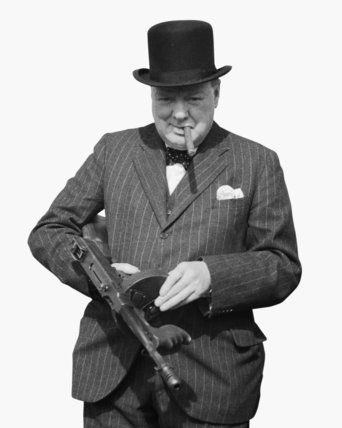
Prime Minister Winston Churchill visited the coastal defenses of Northeast England today. He was accompanied by high staff officers and was cheered wherever he went.
The face of Britain is being transformed by the war as a massive effort gets under way to ensure that the country is not starved into submission. From rural hills to suburban gardens, “digging for victory” has become a patriotic duty.
Barely one-third of Britain’s food was produced at home when the war began – and Hitler knows it, boasting that his U-boat blockade will bring Britain to its knees. Rationing should mean that less food is consumed, but equally important is the campaign to produce more food at home. Land traditionally used for grazing, such as the Downs in southern England, is now being ploughed up to produce cereal crops such as wheat or potatoes. Arable land is expected to increase by 14% this year.
Government money is being pumped into agriculture in order to guarantee prices and because the rural depression of the 1930s left most farmers with too little money to finance tractors, milking machines and fertilizers required to boost output quickly. Although farms form the frontline of this campaign, flowers are being replaced by vegetables in gardens, and allotments are appearing in commons and parks.
British fighter production is 50% above the target figures. 1,200 aircraft have been produced since May 1, 1940. The gap with the Luftwaffe is closing.
A conference was held at the Berghof between Hitler, Keitel, Jodl, Raeder, Brauchitsch, Halder and Puttkamer. Raeder reported that the navy would not be ready for Operation Sea Lion until mid-September, if then, so discussion turned to attacking the Soviet Union instead. Hitler believed that defeating Russia would make Germany unbeatable and force Britain to come to terms, so an invasion of the Soviet Union was set for spring 1941.
The French government of Marshal Henri Philippe Petain has ordered confiscation of the wealth and private estates of Baron Edouard de Rothschild and Louis Louis-Dreyfus, who hold two of the five great fortunes of France, it was revealed tonight. The names of Baron de Rothschild and Louis-Dreyfus were included in the first unofficial list of prominent Frenchmen who are to be stripped of their wealth under the Petain regime’s recent decree punishing those who fled abroad at the time of France’s collapse.
All French servicemen who join a foreign army — including the British Army — are condemned by the Vichy regime to death.
A call for aid from the United States in returning Spain to normal after her wasting civil war was sounded by the Falangist newspaper Arriba today as if in answer to rumors abroad that Spain was preparing to enter the European war.
The defeat of Great Britain must be a slow process in which the present tactics of bombing factories and ports and torpedoing ships must continue for some time, says Virginio Gayda in an editorial in the Giornale d’Italia today.
Vyacheslav M. Molotov, Soviet Premier and Foreign Commissar, is expected to make an important statement on Russia’s foreign policy, including her relations with Germany, when he appears before the Supreme Soviet tomorrow.
U-99, commanded by Kapitänleutnant Otto Kretschmer, sank steamers Jamaica Progress (5475grt) at 56-26N, 08-30W and Jersey City (6322grt) in 55-47N, 09-18W.
At 0138 hours the unescorted Jamaica Progress (Master Alfred McColm) was hit on port side aft by one torpedo from U-99 about 40 miles southwest of Barra Head. The ship was sunk by a coup de grâce at 02.44 hours. Six crew members, one gunner and one passenger were lost. The master, 24 crew members, one gunner and four passengers were picked up by the British trawler Newland and landed at Fleetwood. The chief officer and 16 crew members landed at Barra, Hebrides. The 5,475-ton Jamaica Progress was carrying fruit and was headed for Avonmouth, England.
At 1324 hours on 31 July 1940 the Jersey City (Master Frank Jameson Stirling) in convoy OB.191 was hit by one G7e torpedo from U-99 and sank 70 miles northwest of Tory Island. Two crew members were lost. The master and 42 crew members were picked up by the British steam merchant Gloucester City, transferred to HMS Walker (D 27) (LtCdr A.A. Tait, RN) and landed at Liverpool.
Destroyers HMS Whitshed and HMS Wild Swan of the 18th Destroyer Flotilla and HMS Ambuscade of the 16th Destroyer Flotilla departed Harwich late on the 30th to conduct a sweep in the North Sea off the Zuider Zee. Returning to Harwich after the sweep, HMS Whitshed was mined off Harwich and badly damaged with the forward part of the ship collapsing. Partly under her own power until it was gradually lost and partly in tow of Wild Swan, she was taken stern first to Harwich, screened by Ambuscade. Patrol sloop HMS Puffin and two MTBs also assisted, and tug HMS Krooman was also sent to assist. Whitshed repaired at Chatham completing on 21 December.
Submarine HMS H.28 arrived at Harwich.
Norwegian steamer Stalheim (1298grt) was sunk on a mine one half mile WSW of South Pier, Port Talbot. Five crewmen were lost.
Operation HURRY, the convoy ferrying Hurricanes to Malta, begins at 08:00. Force H leaves Gibraltar and proceeds from the west during the day, while a separate convoy to the island, BS.2, departs from Suez. HMS Ark Royal carries a dozen Hurricanes for the island. Operation Spark, a diversionary operation off Minorca, is set in motion as well.
Cruiser Squadron 7, light cruisers HMS Orion, HMS Neptune, and HMAS Sydney, with destroyers HMS Nubian, HMS Juno, and HMS Garland departed Alexandria at 0600 to operate in the Aegean as a diversion for operation HURRY, the transfer of aircraft to Malta by Force H. Battleships HMS Royal Sovereign and HMS Malaya, aircraft carrier HMS Eagle, with destroyers HMS Jervis, HMS Hero, HMS Hasty, HMS Hereward, HMS Imperial, HMS Ilex, HMS Hostile, and HMS Vendetta departed Alexandria at 1420 to carry out gunnery practices and proceed westward towards Gavdo Island until after dark on 1 August.
German armed merchant cruiser Pinguin sank steamer Domingo de Larringa (5358grt) in the South Atlantic in 05-27S, 18-21W. Eight crewmen were lost, and 30 made prisoners of war.
At the end of July, the following destroyers were under repair – HMS Achates at Scapa Flow boiler cleaning, HMS Antelope at Tyne repairing, HMS Anthony at Scapa Flow boiler cleaning, HMS Beagle at Portsmouth repairing, HMS Bedouin at Scapa Flow boiler cleaning, HMS Brilliant at Chatham repairing, HMS Boadicea at Portsmouth repairing, HMS Boreas at London repairing, HMS Broke at Plymouth boiler cleaning, HMS Diana at London refitting, HMS Douglas at Portsmouth refitting, HMS Eskimo at Barrow repairing, HMS Eclipse at Clyde refitting, HMS Electra at Greenock repairing, HMS Fame at Rosyth repairing, HMS Harvester at Liverpool boiler cleaning, HMS Isis at Plymouth repairing, HMS Ivanhoe at Chatham repairing, HMS Jersey at Hull repairing, HMS Kashmir at Hull repairing, HMS Kelly at Tyne repairing, HMS Matabele at Falmouth repairing, HMS Montrose at Chatham repairing, HMS Shikari at Portsmouth refitting, HMS Somali at Liverpool repairing, HMS Vanessa at Sheerness refitting, HMS Wallace at Rosyth refitting, HMS Waterhen at Suez refitting, HMS Whitehall at Plymouth reboilering, HMS Wishart at Gibraltar refitting, HMS Witch at Plymouth repairing, HMS Zulu at Tyne repairing, and Polish ORP Blyskawica and ORP Burza, both at Portsmouth repairing.
Convoy OB.192 departed Liverpool escorted by destroyer HMS Vanoc with corvettes HMS Mallow and HMS Gladiolus from 31 July to 4 August. The destroyer was detached to inbound convoy HX.60.
Convoy FN.238 departed Southend, and arrived in the Tyne on 2 August.
Convoy MT.126 departed Methil, and arrived in the Tyne later that day.
Convoy FS.238 departed the Tyne, escorted by sloop HMS Fleetwood. On 1 August, destroyers HMS Woolston, HMS Jupiter, and HMS Kelvin joined. Destroyers Jupiter and Kelvin were detached later that day. On 2 August, destroyers HMS Ambuscade, HMS Malcolm, and HMS Wild Swan joined, and arrived at Southend on 2 August.
Convoy HX.62 departed Halifax escorted by Canadian destroyer HMCS Saguenay and auxiliary patrol vessel HMCS French at 0715. At midnight the convoy was turned over to armed merchant cruiser Aurania. French detached on 1 August and Saguenay on the 2nd,
Convoy BHX.62 departed Bermuda on the 30th escorted locally by sloop HMS Penzance, and with ocean escort provided by armed merchant cruiser HMS Montclare. The convoy rendezvoused with convoy HX.62 on 4 August when Montclare detached. Aurania continued on with the convoy until the 11th, when she detached. HX.62 reached Liverpool on the 15th.
Convoy BS.2 departed Suez, escorted by sloops HMS Grimsby and HMS Clive. The sloops were detached on 3 August when anti-aircraft cruiser HMS CARLISLE, light cruiser HMS Leander, and sloop HMS Flamingo joined. The convoy was dispersed on 9 August.
The War at Sea, Wednesday, 31 July 1940 (naval-history.net)
Destroyers WHITSHED and WILD SWAN of the 18th Destroyer Flotilla and AMBUSCADE of the 16th Destroyer Flotilla departed Harwich late on the 30th to conduct a sweep in the North Sea off the Zuider Zee. Returning to Harwich after the sweep, WHITSHED was mined off Harwich and badly damaged with the forward part of the ship collapsing. Partly under her own power until it was gradually lost and partly in tow of WILD SWAN, she was taken stern first to Harwich, screened by AMBUSCADE. Patrol sloop PUFFIN and two MTBs also assisted, and tug KROOMAN was also sent to assist. WHITSHED repaired at Chatham completing on 21 December.
Submarine H.28 arrived at Harwich.
Convoy OB.192 departed Liverpool escorted by destroyer VANOC with corvettes MALLOW and GLADIOLUS from 31 July to 4 August. The destroyer was detached to inbound convoy HX.60.
Convoy FN.238 departed Southend, and arrived in the Tyne on 2 August.
Convoy MT.126 departed Methil, and arrived in the Tyne later that day.
Convoy FS.238 departed the Tyne, escorted by sloop FLEETWOOD. On 1 August, destroyers WOOLSTON, JUPITER, and KELVIN joined. Destroyers JUPITER and KELVIN were detached later that day. On 2 August, destroyers AMBUSCADE, MALCOLM, and WILD SWAN joined, and arrived at Southend on 2 August.
U-99 sank steamers JAMAICA PROGRESS (5475grt) at 56‑26N, 08‑30W and JERSEY CITY (6322grt) in 55‑47N, 09‑18W. Six crew and one gunner were lost on JAMAICA PROGRESS, and two on JERSEY CITY. Steamer GLOUCESTER CITY (3071grt) rescued 43 survivors from JERSEY CITY, who were taken into Liverpool by destroyer WALKER. (Uboat.net – trawler NEWLAND rescued thirty JAMAICA PROGRESS survivors.)
Norwegian steamer STALHEIM (1298grt) was sunk on a mine one half mile WSW of South Pier, Port Talbot. Five crew were lost.
Convoy HX.62 departed Halifax escorted by Canadian destroyer SAGUENAY and auxiliary patrol vessel FRENCH at 0715. At midnight the convoy was turned over to armed merchant cruiser AURANIA. FRENCH detached on 1 August and SAGUENAY on the 2nd,
Convoy BHX.62 departed Bermuda on the 30th escorted locally by sloop PENZANCE, and with ocean escort provided by armed merchant cruiser MONTCLARE. The convoy rendezvoused with convoy HX.62 on 4 August when MONTCLARE detached. AURANIA continued on with the convoy until the 11th, when she detached. HX.62 reached Liverpool on the 15th.
Cruiser Squadron 7, light cruisers ORION, NEPTUNE, and HMAS SYDNEY, with destroyers NUBIAN, JUNO, and ORP GARLAND departed Alexandria at 0600 to operate in the Aegean as a diversion for operation HURRY, the transfer of aircraft to Malta by Force H
Battleships ROYAL SOVEREIGN and MALAYA, aircraft carrier EAGLE, with destroyers JERVIS, HERO, HASTY, HEREWARD, IMPERIAL, ILEX, HOSTILE, and VENDETTA departed Alexandria at 1420 to carry out gunnery practices and proceed westward towards Gavdo Island until after dark on 1 August.
Convoy BS.2 departed Suez, escorted by sloops GRIMSBY and CLIVE. The sloops were detached on 3 August when anti-aircraft cruiser CARLISLE, light cruiser HMNZS LEANDER, and sloop FLAMINGO joined. The convoy was dispersed on 9 August.
German armed merchant cruiser PINGUIN sank steamer DOMINGO DE LARRINGA (5358grt) in the South Atlantic in 05‑27S, 18‑21W. Eight crew were lost, and 30 made prisoners of war.
July, miscellaneous
From early July to late August, light cruisers (mainly) of the Home Fleet were deployed in the south of England for invasion defense under operation PURGE.
At Humber and Sheerness – AURORA and GALATEA of the 2nd Cruiser Squadron.
Between Humber, Sheerness, Firth of Forth, and Southend – SHEFFIELD and BIRMINGHAM of the 18th Cruiser Squadron. They arrived at Sheerness from the Humber at 0750/2nd.
At Portsmouth – MANCHESTER of the 18th Cruiser Squadron.
At Plymouth – NEWCASTLE of the 18th Cruiser Squadron.
At Clyde – heavy cruiser DEVONSHIRE of the 1st Cruiser Squadron.
At the end of July, the 5th Destroyer Flotilla was transferred from Scapa Flow to Immingham for invasion defense duties. Destroyers transferred at that time were JAVELIN, JAGUAR, JUPITER, JACKAL, KIPLING, and KELVIN.
At the end of July, submarines were assigned to patrol in the Bay of Biscay off Bordeaux. The first two were TIGRIS, which departed Rothesay on the 16th and returned on 5 August, and TALISMAN, which departed Greenock on the 27th to relieve TIGRIS.
In August, the patrols continued with CACHALOT sailing on the 15th, TRIBUNE on the 16th, TIGRIS for a second patrol on the 27th, and TALISMAN for a second patrol on the 29th, all from Rothesay.
Dutch submarine HrMs (HNMS) O.15 was out of service with defects at Bermuda.
At the end of July, the following destroyers were under repair – ACHATES at Scapa Flow boiler cleaning, ANTELOPE at Tyne repairing, ANTHONY at Scapa Flow boiler cleaning, BEAGLE at Portsmouth repairing, BEDOUIN at Scapa Flow boiler cleaning, BRILLIANT at Chatham repairing, BOADICEA at Portsmouth repairing, BOREAS at London repairing, BROKE at Plymouth boiler cleaning, DIANA at London refitting, DOUGLAS at Portsmouth refitting, ESKIMO at Barrow repairing, ECLIPSE at Clyde refitting, ELECTRA at Greenock repairing, FAME at Rosyth repairing, HARVESTER at Liverpool boiler cleaning, ISIS at Plymouth repairing, IVANHOE at Chatham repairing, JERSEY at Hull repairing, KASHMIR at Hull repairing, KELLY at Tyne repairing, MATABELE at Falmouth repairing, MONTROSE at Chatham repairing, SHIKARI at Portsmouth refitting, SOMALI at Liverpool repairing, VANESSA at Sheerness refitting, WALLACE at Rosyth refitting, HMAS WATERHEN at Suez refitting, WHITEHALL at Plymouth reboilering, WISHART at Gibraltar refitting, WITCH at Plymouth repairing, ZULU at Tyne repairing, Polish ORP BLYSKAWICA and ORP BURZA, both at Portsmouth repairing.
Today in Washington, President Roosevelt discussed in two conferences with Senator Byrnes the question of a successor to James A. Farley as chairman of the Democratic National Committee; he received a report from Chairman Doughton of the House Ways and Means Committee on progress in framing a new excess-profits tax bill.
The Senate was in recess, but its Military Affairs Committee redrafted the Compulsory Military Training Bill; the Banking and Currency group redrafted a bill to grant $500,000,000 for Export-Import Bank loans to Latin-American countries; the Finance Committee approved a bill to strengthen border patrols, and a Judiciary subcommittee heard testimony supporting a bill to require registration of alleged subversive organizations.
The House passed a $4,963,151,957 Defense Deficiency Bill; discussed a proposed excess-profits tax bill; received the Secrest bill to authorize one-year army enlistments and increase base pay, and adjourned at 3:04 PM until noon tomorrow. The Military Affairs Committee heard Secretary Stimson on compulsory military training; the Naval Affairs Committee considered a bill for the construction of a graving dock in New York, and the Appropriations Committee early in the day approved the Defense Deficiency Bill passed by the House.
British Prime Minister Churchill, in telegram sent from the U.S. Ambassador to the Court of St. James (Joseph P. Kennedy) to U.S. Secretary of State Hull, again asked U.S. President Franklin D. Roosevelt for the loan of destroyers. In the previous ten days, the Royal Navy had suffered the loss of four of its destroyers and damage to seven. “If we cannot get reinforcement,” Churchill stated, “the whole fate of the war may be decided by this minor and easily remediable factor.”
The United States Government prohibited the export of aviation petrol outside of the American continent. President Roosevelt today ordered an embargo on exports of aviation-type gasoline to all countries outside the Western Hemisphere, except quantities, that may be necessary for the operation of American-owned airplanes operating in foreign services. An announcement from the White House explained the move was in “the interest of national defense.” It asserted Colonel R. L. Maxwell, administrator of export control, had recommended the step and Mr. Roosevelt had approved. The commerce department said immediately the order virtually would kill off the aviation gasoline export business in this country, Canada and other western hemisphere countries are free to continue buying American aviation fuel, but the trans-shipment of that fuel to Europe or Asia is now prohibited.
Secretary of War Stimson calls for military conscription. In the face of a warning by Secretary Stimson to the House Military Affairs Committee that a “very grave danger” exists of a direct attack by Hitler on the United States, the corresponding Senate committee today virtually recast the Burke-Wadsworth Compulsory Selective Service bill to require only the registration of males between the ages of 21 and 31. The Secretary of War expressed the opinion that Great Britain may be conquered in thirty days, with the remaining part of her fleet passing to Germany. He strongly urged that all men between the ages of 18 and 64 be registered, as the original measure provided, even though only a restricted group would be subject to immediate training and service. He held that this would tend to deter the dictators and would have “a tremendous moral effect both inside and outside our national boundaries.” Despite this statement and despite the possession of official information that the bill, as it stood, had the approval of the Budget Bureau, usually tantamount to Presidential endorsement, the Senate committee not only voted to restrict registrations to the 21-to-31 age group, but to provide that men between the ages of 18 and 35 years should be permitted to enlist voluntarily for only one year instead of the three years now required everywhere, except in New York City, for Regular Army service.
The House, without a record vote and in unprecedented time of two hours and forty-nine minutes for a bill of such magnitude, today passed and sent to the Senate the supplemental National Defense Appropriation Bill to pour the sum of $4,963,151,957 in cash and contract authorizations into the rearmament drive. The debate preceding the vote — in which only the voice of Representative Marcantonio of New York was heard in opposition — was mainly in praise of progress already made by the National Defense Advisory Commission and the War and Navy Departments toward expanding the defense forces to meet any eventuality.
The only critical part of the debate was led by Representative Taber of New York, who deplored the Administration’s “coddling” of labor, declaring that such had played a large part in the collapse of France. The bill brings to $10,040,225,543 the amount voted so far by the House for defense purposes in the 1941 fiscal year, allotted as follows: to the Army, $3,982,725,786 in cash and $2,827,136,397 in contractual authority; to the Navy, $2,439,377,748 in cash and $790,985,612 in contractual authority.
President Roosevelt signed today the bill to start the $68,500,000 national defense program of the Tennessee Valley Authority. The bill, passed by both Congressional houses yesterday, appropriates $25,000,000 to start a plan described by Mr. Lilienthal as of great magnitude, which will eventually involve all the $68,500,000. In signing the measure, President Roosevelt emphasized its value to the national defense program. “The funds made available by Congress on the recommendation of the Defense Advisory Council will help augment the very substantial blocks of power already available or in prospect not only at TVA but in other parts of the country,” he said. “This tremendous amount of low cost energy is strategically located for the manufacture of material essential to the national defense.”
Wendell L. Willkie announced today that he had started to work on the series of major speeches on national issues which he would deliver during his campaign for the Presidency.
Threat of a midnight strike at the Boeing Aircraft company’s three plants in the Seattle region was eliminated late tonight when the company’s union employes voted to extend negotiations for at least 10 days. The action at an overflow meeting of the Aeronautical Mechanics union (A.F.L.) followed an appeal from Secretary of Labor Perkins for such a course. J. R. Steelman, department of labor commissioner of conciliation in Washington, D. C, also asked for a 10-day extension.
The Marquess of Lothian, British Ambassador to the United States, clarified today the position of his government toward the sending of British children to this country, declaring that many were willing to go and that, contrary to some reports that they were mostly children of rich parents, 98 percent were from grant-aided schools.
A head-on collision on the Pennsylvania Railroad carried forty-one persons to flaming death tonight. A gasoline-propelled “doodlebug” railroad motor coach, shuttling from Hudson, Ohio, to Akron, and a doubleheader freight train of seventy-three cars crashed. The motor coach, pushed back 200 yards along the track, burst into flames. Railroad officials said the coach, shuttling from Hudson, Ohio, to Akron, failed somehow to take a siding to allow the double-engined, seventy-three-car freight train to pass. All those killed were in the steel coach, whose gasoline tanks, bursting at the deafening impact, turned the car into a fiery trap. Coroner R. E. Amos said most of the victims were burned to death.
The doodlebug should have pulled into a siding at Silver Lake to allow the freight to pass through the single-track railway section at that point, but instead, it continued southward. Although both trains braked, their combined speed was 55 mph (89 km/h) when they collided at 5:58 pm. The engineer, conductor, and a railroad employee managed to jump free, though they were badly injured; no one else on the doodlebug survived. As the lead freight engine telescoped 12 feet (3.7 m) into the railcar, the doodlebug’s 350-US-gallon (1,300 L; 290 imp gal) gasoline tank ruptured and sprayed the interior of the coach with burning fuel, as the doodlebug was pushed over 500 feet (150 m) up the track by the momentum of the heavy freight train (which remained on the track); “flames shooting out 25 feet” [7.6 m] in all directions. The medical examiner determined that only nine passengers were killed on impact, the rest were burned to death. Firemen fought the blaze for 45 minutes, but several hours were needed before the bodies could be removed; most required saws to separate them from the seats to which they had been fused by the flames. Ambulances soon gathered at the scene, but only the three railroad employees needed to be taken to a hospital; instead, they took the charred bodies to funeral homes.
David Lilienthal, a director of the Tennessee Valley Authority, said T.V.A. directors and employes would take “absolutely no part” in the presidential campaign.
Actress Loretta Young (27) weds advertising executive Tom Lewis at the chapel of St. Paul’s Church in Westwood.
Major League Baseball:
The Cardinals took both ends of a twin bill from the Bees today, 3–1 in eleven innings and 17–8, to sweep the four-game series and creep within a few percentage points of the first division. Johnny Mize hit home runs in both games to reach 30 for the season.
Harry Danning cracks a two-out ninth-inning homer to give the Giants a come-from-behind 5–4 win over the Reds. Four times in a row Bucky Walters was one strike away from winning. Four times he failed. He had a 3-and-2 count on Bob Seeds and lost him by issuing a pass. He reached the same tally on Burgess Whitehead and Whitey slashed a home run just inside the right-field foul line. He did it again before Mel Ott walked. Then up stepped Harry the Horse Danning.
The Cubs went down to a costly 7–3 defeat at the hands of the Phillies today as outfielder Augie Galan suffered a fractured left knee crashing against a concrete wall. Galan, who probably will be out for the remainder of the season, was chasing a ly ball in foul territory when he crashed into the wall.
A four-run rally in the eighth inning gave the Indians a 12–11 victory in a slugfest with Boston today and kept the Tribe tied with Detroit for first place. Jimmy Foxx, who had been out with a leg injury, returned to the Red Sox lineup as catcher instead of at first base. He poled two singles and batted in two runs. Manager Joe Cronin made the move to keep the heavy-hitting Lou Finney at first.
Joe DiMaggio’s hitting streak of 23 games come to an end today in Detroit, and the Tigers top the Yankees, 7–6, in eleven innings. The winning RBI was delivered by Hank Greenberg, who singled in Bruce Douglas Campbell to end it. Campbell had three hits on the day. Lefty Gomez took the loss for New York.
The Athletics defeated the White Sox, 4 to 3, tonight, the loss again preventing Chicago from catching the Yankees in their fight for fourth place. The victory enabled Philadelphia to climb out of the American League cellar, a half game ahead of the Browns.
Five of the Browns’ pitchers tried to stop Washington today, but the Senators scored on each of them for an easy 13–5 victory. Ken Chase, the Senators’ pitcher, was the leading slugger, getting three hits, including a home run. Buddy Lewis also hit a homer for Washington.
St. Louis Cardinals 3, Boston Bees 1
St. Louis Cardinals 17, Boston Bees 8
Philadelphia Athletics 4, Chicago White Sox 3
Boston Red Sox 11, Cleveland Indians 12
New York Yankees 6, Detroit Tigers 7
Cincinnati Reds 4, New York Giants 5
Chicago Cubs 3, Philadelphia Phillies 7
Washington Senators 13, St. Louis Browns 5
The Administration intends to convey to the Senate as soon as feasible the convention signed last night. at Havana, setting up machinery to take over European possessions in this hemisphere that might be threatened with German seizure, Secretary of State Cordell Hull indicated today aboard the special train taking him back to Washington. From other sources it was learned that strong efforts will be made to obtain Senate ratification at the present session, and within the next few weeks if possible. Not only would prompt ratification by the United States stimulate similar parliamentary action by the other American republics but it would serve effective notice on all non-American powers that transfers of sovereignty among them as regards American dependencies would not be tolerated.
Redrafting of legislation designed to grant to the Export-Import Bank $500,000,000 more with which to make loans to Latin-American countries to help them meet the war situation was ordered today by the U.S. Senate Banking and Currency Committee.
The U.S. Navy heavy cruisers USS Wichita (CA 45), under command of Rear Admiral Andrew C. Pickens, and USS Quincy (CA 39) reached Bahia, Brazil. These ships were visiting South America “to furnish a reminder of the strength and the range of action of the armed forces of the United States.”
Udham Singh is hanged in London for the assassination of Michael O’Dwyer, the former lieutenant governor of the Punjab in India, on 13 March 1940. The assassination was done in revenge for the Jallianwala Bagh massacre in Amritsar in 1919, for which O’Dwyer was responsible and of which Singh himself was a survivor.
Eighty persons were killed or wounded and forty buildings destroyed when Japanese bombers raided the Chinese wartime capital of Chungking (Chongqing) for four hours this afternoon. Three bombs fell within the American Methodist compound, badly shaking the organization’s building. The American gunboat Tutuila was slightly damaged when three Chinese boats got out of control in the swollen Yangtze River and fouled her anchor chains.
Carrying terms of a comprehensive settlement of differences between the Kuomintang and the Communists, Chou En-lai, Communist leader, has left Chungking for Yenan. He will confer with Mao Tse-tung, chairman of the Chinese Soviet, Chu Teh and other Communist leaders regarding terms worked out in conferences here between Mr. Chou, Generalissimo Chiang Kai-shek and other Communist and Kuomintang leaders. It is understood a tentative agreement was reached to fix the long-disputed boundaries of the Communist special area in North Shensi. The area would be administered by officials put forward by the Communists but appointed and responsible to the Kuomintang Executive Yuan. The preliminary agreement also defined the strength and spheres of operation of the Communist armies. Coming after restriction of traffic across Burma to China with its concomitant greater Chinese reliance on Russia, the agreement is taken to emphasize General Chiang’s determination to carry on the war.
The Japanese release four of the 9-12 Britons arrested on espionage charges.
Mitsubishi delivered the first production Zero fighter to the Japanese Navy.
The spokesman for the Japanese admiralty today described President Roosevelt’s ban on export of aviation gasoline from the western hemisphere as an act directed against Japan and the Rome-Berlin axis. The spokesman said the gasoline order was an attempt to “kill two birds with one stone” namely the axis and Japan. “Under whatever pretext the order on aviation gasoline was issued,” said the spokesman, “it undoubtedly is designed to exert economic pressure on Japan.”
Dow Jones Industrial Average: 126.14 (+0.17)
Born:
Stanley Jaffe, American producer (“Fatal Attraction”), in New Rochelle, New York
Roy Walker, television personality and comedian, in Belfast, Northern Ireland, United Kingdom.
Naval Construction:
The Royal Navy Dance-class ASW trawler HMS Rumba (T 122) is launched by A & J Inglis Ltd. (Glasgow, Scotland); completed by Aitchison Blair.
The Japanese (Nippon Yusen Kaisha) Nitta Maru-class cargo liner Yawata Maru (八幡丸) is completed. She will be transferred to the Imperial Japanese Navy (IJN) during the Pacific War, renamed Un’yō (雲鷹, Cloud Hawk), and was converted into an Taiyō-class escort carrier in 1942
The Royal Canadian Navy Prince-class armed merchant cruiser HMCS Prince Robert (F 56) is commissioned. Her first commander is Commander Charles Tachereau Beard, RCN.
The Вое́нно-морско́й флот СССР (ВМФ) (Soviet Navy) “M” (Malyutka)-class (3rd group, Type XII) submarine M-62 is commissioned.
The Вое́нно-морско́й флот СССР (ВМФ) (Soviet Navy) “M” (Malyutka)-class (3rd group, Type XII) submarine M-63 is commissioned.
For the month of July 1940, U-boats sink 41 ships of a total of 203,709 tons and damage 2 ships of a total of 13,027 tons.
Total shipping losses for July 1940:
134 Allied ships sunk
195,825 tons sunk by U-boat
70,193 tons sunk by aircraft
80,796 tons sunk by surface ships (raiders, etc.)
33,598 tons sunk by mines
U-Boats: 28 in operation at the end of the month, 2 lost in July.
Thames-out OA convoys are now joining FN East Coast ships and passing around the north of Scotland before going out through the North West Approaches. They stop altogether in October. The Thames/Forth FN/FS convoys continue along the East Coast. Two additional ones are Forth/ Clyde EN/WN around the north of Scotland. Thames/English Channel CW/CE through the Strait of Dover. [Losses in the Channel are so heavy that the latter have to be stopped for a while.] Slow Sydney, Cape Breton/UK convoys start in August with SC.1.
Convoys are now being re-routed through the North Western Approaches to the British Isles instead of to the south of Ireland and through the Irish Sea. North Channel and the sea lanes leading to it becomes a focal point for all shipping leaving or arriving in British waters.
The following convoys continue:
Liverpool out – OB
UK/Gibraltar – OG
Fast Halifax/UK – HX
Gibraltar/UK – HG
Sierra Leone/UK – SL
The limits of the few escorts available are only just pushed out from 15 W to 17 W where they stay until October. U-boats are patrolling well beyond this range and so many sinkings are taking place in unescorted convoys or when the ships have dispersed.
 History Diaries