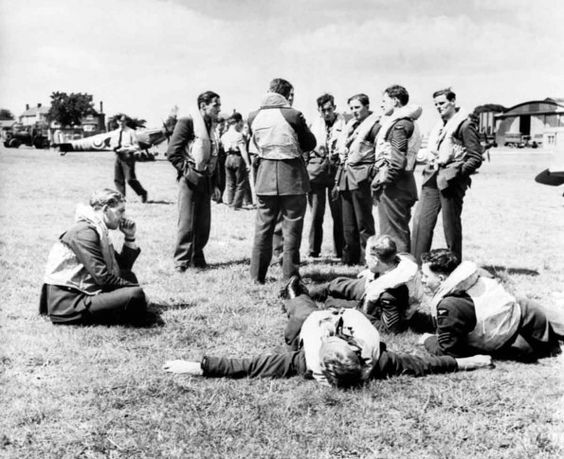
The Battle of Britain: During the day Dover Harbor was heavily attacked, several reconnaissance aircraft were attacked, and a raid which was attacking a convoy off Harwich was intercepted and driven off. [battleofbritain1940 web site]
On July 29, the weather was fine and it was expected that more attacks would be made by the Luftwaffe as flying conditions were as perfect as one could get. Slow to make their presence felt, it was not until 0700 hours that the first enemy formations were detected coming in across the Channel towards Dover. The observer Corps reported that the formation consisted of 30+ Ju 87 Stukas and 50 + Bf109s. Fighter Command sent up more squadrons than usual including 41 Squadron Hornchurch (Spitfires), 56 Squadron North Weald (Hurricanes), 64 Squadron Kenley Spitfires) and it is believed 43 Squadron Northolt (Hurricanes) although there is no mention of attacking Ju 87s over Dover, although they were airborne at the time.
The massed formations of Spitfires and Hurricanes arrived over the town of Dover just as the Ju 87s were making their first attacks at 0730 hours and the skies above the town became a swirling mass of weaving aircraft and vapor trails as an estimated number of 200 aircraft engaged in combat. Four Ju 87s were reported to have been shot down into the sea while Fighter Command received a number of damaged aircraft including five Spitfires from 41 Squadron. Two RAF fighters were lost.
During the afternoon, formations of He 111 and Do 17s were intercepted by 66 Squadron Coltishall (Spitfires), 17 Squadron Debden (Hurricanes) and 85 Squadron Martlesham (Hurricanes) off the Essex coast near Harwich and shot down two He 111’s while 151 Squadron North Weald (Hurricanes) attacked a formation of Me110s off the coast at Orfordness. Two Hurricanes were damaged by accurate gunfire from the Bf110s and both made forced landings at Martlesham and Rochford respectively.
The Stukas also catch destroyer HMS Delight off Portland at 17:00 and sink it. This attack is based on Freya Radar operating 60 miles away. There are 12 deaths and 59 other casualties.
To solidify the defense of Dover, from which all destroyers have been withdrawn, the Royal Navy sinks 5183 special service vessel Umvotti as a blockship.
The Admiralty expands upon its decision to take destroyers out of Dover Harbour. Now, destroyers are forbidden from any operations during daylight hours in the eastern English Channel. Minesweepers remain in action at great risk to themselves.
During the early hours of the morning, a He 111 en route to bomb the Bristol works at Filton was detected by searchlights and came under fire from AA gun batteries which managed to hit and damage the bomber. A fire started to engulf one of the engines believed to be the port engine, and soon the other engine began to lose power and the crew decided to abandon the aircraft. All Bailed out and were eventually captured. Two of the crew were at large for some 48 hours, but one crew member, Fw J Markl, managed to evade capture for nine days, believed to be the longest period of time that a German airman was “at large” before being captured.
During the night there was considerable minelaying activity on the Dover, Thames Estuary and Harwich areas.
RAF Statistics for the day: 205 patrols were flown involving 798 aircraft. Luftwaffe casualties: Fighters – 7 confirmed, 2 unconfirmed; Bombers – 15 confirmed, 8 unconfirmed. RAF casualties: 2 Spitfires, 2 Hurricanes confirmed.
RAF Casualties: July 29th 1940
F/O D.R. Gamblen. 41 Sqn Manston. Spitfire N3038. Disappeared over Dover. Missing.
P/O K.C. Campbell. 43 Sqn Northolt. Hurricane L1955. Crashed and burnt out. Killed.
F/Sgt C.J. Cooney. 56 Sqn Nth Weald. Hurricane P3879. Exploded in Channel off Dover.
RAF Bomber Command dispatches 14 Blenheims to targets in Germany and to Leeuwarden airfield during the day. Only 6 aircraft bombed; 1 lost.
RAF Bomber Command dispatches 76 Hampdens, Wellingtons and Whitleys overnight to Homberg. Cologne, Hamm; barges in Dutch ports and minelaying. No losses. Bomber Command continues its daylight raids over Occupied Europe. This includes raids on barges being collected at Channel ports for a possible invasion and airfields in northwest Europe. The RAF is being aided in these raids by Free French airmen. Other targets of opportunity are infrastructure installations such as railway marshaling yards and oil installations.
Italian bombers raid Aden without much effect. Regia Aeronautica planes also attack Royal Navy ships north of Bardia but do not score any hits.
Malta is being bombed almost every day, and people have begun practically living in the larger shelters. Many of these underground chambers were created centuries ago by the Knights of Malta. During the day, there are two air raid alerts, but no bombs are dropped.
Hitler told the military commander Alfred Jodl that the planned attack on the Soviet Union in the fall of 1940 was no longer logistically feasible and that it would be postponed to spring 1941. At a conference held in a converted railway carriage, Colonel-General Alfred Jodl, Adolf Hitler’s Chief of Operations, announced that the Führer had decided “once and for all” to rid the world of the Soviet menace. However, recognizing that the war against the United Kingdom took a higher priority at this point in time, Hitler pushed the invasion date to the spring of 1941.
Jodl briefs top military personnel on Hitler’s decision to attack the Soviet Union. “The collision with Bolshevism is bound to come. Better to have it now, when we are at the height of our military power,” he says. The decision, of course, is not up for debate.
The timing given for the attack is spring 1941, which pretty much everyone believes will give the Wehrmacht plenty of time to settle matters with Great Britain. Eventually, the codename Operation BARBAROSSA will be given to this invasion.
While there are off-handed ruminations by some that the attack would occur as early as the fall of 1940, this is the first time a specific time frame has been officially established. In fact, while treated very matter-of-factly, this is the first real communication from Hitler to the Wehrmacht, aside from off-handed comments, that an attack on the USSR will occur at all. After this, the idea of an attack on the USSR will be an accepted, in fact almost obvious and inevitable, idea among the top military leadership.
Hitler is at the absolute peak of his popularity following the fall of France, and while many have misgivings about attacking the Soviet Union — with very good reason — it is impossible to oppose his next move absent some intervening event. Among the many who oppose the idea to one extent or another is Reichsmarschall Hermann Göring, but there really is nothing that he or anyone else can do within the chain of command once Hitler has made a decision.
The German naval command (Oberkommando der Kriegsmarine) issued a memo noting that the mid-September 1940 invasion date for Britain as demanded by Adolf Hitler was possible, but considering the present state of affairs, a postponement to May 1941 was suggested. Meanwhile, a special economic board was set up to oversee the looting of British industry upon conquest.
With Great Britain supposedly about to fall into its hands, the Germans set up an economic board to oversee the exploitation of the British industry after Operation SEA LION succeeds.
Germany annexes Belgian provinces Eupen, Malmedy, and Moresnet. Speaking French/Flemish there now is banned. There is a large ethnic German population in this region, and many already tend to view themselves as German in nationality as well as by origin.
German Jews are forbidden to have telephones in their homes.
Another invasion alert at 21:00 on 29 July 1940 brings the Home Fleet at Scapa Flow to readiness, but once again it is a false alarm.
British Air Ministry accused Germany of using rescue aircraft with Red Cross markings for reconnaissance purposes. The Air Ministry justifies the fact that it has shot down four Luftwaffe Heinkel He 59 search and rescue planes that are clearly marked with the Red Cross symbol by stating that any plane that acts “suspiciously” is fair game. In point of fact, the RAF has been shooting down such planes while in the very act of rescuing downed crewmen in the Channel when there was nothing suspicious about them.
The weapons firm Albright & Wilson of Oldbury, England, United Kingdom demonstrated to the British Royal Air Force a self-igniting explosive containing petrol and phosphorus.
Four British soldiers were reported killed and seven injured today in the explosion of an ammunition dump in Britain’s great rock fortress at Gibraltar.
Neville Chamberlain, who in spite of his 71 years and the strain of his long term as Prime Minister, has been free so far from serious illness, underwent a successful operation tonight in a nursing home that he had entered earlier in the day.
The Rumanian government has recently nationalized a Dutch Royal Shell subsidiary. The British government formally protests via a diplomatic note.
Rumania, is “willing and ready” to cede territory to Hungary and Bulgaria, it was stated in official quarters tonight.
Royal Navy implements blockade of Vichy French Madagascar.
With trials scheduled for former Prime Minister Daladier and other “traitors,” the Vichy government sets up a special Supreme Court to try former officials of the Third Republic. This becomes known as the Riom Trial.
Portugal and Spain added a clause to the 1939 friendship treaty; it was later known as the Iberian Pact. Franco and Salazar sign a protocol calling for consultations if Spanish or Portuguese territory threatened.
Premier Mussolini’s fifty-seventh birthday and the fortieth anniversary of King Victor Emmanuel’s accession to the throne both came today, but only the King’s anniversary was celebrated. Even in that case, since it was also forty years ago that King Humbert I was assassinated, all flags were at half staff.
U-99, commanded by Kapitänleutnant Otto Kretschmer, sank steamer Clan Menzies in 54-10N, 12W. At 0215 hours the unescorted Clan Menzies (Master William John Hughes) was hit aft by one G7e torpedo from U-99 and sank by the stern after one hour about 150 miles west of Loop Head, Co. Clare. The ship had been spotted five hours earlier and missed with a first G7e torpedo at 02.03 hours. Six crew members were lost. The master and 87 crew members landed at Enniscrone, Co. Sligo. The 7,336-ton Clan Menzies was carrying wheat, grain, dried fruit, zinc, and general cargo and was headed for Liverpool, England.
The Home Fleet at Scapa Flow was brought to four hour’s notice at 0905.
Destroyer HMS Delight (Cdr M. Fogg-Elliot DSO) of the 3rd Destroyer Flotilla departed Portsmouth at 1500 for the Clyde, but was heavily damaged by German bombing off Portland, and subsequently sunk. (Seekrieg – The new “Freya” radar, 60 miles away, spotted the destroyer and vectored in the bombers.) Eight ratings were killed, four missing, and six died of wounds. Fogg-Elliott, Midshipman R. T. Hale RNR, and Gunner (T) W. W. G. Hubbert, and fifty six ratings were wounded. Her survivors were rescued by ML.102, ML.105, MA/SB.1, MA/SB.5, destroyers HMS Broke, HMS Vansittart, and auxiliary patrol boats HMS Pilot (103grt) and HMS Conqueror (177grt).
Destroyers HMS Sikh and HMS Amazon departed Scapa Flow at 0400, HMS Inglefield and HMS Keppel the Clyde at 0535, and HMS Highlander, HMS Viscount, HMS Vanquisher, and HMS Wanderer from Liverpool to join inbound Canadian troop convoy TC.6. The convoy was met in 57-12N, 21-50W at 2000/30th, and safely arrived at Greenock at 1430/1 August.
Destroyer HMS Zulu departed Scapa Flow at 1600 for the Tyne where she arrived at 0700/30th for a refit. Part of the refit included the placement of a twin 4in anti-aircraft gun in her X gun position.
Destroyer HMS Fernie departed Scapa Flow at 1315 for Dover to join the Dover Command, but en route, was diverted to Portsmouth.
Submarine HMS Porpoise laid minefield FD.23 in 55-56N, 06-18E off the Norwegian coast. After this minelay, the minelaying submarines were diverted to the Bay of Biscay, and there was no more submarine minelaying off Norway until January 1941.
Submarine HMS Sealion attacked a U-62 with gunfire and torpedoes west of Jaederens. Neither submarine was damaged.
Submarine HMS Triton sighted a German submarine off Korsfjord steering west.
Submarine HMS H.50 arrived at Harwich.
Submarine HMS L.26, Dutch submarine HNLMS O.23, and Dutch torpedo boat Z.6 arrived at Rosyth.
A Swordfish aircraft was lost in a torpedo exercise near Lady Isle. Probationary Temporary Midshipman (A) G J A Shelley RNVR, was killed.
Anti-submarine trawler HMS Daneman (516grt) engaged German motor torpedo boats 22 miles WSW of Beachy Head between 0044 and 0315.
Steamer Gronland (1264grt), which had been damaged on the 25th, was sunk in outer Dover Harbor by German bombing. Nineteen crewmen were killed.
Patrol yacht HMS Gulzar (197grt) was sunk by German bombing in the submarine basin in Dover Harbor. The entire crew was rescued.
Steamer Ousebridge (5601grt) was sunk on a mine in Queen’s Channel, Liverpool, 800 feet 5° from Q. 5 red buoy. Her bow was blown off and back broken. Two crewmen were killed.
Steamer Moidart (1262grt) was sunk on a mine in 51-59N, 01-49E. Eleven crewmen were killed.
Steamer Clan Monroe (5952grt) was badly damaged on a mine in 51-52N, 01-48E. Thirteen crewmen were lost. She anchored off South Shipwash on the 30th with a broken back, was taken in tow on the 31st but grounded 3.8 miles 224° from Orfordness Light House.
Trawler Leach’s Romance (44grt) was sunk on a mine 10½ miles due south of Kemp Town. The crew of four was lost.
Special service vessel HMS Umvoti (5183grt) was sunk as a blockship.
Attacked by Italian bombers, light cruiser HMS Liverpool of the AS.2 escort was struck by a bomb which passed through B gun deck without exploding. One rating was killed and two wounded.
Light cruiser HMS Gloucester arrived at Port Said.
Sea Gladiator fighters from HMS Eagle shot down an Italian SM.79 bomber while escorting a convoy in the Mediterranean Sea.
The German commerce raider Atlantis rendezvoused with the captured Norwegian freighter Tirranna and began transferring 400 tons of fuel and various supplies, and approximately 300 prisoners to the ship. The crew also began maintenance on the two ships.
Convoy OB.191 departed Liverpool escorted by destroyer HMS Walker and corvette HMS Periwinkle from 30 July to 2 August. The escort was detached to inbound convoy SL.40.
Convoy FN.236 departed Southend, and arrived in the Tyne on the 31st.
Convoy MT.124 departed Methil, and arrived in the Tyne later that day.
Convoy FS.236 departed the Tyne, escorted by destroyer HMS Winchester and sloop HMS Weston, and arrived at Southend on the 31st.
The War at Sea, Monday, 29 July 1940 (naval-history.net)
The Home Fleet at Scapa Flow was brought to four hour’s notice at 0905.
Destroyer DELIGHT (Cdr M. Fogg-Elliot DSO) of the 3rd Destroyer Flotilla departed Portsmouth at 1500 for the Clyde, but was sunk by German bombing off Portland. (Seekrieg – The new “Freya” radar, 60 miles away, spotted the destroyer and vectored in the bombers.) Eight ratings were killed, four missing, and six died of wounds. Fogg-Elliott, Midshipman R. T. Hale RNR, and Gunner (T) W. W. G. Hubbert, and fifty-six ratings were wounded. Her survivors were rescued by ML.102, ML.105, MA/SB.1, MA/SB.5, destroyers BROKE, VANSITTART, and auxiliary patrol boats PILOT (103grt) and CONQUEROR (177grt).
Destroyers SIKH and AMAZON departed Scapa Flow at 0400, INGLEFIELD and KEPPEL the Clyde at 0535, and HIGHLANDER, VISCOUNT, VANQUISHER, and WANDERER from Liverpool to join inbound Canadian troop convoy TC.6. The convoy was met in 57-12N, 21-50W at 2000/30th, and safely arrived at Greenock at 1430/1 August.
Destroyer ZULU departed Scapa Flow at 1600 for the Tyne where she arrived at 0700/30th for a refit. Part of the refit included the placement of a twin 4in anti-aircraft gun in her X gun position.
Destroyer FERNIE departed Scapa Flow at 1315 for Dover to join the Dover Command, but en route, was diverted to Portsmouth.
Submarine PORPOISE laid minefield FD.23 in 55‑56N, 06‑18E off the Norwegian coast. After this minelay, the minelaying submarines were diverted to the Bay of Biscay, and there was no more submarine minelaying off Norway until January 1941.
Submarine SEALION attacked a U-62 with gunfire and torpedoes west of Jaederens. Neither submarine was damaged.
Submarine TRITON sighted a German submarine off Korsfjord steering west.
Submarine H.50 arrived at Harwich.
Submarine L.26, Dutch submarine HrMs (HNMS) O.23, and Dutch torpedo boat HrMs (HNMS) Z.6 arrived at Rosyth.
A Swordfish aircraft was lost in a torpedo exercise near Lady Isle. Probationary Temporary Midshipman (A) G J A Shelley RNVR, was killed.
Anti-submarine trawler DANEMAN (516grt) engaged German motor torpedo boats 22 miles WSW of Beachy Head between 0044 and 0315.
Convoy OB.191 departed Liverpool escorted by destroyer WALKER and corvette PERIWINKLE from 30 July to 2 August. The escort was detached to inbound convoy SL.40.
Convoy FN.236 departed Southend, and arrived in the Tyne on the 31st.
Convoy MT.124 departed Methil, and arrived in the Tyne later that day.
Convoy FS.236 departed the Tyne, escorted by destroyer WINCHESTER and sloop WESTON, and arrived at Southend on the 31st.
U-99 sank steamer CLAN MENZIES (7336grt) in 54‑10N, 12W. Six crew were killed.
Steamer GRONLAND (1264grt), which had been damaged on the 25th, was sunk in outer Dover Harbour by German bombing. Nineteen crew were killed.
Patrol yacht GULZAR (197grt) was sunk by German bombing in the submarine basin in Dover Harbour. The entire crew was rescued.
Steamer OUSEBRIDGE (5601grt) was sunk on a mine in Queen’s Channel, Liverpool, 800 feet 5° from Q. 5 red buoy. Her bow was blown off and back broken. Two crew were killed.
Steamer MOIDART (1262grt) was sunk on a mine in 51‑59N, 01‑49E. Eleven crew were killed.
Steamer CLAN MONROE (5952grt) was badly damaged on a mine in 51‑52N, 01‑48E. Thirteen crew were lost. She anchored off South Shipwash on the 30th with a broken back, was taken in tow on the 31st but grounded 3.8 miles 224° from Orfordness Light House.
Trawler LEACH’S ROMANCE (44grt) was sunk on a mine 10½ miles due south of Kemp Town. The crew of four were lost.
Special service vessel UMVOTI (5183grt) was sunk as a blockship.
Attacked by Italian bombers, light cruiser LIVERPOOL of the AS.2 escort was struck by a bomb which passed through B gun deck without exploding. One rating was killed and two wounded.
Light cruiser GLOUCESTER arrived at Port Said.
In Washington today, President Roosevelt asked Congress for authority to call out the National Guard for use, if necessary, in defending the Western Hemisphere and American possessions.
The Senate passed a bill increasing benefits paid under the Railroad Unemployment Insurance Act, heard Senator Thomas of Idaho criticize the Administration’s sugar policy, and recessed at 4:58 PM until noon tomorrow.
The House passed a bill for erection of an electric power system by Sitka, Alaska, and adjourned at 12:30 PM until noon tomorrow.
A request from President-Roosevelt for authority to order the national guard and army reserve officers to active training duty was received today by a congress engaged in a deep-seated controversy over the question of compulsory military training. “The developments of modern warfare are such,” Mr. Roosevelt said in a letter read to the senate, “that only seasoned and highly trained troops can hope for success. This group of men who of necessity must be among the first to fight in the nation’s defense have a right to the best preparation that time and circumstance permit.”
Senator Norris, Nebraska Independent said today that “congress has become the hysteria center of the country” and urged adjournment on the ground that further sessions would be “dangerous,” but others held that prospective defense measures made chances remote for leaving the sizzling capital. “There is not a member of congress who is in shape to pass upon legislation,” Norris said in an interview, referring to a heat wave which has seen the temperature in the upper 90’s for more than a week. “Congress has not done a damn thing since before the Republican convention and it’s in no mood to do things right now. All this talking and bickering only tends to produce hysteria.”
The prospect of being drafted for military training under legislation now before congress is causing men to marry, or at least to move up their wedding dates, Rosamond Rice, head of the Los Angeles county marriage license bureau, said today. Applications have averaged about 70 a day until recently, she said. Saturday 123 couples filed notice of intention to wed and 116 filed notices today. “From remarks they make,” said Miss Rice, “there is little doubt but that the fear of being drafted has accelerated the marriage pace, particularly since it is the general belief that married men will be exempt. A great many applicants confide in us that because of the draft measures they are advancing their wedding date.”
U.S. President Franklin Roosevelt, Secretary of the Navy Frank Knox, and House Naval Affairs Committee chairman Carl Vinson arrived at Norfolk Navy Yard, Virginia, United States, via presidential yacht Potomac, for an inspection. After the navy yard, they also visited the U.S. Army’s Langley Field and the Newport News Ship Building and Drydock Company. A long and energetic day spent in inspecting the network of defense works and defense-building operations that honeycomb this Virginia peninsula gave President Roosevelt confidence tonight that “a year from now we can feel a lot better” about the invulnerability of the United States against invasion by any foreign power.
A poll in LIFE Magazine shows that 36% of the public thinks that Germany will beat Great Britain, versus 24% who see the reverse outcome. There is 70% support for a draft.
A confidential Navy plan to station towing vessels in every major harbor to lay and tend submarine nets in an emergency was disclosed today by the Defense Commission. In a report of recent Army and Navy orders the commission listed six contracts totaling $16,499,000 for the construction of net tenders.
The U.S. Army disclosed today that it is establishing four new fast-moving aircraft warning units, using sound locators, as the first part of a program to strengthen defenses on sea coasts and in island outposts against bombing attack.
Prospects for an “economic front” made up of the American nations and the countries of the British Empire were discussed today by James A. Farrell, chairman of the National Foreign Trade Council and former head of the United States Steel Corporation, as a means of combating a prospective totalitarian bloc in Europe.
An enthusiastic demonstration for President Roosevelt by delegates to the convention of the C.I.O. United Automobile Workers of America today set at rest earlier reports that a floor fight might develop against the endorsement of the President for a third term which had been voted by the union’s general executive board.
Wendell L. Willkie predicted today that traditional Democratic and Republican party allegiances would be overturned in this year’s campaign and that a new political alignment centering around approval or disapproval of the New Deal, would be the demarcation line for the vast majority of American voters. This belief has been strengthened considerably during his stay here by telegrams and letters from all parts of the country, expressing opposition to the third-term nomination of President Roosevelt and pledging support to Mr. Willkie.
Among 1,323 passengers arriving in New York aboard the Cunard White Star liner Britannic and the Anchor liner Cameronia were 372 British children, here for the duration of the war.
Major League Baseball:
The Pirates use 21 players and rally for 6 runs in the 9th to tie it, but still lose to Brooklyn, 7–6. The Dogers get the winning run on two walks and an RBI single by Pete Coscarart with two outs in the bottom of the ninth. Tot Presnell works just a third of an inning for Brooklyn and gets the win.
Paced by Johnny Mize, who batted in four runs, the Cardinals made their hits count today to beat the Bees, 8–3, in the opener of a four-game series and returned to fifth place in the National League. The Cards picked up four runs on four hits in the first inning, then got three for three in the seventh. Terry Moore chalked up seven put-outs in centerfield. It was the sixth straight defeat for Boston
With the game tied at 3–3 at the Polo Grounds, and the Giants’ Harry Danning on first base, the result of getting a sharp crack on the knuckles with a pitched ball, Babe Young smashed a terrific double off the right-field wall. The blow, banged off Whitey Moore, fourth Cincinnati pitcher to appear in the battle, scored Danning and sank the Reds, 4–3, in the opener of a three-game series.
Claude Passeau settled down after the first inning today and pitched the Cubs to a 7–3 victory over the Phillies for his twelfth triumph of the year. Ike Pearson held the Cubs in check until the sixth, when singles by Hank Leiber and Al Todd put Passeau ahead, 3–2. Four runs in the seventh, featured by Todd’s double with the bases full, sewed up the game.
The Tigers were toppled again by the Athletics today and their American League lead was cut to one game. The score was 9–7. Freddie Hutchinson started on the mound, and for four innings tamed the A’s. Then he lost his cunning and the Athletics jumped on him for four runs in the fifth. They shelled him from the hill in the seventh, in which they tallied five times.
Pittsburgh Pirates 6, Brooklyn Dodgers 7
St. Louis Cardinals 8, Boston Bees 3
Philadelphia Athletics 9, Detroit Tigers 7
Cincinnati Reds 3, New York Giants 4
Chicago Cubs 7, Philadelphia Phillies 3
As a vanguard of a new Canadian Army to defend the country 300,000 single men will be trained in successive monthly waves of 30,000 each, Defense Minister J.L. Ralston announced to Parliament tonight.
U.S. Navy destroyers USS Walke and USS Wainwright departed Rio Grande du Sol, Brazil for Buenos Aires, Argentina.
The Nationalist Chinese government rejects a semi-serious Japanese peace offer which would assure Japanese hegemony in the region. China was reported today to have turned down unconditionally Japanese peace overtures giving Japan five northern Chinese provinces outright plus indirect hegemony over the Asiatic possessions of France and Britain.
The Japanese reported that Mr. Melville Cox, one of nine British residents arrested in Japan on the previous day, had “committed suicide” by throwing himself out of a police station window. Great Britain demanded a full investigation. Cox was a veteran English newspaperman who, Japanese said, committed suicide after his arrest on espionage charges. Britain also has called for substantiation of charges of a British “espionage network” operating in Japan following Tokyo’s action in rounding up several prominent British businessmen. Japanese officials said Cox, a Reuter’s correspondent, dodged his guards and hurled himself through a second story window of the police headquarters while being questioned. British officials were not inclined to accept a purported farewell note Cox was reported to have left.
Ambassador Kensuke Horinouchi’s reports from Washington enabled Yakichiro Suma, the Foreign Office spokesman, to say today that the United States’ export licensing restrictions were not intended as an embargo against Japan. Mr. Suma added that it was believed the export restrictions on vital American defense materials would not affect Japan much. A question as to why charters had been granted to American tankers for Vladivostok and refused for Japan is exercising the Japanese press considerably, but Mr. Suma avoided comment. He said Ambassador Horinouchi expected to see Acting Secretary of State Sumner Welles on this matter. Japanese sensitiveness to American economic weapons is again revealed in the press. The Nationalist newspaper Kokumin upbraids the Japanese for being “haunted by the ghost of a possible suspension of Japan’s exports to America, which furnish Japan with foreign exchange, and by the bugaboo of an American embargo on scrap metal and oil.”
Dow Jones Industrial Average: 123.15 (+0.7)
Born:
Bernard Lafayette, civil rights leader, in Tampa, Florida.
Naval Construction:
The Royal Navy Flower-class corvette HMS Clover (K 134) is laid down by Fleming & Ferguson Ltd. (Paisley, Scotland).
The Royal Navy Hunt-class (Type II) escort destroyer HMS Tetcott (L 99) is laid down by J.S. White & Co. (Cowes, U.K.).
The Royal Canadian Navy Flower-class corvette HMCS Chambly (K 116) is launched by Canadian Vickers Ltd. (Montreal, Quebec, Canada).
The Royal Navy Flower-class corvette HMS La Malouine (K 46) is commissioned. Her first commander is Lieutenant Commander (retired) Ronald William Keymer, RN. Laid down as La Malouine for the French Navy, but completed as HMS La Malouine for the Royal Navy after France was invaded by Germany.
 History Diaries