The Battle of Britain: During the day there was a major engagement in the Straits, off Dover. Other Luftwaffe raids approached shipping and ports on the south and west coasts, either doing no damage or retiring before RAF fighters could intercept. [battleofbritain1940 web site]
On July 28th 1940 the weather was a carbon copy of the previous day, and Fighter Command expected stronger attacks by the Luftwaffe. But the morning proved to quiet and allowed the pilots of 11 Group to take a breather. The people in the towns and villages took advantage of the fine Sunday morning and while many took to whatever beaches were accessible, other went to their morning church services. For a few hours at least, the war was a million miles away.
Air Marshal Dowding shifts his Fighter Command Squadrons closer to the Channel to face the increased Luftwaffe pressure from Albert Kesselring’s Luftflotte 2. The RAF has had a better loss ratio since the beginning of the air battle, but it is being worn down by the constant Luftwaffe attacks and the strain of having to defend the Channel convoys. The larger strategic question of who will establish control over the Channel and the potential invasion beaches remains open.
The Luftwaffe continues shifting units toward England. III,/JG2 moves from Frankfurt-Rebstock to Evreux-West, and III,/JG77 leaves Berlin-Tempelhof for Wyk auf Föhr in the Frisian Islands.
The Royal Navy destroyers based at Dover are withdrawn to Portsmouth. This reduces convoy defense, antiaircraft defense at Dover, and also creates an opening for a possible invasion.
The Luftwaffe gets an early start that doesn’t turn out well. At 05:00, the pilot of a Junkers Ju 88 of 3/KG51 becomes disoriented and crash-lands at Bexhill, Sussex. At 05:25, Junkers Ju 88s cross the coast near Plymouth, losing one plane.
The Luftwaffe makes a more successful attack on Glasgow an hour later, bombing the Hillingdon district and causing casualties. An hour after that, at 07:30, another Junkers Ju 88 goes down while attacking shipping at Porthcawl. These piecemeal attacks are proving problematic for the attacking forces.
1200 hours: Dover, Rye and Pevensey radar picked up a plot over Calais. A large formation was detected to the west of the town, and moments later another formation was picked up on the other side. But the amalgamating formations seemed to hold their pattern, then when part way across the Channel turned back. Around noontime, the real battle begins. Forty fighters of JG 26 and 51 assemble over Calais and cross over towards Dover, escorting 60 Heinkel He 111s. RAF Nos. 41, 74, 111 and 257 Squadrons rise to intercept. Hurricanes attacked the bombers, and Spitfires the fighters. The bombers immediately turn back to France as part of a pre-planned strategy, while the fighters mix it up. Losses are even, both sides losing five fighters.
1330 hours: The radar stations again detected a large build up in the vicinity of Calais and headed towards Dover. Fighter Command HQ and 11 Group HQ were put on alert. Slowly the German formation made its way towards the English coastline. As soon as the formation was detected, Park put many of his squadrons “at readiness” and watched the armada of hostile aircraft on the table below him. As the German bombers with their escort approached the Kent coast, the Observer Corps reported 60+ Heinkel’s and 40+ Messerschmitts. Fighter Command release 41 Squadron Hornchurch (Spitfires), 74 Squadron Hornchurch (Spitfires), 111 Squadron Croydon (Hurricanes) and 257 Squadron Northolt (Hurricanes) to intercept.
It turned out to be a disastrous day for the Luftwaffe. Their losses started at 0500 hours Ju88 of 3/KG51 on a mission to bomb Crewe in Lancashire lost its bearings and became hopelessly lost, then ran out of fuel and made a forced landing at Bexhill Sussex. Then at 0525hrs, 10 Group released a flight from 234 Squadron St Eval (Spitfires) to intercept Ju88’s approaching the Devon coast south of Plymouth. F/L P.C.Hughes, P/O K.S.Horton and P/O P.W.Horton all contributed in shooting down one Ju88. In the combat off Dover, a total of five Me109’s were shot down, and F/L J.T.Webster was also successful in claiming another Bf109 at 1450hrs. P/O G.H.Bennions also of 41 Squadron damaged a Me109 at 1500 hours that successfully made it back to its base at Wissant.
Because a number of German rescue and Red Cross planes had been detected on observation, photographic and possibly other missions as well as carrying out their primary roll as search and rescue aircraft, the Air Ministry on July 14th 1940 gave instructions for them to be shot down if they were seen near to allied shipping or close to the English coast. One of these Heinkel 59 rescue planes was spotted by 111 Squadron Croydon (Hurricanes) and shot down. Whether they were in their rights to do so is a debatable question as they were about 10 miles to the east of Boulogne off the French coast. The time would have been at around 1500 hours as they had taken off at 1435hrs. As the crew of the He59 scrambled in the water another He-59 made a landing closeby to rescue them and a Hurricane of 111 Squadron Croydon flown by F/O H.M.Ferris strafed the second He59 causing damage, but it managed to take off and make for safety. Another He59 was also shot down by 111 Squadron whilst on a search and rescue mission at approx 1530hrs.
Incidents like this tend not to be mentioned in the history books touting the glorious, heroic RAF defense of England. However, pilots on both sides know exactly what is going on and vengeance is usually meted out at some point, if not immediately. The British rationale is that any German rescue plane near the British coastline is engaging in aerial reconnaissance and thus a fair target, but planes obviously trying to rescue downed pilots also are shot down indiscriminately. Hitler issues a statement calling the RAF pilots downing rescue planes “cold-blooded murders,” which from one point of view may not be not far from the truth even though the pilots are acting “under orders.” There are many such murderers during wartime, it is a part of this war and any war.
In all, a total of 18 German aircraft had been shot down, and the shooting down of He-59 search and rescue planes caused Hitler to proclaim that the RAF in attacking unarmed aircraft with defenseless and injured personnel on board nothing but cold blooded murderers.
Newcastle is bombed heavily during the day by 25 bombers, killing several female civilians.
During the night there was considerable enemy activity in most areas. The main feature of the earlier part was the intense activity of the minelaying operations. There were also a number of instances where the Luftwaffe dropped bombs on targets based on land. Small raids take place across southern England. Shortly before midnight, Heinkel He 111s of III,/KG55 bomb the Rolls Royce plant at Crewe in Cheshire, and also bomb Kent and Sussex. Later at night, the Sealand airfield, south Wales, railway tracks at Neath, and areas near Swansea are bombed.
RAF Statistics for the day: 220 patrols were flown involving 840 aircraft. Luftwaffe casualties: Fighters – 5 confirmed; Bombers – 2 confirmed 1; Floatplanes – 2 confirmed. RAF casualties: 3 Spitfires 1 Hurricane.
RAF Casualties: July 28th 1940
P/O J.H.R. Young. 74 Sqn Hornchurch. Spitfire P9547. Crashed in Channel off Ramsgate.
Werner Mölders flew his first combat sortie in the Battle of Britain; he sustained injuries in crash landing in France after being hit in the legs by RAF Flight Lieutenant J. L. Webster over Dover, England, but managed to return to base at Wissant. Mölders spent the next month recovering in a hospital.
RAF Bomber Command dispatches 9 Blenheims to attack Leeuwarden Airfield in Holland; all bombed without loss.
RAF Bomber Command dispatches 89 aircraft to bomb a variety of targets overnight in Germany, France, Belgium and the Netherlands and on minelaying operations. 2 Battles and 1 Hampden lost.
Free French pilots operate with the RAF in Egypt and carry out reconnaissance over Diredawa, Abyssinia. The Italians carry out scattered bombing raids without much success.
At Malta, Italian fighters jump a Short Sunderland flying boat that carries out reconnaissance over Sicily (it spots five flying boats at Augusta) and drops some bombs without causing any damage. The Italians quickly get fighters in the air which use the explosive ammunition previously identified from downed Regia Aeronautica planes, which may violate international law. The Sunderland sustains heavy damage and several of the crew are wounded, but it shoots down one or two of the attackers and returns to base under continued attack, barely making it.
There is only one air raid alert on Malta, shortly before noontime. Heavy anti-aircraft fire drives the bombers off before they drop their bombs, and the Italians lose one plane.
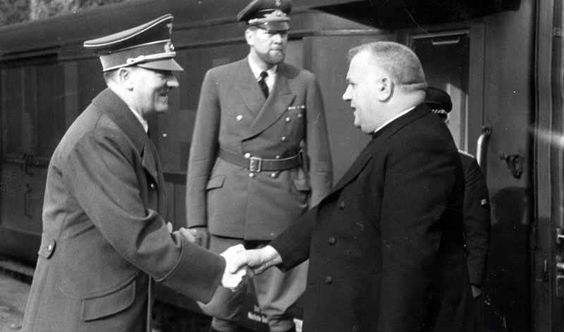
President Jozef Tiso, Prime Minister Vojtech Tuka and Hlinka Guard leader Alexander Mach of the Slovak Republic met with Hitler at the Berghof. Hitler demanded that “Slovakia should adhere loyally and unequivocally to the German cause in her domestic politics.” Hitler broadly hints to the Slovak leaders that they have little choice if they wish to remain free. The Slovaks agree to set up a German-style state that represses Jewish people.
The German Army examined closely the German Navy’s draft plan for an invasion of England, United Kingdom, but it was horrified to note that the Navy estimated that it would take ten days to put the first assault ashore in the Dover area.
All rail lines between occupied France and Vichy France were cut by the Germans. At 05:00, the Germans in occupied France close rail lines to Vichy France without warning. The choke point is Moulins. The reason given is invasion fears – by the British.
Radio Oranje (Radio Orange) begins broadcasting from London. During World War II, Radio Oranje was a Dutch radio program, aired by the BBC European Service 1 on behalf of the Dutch Government in exile in London. The programs, that were typically 15 minutes long, were broadcast from London and were aimed at the German-occupied Netherlands. It is named after the Dutch monarchy’s House of Orange-Nassau. Radio Oranje is best known for the speeches of the Dutch Queen Wilhelmina, although she only appeared on the show 34 times in 4 years, first on the opening broadcast on 28 July 1940. The program was on the on the air between 1940 and 1945, every evening between 20:15 and 20:30 (CET). The aim was to provide support and information to the Dutch people and also to counter German propaganda. In addition, it aired the so-called special messages, in which secret messages in code were passed to the Dutch resistance — usually a common saying or a short phrase.
The British Government formally protested today to Rumania in connection with that country’s apparently anti-British attitude in the lace of Germany’s demands.
A map delineating tho frontiers of a greater Albania, which includes large sections of Greece and Yugoslavia, is now being circulated in Italy’s newest province and posted in such gathering places as barber shops and cafes. It is a natural assumption that this map is intended to convince Albanians that the Rome government expects to enlarge their frontiers and group all regions inhabited by Albanian-speaking people into a single territory, presumably under fascist domination.
In pursuit of its sovietization policy, the Latvian Government has nationalized the Latvian merchant fleet.
Kabul and Moscow sign a commercial trade agreement.
U-99, commanded by Kapitänleutnant Otto Kretschmer, sank steamer Auckland Star (13,212grt) in 52-17N, 12-32W. At 0557 hours the unescorted Auckland Star (Master David Rattray MacFarlane) was hit in the stern by one torpedo from U-99 80 miles west-northwest of Valentia Island, Co. Kerry. The ship was hit by two G7e coups de grâce at 0633 and 0711 hours and capsized and sank at 0733 hours. The master and 54 crew members landed three days later at Dingle, Co. Kerry and 19 crew members landed at Slyne Head near Clifden, Co. Galway, Ireland. The 13,212-ton Auckland Star was carrying general cargo, including lead, steel, hides, refrigerated goods and wheat and was headed for Liverpool, England.
Heavy cruiser HMS Norfolk and destroyer HMS Watchman departed Greenock at 0200 with British steamer Georgic (27759grt) and Dutch steamer Koningin Emma (4135grt) for Reykavik. Off the Mull of Kintyre at 0500, destroyer HMS Vortigern joined the force from Belfast.
Anti-aircraft cruiser HMS Coventry arrived at Plymouth for drydocking. On 19 August, Coventry departed for Greenock arriving on the 21st.
Derelict Norwegian yacht Maski was sunk by gunfire of submarine HMS Swordfish in 55-32N, 1-31E. Four Norwegians were rescued by the submarine which arrived back at Blyth on 8 August.
Submarine HMS Ursula departed Rosyth for Blyth, arriving later that same day.
Submarine HMS H.44 departed Harwich for patrol north of Hinder.
Dutch submarines HrMs (HNMS) O.21 and HrMs (HNMS) O.22 were undocked at Rosyth.
Submarine depot ship Titania departed the Tyne for Blyth, where she arrived later the same day.
Steamer Orlock Head (1563grt) was badly damaged by German bombing in 58-44N, 04-21W. She was hit by three bombs and also hit by strafing, and sank later that day 6.7 miles 320° from Strathie Point. Six crew were lost. Destroyers HMS Berkeley and HMS Amazon departed Scapa Flow at 0530 to assist, but although they did not locate the ship, did find the survivors in their boats, who were landed at Thurso.
Armed patrol trawler HMS Staunton (283grt, Skipper S. W. Campbell RNR) was sunk on a mine eight cables 50° from East Knoll Buoy. Campbell and twelve ratings were lost, and there were no survivors.
Small Greek steamer Ermioni (440grt), carrying military supplies to Italy, was intercepted and captured by light cruisers HMS Neptune and HMAS Sydney in the Aegean. Together with destroyer HMS Decoy, they had been detached from the Main Fleet to intercept the ship and were sweeping in the Aegean. Ermioni was scuttled.
Steamer Mathura (8890grt) was damaged by Italian bombing at Aden.
German armed merchant cruiser Thor damaged armed merchant cruiser HMS Alcantara in an engagement off Trinidade, off the coast of Brazil. Lt R. W. Pickersgill RNR and one rating were killed and seven crew wounded in the British ship. HMS Alcantara was hit by 3 shells from German armed merchant ship Thor; as Thor turned away to disengage from battle, Alcantara fired and hit Thor with 2 shells, killing 3. Heavy cruiser HMS Dorsetshire returned to Freetown for refueling, arriving on the 29th, and left to search for the German raider, but did not make contact. Alcantara arrived at Rio de Janiero for repairs on 1 August.
Due to the political situation with the Vichy French at Duala, light cruiser HMS Dragon departed Duala and proceeded to Lagos, arriving on the 29th. She was relieved by sloop HMS Bridgewater on 1 August.
Convoy OA.191 departed Methil. No escorts were listed.
Convoy MT.123 departed Methil, and arrived in the Tyne on the 29th.
Convoy FS.235 departed the Tyne, and arrived at Southend on the 30th.
Convoy SLF.41 departed Freetown escorted by armed merchant cruiser HMS Pretoria Castle to 10 August. Armed merchant cruiser HMS Bulolo joined on the 8th when convoy SL.41 merged. On the 10th, both escorts were detached. Destroyers HMS Hesperus, HMCS Skeena, HMS Warwick and corvettes HMS Clarkia and HMS Clematis joined the same day and escorted the convoy to Liverpool, arriving on the 14th.
The War at Sea, Sunday, 28 July 1940 (naval-history.net)
Heavy cruiser NORFOLK and destroyer WATCHMAN departed Greenock at 0200 with British steamer GEORGIC (27759grt) and Dutch steamer KONINGIN EMMA (4135grt) for Reykjavik. Off the Mull of Kintyre at 0500, destroyer VORTIGERN joined the force from Belfast.
Anti-aircraft cruiser COVENTRY arrived at Plymouth for drydocking. On 19 August, COVENTRY departed for Greenock arriving on the 21st.
Derelict Norwegian yacht MASKI was sunk by gunfire of submarine SWORDFISH in 55-32N, 1-31E. Four Norwegians were rescued by the submarine which arrived back at Blyth on 8 August.
Submarine URSULA departed Rosyth for Blyth, arriving later that same day.
Submarine H.44 departed Harwich for patrol north of Hinder.
Dutch submarines HrMs (HNMS) O.21 and HrMs (HNMS) O.22 were undocked at Rosyth.
Submarine depot ship TITANIA departed the Tyne for Blyth, where she arrived later the same day.
Convoy OA.191 departed Methil. No escorts were listed.
Convoy MT.123 departed Methil, and arrived in the Tyne on the 29th.
Convoy FS.235 departed the Tyne, and arrived at Southend on the 30th.
U-99 sank steamer AUCKLAND STAR (13,212grt) in 52‑17N, 12‑32W. The crew rowed for Ireland and arrived three days later.
Steamer ORLOCK HEAD (1563grt) was badly damaged by German bombing in 58‑44N, 04‑21W. She was hit by three bombs and also hit by strafing, and sank later that day 6.7 miles 320° from Strathie Point. Six crew were lost. Destroyers BERKELEY and AMAZON departed Scapa Flow at 0530 to assist, but although they did not locate the ship, did find the survivors in their boats, who were landed at Thurso.
Armed patrol trawler STAUNTON (283grt, Skipper S. W. Campbell RNR) was sunk on a mine eight cables 50° from East Knoll Buoy. Campbell and twelve ratings were lost, and there were no survivors.
Small Greek steamer ERMIONI (440grt), carrying military supplies to Italy, was intercepted and captured by light cruisers NEPTUNE and HMAS SYDNEY in the Aegean. Together with destroyer DECOY, they had been detached from the Main Fleet to intercept the ship and were sweeping in the Aegean. ERMIONI was scuttled.
Steamer MATHURA (8890grt) was damaged by Italian bombing at Aden.
German armed merchant cruiser THOR damaged armed merchant cruiser ALCANTARA in an engagement off Trinidade, off the coast of Brazil. Lt R. W. Pickersgill RNR and one rating were killed and seven crew wounded in the British ship. Heavy cruiser DORSETSHIRE returned to Freetown for refueling, arriving on the 29th, and left to search for the German raider, but did not make contact. ALCANTARA arrived at Rio de Janiero for repairs on 1 August.
Due to the political situation with the Vichy French at Duala, light cruiser DRAGON departed Duala and proceeded to Lagos, arriving on the 29th. She was relieved by sloop BRIDGEWATER on 1 August.
Convoy SLF.41 departed Freetown escorted by armed merchant cruiser PRETORIA CASTLE to 10 August. Armed merchant cruiser BULOLO joined on the 8th when convoy SL.41 merged. On the 10th, both escorts were detached. Destroyers HESPERUS, SKEENA, WARWICK and corvettes CLARKIA and CLEMATIS joined the same day and escorted the convoy to Liverpool, arriving on the 14th.
A drive aimed at completing national defense legislation by September 1 will start Tuesday in Congress. Leaders entertain hopes that when that is done either adjournment or a long recess can be taken. The immediate program in what may be one of the busiest weeks of the session so far contemplates. starting debate Wednesday in the Senate over the Burke-Wadsworth Selective Compulsory Military Training Bill, House consideration of bills to provide funds for starting new power facilities for the Tennessee Valley Authority and construction of new shore facilities for the Navy.
Although both the Senate and House meet tomorrow, the sessions are expected to be perfunctory since many members of both were guests of the United States Maritime Commission on the cruise of the new liner America and will not return to Washington until tomorrow night. The remaining items in the national defense program, in the probable order of their consideration, are:
- The Burke-Wadsworth bill.
- The $25,000,000 appropriation for construction of a new dam and steam plant for the TVA, to provide power for manufacture by the Aluminum Company of America of aluminum sheets for plane wings.
- The Vinson bill to authorize expenditure of $59,000,000 for construction of naval shore establishments.
- The bill requested by President Roosevelt for authority to call out the National Guard, which will be needed to train, in cooperation with the Regular Army, the men who will be called if the Burke-Wadsworth bill is enacted.
- The $4,848,000,000 appropriation bill to pay for equipment for an army of 1,500,000, and for new Navy construction.
- An excess profits tax bill, designed to recapture unreasonable profits on defense contracts and to be substituted for the 8 percent profit limitation on defense contracts imposed by the Vinson-Trammell act.
If the Burke-Wadsworth bill is enacted, the War Department is expected to ask for some additional legislation, but its nature will depend upon the final terms of the Burke-Wadsworth measure.
John L. Lewis threw C.I.O. influence against enactment of the administration’s compulsory military training legislation today, declaring his organization opposed to peacetime conscription. The labor leader, who conferred with Senator Wheeler, Montana Democrat, yesterday, said he was “in full agreement with Senator Wheeler on this thing.” Wheeler predicted congressional defeat of the proposal “when the people of the country actually understand what this will mean.” The Montana senator said he had received more than 2,000 letters and telegrams from church, labor, peace and farm groups opposing compulsory training.
Meeting today on the eve of the opening of the fourth constitutional convention of the United Automobile Workers of America (C.I.O.), the constitution committee discussed several far reaching proposals which would not only constitutionally bar Communists, Nazis and Fascists from holding office in the union, but from membership as well.
Wendell L. Willkie today started dictating the first draft of his formal acceptance speech, to be delivered at Elwood, Indiana, on August 17.
With more than a third of its population seeking refuge at nearby beaches and other resorts and most of the remaining residents relaxing at home, New York City seemed almost like a lifeless metropolis yesterday as the temperature rose above 90 degrees for the third consecutive day.
Martha’s Vineyard and Nantucket passed the most dismal Sunday of the Summer today as Ctate labor officials and a Federal conciliator struggled to bring about settlement of a steamboat strike that has halted normal transportation between the islands and the mainland.
Rear Admiral David Watson Taylor, retired, who as naval constructor had a prominent part in the creation of the modern American Navy, died in the Naval Hospital in Washington today at the age of 76 after a long illness.
Major League Baseball:
At Ebbets Field, the Dodgers snap a six-game losing streak and sweep a pair from the Cardinals, as Whit Wyatt (9–9) wins the opener, 3–0, and Freddy Fitzsimmons (10–1) follows with a 7–4 victory. Dixie Walker has 2 hits and 3 RBI. It is Walker Day and Night at Ebbets Field and the Bossart Hotel where the popular Dixie is showered with gifts. At the nighttime festivities at the hotel, Dixie sings the song he co-wrote “You Thrilled Me.”
Harry Gumbert limits the Cubs to 8 hits as the Giants win, 8–4. Gumbert also collects a home run, triple, and single to drive in 3 runs. Harry Danning and Frank Demaree also homered for the Giants. Cubs’ starter Jake Mooty did not make it through the fifth inning. Stan Hack had a three-run homer for the Cubs.
Honeymoon at Braves Field? Ray Berres of the Bees gets married in the morning in Newton, then hurries to the Hive in time to catch game 2 of a Pirates sweep of the Bees. Pittsburgh’s flying Pirates took both ends of a twin bill today, 5–3 and 7–3, to sweep a four-game series with the battered Bees and climb into fifth place ahead of the Cardinals, who dropped a doubleheader to Brooklyn.
The Phillies climbed out of the National League cellar today by splitting a double-header with the first-place Reds before 10,160, while the Bees lost twice to Pittsburgh. The Reds took the opener, 7–2, as Jim Turner chalked up his sixth straight victory and his eighth of the season. The Phils ended Bucky Walters’s six-game streak in the nightcap, winning, 4–1, behind Cy Blanton’s seven-hit pitching. Cincinnati socked three Philadelphia pitchers for fourteen hits in the first game, while Turner gave up only seven safeties. Successive home runs by Ival Goodman and Frank McCormick accounted for three runs in the fifth. Shortstop Bobbie Bragan homered for the Phils in the second game.
King Kong Keller clouts 3 home runs and Joe DiMaggio adds 2 home runs — each hitting back-to-back homers twice — for the New York Yankees in a 10–9 win over Chicago in the first game of a doubleheader. Skeeter Webb is 5–for-6 with a homer for the Sox. The Sox rebound for an 8–4 win in the nitecap.
Eleven days after his thumb was broken in Boston, the Tigers’ Buck Newsom (13–2) pitches 11 innings against the A’s, but loses 9–5, snapping his 13–game winning streak. The A’s push 4 runs across in the 11th against Buck, whose control is off all game. Newsom’s only other defeat was to the lowly Browns. While recuperating, Newsom appeared in a vaudeville act at the Fox Theatre in Detroit. Part of his routine was appearing with a large fake thumb covering his real one.
The Indians pounced on Washington for a 6–3 victory in the first game of today’s double-header, then booted another chance to gain in their pennant tussle with Detroit by bowing, 9–1, before Sid Hudson’s six-hit hurling. Cleveland rode over pitchers Walter Masterson, Alejandro Carrasquel and Joe Krakauskas in the opener for fifteen hits, but the Senators collected as many in the second game off Al Smith, Mel Harder, Joe Dobson, Johnny Humphries and Bill Zuber.
Fourteen pitchers were summoned to the mound today as the Red Sox beat the Browns, 3–1 and 13–10. Ten hurlers saw service in the free-hitting nightcap, in which the Red Sox raked six Brown hurlers with a 22-hit assault paced by Bobby Doerr, who got two home runs and a three-bagger. Jim Tabor also homered for the victors. Although Johnny Niggeling and Bob Harris yielded only five hits between them in the opener, the Red Sox triumphed on Joe Glenn’s second-inning double with two mates aboard.
St. Louis Cardinals 0, Brooklyn Dodgers 3
St. Louis Cardinals 4, Brooklyn Dodgers 7
Pittsburgh Pirates 5, Boston Bees 2
Pittsburgh Pirates 7, Boston Bees 3
New York Yankees 10, Chicago White Sox 9
New York Yankees 4, Chicago White Sox 8
Washington Senators 3, Cleveland Indians 6
Washington Senators 9, Cleveland Indians 1
Philadelphia Athletics 9, Detroit Tigers 5
Chicago Cubs 4, New York Giants 8
Cincinnati Reds 7, Philadelphia Phillies 2
Cincinnati Reds 1, Philadelphia Phillies 4
Boston Red Sox 3, St. Louis Browns 1
Boston Red Sox 13, St. Louis Browns 10
The Pan-American Foreign Ministers put in a hard Sunday today working in committees and subcommittees that are trying to include the last-minute ideas of the lesser lights, intended to improve the general agreement reached by their leaders yesterday, but the prospects were that the second consultative meeting since the outbreak of the European war would confine its concrete conclusions to the problems most likely to arise in the next few weeks. These problems obviously depend on military developments in Europe more than on the volition of the American republics. For instance, the Chilean delegation is convinced that the Economic Committee on Hemisphere Defense must include machinery that could quickly expropriate public utilities owned by non-American nationals in the event of the capture of the governments heretofore protecting those investments. No doubt this viewpoint takes in the possibility of an emergency that might arise if, for example, shares now owned by British individuals in an Argentine railroad were suddenly declared to belong to the German Economic Ministry. The Argentine Government would have to review the situation, since the public interest obviously would be affected differently where shares were distributed among individuals, trust funds and bank portfolios in England and Scotland, and where they were concentrated in the hands of the German Government.
To promote inter-American relations, the U.S. grants Brazil a $20 million loan that likely will never be repaid. Foreign Affairs Minister Osvaldo Aranha, a former Ambassador to the U.S., notes that “We should erect a statue to Hitler — he made the USA finally notice us.” Aranha typically represents Brazil at pan-American conferences such as the recent Havana Conference and is a strong proponent of pan-Americanism.
The Nazi fifth column has penetrated deeply into Bolivian political life, affecting the government and the army, which is the most important political factor.
More than 100 Japanese bombers attacked Chungking, China in five waves; 16 fighters from Chinese 4th Pursuit Group and 5th Pursuit Group rose to intercept, claiming one bomber shot down.
It was learned from private reports today that eleven prominent British business men in Japan have been arrested by Japanese authorities in five cities. Previous reports had listed nine men.
Yakichiro Suma, foreign office spokesman, said today the Japanese government was satisfied that President Roosevelt’s oil order of last week was not an embargo against Japan. “Official reports,” he said, “confirm the belief the order won’t affect us much.”
Born:
Phil Proctor, American comedian (“Firesign Theater”), in Goshen, Indiana.
Died:
Rear Admiral David W. Taylor, 76, American naval officer.
Naval Construction:
The Marynarka Wojenna (Polish Navy) British Power Boat 63 foot-class motor anti-submarine boat ORP S 3 is commissioned.
 History Diaries