Following through with the order for closure of American bases in Turkey, Turkish military commanders entered five U.S. bases to take control, and pledged to take control of 20 more the next day. The five, located at Karamürsel, Sinop, Pirinçlik, Bebasi and Karaburun, had been used for intelligence gathering along the Soviet border.
High Turkish officials said that some United States bases in Turkey would stay closed permanently even if Congress ultimately lifted the Turkish arms embargo. The officials believe that it would be politically impossible for any Turkish government to restore the relationship that existed with the United States before last Friday, when Turkey announced she was taking control of the American bases. “It was easy to close the bases, but it would be very difficult to make them operational again, that’s why we waited six months before we acted,” one of the Turkish officials said. “No government would dare move against the pressure of public opinion.”
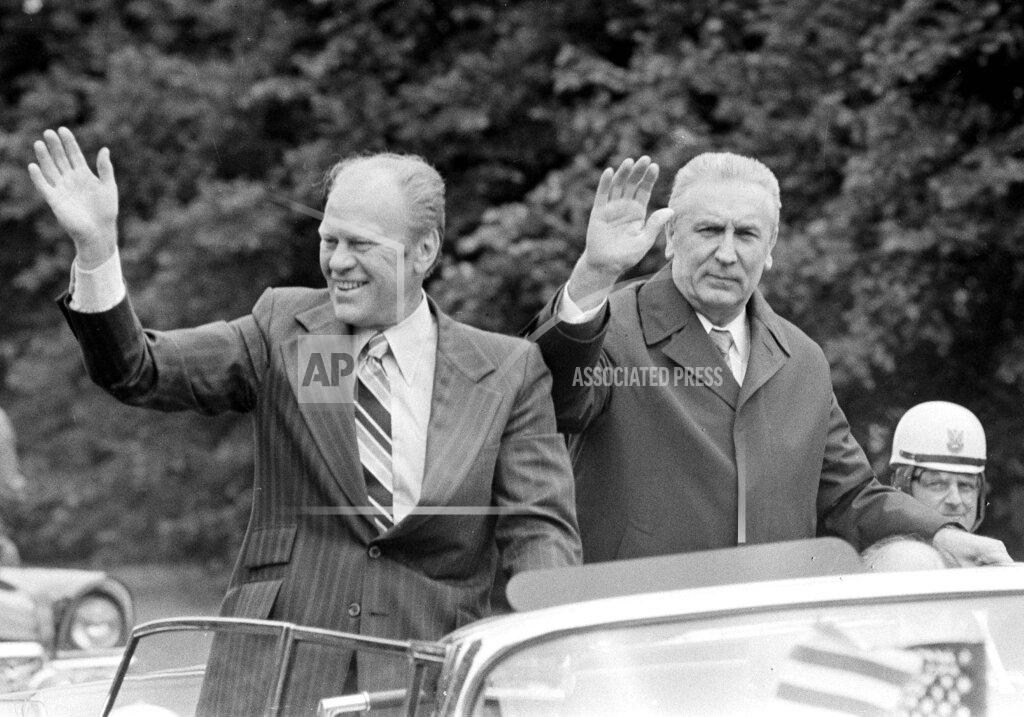
Huge crowds welcomed President Ford as he arrived in Warsaw for a visit before the opening of the European security conference in Helsinki tomorrow. Mr. Ford, speaking a few words of Polish, greeted the crowd at Okecie Airport with “Niech zyje Polska”? “Long live Poland!” Edward Gierek, the Communist party leader, lavished praise on Mr. Ford, calling him a partner in the search for world harmony. He and Mr. Ford issued a joint statement reaffirming their commitment to pursue military — not only political — détente in Europe. Although Mr. Ford met privately for nearly two hours with Mr. Gierek, United States officials acknowledged that there were no “burning issues” outstanding and that cooperative agreements signed when Mr. Gierek visited Washington in October left little opportunity to “break new ground.”
Officials accompanying President and Mrs. Ford on their five‐nation journey across Europe characterized the stop in Poland, as well as later visits to Rumania and Yugoslavia, as opportunities to give visible encouragement to the three Eastern European nations least subservient to Moscow. The President’s appearance in Warsaw also created another occasion for Mr. Ford to assert that the European security, agreement to be signed by him and 34 other leaders in Helsinki is a positive step toward international harmony. Domestic critics, including some in Congress and the press who urged Mr. Ford to turn back from Helsinki without agreeing to the security charter, have put the President on the defensive.
After President Ford’s meeting in Bonn with Chancellor Helmut Schmidt, the West German Government is still worried that conservative economic policies in Washington may kill a worldwide economic recovery before it really gets started, according to a West German official.
Mr. Ford, who left Bonn for Warsaw this morning, agreed yesterday to coordinate economic policy more closely with the Western European countries, apparently at Mr. Schmidt’s urging. But West German sources close to the Chancellor said they had not agreed to anything specific and that there would be further discussions with the French President, Valéry Giscard d’Estaing, and the British Prime Minister, Harold Wilson, in Helsinki later this week. The West German leader, who is an economist, told Mr. Ford yesterday that “the world economic recession can only be overcome if it is overcome on an international basis in the same manner by all participants.”
Twenty leaders of the Greek military coup of 1967 were put on trial today for high treason and revolt. The chief defendant, former President George Papadopoulos, said he rejected the charge, assumed full responsibility for the coup, and refused to defend himself. “I shall sit in this room silently and wait for your verdict,” he told the court. The trial of the junta began before the five‐judge Court off Appeals. For security reasons the hearings are held inside Korydallos Prison, near Piraeus, where the defendants are detained. They face maximum sentences of death or life imprisonment. Security precautions involved the deployment of policemen armed with submachine guns, armored vehicles and army helicopters. Metal detectors screen all persons entering the prison compound.
Portugal’s President has put off for 48 hours his departure for the European security conference in Helsinki, Finland, apparently because of the continuing political crisis. The announcement or the change in plans of President Francisco da Costa Gomes was made by a Government spokesman as Premier Vasco Gonçalves continued efforts to form a Cabinet to back the threeman junta announced last Friday. In addition to the President and the Premier, the junta includes the nation’s security chief, General Otelo Saraiva de Carvalho. The present Foreign Minister, General Ernesto Melo Antunes, who is known to oppose the new junta, is rumored to have resigned. He was to have accompanied the President to the Helsinki session, which is due to begin Wednesday, for the signing of a document on East-West relations.
The Senate and House approved expansion of the U.S. naval communication station on the British-owned island of Diego Garcia in the Indian Ocean. The expansion into a support base for a Navy carrier task force was opposed by Senate Democratic leader Mike Mansfield of Montana, who called it comparable to the initial U.S. involvement in South Vietnam. The Senate vote after a six-hour debate was 53 to 43, freeing $18.1 million appropriated for the base last year. The House earlier included $13.8 million more for the base in a military construction authorization bill for this year.
Again rejecting preliminary money for new nerve gas weapons, the House approved 369 to 47 a $4 billion military construction authorization bill. Rep. Floyd V. Hicks (D-Washington), who persuaded Congress to reject $5.8 million for the new binary nerve gas weapons last year, won, by a 219–195 vote, a cut of all $562,000 from the bill for remodeling a building to manufacture the weapons. Hicks contended that preparing a building to manufacture the weapons was “the first step to a $750 million or $1 billion program.”
Sentiment for restricting nuclear power development or subjecting it to tightened controls has manifested itself in at least a score of states this year. This sentiment has shown itself conspicuously in legislative proposals, in the circulation by voters of petitions favoring statutory brakes on atomic power development and in litigation, including citizen challenges of nuclear generating plans. There is also, in the absence of definitive Federal legislation, puzzlement among the states as to whether the Federal or the state authorities have the final say on various aspects of atomic power development. The root of this ferment appears to be the still unresolved doubts about the safety of nuclear power generation, along with reservations on such aspects as financial feasibility and immediate need. President Ford said early this year that national energy needs called for the construction of 200 nuclear power plants in the next 10 years. There are now 55 plants licensed to operate, and some 180 in various stages of planning. But the latter face various degrees of public resistance.
The Senate delayed consideration of the promotion of Air Force Major General Alton D. Slay after Senator Birch Bayh (D-Indiana) protested his role in unauthorized air strikes in North Vietnam. Bayh asked that the Senate hold up on the promotion to lieutenant general until it could be fully debated. Slay’s name was passed over as the Senate approved 16 other Air Force promotions.
A pro-Franco group, the Union of the Spanish People, became Spain’s first officially recognized political association. It was granted full recognition at a meeting of the national council, the ruling body of Franco’s National Movement which has served in place of political parties during Franco’s regime. Because the new association gained a significant head start in its recognition, political observers said it could become the largest right-wing political party in post-Franco Spain. The law allowing political association was passed seven months ago.
Defense Minister Shimon Peres said today that Israel’s latest proposals passed to Egypt by way of Washington for an interim agreement in Sinai were final. In an interview published by the newspaper Haaretz, Mr. Peres said: “We have gone far, very far, and we have made it clear that our suggestions are final. It is hard to believe that we shall be able to concede any more.” He said that if Egypt believed that Israel could be persuaded to relinquish her stand or succumb to greater American pressure, she was mistaken. He added that the question had now arisen whether Egypt still wanted an agreement.
Facing overwhelming opposition in Congress, the Ford administration today suspended plans to sell 14 batteries of Hawk antiaircraft missiles to Jordan. Congress has opposed the sale on the ground that the 14 batteries — with six missile launchers to a battery — gave Jordan an offensive capacity against Israel and was more than she needed for her air defense.
State legislatures across India began meeting today to give support to the sweeping emergency laws enacted over the last month by the Government of Prime Minister Indira Gandhi. The special sessions, to be held in more than half of the country’s 22 state capitals, are regarded as an important symbol not only of support from the grassroots, but also of the continuance, in an orderly manner, of the institutions of government. “Everything is being done normally, and legally, under the constitution,” Prime Minister Gandhi said the other day, expressing a theme common to statements by her and her Cabinet ministers since the declaration of the national emergency on June 26.
More than 10,000 Chinese troops have been sent into factories in the city of Hangchow to help with production and three key officials there have been replaced because of continued factional strife and labor unrest, broadcasts from the central coastal city indicate. According to the series of broadcasts, the troops were ordered into 13 factories in Hangchow following recent “important instructions on the work of Chekiang Province by Chairman Mao and the party Central Committee.” Hangchow is the capital of Chekiang. This was believed to be the first time since the period of the ascendancy of Defense Minister Lin Piao that the party had called on the army to send troops into factories. Mr. Lin was reportedly killed in a plane crash in Mongolia in 1971 after what was said to have been a plot to displace Chairman Mao Tse‐tung. After Mr. Lin’s death, party authorities sought to purge many of his followers and reduce the enormous powers the army had acquired because of incidents of sending troops in during the Cultural Revolution in the late nineteen‐sixties.
An unarmed 17-year-old Japanese high school student hijacked an All Nippon Airways jetliner carrying 286 people on a domestic flight “on the spur of the moment” and ordered it flown to Hawaii or Okinawa. Instead, the pilot landed in Tokyo, where security guards disguised as airline employees overpowered the youth. Nobody was hurt.
The lower house of Venezuela’s Congress approved legislation to nationalize U.S.-owned oil companies running the nation’s oil industry which earned $10 billion last year. Exxon, Shell, Gulf, Mobil and Texaco subsidiaries with assets unofficially estimated at about $1.1 billion would be affected by the bill, which now goes to the Senate. Venezuela produces 2.5 million barrels of crude oil a day.
The leader of one of three black liberation movements locked in a power struggle demanded that Portugal withdraw all its troops from Angola. Agostinho Neto, president of the Marxist Movement for the Liberation of Angola, made the demand after Portuguese commandos fired on a crowd of guerrilla soldiers and civilians at the group’s Luanda headquarters, killing 20 and wounding 22. About 5,000 people attended funeral ceremonies for the victims in Luanda’s main cemetery. The shooting took place Sunday.
Heavy fighting has reportedly broken out again between Ethiopian Government troops and Eritrean rebels, and Asmara, the provincial capital, is said to be in a virtual state of siege. According to Western diplomatic reports, the fighting has been going on near Asmara, while in the city itself, in the last few days, rebels have shot several persons believed to be informers and troops have killed at least 30 civilians in reprisal raids. Secessionist guerrillas of the Eritrean Liberation Front have been fighting for independence intermittently for 13 years. There was a major outbreak in the Asmara area early this year, and it is estimated that more than 6,000 people have been killed since February 1. Diplomatic reports today said fighting was under way along a road linking Asmara to the garrison town of Keren northwest of the provincial capital.
By a vote of 346 to 56, the House passed and sent to President Ford a bill extending the Voting Rights Act of 1965 for seven years and broadening its protection to Spanish-speaking Americans and other “language minorities.” Mr. Ford is expected to sign it. The voting rights legislation is credited with aiding the registration of large numbers of black voters — and the election of many black officials — in the South since 1965. With the existing voting rights law scheduled to expire August 6 and Congress leaving Friday for an August recess, the House took the unusual procedural step of accepting the measure that had been passed by the Senate last Thursday night and sending it directly to the White House without a Senate‐House conference. The bill would continue to guarantee black voting rights in six Southern states—Alabama. Georgia, Louisiana, Mississippi, South Carolina and Virginia—most of North Carolina and parts of several other states, such as New York, where Manhattan, the Bronx and Brooklyn would be covered by provisions of the act.
Anticipating that all oil price controls will end in five weeks, the Senate Finance Committee approved legislation to soak up windfall oil profits of $18 billion and return them to consumers. Chairman Russell B. Long (D-Louisiana) said he hoped Congress would complete action on the measure before starting a month-long vacation on Saturday. The committee will attempt to determine today how the billions to be taxed away from the oil companies will be rebated to consumers. Under the proposed bill, the government would tax away 90% of the profit. The companies, however, would be allowed to avoid part of the tax by reinvesting a greater share of windfall profits in the search for more oil and gas.
One black man was in the hospital in Boston after he and five black companions, traveling Bible and magazine salesmen, were attacked and beaten by about 100 white men and women on a beach in south Boston. A hospital spokesman said Robert Jackson, 31, of Cambria Heights, New York, was in fair condition after treatment for head injuries. Police said the attack occurred at Carson Beach. It was on a road paralleling the beach that buses carrying black children were stoned last fall when Boston schools were integrated by federal court order. Two whites, Patrick Kennedy, 24, and Arthur Nichols, 23, were arrested in connection with the latest incident.
President Ford sent to Congress his formal proposal to continue present auto emission standards through 1981. instead of toughening them sharply in 1978 as required by current law. The legislative draft, which Mr. Ford had announced earlier this year, amounted to a rejection of the proposal by Russell E. Train, the environmental protection administrator, for postponement of the 1978 standards until 1982, with partial tightening of controls in between. A statement explaining Mr. Ford’s decision. said that pollution had been significantly reduced by federal standards applied over the last five years.
Elliot L. Richardson, the U.S. ambassador to Britain and a former Cabinet member, is “a prime possibility” to replace William Colby as head of the CIA, TIME magazine reported. “It is the first I have heard of it,” aides quoted a surprised Richardson as saying in London. The magazine said that “sooner or later, quite possibly by the end of this year,” Colby would “be asked to leave.” Richardson earned a national reputation when he resigned as U.S. attorney general rather than dismiss Watergate special prosecutor Archibald Cox at the Nixon administration’s orders.
The Commerce Department reported that in June the nation had its biggest foreign trade surplus on record, as imports continued to reflect the deep recession in the United States economy. The slowdown in imports has affected oil as well as most other products. Oil imports in June were the lowest for any month since early 1974 after prices were increased sharply by the exporting countries.
The Ford Administration sent Congress proposed legislation strengthening the attorney general’s control over the Law Enforcement Assistance Administration. The bill, sent to House and Senate leaders by the Justice Department, would also extend the life of the agency for five years and would authorize $6.81 billion for agency programs through 1981. That would include $262.5 million “for special programs aimed at reducing crime in heavily populated urban areas,” Attorney General Edward H. Levi said in an accompanying letter. The bill would give Levi stronger budget control and permission to appoint the director of the National Institute of Law Enforcement and Criminal Justice, LEAA’s research arm.
Special Watergate prosecutor Henry S. Ruth said he did not foresee public disclosure of former President Richard M. Nixon’s secret testimony or any other grand jury proceedings in the Watergate investigations. Three grand juries have heard from scores of witnesses about the scandal over the last three years. Among the last witnesses was Mr. Nixon, who underwent 11 hours of questioning under oath in June near his home in San Clemente. While Ruth did not flatly rule out possible publication, he said the records “must stay in the legal arena” after his special force is disbanded this fall.
The government will not appeal a federal court ruling ordering correction of food stamp allotment formulas that short-change larger families, said John Damgard, a deputy assistant secretary of agriculture. The court ruled that the current formula, which is based on food quantities and costs for an average four-person family, fell below legal requirements when applied to some larger families or households with above-average nutritional needs. One plan under consideration would add $1 billion to the current cost of $6.5 billion.
The prosecution opened its case today in the trial of the San Quentin Six, five inmates and a parolee who are accused of having participated in an escape attempt at San Quentin Prison nearly four years ago that resulted in the death of George Jackson, the black revolutionary writer, three guards, and two inmate trustees. Five of the six defendants were shackled with chains and leg irons bolted to the floor in the courtroom. This morning, Judge Henry Broderick warned one of the five without naming him not to rattle his chains. The chained defendants are Johnny Spain, 25 years old; Fleeta Drumgo, 30; David Johnson, 28; Hugo Pinnell, 30, and Luis Talamantez, 32. Only Willie Tate, 30, who was paroled in January after serving 10 years for assault, was not shackled.
Federal District Judge W. Brevard Hand will open hearings tomorrow in Mobile, Alabama on whether overcrowding, inadequate care and exposure to physical violence in the Alabama prison system deprive inmates of their constitutional rights. The hearing will follow by five days the resignation of the State Prison Commissioner, L. B. Sullivan, who said he had been “unable to do many things I feel could and should be done to improve Alabama’s penal system.” Mr. Sullivan acknowledged failure in his effort to get the Legislature to appropriate more money to run the prisons.
Unemployment in New York City rose by nearly 1 percent in June to 11.7 percent, the highest level since the recession began in 1973 and the highest level in the quarter century that records have been kept on a comparable basis, according to the city’s Industrial Commissioner, Louis Levine. The increase confirmed that New York was one of the cities hardest hit by the recession.
The second and third major oil spill in less than 10 days were spotted in the Atlantic off southern Florida and coast guardsmen said one of the spills is moving toward shore. Efforts to track down the source of the first spill, which has been polluting the shoreline of the lower Florida Keys since July 20, have been unsuccessful, the Coast Guard reported. That spill, like the two latest ones, is attributed to a tanker flushing with sea water. The first of the new spills was spotted by a Coast Guard airplane; it was said to stretch from Elliott Key south of Miami to Boca Raton and was said to be within seven miles of resort beaches. The second new spill was spotted by a civilian airplane 10 miles off Palm Beach.
The proposed 6,280-mile pipeline designed to carry natural gas from Alaska’s north slope could have adverse effects on the climate and soil in surrounding areas, an Interior Department study indicated. But Roman Koenings, the official who headed the study, said he thought the line still would be “feasible” if the problems can be mitigated to the government’s satisfaction. He cited major concern over the effect on permafrost through which the buried pipeline would run and which could be heated as a result, noise at compressor stations and the impact on Alaska wildlife.
In a surprise move a Nevada state official impounded 70 wild horses rounded up by the federal government, contending the mustangs are state property. State agriculture Director Thomas Ballow claims the federal law that gives the Bureau of Land Management jurisdiction over the mustangs is unconstitutional. The BLM immediately closed down its program to round up 400 horses in the Stone Cabin Valley area where range forage is depleted. The agency contacted the Justice Department to see what action to take, a spokesman for the BLM reported. Nevada law had allowed the boards of county commissioners to issue permits for individuals to capture the mustangs.
Busy solving problems that no one knew existed is biochemist Isaac Asimov. The well-known lecturer, author of lucid and humorous books on science for the layman and a prolific science-fiction writer, proposes a “space patrol” to protect the earth from huge meteorites and other debris from outer space. Asimov, 55, noted that in this century alone two large meteorites have crashed into Siberia, luckily hitting desolate areas. Speaking in Rensselaerville, New York, at the start of “A Week With Isaac Asimov,” seminar, he said the “patrol” could use a device to blast the meteor into pebbles before it hit. “Instead of really getting clobbered, we’d get a beautiful meteor shower.”
Major League Baseball:
A two-run single by rookie Biff Pocoroba in the eighth inning was the decisive blow as the Braves pinned a 5–3 defeat on Mike Marshall and the Dodgers. Pocoroba wiped out a 3–2 Los Angeles lead with his bases-loaded blow. Winning pitcher Phil Niekro followed with a single for an insurance run as Marshall was pinned with his 10th defeat in 16 decisions. Pocoroba also got an RBI single in the second after walks to Dusty Baker and Larvell Blanks. The Braves’ other run came in the third on a walk, stolen base by Darrell Evans, throwing error by L. A. catcher Paul Powell and single by Rowland Office. Willie Crawford singled home the first Dodger run in the first. The losers added two in the fourth on a sacrifice fly by Ron Cey and RBI single by Bill Russell.
Jose Cardenal’s first homer since May 31, with Rick Monday aboard in the fifth inning, snapped a tie and carried the Cubs to a 4–2 triumph over the Expos. Chicago scored twice in the first on two walks, Bill Madlock’s single, a sacrifice fly by Jerry Morales and Pete LaCock’s RBI single. Mike Jorgensen and Larry Biittner produced the Expos’ tallies with run-scoring singles in the top of the third.
The Mets, leading in the sixth by a 10–1 margin, hung on to win a slugfest from the Cardinals, 11–7, with Felix Millan providing four of the winners’ 17 hits. Millan singled and scored in the first, opened a four-run third with a base hit, singled across two runs in a five-run sixth, and doubled home the final New York run in the seventh. The Cardinals rallied with four markers in the sixth and got a two-run homer from Ken Reitz in the ninth.
Dick Allen snapped a 1–1 tie with a two-run triple in the eighth and scored on pinch-hitter Ollie Brown’s single to lift the Phillies past the Pirates, 5–2. Philadelphia added one run in the ninth on a walk and double by Greg Luzinski. Larry Christenson went the route for the winners, allowing six hits, including solo homers by Al Oliver in the fourth and Willie Stargell in the ninth.
Dave Freisleben blanked the Astros on five hits and drove in the only run he required as the Padres defeated Houston, 2–0. San Diego tallied once in the fifth when Hector Torres doubled, advanced to third on an infield hit by Bob Davis, and crossed the plate as Freisleben hit into a forceout. Willie McCovey’s ninth-inning homer accounted for the game’s only other scoring. Freisleben escaped his only jam in the third when he got Bob Watson on a pop-up with the bases loaded and two out.
The Reds went to their bullpen for the 44th consecutive game, a major league record, but still rolled, defeating the Giants, 8–4. Pedro Borbon relieved starter Gary Nolan after the Giants had scored single runs in the second and third, but the Reds had gotten an early jump on Dan Driessen’s three-run homer off loser Ed Halicki in the first. They got two more in the fourth, Pete Rose doubling home one, and added three in the sixth, Rose again contributing a two-bagger. Chris Speier homered for the losers in the eighth.
Carlton Fisk drove in five runs, including the clincher in the ninth when he singled with the bases loaded, boosting the Red Sox to a 7–6 victory over the Brewers, Boston’s 18th win in their last 21 games. The Red Sox’ catcher singled home a run in the first, hit a two-run homer in the fourth, and tied the score with a solo four-bagger in the seventh. Five Milwaukee runs were the result of homers. Darrell Porter hit a two-run shot in the third, Kurt Bevacqua duplicated that effort in the fourth, and Sixto Lezcano connected with the bases empty in the sixth.
Vern Ruhle shut out the Yankees, scoreless in their last 27 innings, on six hits, and Willie Horton whacked his 17th homer of the season as the Tigers tamed New York, 3–0. After Horton led off the second with his round-tripper, Bill Freehan walked, took third on Aurelio Rodriguez’ single and scored as the Yankees turned over a double play. New York reliever Ron Guidry forced home the final Tiger run with a bases-loaded walk in the ninth.
The White Sox bunched all their scoring in the fifth inning to edge the Angels, 3–2, rookie Nyls Nyman singling home two of the runs. Brian Downing chased home the winning run with a sacrifice fly. The Sox’ Wilbur Wood, although he was relieved in the eighth, got credit for his fourth straight victory. California scored twice after two were out on a walk, double by Mickey Rivers and single by Dave Collins. Rich Gossage replaced Wood and was credited with his 15th save.
Rick Waits claimed his first major league victory, thanks to a two-run, two-out, 10th-inning single by Charlie Spikes, who earlier had contributed a solo homer in the Indians’ 7–5 decision over the Orioles. Baltimore rallied with three runs in the ninth on a two-run single by Ken Singleton, the tying run scoring later when Cleveland could not complete what would have been a game-ending double play. Spikes homered in the third and Rico Carty in the eighth for the Indians. Bobby Grich connected with the bases empty for the Orioles in the sixth.
Lyman Bostock singled with the bases loaded in the ninth to make 9–8 winners of the Twins, who stopped new Royal manager Whitey Herzog’s victory streak at four games. Bostock’s fourth hit of the night followed a double by Eric Soderholm, a walk and infield hit by Luis Gomez. The Royals had tied the score in the eighth on John Mayberry’s RBI double, after blowing a 5–1 third-inning lead. Cookie Rojas hit a first-inning solo homer for the losers, who added four runs in the top of the third before Rod Carew homered with a man aboard in the bottom of the frame. The Twins led for the first time in the sixth after a homer by Johnny Briggs and RBI single by Jerry Terrell.
Helped by three Ranger errors which led to five runs in the sixth inning, reliever Paul Lindblad picked up his eighth victory without a loss as the Athletics defeated Texas, 12–6. The Rangers got away to a 3–0 lead, but Reggie Jackson’s two-run homer in the fourth, his sixth in eight games, closed the gap. The A’s entered the sixth trailing, 4–2. Jackson doubled and scored on a single by Joe Rudi, who went to second on an error by Mike Hargrove. Reliever Tommy Moore walked Gene Tenace and gave an intentional pass to Sal Bando after a wild pitch to the load bases with none out. Tenace scored the tying run on catcher Jim Sundberg’s throwing error, and pinch-hitter Jim Holt singled home the go-ahead run. Claudell Washington singled home another run with two out, and the fifth marker tallied on a second error by Hargrove.
Los Angeles Dodgers 3, Atlanta Braves 5
Cleveland Indians 7, Baltimore Orioles 5
Milwaukee Brewers 6, Boston Red Sox 7
Chicago White Sox 3, California Angels 2
Montreal Expos 2, Chicago Cubs 4
San Francisco Giants 4, Cincinnati Reds 8
San Diego Padres 2, Houston Astros 0
Kansas City Royals 8, Minnesota Twins 9
Detroit Tigers 3, New York Yankees 0
Texas Rangers 6, Oakland Athletics 12
Philadelphia Phillies 5, Pittsburgh Pirates 2
New York Mets 11, St. Louis Cardinals 7
Dow Jones Industrial Average: 827.83 (-6.26, -0.75%)
Born:
Chad Paronto, MLB pitcher (Baltimore Orioles, Cleveland Indians, Atlanta Braves, Houston Astros), in Woodsville, New Hampshire.
Gerald Brown, NBA shooting guard (Phoenix Suns), in Los Angeles, California.
Leonor Watling, Spanish actress and singer, in Madrid, Spain.
Died:
Donald Mattison, 70, American artist.
Jean Chalvet, 82, former French Governor of Ubangi-Shari, now the Central African Republic, 1946–48.
 History Diaries