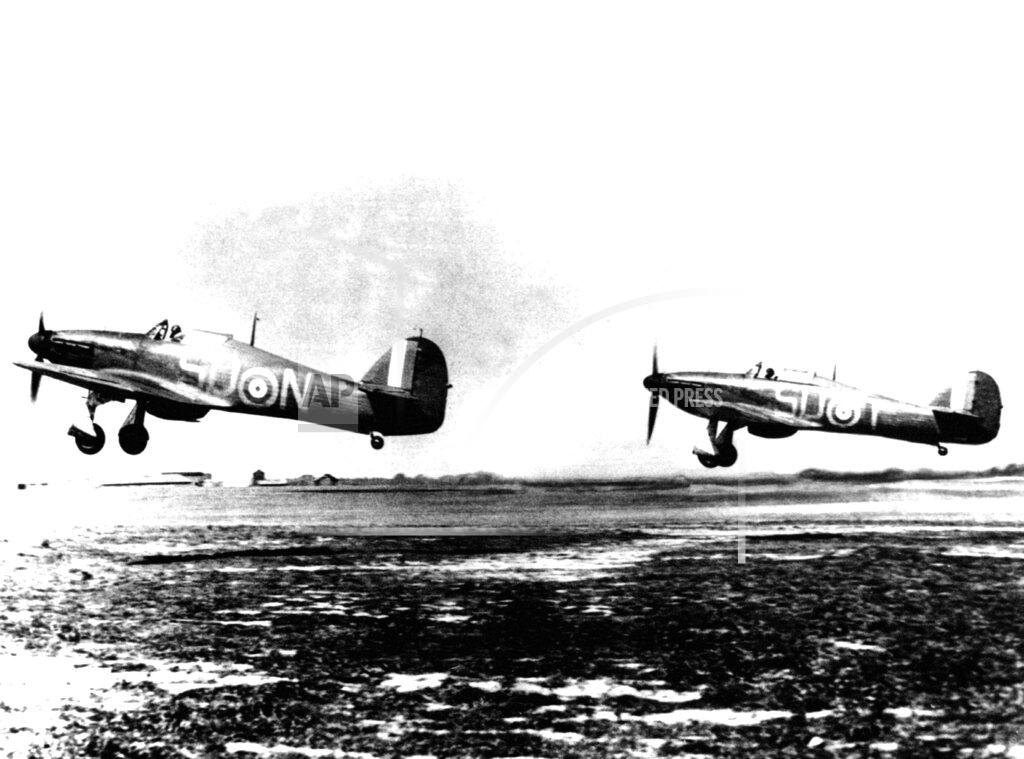
The Battle of Britain: RAF fighters were mainly engaged in the south against Luftwaffe formations dispatched to attack convoys and shipping in Dover Harbor. [battleofbritain1940 web site]
On the 20th, the Luftwaffe again continued attacks on coastal shipping and convoys in the channel. They were hoping that their efforts would draw RAF Fighter Command into combat over the open waters, but this was not to happen. Keith Park would not be a part of contemplating aerial warfare at great distances from the fighter bases. So, many convoys came under attack, and many dogfights took place over the channel and as close as possible to the English coast. 32 Squadron Biggin Hill (Hurricanes) were providing air cover for a channel convoy when attacked by Ju87s and Bf109s with the loss of two Hurricanes. 238 Squadron Middle Wallop (Hurricanes) were also busy over Swanage, 65 Squadron Hornchurch (Spitfires) had also engaged the enemy off the French coast destroying a Bf109, while 56 Squadron North Weald (Hurricanes) destroyed a Ju88 off the Essex coast. Up north, a Do17 was shot down by 603 Squadron (Spitfires) off the coast at Aberdeen.
During the afternoon, the Luftwaffe attacks destroyer HMS Acheron off the Isle of Wight. It is damaged by near misses and proceeds to Portsmouth for repairs. The Luftwaffe loses two Bf 109s of II,/JG51, while the RAF loses three fighters of No. 32 Squadron. Joseph “Pips” Priller, one of the Luftwaffe’s great aces, gets one of the kills.
Luftwaffe Stukas of II,/StG1 attacks Convoy CW 7 off Dover. They sink destroyer HMS Brazen (sinks on the 21st, one death) and 960 ton freighter Pulborough, while damaging 710 ton freighter Westown and Norwegian freighters Kollskegg and Nina Borthen. The Germans lose two planes from 3,/JG27. The RAF loses three fighters.
The Gruppenkommandeur of JG27, Major Helmut Riegel, is shot down over Sark, Dover by Hurricanes of RAF No. 501 Squadron. His replacement is Major Eduard Neumann.
During the night very extensive mining operations were carried out by the Luftwaffe.
RAF Statistics for the day: 191 patrols were flown involving 655 aircraft. Luftwaffe casualties: 6 confirmed, 10 unconfirmed; Bombers – 2 confirmed, 1 unconfirmed; Seaplanes -1 confirmed, 1 unconfirmed; Type unknown – 1 unconfirmed. RAF casualties: 5 Hurricanes confirmed , 1 Spitfire confirmed.
RAF Casualties: July 20th 1940
1315hrs: Off Swanage. Hurricane P3766, 238 Sqn Middle Wallop. (Aircraft lost at sea)
Sgt C. Parkinson. Died of Injuries 21.06.40 (Bailed out after being shot down by Bf109. Rescued by ship)
1630hrs: Lyme Bay (Dorset). Hurricane P3082, 501 Sqn Middle Wallop. (Aircraft lost at sea)
P/O E.J.H. Sylvester. Certified as missing. (Damaged by Bf109 off Cherbourg, crashed approaching coast)
1635hrs: Swanage. Spitfire K9880, 152 Sqn Warmwell. (Aircraft lost at sea)
P/O N.H. Posener Certified as missing. (Crashed into Channel after being hit by gunfire from Bf109)
1800hrs: Off Dover. Hurricane N2670, 32 Sqn Biggin Hill. (Aircraft lost at sea)
Sub/Lt G.G.R. Bulmer. Certified as missing. (Hit by gunfire from Bf109 and crashed into Channel)
1800hrs: Sth of Isle of Wight. Hurricane P3964, 43 Sqn Tangmere. (Aircraft lost at sea)
F/O J.F.J. Haworth. Certified as missing. (Shot down while investigating E/A, Bailed out over Channel)
1820hrs: Off Cherbourg. Blenheim L1300, 236 Sqn Thorney Island. (Aircraft lost at sea)
Sgt W.E. Lockton. Certified as missing. and
Sgt H. Corcoran. Certified as missing. (Shot down by Bf109 during escort mission. Crashed into Channel)
Time N/A: Grangemouth. Hurricane P2917, 263 Sqn Grangemouth. (Aircraft destroyed)
P/O A.R. Downer Died of Injuries 21.06.40 (Crashed while making a forced landing at base)
RAF Bomber Command dispatches 24 Blenheims. to attack Flushing airfield in the Netherlands during the day. Only 1 bombed, 1 lost
RAF Bomber Command dispatches 95 aircraft to 6 German targets, airfields in Holland and minelaying overnight. 4 Hampdens and 2 Wellingtons lost. Bomber Command records state that attacks with ‘special bombs’, possibly a type of mine, were carried out from 30-100 ft against the cruiser Admiral Scheer at Wilhelmshaven. This must have been a dangerous method of attack; Wilhelmshaven records say that 2 bombers crashed in the town and 3 nearby, all shot down by local Flak.
James Lacey shot down his first enemy aircraft during the Battle of Britain, a Bf 109E fighter of German Jagdgeschwader 27 wing.
First Lieutenant Werner Streib, flying a Me110, using only visual contact, was credited with downing a British Whitley bomber while operating out of Güterloh northwestern Germany. This was the first nighttime kill of the war. This kind of night visual interception will later be known as “Wild Boar.” Streib himself becomes known as “The Father of Night Fighting.”
The Luftwaffe conducts minelaying operations off England, and the Germans lose an FW200C of 1,/KG40. The Luftwaffe bombs Stirling during the night, causing some damage to vehicles at the Royal Ordnance Factory in Forthside.
Colonel Josef Kammhuber was ordered by Reichsmarschall Hermann W. Göring, commander in chief of the Luftwaffe, to form a night-fighter force: the Nachtjagdgeschwader Nr.1. Kammhuber, a good organizer who briefly had been a prisoner of the French, will command the force. Kammhuber sets to work preparing a night fighter defensive line across Europe for Nachtverteidigung, or the protection of the skies. This becomes known as the Kammhuber Line, and Kammhuber effectively becomes the Night Fighter Czar with priority to get whatever equipment he needs.
3,/JG77 begins operating out of Tempelhof Airport in defense of Berlin.
At Malta, there is an air raid at 02:42 by three airplanes which attacks the airbase at Hal Far and at Kalafrana. The raid causes extensive damage at Kalafrana, damaging a Sunderland Flying Boat and other assets. One of the Italian planes is damaged.
Morale at Malta is faltering, so the War Office plans a propaganda campaign to prop up the citizens’ spirits.
Wehrmacht soldiers are warned to avoid too much mingling with the French in Paris and to patronize Wehrmacht coffee shops and canteens (which are being set up). France, particularly Paris, quickly is gaining a reputation as the favorite billet for Wehrmacht soldiers.
With Hitler having given his “Last Appeal to Reason” speech to the Reichstag on the 19th, there are some within the British government who at least want to open some kind of negotiations with the Reich. Churchill, however, remains adamantly opposed.
The Ministry of Home Security gives statistics on recent civilian casualties. During the month beginning 18 June 1940, there have been 336 civilian deaths and 476 other casualties.
Churchill continues to reshuffle the military top commands. He appoints Field Marshal John Standish Surtees Prendergast Vereker, 6th Viscount Gort, the former BEF commander, Inspector of Training and the Home Guard. Sir Alan Brooke, the new commander of the Home Guard, has full authority, so this is a meaningless post. However, Gort remains under consideration for posts with real authority, though not for anything critical.
The British government banned the buying and selling of new cars.
New Hebrides Islands delegates vote to join Free France.
The University of Rome seeks the return of the Mona Lisa from the Louvre.
British submarine HMS Parthian disembarked a British agent on Crete, Greece.
Australian heavy cruiser HMAS Australia arrived at Scapa Flow from the Clyde.
Light cruiser HMS Sheffield arrived at Scapa Flow from Sheerness.
A report was received that German battlecruiser Gneisenau had departed Trondheim at 0900. The Home Fleet came to short notice for steam and the destroyers at sea were recalled at 1938. Anti-aircraft cruiser HMS Coventry, destroyers HMS Echo and HMS Firedrake departed convoy WN.2 and arrived at Scapa Flow at 0010/21st, while destroyers HMS Fortune and HMS Fury departed their anti-submarine patrol off Cape Wrath and arrived at Scapa Flow at 2320/20th. The Home Fleet at Scapa Flow was organized for the interception of Gneisenau: Force D – battlecruisers HMS Renown and HMS Repulse, cruisers HMS Shropshire, HMS Sussex, and HMS Southampton, with destroyers HMS Cossack, HMS Sikh, HMS Zulu, HMS Mashona, HMS Fortune, and HMS Fury. Force E – battleships HMS Rodney, HMS Nelson, and HMS Barham, aircraft carrier HMS Furious, anti-aircraft cruiser HMS Coventry, with destroyers HMS Echo, HMS Firedrake, HMS Hambledon, HMS Atherstone, HMS Fernie, HMS Garth, and HMS Berkeley. The Fleet did not sail as the information was later found to be incorrect, and returned to usual notice at 0838 on the 22nd.
On the report that Gneisenau might have left Trondheim, submarine HMS Trident was ordered to remain off Korsfjord and HMS Truant, returning to Rosyth, was ordered to patrol west of Sognefjord. On the 21st, these orders were cancelled with Trident proceeding to Stadlandet and Truant returning to Rosyth, arriving on the 24th.
Light cruiser HMS Southampton departed Scapa Flow for Sheerness. .
Destroyer HMS Maori departed Scapa Flow at 0700 for Invergordon to embark the new Flag Officer of the Shetlands/Orkney Command, Admiral of the Fleet Lord Cork, and his staff. She departed Invergordon that evening at 2100 and arrived at Lerwick at 0700/21st.
Anti-aircraft cruiser HMS Naiad departed the Tyne at 1600 for trials, escorted by destroyers HMS Bedouin and HMS Punjabi.
Destroyers HMS Boreas, HMS Versatile, and HMS Windsor were escorting convoy CW.7 off Dover, with destroyer HMS Brazen and anti-submarine trawler HMS Lady Philomena on patrol with the convoy, when they were attacked by German bombers. Brazen (Lt Cdr Sir Michael Culme-Seymour, Bt) was badly damaged, taken in tow by tug HMS Lady Brassey, but sank next day. One rating was lost and Boreas took off the crew. Destroyer HMS Scimitar joined the convoy on the 21st and escorted it until the 22nd.
Destroyer HMS Acheron was attacked by German bombers ten miles south of St Catherine’s Point, near missed by nine bombs and suffered some damage. She later proceeded to Portsmouth for repairs begun on 6 August. However, before they were completed, she was further damaged in German bombing on 24 August.
Destroyers HMS Havelock and HMS Vanoc were in a minor collision leaving Liverpool. Both were repaired at Liverpool, Havelock completing on 3 August, and Vanoc on the 28th.
Submarine HMS Swordfish undocked at Blyth.
Submarines HMS Triton and HMS Snapper arrived at Rosyth.
Submarine H.50 arrived at Harwich.
Submarine HMS Narwhal departed Blyth for the Humber where she arrived later the same day.
Convoy OA.187 departed Methil escorted by destroyer HMS Hesperus from 20 to 25 July, sloop HMS Weston from 20 to 22 July, and destroyer HMCS Restigouche from 22 to 25 July. Restigouche was detached to convoy SL.39.
Convoy FN.227 departed Southend, escorted by destroyer HMS Wolsey, sloop HMS Egret, and patrol sloop HMS Guillemot, and arrived at the Tyne on the 22nd.
Convoy MT.115 departed Methil, and arrived at the Tyne on the 21st.
Steamer Pulborough (960grt) from convoy CW.7 was sunk by German bombing, two and a half miles southeast of Dover Pier. Trawler HMS Lady Philomena (417grt) took off the seventeen survivors.
German bombing damaged steamer Westown (710grt) off Dover.
Steamer Troutpool (4886grt) was sunk on a mine, eight cables 3° from Bangor Pier Light in 54-40N, 05-40W. Eleven crew were lost.
The Mediterranean Fleet, which departed Alexandria on the 20th, launched air attacks on Tobruk searching for the damaged Italian light cruiser Bande Nere. Six Swordfish of 813 Squadron (824 Squadron according to Seekrieg) of aircraft carrier HMS Eagle took off from Sidi Barrani and sank Italian destroyers Ostro, Nembo and steamer Sereno (2333grt) in Tobruk Harbor. One Swordfish crashed, with Lt G. R. Brown and Lt K. C. Grieve wounded and Petty Officer R. J. W. Wynn dying of wounds on the 21st. Cdr W. L. M. Brown and Lt P. N. Medd from 700 Squadron in battleship HMS Warspite were forced to land in Italian territory. Medd was later able to escape, while Brown was later repatriated. After this raid, the Italians abandoned Tobruk as a sea base. The guns from the two sunken destroyers were later salved and used in the defense of Bardia.
Convoy SLF.40 departed Freetown escorted by armed merchant cruiser HMS Canton to 1 August when convoy SLF.40 merged with SL.40. On 2 August, both Canton and HMS Asturias of SL.40 were detached, and proceeded to Greenock for fuel and water before returning to Freetown. Sloop HMS Aberdeen joined the convoy on 2 August, destroyer HMS Walker and corvette HMS Periwinkle on the 3rd, and corvettes HMS Godetia and HMS Primrose on the 4th. The convoys arrived at Liverpool on the 8th.
Sloop HMS Bridgewater departed Simonstown for Walvis Bay to refuel, and then proceeded to Lagos to relieve light cruiser HMS Dragon. She arrived at Lagos on 1 August.
Light cruiser HMS Delhi, detached from Force H, departed Gibraltar for Freetown to rejoin the South Atlantic Command. Patrolling in the area of Cape Verde Island en route, she arrived at Freetown on the 27th.
New Zealand Division light cruiser HMS Achilles departed Auckland for Suva, carrying the Chief of the General Staff and the Chief of the Air Staff for defense conferences. She arrived at Suva on the 23rd, departed on the 26th and proceeded to Tonga for further conferences, reaching there on the 28th. Achilles arrived back at Auckland on the 31st.
Canadian patrol vessel HMCS Ambler departed Quebec City, Quebec, Canada to patrol Riviere du Loup.
The War at Sea, Saturday, 20 July 1940 (naval-history.net)
Australian heavy cruiser HMAS AUSTRALIA arrived at Scapa Flow from the Clyde.
Light cruiser SHEFFIELD arrived at Scapa Flow from Sheerness.
A report was received that German battlecruiser GNEISENAU had departed Trondheim at 0900. The Home Fleet came to short notice for steam and the destroyers at sea were recalled at 1938.
Anti-aircraft cruiser COVENTRY, destroyers ECHO and FIREDRAKE departed convoy WN.2 and arrived at Scapa Flow at 0010/21st, while destroyers FORTUNE and FURY departed their anti-submarine patrol off Cape Wrath and arrived at Scapa Flow at 2320/20th.
The Home Fleet at Scapa Flow was organized for the interception of GNEISENAU:
Force D – battlecruisers RENOWN and REPULSE, cruisers SHROPSHIRE, SUSSEX, and SOUTHAMPTON, with destroyers COSSACK, SIKH, ZULU, MASHONA, FORTUNE, and FURY.
Force E – battleships RODNEY, NELSON, and BARHAM, aircraft carrier FURIOUS, anti-aircraft cruiser COVENTRY, with destroyers ECHO, FIREDRAKE, HAMBLEDON, ATHERSTONE, FERNIE, GARTH, and BERKELEY.
The Fleet did not sail as the information was later found to be incorrect, and returned to usual notice at 0838 on the 22nd.
On the report that GNEISENAU might have left Trondheim, submarine TRIDENT was ordered to remain off Korsfjord and TRUANT, returning to Rosyth, was ordered to patrol west of Sognefjord. On the 21st, these orders were cancelled with TRIDENT proceeding to Stadlandet and TRUANT returning to Rosyth, arriving on the 24th.
Light cruiser SOUTHAMPTON departed Scapa Flow for Sheerness. .
Destroyer MAORI departed Scapa Flow at 0700 for Invergordon to embark the new Flag Officer of the Shetlands/Orkney Command, Admiral of the Fleet Lord Cork, and his staff. She departed Invergordon that evening at 2100 and arrived at Lerwick at 0700/21st.
Anti-aircraft cruiser NAIAD departed the Tyne at 1600 for trials, escorted by destroyers BEDOUIN and PUNJABI.
Destroyers BOREAS, VERSATILE, and WINDSOR were escorting convoy CW.7 off Dover, with destroyer BRAZEN and anti-submarine trawler LADY PHILOMENA on patrol with the convoy, when they were attacked by German bombers. BRAZEN (Lt Cdr Sir Michael Culme-Seymour, Bt) was badly damagedi, taken n tow by tug LADY BRASSEY, but sank next day. One rating was lost and BOREAS took off the crew. Destroyer SCIMITAR joined the convoy on the 21st and escorted it until the 22nd.
Destroyer ACHERON was attacked by German bombers ten miles south of St Catherine’s Point, near missed by nine bombs and suffered some damage. She later proceeded to Portsmouth for repairs begun on 6 August. However, before they were completed, she was further damaged in German bombing on 24 August.
Destroyers HAVELOCK and VANOC were in a minor collision leaving Liverpool. Both were repaired at Liverpool, HAVELOCK completing on 3 August, and VANOC on the 28th.
Submarine SWORDFISH undocked at Blyth.
Submarines TRITON and SNAPPER arrived at Rosyth.
Submarine H.50 arrived at Harwich.
Submarine NARWHAL departed Blyth for the Humber where she arrived later the same day.
Convoy OA.187 departed Methil escorted by destroyer HESPERUS from 20 to 25 July, sloop WESTON from 20 to 22 July, and destroyer HMCS RESTIGOUCHE from 22 to 25 July. RESTIGOUCHE was detached to convoy SL.39.
Convoy FN.227 departed Southend, escorted by destroyer WOLSEY, sloop EGRET, and patrol sloop GUILLEMOT, and arrived at the Tyne on the 22nd.
Convoy MT.115 departed Methil, and arrived at the Tyne on the 21st.
S/Lt G. G. R. Bulmer was killed when his RAF Hurricane of 32 Squadron from Biggin Hill was shot down five miles northeast of Dover.
Steamer PULBOROUGH (960grt) from convoy CW.7 was sunk by German bombing, two and a half miles southeast of Dover Pier. Trawler LADY PHILOMENA (417grt) took off the seventeen survivors.
German bombing damaged steamer WESTOWN (710grt) off Dover.
Steamer TROUTPOOL (4886grt) was sunk on a mine, eight cables 3° from Bangor Pier Light in 54‑40N, 05‑40W. Eleven crew were lost.
The Mediterranean Fleet, which departed Alexandria on the 20th, launched air attacks on Tobruk searching for the damaged Italian light cruiser BANDE NERE. Six Swordfish of 813 Squadron (824 Squadron according to Seekrieg) of aircraft carrier EAGLE took off from Sidi Barrani and sank Italian destroyers OSTRO, NEMBO and steamer SERENO (2333grt) in Tobruk harbour.
One Swordfish crashed, with Lt G. R. Brown and Lt K. C. Grieve wounded and Petty Officer R. J. W. Wynn dying of wounds on the 21st. Cdr W. L. M. Brown and Lt P. N. Medd from 700 Squadron in battleship WARSPITE were forced to land in Italian territory. Medd was later able to escape, while Brown was later repatriated.
After this raid, the Italians abandoned Tobruk as a sea base. The guns from the two sunken destroyers were later salved and used in the defense of Bardia.
Convoy SLF.40 departed Freetown escorted by armed merchant cruiser CANTON to 1 August when convoy SLF.40 merged with SL.40. On 2 August, both CANTON and ASTURIAS of SL.40 were detached, and proceeded to Greenock for fuel and water before returning to Freetown.
Sloop ABERDEEN joined the convoy on 2 August, destroyer WALKER and corvette PERIWINKLE on the 3rd, and corvettes GODETIA and PRIMROSE on the 4th. The convoys arrived at Liverpool on the 8th.
Sloop BRIDGEWATER departed Simonstown for Walvis Bay to refuel, and then proceeded to Lagos to relieve light cruiser DRAGON. She arrived at Lagos on 1 August.
Light cruiser DELHI, detached from Force H, departed Gibraltar for Freetown to rejoin the South Atlantic Command. Patrolling in the area of Cape Verde Island en route, she arrived at Freetown on the 27th.
New Zealand light cruiser HMNZS ACHILLES departed Auckland for Suva, carrying the Chief of the General Staff and the Chief of the Air Staff for defense conferences. She arrived at Suva on the 23rd, departed on the 26th and proceeded to Tonga for further conferences, reaching there on the 28th. ACHILLES arrived back at Auckland on the 31st.
Prompt action to begin construction of the greatest fleet in world history was promised by the Navy Department today after President Roosevelt signed a bill authorizing a 70 percent, $4,000,000,000 increase in naval strength. Within the past 40 days, officials pointed out, construction has been started on 92 vessels previously authorized, thus clearing the way for immediate negotiations on contracts for the first of the 200 combat vessels to be added to the fleet under the new act. Upon completion of those 200 vessels, scheduled for 1946 or 1947, the United States will have a “two-ocean” navy of 701 fighting ships of 3,547,700 tons. That record-shattering armada would outweigh today’s combined fleets of Great Britain and Japan, the two other principal sea powers.
With the additional $4,000,000,000 of construction just added to the naval shipbuilding program, the problem of providing ways on which to build the fighting and auxiliary units thus provided for is one of grave concern to the shipbuilders, naval and civilian, of the country. New ship ways costing millions of dollars must be built in a minimum of time, thousands more of skilled mechanics and other workers must be recruited and designs, in the light of the lessons of the wars in Europe and the Far East, must be brought up to date. Every shipbuilding yard in the United States is now carrying a peak load with approximately 150 fleet units under construction or contracted for, including ten battleships, cruisers, aircraft carriers. destroyers and submarines. Within a few weeks this load will be more than doubled, which means that the shipyards equipped for naval work must take on every ton of new construction they can possibly carry. This applies to Navy as well as private shipyards. The solution of the problem involves not only the expansion of construction facilities and new ways, but new tools and equipment for yards hitherto building only merchant vessels, the rehabilitation of yards which have been idle for years and the erection of new plants.
The administration is studying the possibility of invoking its powers under the May Defense Expediting Act to curtail shipments of such raw materials as scrap iron to Japan.
President Roosevelt signed today the Hatch “clean state politics bill,” designed to curb pernicious political activity by some 250,000 state and municipal workers paid from federal funds and imposing drastic limitations on national campaign expenditures. The measure becomes effective immediately. In signing it, Mr. Roosevelt wrote “finis” to one of the most hard-fought Congressional battles of the year, which found many Administration leaders voting against the bill, although it had the President’s approval. The bill, which is an amendment to the original Hatch Act restricting federal employees, prohibits political activity by state and local employees paid in whole or in part with federal funds. A limit of $3,000,000 is put on the annual expenditures of any political committee, including the Republican and Democratic National Committees. The Republican National Committee spent $8,000,000 during the 1936 campaign and the Democratic National Committee $6,000,000.
Vice-President Garner, foe of a third term for Franklin D. Roosevelt, packed away some office belongings today, expressed his private views to a few senatorial cronies and, friends said, made ready to quit the capital. His friends said Garner planned to go to his Uvalde, Texas, home to vote in the primary elections on July 27, and might stay there, leaving Congress, the administration and the Democratic party to their own devices. Because of his third term views, his associates said, the 71-year-old Texan felt he could not participate the campaign for President Roosevelt and Secretary Wallace, nominated to succeed Garner as vice-president. Garner declined to say whether he had sent any congratulatory message to the president or Wallace, but friends said they understood he had not.
A group of anti-Roosevelt third-termers, of whom former Senator James A Reed is a leader, are preparing to consider possible action in the Presidential campaign. Mr. Reed, chairman of the Democratic Executive Committee of the Jeffersonian movement, has called a meeting for Thursday in Chicago. He has invited Senator Burke, Democrat of Nebraska, who recently bolted to support Wendell L. Willkie, to be present. “I have simply issued a call for the members of that committee, numbering five or six, to see what ought to be done,” former Senator Reed said today. “Just what course will be pursued will be discussed then.” The movement, it was said, might cover the country. The committee of which Mr. Reed is the head was set up in the campaign of 1936 when President Roosevelt was nominated for a second term.
In addition to Mr. Reed, the committee includes Joseph B. Ely, Colonel Henry Breckinridge, Bainbridge Colby, former Secretary of State; Graham Wright of Georgia and Joseph W. Bailey of Texas, former member of the House of Representatives. Mr. Reed said that he did not know what form the possible nation-wide activities of anti-third-term and anti-New Deal Democrats would take. Anti-third-termers say that many delegates at the party’s Chicago convention were not sympathetic to a third term, and assert that this sentiment was emphasized when President Roosevelt let it be known that he desired Secretary Wallace as his running mate. Mr. Reed has long opposed the New Deal and its policies. He has not yet proclaimed his personal opinions of the ticket named by the Chicago convention, but his friends said that he had expressed views indicating that he was not satisfied and that he had evidenced a high regard for Wendell L. Willkie, the Republican nominee.
The split among Louisiana Democrats over Secretary Wallace’s nomination for vice-president widened into direct action tonight with announcement of David W. Pipes Jr. he was a Republican candidate for congress. Pipes, a life-long Democrat and nationally known sugar planter from Houma, was the second to announce his withdrawal from the state’s anciently solid Democratic ranks within 24 hours. Charles A. Farwell, spokesman for the American Sugar Cane league, last night pinned on a “Willkie for President” button, and said “the Republicans are Louisiana’s only hope.”
Wendell L. Willkie conferred here today on agricultural and foreign trade problems with George N. Peek, first administrator of the New Deal’s AAA, and former special foreign trade adviser to President Roosevelt.
William C. Bullitt, American Ambassador to France, returned to the United States yesterday with praise for Marshal Henri Philippe Petain and the French people, and with disbelief that the government of Premier Petain rightly could be called a fascist State.
With Washington sweltering in the warmest day of the Summer. President Roosevelt decided to prolong his yacht cruise on the Potomac, which started last evening, and informed the White House that he would not return to the capital until tomorrow. He had intended to leave for Hyde Park this evening but now plans to go there tomorrow night. The President is expected to return early enough tomorrow to confer before leaving for Hyde Park with William C. Bullitt, Ambassador to France, who arrived today in New York aboard a transatlantic clipper. Mr. Bullitt also is expected to confer with Sumner Welles, Acting Secretary of State. It was reported that Mr. Bullitt had sought an interview with the President today to report at first hand on the defeat of France by Germany and subsequent events.
Charging false arrest, violation of civil rights and imprisonment in dirty jail cells, a group of C.I.O. fruit pickers asked a total of $131,500 from Yuba county authorities in California in damage suits filed in federal court. The lawsuits evolved from the 1939 Marysville strike, when numerous unionists were arrested.
The worst heat wave of the summer engulfed most of the eastern half of the nation today. Twelve deaths were attributed directly to the sweltering siege while nine persons who sought temporary relief in cooling waters drowned. Thousands of residents of states between the Rocky Mountains and the Atlantic seaboard hurried to beaches and woodlands for the week-end when forecasters reported no general break in the sultry spell was in sight. Temperatures In the nineties were common in many cities. Washington’s 96.6 and Baltimore’s 96 established new tops for the season. Readings of 95 in Des Moines and Kansas City and 92 in Cleveland provided samples of the abnormal conditions in the Midwest. Chicago’s 94 brought the largest crowds of the summer to forest preserves, parks and shore line. New York City’s maximum of 89.6 was accompanied by oppressive humidity. Heat deaths included: South Dakota, 2; New York state, 2; Wisconsin, 2; Minnesota, 1; Pennsylvania, 2; Nebraska, 1; New Jersey, 1; Kansas, 1.
California officially opens the first section of the first U.S. freeway, the Arroyo Seco Parkway. The opening marked a transition for U.S. roads from early parkways to modern freeways. The Arroyo Seco Parkway is today known as the Pasadena Freeway, or California SR-110.
Hoagy Carmichael and Johnny Mercer’s musical “Walk With Music”, closes at the Ethel Barrymore Theatre, NYC, after 50 performances
In the U.S., “Billboard” magazine publishes its first listing of best-selling single records. Ten tunes are listed. The first ever Number One Hit is “I’ll Never Smile Again” by Tommy Dorsey, Frank Sinatra and the Pied Pipers.
Major League Baseball:
The Indians snapped a six-game losing streak today by pounding out a 9–6 victory over the Red Sox in a free-hitting game marked by five home runs, two by the Indians and three by the Red Sox. The Indians score four in the second inning to send Lefty Grove to the showers. Mel Harder gets the win over Earl Johnson, who is the victim of another Indian rally for three runs in the seventh that breaks a 4–4 tie.
At Yankee Stadium, 19-year-old southpaw Hal Newhouser stops the Yankees, 3–1, as Hank Greenburg is 4–for-4 for Detroit, including a double and triple. Joe DiMaggio singled in the lone Yankee run to extend his current hitting streak to 16 games.
Pounding four pitchers for nineteen hits, the White Sox set an American League scoring record for the season by defeating the Athletics, 19–7, today. The victory was the sixth in a row for Southpaw Edgar Smith, who tired in the eighth and was replaced by Pete Appleton.
John Niggeling limited Washington to seven hits, all in the first four innings, today while the St. Louis Browns snapped Rookie Sid Hudson’s 6-game winning streak, 4–1. The Senators took a 1–0 lead in the first inning, but Niggeling escaped trouble in the next three and from then on was invincible.
Bucky Walters won his 14th game of the season as the Reds rolled over the Giants, 5–1. Babe Young accounted for the only Broolyn run with a homer. Cincinnati put it away in the sixth with doubles by Ival Goodman, Mike McCormick, and Harry Craft, and a New York error.
The Cardinals edged the Dodgers, 3–2. A triple by Jose Orengo and an error by Dixie Walker on the play provide the winning run. The Dodgers dropped to four games behind the Reds in the National League pennant race.
Led by first baseman Art Mahan, who drove in five runs with a homer and three singles, the Phillies pounded out sixteen hits to beat the Cubs, 9–3, before 5,382 today in the opening game of a series.
The Boston Bees ran into their worst nightmare of the season today as the Pirates blasted six pitchers for twenty-two hits and a 17–6 triumph. The Bees held a 6–4 lead until the seventh, when the Pirates went on a rampage and counted nine runs. Four more tallies in the eighth added insult to injury. Fifteen Pittsburgh batters went to the plate in the hectic seventh. Debs Garms got two hits during the frame and four for the afternoon.
Cleveland Indians 9, Boston Red Sox 6
Philadelphia Phillies 9, Chicago Cubs 3
New York Giants 1, Cincinnati Reds 5
Detroit Tigers 3, New York Yankees 1
Chicago White Sox 19, Philadelphia Athletics 7
Boston Bees 6, Pittsburgh Pirates 17
Brooklyn Dodgers 2, St. Louis Cardinals 3
St. Louis Browns 4, Washington Senators 1
Although the United States-Canadian border remains unfortified, it is now easier for Americans to cross it going north than for Canadians to journey over it south. And this notwithstanding the fact that Canada is a country at war, while the United States remains at peace with the world.
The prospect of a Mexican Congressional struggle between General Juan Andreu Almazan and General Manuel Avila Gamacho, rivals in Mexico’s recent Presidential election, appeared tonight when General Almazan’s campaign manager, Eduardo Neri, said Congressional candidates on the Almazan ticket would set up their own Congress.
The Pan-American Conference of Foreign Ministers, which opens in Havana tomorrow, “will be a new demonstration of the vigor and vitality of the American republics when they work jointly for their common interest,” Secretary of State Cordell Hull declared upon his arrival here this morning. The Secretary, accompanied by Mrs. Hull and fifteen members of the American delegation, arrived at 10 o’clock on the steamship Florida from Miami. As the boat came in a crowd at the dock cheered the Secretary and Mrs. Hull, who were on the deck, and later they received an ovation as they descended the gangplank. Mr. Hull was met by Dr. Miguel Angel Campa, Cuban Secretary of State, and other Cuban State Department officials, and George Messersmith, United States Ambassador, and members of the embassy and consulate staff. In a press conference at his hotel. Mr. Hull expressed his pleasure at again visiting Cuba, where he served in the United States Army during the Spanish-American War, and voiced his appreciation for the hospitality of the Cuban Government.
Luiz Aranha, Brazilian business man and brother of Oswaldo Aranha, the Brazilian Minister of Foreign Affairs, launched today the idea of the formation of a Pan-American institute of trade development.
Following a week of terrorism against American, British and Chinese newspapermen in Shanghai, the Shanghai International Settlement authorities today took measures for their protection. Guards are protecting newspaper men who have annoyed the Japanese.
The idea of a Cabinet entertained by the Premier-designate, Prince Fumimaro Konoye, is a strong central core of policy-making statesmen, surrounded by lesser Ministers who will simply be efficient non-political departmental heads. “Big names,” as he said, are not needed for those posts.
Jean Decoux assumed office as Governor-General of French Indochina.
President Manuel Quezon of the Philippine Commonwealth took issue today with High Commissioner Francis B. Sayre on the necessity for a two-party system to maintain democracy. Quezon calls the two-party sytem “a fetish” and unnecessary. In a university speech, Quezon also frankly advocates limiting individual liberty “in the interest of the well-being of the entire community.”
Dow Jones Industrial Average: 121.87 (-0.31)
Born:
Tony Allen, Nigerian drummer who pioneered Afrobeat sound, in Lagos, Nigeria (d. 2020).
David Jemibewon, Nigerian Army major general, in Iyah-Gbedde, Ijumu, Colonial Nigeria.
Naval Construction:
The Royal Navy Bangor-class (Turbine-engined) minesweeper HMS Hythe (J 194) is laid down by the Ailsa Shipbuilding Co. Ltd. (Troon, Scotland).
The Royal Canadian Navy Flower-class corvette HMCS Trail (K 174) is laid down by the Burrard Dry Dock Co. Ltd. (Vancouver, British Columbia, Canada).
The Kriegsmarine (German Navy) Type 37 torpedo boat T19 is launched by F. Schichau, Elbing, East Prussia (werk 1446).
The Regia Marina (Royal Italian Navy) submarine Ammiraglio Cagni, lead boat of her class of 4, is launched by Cantieri Riuniti de l’Anreitico (Montfalcone, Italy).
The Türk Donanması (Turkish Navy) Oruç Reis-class (modified British “S”-class) submarine Murat Reis (later briefly HMS P 612) is launched by Vickers Armstrong (Barrow-in-Furness, U.K.).
The Marinha do Brasil (Brazilian Navy) destroyer Marcilio Dias (M 2), lead ship of her class of 3, is launched by Arsenal de Marinha do Rio de Janeiro (Ilha das Cobras, Rio de Janeiro, Brazil).
The Royal Canadian Navy HMCS Norsal is commissioned into service. Her first commanding officer is A/Lieutenant Ronald Jackson, RCNR.
The Royal Navy motor anti-submarine boat HMS MA/SB 49 (former private yacht Bulldog) is commissioned.
 History Diaries