The Battle of Britain: During the day two major engagements took place off Dover. Glasgow was bombed in the morning and small vessels were attacked east of Clacton and south of the Isle of Wight. [battleofbritain1940 web site]
The Luftwaffe bombs the RAF airfield at Norwich at first light, destroying a hangar.
The 19th was a disastrous day for the RAF. RAF No. 141 Squadron from Biggin Hill, was flying Boulton Paul Defiants, twelve of which had just recently arrived within 11 Group from Turnhouse and on this day had flown from West Malling to operate out of Hawkinge. They took off on routine patrol at 1232 hours, ordered to patrol a line just south of Folkestone at 5,000 feet. Three of the aircraft had aborted the patrol because of engine malfunctions. At 1300 hours, the nine Defiants were patrolling in the middle of the English Channel, it was obvious that they were unaware of 16 Bf109 flying “up sun” and were were unexpectedly jumped on without any warning by the Bf109s of JG51 led by Oberleutnant Hannes Trautloft. One by one the RAF fighters fell from the sky into the channel, being no match for the far superior Bf109 (the Defiant “turret fighter” could only attack and defend itself from the sides and the rear, as it had no forward facing guns). Six Defiants were shot down in rapid succession while three just managed to make it back to Hawkinge, thanks to the intervention of 111 Squadron Northolt (Hurricanes) while one Bf109 was severely damaged and crashed on landing back at its base. Serious thought was now to be given as to the future of the Defiant in the role of a front line fighter.
The action is made much, much worse than just the loss of fighters due to the fact that 10 pilots/crew perish.
During the night considerable activity took place around midnight. Most of the activity consisted of suspected minelaying activity.
RAF Statistics for the day: 175 patrols were flown involving 735 aircraft. Luftwaffe casualties: Fighters – 3 confirmed, 8 unconfirmed; Bombers – 3 confirmed, 1 unconfirmed; Seaplanes -1 confirmed, 2 unconfirmed. RAF casualties: 6 Defiants confirmed (all No. 141 Squadron), 3 Hurricanes confirmed plus one unconfirmed.
RAF Casualties: July 19th 1940
1245hrs: Dover. Defiant L7009. 141 Sqn Hawkinge. (Aircraft destroyed)
F/Lt I.D.G. Donald. Killed.
P/O A.C. Hamilton. Killed. (Shot down by Bf109 and crashed into residential street in Dover)
1245hrs: Off Dover. Defiant L6974 141 Sqn Hawkinge. (Aircraft lost at sea)
P/O J.R. Kemp. Certified as missing.
Sgt R. Crombie. Certified as missing. (Crashed into Channel after being shot down by Bf109)
1245hrs: Off Dover. Defiant L6995 141 Sqn Hawkinge. (Aircraft lost at sea)
P/O R.A. Howley. Certified as missing.
Sgt A.G. Curley. Certified as missing. (Crashed into Channel after being shot down by Bf109)
1245hrs: Off Dover. Defiant L7015 141 Sqn Hawkinge. (Aircraft lost at sea)
P/O R. Kidson. Certified as missing.
Sgt F.P.J. Atkins. Killed. (Crashed into Channel after being shot down by Bf109)
1245hrs: Off Dover. Defiant L7016 141 Sqn Hawkinge. (Aircraft lost at sea)
P/O D.M. Slatter. Certified as missing. (Crashed into Channel after being shot down by Bf109) (Pilot wounded)
1245hrs: Off Dover. Defiant L6983 141 Sqn Hawkinge. (Aircraft damaged)
Sgt J.F. Wise. Certified as missing. (Damage sustained by Bf109. Sgt Wise Bailed out over Channel but pilot managed to get aircraft base) For some reason Sgt Wise is officially recorded as giving his life on Aug 19th.
1715hrs: Off Selsey Bill. Hurricane 43 Sqn Tangmere. (Aircraft lost at sea)
Sgt J.A. Buck. Drowned. (Hit by gunfire from Bf109, Bailed out over Channel)
RAF Bomber Command dispatches 16 Blenheims to attack railways in Northern Germany during the day, but they lacked enough cloud cover and turned back.
RAF Coastal Command attacks naval bases at Emden and Harlingen. Among the targets is the battleship Tirpitz, still under construction at Wilhelmshaven, and Admiral Scheer.
RAF Bomber Command dispatches 89 aircraft to 5 targets in Germany, to airfields in Holland and minelaying overnight. 3 aircraft, 1 of each type, lost.
Luftwaffe Dornier Do 17 bombers conducted a night raid on the Rolls-Royce aero engine factory at Glasgow. There are 42 casualties.
The Luftwaffe again raids Dover at 14:00 to disperse British Royal Navy ships preparing to meet any invasion. The destroyer HMS Griffin is damaged by near misses. Destroyer HMS Beagle also is damaged off Dover by near misses. The 5574-ton British tanker HMS War Sepoy is damaged by the attack in Dover Harbor and ultimately sinks, used as a blockship. British 550 ton trawler HMS Crestflower also sinks, with two deaths.
During the night, the Luftwaffe sends bombers from KG55 to attack the port of Southampton, with the Germans losing on Heinkel 111.
The Luftwaffe lays mines in the Thames estuary during the night.
At Malta, there is an air raid shortly after noontime. Two Gloster Gladiators defending the island are damaged by air raids, but they prevent any bombs from being dropped. There is now only one serviceable aircraft left, aptly nicknamed “Faith.” The other two Gladiators and a Hurricane can be repaired with a little time, but reinforcements from Egypt or England are difficult.
Hitler gives his speech for peace with United Kingdom: “Last appeal to reason…” Adolf Hitler spoke to the German Reichstag about Allied warmongering and asked the United Kingdom to listen to reason and avoid war, stating “For millions of other persons, great suffering will begin. Mr. Churchill, or perhaps others, for once believe me when I predict a great empire will be destroyed, an empire that it was never my intention to destroy or even to harm…I do realize that this struggle, if it continues, can end only with the complete annihilation of one or the other of the two adversaries. Mr. Churchill may believe this will be Germany. I know that it will be Britain.” Hitler then appealed “once more to reason and common sense”, saying, “I can see no reason why this war must go on.” He said if Churchill brushed aside this appeal, “I shall have relieved my conscience in regard to the things to come.” BBC German-language broadcaster Sefton Delmer unofficially rejected it at once.
The timing of the speech suggests that the start of the true Battle of Britain is not 10 July, as the British claim, but August as the Germans maintain. The British date is somewhat arbitrary, as the Luftwaffe had been staging raids during late June. US journalist William Shirer considers the speech a “masterpiece,” though of little value as a basis of peace. He considers Hitler the “finest liar in History.”
The British government takes its time refusing the peace offer, but the BBC — on its own initiative — immediately rejects it. The Germans use the speech as the basis of a propaganda campaign, dropping leaflets with that theme in London. This is the last open peace proposal of any kind between the UK and Germany before the closing days of the Reich, though there are various half-hearted attempts by the Germans to start some kind of negotiations along the way.
It is easy to dismiss Hitler’s proposal. However, to him, it is quite serious – he does not want to invade and probably knows that he can’t launch a successful invasion. As for the British, while Churchill is adamantly opposed to the mere idea of negotiations, there is a large faction headed by Lord Halifax within the British War Cabinet that believes there is no harm with at least discussing the matter with the Germans even if nothing comes of it.
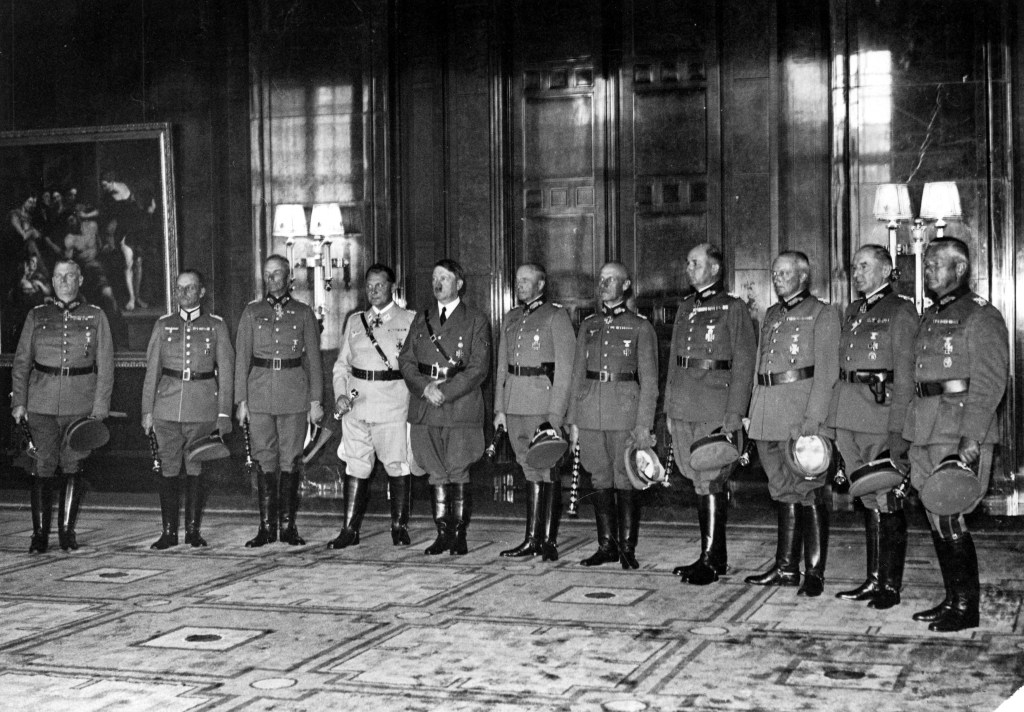
The Field Marshal Ceremony was held at the Kroll Opera House in Berlin. Hermann Göring was promoted to the rank of Reichsmarschall, a rank created for him so that he would outrank all Field Marshals of the German military.
Günther von Kluge was promoted to the rank of Generalfeldmarschall (Field Marshal).
Walter von Brauchitsch was promoted to the rank of Generalfeldmarschall.
Wilhelm Keitel was promoted to the rank of Generalfeldmarschall.
Fedor von Bock was promoted to the rank of Generalfeldmarschall.
Gerd von Rundstedt was promoted to the rank of Generalfeldmarschall.
Albert Kesselring was promoted to the rank of Generalfeldmarschall.
Siegmund Wilhelm Walther List was promoted to the rank of Generalfeldmarschall.
Walther Reichenau was promoted to the rank of Generalfeldmarschall.
Hugo Sperrle was promoted to the rank of Generalfeldmarschall.
Other German generals promoted to Field Marshal include Leeb, Kluge, Milch, and Witzleben.
Heinz Guderian was promoted to the rank of Generaloberst (Colonel General).
Eduard Dietl became the first person to receive Oak Leaves to the Knight’s Cross of the Iron Cross.
Ernst Udet was promoted to Generaloberst (equivalent to Air Chief Marshal of the British RAF).
Hermann Hoth was promoted to the rank of general.
Werner Mölders was promoted to the rank of Major.
Wolfgang Falck was ordered to see Hermann Göring; during this meeting, Falck would be promoted to the rank of Major.
Robert von Greim was promoted to the rank of General der Flieger.
As a special gesture toward one of his favorite Generals, Hitler bestows the first Oak Leaves to the Knight’s Cross upon Eduard Dietl, who managed to avoid either being defeated or forced to flee into internment in Sweden during the Battle of Narvik. There are other awards, such as the award of the Knight’s Cross to Major Michael Pössinger. While military rank, of course, is always important, the huge separate track of medals created by the Wehrmacht is often more important in terms of how a soldier is perceived. A major with a Ritterkreuz has infinitely more status in the eyes of his comrades, for instance than a mere office General. Rank confers power, but top medals grant unique status.
The British are setting up internment camps on the Isle of Wight for German and Italian nationals caught up in the war. Conditions are quite poor, with not enough food or shelter. Many of those imprisoned actually are anti-German refugees, but their official documents just list them as German.
Prime Minister Winston Churchill made a proposal to the British War Cabinet suggesting the creation of Special Operations Executive (SOE) to conduct unscrupulous, underhand methods to be pursued against Germany.
British General Alan Brooke took over as Commander-in-Chief of Home Forces, relieving Edmund Ironside. Ironside was promoted to Field Marshal as consolation; he had only been at the helm of Home Forces for two months.
General Claude Auchinleck named to command Southern Command.
General Andrew McNaughton takes command of Canadian 1st Corps.
The first prototype of the cavity magnetron was delivered to the British radar research center near Swanage, England, United Kingdom.
Daphne Pearson was awarded the Empire Gallantry Medal for her 31 May 1940 rescue of a pilot from a crashed bomber at RAF Detling, unspent ammunition exploding all around her. The medal was later updated to the George Cross in 1941.
The British Army Intelligence Corps was established.
The British Government removed the right of workers to strike.
The Battle of Cape Spada was fought in the Mediterranean Sea, resulting in Allied victory. The Italians lost the light cruiser Bartolomeo Colleoni.
In retaliation for the refusal of Dutch colonies to surrender, the Germans arrest Dutch leaders. German authorities announced today that reprisals would be taken against certain distinguished persons now in the Netherlands because of the alleged mistreatment of German subjects in the Netherland Indies and the West Indies.
Nazi occupiers imprison 231 prominent Dutch citizens in Buchenwald.
Nazi occupiers in Netherlands forbid anti-nazi films.
Denmark withdraws from the League of Nations.
Rumanian political insiders predict a Nazi drive into Russia and the Ukraine.
The Rumanian Government today sent an answer to the Bulgarian protest against the way in which the Bulgarian minority in the Dobruja are said to be treated. It agreed to the formation of a mixed commission to look into the minority question in that province.
Political and military leader General Johan Laidoner of Estonia was deported to the Soviet Union. Laidoner was one of the few Estonian leaders who was deported and not executed. Others, of course, are simply being shot with little fanfare.
U-62, commanded by Oberleutnant zur See Hans-Bernhard Michalowski, sank steamer Pearlmoor (4681grt) in 55-23N, 09-18W. At 1828 hours the Pearlmoor (Master James Basil Rodgers), a straggler from convoy SL.38, was hit by one torpedo from U-62, broke in two and sank 62 miles west of Malin Head. 13 crew members were lost. The master and 25 crew members landed by lifeboat at Gola Island, County Donegal. The 4,581-ton Pearlmoor was carrying iron ore and was headed for Immingham, England.
Destroyers HMS Echo and HMS Firedrake departed the Clyde at 1130 for Scapa Flow. At 0005 on the 20th, the ships to ordered to reinforce convoy WN.2 and remain in company until joining outbound OA.187. Anti-aircraft cruiser HMS Coventry departed Scapa Flow at 1135 on the 20th, also to join WN.2. All three ships were later ordered to return to Scapa Flow after escorting WN.2, but without joining convoy OA.187. They arrived there at 0010/21st.
Destroyers HMS Zulu, HMS Hambledon, and HMS Fernie departed their anti-submarine patrol in the Cape Wrath area at 1800 to return to Scapa Flow. Hambledon and Fernie arrived at Scapa Flow at 0457 on the 20th. Destroyers HMS Fortune and HMS Fury remained on patrol to cover convoys passing between Pentland Firth and the Minches, and arrived at Scapa Flow at 2330/20th.
Destroyers HMS Bedouin and HMS Punjabi departed Scapa Flow at 1410 for the Tyne to cover anti-aircraft cruiser HMS Naiad on trials. Due to mining, the cruiser was unable to sail and the destroyers remained off the river entrance.
Dover, which was the anti-invasion base for the 1st Destroyer Flotilla, was raided twice by German bombers. Destroyer HMS Griffin was slightly damaged by near misses in the bombing and sustained no casualties. She returned to service in two weeks. Destroyer HMS Beagle, en route from Dover to Devonport, was lightly damaged by near misses off Dover, with damage to her gyro suspension. There were no casualties, and she received temporary repairs at Plymouth. On 17 August, she proceeded to Portland and repairs were completed on 28 August.
Tanker War Sepoy (5574grt) was badly damaged by German bombing at Dover. Beyond repair, she was broken in two and later used as a block-ship at Dover.
Minesweeping trawler HMS Crestflower (550grt, Skipper C. Pollard RNR) of the 28th Minesweeping Group was badly damaged by German bombing off Portsmouth and foundered in 50-29-06N, 01-17-08W. Two ratings were killed.
German torpedo boats T.5, T.6, T.7, and T.8 of the 2nd Torpedo Boat Flotilla with Falke and Jaguar of 5th Torpedo Boat Flotilla screened minelayers Roland, Konigin Luise, Kaiser, Hansestadt Danzig, Cobra, and Preussen laying mines in the northwest North Sea in minefield designated “NW 1”.
The Battle of Cape Spada: Italian light cruisers Colleoni and Bande Nere entering the Aegean between Crete and Cerigotto engaged Destroyers HMS Ilex, HMS Hero, HMS Hasty, and HMS Hyperion supported by Australian light cruiser HMAS Sydney and Destroyer HMS Havock. Colleoni was badly damaged by Sydney and later scuttled by Ilex and Hyperion. Bande Nere was damaged by Hyperion, but was able to escape. During the engagement, the only damage sustained by the British force was a shell hit in Sydney’s funnel. After the battle, Havock, Ilex, and Hyperion picked up 525 survivors from Colleoni, but the rescue was cut short by Italian bombing attacks. Havock was damaged by a near miss three miles south of Gavdo Island and temporarily lost way. Light cruisers HMS Orion and HMS Neptune departed Alexandria at 0915 to carry out a sweep to the northwest. Battleship HMS Warspite and destroyers departed Alexandria at 1100 and also swept northwest. Battleships HMS Barham and HMS Malaya and aircraft carrier HMS Eagle with destroyers departed Alexandria at 1230 and swept to the west. Havock was escorted back to Alexandria by Sydney, Hyperion and Ilex, later joined by light cruiser HMS Liverpool. Destroyers Hasty and Hero returned independently. All forces arrived back at Alexandria on the 20th. Havock arrived at Suez for repairs on the 27th, which were completed on 15 September, and she departed Port Said on 19 September.
Troopship Royal Ulsterman, escorted by destroyer HMS Velox, departed Gibraltar with evacuees to Madeira. The destroyer parted company at 2100/20th and returned to Gibraltar.
Australian heavy cruiser HMAS Canberra departed Simonstown to patrol the southern half of the Cape-Freetown route, but her aircraft was left behind as defective. She arrived back at Simonstown on the 28th.
German armed merchant cruiser Thor sank Dutch steamer Tela (3777grt) in the South Atlantic at 14S, 33W. The 33 crew were made prisoners of war.
Convoy OB.186 departed Liverpool escorted by destroyer HMS Wanderer and corvette HMS Periwinkle from 19 to 22 July. The escorts were detached to inbound convoy HX.57.
Convoy FN.226 departed Southend, escorted by destroyer HMS Vimiera, sloop HMS Londonderry, and patrol sloop HMS Sheldrake, and arrived in the Tyne on the 21st.
Convoy MT.114 departed Methil, and arrived in the Tyne on the 20th.
Convoy FS.226 departed the Tyne, escorted by destroyer HMS Woolston and sloop HMS Fleetwood. Destroyers HMS Jackal and HMS Kelvin , with patrol sloop HMS Sheldrake joined the convoy on the 20th. Destroyers Jackal and Kelvin were detached later on the 20th, and the convoy arrived at Southend on the 21st.
Convoy HX.59 departed Halifax at 0730 escorted by Canadian destroyers HMCS Ottawa and HMCS Saguenay. At 1430, the convoy was turned over to armed merchant cruiser HMS Voltaire and the destroyers arrived back at Halifax at 0050/20th. The armed merchant cruiser was detached on the 30th.
Convoy BHX.59 departed Bermuda on the 18th escorted by ocean escort, armed merchant cruiser HMS Aurania. The convoy rendezvoused with HX.59 on the 23rd and the armed merchant cruiser was detached. On the 31st, destroyer HMS Warwick, sloop HMS Fowey, with corvettes HMS Heartsease and HMS Hibiscus joined the convoy, which arrived at Liverpool on 3 August.
The War at Sea, Friday, 19 July 1940 (naval-history.net)
Destroyers ECHO and FIREDRAKE departed the Clyde at 1130 for Scapa Flow. At 0005 on the 20th, the ships to ordered to reinforce convoy WN.2 and remain in company until joining outbound OA.187.
Anti-aircraft cruiser COVENTRY departed Scapa Flow at 1135 on the 20th, also to join WN.2. All three ships were later ordered to return to Scapa Flow after escorting WN.2, but without joining convoy OA.187. They arrived there at 0010/21st.
Destroyers ZULU, HAMBLEDON, and FERNIE departed their anti-submarine patrol in the Cape Wrath area at 1800 to return to Scapa Flow. HAMBLEDON and FERNIE arrived at Scapa Flow at 0457 on the 20th.
Destroyers FORTUNE and FURY remained on patrol to cover convoys passing between Pentland Firth and the Minches, and arrived at Scapa Flow at 2330/20th.
Destroyers BEDOUIN and PUNJABI departed Scapa Flow at 1410 for the Tyne to cover anti-aircraft cruiser NAIAD on trials. Due to mining, the cruiser was unable to sail and the destroyers remained off the river entrance.
Dover, which was the anti-invasion base for the 1st Destroyer Flotilla, was raided twice by German bombers.
Destroyer GRIFFIN was slightly damaged by near misses in the bombing and sustained no casualties. She returned to service in two weeks.
Destroyer BEAGLE, en route from Dover to Devonport, was lightly damaged by near misses off Dover, with damage to her gyro suspension. There were no casualties, and she received temporary repairs at Plymouth. On 17 August, she proceeded to Portland and repairs were completed on 28 August.
Tanker WAR SEPOY (5574grt) was badly damaged by German bombing at Dover. Beyond repair, she was broken in two and later used as a block-ship at Dover.
Minesweeping trawler CRESTFLOWER (550grt, Skipper C. Pollard RNR) of the 28th Minesweeping Group was badly damaged by German bombing off Portsmouth and foundered in 50-29-06N, 01-17-08W. Two ratings were killed.
Convoy OB.186 departed Liverpool escorted by destroyer WANDERER and corvette PERIWINKLE from 19 to 22 July. The escorts were detached to inbound convoy HX.57.
Convoy FN.226 departed Southend, escorted by destroyer VIMIERA, sloop LONDONDERRY, and patrol sloop SHELDRAKE, and arrived in the Tyne on the 21st.
Convoy MT.114 departed Methil, and arrived in the Tyne on the 20th.
Convoy FS.226 departed the Tyne, escorted by destroyer WOOLSTON and sloop FLEETWOOD. Destroyers JACKAL and KELVIN, with patrol sloop SHELDRAKE joined the convoy on the 20th. Destroyers JACKAL and KELVIN were detached later on the 20th, and the convoy arrived at Southend on the 21st.
German torpedo boats T.5, T.6, T.7, and T.8 of the 2nd Torpedo Boat Flotilla with FALKE and JAGUAR of 5th Torpedo Boat Flotilla screened minelayers ROLAND, KONIGIN LUISE, KAISER, HANSESTADT DANZIG, COBRA, and PREUSSEN laying mines in the northwest North Sea in minefield designated “NW 1”.
Convoy HX.59 departed Halifax at 0730 escorted by Canadian destroyers HMCS OTTAWA and HMCS SAGUENAY. At 1430, the convoy was turned over to armed merchant cruiser VOLTAIRE and the destroyers arrived back at Halifax at 0050/20th. The armed merchant cruiser was detached on the 30th.
Convoy BHX.59 departed Bermuda on the 18th escorted by ocean escort, armed merchant cruiser AURANIA. The convoy rendezvoused with HX.59 on the 23rd and the armed merchant cruiser was detached. On the 31st, destroyer WARWICK, sloop FOWEY, with corvettes HEARTSEASE and HIBISCUS joined the convoy, which arrived at Liverpool on 3 August.
U-62 sank steamer PEARLMOOR (4681grt) in 55‑23N, 09‑18W. Thirteen crew were lost.
Italian light cruisers COLLEONI and BANDE NERE entering the Aegean between Crete and Cerigotto engaged Destroyers ILEX, HERO, HASTY, and HYPERION supported by Australian light cruiser HMAS SYDNEY and Destroyer HAVOCK. COLLEONI was badly damaged by SYDNEY and later scuttled by ILEX and HYPERION. BANDE NERE was damaged by HYPERION, but was able to escape. During the engagement, the only damage sustained by the British force was a shell hit in SYDNEY’s funnel.
After the battle, HAVOCK, ILEX, and HYPERION picked up 525 survivors from COLLEONI, but the rescue was cut short by Italian bombing attacks. HAVOCK was damaged by a near miss three miles south of Gavdo Island and temporarily lost way.
Light cruisers ORION and NEPTUNE departed Alexandria at 0915 to carry out a sweep to the northwest.
Battleship WARSPITE and destroyers departed Alexandria at 1100 and also swept northwest.
Battleships BARHAM and MALAYA and aircraft carrier EAGLE with destroyers departed Alexandria at 1230 and swept to the west.
HAVOCK was escorted back to Alexandria by SYDNEY, HYPERION and ILEX, later joined by light cruiser LIVERPOOL. Destroyers HASTY and HERO returned independently. All forces arrived back at Alexandria on the 20th. HAVOCK arrived at Suez for repairs on the 27th, which were completed on 15 September, and she departed Port Said on 19 September.
Troopship ROYAL ULSTERMAN, escorted by destroyer VELOX, departed Gibraltar with evacuees to Madeira. The destroyer parted company at 2100/20th and returned to Gibraltar.
Australian heavy cruiser HMAS CANBERRA departed Simonstown to patrol the southern half of the Cape-Freetown route, but her aircraft was left behind as defective. She arrived back at Simonstown on the 28th.
German armed merchant cruiser THOR sank Dutch steamer TELA (3777grt) in the South Atlantic at 14S, 33W. The 33 crew were made prisoners of war.
On a goodwill cruise, American heavy cruisers WICHITA and QUINCY and destroyers WAINWRIGHT and WALKE arrived at Rio de Janeiro. The heavy cruisers departed Rio on the 25th for the north. The destroyers departed Rio Grande on the 29th for Buenos Aires.
The United States enacted the Two-Ocean Navy Act. The Vinson-Walsh Act (the Two-Ocean Navy Act) was approved by the U.S. Congress. This act increased the authorized strength of the Navy by approximately 70 percent in the combatant categories authorized the building of 100,000 tons of auxiliary vessels, and the expenditure of $50,000,000 to construct patrol, escort, and miscellaneous craft. It also authorized an expenditure of $150,000,000 for essential equipment and facilities at either private or naval establishments, for building or equipping naval vessels; $65,000,000 for the manufacture of ordnance material or munitions at either private or naval establishments; and $35,000,000 for the expansion of facilities; for the production of armament at either private or naval establishments. U.S. President Franklin D. Roosevelt signed the Act the same day.
U.S. President Franklin D. Roosevelt, in a radio address to the Democratic convention, said that he accepted the nomination from a sense of duty to serve the country in a crisis. Roosevelt gave his acceptance speech to the Democratic National Convention. The president listed his reasons for running again and stated, “my conscience will not let me turn my back upon a call to service. The right to make that call rests with the people, through the American method of a free election. Only the people themselves can draft a President. If such a draft should be made upon me, I say to you, in the utmost simplicity, I will, with God’s help, continue to serve with the best of my ability and with the fullness of my strength.”
U.S. President Franklin Roosevelt departed Washington Navy Yard, Washington, D.C., United States aboard the presidential yacht USS Potomac, along with auxiliary vessel USS Cuyahoga, for a cruise in the Chesapeake Bay.
Formation of a national organization of anti-third-term Democrats to support Wendell L. Willkie for the Presidency in November was predicted today by Senator Burke, who bolted his party yesterday in protest against the nomination of President Roosevelt as a violation of American political tradition.
As delegates to the Democratic National Convention, many of them disgruntled, were leaving town today, the new Democratic National Committee reelected Postmaster General Farley chairman to serve until August 17 and appointed a subcommittee of five with power to select Mr. Farley’s successor.
Declaring that he had “frankly sought the opportunity to run for President,” Wendell L. Willkie today took President Roosevelt to task for his address last night to the Democratic National Convention.
The United Veterans of the Republic, meeting in Los Angeles in a joint state and national convention, today endorsed the candidacy of Wendell L. Willkie for the presidency of the United States and announced its opposition to the third term nomination of President Roosevelt.
Henry A. Wallace, nominated early this morning for Vice President on the Democratic ticket, will confer with President Roosevelt in Washington on Thursday regarding his campaign plans.
The American Federation of Labor will follow its traditional nonpartisan policy in the coming Presidential campaign in the United States, President William Green said today.
Representatives of 65,000 seamen members of the National Maritime Union repudiated yesterday its previous endorsement of the New Deal and a third term for President Roosevelt, and came out for the formation of a third party.
Fear that oil sent by American companies to Spain may seep through to feed Chancellor Hitler’s war machine was expressed in diplomatic circles here today. Gasoline and oil have been going to Spain not only from Texas but also from fields in Venezuela and Colombia. Commerce Department figures show that in the first seven months of the war, through April from September American motor gasoline, totaling 1,350,604 barrels, was sent to Spain and, in addition, 668,393 barrels of gas-oil and 395,860 barrels of lubricating oils were shipped. All these amounts are greatly in excess of shipments for the comparable period of 1938-39.
The War Department announced today that $32,264,951 worth of contracts had been awarded for ordnance, aircraft, supplies, and engineering equipment for the national defense program. The largest contract was one of $20,000,000 for smokeless powder, awarded to E. I. du Pont de Nemours & Co. This powder is to be produced at the $25,000,000 du Pont plant at Charlestown, Indiana, which the Army has just commissioned the company to build and operate for the government. A $900,378 order for training planes, of AT-8 style, was placed with the Cessna Aircraft Company of Wichita, Kansas.
A hunger strike at Alcatraz Prison entered its fifth day. “We can’t punish a man merely for not eating,” explained Warden James A. Johnston.
Major League Baseball:
Detroit’s resurgent Tigers strengthened their grip on the American League’s top rung today by shutting out the Red Sox, 4–0, behind the fine curveball pitching of Tommy Bridges. The veteran right-hander kept seven Boston hits scattered. His teammates gained their winning margin by belting Denny Galehouse for singles and a home run during the second and third frames.
Catcher Buddy Rosar hits for the cycle and Babe Dahlgren homers twice to lead the Yanks to a 15–6 win over Cleveland. Gomez and Murphy combine for the win. Under cover of a thirteen-hit barrage against four hurlers and for a total of thirty-two bases, the Yankees crush the Indians to sweep their three-game series.
Johnny Berardino’s homer with one on in the ninth inning supplied the winning margin today as the Browns snapped a fourteen-game losing streak by beating the Athletics, 9–7. Berardino’s blow off a relief pitcher, Chubby Dean, topped a sixteen-hit attack off Dean and Lee (Buck) Ross, who started for Philadelphia. Bob Johnson of the Athletics hit his sixteenth and seventeenth homers, each with a man on base, but Vernon Kennedy never permitted the A’s to catch up after the Browns scored four runs in the second inning.
Thornton Lee held the Senators to five hits today as the White Sox raided Walter Masterson and Joe Krakauskas for a dozen hits and a 9-1 victory. Washington, which broke a five-game winning streak, took a 1–0 lead in the second inning. Chicago bounced back with three runs in the fourth, featured by doubles by Taft Wright and Luke Appling and a single by Mike Kreevich.
Outhit by 14 to 8, the Boston Bees nevertheless bunched four safeties with two errors for seven runs in the seventh inning today to defeat the first-place Reds, 8–7. However, the Reds remained three games ahead of Brooklyn. Held to four hits and one run through six frames, Boston filled the bases in the seventh on a walk and two singles. Milt Shoffner replaced Gene Thompson in the box. Ernie Lombardi juggled Eddie Joost’s return of Rabbit Warstler’s grounder and Eddie Miller scored. Sebie Sisti walked, to force in Alban Glossop. Then Joost threw Buddy Hassett’s grounder far beyond Lombardi’s reach and Al Masi, Warstler and Sisti scored. Johnny Cooney tripled to tally Hassett. Joe Beggs, the third of four Red hurlers, allowed Miller to single, scoring Cooney.
At Wrigley, Hank Lieber hits a 1st inning grand slam as the Cubs blast the Dodgers, 11–4. In the 8th inning, Chicago’s Swish Nicholson adds a 2–run home run, but the real action comes after Brooklyn pitcher Hugh Casey plunks Chicago pitcher Claude Passeau in the back with a pitch. When Passeau throws his bat at Casey, both benches erupt. Dodger reserve Joe Gallagher and Passeau are tossed, but the pitcher picks up his 11th win of the year. The bat-tossing will cost Passeau $75.
Pitcher Hal Schumacher, unloading a base-clearing triple in the fourth inning and presently scoring a fourth tally himself, provided the highlight of a five-run splurge by the Giants that sank the Pirates, 5 to 2, to give New York a clean sweep of the two-game series.
The Cardinals took a doubleheader from the Phillies today, 3–2 and 5–3. In the first game, Kirby Higbe allowed only one scratch hit for six innings and had a 2–0 lead until St. Louis rallied in the seventh and eighth. Johnny Rizzo’s twelfth homer gave the Phils a 3–2 lead in the eighth of the second game, but in the Cardinals’ half Ernie Koy hit his fifth, scoring Enos Slaughter.
Detroit Tigers 4, Boston Red Sox 0
Brooklyn Dodgers 4, Chicago Cubs 11
Boston Bees 8, Cincinnati Reds 7
Cleveland Indians 6, New York Yankees 15
St. Louis Browns 9, Philadelphia Athletics 7
New York Giants 5, Pittsburgh Pirates 2
Philadelphia Phillies 2, St. Louis Cardinals 3
Philadelphia Phillies 3, St. Louis Cardinals 5
Chicago White Sox 9, Washington Senators 1
Secretary of State Cordell Hull left United States soil tonight to promote among American republics a “common cause” which he said was “wholly divorced from any thought of aggrandizement or domination.” Before boarding an overnight boat for Havana to attend a meeting of Foreign Ministers of the twenty-one American republics he summed up the aims of this country as a desire “that the calamities of other parts of the world may not reach our shores to any greater extent than they have through the dislocation of trade and commerce and of free interchange of things worth while.”
The U.S. Navy heavy cruisers USS Wichita (CA-45), under command of Rear Admiral Andrew C. Pickens, and USS Quincy (CA-39) reached Rio de Janeiro, Brazil. The destroyers USS Walke (DD-416) and USS Wainwright (DD-420) arrived the same day and transferred the Marine contingents aboard to the USS Wichita and USS Quincy. These ships were visiting South America “to furnish a reminder of the strength and the range of action of the armed forces of the United States.”
The assassination of Samuel H. Chang, an American-educated former newspaperman, and the invasion of a New York Times correspondent’s apartment by two armed Japanese who fled with several manuscripts closed a week in which one Shanghai newspaper plant was bombed after the Japanese-sponsored Nanking regime ordered the deportation of its director, along with six other foreign journalists. Mr. Chang, a 40-year-old graduate of Haverford College and Columbia University School of Journalism, was having cakes and tea in a German-owned tea shop on Bubbling Well Road at 5 o’clock yesterday afternoon when an unidentified assassin fired four shots into his back. Mr. Chang died instantly.
Most of the ammunition for the Chinese Government that had been awaiting transportation from Rangoon along the Burma Road got away before the ban was officially imposed today in accordance with the Anglo-Japanese agreement. Notice of the ban was published in The Burma Gazette. A big fleet of Chinese trucks raced for the China border so as to be well away across British territory before midnight, according to a telegram from Lashio, near the border. But much other cargo remained that would take months to clear.
The “big four” of Japan’s new political hierarchy conferred for five and a half hours today, after which the Premier-designate, Prince Fumimaro Konoe, informed the press that they had agreed on fundamental policies regarding the China affair, the strengthening of Japan’s ties with Germany and Italy and her relations with Great Britain, the United States and Russia. He said he had explained his plans, and concrete measures had been left to the Cabinet, which he expected would be completed tomorrow. Lieutenant General Hideki Tojo, the Incoming War Minister, conferred with colleagues at the War Office for three hours this morning, and in the afternoon the four chief Ministers-designate opened their discussions at Prince Konoe’s villa.
What Prince Konoe and Yoshuke Matsuoka, his choice for Foreign Minister, want is some guarantee that they will not be suddenly deprived of the army’s support. The question is evidently being approached by the discussion of methods by which the Cabinet and the High Command can maintain constant touch. One method would be a revival of the liaison conferences between the Cabinet and Imperial Headquarters, suspended since 1938. Another would be revision of Imperial Headquarters regulations to permit the Premier to attend its conferences. These are evidently the army’s suggestions. It is announced that the army does not intend to impose any conditions regarding Cabinet personnel. Earlier suggestions that Prince Konoe would appoint a very small Cabinet have been greatly modified. Admiral Zengo Yoshida, Navy Minister-designate, was the fourth at today’s conferences.
Dow Jones Industrial Average: 122.18 (-0.82)
Born:
Vikki Carr [Florencia Vicenta de Casillas Martinez Cardona], American Grammy Award-winning pop and Latin singer (“It Must Be Him”), in El Paso, Texas.
Dennis Cole, American actor (“Felony Squad”, “Bracken’s World”), in Detroit, Michigan (d. 2009)
Little Freddie King, American Delta blues guitarist, in McComb, Mississippi.
Died:
Samuel H. Chang, U.S. newspaper magnate, murdered in Shanghai.
Naval Construction:
The Royal Navy Isles-class minesweeping trawler HMS Canna (T 161) is laid down by Cochrane & Sons Shipbuilders Ltd. (Selby, U.K.); completed by Amos & Smith.
The Royal Navy “U”-class (Third Group) submarine HMS Umbra (P 35) is laid down by Vickers Armstrong (Barrow-in-Furness, U.K.).
The Royal Navy Flower-class corvettes HMS Kingcup (K 33) and HMS Pimpernel (K 71) are laid down by Harland & Wolff Ltd. (Belfast, Northern Ireland).
The Royal Navy Flower-class corvette HMS Ranonculus (K 117) is laid down by William Simons & Co. Ltd. (Renfrew, Scotland). She is transferred to the Forces Navales Françaises Libres (Free French Naval Forces) upon completion on 28 July 1941 and commissions as the corvette Renoncule (K 117).
The Türk Donanması (Turkish Navy) submarine Oruç Reis (later briefly HMS P 611), lead boat of her class (modified British “S”-class), is launched by Vickers Armstrong (Barrow-in-Furness, U.K.).
The Royal Navy Flower-class corvette HMS Picotee (K 63) is launched by Harland & Wolff Ltd. (Belfast, Northern Ireland).
The Royal Navy Flower-class corvette HMS Snowdrop (K 67) is launched by the Smiths Dock Co., Ltd. (South Bank-on-Tees, U.K.).
The Royal Navy Flower-class corvette HMS Bluebell (K 80) is commissioned. Her first commander is Lieutenant Commander Robert Evan Sherwood, RNR.
 History Diaries