The Battle of Britain: Sparse Luftwaffe activity centered on attacks on shipping. Luftwaffe aircraft bombed a coastguard station and sank the East Goodwin Light Vessel. [battleofbritain1940 web site]
On the 18th, with improved flying conditions, a number of channel ports came under attack and things started to ‘hot up’ off the coast near Dover.
At 09:30, the Luftwaffe sends a major fighter sweep of about 30 Bf 109s from JG51 to attack Channel shipping. The RAF responds with 15 Spitfires from RAF Nos. 152 and 610 squadrons. What could be described as a major dogfight off the coast at Beachy Head, fifteen Spitfires of 152 Squadron Warmwell and 610 Squadron Biggin Hill came into contact with about thirty Bf109s over the channel. 152 had two aircraft damaged, but 610 lost one Spitfire over Calais. No. 235 and 236 Squadrons lost six aircrew total when three Blenheims were shot down over the French coast.
Luftwaffe attacks against land targets took place at St Margaret’s Bay and the Goodwin Lightship, which was sunk. Another attack on Gillingham destroyed some houses.
The Luftwaffe sent solo bombers against an RAF airfield at Montrose and Cardiff.
A major operation against the Isle of Wight took place at 13:00, with both sides getting victories.
During the night, the Luftwaffe attacks the Liverpool sector, including some minelaying off this key port.
RAF Statistics for the day: 166 patrols were flown involving 583 aircraft. Luftwaffe casualties: Fighters – none; Bombers -1 confirmed, 2 unconfirmed. RAF casualties: 3 Spitfire confirmed.
RAF Casualties: July 18th 1940
1000hrs: Off Essex coast. Blenheim N3541. 235 Sqn Bircham Newton. (Aircraft lost)
P/O R.L. Patterson. Certified as missing. and
Sgt R.Y. Tucker. Certified as missing. and
Sgt L.H.M. Reece. Certified as missing. (Failed to return from operational flight)
1000hrs: Off Calais. Spitfire P9452. 610 Sqn Biggin Hill. (Aircraft destroyed)
P/O P. Litchfield Killed. (Shot down by Bf109 over Channel. Body never recovered)
1215hrs: Le Havre. Blenheim L6779 236 Sqn Thorney Island. (Aircraft destroyed)
P/O C.R.D. Thomas. Killed. and
Sgt H.D.B. Elsdon. Killed. (Shot down during photo-recon mission over Le Havre France)
1215hrs: Le Havre. Blenheim L6639 236 Sqn Thorney Island. (Aircraft destroyed)
P/O R.H. Rigby. Killed. and
Sgt D.D. Mackinnon. Killed. (Shot down by Bf109 during photo-recon mission over Le Havre France)
Overall, it was a small RAF victory over England, as the RAF lost three fighters and the Luftwaffe lost a Bf 109, a Heinkel He 111, a Dornier Do 17, and two Junkers Ju 88s.
The RAF announces that its records show that the Luftwaffe has lost 200 planes due to attacks on Great Britain since 3 September 1939.
RAF Bomber Command dispatches 41 Blenheims to attack barges during the day at ports in the Netherlands and Belgium. 40 bombed, 1 lost.
RAF Coastal Command raid against Le Havre.
RAF Coastal Command bombers attack Emden.
British bombers attacked the Dortmund-Ems Canal in Germany.
RAF Bomber Command raids the Essen Krupp arms factory. It also sends raids against the Bremen and Hamm railway yards, losing one bomber.
RAF Bomber Command dispatches 68 Hampdens and Wellingtons to 6 targets. 1 Wellington lost. 3 further Wellingtons from the newly formed Operational Training Units (O.T.U.s) carried out leaflet raids to towns in France and 1 of them bombed an airfield. This was the first example of the short operational flights made by crews at the end of their training period. These flights were usually to short-range targets in Northern France; most of them were leaflet raids but sometimes bombs were dropped.
The RAF raids various Italian bases in Libya, Eritrea, and Abyssinia. These include Tobruk, Neghelli and Agordat. The Italians respond with a raid against Mersa Matruh.
Vichy France sends bombers from Morocco against Gibraltar, killing three and injuring 11. There are reports that many of the bombers drop their loads in the nearby sea because they have nothing against their former allies.
Adolph Galland of JG26 receives a promotion to Oberst (Major).
Hans-Joachim Marseille completed flight training at Jagdfliegerschule 5 in Schwechat, Austria.
The United Kingdom recognized the Czechoslovakian government-in-exile in London, England, United Kingdom.
Thirty thousand Jews out of the capital’s 200,000 have stayed in Paris, braving whatever dangers they thought the new situation would hold for them personally.
The Admiralty announces that it is taking over all French ships interned in English ports and putting them under joint French/British flags.
German began broadcasting propaganda through Radio Caledonia, aiming at urging Scottish separatism.
There are major celebrations in Germany in honor of the country’s victorious soldiers.
Two hundred thousand Spanish workers, shouting in rhythm “Gibraltar! Spanish!” paraded in Madrid’s streets today in celebration of the Fourth Anniversary of the outbreak of the Nationalist revolution.
Recent praise in the Vatican newspaper, Observatore Romano, for “good Marshal” Philippe Petain, chief of the new French State, attracted the attention of diplomats here in view of the Vatican’s previous attitude toward totalitarian regimes.
The Italians made a determined attempt yesterday to relieve the besieged garrison at Fort Capuzzo in the Western Desert. An Italian transport column escorted by tanks was shelled by the British, it was reported, and eleven trucks were destroyed.
Haile Selassie, Emperor of Ethiopia, is in Anglo-Egyptian Sudan rallying resistance against Italy among his scattered tribesmen, it was revealed today.
U-58, commanded by Oberleutnant zur See Heinrich Schonder, sank Norwegian steamer Gyda in 55, 50N, 09, 00W. At 1641 hours the unescorted Gyda (Master Birger Larssen) was hit by one torpedo from U-58 northwest of Ireland. The day before the ship had stopped in Loch Swilly due to an engine defect and continued her voyage at 0500 hours with a Sunderland fyling boat as escort. The torpedo struck close to the bridge on the starboard side, opening the side, destroying the radio room and blowing away a half of the bridge. The vessel sank within one minute with the engines still running. The master and ten crew members were lost. Three men were thrown overboard and were later picked up by six men, which had left the ship on a raft aft of the ship. The survivors were picked up the next morning by the Ville d´Arlon and taken to New York on 26 July. The 1,591-ton Gyda was carrying salt and was headed for Bathurst, New Brunswick.
U-99, commanded by Kapitänleutnant Otto Kretschmer, sank steamer Woodbury in 50-46N, 13-56W. At 0203 hours the unescorted Woodbury (Master Norman Rice) was hit aft of amidships by one G7e torpedo from U-99 and sank at 0250 hours about 300 miles west of Lands End. The entire crew made it into the lifeboats and made landfall. The master and 18 crew members made landfall at Castletown Berehaven, Co. Cork and 16 crew members at Cahiriveen, Co. Kerry on 19 July. The 4,434-ton Woodbury was carrying canned meat, wheat, and general cargo and was headed for Manchester, England.
Australian light cruiser HMAS Sydney (Captain J. A. Collins, RAN) with destroyers HMS Hyperion (Cdr H. St L. Nicolson DSO, D.2), HMS Hero (Cdr H. W. Biggs), HMS Hasty (Lt Cdr L. R. K. Tyrwhitt), HMS Havock (Cdr R. E. Courage DSO DSC), and HMS Ilex (Lt Cdr P. L. Saumarez DSC) departed Alexandria. Sydney and Havock were to operate in the Gulf of Athens against Italian shipping. The other destroyers were to make an anti-submarine sweep along the north coast of Crete. Destroyers HMS Hereward and HMS Imperial departed Alexandria at the same time to escort convoy AN.2 from Port Said.
Heavy cruiser HMS Cumberland departed Simonstown to search for German armed merchant cruiser Thor.
German armed merchant cruiser Pinguin rendezvoused with U-A in mid Atlantic between Belem and Dakar, so that the submarine could be replenished with fuel and torpedoes.
Heavy cruiser HMS York arrived at Scapa Flow at 0750 from Rosyth.
After D/F reports received at 0940, destroyers HMS Zulu, HMS Fortune, and HMS Fury departed Scapa Flow at 1515 and made an anti-submarine sweep towards Cape Wrath. This search was in an area bordered by Cape Wrath, North Rona, and the Butt of Lewis, but no contact was made. Destroyer HMS Atherstone departed Scapa Flow at 1445 on the 18th for anti-submarine duties off Cape Wrath. Fortune and Fury arrived back at Scapa Flow at 2330/19th.
Minesweeper HMS Britmart departed Scapa Flow at 0415 for Aberdeen, while minesweeper HMS Speedy arrived at Scapa Flow at 2000 from Aberdeen.
British minefield BS.25 was laid by destroyers HMS Express and HMS Impulsive.
Submarine H.31 (Lt M. D. Wanklyn) attacked three trawlers and sank German anti-submarine trawler UJ.126 (trawler Steiermark, 446grt) northwest of Terschelling in 53-29N, 5-03E. H.31 was unaware she had sunk the trawler, and was undamaged in the counterattack.
Base repair ship HMS Vindictive (ex-cruiser) departed Devonport for Freetown.
Anti-submarine trawler HMS Cape Finisterre (591grt) was machine gunned and bombed in the North Sea. Destroyer HMS Arrow and anti-submarine trawler HMS Agate (627grt) departed Harwich to assist.
Steamer Generton (4797grt) was damaged by German bombing in the North Sea.
Trawler Loddon (200grt) was damaged by German bombing in 51-05N, 08-35W.
Italian submarine Delfino attacked a destroyer in 38-16N, 24-47E in the Aegean northeast of Athens without success.
Lt P. N. Dean and Naval Airman K. L. Jones in a Skua of 806 Squadron from aircraft carrier HMS Illustrious were killed from in exercises.
Convoy FN.225 departed Southend, escorted by sloops HMS Black Swan and HMS Hastings with patrol sloop HMS Pintail, and arrived in the Tyne on the 20th.
Convoy FS.225 departed the Tyne, escorted by destroyers HMS Wallace and HMS Wolfhound, and arrived at Southend on the 19th.
The War at Sea, Thursday, 18 July 1940 (naval-history.net)
Australian light cruiser HMAS SYDNEY (Captain J. A. Collins, RAN) with destroyers HYPERION (Cdr H. St L. Nicolson DSO, D.2), HERO (Cdr H. W. Biggs), HASTY (Lt Cdr L. R. K. Tyrwhitt), HAVOCK (Cdr R. E. Courage DSO DSC), and ILEX (Lt Cdr P. L. Saumarez DSC) departed Alexandria. SYDNEY and HAVOCK were to operate in the Gulf of Athens against Italian shipping. The other destroyers were to make an anti-submarine sweep along the north coast of Crete.
Destroyers HEREWARD and IMPERIAL departed Alexandria at the same time to escort convoy AN.2 from Port Said.
Heavy cruiser CUMBERLAND departed Simonstown to search for German armed merchant cruiser THOR.
German armed merchant cruiser PINGUIN rendezvoused with U-A in mid Atlantic between Belem and Dakar, so that the submarine could be replenished with fuel and torpedoes.
Heavy cruiser YORK arrived at Scapa Flow at 0750 from Rosyth.
After D/F reports received at 0940, destroyers ZULU, FORTUNE, and FURY departed Scapa Flow at 1515 and made an anti-submarine sweep towards Cape Wrath. This search was in an area bordered by Cape Wrath, North Rona, and the Butt of Lewis, but no contact was made.
Destroyer ATHERSTONE departed Scapa Flow at 1445 on the 18th for anti-submarine duties off Cape Wrath. FORTUNE and FURY arrived back at Scapa Flow at 2330/19th.
Minesweeper BRITMART departed Scapa Flow at 0415 for Aberdeen, while minesweeper SPEEDY arrived at Scapa Flow at 2000 from Aberdeen.
British minefield BS.25 was laid by destroyers EXPRESS and IMPULSIVE.
Submarine H.31 (Lt M. D. Wanklyn) attacked three trawlers and sank German anti-submarine trawler UJ.126 (trawler STEIERMARK, 446grt) northwest of Terschelling in 53-29N, 5-03E. H.31 was unaware she had sunk the trawler, and was undamaged in the counterattack.
Base repair ship VINDICTIVE (ex-cruiser) departed Devonport for Freetown.
Anti-submarine trawler CAPE FINISTERRE (591grt) was machine gunned and bombed in the North Sea. Destroyer ARROW and anti-submarine trawler AGATE (627grt) departed Harwich to assist.
Convoy FN.225 departed Southend, escorted by sloops BLACK SWAN and HASTINGS with patrol sloop PINTAIL, and arrived in the Tyne on the 20th.
Convoy FS.225 departed the Tyne, escorted by destroyers WALLACE and WOLFHOUND, and arrived at Southend on the 19th.
U-58 sank Norwegian steamer GYDA (1591grt) in 56N, 10W (Uboat.net – 55, 50N, 09, 00W). Eleven crew were lost and nine rescued by Belgian steamer Ville d’Arlon.
U-99 sank steamer WOODBURY (4434grt) in 50‑46N, 13‑56W. The entire crew was rescued.
Steamer GENERTON (4797grt) was damaged by German bombing in the North Sea.
Trawler LODDON (200grt) was damaged by German bombing in 51‑05N, 08‑35W.
Italian submarine DELFINO attacked a destroyer in 38‑16N, 24‑47E in the Aegean northeast of Athens without success.
Lt P. N. Dean and Naval Airman K. L. Jones in a Skua of 806 Squadron from aircraft carrier ILLUSTRIOUS were killed from in exercises.
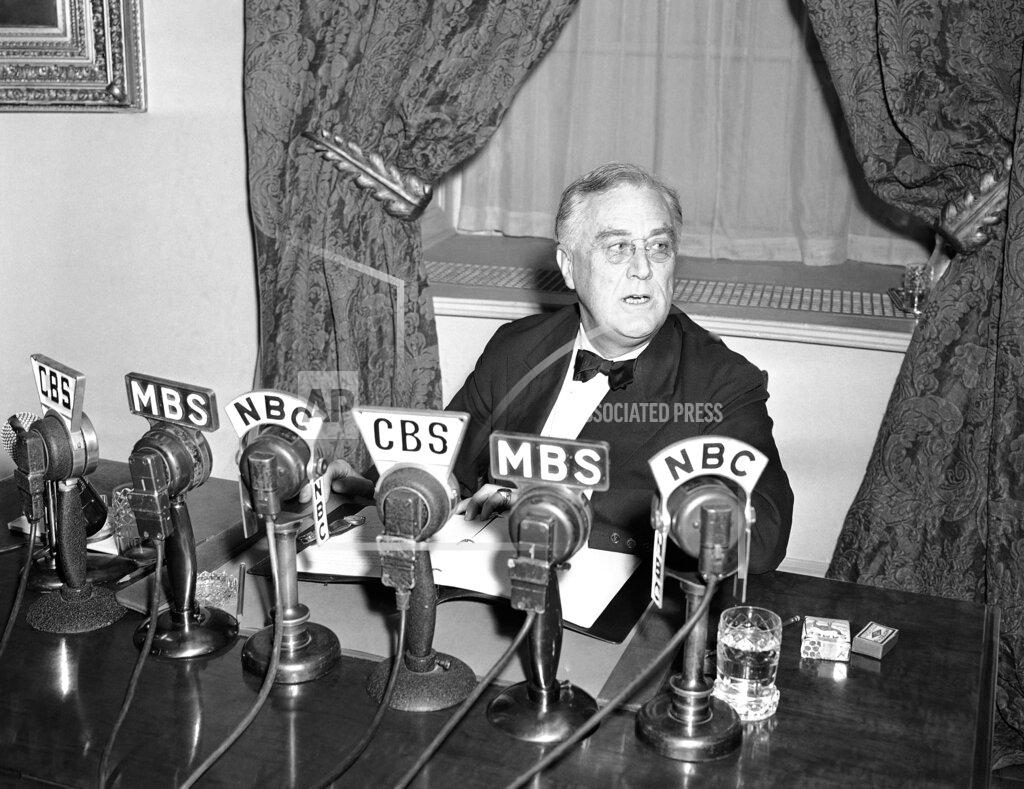
U.S. President Franklin D. Roosevelt was nominated for a third presidential term at the Democratic Party convention in Chicago. The President received some criticism for running again because there was an unwritten rule in American politics that no U.S. President should serve more than two terms. President Roosevelt informed a silent and intently listening Democratic convention tonight he accepted its tradition-shattering third-term nomination and asserted that in the face of “grave public danger,” his conscience would not let him ignore “a call to service.” But that, Mr. Roosevelt said, rested not with the party, but with the people as a whole and was subject to the national election in November which will have him pitted against Wendell L. Willkie, the Republican nominee. “If such a draft should be made upon me,” he said, referring to the election, “I say in the utmost simplicity, I will, with God’s help continue to serve with the best of my ability and with the fullness of my strength.”
FDR runs as a strict non-interventionist. He defends his decision to run by citing the current turmoil in the world:
“It is not an ordinary war. It is a revolution imposed by force of arms, which threatens all men everywhere. It is a revolution which proposes not to set men free but to reduce them to slavery — to reduce them to slavery in the interest of a dictatorship which has already shown the nature and the extent of the advantage which it hopes to obtain.”
Governor Culbert L. Olson of California, a candidate for the Democratic vice-presidential nomination, withdrew today in favor of Agriculture Secretary Wallace, whose nomination the Golden state executive seconded. Olson announced ho felt he should serve in the “capacity to which the (California) people elected me, because they did not elect anyone else for that purpose.” “It would be in the nature of yielding to temptations of ambition to allow myself to be drawn away from performance of my plain duties,” he said. A chorus of boos, mingled with cheers, greeted Olson’s speech seconding Wallace.
Secretary of Agriculture Henry A. Wallace was chosen to run for vice-president. The nomination came over the opposition of an antagonistic, booing and derisive minority who staged a prolonged demonstration against it. First they called for Paul V. McNutt and when he refused to stand as a candidate they turned to Speaker William B. Bankhead who early in the day had refused to follow the lead of Jesse Jones, McNutt, Sam Rayburn, Senator Byrnes and others and withdraw in order to clear the way for Roosevelt’s choice. It was not until the last three states had cast their ballots that defeat came for the revolt and victory for the president’s unrelenting insistence for Wallace. An acceptance speech Wallace had prepared for the convention remained undelivered. Because of the lateness of the hour, he explained, he changed previous plans to make the address before the convention adjourned. Wallace will formally accept the nomination later, probably at ceremonies nt Des Moines, Iowa, late this month.
Eight years after her husband shattered the tradition of the non-appearance of Presidential candidates before the conventions which nominated them, Mrs. Franklin D. Roosevelt, in the same hall and on the same platform, established another tonight, the first wife of a President or nominee ever to address a major political party conclave. Her talk was brief, her word was not the last word by many thousands in the convention record. But the message she brought and the tribute she got, of sustained silence, for an impressively delivered appeal for a united country, loomed as another peak in a turbulent evening.
She was introduced at 10:30 PM while the State delegations were at a fever heat over contests for the Vice Presidential nomination and before the President had addressed the assembly, because she was due to return East in a specially chartered plane tonight. She arrived just before sunset, in a plane which left New York at 2:45, with her son, Franklin D. Roosevelt Jr., as her only companion on the flight. She was, in effect, the deputy of the President to the convention in this city where he was nominated for the Presidency in 1932. She brought the news to the delegates that the President, who sent word earlier that he “had no wish to be a candidate,” did not plan a campaign, due to the heavy burden involved in the conduct of the nation’s affairs during the world crisis.
Describing as “sacred” the traditional limitation of two terms for a president, Senator Burke, Nebraska Democrat, publicly pledged his support to Wendell Willkie today and offered to lead a “campaign of education” against another four years for President Roosevelt. The Nebraska Democrat, long at odds with some new deal policies, made public a letter to the Republican presidential nominee which said: “As one who feels deeply that In the light of present world conditions it is essential for our country to maintain the two-term limitation on the tenure of office of president, I shall work for your victory at the polls in November.”
The War Department disclosed today formation of an experimental unit of parachute troops and plans to train air corps bombardment crews in mass. Secretary Stimson announced a test platoon of two officers and 48 men, chosen from 29th infantry volunteers at Fort Benning, Georgia, would undergo parachute training from July 29 through August 3 at the Safe Parachute company, Highstown, New Jersey, near Fort Dix. Army air corps men and parachute company representatives will instruct the men.
The most definite indications to date that the Administration seeks legal means of keeping from the French Government at Vichy the French assets frozen in this country by Executive order were given today by Secretary of the Treasury Henry Morgenthau Jr.
The musical comedy film “The Boys from Syracuse” premiered in Syracuse, New York.
Major League Baseball:
A triple play and three walks off Jackie Wilson in the final frame help the Tigers top the Red Sox, 10–8, and return to first place. Rudy York and Barney McCosky each have 4 hits for Detroit. The Red Sox might want a mulligan when, in the 11th, the first two batters single to bring up Ted Williams, who lays down a successful sacrifice bunt. Two out follow and Boston loses.
The Browns broke their own record for consecutive defeats today, losing to the Athletics for their fourteenth straight setback as the A’s pound 5 pitchers for 17 hits to win, 10–3. The longest previous losing streak by the Browns was in 1936 when they lost thirteen in a row. The Athletics scored in every inning but the eighth. Johnny Babich held the Browns to five hits in recording his eighth victory against seven defeats. He retired the Browns in order in the last four innings.
At Yankee Stadium, Buddy Rosar’s first inning grand slam, off Al Milnar, jump starts the Yankees to a 9–6 win over Cleveland. Finding the Indians still reeling from their thirteen-inning setback of the day before, the Yankees landed on the Clevelanders early and often yesterday to encompass the fifth setback in a row for the Indians, who fell into second place.
The surprising Senators captured their fifth straight victory today, rallying to produce two runs in the eighth inning to defeat Chicago, 5–4. Edgar Smith, relieving Jack Knott on the mound for Chicago after Gerald Walker and Cecil Travis had singled to place the tying run on third base in the eighth, saw Buddy Myer lay down a neat bunt to score Walker. Smith then walked Jimmy Pofahl and Rick Ferrell, forcing in Travis with the winning run.
Carl Hubell, pitching for the first time at night, holds the Pirates to six hits as the Giants down Pittsburgh, 6–1. Frank Demaree has a triple and a double for New York, and Harry Danning had a triple and two singles.
In the second game of their series with the Cubs at Wrigley Field today the Dodgers again steam-rollered Chicago, 7–4, to make it two triumphs in a row. Vitautas Tamulis got the win in relief for Curt Davis.
Detroit Tigers 10, Boston Red Sox 8
Brooklyn Dodgers 7, Chicago Cubs 4
Cleveland Indians 6, New York Yankees 9
St. Louis Browns 3, Philadelphia Athletics 10
New York Giants 6, Pittsburgh Pirates 1
Chicago White Sox 4, Washington Senators 5
Promising “realistic” treatment of “immediate problems of economic and political security” facing the Western Hemisphere as a result of Nazi victories in Europe, Secretary of State Cordell Hull and his staff entrained this afternoon for the trip to Havana and the Pan-American conference.
Chile termed the Spanish Nationalist Government “usurpers” in a reply today to Spain’s breaking off diplomatic relations and declared the reasons given for the action “represent undue meddling in the internal policy of Chile.”
The U.S. Navy heavy cruisers USS Wichita (CA-45), under command of Rear Admiral Andrew C. Pickens, and USS Quincy (CA 39) departed Santos, Brazil, to pay a return call at Rio de Janeiro, Brazil. The light cruiser USS Phoenix (CL-46) departed Valparaiso, Chile, for Callao, Peru. These ships were visiting South America “to furnish a reminder of the strength and the range of action of the armed forces of the United States.”
Prime Minister Winston Churchill put his seal on the British negotiations with Japan by announcing in the House of Commons today that an agreement had been reached whereby the Burma road would be closed for three months to the transit of arms, ammunition, gasoline, trucks and railroad supplies for China. The British government announced that it was closing the Burma Road and Hong Kong for the transit of war supplies to China in hopes that it would lead to better relations with Japan: “Continuance of transit of these materials was represented as having a serious effect on Anglo-Japanese relations… What we have therefore made is a temporary agreement in the hope that the time so gained may lead to a solution just and equitable to both parties of the dispute and freely accepted by them both.”
Monsoon season is beginning in Asia, which will curtail military operations and make supply from the outside difficult. This makes the closing of the Burma Road supply route of less consequence than if it happened at another time of year.
With Prince Fumimaro Konoe’s selection of Yosuke Matsuoka as Foreign Minister the general character of the new Cabinet’s diplomacy can be estimated. It will be less cautious and less conservative than before and more responsive to the army’s desire to employ all means whereby a settlement in China can be hastened. Ingenuity and determination will be shown in utilizing Britain’s difficulties to advance Japan’s pressing need of peace in China. The risk of impulsive action will be greater than before. Since France’s capitulation the Japanese press has been showing increasing, sometimes contemptuous, disregard of the United States. The war in China began during Prince Konoe’s first Premiership and the Japanese press occasionally says that since he was responsible for starting the war it is his duty to finish it.
Dow Jones Industrial Average: 123 (+0.18)
Born:
James Brolin, American actor (“Marcus Welby, M.D.”, “Hotel”), producer and director, in Los Angeles, California;.
Joe Torre, MLB catcher, first baseman, and third baseman (NL MVP & batting champion, 1971; All Star, 1963-1967, 1970-1973; Milwaukee-Atlanta Braves, St. Louis Cardinals, New York Mets), manager (Hall of Fame, inducted 2014; World Series Champions-New York Yankees 1996, 1998–2000) and executive, in Brooklyn, New York, New York.
Peter Mutharika, President of Malawi (2014-2020), in Chisoka, Thyolo, Nyasaland.
Naval Construction:
The Royal Navy Bangor-class (Turbine-engined) minesweeper HMS Polruan (J 97) is launched by Ailsa Shipbuilding Co. Ltd. (Troon, Scotland).
The Kriegsmarine (German Navy) Type VIIC U-boat U-95 is launched by F. Krupp Germaniawerft AG, Kiel (werk 600).
The Royal Canadian Navy Flower-class corvette HMCS Wetaskiwin (K 175) is launched by Burrard Dry Dock Co. Ltd. (Vancouver, British Columbia, Canada).
The Royal Navy Hunt-class (Type I) escort destroyer HMS Cotswold (L 54) is launched by Yarrow Shipbuilders Ltd. (Scotstoun, Scotland).
The Royal Navy ASW trawler HMS St. Zeno (FY 280) is commissioned. Her first commanding officer is Lieutenant Commander (retired) Leslie Hugh Moorhouse, RNR
 History Diaries