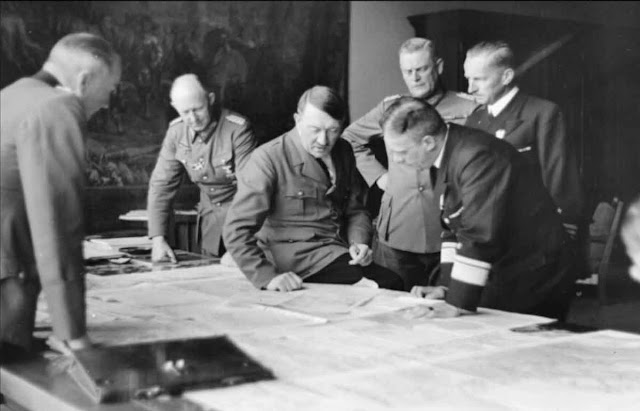
German Chancellor Adolf Hitler issued Führer Directive No. 16 ordering preparations to begin for Unternehmen Seelöwe (Operation Sealion,) the seaborne invasion of England, to be completed by mid-August.
The Führer And Supreme Commander Of The Armed Forces.
The Führer’s Headquarters. 16th July, 1940. 7 copies
Directive No. 16 — On Preparations For A Landing Operation Against England
Since England, in spite of her hopeless military situation, shows no signs of being ready to come to an understanding, I have decided to prepare a landing operation against England, and, if necessary, to carry it out.
The aim of this operation will be to eliminate the English homeland as a base for the prosecution of the war against Germany and, if necessary, to occupy it completely.
I therefore order as follows:
- The landing will be in the form of a surprise crossing on a wide front from about Ramsgate to the area west of the Isle Of Wight. Units of the Airforce will act as artillery, and units of the Navy as engineers. The possible advantages of limited operations before the general crossing (for example, the occupation of the Isle Of Wight or of the county of Cornwall) are to be considered from the point of view of each branch of the Armed Forces and the results reported to me. I reserve the decision to myself. Preparations for the entire operation must be completed by the middle of August.
- These preparations must also create such conditions as will make a landing in England possible, namely: (a) The English Airforce must be so reduced morally and physically that it is unable to deliver any significant attack against the German crossing. (b) Mine-free channels must be cleared. (c) The Straits of Dover must be closely sealed off with minefields on both flanks; also the western entrance to the Channel approximately on the line Alderney-Portland. (d) Strong forces of coastal artillery must command and protect the forward coastal area. (e) It is desirable that the English Navy be tied down shortly before the crossing, both in the North Sea and in the Mediterranean (by the Italians). For this purpose we must attempt even now to damage English home-based naval forces by air and torpedo attack as far as possible.
- Command Organisation And Preparations. Under my overriding command and according to my general instructions, the Commanders In Chief will command the branches of the Armed Forces for which they are responsible. From 1st August the Operations Staffs of Commander In Chief Army, Commander In Chief Navy, and Commander In Chief Airforce are to be located at a distance of not more than 50 kilometres from my Headquarters (Ziegenberg). It seems to me useful that the inner Operations Staffs of Commander In Chief Army and Commander In Chief Navy should be placed together at Giessen. Commander In Chief Army will detail one Army Group to carry out the invasion. The invasion will bear the covername Seelöwe — SEA LION. In the preparation and execution of this operation the following tasks are allotted to each Service: (a) Army: The Army will draw up the operational and crossing plans for all formations of the first wave of the invasion. The antiaircraft artillery which is to cross with the first wave will remain subordinate to the Army (to individual crossing units) until it is possible to allocate its responsibilities between the support and protection of troops on the ground, the protection of disembarkation points, and the protection of the airfields which are to be occupied. The Army will, moreover, lay down the methods by which the invasion is to be carried out and the individual forces to be employed, and will determine points of embarkation and disembarkation in conjunction with the Navy. (b) Navy: The Navy will procure the means for invasion and will take them, in accordance with the wishes of the Army, but with due regard to navigational considerations, to the various embarkation points. Use will be made, as far as possible, of the shipping of defeated enemy countries. The Navy will furnish each embarkation point with the staff necessary to give nautical advice, with escort vessels, and with guards. In conjunction with air forces assigned for protection, it will defend the crossing of the Channel on both flanks. Further Orders will lay down the chain of command during the crossing. It is also the task of the Navy to coordinate the setting up of coastal artillery — that is, all artillery, both naval and military, intended to engage targets at sea — and generally to direct its fire. The largest possible number of extra-heavy guns will be brought into position as soon as possible in order to cover the crossing and to shield the flanks against enemy action at sea. For this purpose railway guns will also be used (reinforced by all available captured weapons) and will be sited on railway turntables. Those batteries intended only to deal with targets on the English mainland (K5 and K12) will not be included. Apart from this the existing extra-heavy platform gun batteries are to be enclosed in concrete opposite the Straits Of Dover in such a manner that they can withstand the heaviest air attacks and will permanently, in all conditions, command the Straits Of Dover within the limits of their range. The technical work will be the responsibility of the Organisation Todt. (c) The Task Of The Airforce Will Be: To prevent interference by the enemy Airforce. To destroy coastal fortresses which might operate against our disembarkation points, to break the first resistance of enemy land forces, and to disperse reserves on their way to the front. In carrying out this task the closest liaison is necessary between individual Airforce units and the Army invasion forces. Also, to destroy important transport highways by which enemy reserves might be brought up, and to attack approaching enemy naval forces as far as possible from our disembarkation points. I request that suggestions be made to me regarding the employment of parachute and airborne troops. In this connection it should be considered, in conjunction with the Army, whether it would be useful at the beginning to hold parachute and airborne troops in readiness as a reserve, to be thrown in quickly in case of need.
- Preparations to ensure the necessary communications between France and the English mainland will be handled by the Chief, Armed Forces Signals. The use of the remaining eighty kilometres of the East Prussia cable is to be examined in cooperation with the Navy.
- I request Commanders In Chief to submit to me as soon as possible: (a) The plans of the Navy and Airforce to establish the necessary conditions for crossing the Channel (see paragraph 2). (b) Details ff the building of coastal batteries (Navy). (c) A general survey of the shipping required and the methods by which it is proposed to prepare and procure it. Should civil authorities be involved? (Navy). (d) The organisation of Air Defence in the assembly areas for invasion troops and ships (Airforce). (e) The crossing and operation plan of the Army, the composition and equipment of the first wave of invasion. (f) The organization and plans of the Navy and Airforce for the execution of the actual crossing, for its protection, and for the support of the landing. (g) Proposals for the use of parachute and airborne troops and also for the organisation and command of antiaircraft artillery as soon as sufficient English territory has been captured. (h) Proposals for the location of Naval and Air Headquarters. (i) Views of the Navy and Airforce whether limited operations are regarded as useful before a general landing, and, if so, of what kind. (k) Proposal from Army and Navy regarding command during the crossing.
(signed) Adolf Hitler.
Inside the Wehrmacht, there is low confidence in a successful conclusion to the Battle of Britain. The Chief of the Luftwaffe Operations Staff, Oberst “Beppo” Schmid, submits a sober appraisal that suggests an aerial campaign alone cannot subjugate England; the only feasible strategy is to choke off British aircraft replacements by bombing aircraft factories and sealing off the convoy routes with U-boats, followed by an actual invasion.
British radar also is becoming a major problem, not mentioned in Schmidt’s report but recognized by the Luftwaffe commanders as a decisive British advantage. Overall, Schmidt’s report concludes that the only hope of victory is a full-scale invasion, though Schmidt sees the prospect of successful daylight operations which can be “decisive.” The report smacks of this kind of false optimism that plays well in command chains such as the Wehrmacht’s, but the overall conclusions strongly imply the impossibility of the whole project under current circumstances. Hitler issues his directive after reading these very serious and real problems, and this perhaps explains his own waffly tone.
Battle of Britain: Luftwaffe air activity was greatly reduced, apparently owing to unfavorable weather conditions. The few hostile raids that were carried out were probably meteorological reconnaissance and searching for shipping. In the early evening bombs were dropped on two points in northeast Scotland and one of the raiders shot down. Off the South and South West coasts activity remained slight, but in the evening a raid appeared off the Isle of Wight, and two enemy aircraft were shot down into the sea. [battleofbritain1940 web site]
Weather: The weather in this period played an important part in activities during this time. One day it was heavy fog, not clearing until about midday, another day it was very dull with occasional heavy rain, then when things started to brighten up, the cloud rolled in again and rain became widespread. Low cloud, fog, and heavy rain kept German aircraft grounded until the early afternoon.
Operations were according to the weather pattern. There are scattered attacks in the Bristol area in the morning, and in the early afternoon, there are attacks on Fraserburgh and Peterhead, Scotland, with RAF No. 603 Squadron Spitfires shooting down a Heinkel He 111 from III,/KG26.
Late in the afternoon when clearing conditions prevailed, 601 Squadron (Spitfires) intercepted an enemy formation and a Ju88 was shot down over the Isle of Wight. Again the east coast of Scotland came under attack and bombing occurred at Fraserburgh and Peterhead and 603 Squadron Dyce (Spitfires) shot down one He111.
Activity during the night remained very quiet. Dundee, Middlesbrough, Five or six raids were plotted between Newcastle and the Humber, some of which were probably minelaying, and a few crossed the coast.
The Luftwaffe formations on the Channel coast are becoming depleted. III,/JG51 (Hptm. Hannes Trautloft) is at 40% capability. Some of the formations sent back to Germany for rest and refit, such as JG26, are filtering back and taking up the slack.
RAF Statistics for the day: 119 patrols were flown involving 447 aircraft. Luftwaffe casualties: Fighters – none; Bombers – 2 confirmed,. RAF casualties: none.
RAF Casualties: July 16th 1940
0050hrs: Church Fenton. Hurricane P2995. 249 Sqn Church Fenton. (Aircraft destroyed)
Sgt A.D.W. Main. Killed. (Engine cut out during take off from base airfield)
RAF No. 232 Squadron, composed of Hurricanes, is formed today.
RAF Bomber Command dispatches 15 Blenheims to attack airfields and barges in Belgium and the Netherlands. 1 lost. 2 further Blenheims on photographic reconnaissance to Dortmund-Ems Canal turned back.
Luftwaffe conducts minelaying operations in Thames estuary and along British coast.
Italian air force attacks Matruh and Sidi Barrani with 30 SM-79 bombers.
At Malta, the RAF intercepts a formation of Fiat CR42s. Flight Lt. Peter Keeble goes up in his Hurricane to intercept as usual but is shot down and killed. Keeble is the first RAF pilot to lose his life in the Mediterranean and his death leaves the island’s slight fighter defenses gravely weakened.
Italian air force attacks Alexandria, Egypt, with twelve S-81 bombers overnight.
Italian bombers attacked the British base at Haifa, British Mandate of Palestine.
Vichy France revoked the French citizenship of naturalized Jews.
22,000 Jewish French citizens were forcibly deported to France. Jews in the Alsatian city of Colmar were pushed across the new border into France.
Liquidations by the Germans continue in Poland. Twenty Poles are murdered today in Olkusz. Despite the local German authorities concluding that the incident was criminal and not political, higher German authorities decided to carry out a collective punishment reprisal action to intimidate the Polish inhabitants. The German terror against the local population was aimed at the planned Germanisation of the town and the region. An expeditionary force of Schutzstaffel arrived in the town early on July 16. All German inhabitants were ordered to gather in the town square. Shortly afterward Germans burned down Łapiński’s villa (initially they considered burning down all the houses on the same street, but were convinced to reduce the collateral damage by the arguments of a local interpreter). Shortly after, Germans arrested a number of Polish citizens of the city (Teofil Jurczyk, Wawrzyniec Kulawik, Stanisław Luboń, Jerzy Stroński and Józef Strzelecki). They were gathered together with fifteen Polish prisoners transported from nearby prisons in Mysłowice and Sosnowiec, and around 8:00 PM. all twenty were executed by a firing squad near the Łapiński’s villa. Their burial place remains unknown. The names, and most occupations and family histories of the victims, have been identified; none of the victims have been described as of Jewish ethnicity.
London increasingly is taking on the appearance of an armed camp, with sandbags, barbed wire, and street barriers. So far, though, Luftwaffe attacks on the city itself have been minimal in relation to what might be happening.
Not only is public opinion on the war not as monolithic in England as later accounts would suggest, but a sense of fatalism is also descending in some quarters. Many people welcome a good fight. Novelist George Orwell sends a letter to James Laughlin today which encapsulates such thinking:
“We are all on our toes waiting for an invasion which quite possibly won’t happen. Personally I am much more afraid of Hitler mopping up north Africa and the near East and then making a peace offer. I actually rather hope that the invasion will happen. The local morale is extremely good, and if we are invaded we shall at any rate get rid once and for all of the gang who had got us into this mess.”
Labour Minister Hugh Dalton also is thinking along such lines, but with a different outlook. He is forming a new secret anti-German British guerilla organization somewhat similar to the SS organization Werwolf of later years. Dalton himself likens it to Irish terrorist group Sinn Fein.
Hugh Dalton was appointed the political chief of the British Special Operations Executive.
William Donovan arrives in London by air from the U.S. for meetings with wide range of British officials.
British and Australian warships bombarded Bardia, Libya.
Spanish agents met with the Duke of Windsor, the former King Edward VIII of the United Kingdom, and warned him that his fellow countrymen were sending him to be the governor of the Bahamas to remove him from power.
The Duke and Duchess of Windsor have booked passages today by clipper for New York and are expected to fly on from there to the Bahamas by special airplane immediately on their arrival.
Francoist Spain broke off diplomatic relations with Chile.
U-61, commanded by Oberleutnant zur See Jürgen Oesten, badly damaged tanker Scottish Minstrel from convoy HX.55 in 56-10N, 10-20W. At 1223 hours the Scottish Minstrel (Master Peter Dunn) in convoy HX-55 was hit by one G7e torpedo from U-61 about 130 miles northwest of Bloody Foreland. The tanker caught fire and remained afloat after the hit, but sank the next day. Nine crew members were lost. The master and 31 crew members were picked up by HMS Gardenia (K 99) (LtCdr T.A.O. Ellis, RNR) and landed at Folkestone. The 6,998-ton Scottish Minstrel was carrying fuel oil and was headed for London, England.
The Admiralty reports that thirteen British merchant ships were lost during the week ending 7 July 1940.
Destroyers HMS Firedrake and HMS Echo departed Reykjavik at 1030 with liners Ormonde (14,982grt) and Ulster Prince (3791grt) for the Clyde where they arrived on the 18th at 0500.
British Force C, heavy cruisers HMS Sussex, HMS Shropshire, light cruisers HMS Southampton (Vice Admiral CS 18), HMS Glasgow, and destroyers HMS Cossack (D.4), HMS Sikh, HMS Zulu, HMS Maori, HMS Fury, HMS Fortune, HMS Inglefield (D.3), and HMS Imogen departed Scapa Flow at 1030 to attack German ships off Denmark. The force swept southeast until 1543 when the course was reversed due to negative air reports. HMS Shropshire was detached at 2315 for the Clyde for refitting. At 2355 on the 16th, off Duncansby Head in Pentland Firth in 58-34N, 02-54W, HMS Glasgow accidentally collided with HMS Imogen (Cdr C. L. Firth MVO) in heavy fog. Imogen’s fuel tanks caught fire and the ship had to be abandoned. The destroyer was not seen to sink. Seventeen ratings were lost, while Glasgow rescued ten officers and 123 ratings. Temporary Surgeon Lt J. W. Ashley RNVR, and ten ratings were injured, and one ratings later died of injuries. Glasgow had a six foot gash in her port side 60 feet back from the bow above the water line. Midshipman E. J. M. Lucas and one rating were lost in her. She arrived at Scapa Flow at 0936 with Southampton, with Sussex arriving at 1050/17th. Cossack, Sikh, Maori, Zulu, Fury, Fortune, and Inglefield arrived at Scapa Flow at 1750 after searching for Imogen’s hulk. Stromna Light House keepers had reported a ship drifting westward in Pentland Firth. Destroyer HMS Atherstone departed Scapa Flow at 1445 on the 18th to search south of Stromna, but returned to Scapa Flow that evening at 1650 after failing to locate her.
HMS Glasgow departed Scapa Flow at 1800/19th with destroyers HMS Inglefield, HMS Ashanti, and HMS Mashona. Off Cape Wrath, destroyer HMS Diana joined while Ashanti and Mashona returned to Scapa Flow arriving at 0457 on the 20th. Glasgow arrived at Liverpool escorted by Inglefield and Diana at 1200/21st for repairs completed on 4 September.
Battleship HMS Nelson with destroyers HMS Bedouin, HMS Mashona, and HMS Punjabi arrived at Scapa Flow at 1640 after full caliber firings.
Submarine HMS Phoenix (Lt Cdr G. H. Nowell) unsuccessfully attacked Italian escort ship Albatros off Augusta and was sunk in the counterattack. Lt Cdr Nowell, Lt G. A. Liversidge, Lt M. G. Henderson, A/Lt K. Barkley, Warrant Engineer F. Pegler, and the fifty ratings of the crew were lost.
Cable ship HMS Mirror departed Gibraltar, escorted by destroyer HMS Foxhound, to cut to Fayal-Malaga cable and join the Fayal end to Gibraltar. She later returned to Gibraltar and sailed again on the 19th, escorted by destroyer HMS Wrestler to continue the work. The work continued on the 21st with Mirror escorted again by Wrestler, which was later relieved by destroyer HMS Vidette.
German armed merchant cruiser Thor sank steamer Wendover (5487grt) in the South Atlantic at 23-08S, 34-49W. Four crew were killed, while 36 crew and one gunner were made prisoners of war.
Heavy cruiser HMS Dorsetshire departed Freetown to search for a German naval unit in the South Atlantic.
Convoy FN.224 departed Southend, escorted by destroyer HMS Woolston, sloop HMS Fleetwood, and patrol sloop HMS Shearwater. The patrol sloop was detached later that day. On the 17th, destroyers HMS Javelin and HMS Jupiter covered the convoy, and arrived at the Tyne 18 July.
Convoy MT.112 departed Methil, and arrived in the Tyne on the 17th.
Convoy FS.223 departed the Tyne, and arrived at Southend on the 17th.
Convoy SL.40 departed Freetown escorted by armed merchant cruiser HMS Asturias. Armed merchant cruiser HMS Canton joined the convoy on 1 August, when convoy SLF.40 merged with SL.40. On 2 August, both merchant cruisers were detached and arrived at Greenock for fuel and water on 3 August. Asturias departed Greenock on 6 August to return to Freetown. On 2 August, sloop HMS Aberdeen joined the convoy. On 3 August, destroyer HMS Walker and corvette HMS Periwinkle and on 4 August, corvettes HMS Godetia and HMS Primrose joined, and arrived at Liverpool on 8 August.
The War at Sea, Tuesday, 16 July 1940 (naval-history.net)
Destroyers FIREDRAKE and ECHO departed Reykjavik at 1030 with liners ORMONDE (14,982grt) and ULSTER PRINCE (3791grt) for the Clyde where they arrived on the 18th at 0500.
British Force C, heavy cruisers SUSSEX, SHROPSHIRE, light cruisers SOUTHAMPTON (Vice Admiral CS 18), GLASGOW, and destroyers COSSACK (D.4), SIKH, ZULU, MAORI, FURY, FORTUNE, INGLEFIELD (D.3), and IMOGEN departed Scapa Flow at 1030 to attack German ships off Denmark. The force swept southeast until 1543 when the course was reversed due to negative air reports. SHROPSHIRE was detached at 2315 for the Clyde for refitting.
At 2355 on the 16th, off Duncansby Head in Pentland Firth in 58‑34N, 02‑54W, GLASGOW accidentally collided with IMOGEN (Cdr C. L. Firth MVO) in heavy fog. IMOGEN’s fuel tanks caught fire and the ship had to be abandoned. The destroyer was not seen to sink. Seventeen ratings were lost, while GLASGOW rescued ten officers and 123 ratings. Temporary Surgeon Lt J. W. Ashley RNVR, and ten ratings were injured, and one rating later died of injuries.
GLASGOW had a six-foot gash in her port side 60 feet back from the bow above the water line. Midshipman E. J. M. Lucas and one rating were lost in her. She arrived at Scapa Flow at 0936 with SOUTHAMPTON, with SUSSEX arriving at 1050/17th.
COSSACK, SIKH, MAORI, ZULU, FURY, FORTUNE, and INGLEFIELD arrived at Scapa Flow at 1750 after searching for IMOGEN’s hulk.
Stromna Light House keepers had reported a ship drifting westward in Pentland Firth. Destroyer ATHERSTONE departed Scapa Flow at 1445 on the 18th to search south of Stromna, but returned to Scapa Flow that evening at 1650 after failing to locate her.
GLASGOW departed Scapa Flow at 1800/19th with destroyers INGLEFIELD, ASHANTI, and MASHONA. Off Cape Wrath, destroyer DIANA joined while ASHANTI and MASHONA returned to Scapa Flow arriving at 0457 on the 20th.
GLASGOW arrived at Liverpool escorted by INGLEFIELD and DIANA at 1200/21st for repairs completed on 4 September.
Battleship NELSON with destroyers BEDOUIN, MASHONA, and PUNJABI arrived at Scapa Flow at 1640 after full calibre firings.
Convoy FN.224 departed Southend, escorted by destroyer WOOLSTON, sloop FLEETWOOD, and patrol sloop SHEARWATER. The patrol sloop was detached later that day. On the 17th, destroyers JAVELIN and JUPITER covered the convoy, and arrived at the Tyne 18 July.
Convoy MT.112 departed Methil, and arrived in the Tyne on the 17th.
Convoy FS.223 departed the Tyne, and arrived at Southend on the 17th.
U-61 badly damaged tanker SCOTTISH MINSTREL (6998grt) from convoy HX.55 in 56‑10N, 10‑20W. Nine crew were lost and the survivors rescued by steamer FISCUS (4815grt). (Uboat.net – 32 survivors rescued by corvette GARDENIA). SCOTTISH MINSTREL sank on the 17th.
Submarine PHOENIX (Lt Cdr G. H. Nowell) attacked Italian escort ship ALBATROS off Augusta and was sunk in the counterattack. Lt Cdr Nowell, Lt G. A. Liversidge, Lt M. G. Henderson, A/Lt K. Barkley, Warrant Engineer F. Pegler, and the fifty ratings of the crew were lost.
Cable ship MIRROR departed Gibraltar, escorted by destroyer FOXHOUND, to cut to Fayal-Malaga cable and join the Fayal end to Gibraltar. She later returned to Gibraltar and sailed again on the 19th, escorted by destroyer WRESTLER to continue the work.
The work continued on the 21st with MIRROR escorted again by WRESTLER, which was later relieved by destroyer VIDETTE.
German armed merchant cruiser THOR sank steamer WENDOVER (5487grt) in the South Atlantic at 23‑08S, 34‑49W. Four crew were killed, while 36 crew and one gunner were made prisoners of war.
Heavy cruiser DORSETSHIRE departed Freetown to search for a German naval unit in the South Atlantic.
Convoy SL.40 departed Freetown escorted by armed merchant cruiser ASTURIAS. Armed merchant cruiser CANTON joined the convoy on 1 August, when convoy SLF.40 merged with SL.40. On 2 August, both merchant cruisers were detached and arrived at Greenock for fuel and water on 3 August.
ASTURIAS departed Greenock on 6 August to return to Freetown.
On 2 August, sloop ABERDEEN joined the convoy. On 3 August, destroyer WALKER and corvette PERIWINKLE and on 4 August, corvettes GODETIA and PRIMROSE joined, and arrived at Liverpool on 8 August.
The President’s message to the Democratic convention left 20,000 delegates and spectators speechless for fully five minutes tonight and then the weirdest demonstration in the history of American politics broke loose. As Senator Barkley told of the president’s message, the convention listened in bewilderment. It could not comprehend the meaning of his words. “The president has never had, and has not today, a desire or purpose to continue as president, to be a candidate for that office, or to be nominated by the convention for that office,” said Senator Barkley in measured words. “He wishes in all earnestness and sincerity to make it clear that all of the delegates to this convention are free to vote for any candidate.” Delegates and spectators looked at each other and gasped: “What does he mean?” But the third term strategy board knew what Mr. Roosevelt meant; it knew his words were an invitation to the convention to tender him the nomination and that if the nomination were tendered he would accept. “We want Roosevelt!” thundered a voice over the loudspeaker. “We want Roosevelt!” the voice repeated. The great organ and band began to thunder.
Clearing of the decks for nomination of President Roosevelt tomorrow evening for a third term in the White House tonight solidified the opposition, although there was no way of gauging its strength.
Complete agreement on all important provisions of the Democratic platform, particularly the declaration on foreign policy. was reported tonight by the resolution committee’s subcommittee of seventeen which had spent all day and most of the evening drafting the document. All factions were reticent to discuss what the platform contained, but Senators Wheeler of Montana and McCarran of Nevada claimed a victory for the strict non-interventionists on what the party would be asked to say about international relations and defense.
“It’s a good platform and there’ll be no minority plank,’ Senator Wheeler said. “It’s emphatic and satisfactory to me,” Senator McCarran said of the foreign affairs declaration. Mr. McCarran said that the proposal of himself and several others for a plank pledging the party against the principle of a third term for President would probably be dropped in view of Mr. Roosevelt’s views, as presented to the convention tonight by Senator Barkley. He took the position that the President himself had declared in favor of his (McCarran’s) position and there was no need to press the proposal further. No effort toward its adoption was made by the group in the subcommittee tonight.
Wendell L. Willkie, Republican presidential nominee, heard tonight the statement of Senator Alben W. Barkley to the Democratic national convention and then made this comment: “I’ll make the same prediction I made the other night, that the president will be nominated on the first ballot and that he will accept.”
Secretary of Agriculture Wallace and Louis Johnson, assistant secretary of war, were reported on high authority tonight to be acceptable to President Roosevelt as possible Democratic vice-presidential nominees. Word that Mr. Roosevelt would be satisfied with selection of either of these two members of his “official family” spread shortly after Johnson returned from Washington and a 10-minute private conference with the chief executive. Ostensibly the reports were not linked with the third term movement or the probability that Mr. Roosevelt himself may head the ticket. Rather it was Indicated that Mr. Roosevelt talked with Johnson in his capacity as head of the Democratic party.
A picture of how the National Advisory Defense Commission had cleared since July 6 contracts totaling $1,661,891,494 for the Army and Navy and of the progress made by the commission in developing its preparedness program was drawn by President Roosevelt today at his press conference. He read reports from each of the commission’s seven departments, giving the first details of what has been done toward mobilizing men, materials and machines in the $10,000,000,000 rearmament program. The reports had been presented to him at an earlier meeting with the commission and several members of the Defense Council of the Cabinet.
In reporting the total amount of contracts cleared, William S. Knudsen, chief of the commission’s production division, said that $1,390,575,404 was for the Navy and $271.316,089 for the Army. The contracts were for airplanes, tanks, battleships, ammunition, anti-tank guns, anti-aircraft searchlights, machine guns, various fire-control precision instruments, tractors, trucks, blankets, overcoating, serge cloth, worsted shirting, service shoes, ship propulsion machinery, storage batteries for submarines, airport and air station construction, barracks and many other items. “Evidence has developed indicating progress toward solution, for the time being at least, of the bottlenecks in the machine tool industry,” Mr. Knudsen reported. “The embargo authority has contributed substantially to the retention in this country of vital machine tool units which otherwise would have been exported.”
Major League Baseball:
The Giants out-hit the Cubs, 6 to 4, with three of the blows good for two-baggers, but could not score, as the Cubs won, 2–0. The Giants hit into four double plays. As for the Cubs, opportunity really knocked only once at their door, but they almost knocked the door down to capitalize on it. With the bases full in the seventh, Phil Cavarretta sliced a weak-looking single to left for the only hit of the inning. But the puny poke scored two runs and that decided the ball game.
Enos Slaughter’s second home run of the game and tenth of the year in the sixth inning today broke a tie and gave the Cardinals a 4–3 victory over the Bees. It was the sixth consecutive triumph for the Cards and gave them a sweep of the four-game series. Sebastian Sisti of Boston hit the first ball pitched by southpaw Clyde Shoun for a home run. Johnny Mize’s twenty-fourth of the season came in the fourth right after Slaughter’s ninth.
The Pirates came from behind with three runs in the sixth to tie, then two more in the eighth, to beat the Dodgers, 5–3. Johnny Lanning (3–1) got the win; Tot Pressnel took the loss. Bob Elliott had a single and a triple, both of which drove in runs.
The Yankees arrived at the halfway mark in their campaign yesterday, but it was just another off-day for them. Johnny Rigney set them down with only six hits, while the Chicago White Sox ripped Marius Russo for twelve and a 5–1 victory. Joe Kuhel homered for the second straight day for the Sox.
Paced by George Caster’s six-hit pitching, the Philadelphia Athletics beat the Tigers, 3–1, today for their third triumph in the four-game series. However, Detroit held first place, as the Indians also lost. Freddy Hutchinson,, making his first start for the Tigers since his recall from Buffalo, allowed only six hits, but Philadelphia bunched three with Pinky Higgins’s error in the third to score two runs. Sam Chapman added the third run with his thirteenth circuit clout in the eighth.
Cleveland’s pitchers presented the Senators with four bases on balls, filling the sacks for them twice, all in the same inning today as Washington won an 11–8 victory and swept the three-game series. Five Indian pitchers failed to hold the Senators. The big inning was the sixth, which Washington entered with a 17–2 deficit and came out of with a 9–7 lead.
New York Giants 0, Chicago Cubs 2
Chicago White Sox 5, New York Yankees 1
Detroit Tigers 1, Philadelphia Athletics 3
Brooklyn Dodgers 3, Pittsburgh Pirates 5
Boston Bees 3, St. Louis Cardinals 4
Cleveland Indians 8, Washington Senators 11
The United States, siding with China, let Japan and Britain know today that it opposed the threatened closing of the Burma Road over which most of the arms now move to the hard-pressed Chinese forces for their war with Japan. A formal statement from the state department said, “This government has a legitimate interest in the keeping open of arteries of commerce in every part of the world and considers that, action such as this, if taken, and such as was taken recently in relation to the Indo-China railway, would constitute unwarranted interpositions of obstacles to world trade.” Secretary of State Cordell Hull took direct issue with Great Britain and Japan today over the proposed closing of the Burma route for supplies to China, serving notice through a statement issued by the State Department of opposition to the closing of the road. Whether this means that steps may be taken to support this opposition or only that the United States is merely giving notice that she does not acquiesce in the stopping of essential traffic over the road will become known only as events unfold.
The Japanese navy announced today it had opened operations early this morning against the Hangchow Bay area with warships, marines and aircraft. The area concerned includes the important treaty port of Ningpo through which extensive trade has been maintained with the Chinese territory governed by Generalissimo Chiang Kai-shek’s regime.
Japanese Prime Minister Yonai Mitsumasa resigned because of military pressure. War Minister General Hata Shunroku forced Yonai’s hand by resigning because he thought renovation necessary. A new government was formed under Prince Konoye Fumimaro along totalitarian lines. The new prime minister set up the new government to implement a policy of national consolidation and defense. This is a major step toward a much more militaristic Japan (not that it already hasn’t been militaristic for the past decade).
54 Japanese aircraft based in Wuhan, Hubei Province, China attacked Chungking, China in two waves; 31 Chinese fighters (I-15bis, I-16, and Hawk III models) rose to intercept, claiming damage on several bombers.
New Zealand Prime Minister Fraser announces his War Cabinet.
Dutch Army begins forming local guard units in Netherlands East Indies.
Dow Jones Industrial Average: 123.12 (+1.4)
Born:
Jim Cadile, NFL guard and tackle (NFL Champions-Bears, 1963; Chicago Bears), in San Jose, California.
Tom Metcalf, MLB pitcher (New York Yankees), in Amherst, Wisconsin.
Naval Construction:
The Royal Navy “S”-class (Third Group) submarine HMS Saracen (P 247) is laid down by Cammell Laird Shipyard (Birkenhead, U.K.).
The Royal Navy Hunt-class (Type II) escort destroyer HMS Dulverton (L 63) is laid down by A. Stephen & Sons Ltd. (Glasgow, Scotland).
The Royal Navy Hunt-class (Type I) escort destroyer HMS Whaddon (L 45) is launched by A. Stephen & Sons Ltd. (Glasgow, Scotland).
 History Diaries