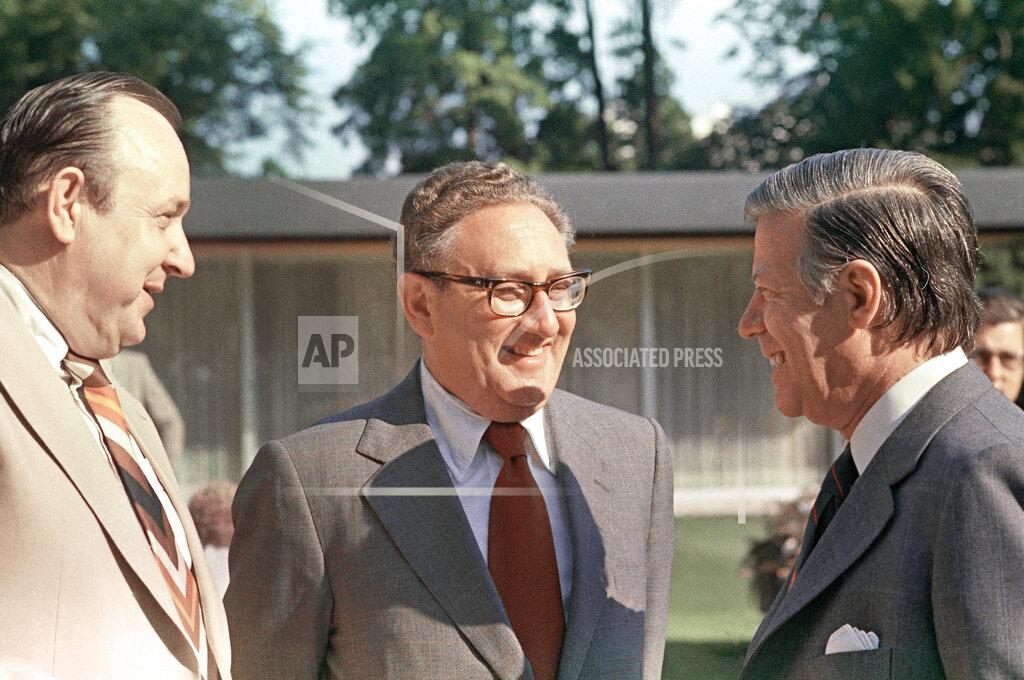
Secretary of State Kissinger flew to Bonn today after completing talks in Geneva with the Soviet Foreign Minister, Andrei A. Gromyko, which he said produced “progress” on a nuclear arms pact. Both Americans and Russians confirmed that Moscow had accepted the principle of direct inspection of nuclear explosions conducted under the provisions of a planned “nuclear threshold treaty.” The treaty would set 150 kilotons — the equivalent of 150,000 tons of TNT — as the ceiling on underground weapons tests, although explosions for peaceful purposes could be higher if the United States could verify that they were really nonmilitary. The Hiroshima bomb had a force of 20 kilotons. The ceiling would not inhibit the kind of weapons tests both sides have been interested in for the production of smaller weapons. Mr. Gromyko told newsmen yesterday that an “understanding” had been worked out with the United States for on‐site inspection of explosions. On Mr. Kissinger’s plane to Bonn, it was explained that the Russians had actually accepted this principle for peaceful nuclear explosions during last year’s Nixon‐Brezhnev meeting in Moscow and that it had been confirmed recently.
Prime Minister Harold Wilson, in an address to the House of Commons, proposed a series of measures that would limit wage increases for nearly 25 million British workers, both public and private, to $13.20 a week for the next year at least. The wage controls, it was hoped, would cut Britain’s 25 percent rate of inflation to 10 percent. The $13.20 limit would be an average wage increase of 10 percent, about one-third of the wage settlements made earlier this year that frightened foreign investors and weakened the pound.
The House International Relations Committee voted 16 to 11 today to approve a bill today that would end the embargo on sales of American arms to Turkey. The bill would release to Turkey $184.9‐million worth of arms, including fighter planes, guns, ships, trucks, communications equipment and ammunition. Turkey has already paid for nearly $53‐million of the arms, blocked last February 5 by a Congressional ban as retaliation for Turkish use of American weapons in the invasion of Cyprus last summer. In committee hearings on the measure yesterday, under Secretary of State Joseph J. Sisco testified that Greece had also sent American‐supplied weapons to Cyprus.
Portugal’s Socialist party followed up its resignation from the coalition Government today by serving notice that it would not be shunted aside from the revolution. The reason, the Socialist leader, Mario Soares, said at a news conference, is that “it is the majority party in the country.” Mr. Soares, calling on the military rulers to respect popular suffrage as the essential element of democracy, said that the fundamental question was whether the military would seek to govern with minority groups that were backed at most by 18 percent of the electorate.
John D. Hemenway, a former foreign service officer who has been a critic of the State Department, was elected the new president of the American Foreign Service Association today. In a clear protest vote against the foreign policy establishment in Washington, the association elected Mr. Hemenway by a narrow margin over two other candidates, one the nominee of the current board of the association, and the other a retired ambassador. Mr. Hemenway who has regularly assailed the State Department’s personnel policies before Congressional committees, waged an independent campaign to win votes from the members of the association, which is the legal bargaining agent for the 12,000 employes of the State Department, the United States Information Agency and the Agency for International Development.
Secretary of State Kissinger flew to Bonn tonight for talks with Israel’s Premier, Yitzhak Rabin, on issues holding up a new Israeli‐Egyptian agreement on troop withdrawals in Sinai. Reporters traveling on the Secretary’s plane were told that Mr. Kissinger planned to give specific answers tomorrow to Mr. Rabin’s requests for clarification of the Egyptian response to an Israeli disengagement proposal. The Secretary reportedly will also try to obtain from Mr. Rabin a clarification of what Israel can agree to before he goes back to the Egyptians. Mr. Rabin’s Cabinet postponed a decision on whether to make the territorial concessions the Egyptians asked for, through Mr. Kissinger, until the Premier returned to Israel. He finished an official visit to West Germany today. Mr. Kissinger arrived here from two days of talks in Geneva with Foreign Minister Andrei A. Gromyko of the Soviet Union.
Anonymous donors distributed an estimated 12 tons of food in an impoverished section of Beirut, apparently in an attempt to achieve the release of a United States Army colonel, Ernest Morgan, who was kidnapped on June 29 by a group describing itself as the Revolutionary Socialist Action Organization.
The Ford administration informed key members of Congress that it would sell Jordan an air-defense system costing about $350 million, more than three times the cost estimated in May when it was announced that the United States would sell Hawk ground-to-air missiles to Jordan. There was no explanation for the larger figure. The proposed sale brought expressions of concern on Capitol Hill, and there was talk of whether the sale would be permitted.
The police in India arrested two Communist leaders during demonstrations protesting Prime Minister Indira Gandhi’s state‐of‐emergency decree, according to opposition sources. The sources said yesterday that a block of opposition parties led by the pro‐Peking ComMiinist party marched through cities in the southern state of Kerala Wednesday in defiance of the decree, which bans demonstrations. The sources said several members of the Communist party and splinter parties were arrested, including E. M. S. Namboodiripad, a former state chief minister, and A. K. Gopalan, the party’s leader in the national Parliament.
To the 7,000 people of the dust‐blown farm village of Chhaprauli, 50 miles north of New Delhi, the price of fertilizer and the coming of the rains are much more pressing concerns than whatever Prime Minister India Gandhi may or may not have done to the democratic ideal. “Why should we care for politics?” asked one of several farm laborers lounging in the shade on cots woven from coarse homespun rope. “It does not change our life any.” Life has scarcely changed in Chhaprauli for generations. The people lucky enough to own patches of the hard, dry land hack away at it with hand‐held plows forged by the local smith. The ones who do not own land, like their fathers before them spend their lives working for the ones who do.
Two‐thirds of India’s 600 million people live in villages like this one, in which the meanness of daily life tends to make irrelevancies out of the talk in such places as New Delhi and Bombay about the Government’s recent abridgement of civil liberties and freedom of the press. A well‐educated woman who is “grieved” by what the Government has done explained at a cocktail party in the capital the other night: “The lesson of all this is that the veneer of Indian democracy was very, very thin indeed, and the elite who cared about it were very few. It’s the villages that are India, and the villages don’t care.”
The ruling military committee in Saigon said today that people should not believe “false rumors aimed at sowing suspicion among the families of persons undergoing re-education.” The statement followed persistent rumors that dozens of former South Vietnamese officers had been killed while attending re-education courses organized by the revolutionary administration.
The Chinese have discovered a pottery army of thousands of life‐size figures of warriors and horses that has been buried near Sian, in the northwest, for more than 2,000 years. As described yesteraay by Hsinhua, the official press agency, the pottery army appears to be one of the most extraordinary of archeological finds. An amateur archeologist visiting Peking says it may be the most important and valuable of the recent discoveries made in China. Archeologists and peasants have unearthed 530 figures of warriors arrayed in rows and phalanxes and carrying actual bows and arrows or holding such weapons as swords, spears and crossbows. “The swords in particular,” Hsinhua reports, “remain stainless and shiny.” With helmets and armor the warriors are almost six feet tall. In the military formations are chariots, each pulled by four horses.
The United States plans to meet Philippine requests and begin talks soon that may lead to the most significant changes in the 28‐year‐old agreement that has allowed American forces to control key naval and air bases in the Philippines. Ambassador William H. Sullivan, who has just completed consultations in Washington, will fly back to Manila next week and hold exploratory discussions with President Ferdinand E. Marcos and other officials. Full‐scale negotiations are to begin in late summer or early fall. Officials familiar with American‐Philippine relations say that there is considerable sympathy in Washington with the desire of the Manila Government for more control over the bases, such as Clark Air Base and the Subic Bay naval base, that have been important American outposts in Southeast Asia for years.
Deputy Secretary of State Robert S. Ingersoll strongly admonished Chile’s Deputy Foreign Minister Wednesday and again today over the decision of his Government to deny entry to a United Nations panel seeking to investigate charges of violations of human rights. The six‐nation United Nations Human Rights Commission had been scheduled to visit Chile yesterday, having been invited to do so by the Chilean Government. But on July 4, President Augusto Pinochet declared that the group could not come at this time. The panel members, from Pakistan, Sierra Leone. Belgium, Rumania. Ecuador and Austria, were assembling in Lima, Peru, last weekend to prepare for the visit when General Pinochet’s message reached them.
President Isabel Martinez de Peron of Argentina named a new eight-man cabinet that did not include Jose Lopez Rega, the controversial right-wing strong man who has been in the center of the country’s political and economic crisis. But most of the cabinet members are considered supporters of Mr. Lopez Rega, who was said to have virtually controlled the government through his influence over Mrs. Peron. Despite the new cabinet, it was doubtful that it would stave off mounting opposition from Mrs. Peron’s own party, organized labor, non-Peronist politicians and the armed forces.
Rival black liberation groups in Angola staged heavy attacks on each other’s strongholds last night and early today. Authorities estimated that 200 people were killed and scores wounded. The clashes were the worst since three rival movements agreed last month to end hostilities and prepare for the forthcoming independence of this Portuguese territory. The fighting appeared to be a renewal of a feud between the Soviet-backed Popular Movement and the Liberation of Angola and the National Front for the Liberation of Angola, which is supported by China and Zaire. Also seeking power when Angola becomes independent November 11 is the National Union for the Total Independence of Angola, a moderate Socialist group.
President Ford counseled adherence to such traditional values as moderation, restraint, reason and steadiness as the cure for the nation’s ills in a speech tonight that set the tone for his coming campaign. “These are not new ideas or new virtues,” he said, restating his familiar appeal for reduced governmental spending. “They are as old as civilization. They are sound. And they are proven.” Mr. Ford made no overt political appeals today either in his speech to the mid‐America Committee for International Business and Government Cooperation here, or during an afternoon stop in Traverse City, Michigan, for the National Cherry Festival. For that reason, according to Ron Nessen, Mr. Ford’s press secretary, the White House classifies the President’s current trip — his first since announcing his candidacy for 1976 — as “nonpolitical.” It will be paid for by the taxpayers. Not until early next year, Mr. Nessen said, will Mr. Ford’s campaign committee start paying his travel expenses.
The Central Intelligence Agency has “detailed” its staff employees to serve for various periods in White House offices and in such executive departments as Commerce and the Treasury, according to a 1973 report of the CIA’s Inspector General, Part of the report providing a summary of what employees of the agency believed were improper or inappropriate CIA activities was read to reporters by Representative Lucien Nedzi, chairman of the House Select Committee on Intelligence. He said he had received the report Thursday and had found “nothing” to support recent allegations that a CIA agent had been placed in the Nixon White House.
Neither President Kennedy nor his brother Robert F. Kennedy nor senior members of the Kennedy Administration authorized assassination plots against foreign leaders, according to two key aides to the former president. The two aides, Robert S. McNamara, former Secretary of Defense and McGeorge Bundy, who served as assistant to President Kennedy for national security affairs, issued short statements of denial today after testifying before the Senate Select Committee on interlligence. Both men, however, refused to answer reporters’ questions about their statements, their testimony or the details of allegations that officials in the Kennedy Administration had been aware of and might have authorized a Central Intelligence Agency plot to kill Fidel Castro, Premier of Cuba. Mr. Bundy said that the “most important point” he had made before the Senate committee was that “as far as I ever knew, or know now, no one in the White House or at the Cabinet level ever gave any approval of any kind to any CIA effort to assassinate anyone.”
United States District Judge John J. Sirica, following a pattern he has set for major Watergate figures, today reduced to time already served the sentences of four CubanAmericans involved in bugging Democratic party headquarters. The order will mean the most to Bernard L. Barker, a Watergate conspirator who had been faced with returning to prison for at least five more months. The three others — Frank A. Sturgis, Eugenio R. Martinez and Virgilio R. Gonzalez — have been on parole for more than a year after serving their sentences and so Judge Sirica’s order has the effect simply of erasing their probation. The four men were arrested at Democratic National Headquarters at the Watergate complex on June 17, 1972, and pleaded guilty the following January to charges of conspiracy, burglary, bugging and wiretapping.
Senator Lloyd M. Bentsen raised nearly $500,000 in the first half of 1975 to finance his Presidential campaign but he spent only about $78,000 of it, saving the rest for crucial competition ahead. The Texas Democrat, in reports filed today with the Federal Election Commisison, appeared to rank third financially among contenders for his party’s nomination. Senator Henry M. Jackson has reported raising $1.2‐million this year, and Governor George C. Wallace says he has taken in $1.6‐Million.
Representative Elizabeth Holtzman (D-New York), in a bill with nearly 100 co-sponsors in the House, is seeking stiff criminal and civil penalties for companies that engage in secondary boycotts of American businesses. The Brooklyn Democrat told the Judiciary Committee’s subcommittee on Monopolies and Commercial Law at a hearing here that Arab nations and businesses had not only refused to deal with American companies with Jewish owners or employes or those that trade with Israel, but that they also had tried to force other American concerns to discriminate against these companies.
Julian Bond has ruled out a possible bid for the Democratic Presidential nomination, citing a lack of campaign funds. The Georgia State Senator, who drew national attention when he was denied a seat in the Georgia legislature in 1966 for his opposition to the Vietnam war, had been traveling around the country for weeks trying to elicit support for a Presidential bid.
Authorities said that a man believed to have been a Central Intelligence Agency employee withheld major facts from the Manhattan Medical Examiner’s office about the death of Frank Olson, a biochemist, who had allegedly been given LSD in a drug experiment conducted by the agency 22 years ago. Dr. Dominick Di Maio, acting Chief Medical Examiner of New York City, said he was reopening the case because of new disclosures.
The Central Intelligenc Agency was one of the pioneers in studying the drug LSD, having begun its research eight years before Dr. Timothy Leary swallowed his first dose of the powerful mind‐altering substance. The CIA, a review of the history of LSD research indicates, began its experiments with the drug at about the same time the Army and Navy began their studies of what was then, in the early nineteen–fifties, a mysterious drug with extraordinary powers to modify perception, thought, emotion and behavior. LSD’s potential utility as a chemical warfare agent was obvious from its earliest days in the laboratory in the late, nineteen–forties.
The practice of negotiating pleas and sentences in criminal cases will end in Alaska on August 15 in a move Attorney General Avrum Gross calls “to some degree experimental.” Governor Jay S. Hammond announced yesterday an end to plea bargaining in an effort, he said, to bolster “weakened public confidence in the administration of criminal justice. Mr. Hammond said there was a “unanimity of opinion” between prosecutors and defense lawyers that plea bargaining should be abolished. “It is generally felt,” he said, “that sentencing is a function of the courts and that too‐lenient sentences are often handed out as a result of judges being bound by arrangements” between attorneys.
The Los Angeles City Council voted 10-1 to approve a $750 million project for “The biggest downtown redevelopment plan any American city had ever taken on”, with 255 city blocks to be affected.
A contaminated water supply resulted in the closing today of Crater Lake National Park. The park, which attracts more than 500,000 visitors a year, may be closed to all visitors for the entire summer, according to the Oregon Health Division director, Robert Oliver. Water quality tests by the United States Public Health Service have indicated that sewage is seeping into the park’s only water source. Until a new source is found, the park will remain shut.
The Ford Motor Company, in an action similar to one taken by the General Motors Corporation last week, notified its dealers today that they would be protected for any price increase of more than 6 per cent on cars and light trucks and 7 per cent on heavy trucks on orders for 1976 models taken for fleet buyers. The step by Ford and G.M. does not indicate what the expected final price increases will be next fall.
Major League Baseball:
The Expos committed six errors and deprived themselves of a possible 1–0 victory before losing to the Braves in the 10th inning, 2–1. A double by Gary Carter and single by Larry Parrish produced the Expos’ run in the seventh. However, Parrish booted a grounder by Dusty Baker in the ninth and when Larry Biittner also bobbled the ball in left field, Baker reached second, in position to score the tying run on a single by Larvell Blanks. Marty Perez drew a walk in the Braves’ 10th, advanced to second on a single by Darrell Evans and continued to third when Carter fumbled the ball in right field. Earl Williams then popped a single over first base to drive in the winning run.
Will McEnaney, pitching in relief in both games, picked up credit for his ninth and 10th saves of the season as the Reds defeated the Mets in a twi-night doubleheader, 4–3 and 4–1. The Reds started the scoring in the opener with a homer by Tony Perez in the second inning, but the Mets took a 2–1 lead before the Reds broke away with three runs in the sixth. After a single by Johnny Bench, double by Perez and sacrifice fly by George Foster tied the score, Perez beat the throw home on a grounder by Merv Rettenmund. Doug Flynn walked and Fred Norman was safe on an error by Jon Matlack to load the bases. Pete Rose then singled to drive in the deciding run. Rusty Staub homered for the Mets in the seventh. In the nightcap, the Reds put the game away with three runs in the first inning on a double by Rose, pass to Ken Griffey and homer by Bench. Dan Driessen also hit for the circuit to account for the Reds’ last run in the eighth.
The Pirates, after winning the first game of a twi-night doubleheader, 6–2, completed the sweep with a 5–0 victory over the Padres in the second game behind the four-hit hurling of John Candelaria. Rennie Stennett and Dave Parker each had three hits to lead the Pirates’ attack in the opener. Dave Giusti, who picked up his third save in as many games and his 11th of the season, helped clinch the victory, hitting a single in the eighth inning to score Parker, who had tripled. Giusti then crossed the plate himself on singles by Stennett and Manny Sanguillen. In the nightcap, Willie Stargell and Ed Kirkpatrick provided the scoring support for Candelaria. Stargell batted in three runs with a homer and two singles, while Kirkpatrick accounted for the two other tallies with a homer.
A passed ball, error and wild pitch helped the Cubs score three runs in the eighth inning to post an 8–6 victory over the Giants. Jerry Morales and Rick Monday each hit a homer with a man on base for the Cubs in the early going, while the Giants had a two-run drive by Chris Speier. The Cubs opened their rally in the eighth with a single by Manny Trillo. After a passed ball by Dave Rader, Pete LaCock delivered a pinch-single to tie the score. Don Kessinger followed with a single. With one away, Speier threw wildly on a grounder by Bill Madlock, allowing Pete LaCock to count the go-ahead run. Kessinger reached third on the error and scored an insurance run on a wild pitch by Randy Moffitt.
Greg Luzinski smashed four hits in four trips, but the most important one was his 24th homer of the season to give the Phillies a 2–1 victory over the Astros. The Phillies counted their initial run in the second inning on back-to-back doubles by Mike Schmidt and Garry Maddox. Luzinski followed with his circuit clout off Doug Konieczny in the sixth before the Astros picked up their lone run off Larry Christenson in the seventh on a triple by Wilbur Howard and infield out by Greg Gross.
The Dodgers scored two runs in the seventh inning, one of them unearned on an error by Ted Sizemore, to defeat the Cardinals, 6–5. One of the Dodgers’ earlier runs also was unearned on an error by Ken Reitz, but the Cardinals’ third baseman doubled in the sixth and scored on a single by Lou Brock to put his club ahead, 5–4. In the seventh, Leron Lee led off with a pinch-single for the Dodgers. Davey Lopes grounded to Mike Tyson, but Sizemore dropped the shortstop’s throw to second, Lee reaching third on the error. Lopes then stole second and both runners proceeded to cross the plate when Bill Buckner singled.
The Twins, who batted out 12 hits to win the first game of a twi-night doubleheader, 11–1, got 11 more hits in the second game, but lost to the Yankees, 4–3. In the opener, Tony Oliva homered for the Twins with a man on base in the first inning. The Twins added three runs in the second, one coming on a homer by Johnny Briggs for his 1,000th major league hit. Briggs also doubled for an RBI in the third when the Twins put three more runs on the scoreboard. Bert Blyleven limited the Yankees to six hits. In the nightcap, Dan Ford homered in the fifth inning to put the Twins ahead, 3–2, but the Yankees came back with the tying and winning runs in their half on singles by Jim Mason and Sandy Alomar, a pass to Bobby Bonds, sacrifice fly by Lou Piniella and single by Roy White.
The Red Sox, after taking the lead when Bernie Carbo homered with two men on base in the sixth inning, added four runs in the eighth to defeat the Rangers, 11–8. The Red Sox started the eighth by loading the bases with one out on a single by Bob Heise, double by Tim Blackwell and intentional pass to Rick Miller. Doug Griffin singled, driving in two runs. Miller took third and Griffin advanced to second on the throw to the plate. Carl Yastrzemski then singled to plate another pair. The Rangers had two-run homers by Jeff Burroughs, Mike Cubbage and Toby Harrah.
At Anaheim, Rick Manning makes his first Major League hit a good one as he clouts a 2–run inside-the-park homer in Cleveland’s 5–3 win over the Angels. The Indians gained their 11th straight victory in Anaheim Stadium since July 17, 1973, by rallying for three runs in the seventh inning. Boog Powell homered for the Indians in the second and singles by Powell, George Hendrick and John Ellis added a run in the fourth before the Angels went ahead in the sixth, 3–2. The Indians quickly tied the score in the seventh on back-to-back doubles by Frank Duffy and John Lowenstein. Manning then hit an inside-the-park drive, scoring behind Lowenstein, to win the game for the Indians.
Claude Osteen yielded only five hits in 6 ⅓ innings and Rich Gossage yielded just one more hit the rest of the way as the White Sox defeated the Brewers, 5–3. Sixto Lezcano homered with a man on base in the second inning and Robin Yount drove in a run with a single in the fifth to give the Brewers a 3–2 lead before the White Sox took command of the game in the sixth when Deron Johnson singled, Bill Melton walked and Jerry Hairston batted in both baserunners with a double.
The Tigers, who had won nine straight games, were stopped on their streak by the Royals, 5–2. Cookie Rojas hit a single, double and triple to lead the Royals’ attack in support of Marty Pattin. Tigers’ runs counted in the fourth inning on a single by Mickey Stanley, double by Tom Veryzer and single by Aurelio Rodriguez.
Mike Torrez shut out the Athletics on four hits and Mark Belanger and Tommy Davis each drove in two of the Orioles’ runs in a 4–0 victory. The Orioles, in beating Vida Blue, counted their initial run in the first inning on a double by Ken Singleton and single by Davis. Belanger accounted for two RBIs with his first homer of the season in the second. Davis capped the scoring with a sacrifice fly in the fifth.
Montreal Expos 1, Atlanta Braves 2
Texas Rangers 8, Boston Red Sox 11
Cleveland Indians 5, California Angels 3
San Francisco Giants 6, Chicago Cubs 8
New York Mets 3, Cincinnati Reds 4
New York Mets 1, Cincinnati Reds 4
Philadelphia Phillies 2, Houston Astros 1
Detroit Tigers 2, Kansas City Royals 5
Chicago White Sox 5, Milwaukee Brewers 3
Minnesota Twins 11, New York Yankees 1
Minnesota Twins 3, New York Yankees 4
Baltimore Orioles 4, Oakland Athletics 0
San Diego Padres 2, Pittsburgh Pirates 6
San Diego Padres 0, Pittsburgh Pirates 5
Los Angeles Dodgers 6, St. Louis Cardinals 5
Dow Jones Industrial Average: 871.09 (-0.78, -0.09%)
Born:
Spencer Cox, American lawyer and Republican politician (18th governor of Utah, 2021–), in Fairview, Utah.
Willie Anderson, NFL tackle (Pro Bowl, 2003-2006; Cincinnati Bengals; Baltimore Ravens), in Mobile, Alabama.
Samer el Nahhal, Finnish heavy metal bassist, sometimes known as OX (Lordi, 2005-19), in Espoo, Finland.
Died:
Andrew W. Cordier, 74, United Nations official who helped defuse the Cuban Missile Crisis.
Martin Cox, 17, at the time the longest survivor of a liver transplant. Cox was two days short of the sixth anniversary of the July 13, 1969 transplant.
 History Diaries