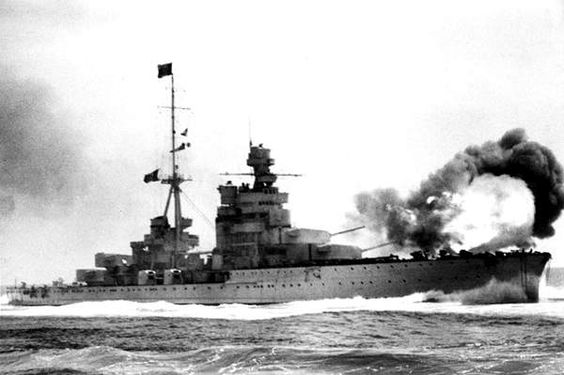
The Battle of Calabria was fought in the Mediterranean Sea off the coast of Italy. The battle was one of the few in the Mediterranean campaign involving large numbers of ships on both sides. The battle was indecisive and the ships returned to base; it was the first battleship engagement between the Regia Marina and the Mediterranean Fleet.
BATTLE OF CALABRIA or PUNTA STILO: The battle took place between the Mediterranean Fleet and Italian Fleet units, both on convoy escort missions.
At 14:40 on 8 July two Italian Cant Z.506 aircraft from Tobruk spotted the British fleet and shadowed it for nearly four hours. Admiral Campioni ordered his fleet to defend the convoy by turning eastward and preparing for action. The Italian Supreme Command, however, was reluctant to risk its warships in a night-time encounter, and they ordered the fleet to avoid contact. During the initial positioning the Italians suffered technical problems on three destroyers and two light cruisers, so these ships, with several additional destroyers, were detached to refuel in Sicily. In order to make up for these “losses”, another destroyer group was summoned from Taranto. At this point, the Italian fleet had 16 destroyers.
At noon on 9 July the two fleets were 90 miles apart. Vice Admiral Cunningham could not close the distance to engage with the significantly slower HMS Royal Sovereign and HMS Malaya (18 knots vs 28 knots) and took HMS Warspite in on its own. Meanwhile, at 13:15, HMS Eagle launched several unsuccessful sorties by Fairey Swordfish against the Italian heavy cruisers, which they took for battleships.
The Allied cruiser group was spread out in front of HMS Warspite and at 15:15 they caught sight of the Italian main battle force and the two groups opened fire at 21,500 metres. Italian rangefinding was better than the Allied, and within three minutes they had found the distance even though they were firing at extreme range. Although the Allies’ rangefinding was not as good and they had trouble with their rounds falling short, the Allied gunlaying was better and they were able to place their rounds in much tighter groups. Generally the gunnery of the two forces was fairly well matched. After only a few minutes the range was down to 20,000 meters and the Allied guns became useful. However, by 15:22, the Italian fire came dangerously close to the Allied cruisers and Vice Admiral John Tovey decided to disengage. At this point splinters from a 6″ shell fired by the Italian cruiser Giuseppe Garibaldi hit HMS Neptune, damaging her catapult and the reconnaissance aircraft beyond repair. The cruisers continued to open the range and by 15:30 fire ceased.
One group of Italian light cruisers, mistaken for the heavy cruisers of the Zara class, was on the Allied side of the battle line and was soon within range of the charging Warspite. Once again the Allied rounds fell short, and neither of her targets, Alberico da Barbiano and Alberto di Giussano, received any damage in the initial salvos. However by this time Warspite was also out of position, and she circled in place in order to allow Malaya to catch up. Meanwhile, Royal Sovereign was still well to the rear.
The Italian commander decided to take on Warspite, and started moving his two battleships into position. At 15:52 Giulio Cesare opened fire at a range of 26,400 meters. Conte di Cavour did not fire, a decision many have questioned. Italian strategy was to have only one ship targeted at a time, as it was learned during the Battle of Jutland that with more than one ship firing at a single target it became very difficult for the rangefinding parties to tell which rounds were theirs. Conte di Cavour had been assigned to Malaya and Royal Sovereign, which were further back and did not enter the engagement.
Warspite, not aware of the Italian firing patterns, split her guns between the two ships. During the exchange one of Giulio Cesare’s rounds fell long and caused splinter damage to Warspite’s escorting destroyers (Hereward and Decoy) which had formed up on the far side of the action. At 15:54 Malaya started firing, well out of range, hoping to cause some confusion on the Italian ships. Meanwhile the Italian heavy cruisers came into action and started firing on Warspite at 15:55 but had to break off as the Allied cruisers returned.
At 15:59 two shells from Giulio Cesare fell very close to Warspite. Almost immediately after one of Warspite’s 15-inch (381 mm) rounds hit the rear deck of Giulio Cesare, exploding in the funnel, and setting off the stored ammunition for one of her 37 mm anti-aircraft guns. The damage was quite superficial, but 66 seamen were killed and 49 wounded, around the 10% of the whole crew. The fumes from the burning ammunition were sucked down into the engine room, which had to evacuate and shut down half of the boilers. Giulio Cesare’s speed quickly fell off to 18 knots and Conte di Cavour took over. Giulio Cesare and Warspite were well over 24,000 meters (26,000 yards) apart at the time of the hit, which was one of the longest-range naval artillery hits in history.
It would appear that Warspite was in an excellent position to deal some serious blows to the slowing Giulio Cesare, but she once again executed another tight turn to allow Malaya to catch up. With her guns suddenly silenced during the turn, rangefinders on Malaya discovered what the Italians had been intending to avoid, that her rounds were falling 2,700 yards short of Giulio Cesare and they had been watching Warspite’s rounds, not their own.
At 16:01 the Italian destroyers generated smoke and the battleships got under cover. There is some debate about this point today, the Allied position being that the battleships were leaving battle, the Italian that they were attempting to make a torpedo attack with their destroyers from within the smoke.
At 15:58 Fiume re-opened fire on her counterpart in the Allied line, Liverpool and soon two groups of Italian cruisers: Zara, Bolzano and Pola had opened fire. The Gorizia and Trento followed soon and enter in combat range with the main Allied cruiser battle group. Firing continued as both groups attempted to form up and at 16:07 the Italian cruiser Bolzano was hit three times by 6″ shells from HMS Neptune, temporarily locking her rudder and suffering two fatalities at the torpedo room. A near miss on the destroyer Vittorio Alfieri caused minor damage.
Meanwhile the mechanics on Giulio Cesare were able to repair two of the four damaged boilers, allowing the battleship to reach 22 knots. Admiral Campioni, considering the possibilities of his remaining battleship, Conte di Cavour against three enemy battleships and an aircraft carrier, decided to withdraw the battleships towards Messina. Cesare was out of action for 30 days.
Over the next hour both fleets attempted to make long-range torpedo runs with their destroyer groups without success. At 16:40, the Italian air force made an attack with 126 aircraft, reporting damage on Eagle, Warspite and Malaya; because of some misunderstanding, 50 of the Italian aircraft also attacked the Italian ships, without damage. The battle ended at 16:50 with both sides withdrawing.
One final victim was the destroyer Leone Pancaldo, sent to Augusta in Sicily, which was hit by a torpedo launched from a Swordfish at 09:40 the next day and sank in shallow water. (She was refloated and returned to service in December 1941.) After the battle both fleets turned for home.
Italian aircraft start five days of high-level bombing against Adm. Cunningham’s force. Force H is the subject of repeated bombing attacks by Sicilian based aircraft of Reggio Aeronautica. In a series of actions, Skua II fighters from 800 and 803 Squadron, FAA, break up most of the attacks, downing three and damaging several more of the attackers. No hits are obtained. Swordfish I search planes from 813 Squadron, FAA aboard HMS Eagle having established contact with the Italian Fleet for Admiral Cunningham’s Mediterranean Fleet, the 9 Swordfish Is of 824 squadron, FAA, also aboard HMS Eagle, deliver two separate torpedo attacks on Italian warships in the Ionian Sea. Unfortunately for the Royal Navy, the Italian cruisers outmaneuver both attacks. The second of the two attacks is delivered within sight of the British Fleet during the gunnery engagement between HMS Warspite and the Italian battleships Conti di Cavour and Giulio Cesare. These are the first aerial attacks delivered by carrier-based aircraft on the Italian Navy in the Mediterranean.
After the battle both fleets turned for home. This allowed the Italians to claim a victory of sorts, as their cargo ships were already past the action by this time and sailed safely for Libya. Meanwhile, the Allied ships also reached Alexandria along with their escort. Although the battle was indecisive, Allied sources claimed that the Royal Navy asserted an important “moral ascendancy” over their Italian counterpart.
Other sources instead dispute those claims, pointing out that, in the immediate aftermath of the battle, the moods of the two commanders were quite different. Campioni wrote that, even having been able to employ only two old refurbished battleships, the battle gave to every man in the fleet, from the senior officers to the seamen, the impression of being able to cope with the British Fleet on equal terms. Cunningham, conversely, was dismayed by the performance of his two older units, whose lack of speed permitted the Italians to dictate the course of the action, and whose guns were out-ranged not only by those of the two Italian battleships, but by those of the heavy cruisers as well. Cunningham dismissed the Royal Sovereign as a “constant source of anxiety”, and asked the Admiralty for two or three more Queen Elizabeth-class battleships, possibly equipped with radar, a new carrier with an armoured deck, the heavy cruisers York and Exeter, and enough smaller ships to cover the major units.
Mussolini told his fleet “You have obtained our first naval victory!”
Light cruiser HMS Gloucester operated with aircraft carrier HMS Eagle.
Battleship HMS Warspite had a fire, caused by the flash of her own guns which fired and demolished one of her seaplanes.
Destroyers HMAS Stuart and HMAS Voyager attacked an Italian submarine during the engagement.
Destroyers HMS Nubian, HMS Mohawk, HMS Juno, and HMS Janus were formed into a group to fend off Italian ships that might attempt to fire torpedoes at the British ships.
Submarine HMS Parthian was at sea in the area during the battle.
Force H was to have raided Cagliari. Before the raid was launched, Force H was attacked by Italian bombers south of Minorca. Battleship HMS Resolution was straddled and battlecruiser HMS Hood was near missed. The raid was cancelled.
French National Assembly votes that a decision must be made to end the Third Republic. Stricken France’s parliament signed the death warrant of the democratic third republic today by giving Premier Marshal Henri Philippe Petain unrestricted powers to write a new totalitarian constitution. The vote of the chamber of deputies and senate, born of defeat and desperation, gave the Petain government authority to frame its own laws and constitution, then create its own national assembly to ratify them. The measure was voted with only four negative voices against it. Only formal joint approval by both houses tomorrow remains before Marshal Petain is expected to emerge as a figurehead ruler in a government dominated by a triumvirate composed of Gen. Maxime Weygand, former allied commander-in-chief, Pierre Laval, former premier and foreign minister; and Adrien Marquet, former labor minister. Geneva dispatches said France had little choice. These dispatches said Vice-Premier Laval told parliament as much that the only hope for an “honorable peace” lay in adopting a new constitution. Frenchmen in Switzerland said that Germany let the Petain cabinet know it must either form a totalitarian government along Spanish, German, and Italian lines or lose the right even to rule the unoccupied zone.
Pierre Laval, the French vice-PM, announces that the Republic will become “a Fascist form of government, which I have long admired.” This is the first time any member of the Vichy government has openly admitted to Fascist leanings. The new national slogan, “Work, Family, and Fatherland,” is adopted.
The Armistice Commission announces that all German POWs in French custody have now been released.
A United States citizen was the only one among the French senators meeting in Vichy today who cast a vote against the abandonment of France’s democratic government in favor of a totalitarian dictatorship. He was the 75-year-old Marquis Pierre de Chambrun, a great-great-grandson of Lafayette, from whom he derives honorary American citizenship as do all the direct descendants of the Revolutionary hero.
The Duke of Windsor was appointed Governor of the Bahamas. He is widely viewed as having German sympathies, and this position is more to keep an eye on him than to reward him with new responsibilities. Hog’s Island (Nassau) in the Bahamas has several residents who are considered suspicious, such as industrialist Axel Wenner-Grenn of Sweden.
The British Admiralty claims credit for sinking the French battleship Richelieu during recent Operation Catapult. The claim technically is correctly, but the Richelieu has settled in very shallow water and is quickly repaired and refloated.
The British House of Commons unanimously passed a £1 billion war credit.
British government implemented rationing on tea: each person was allowed 2 ounces of tea per week.
War jitters are at a fever pitch in England. There are so many rumors of parachutists, German ray guns and the like that the government warns that spreading false rumors will be prosecuting.
The German Evangelist Church protests against euthanasia pogroms.
The Swedish Government denies that it is joining the Axis despite allowing the Wehrmacht transit rights.
It is reported that Vidkun Quisling is now a local radio commentator in Norway. “Quisling” already has become a synonym for “traitor.”
Edvard Beneš forms the Czechoslovakian government-in-exile in London.
Polish Silesian Socialist Party politician Józef Biniszkiewicz perishes at the Buchenwald Concentration Camp.
Rumanian King Carol II orders the arrest of Marshal Ion Antonescu after Antonescu sends him a note protesting the decision to give the Soviet Union the lands it had demanded in the east. Antonescu is interned at Bistrița Monastery. At this time, Antonescu is viewed with suspicion by just about everyone.
Remainder of Canadian Z Force arrives to reinforce British garrison in Iceland.
Italian artillery shells the 1st King’s African Rifles outpost at Moyale, Kenya.
At Malta, there is a raid at 08:00 by an SM79 bomber and seven CR42s. They bomb Luga, with the RAF prominent in the defense. The Italians lose two planes. Governor Dobbie requests and receives permission to stop using his limited air resources in offensive operations against Sicily, instead of using them to defend the island only at his discretion.
German Luftwaffe aircraft attacked shipping in the English Channel and off the British coast. The Germans send about 60 Bf 109s and 110s on a sweep across the English channel and find targets in a convoy forming up at the mouth of the Thames River. The Luftwaffe catches British freighters Kenneth Hawksfield and Polgrange in the Dover sector and damages them. The Luftwaffe sinks Latvian freighter Talvaldis off Devon. Dutch steamer Iola also was damaged, along with Greek freighter Aegeon.
The RAF considered this date the official start of their night bombing campaign against Germany.
German Nachtjagdgeshchwader (Night Fighter) 1 wing scored its first kill. Ofw Paul Förster of 8/NJG1 shoots down a Whitney bomber at 02:50. The British crew becomes POWs (this is not the initial night fighter victory of the war, just of this unit).
RAF Bomber Command dispatches 12 Blenheims to attack Stavanger airfield during the day with seven aircraft lost.
Spitfires of RAF No. 54 Squadron shoot down such an unarmed He-59 marked as a search-and-rescue aircraft on the Goodwin Sands and capture the crew. Nothing incriminating is found and the official report states that “The men were unarmed and whatever else they may or may not have been doing they seem to be genuine sea-rescue Red Cross workers.” However, the apparent innocence of the craft does not sway the British, who are deeply suspicious that such planes are performing reconnaissance missions.
RAF Bomber Command dispatches 14 Blenheims to bomb various targets during the day in Holland and Belgium.
RAF Bomber Command dispatches 55 Hampdens and Wellingtons to various targets in Germany and Holland and minelaying overnight. 19 of the Wellingtons were recalled because of weather conditions. No losses.
Douglas Bader’s No. 242 Squadron RAF, based at RAF Coltishall at Norwich, England, United Kingdom, was declared fully operational.
King George VI made a royal visit to RAF Digby during which he presented a Distinguished Flying Cross to Flying Officer Guy Gibson, the future leader of the Dambusters Squadron.
During the night, 11 British Hampden aircraft (out of 14 dispatched) attacked battleship Tirpitz to little effect.
U-34, commanded by Kapitänleutnant Wilhelm Rollmann, sank Estonian steamer Tiiu 280 miles west of St Ann’s in 50-20W, 12W. At 1232 hours the unescorted and unarmed Tiiu was torpedoed without warning by U-34 about 100 miles southwest of Mizen Head, Ireland. The torpedo struck in the engine room and caused her to sink within 6 minutes after the crew had abandoned ship in two lifeboats. On 11 July, nine survivors in one boat were picked up by the British fishing trawler Bass Rock about 90 miles west of St. Ann’s Head and landed at Milford Haven two days later. The remaining survivors in the other boat were landed at Glasgow on 18 July. The entire crew was rescued. The 1,865-ton Tiiu was carrying general cargo, including food and naval stores and was headed for Liverpool, England.
U-43, commanded by Kapitänleutnant Wilhelm Ambrosius, sank British steamer Aylesbury in 48-39N, 13-55W. At 2119 hours the unescorted Aylesbury (Master Theodore Pryser) was hit aft by one G7e torpedo from U-43 and sank by the stern 15 minutes after being hit in the engine room by a coup de grâce at 21.35 hours about 230 miles southwest of Cape Clear. The ship had been missed by a first G7e torpedo at 21.16 hours. The master and 34 crew members were picked up by HMS Harvester (H 19) (LtCdr M. Thornton, RN) and HMS Havelock (H 88) (Capt E.B.K. Stevens, DSC, RN) and landed at Liverpool. The 3,944-ton Aylesbury was carrying general cargo and grain and was headed for Avonmouth, England.
Submarine HMS Salmon (Lt Cdr E. O. B. Bickford DSO) was sunk in mining off Egersund in 57-22N, 5-00E. Lt Cdr Bickford, Lt M. F. Wykeham-Martin DSC, Lt R. H. M. Hancock DSC, Lt K. D. Skelt, Warrant Engineer W. L. Davis, and the thirty six ratings of the crew were lost with Salmon.
Sloop HMS Foxglove, proceeding to Portsmouth, was bombed at 1130 and badly damaged off the Nab. Acting Gunner F. Brown died of wounds on the sloop. Sloop Foxglove was able to proceed under tow by naval trawler HMS Holly, which was relieved en route by tug HMS Resolve to Portsmouth, where she was under repair until July 1941.
At 0030/9th, heavy cruisers HMS Shropshire and HMS Sussex and destroyers HMS Firedrake and HMS Echo departed the Clyde to escort British troopships Ormonde (14,982grt) and Ulster Prince (3791grt) to Iceland. They convoy arrived at Reykjavik at 2030/11th. Destroyer Echo took Ulster Prince departed Reykjavik at 1430/12th for Akreyri arriving on the 13th. Then they proceeded on to Seidisfjord on the 13th. Destroyer Echo and troopship Ulster Prince departed Seidisfjord on the 15th and returned to Reykjavik. The heavy cruisers arrived at Scapa Flow after the operation on the 14th. On the 16th, the Destroyers and troopships departed Reykjavik on their return.
Destroyers HMS Inglefield, HMS Imogen, HMS Hambledon, HMS Fernie, and HMS Atherstone departed Scapa Flow at 2145 for Loch Alsh for escort duties with the 1st Minelaying Squadron.
German armed merchant cruiser Komet sailed from Bergen to raid in the Pacific. She reached this destination by going around the north of Russia assisted by Russian icebreakers. Armed merchant cruiser Komet carried twenty five ground mines for this operation.
German armed merchant cruiser Thor sank Belgian steamer Bruges (4983grt) in the South Atlantic in 4S, 28W. The crew was made prisoners of war.
Latvian steamer Talvaldis (534grt) in convoy CW.2 was sunk by German bombing three miles 120° from Prawle Point. One crewman was lost.
British steamer San Felipe (5919grt) was damaged by German bombing at Roath Docks, Cardiff.
British steamer Kenneth Hawksfield (1546grt) was damaged by German bombing in the Dover area.
British steamer Polgrange (804grt) was damaged by German bombing in 51-46N, 01-46E.
British steamer Empire Diaffodil (398grt) was damaged by German bombing 13 miles SSW of Portland.
Dutch steamer Jola (269grt) was damaged by German bombing three miles SW of Start Point.
Greek steamer Aegeon (5285grt) was damaged by German bombing at Weymouth.
Submarine HMS Proteus arrived at Gibraltar after patrol off Mer el Kebir.
Convoy FN.218 departed Southend, escorted by destroyer HMS Woolston, sloop HMS Fleetwood, and patrol sloop HMS Pintail. The convoy was joined on the 10th by destroyers HMS Javelin and HMS Jupiter. The two J destroyers and the patrol sloop were detached later on the 10th. The convoy arrived at the Tyne on the 11th.
Convoy MT.105 departed Methil. The convoy arrived in the Tyne on the 11th.
There was no convoy MT.106
Convoy FS.217 departed the Tyne, escorted by destroyer HMS Vimiera and sloop HMS Londonderry. The convoy arrived at Southend on the 10th.
Convoy SL.39 departed Freetown escorted by armed merchant cruiser HMS Corfu. When the cruiser was damaged in a collision the next day with aircraft carrier HMS Hermes, armed merchant cruiser HMS Dunvegan Castle joined the convoy to 25 July. The convoy merged with convoy SLF.39 on the 19th. Armed merchant cruiser Dunvegan Castle arrived at the Clyde for refueling and watering on the 26th. On the 25th, destroyers HMS Hesperus, HMCS Restigouche, and HMS Walker and corvette HMS Mallow joined the convoy and escorted it to Liverpool, arriving on the 29th.
A convoy of merchant ships, MF.1, consisting of Egyptian steamer El Nid (7769grt), British steamer Knight Of Malta (1553grt), and former Italian steamer Rodi (3220grt) put to sea from Malta at 2300/9th escorted by destroyers HMS Vendetta, HMS Jervis, and HMS Diamond. Light cruiser HMS Gloucester and destroyer HMAS Stuart also arrived for refueling. After refueling, they joined the convoy which was covered by light cruisers HMS Orion and HMS Neptune. Destroyers HMAS Stuart, HMS Dainty, HMS Defender, HMS Hyperion, HMS Hostile, HMS Hasty, HMS Ilex, and HMS Juno were detached to Malta to refuel late on the 9th. They arrived at 0530 and departed at 1115 on the 10th. In turn, destroyers HMS Hero, HMS Hereward, HMS Decoy, HMAS Vampire, and HMAS Voyager were sent to Malta to refuel.
A slow convoy, MS.1, of four merchant ships, British steamers Kirkland (1361grt), Tweed (2697grt), and Masirah (6578grt), former Dutch steamer under British flag Zeeland (2726grt), and Norwegian steamer Novasli (3204grt), departed Malta early on the 10th escorted by destroyers HMS Decoy, HMAS Vampire, and HMAS Voyager. At 2030/10th, battleship HMS Royal Sovereign with destroyers HMS Nubian, HMS Mohawk, and HMS Janus were to detached to refuel at Malta.
This group sailed at 0800/11th with destroyers HMS Hero and HMS Hereward. Destroyers Hero and Hereward later were transferred to convoy MF.1 and destroyer HMS Janus joined MS.1, replacing destroyer HMAS Vampire. On the 11th, air attacks on the British ships saw Gunner (T) J. H. Endicott on Australian destroyer Vampire badly wounded by bomb splinters. He was transferred to destroyer HMS Mohawk and died of wounds later that day. On the 12th, air attacks on the British ships saw two ratings killed in HMS Liverpool and several wounded, including Cdr J. J. Weld MVO. Both convoys were given cover by battleships HMS Royal Sovereign and HMS Malaya, aircraft carrier HMS Eagle, light cruiser HMS Gloucester, and destroyers HMS Hasty, HMS Hyperion, HMS Ilex, HMS Hostile, HMS Defender, HMS Dainty, HMS Hero, and HMS Hereward. Battleship HMS Warspite, light cruisers HMS Liverpool and HMAS Sydney, and destroyers HMS Nubian, HMS Mohawk, HMAS Vampire, and HMS Juno pressed onto Alexandria arriving at 0600/13th. The fast convoy MF.1 arrived safely at Alexandria at 0900/13th.
On the 13th, Light cruisers HMS Caledon and HMS Capetown of the 3rd Cruiser Squadron met convoy MS.1 midway between Cape Spada and Derna. These ships were given heavy support by battleship HMS Ramillies and destroyers HMS Diamond, HMS Havock, HMS Imperial, and HMS Vendetta which departed Alexandria on the 13th. At 0900/15th, battleship Ramillies, the 3rd Cruiser Squadron, and the slow convoy arrived safely at Alexandria.
The War at Sea, Tuesday, 9 July 1940 (naval-history.net)
BATTLE OF CALABRIA or PUNTA STILO
The battle took place between the Mediterranean Fleet and Italian Fleet units, both on convoy escort missions.
Light cruiser GLOUCESTER operated with aircraft carrier EAGLE.
Italian heavy cruiser BOLZANO was hit by three medium caliber hits.
Italian battleship CESARE (Flagship of Campioni) was hit by one 381 mm shell.
Light cruiser NEPTUNE was damaged at 1525 by a near miss which damaged her aircraft and catapult.
Battleship WARSPITE had a fire, caused by the flash of her own guns which fired and demolished one of her seaplanes.
Destroyers HMAS STUART and HMAS VOYAGER attacked an Italian submarine during the engagement.
Destroyers NUBIAN, MOHAWK, JUNO, and JANUS were formed into a group to fend off Italian ships that might attempt to fire torpedoes at the British ships.
Submarine PARTHIAN was at sea in the area during the battle.
Force H was to have raided Cagliari. Before the raid was launched, Force H was attacked by Italian bombers south of Minorca. Battleship RESOLUTION was straddled and battlecruiser HOOD was near missed. The raid was cancelled.
A convoy of merchant ships, MF.1, consisting of Egyptian steamer EL NID (7769grt), British steamer KNIGHT OF MALTA (1553grt), and former Italian steamer RODI (3220grt) put to sea from Malta at 2300/9th escorted by destroyers VENDETTA, JERVIS, and DIAMOND.
Light cruiser GLOUCESTER and destroyer HMAS STUART also arrived for refueling. After refueling, they joined the convoy which was covered by light cruisers ORION and NEPTUNE.
Destroyers HMAS STUART, DAINTY, DEFENDER, HYPERION, HOSTILE, HASTY, ILEX, and JUNO were detached to Malta to refuel late on the 9th. They arrived at 0530 and departed at 1115 on the 10th.
In turn, destroyers HERO, HEREWARD, DECOY, HMAS VAMPIRE, and HMAS VOYAGER were sent to Malta to refuel.
A slow convoy, MS.1, of four merchant ships, British steamers KIRKLAND (1361grt), TWEED (2697grt), and MASIRAH (6578grt), former Dutch steamer under British flag ZEELAND (2726grt), and Norwegian steamer NOVASLI (3204grt), departed Malta early on the 10th escorted by destroyers DECOY, VAMPIRE, and VOYAGER.
At 2030/10th, battleship ROYAL SOVEREIGN with destroyers NUBIAN, MOHAWK, and JANUS were to detached to refuel at Malta.
This group sailed at 0800/11th with destroyers HERO and HEREWARD. Destroyers HERO and HEREWARD later were transferred to convoy MF.1 and destroyer JANUS joined MS.1, replacing destroyer HMAS VAMPIRE.
On the 11th, air attacks on the British ships saw Gunner (T) J. H. Endicott on Australian destroyer VAMPIRE badly wounded by bomb splinters. He was transferred to destroyer MOHAWK and died of wounds later that day.
On the 12th, air attacks on the British ships saw two ratings killed in LIVERPOOL and several wounded, including Cdr J. J. Weld MVO.
Both convoys were given cover by battleships ROYAL SOVEREIGN and MALAYA, aircraft carrier EAGLE, light cruiser GLOUCESTER, and destroyers HASTY, HYPERION, ILEX, HOSTILE, DEFENDER, DAINTY, HERO, and HEREWARD.
Battleship WARSPITE, light cruisers LIVERPOOL and SYDNEY, and destroyers NUBIAN, MOHAWK, VAMPIRE, and JUNO pressed onto Alexandria arriving at 0600/13th.
The fast convoy MF.1 arrived safely at Alexandria at 0900/13th.
On the 13th, Light cruisers CALEDON and CAPETOWN of the 3rd Cruiser Squadron met convoy MS.1 midway between Cape Spada and Derna. These ships were given heavy support by battleship RAMILLIES and destroyers DIAMOND, HAVOCK, IMPERIAL, and VENDETTA which departed Alexandria on the 13th.
At 0900/15th, battleship RAMILLIES, the 3rd Cruiser Squadron, and the slow convoy arrived safely at Alexandria.
Submarine SALMON (Lt Cdr E. O. B. Bickford DSO) was sunk in mining off Egersund in 57‑22N, 5‑00E.
Lt Cdr Bickford, Lt M. F. Wykeham-Martin DSC, Lt R. H. M. Hancock DSC, Lt K. D. Skelt, Warrant Engineer W. L. Davis, and the thirty-six ratings of the crew were lost with SALMON.
Sloop FOXGLOVE, proceeding to Portsmouth, was bombed at 1130 and badly damaged off the Nab.
Acting Gunner F. Brown died of wounds on the sloop.
Sloop FOXGLOVE was able to proceed under tow by naval trawler HOLLY, which was relieved en route by tug RESOLVE to Portsmouth, where she was under repair until July 1941.
At 0030/9th, heavy cruisers SHROPSHIRE and SUSSEX and destroyers FIREDRAKE and ECHO departed the Clyde to escort British troopships ORMONDE (14,982grt) and ULSTER PRINCE (3791grt) to Iceland.
They convoy arrived at Reykjavik at 2030/11th.
Destroyer ECHO took ULSTER PRINCE departed Reykjavik at 1430/12th for Akreyri arriving on the 13th. Then they proceeded on to Seidisfjord on the 13th.
Destroyer ECHO and troopship ULSTER PRINCE departed Seidisfjord on the 15th and returned to Reykjavik.
The heavy cruisers arrived at Scapa Flow after the operation on the 14th. On the 16th, the Destroyers and troopships departed Reykjavik on their return.
Destroyers INGLEFIELD, IMOGEN, HAMBLEDON, FERNIE, and ATHERSTONE departed Scapa Flow at 2145 for Loch Alsh for escort duties with the 1st Minelaying Squadron.
Convoy FN.218 departed Southend, escorted by destroyer WOOLSTON, sloop FLEETWOOD, and patrol sloop PINTAIL. The convoy was joined on the 10th by destroyers JAVELIN and JUPITER. The two J destroyers and the patrol sloop were detached later on the 10th. The convoy arrived at the Tyne on the 11th.
Convoy MT.105 departed Methil. The convoy arrived in the Tyne on the 11th.
There was no convoy MT.106
Convoy FS.217 departed the Tyne, escorted by destroyer VIMIERA and sloop LONDONDERRY. The convoy arrived at Southend on the 10th.
German armed merchant cruiser KOMET sailed from Bergen to raid in the Pacific. She reached this destination by going around the north of Russia assisted by Russian icebreakers.
Armed merchant cruiser KOMET carried twenty-five ground mines for this operation.
German armed merchant cruiser THOR sank Belgian steamer BRUGES (4983grt) in the South Atlantic in 4S, 28W. The crew was made prisoners of war.
U-34 sank Estonian steamer TIIU (1865grt) 280 miles west of St Ann’s in 50‑20W, 12W. The entire crew was rescued.
U-43 sank British steamer AYLESBURY (3944grt) in 48‑39N, 13‑55W. The entire crew was rescued.
Latvian steamer TALVALDIS (534grt) in convoy CW.2 was sunk by German bombing three miles 120° from Prawle Point. One crewman was lost.
British steamer SAN FELIPE (5919grt) was damaged by German bombing at Roath Docks, Cardiff.
British steamer KENNETH HAWKSFIELD (1546grt) was damaged by German bombing in the Dover area.
British steamer POLGRANGE (804grt) was damaged by German bombing in 51‑46N, 01‑46E.
British steamer EMPIRE DIAFFODIL (398grt) was damaged by German bombing 13 miles SSW of Portland.
Dutch steamer JOLA (269grt) was damaged by German bombing three miles SW of Start Point.
Greek steamer AEGEON (5285grt) was damaged by German bombing at Weymouth.
Submarine PROTEUS arrived at Gibraltar after patrol off Mer el Kebir.
Convoy SL.39 departed Freetown escorted by armed merchant cruiser CORFU. When the cruiser was damaged in a collision the next day with aircraft carrier HERMES, armed merchant cruiser DUNVEGAN CASTLE joined the convoy to 25 July. The convoy merged with convoy SLF.39 on the 19th.
Armed merchant cruiser DUNVEGAN CASTLE arrived at the Clyde for refueling and watering on the 26th.
On the 25th, destroyers HESPERUS, HMCS RESTIGOUCHE, and WALKER and corvette MALLOW joined the convoy and escorted it Liverpool, arriving on the 29th.
In Washington, President Roosevelt discussed political matters with Paul V. McNutt, Federal Security Administrator; Representative Adolph J. Sabath and Mrs. Thomas F. McAllister, head of the Women’s Division of the Democratic National Committee. At a press conference he parried questions regarding his third term intentions and expressed the belief that shipping conditions for which the British are responsible is the cause of delay in bringing British refugee children to this country.
The Senate confirmed the nomInation of Henry L. Stimson to be Secretary of War, received the Downey bill to authorize visas for refugee children from Europe and recessed at 5:57 PM until noon tomorrow.
The House debated the Hatch “clean politics” bill, completed Congressional action on a bill permitting Colonel Donald H. Connolly to serve as Administrator of the Civil Aeronautics Authority, refused to accept Senate amendments to a bill creating a division of Water Pollution Control in the Public Health Service and adjourned at 5:04 PM until noon tomorrow. An appropriations subcommittee approved a request for $25,000,000 to increase the production of the Tennessee Valley Authority.
U.S. President Franklin D. Roosevelt held a press conference in which he continued to skillfully dodge questions about whether or not he was seeking the Democratic nomination for a third term at next week’s convention. Amid increasing indications that he will accept nomination for a third term President Roosevelt today passed up a press conference opportunity to reveal his intentions before the Democratic National Convention. He devoted the half-hour session with reporters to sidestepping a long series of questions intended to draw him out on the subject. After a conference on the social security plank in the party platform, Paul V. McNutt, Federal Security Administrator, left the White House saying he had heard nothing from Mr. Roosevelt which might lead him to change his earlier opinion that the President would accept the nomination.
Mr. McNutt said he had felt for some time that he had a good idea of what the President had in mind. Having withdrawn his candidacy, Mr. McNutt has been mentioned recently as a possible choice as Mr. Roosevelt’s running mate. He has said publicly that the President should seek a third term and his remarks on leaving the executive office today were taken to mean Mr. Roosevelt would do nothing to stop the draft movement.
The same impression was left with reporters by Representative Sabath, chairman of the Rules Committee, and Mrs. Dorothy McAllister, head of the women’s division of the Democratic National Committee, with whom the President discussed convention arrangements during the day. Chairman Sabath went further than the others in predicting that the President would be unable to prevent his own renomination, even if he wanted to.
“I told him that if he was thinking of coming to Chicago to stop the nomination, it is useless, because not even he can prevent it,” said the Illinois Representative. “I told him he owes it to the party, to the nation and to the world to accept. The President is not a candidate, but he cannot refuse the nomination that will be given him. He will be nominated and elected. I would stake my life on it.”
The few questions the President did answer at his press conference were on national defense rather than politics. Tomorrow, he will send his message to Congress requesting a supplemental defense appropriation of $5,000,000,000. The President would not reveal whether he would announce his decision on a third term race before the Democratic Convention opens. When the convention begins, he said, he will be cruising on the Potomac on the White House yacht.
President Roosevelt’s nomination of Henry Stimson, Republican, to Secretary of War was confirmed by the full senate today 56 to 28, after Majority Leader Alben Barkley, of Kentucky, had urged such approval in the “interests of American unity.” Senators who had bitterly criticized the appointment as a “step toward war” conceded that similar confirmation would be voted tomorrow for Frank Knox, Republican selected for the key national defense post of Secretary of the Navy. Party lines split wide open on the Stimson vote with 45 Democrats, 10 Republicans and one Independent approving and 14 Democrats, 12 Republicans, one Progressive and one Farmer-Laborite opposing. Earlier, crowds who jammed the senate galleries to listen to the crackling debate were threatened with expulsion when they hissed and applauded. The applause came as Senator Tydings, Maryland Democrat, protesting the “stripping of our defenses” to aid Great Britain, engaged in a brisk exchange with Senator Pepper, Florida Democrat, advocate of “every aid short of war” for England.
President Roosevelt said at his press conference today that the Burke-Wadsworth bill for compulsory selective military service was being mulled over but he denied that the Administration had abandoned the idea of training boys and girls for second-line defense as distinguished from active military service.
An attack on the campaign of Wendell L. Willkie, Republican Presidential nominee, through a proposed amendment to the Hatch “clean politics” bill was threatened today as the House began debate on the proposal to extend the anti-pernicious political activity act to State employees paid wholly or partially from federal funds. The debate brought also a threat from another source to attach a rider to the bill making unlawful the collection of poll taxes in the eight Southern States which now. have such a tax. Both proposals were held by some sponsors to be dangerous to chances of enactment of the bill.
Wendell L. Willkie and his party arrived in Colorado Springs, Colorado tonight at 10:15 PM Mountain standard time after a ten-and-a-half-hour flight from Washington aboard a chartered United Air Lines plane.
U.S. Coast Guard cutter Campbell arrived at Boston, Massachusetts, United States with U.S. Consul to Greenland James K. Penfield, Governor of North Greenland E. Brun, and a group of Danish officials on board. They came to Boston to discuss commerce and trade of Greenland as an independent entity due to the German occupation of Denmark.
U.S. Marine Corps Captain Kenneth W. Benner was ordered to continue the survey of Midway Atoll with another officer, 8 enlisted Marines, and 2 US Navy corpsmen. He was to relieve Captain Samuel G. Taxis who had been been there since early Jun 1940 on the same mission.
Major League Baseball:
At Sportsman’s Park, five National League pitchers combine to shut out the powerful American League all-star team, 4–0, allowing just three hits. Paul Derringer goes the first two innings to earn the victory. Billy Herman is 3–for-3 and Max West, in his only at bat, clubs a three-run homer in the 1st inning off Red Ruffing.
Registration of every man and woman in Canada under the Mobilization of Resources Act recently passed will take place during a five-day period in the last two weeks in August. Every Canadian citizen, whether on holiday at that time or not, will have to arrange to be on hand to register.
It was learned from reliable diplomatic sources today that fear that the United States would not give Uruguay effective economic and financial support in an emergency was one of the decisive factors in the government’s recent action in releasing from custody twelve ringleaders of a Nazi plot to seize Uruguay as a German colony.
U.S. Navy destroyer O’Brien (DD-415) reaches Pará, Brazil, in the course of her shakedown cruise.
A Japanese embassy spokesman in Shanghai demands an apology for the recent arrest of 16 Japanese Gendarmes by US Marines, threatening that this could affect “the whole course of Japanese – United States relations.”
Handbills carrying the slogan “Down With America” were posted in Shanghai’s streets today and a Japanese warship emphasized Tokyo’s attitude toward England by seizing a British ship in Shanghai’s harbor.
The daily bombing of Chungking by Japanese planes continues with unremitting violence. Eighty-five planes raided the capital today, causing widespread destruction in the walled city and northern suburbs. The housing of government departments is becoming more difficult every day. Many carry on in half demolished buildings. The Chinese say they shot down four of today’s raiders.
Continued refusal of Britain to close the Burma road to China possibly may result in armed Japanese action against the British crown colony of Hong Kong, persons close to the Japanese government declared today. The war, navy and foreign minis tries scheduled immediate emergency conferences to discuss the British rejection yesterday of Japanese demands that this last link between the Chinese nationalist forces and the outside world be shut off. Reliable sources said the Japanese would take “drastic action” if the British stand were not changed. Foreign Minister Hachiro Arita yesterday told British Ambassador Sir Robert Leslie Craigie that his reply was not satisfactory and urged him to advise London to reconsider. The Japanese press unanimously asserted that “an understanding” with the United States and Russia preceded Britain’s rejection of the Japanese demand and repeated previous charges that the United States was acting as Britain’s “watchdog in the Pacific.”
There are sensational reports this morning in the Japanese press — they cannot be confirmed officially — that an agreement has been reached whereby the Government of French Indo-China will invite the cooperation of the Japanese Government to “protect Indo-China against any possible attempts by the United States, Britain, or the Chungking government [the Government of China] to interfere with the status quo.” In order to effect the security of the present Indo-China regime, the report continues, Japan will land the requisite number of army divisions at Haiphong and Saigon where the Japanese Navy will assist in patrolling the Indo-China coast.
Dow Jones Industrial Average: 121.6 (-0.03)
Born:
Manfred Jung, German operatic tenor (Wagner’s heldentenor roles), in Oberhausen, Germany (d. 2017).
Died:
Józef Biniszkiewicz, 65, Silesian socialist politician (died in Buchenwald concentration camp).
Naval Construction:
The Royal Navy Shakespeare-class minesweeping trawler HMS Fluellen (T 157) is laid down by Cochrane & Sons Shipbuilders Ltd. (Selby, U.K.); completed by Amos & Smith.
The Royal Navy Flower-class corvette HMS Veronica is laid down by the Smiths Dock Co., Ltd. (South Bank-on-Tees, U.K.). She is later transferred to the U.S. Navy under reverse lend lease, becoming the USS Temptress (PG-62).
The Royal Navy “U”-class (Second Group) submarine HMS Unbeaten (N 93) is launched by Vickers Armstrong (Barrow-in-Furness, U.K.).
The Royal Navy Flower-class corvette HMS Jonquil (K 68) is launched by Fleming & Ferguson Ltd. (Paisley, Scotland).
The Royal Navy Flower-class corvette HMS Dianthus (K 95) is launched by Henry Robb Ltd. (Leith, U.K.); completed by Ailsa Shipbuilding Company Ltd. (Troon, Scotland).
The Royal Navy “N”-class destroyer HMS Nestor (G 02) is launched by Fairfield Shipbuilding & Engineering Co. (Govan, Scotland). She is transferred to the Royal Australian Navy before completion and commissions as the HMAS Nestor (G 02).
The Royal Navy British Power Boat 63 foot-class motor anti-submarine boat HMS MA/SB 42 is commissioned.
 History Diaries