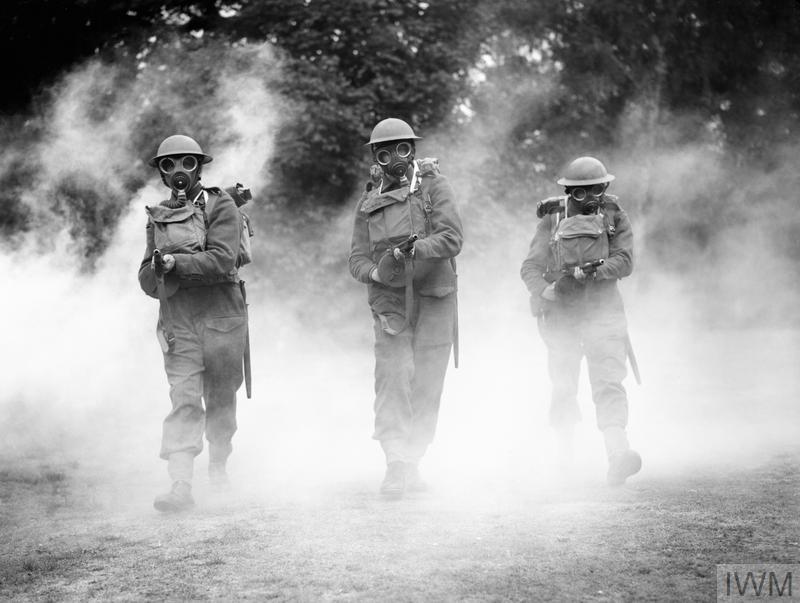
In the eight weeks since Anthony Eden’s appeal, 1,060,000 men have signed on with the Local Defence Volunteers. However, they still have no uniforms, no ranks, and few weapons apart from rifles borrowed from museums and even from London’s Drury Lane theatre. The LDV average age is high, and some units include several generals of the last war now in the ranks. In two days’ time the first course begins at the LDV training school set up at Osterley Park, near London. It is run by Tom Wintringham, the former commander of the British volunteers in Spain, whose articles in Picture Post on guerrilla fighting inspired its publisher, Edward Hulton, to set up the “guerrilla” school. The LDV may soon see a change of name. Churchill recently suggested to Eden that they be given the shorter title “Home Guard”.
The nine British Army divisions recovered from France are being reorganized to face a possible invasion.
British Metropolitan Police was ordered to be armed when guarding important locations.
Admiral Sir Barry Domville, former director of the British naval intelligence, was arrested with Lady Domville today under the defense regulations. The admiral was taken to Brixton prison and his lady to Holloway prison. Nature of the charges was not disclosed, but it was reported that they would be interned. The admiral, who retired in 1936, went to Germany in 1937 to shoot chamois with Heinrich Himmler, head of the Nazi Gestapo (secret police). Twice before that he was a guest of Adolf Hitler. He was at Salzburg a month before war was declared last fall. He was chairman of the pro-German organization, “the Link,” but some time ago announced that it had been dissolved.
Tea rationing begins, with 2 oz. per person per week. This is a big deal in the British Isles, with many extravagant literary expressions of calamity. This is a subtle but telling indication that the U-boat menace is real and growing.
The Vichy French prepare to withdraw their ambassador to the Court of St. James in London.
General Charles de Gaulle criticized the British in a BBC address for their actions against the French fleet that began on July 3, 1940. Charles de Gaulle makes a BBC address in which he criticizes the British for their attacks on the French fleet, saying “all Frenchmen are dismayed.”
Operation CATAPULT, the neutralization of the French fleet, continues. At Casablanca, British torpedo boats attack the French battleship, Jean Bart. In addition, the British attack Dakar for the second day without inflicting any major damage.
French aircraft carrier Bearn and two cruisers are immobilized by mainly diplomatic means in the French West Indies.
Expanding on their previous agreement, Sweden allowed Germany to transport war materiel across their rail lines.
The British lodge a formal protest about the decision by Stockholm to allow German military transit on the Narvik railway.
The Soviets demand transit privileges across Finnish territory to their base at Hango.
Hitler accepts Hans Frank’s proposal that the Government General formally become part of the German Reich.
The Swiss government mobilizes its army and allocates them to three Alpine fortresses. The Swiss have gotten wind of a German desk planning exercise, Operation TANNENBAUM, the invasion of Switzerland. Hitler has some sort of grudge against Switzerland which leads to violent outbursts among his staff.
King Haakon refuses a request made by the German-controlled Storting (legislature) that he abdicate.
Soviet Navy establishes Danube Flotilla on the river in occupied territory.
Light scattered raids by the Luftwaffe from Scotland to Land’s End.
The fighter forces “mix it up” during the day, and the Luftwaffe shoots down 3 Spitfires and two Hurricanes. JG51 gets the kills.
Lt. Johann Bohm of 4./JG51 is forced down after being damaged in combat. He lands at Bladbean Hill, Elham, Kent. This gives the British a good Bf 109E to study and is the first largely undamaged Bf 109 to land in Great Britain. Coincidentally, later in the day another Bf 109E also lands later in the day at Sandwich, Kent, flown by Lt. A. Striberny of 3(J)./LG 2. This one is a Bf 109E-3. The British learn that there is heavier armor plating in the cockpit area on this series of aircraft.
Twin-engine Bf 110 Zerstorers are being used as fighter-bombers. A flight of them crosses the English coast at Dungeness and is intercepted by Spitfires from No. 54 Squadron. An escorting formation of Bf 109s then gets involved and shoots down two Spitfires and damages another.
Heinkel 111s of III./KG 54 attack industrial targets at Bristol.
RAF Bomber Command dispatches 51 Blenheims on various tasks to targets in Holland, Belgium and France during daylight; only 24 bombed. No losses.
RAF Bomber Command dispatches 64 aircraft to ports in Northern Germany, airfields in Holland and minelaying overnight. 1 Whitley lost.
The RAF mistakenly bombs two Swedish torpedo boats temporarily being held in the Faeroe Islands by the authorities. The boats had been bought from Italy. The two boats are damaged but proceed on to Sweden.
British torpedo bombers attacked the French battleship Richelieu at Dakar, inflicting damage but failing to sink their target.
British bombers attacked German heavy cruiser Lützow in dock at Kiel, Germany. Lützow, under repair for extensive torpedo damage to her stern caused by HMS Spearfish on 11 April 1940, was hit by a bomb that failed to detonate.
The British RAF Fighter Command established the 10 Group for the defense of southwestern Britain.
At Malta, quarrymen dig out 30 new rock shelters near Luqa aerodrome. There are international press reports about recent raids on the island. There is an attempted raid at 14:20, but defending RAF fighters disperse it before it reaches the coast.
U-99, commanded by Kapitänleutnant Otto Kretschmer, sank British steamer Humber Arm (5758grt) from convoy HX.53 in 50-36N, 09-24W. At 0753 hours the Humber Arm (Master Jack Rowland Morbey) was hit in the foreship by one torpedo from U-99 and sank 60 miles south of Fastnet. The master, 41 crew members and one passenger were picked up by HMS Scimitar (H 21) (Lt R.D. Franks, OBE, RN) and HMS Vanquisher (D 54) (Cdr C.B. Alers-Hankey, RN) and landed at Milford Haven. The 5,758-ton Humber Arm was carrying newsprint, steel, pulp, and lumber and was headed for Ellesmere Port, England.
Heavy cruiser HMS Glasgow arrived at Scapa Flow from Liverpool at 1400.
Heavy cruiser HMS Devonshire arrived at Scapa Flow from the Clyde at 1909.
Heavy cruiser HMS Norfolk departed Scapa Flow at 1935 for the Clyde.
Destroyer HMS Diana departed Scapa Flow at 2230 to rendezvous with the Finnish steamer Lahti (616grt) at 0400 hours on the 9th, three miles from Rattray Head, and escort her to Rosyth. Destroyer Diana did not locate the Finnish ship. At 1234 on the 9th, the destroyer was ordered to search for a Blenheim in the sea in 58-14N, 1-04W. This search was also unsuccessful and destroyer Diana arrived back at Scapa Flow at 0200/10th.
French sloop Suippe was damaged by German bombing at Falmouth. No crew was aboard the sloop at the time. Sloop Suippe was beached at St Just’s Pool.
Submarine HMS Sealion attacked the wreck of sunken German steamer Palime (2863grt) at Obrestad.
British steamer Eastwood (1551grt) was damaged by German bombing one mile north of 20D Buoy, Hartlepool.
British steamer Corundum (929grt) was damaged by German bombing seven miles southwest of Folkestone.
Anti-submarine trawler HMS Cayton Wyke (550grt, Chief Skipper D. F. Noble DSC RNR) of the 9th Anti-submarine Group was reported lost on a mine off Dover, but may have been sunk by German motor torpedo boat S.36. Noble and Probationary Temporary Lt A. E. Brown RNR, and sixteen ratings were lost on the trawler.
Special service ship James 9 (85grt) was sunk as a blockship.
German heavy cruiser Lützow while in dock at Kiel was hit by a British bomb which did not explode.
Force H consisting of battlecruiser HMS Hood, battleships HMS Resolution and HMS Valiant, aircraft carrier HMS Ark Royal, light cruisers HMS Arethusa, HMS Delhi, and HMS Enterprise, and destroyers HMS Faulknor, HMS Forester, HMS Foxhound, HMS Escort, HMS Fearless, HMS Active, HMS Douglas, HMS Velox, HMS Vortigern, and HMS Wrestler sortied from Gibraltar to cover the Mediterranean Fleet. As a diversion for the convoys leaving Malta, Ark Royal was to launch an air raid against Cagliari, but the raid was later cancelled. Light cruiser Arethusa arrived back at Gibraltar on the 10th. Destroyer HMS Escort (Lt Cdr J. Bostock) of Force H was torpedoed by Italian submarine Marconi southwest of Minorca in 36-20N, 03-46W at 0300/11th. Destroyer Escort was taken in tow by destroyer Forester and screened by destroyer Faulknor. In addition, after safely delivering Force H to Gibraltar on the 11th, destroyers HMS Keppel, HMS Foresight, and HMS Foxhound returned to screen Escort’s withdrawal. However, destroyer Escort was lost later that day when she foundered in tow. Two ratings were lost and Commissioned Gunner F. E. V. Mathews and twelve ratings were wounded in Escort.
Light cruiser HMS Gloucester of the Mediterranean Fleet was bombed by Italian aircraft. A bomb struck the compass platform of the bridge of the cruiser killing Captain F. R. Garside, his first officer Cdr J. R. H. D’Aeth, Lt Cdr M. Lindsay, Lt Cdr P. N. Churchill, S/Lt W. K. M. Murray, Paymaster S/Lt B. V. Layard, and Paymaster Midshipman A. J. Atkinson and eleven ratings and wounding Lt Cdr J. Brett, S/Lt R. H. Basford RNVR (SAD), and Midshipman P. N. Wylie and six ratings. Damage to Gloucester was not serious, but the loss of many officers on her caused her to be assigned to the aircraft carrier HMS Eagle’s screen.
At 0515, submarine HMS Phoenix sighted the Italian Fleet at sea midway between Taranto and Benghazi. The submarine unsuccessfully attacked Italian battleships Giulo Cesare and Conte Di Cavour.
A major Italian convoy arrives at Benghazi from Naples.
Convoy FN.217 departed Southend, escorted by destroyer HMS Woolston and sloop HMS Egret. The convoy arrived in the Tyne on the 10th.
The War at Sea, Monday, 8 July 1940 (naval-history.net)
Heavy cruiser GLASGOW arrived at Scapa Flow from Liverpool at 1400.
Heavy cruiser DEVONSHIRE arrived at Scapa Flow from the Clyde at 1909.
Heavy cruiser NORFOLK departed Scapa Flow at 1935 for the Clyde.
Destroyer DIANA departed Scapa Flow at 2230 to rendezvous with Finnish steamer LAHTI (616grt) at 0400/9th three miles 064° from Rattray Head and escort her to Rosyth.
Destroyer DIANA did not locate the Finnish ship. At 1234 on the 9th, the destroyer was ordered to search for a Blenheim in the sea in 58-14N, 1-04W.
This search was also unsuccessful and destroyer DIANA arrived back at Scapa Flow at 0200/10th.
French sloop SUIPPE was damaged by German bombing at Falmouth.
No crew was aboard the sloop at the time. Sloop SUIPPE was beached at St Just’s Pool.
Submarine SEALION attacked the wreck of sunken German steamer PALIME (2863grt) at Obrestad.
Convoy FN.217 departed Southend, escorted by destroyer WOOLSTON and sloop EGRET. The convoy arrived in the Tyne on the 10th.
U-99 sank British steamer HUMBER ARM (5758grt) from convoy HX.53 in 50‑36N, 09‑24W.
The entire crew was rescued from the British steamer.
British steamer EASTWOOD (1551grt) was damaged by German bombing one mile north of 20D Buoy, Hartlepool.
British steamer CORUNDUM (929grt) was damaged by German bombing seven miles southwest of Folkestone.
Anti-submarine trawler CAYTON WYKE (550grt, Chief Skipper D. F. Noble DSC RNR) of the 9th Anti-submarine Group was reported lost on a mine off Dover, but may have been sunk by German motor torpedo boat S.36.
Noble and Probationary Temporary Lt A. E. Brown RNR, and sixteen ratings were lost on the trawler.
Special service ship JAMES 9 (85grt) was sunk as a blockship.
German heavy cruiser LUTZOW while in dock at Kiel was hit by a British bomb which did not explode.
Force H consisting of battlecruiser HOOD, battleships RESOLUTION and VALIANT, aircraft carrier ARK ROYAL, light cruisers ARETHUSA, DELHI, and ENTERPRISE, and destroyers FAULKNOR, FORESTER, FOXHOUND, ESCORT, FEARLESS, ACTIVE, DOUGLAS, VELOX, VORTIGERN, and WRESTLER sortied from Gibraltar to cover the Mediterranean Fleet. As a diversion for the convoys leaving Malta, ARK ROYAL was to launch an air raid against Cagliari, but the raid was later cancelled.
Light cruiser ARETHUSA arrived back at Gibraltar on the 10th.
Destroyer ESCORT (Lt Cdr J. Bostock) of Force H was torpedoed by Italian submarine MARCONI southwest of Minorca in 36‑20N, 03‑46W at 0300/11th.
Destroyer ESCORT was taken in tow by destroyer FORESTER and screened by destroyer FAULKNOR. In addition, after safely delivering Force H to Gibraltar on the 11th, destroyers KEPPEL, FORESIGHT, and FOXHOUND returned to screen ESCORT’s withdrawal.
However, destroyer ESCORT was lost later that day when she foundered in tow.
Two ratings were lost and Commissioned Gunner F. E. V. Mathews and twelve ratings were wounded in ESCORT.
Light cruiser GLOUCESTER of the Mediterranean Fleet was bombed by Italian aircraft. A bomb struck the compass platform of the bridge of the cruiser killing Captain F. R. Garside, his first officer Cdr J. R. H. D’Aeth, Lt Cdr M. Lindsay, Lt Cdr P. N. Churchill, S/Lt W. K. M. Murray, Paymaster S/Lt B. V. Layard, and Paymaster Midshipman A. J. Atkinson and eleven ratings and wounding Lt Cdr J. Brett, S/Lt R. H. Basford RNVR (SAD), and Midshipman P. N. Wylie and six ratings.
Damage to GLOUCESTER was not serious, but the loss of many officers on her caused her to be assigned to the aircraft carrier EAGLE’s screen.
At 0515, submarine PHOENIX sighted the Italian Fleet at sea midway between Taranto and Benghazi.
The submarine unsuccessfully attacked Italian battleships GIULO CESARE and CONTE DI CAVOUR.
In Washington, President Roosevelt conferred with Admiral J. O. Richardson, Commander in Chief of the Fleet; Representative McCormack and William H. Burke, chairman of the Massachusetts Democratic Committee: Secretary Morgenthau and Treasury tax experts; Louis Johnson, Acting Secretary of War; Lewis Compton, Acting Secretary of the Navy; Harold D. Smith, Director of the Budget; Daniel J. Tobin, Sidney Hillman, and legislative leaders. He sent to the Senate the nomination of Daniel Tracy to be Assistant Secretary of Labor.
The Senate considered the nomination of Henry L. Stimson to be Secretary of War, confirmed the nomination of Colonel Glen E. Edgerton as Governor of the Panama Canal Zone, and recessed at 5 PM until noon tomorrow.
The House passed a bill authorizing payment of certain claims against the Mexican Government, considered District of Columbia legislation and adjourned at 3:03 PM until noon tomorrow.
Senators opposing President Roosevelt’s nomination of two Republicans to the cabinet Henry L. Stimson to be Secretary of War and Frank Knox to be Secretary of the Navy conceded today that they would be confirmed but insisted that their appointment represented a step on the road to war. “If we are going into this war, which God forbid,” cried Senator Vandenberg, Michigan Republican, “let it be by the deliberative judgment of the whole congress of the United States.” He contended that Stimson advocated policies which “immediately threaten to bring this war to the United States and fling us into it” while Senator Holt, West Virginia Democrat, asserted that “America is establishing a war cabinet.” Senator Sheppard of Texas, meanwhile, praised the nomination of Stimson as “a notice to the world of the fundamental unity of the American people.”
Admiral James O. Richardson, Commander in Chief of the Fleet, arrived from Hawaii today for a visit and conference with President Roosevelt.
The vanguard of the 1940 Democratic National Convention began moving slowly into Chicago today.
Democratic Senators of both the Administration and anti-New Deal groups were said today to be convinced that President Roosevelt would accept renomination and would be named by acclamation at the national convention in Chicago.
President Roosevelt was assured today of virtually unanimous support of Massachusetts delegates to the Democratic National Convention previously pledged to Postmaster General James A. Farley. After an interview with the Chief Executive yesterday, Mr. Farley said he had “full information” on the President’s convention plans as well as his intentions regarding a third term in the White House. Accompanied by Secretary Hopkins, the President returned to the capital which is still speculating upon his attitude toward renomination and, in some quarters, hopeful that he would reveal his stand before the convention opens next Monday.
The Bay State assurance was conveyed through Representative John W. McCormack, head of the delegation, and William H. Burke Jr., chairman of the State Democratic Committee, during a White House conference a few hours after Mr. Roosevelt’s arrival from Hyde Park early this morning. They predicted that at least 95 percent of the delegation would eventually climb the bandwagon for Mr. Roosevelt. Mr. Farley announced earlier this year that his name would go before the Democratic convention. Subsequently 32% of the 34 votes of the Massachusetts delegation were pledged to him. Yesterday, following his talk with the President, Mr. Farley refused to state whether his name would go before the convention.
Word spread through Republican ranks tonight that Representative Joseph W. Martin Jr., of Massachusetts, the minority leader of the house, would become Republican national chairman and director of the Wendell Willkie presidential campaign. Although neither Mr. Willkie, who arrived in Washington by plane from New York, nor Mr. Martin would comment, pending formal announcement tomorrow after ratification by the subcommittee of the national committee, it was learned on good authority that Mr. Martin had accepted. Mr. Willkie, who has urged the injection of “young blood” into the Republican party, has from the beginning wanted Representative Martin to handle his campaign, it was ascertained.
Caustic criticism greeted G. Wilhelm Kunze, acting head of the German-American Bund, when he appeared before a Senate Judiciary subcommittee today to protest a bill which, he said, would force the bund out of existence.
An inquiry into the activities and conduct of consular agents of “certain” foreign governments was started in Austin, Texas today by Representative Dies, chairman of the Congressional committee investigating alleged un-American activities.
Directors of the Packard Motor Car Company late today failed to approve a proposed contract for construction of 3,000 Rolls Royce airplane engines for the United States government and 6,000 for Great Britain. A contract for the engines’ was offered Packard after Henry Ford had declined to build them, reaffirming a former statement that he would not contribute war machines for a foreign power. President M. M. Gilman of Packard announced the board’s action in a brief statement which said: “The Packard Motor Car Company is anxious to be of public service and is hopeful that a satisfactory agreement can be reached but there are many matters that require further study.” The contract was offered Packard by William S. Knudsen, production coordinator of the national defense commission, after a conference with Gilman and other Packard officials in Washington July 3. Knudsen had said Packard agreed to build the engines. Approval by the directors was expected to be only a formality.
Transcontinental and Western Airlines (TWA) begins operating the Boeing SA-307B Stratoliner on their San Francisco, California, to New York City route. The Boeing 307 is the first pressurized airliner allowing it to fly “above the weather.” Total flight time is 13 hours and 40 minutes, two hours faster than the unpressurised Douglas DC-3.
The United Automobile Workers of America, affiliated with the Congress of Industrial Organizations, announced tonight the beginning of a drive to unionize the country’s aircraft industry.
No baseball today (it’s the All-star break).
The long-awaited changes in the Canadian Cabinet were announced to the House of Commons today by Prime Minister W.L. Mackenzie King. They constitute an enlargement and a reshuffling of the Canadian governing body rather than the broadening of its base expected by the Opposition elements.
U.S. Navy cruisers USS Wichita and USS Quincy departed Santos, Brazil for Rio de Janeiro, Brazil.
U.S. Navy cruiser USS Phoenix departed Valparaiso, Chile for Callao, Peru.
The U.S. Joint War Planning Committee completed a plan calling for an expeditionary force to be dispatched from New York, New York, United States to the French colony of Martinique; the U.S. 1st Marine Brigade was earmarked for the initial landing force.
In the most bitterly anti-American statement officially issued from Japanese sources in Shanghai since hostilities began more than three years ago, the Japanese Army spokesman this evening, in connection with the arrest and five-hour detention of sixteen armed civilian-clad Japanese gendarmes caught in the American defense sector yesterday, charged the Fourth United States Marines with an “unfriendly act, and with insulting the honor of the Japanese gendarmes and the Japanese Army.”
He declared that the stoutest protest would be filed immediately and that Japan was reserving the right to make demands upon the United States later. Asserting that none of the apprehended gendarmes had offered the slightest resistance when arrested, the Japanese Army spokesman. charged that the marines had beaten the unresisting men with rifle butts, injuring them on the hips and legs. He charged that the gendarmes were also struck in their faces and that cuts and injuries inside their mouths had occasioned profuse bleeding.
Reading a carefully prepared written statement, the Japanese Army spokesman said that the marines had apparently acted from the beginning with a view to arresting the Japanese. He charged that some of the marines, speaking the Japanese language, had asked the gendarmes, “Are you Japanese?” Upon receiving an affirmative reply, the spokesman asserted, the marines assaulted the gendarmes with the butts of their rifles. He also declared that the marines had trained loaded rifles upon the arrested men when they were in trucks proceeding to marine headquarters. The marines, he said, struck the gendarmes later when they attempted to talk together or when they spat from their bleeding mouths.
“The arrested men were first taken to the marine rifle range,” his statement said, “where they were forced to squat while the marines covered them with loaded rifles, the gendarmes being treated like condemned criminals sentenced to death. The arrested men were also struck brutally in the face when they asked permission to use the lavatory.” According to the Americans, however, the arrested gendarmes were first taken to marine headquarters, where they were briefly kept in a building serving as the .22-caliber range. Their leader was then permitted to telephone the Japanese authorities, and thereafter all sixteen were taken to another compound, to the marine jail. The total time of the arrests lasted from about 10 AM to 3 PM.
Japanese warplanes ranged from the Indo-China border to Chungking today, bombing China’s wartime capital for the nineteenth time in two months and harassing China’s dwindling war supply traffic. Japanese military authorities said their planes destroyed 1,500 drums of oil and fifty trucks on the Chinese side of the Indo-China border. Domei, Japanese news agency, reported the Japanese Army was “indignant” because they believed the oil and trucks proved the French had broken their agreement to close Indo-China roads to Chinese war traffic. Chinese and French quarters said the supplies destroyed were obviously transported some time ago.
One hundred and twenty Japanese planes in four waves bombed the capital of “free China” again today, destroying an estimated 1,000 houses. The attack started at 1 PM and was met by Chinese pursuit planes, which reportedly shot down two of the bombers. Most of the Japanese bombs fell in the walled city and the new, modern suburbs. Casualties were said to have been “about fifty persons,” all Chinese.
Japan has asked the British Government to reconsider its reply regarding the closing of the Burma road into “free” China. The Japanese answer, coupled with an official expression “of deep dissatisfaction,” was given to the British Ambassador, Sir Robert Leslie Craigie, by Foreign Minister Hachiro Arita yesterday afternoon. It leaves the position open, but makes it clear that the Japanese Government still expects its request to be granted.
The British reply did not administer a point-blank refusal, but it was pointed out that there was the difficulty of interfering with legitimate trade and it was observed that the rainy season would reduce the traffic by 90 percent until September. The latter consideration was evidently intended to remove Japanese fears that the traffic that is now being stopped in Indo-China might be diverted to Burma. Sir Robert’s assurances that military supplies were already prohibited from passing through the Hong Kong route was evidently considered satisfactory. It is assumed that the Hong Kong difficulties are settled.
Japanese police today began a roundup of ultra-nationalist agitators following an incident last night in the Hibiya park public hall during which a nationalist attempted to attack Foreign Minister Hachiro Arita. Arita’s assailant was identified as Morio Sato, 26, president of the Fukuoka division of the ultra-nationalist Tohokal political party.
Dow Jones Industrial Average: 121.63 (+0.04)
Born:
Joe B. Mauldin, American rock double-bass player (The Crickets), songwriter, and recording engineer (Gold Start Studios), in Lubbock, Texas (d. 2015).
Marcia Rodd, American actress (“Little Murders”, “T R Baskins”), in Lyons, Kansas.
Darrell Brandon, MLB pitcher (Boston Red Sox, Seattle Pilots, Minnesota Twins, Philadelphia Phillies), in Nacogdoches, Texas.
Naval Construction:
The Kriegsmarine (German Navy) Type VIIC U-boat U-405 is laid down by Danziger Werft AG, Danzig (werk 106).
The Kriegsmarine (German Navy) Type VIIC U-boat U-702 is laid down by H C Stülcken Sohn, Hamburg (werk 761).
The Royal Navy “U”-class (Second Group) submarine HMS Upholder (N 99) is launched by Vickers Armstrong (Barrow-in-Furness, U.K.).
The Royal Navy Flower-class corvettes HMS Carnation (K 00) and HMS Candytuft (K 09) are launched by the Grangemouth Dry Dock Co. (Grangemouth, Scotland); completed by N.E. Marine.
The Royal Navy Flower-class corvette HMS Azalea (K 25) is launched by Cook, Welton & Gemmill (Beverley, U.K.).
The Royal Navy Flower-class corvette HMS Marguerite (K 54) is launched by Hall, Russell & Co. Ltd. (Aberdeen, Scotland).
The Royal Navy “L”-class destroyer HMS Gurkha (G 63), originally laid down as HMS Larne is launched by the Cammell Laird Shipyard (Birkenhead, U.K.). She was renamed after the loss of HMS Gurkha (F 20) in April 1940.
The Royal Navy Fairmile A-class motor launch HMS ML 105 is commissioned.
 History Diaries