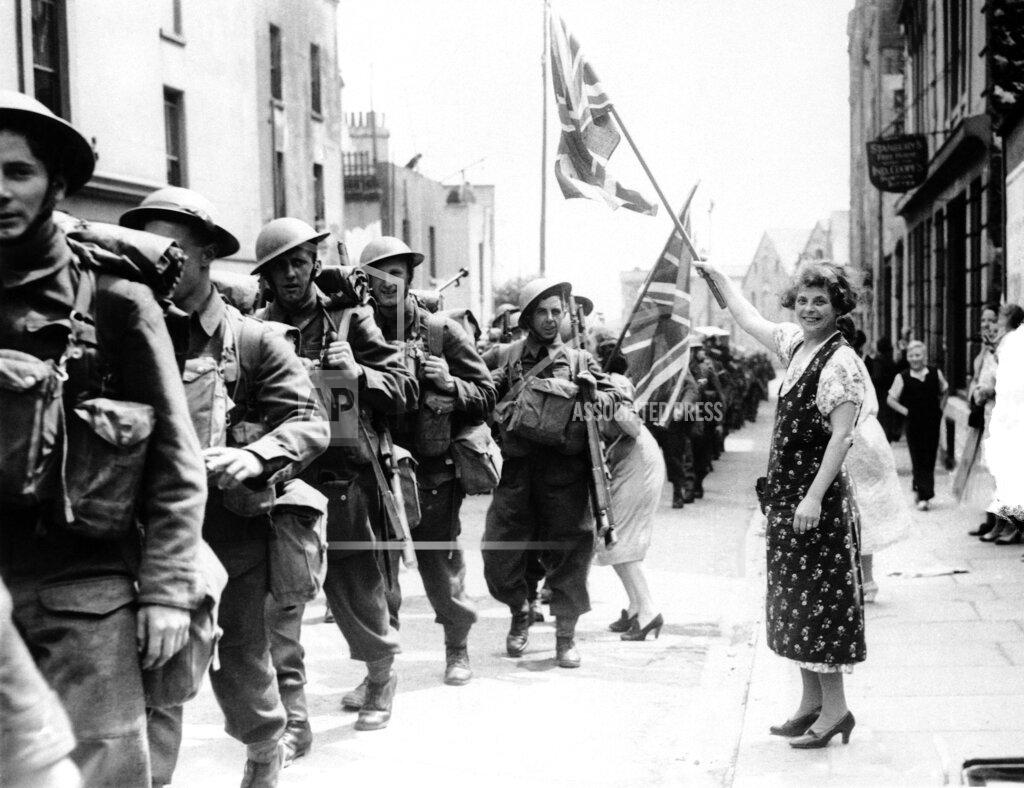
Vichy France severed diplomatic relations with Britain over the attack on Mers-el-Kébir. The French government remains furious at the British for attacking the French fleet at Mers-el-Kebir. The French Government of Marshal Henri Philippe Pétain today broke off diplomatic relations with Great Britain in anger over what it denounced as the “treachery” of the British Navy’s attack on defenseless French warships at Oran, Algeria. Truthfully, there has not been much communication at all between the two governments since the Armistice of 22 June 1940. French Prime Minister Pétain speaks out about declaring war on the UK, but cooler heads prevail.
The Government of Marshal Henri Philippe Pétain has designated Pierre Laval, former Premier and veteran politician, to draw up a new kind of Constitution giving France an “ultra-modern version of democracy.”
The Germans suspend Article 8 of the Armistice Agreement of 22 June 1940 which requires the demobilization and disarming of the French fleet. This may be due to the recent conflict between Vichy France and the British.
Lorient on the Bay of Biscay is now set up for U-boat operations, though as of yet no U-boats have been there. Basing U-boats on the Atlantic coast magnifies the perceived size of the fleet by cutting travel time to stations and reducing fuel required to get there.
The Germans ban all symbols of the French state, including the tricolor flag.
Albert Einstein’s nephew, Carl Einstein, commits suicide in France. He faced deportation to Germany.
Hitler presented the Knight’s Cross of the Iron Cross to Generalluftzeumeister Ernst Udet, the Director General of Luftwaffe Equipment.
Adolf Hitler departed from his headquarters at Tannenberg in southern Germany, returning to Berlin.
Count Ciano, the Italian Foreign Minister, left this morning by train for Berlin. He was accompanied by high officials of the Foreign Office and expects to stay in Berlin “for several days.”
In Britain, the south coast of England for twenty miles inland from Bexhill was declared to be a “Defence Area”.
Operation Fish: A British convoy including HMS Batory sailed from Greenock (Scotland) for Halifax, Nova Scotia, carrying gold bar and other valuables worth $1.7 billion for safe keeping in Canada, the largest movement of wealth in history.
De Valera rejects British proposal of uniting all of Ireland which would then declare war on Germany. Britain proposed uniting the two countries to present a united front against Germany. The Irish government rejects this proposal.
Rumania announced that it had joined the Axis Powers.
The railway line that runs to Narvik originates in Sweden and is vital for any military presence there. Today, the Germans reach an agreement with Stockholm for the transport of Wehrmacht personnel “on leave” to transit through Sweden, along with military supplies.
Pravda, Communist party newspaper, said today that Soviet defense preparations and the actions of the Red Army in the northwest, west and south were directed “against plans of the British-French warmongers” and were not directed against Germany.
A representative of Haj Amin, the Grand Mufti of Jerusalem, meets with Papen, German ambassador, in Istanbul seeking closer German-Arab relations.
The Iraqi government cuts off the flow of oil to Tripoli in Syria, showing its increasing Axis leanings. Iraq, of course, is technically governed by the British but has little control over the government due to its troops being in only a few large bases.
RAF Bomber Command dispatches 60 Blenheims, Hampdens, Wellingtons and Whitleys during daylight to carry out cloud-cover attacks on targets, mainly ports, in Germany and airfields in Holland. 2 Blenheims and 1 Wellington lost. 12 Hampdens carried out a minelaying operation. A report from Hamburg tells how one bomber carried out an attack on the liners Europa and Bremen, which were being prepared for Operation Sea Lion. 3 bombs fell very close to the ships but caused no damage.
RAF Bomber Command dispatches 51 aircraft to Kiel overnight but many bombed alternative targets; 1 Wellington lost. 12 Hampdens minelaying. (The normal minelaying force dispatched each night had now been increased to 12 Hampdens.)
RAF Blenheim bombers attack Tobruk during the day. The RAF sends nine Swordfish of No. 813 Squadron based on HMS Eagle at Sidi Barrani to attack Tobruk. They sink Italian destroyer Zeffro, badly damage destroyer Euro, force troop transport Liguria’s captain to run the ship onto the beach, sink freighter Manzoni and damage freighter Serenitas.
In addition, the RAF sends Blenheim bombers against Italian vehicles at Bardia and El Gubbi.
Italian aircraft attack RAF airfields in Egypt.
At Malta, a French Latecoere seaplane crewed by two French non-commissioned officers lands after a flight from Bizerta, Tunisia. They want to join the Royal Air Force. They are arrested for questioning. Otherwise, it is a fairly quiet day.
Vichy French torpedo bombers attack Gibraltar without causing any damage in retaliation for RN attack at Mers el Kebir
U-99, commanded by Kapitänleutnant Otto Kretschmer, sank Canadian steamer Magog (2053grt), a straggler from convoy HX.52, 58 miles WSW of Fastnet in 50-31N, 11-05W. At 1251 hours the Magog (Master T. Swales Doughty) was damaged by a stern torpedo from U-99 that exploded prematurely. The U-boat surfaced after 20 minutes and began to shell her until the master and 22 crew members abandoned ship in a lifeboat about 58 miles west-southwest of Fastnet. At 1352 hours, a G7e torpedo was fired that hit aft of amidships and broke the ship in two. The stern sank, but the foreship remained afloat on the cargo of timber even after the U-boat fired three rounds from the deck gun into it at 1505 hours. On 8 July, the wreck foundered in 50°32N/11°20W. The survivors had been questioned by the Germans and were later picked up by the Swedish merchant Fidra and landed at Queenstown, Cork. The 2,053-ton Magog was carrying timber and was headed for Preston, England.
Destroyer HMS Whirlwind (D 30) (Lt Cdr J. M. Rodgers) of the 11th Destroyer Flotilla was badly damaged by U-34, commanded by Korvettenkapitän Wilhelm Rollmann, southwest of Ireland in 50-17N, 08-48W. At 1826 hours, HMS Whirlwind was hit underneath the bridge by one G7e torpedo from U-34 about 120 miles west of Land’s End. The U-boat had spotted the destroyer at 1530 hours and missed her with two torpedoes at 1713 hours. The ship immediately lost her forepart while the rest remained afloat and was later scuttled by HMS Westcott (D 47) (LtCdr W.F.R. Segrave, RN) after picking up the survivors. 56 crew members were lost and one died of wounds the following day. Sloop HMS Leith was also standing by.
Destroyer HMS Imogen damaged her propellers in contact with a submerged object in the Fair Isle Channel.
British corvette HMS Calendula was damaged by near misses of German bombing off Plymouth at 1413. The corvette returned to Plymouth.
Six Swordfish of 823 Squadron and nine Skuas of 801 Squadron departed Hatston to attack a damaged merchant ship reported by a Hudson of 269 Squadron off the Norwegian coast. No contact was made, but returning Swordfish attacked Submarine HMS Tetrarch in 59-13N, 3-13E mistaking her for a German submarine. Five torpedoes were launched, but no damage was done to the Submarine.
Destroyer HMS Garth departed the Clyde at 1300 with minelayer HMS Menestheus for Loch Alsh. The destroyer continued on to Scapa Flow.
British minefield AW was laid in the Wash by minelayer HMS Plover and Dutch minelayer Willem Van Der Zaan on 5 and 6 July.
Special service ship HMS Emerald Wings (2139grt) arrived at Scapa Flow as a blockship and she was subsequently deployed.
Nine Swordfish of 813 Squadron from aircraft carrier HMS Eagle took off from Sidi Barrani and raided Tobruk. Italian destroyer Zeffiro was sunk. Italian destroyer Euro was badly damaged and her bow was blown off. She was later towed to Taranto and repaired. Italian liner Liguria (15,354grt) was bombed and beached to prevent sinking. Italian steamer Manzoni (3955grt) was sunk and steamer Serenitas (5171grt) was badly damaged. Both steamers were later repaired by the British for their use. Light cruisers HMS Capetown and HMS Caledon with destroyers HMS Janus, HMS Juno, HMS Imperial, and HMS Ilex, which all departed Alexandria on the 5th, were at sea to render assistance to downed flyers of the Tobruk raid.
U.S. Navy light cruiser USS Omaha (CL-4) relieved USS Trenton as Rear Admiral David M. LeBreton’s flagship for Squadron 40-T at Lisbon, Portugal.
Convoys OA.179 and OA.180 departed Methil escorted by Canadian destroyer HMCS St Laurent from 9 to 13 July and corvette HMS Hibiscus from 9 to 12 July. The convoy passed through the Pentland Firth on the 10th.
Convoy OB.179 departed Liverpool escorted by destroyer HMS Walker and sloop HMS Deptford from 5 to 8 July. The escorts were detached to convoy SL.37. The convoy dispersed on the 9th.
Convoy FN.214 departed Southend, escorted by destroyers HMS Vanessa, HMS Vega, and HMS Winchester. The convoy arrived at the Tyne on the 7th.
Convoy MT.103 departed Methil. The convoy arrived in the Tyne on the 6th.
Convoy FS.214 departed the Tyne, escorted by destroyer HMS Wolsey and sloop HMS Egret. The convoy arrived at Southend on the 6th.
Convoy FS.215 departed the Tyne, escorted by destroyer HMS Woolston and sloop HMS Fleetwood. Destroyers HMS Javelin and HMS Jupiter joined the convoy for 6 July. Patrol sloop HMS Shearwater joined on the 6th and arrived with the convoy. The convoy arrived at Southend on the 7th.
The War at Sea, Friday, 5 July 1940 (naval-history.net)
Destroyer WHIRLWIND (Lt Cdr J. M. Rodgers) of the 11th Destroyer Flotilla was badly damaged by U-34 southwest of Ireland in 50‑17N, 08‑48W.
Fifty-six ratings and the NAAFI manager were lost on the destroyer. Lt Cdr J. M. Rodgers, Lt C. R. Bax, and twenty-one ratings were wounded. Destroyer WESTCOTT took off the survivors and scuttled destroyer WHIRLWIND with gunfire.
Sloop LEITH was also standing by. She then returned to convoy OB.178.
Destroyer IMOGEN damaged her propellers in contact with a submerged object in the Fair Isle Channel.
British corvette CALENDULA was damaged by near misses of German bombing off Plymouth at 1413.
The corvette returned to Plymouth.
Six Swordfish of 823 Squadron and nine Skuas of 801 Squadron departed Hatston to attack a damaged merchant ship reported by a Hudson of 269 Squadron off the Norwegian coast.
No contact was made, but returning Swordfish attacked Submarine TETRARCH in 59-13N, 3-13E mistaking her for a German submarine.
Five torpedoes were launched, but no damage was done to the Submarine.
Destroyer GARTH departed the Clyde at 1300 with minelayer MENESTHEUS for Loch Alsh. The destroyer continued on to Scapa Flow.
British minefield AW was laid in the Wash by minelayer PLOVER and Dutch minelayer WILLEM VAN DER ZAAN on 5 and 6 July.
Convoys OA.179 and OA.180 departed Methil escorted by Canadian destroyer ST LAURENT from 9 to 13 July and corvette HIBISCUS from 9 to 12 July. The convoy passed through the Pentland Firth on the 10th.
Convoy OB.179 departed Liverpool escorted by destroyer WALKER and sloop DEPTFORD from 5 to 8 July. The escorts were detached to convoy SL.37. The convoy dispersed on the 9th.
Convoy FN.214 departed Southend, escorted by destroyers VANESSA, VEGA, and WINCHESTER. The convoy arrived at the Tyne on the 7th.
Convoy MT.103 departed Methil. The convoy arrived in the Tyne on the 6th.
Convoy FS.214 departed the Tyne, escorted by destroyer WOLSEY and sloop EGRET. The convoy arrived at Southend on the 6th.
Convoy FS.215 departed the Tyne, escorted by destroyer WOOLSTON and sloop FLEETWOOD. Destroyers JAVELIN and JUPITER joined the convoy for 6 July. Patrol sloop SHEARWATER joined on the 6th and arrived with the convoy. The convoy arrived at Southend on the 7th.
Special service ship EMERALD WINGS (2139grt) arrived at Scapa Flow as a blockship and she was subsequently deployed.
U-99 sank Canadian steamer MAGOG (2053grt), a straggler from convoy HX.52, 58 miles WSW of Fastnet in 50‑31N, 11‑05W.
The crew was rescued.
Nine Swordfish of 813 Squadron from aircraft carrier EAGLE took off from Sidi Barrani and raided Tobruk.
Italian destroyer ZEFFIRO was sunk.
Italian destroyer EURO was badly damaged and her bow was blown off. She was later towed to Taranto and repaired.
Italian liner LIGURIA (15,354grt) was bombed and beached to prevent sinking.
Italian steamers MANZONI (3955grt) was sunk and SERENITAS (5171grt) was badly damaged.
Both steamers were later repaired by the British for their use.
Light cruisers CAPETOWN and CALEDON with destroyers JANUS, JUNO, IMPERIAL, and ILEX, which all departed Alexandria on the 5th, were at sea to render assistance to downed flyers of the Tobruk raid.
Australian heavy cruiser HMAS AUSTRALIA joined Aircraft carrier HERMES and heavy cruiser DORSETSHIRE off Dakar.
World disarmament and determination by all nations to improve the living standards of their peoples were described by President Roosevelt today as two of the five essentials of a just and enduring peace. The other three were freedom of religion, freedom of speech, and freedom of the press. At the same time Mr. Roosevelt warned against ideological flirtation with the “corporate State,” either as a substitute for democratic government or as a medium for competing with totalitarian efficiency. Although their number was relatively small, still too many people, he said, were wedded to the idea of government by dictatorship, as in Germany, Italy and Russia. The Chief Executive outlined his ideas on the benefits of democratic government, with its checks and balances, as he sat behind a new mahogany desk in a room at the Franklin D. Roosevelt Library, which is to be his private study.
A single press conference question brought about the statement of the President’s views on the fundamental conflict between the diverging concepts of democratic and corporate government. Beginning with the observation that totalitarian governments now dominate the greater part of the world population, Mr. Roosevelt said there could be no compromise, even philosophical, between the two concepts of government. To do so would be to sacrifice the principles of one to those of the other. The remarks were interpreted by some observers as setting the pitch of the Democratic Presidential campaign, but this was suggested more by the approach of the party’s national convention than by the words of Mr. Roosevelt. He was careful to explain at the outset that his remarks were similar to those which he delivered yesterday to a group of employees on his estate.
Talk about the elements of peace at this time, the President conceded, was academic. On the other hand, the prescription of a universal peace should be kept in the mind of every citizen. The five “freedoms” which international tranquillity requires were defined by the President as follows:
- Freedom of information and knowledge, and of the press.
- Freedom of religion.
- Freedom of expression.
- Freedom from fear of attack and threats to territorial integrity.
- Freedom from want, and the greatest possible cultural and commercial intercourse among nations.
The Senate recessed for the week end after an eight-minute session today and made ready for a floor fight on Monday over President Roosevelt’s nominations of Colonel Henry L. Stimson to be Secretary of War and Colonel Frank Knox to be Secretary of the Navy.
Whether war or peace lies ahead, congressional sources estimated today, the country’s national defense bill will run to more than $3, 000,000,000 annually from now on and a good deal more than that the next seven years. In the period just ahead, the projected two-ocean $4,000,000,000 fleet expansion will be under construction and the army will buy planes, tanks, guns, and other equipment in huge quantities, as well as increase its personnel to 375,000 men, With army and navy fully equipped, it was said, there will be a maintenance cost of as much as $1,800,000,000 annually for the navy and $850,000,000 for the army.
A firm declaration in support of the Monroe Doctrine was made by Secretary of State Cordell Hull today on instructions by President Roosevelt as Germany rejected as without point the United States warning of June 18 to the European belligerents to keep hands off the Western Hemisphere.
The United States banned the trade of strategic materials with Japan. US President Roosevelt used the power given by the Export Control Act, which was just passed into law three days prior, to restrict the export of strategic minerals, strategic chemicals, aircraft engines, aircraft engine parts, and other equipment to Japan without special license.
Admiral James O. Richardson arrived in Washington for conferences with U.S. President Franklin D. Roosevelt and Navy and State Department officials concerning the retention of the U.S. Fleet in Hawaiian waters. He would depart to return to the fleet on July 17, 1940. Richardson was highly critical of the decision to retain the fleet at Pearl Harbor and his recalcitrance would lead to his replacement by Admiral Husband Kimmel in early 1941.
Expansion in the present aircraft production rate of 400 per cent will be required to reach the goal of 50,000 military airplanes a year, says T.P. Wright, vice president of engineering at the Curtiss-Wright Corporation and now adviser on aircraft on the National Defense Advisory Commission, in the July issue of Aviation Magazine.
A niece and nephew of Queen Elizabeth spent six strange hours in New York yesterday. The two children, Davina and Simon Bowes-Lyon, wanted only to look at the tall buildings they had seen on picture postcards and to eat American ice cream in peace and quiet. Instead they were floolwed by photographers and the press.
Wendell L. Willkie, Republican Presidential nominee, in a special interview published in today’s issue of The Day, Jewish daily newspaper, characterized anti-Semitism as “a possible criminal movement” and held that any growth of such a movement would be a “calamity” for the United States.
A contention by Senator Sheridan Downey, California Democrat, that the proposed “low pay” provisions of the Burke-Wadsworth compulsory military training bill might encourage “fifth column” activities in the United States was disputed today by Col. Julius Ochs Adler, general manager of the New York Times. He urged the senate military affairs committee to expedite the legislation and suggested a supplementary measure which would make some provision for dependents of men drafted under the program. The measure, sponsored by the Military Training Camps association, would require the registration of all men between the ages of 18 and 65. Those between the ages of 21 and 45 would be selected for military training by lottery methods and would be paid $5 a month and expenses.
Fires, with wind and heat for allies, broke out anew in Oregon today, sending vacationers scurrying from Mount Hood and destroying two industrial plants at Bend.
Lacrosse (Wisconsin State League) righty Merv Henley pitches a doubleheader against Fon Du Lac, allowing just one run in 16 innings, a 7th inning home run in game 2. He allows 7 hits and no walks. The 30–year-old Henley will finish the season at 20–3.
Major League Baseball:
The Brooklyn Dodgers outlast Boston, 6–2, in 20 innings in a contest lasting 5 hours and 19 minutes. The 4 runs in the 20th is a Major League record. The 2 teams’ epic marathon ties record-setters of 1920 and 1939. Bees manager Casey Stengel is tossed in the 10th after complaining too hard to Bick Campbell. Campbell ordered Dolph Camilli to bat again after flying out, because the ump had not seen the pitch. Joe Sullivan takes the loss, giving up the 4 runs in the 20th after tossing 9 scoreless frames.
In St. Louis, the Cubs deal the Cards an 11–5 defeat as Glen Russell drills a grand slam off Carl Doyle in Chicago’s 5–run 5th. Four days from now, Russell will undergo an emergency appendectomy that will sideline him the rest of the year. Augie Galan and Bill Nicholson also homer for the Cubs.
The Reds today came from behind with three runs in the ninth for a 5–4 victory over the Pirates and a clean sweep of their series of three games. Neither Jim Turner nor Danny MacFayden finished his starting mound assignment. The defeat was charged to MacFayden. It was his second of the year. Joe Beggs scored his fourth triumph of the season in a relief role.
The Giants crush the Philadelphia Phillies, 15–2. The Giants amass 17 hits, three of them by pitcher Cliff Melton, who scatters seven Phillie hits. Burgess Whitehead also has three hits, including a triple and a double, for five RBIs. Babe Young hits a two-run homer in the first to give the New Yorkers an early lead.
The Red Sox stopped their descent in the American League today as they pounded out fourteen hits to beat the Senators, 9–4. Jimmy Foxx hit his twentieth homer of the year with none on and Ted Williams walloped his eleventh with one on. Jake Early hit a round-tripper for the Senators. Washington got twelve hits off Jim Bagby.
The White Sox unleashed a thirteen-hit attack today to defeat the Browns, 10–8, in a slugging match that gave Chicago its fourth straight victory, its third in a row over St. Louis. The Sox attack was staged at the expense of Elden Auker, who was knocked out of the box in the fifth inning; Roxle Lawson, and Emil Bildilli.
The Yankees’ four-game winning streak was broken tonight when they lost to the Athletics, 6–3, before a crowd of 25,520 at Shibe Park in their third nocturnal game of the year. Monte Pearson, Steve Sundra and Atley Donald were not quite up to the pitching of Johnny Babich, a former Dodger, who is becoming a menace to Yankee hopes. Joe Gordon’s ninth home run of the year, which arrived in the second inning, and Joe DiMaggio’s thirteenth, a mighty blast that opened the sixth, were the only vital blows hit against Babich.
The Phillies hand Wally Berger his unconditional release.
Brooklyn Dodgers 6, Boston Bees 2
St. Louis Browns 8, Chicago White Sox 10
Pittsburgh Pirates 4, Cincinnati Reds 5
Philadelphia Phillies 2, New York Giants 15
New York Yankees 3, Philadelphia Athletics 6
Chicago Cubs 11, St. Louis Cardinals 5
Boston Red Sox 9, Washington Senators 4
The U.S. Navy heavy cruisers USS Wichita (CA-45), under command of Rear Admiral Andrew C. Pickens, and USS Quincy (CA-39) reached Rio Grande du Sol, Brazil. The light cruiser USS Phoenix (CL-46) departed Balboa, Panama Canal Zone for Valparaiso, Chile. These ships were visiting South America “to furnish a reminder of the strength and the range of action of the armed forces of the United States.”
Half of the 10,000 Japanese troops on the Hong Kong border have been withdrawn, apparently to reinforce the column that suffered severe losses near Tamshui in the East River area where Chinese regulars suddenly attacked recently.
Britain’s control of most of the French fleet has depressed Japanese chauvinists because they feel this immense augmentation of the British fleet will enable the United States Fleet to remain in the Pacific indefinitely. Japanese expansionists had hoped Germany would control the French Navy, thereby weakening British naval strength and causing a wider distribution, which, in turn, would force Washington to shift most American naval vessels into the Atlantic. They believed this would force the United States to adopt a policy of conciliation toward Tokyo.
Reports from Indo-China indicate the French authorities there are likely soon to declare their support of the French committee in London and announce their determination to continue fighting. Such a development, it is believed, would reflect the feeling of most Frenchmen in the Far East. It is also considered inevitable because of Indo-China’s geographical position in reference to Hong Kong, Burma, and Singapore. Such a declaration is believed likely to bring the promise of British assistance in case of Japanese encroachment. [No. The British have enough on their plate in Europe and Egypt and simply do not have the ability to take on Japan’s navy as well.]
“Last-minute” efforts were being made today in Tokyo and London to prevent a final British rejection of Japan’s demand that Britain stop shipments through Burma and Hong Kong into Chinese nationalist territory. Persons close to Foreign Minister Hachiro Arita and the British Ambassador, Sir Robert Craigie, said there “still was hope that a compromise agreement might be reached.” The fact that Britain has not yet delivered a formal reply to Japan’s note on the subject was considered “a hopeful sign.”
An appeal to Britain not to allow “China’s lifeline through Burma to be cut at the expense of China’s friendship and her own enlightened self-interest and democratic purpose” was made tonight by Quo Tai-chi, the Chinese Ambassador.
Dow Jones Industrial Average: 121.51 (+0.55)
Born:
Eddie Miles, NBA shooting guard and point guard (NBA All-star, 1966; Detroit Pistons, Baltimore Bullets, New York Knicks), in North Little Rock, Arkansas.
Karen Shepherd, American politician (Member of the U.S. House of Representatives-D-Utah, 1993-1995), in Silver City, New Mexico.
Arthur Blythe, American jazz saxophonist, in Los Angeles, California (d. 2017).
Chuck Close, American painter and photographer, in Monroe, Washington (d. 2021).
Died:
Carl Einstein, 55, German Jewish writer (suicide).
Naval Construction:
The Royal Navy “S”-class (Third Group) submarine HMS Sahib (P 212) is laid down by the Cammell Laird Shipyard (Birkenhead, U.K.).
The Royal Canadian Navy corvette HMCS Chicoutimi (K 156) is laid down by Canadian Vickers Ltd. (Montreal, Quebec, Canada).
The Royal Navy Hunt-class (Type I) escort destroyer HMS Southdown (L 25) is launched by J.S. White & Co. (Cowes, U.K.).
The Royal Navy Bar-class boom defense vessel HMS Barcliff (Z 70) is commissioned.
The Royal Navy Fairmile A-class motor launch HMS ML 106 is commissioned.
The Royal Navy Vosper 70-foot class motor torpedo boat HMS MTB 31 is commissioned. Her first commanding officer is Lieutenant Denis Jermain, RN.
The Kriegsmarine (German Navy) Type IXB U-boat U-103 is commissioned. Her first commander is Korvettenkapitän Victor Schütze.
 History Diaries