Operation Seelöwe (Sealion), a plan for the invasion of Britain, was first mentioned by the German General Staff.
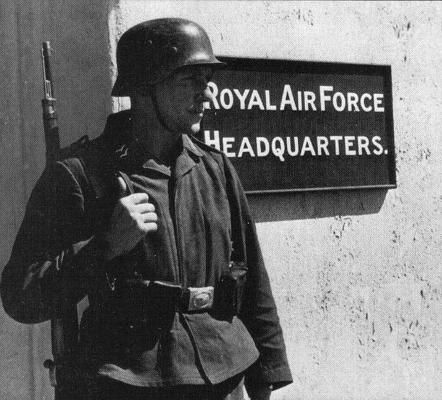
German troops landed on the island of Guernsey off the French coast, meeting no opposition.
German troops landed on the island of Jersey off the French coast, meeting no opposition. German forces took Jersey, completing the occupation of the Channel Islands.
Marshal Philippe Pétain’s government moved to from Bordeaux to Vichy, France. The collaborationist state run from there came to be known as Vichy France.
U.S. Ambassador to France William C. Bullitt had a lengthy private interview with the President of the French Council of Ministers, Marshal Henri Philippe Pétain, in which the latter informed the envoy that orders had been given “to every captain of the French Fleet to sink his ship rather than permit [it] to fall into German hands.” The same day, Bullitt also has interviewed with Admiral François Darlan, who informed him that if the Germans should demand the Fleet, it had orders to leave at once for Martinique and Guantanamo to place its ships in U.S. hands. He echoed Marshal Pétain’s declaration that French ships had orders to scuttle if the Germans attempted to seize them.
The farming area north of Paris, which is occupied by the Wehrmacht, has lost most of its inhabitants to the south. Crops are said to be untended and farm animals on the loose. There remain many unburied corpses.
The Free French government-in-exile established its own Military Intelligence Service under Major André Dewavrin, Service de Renseignements.
Germany requested neutral nations to withdraw their diplomatic missions from Belgium, the Netherlands, Norway, and Luxembourg. Germany asked the United States to withdraw diplomatic missions from Norway, Belgium, The Netherlands, and Luxemburg by July 15, 1940. Political questions would be handled through Berlin.
Albrecht Lanz was declared the military governor of the Channel Islands.
Maximilian von Weichs was promoted to the rank of Generaloberst.
Winston Churchill recorded in his diary that during a meeting with the U.S. Ambassador, Joseph Kennedy had stated that Britain was beaten and that Adolf Hitler would be in London by the 15th of August.
A new anti-invasion defense zone, varying between five and twenty miles in depth, is now being completed along the south and east coasts of England.
King George accompanied by several army officers motored today to a southeast coast town and inspected defense preparations. Members of the party said the king showed “lively interest” in everything, “particularly along the sea front.”
The British government advised women to conserve wood by wearing shoes with flatter heels.
Sir Stafford Cripps delivers message to Stalin from Churchill seeking closer relations.
British milk price ceiling was increased to 4 pence per pint.
Coal rationing introduced in Britain.
Raczkiewicz moves the Polish government-in-exile from France to London after the defeat of France
Italy threatened to take action against Greece saying that it possessed proof that British warships were using Greek territorial waters for the purpose of attack against the naval forces of Italy.
Rodolfo Graziani was named the Governor-General of Italian Libya. Marshal Rodolfo Graziani, Chief of Staff of the Italian Army, has been appointed to succeed Air Marshal Italo Balbo as commander of all the armed forces of North Africa. It was announced this morning that he had already reached Libya by airplane.
Hungarian forces deploy on the Rumanian border. Hungary was on a war footing tonight with troops massed along the border of Transylvania, which Hungary lost to Rumania in 1918.
German bombers, reportedly purchased by Rumania, land at Transylvania airport as Rumania prepares for a possible invasion by Hungary.
The Rumanian government renounced the Anglo-French guarantee of territorial integrity that dated from April 13, 1939. King Carol II of Rumania renounced the guarantees given to him by the United Kingdom in 1939 and announced that henceforth his country’s alliegance would be with Germany.
Diplomatic reports received in Bulgaria today from Bucharest were to the effect that it was an “open question” as to whether Russian troops would stop their advance at the River Pruth or would march into the old kingdom of Rumania.
Joseph Stalin told his Ambassador to Tokyo that the non-aggression pact with Germany “was dictated by the desire to unleash war in Europe”.
Informed Turkish sources predicted tonight that Russia soon would submit proposals to Turkey concerning control of the Aegean and Black seas and the strategic straits connecting them. The government was represented as being confident that it could reach an understanding with Moscow on the question of what fleets would be allowed future use of the Bosporous and the Dardanelles.
Britain, making her first move in an effort to salvage what she can out of the wreck of France, announced tonight that the government “could not allow Syria or Lebanon to be occupied by any hostile power.”
Professor Fritz Lenz of the Kaiser Wilhelm Institute of Anthropology, Human Heredity, and Eugenics expresses his views on “euthanasia” in writing: “Detailed discussion of so-called euthanasia… can easily lead to confusion about whether or not we are really dealing with a matter which affects the safeguarding of our hereditary endowment. I should like to prevent any such discussion. For, in fact, this matter is a purely humanitarian problem.” Note: Between 1939 and 1941, Professor Lenz had proposed the following formulation for Article 2.1 of the proposed law on euthanasia “The life of a patient, who otherwise would need lifelong care, may be ended by medical measures of which he remains unaware.”
Dr. Jaspersen of Bethel attempts to persuade the heads of departments of psychiatry in German universities to make a collective protest against euthanasia. These professors make no move. Professor Ewald remains an isolated protester.
German-Jewish mental patients are murdered during July 1940 in the Brandenburg extermination institute.
Luftwaffe bombers raid Hull and Wick, and according to some reckonings this marks the opening of the Battle of Britain. German bombers began a campaign against British industrial centers, beginning with a daylight raid on Hull, England and Wick, Scotland, killing 12 and wounding 22.
No.80 (Signals) Group is created this month to operate jamming transmitters (Aspirin) to combat the German Knickebein navigation system, codenamed Headache.
The Spitfire PR Mk.IF enters service this month. This is an unarmed reconnaissance model with two 30 gallon blister wing tanks, and the 29 gallon aft fuselage tank. Most earlier models will be converted to PR Mk.IF standard.
RAF Bomber Command dispatches 38 aircraft — 24 Wellingtons, 13 Whitleys, and 1 Blenheim — on ‘cloud-cover raids’ to Germany. Most of the targets were in the Ruhr but 5 Whitleys attempted to bomb the battleship Scharnhorst at Kiel; results are not known. 1 Whitley lost. 24 Blenheims carried out extensive photographic reconnaissance of the French coast without loss.
RAF Bomber Command dispatches 73 aircraft to Osnabruck and Kiel and minelaying. 1 Hampden and 1 Whitley lost. One of the Hampdens attacking the Scharnhorst at Kiel was flown by Flying Officer Guy Gibson of 83 Squadron, who dropped the first 2,000-lb bomb of the war. He released it on the sixth shallow dive-bombing attempt but the bomb overshot the Scharnhorst and exploded in the town of Kiel. 10 people were killed in Kiel on this night.
British RAF Fighter Command chief Hugh Dowding’s son Derek became a pilot with the No. 74 Squadron.
Quintin Brand was promoted to the temporary rank of air vice marshal.
By this date, about 900,000 tons of Allied shipping had been sunk by German U-boats in 6 months of war.
U-52 refueled from German tanker Bessel (1878grt) at Vigo.
U-26, commanded by Kapitänleutnant Heinz Scheringer, damaged steamer Zarian (4871grt) in convoy OA.175 in 48-03N, 11-11W, and corvette HMS Gladiolus stood by her overnight. At 0118 hours, U-26 (Scheringer) fired two G7a torpedoes at two ships in convoy OA.175. One of them hit the Zarian in station #14 on the port side aft. There were no casualties. She was towed to port by HMS Salvonia (W 43) (Lt G.M.M. Robinson, RNR), repaired and returned to service in June 1941. The 4,871-ton Zarian was carrying ballast and was bound for Dakar, Senegal. The U-26 was sunk a few hours after this attack.
The U-26 was scuttled southwest of Ireland after suffering heavy damage by depth charges from the corvette HMS Gladiolus (K 34) and bombs from an Australian Sunderland aircraft. Of the ship’s complement, all 48 survived. During its career under two commanders the U-26 sank 11 merchant ships for a total of 48,645 tons and damaged 1 merchant ship for a total of 4,871 tons.
Sailing with Convoy SL.36, the British steam merchant Clearton was torpedoed and sunk by the U-102, commanded by Kapitänleutnant Harro von Klot-Heydenfeldt, approximately 180 miles west of Ushant in the eastern Atlantic Ocean in 47° 53’N, 9° 30’W. At 1155 hours the Clearton (Master John Edward Elsdon) in convoy SL.36 was torpedoed and damaged by U-102. At 1325 hours, the now straggling vessel was again torpedoed by the U-boat and sank 042° 240 miles from Smalls. Eight crew members were lost. The master, 24 crew members and one gunner were picked up by HMS Vansittart (D 64) (LtCdr R.G.K. Knowling, RN), which had sunk U-102 shortly after the last attack and landed the survivors in Plymouth on 4 July. Four of the survivors had been seriously injured during the attack and one of them died of wounds in a hospital. The 5,219-ton Clearton was carrying cereals and was headed for Manchester, England.
Destroyer HMS Vansittart, escorting tug Salvonia (571grt) to meet Zarian, attacked and sank U-102 with the loss of all 43 crew off Ushant in 48-33N, 10-26W. U-102 was on her first war patrol, had attacked a convoy on 30 June off North Channel, and was not heard from again, believed lost, cause unknown, but probably mined off the southwest of Ireland. However recent investigation has now attributed her loss to Vansittart. During its career under Kapitänleutnant von Klot-Heydenfeldt the U-102 sank 2 merchant ships for a total of 5,430 tons.
U-30, commanded by Kapitänleutnant Fritz-Julius Lemp, sank steamer Beignon (5218grt) in 47-20N, 10-30W. At 0023 hours, U-30 attacked convoy SL.36 about 300 miles west of Ushant and claimed the sinking of one ship with 7,900 tons. This claim is not confirmed by Allied reports. At 0400 hours, the U-boat attacked again and sank the Beignon. The Beignon (Master William John Croome) had picked up 84 survivors of the Avelona Star (13,376grt), which had been torpedoed by U-43 (Ambrosius) in the same convoy at 2227 hours on 30 June. Three crew members and three survivors were lost. The master, 29 crew members and 81 survivors were picked up by the HMS Vesper (D 55) (LtCdr W.F.E. Husssey DFC) and HMS Windsor (D 42) (LtCdr P.P.H.R. Pelly) and landed at Plymouth. The 5,218-ton Beignon was carrying passengers and wheat and was headed for Newcastle, England.
U-29, commanded by Kapitänleutnant Otto Schuhart, sank Greek steamer Adamastos (5889grt) in 46-20N, 14-30W. At 1917 hours the unescorted Adamastos was stopped by U-29 southwest of Ireland. The crew abandoned ship immediately when the U-boat surfaced nearby. The Germans then boarded the ship for fresh provisions and sank her by gunfire. Of the ship’s complement, all 25 survived. The 7,466-ton Adamastos was carrying wheat and was headed for Avonmouth, England.
U-65, commanded by Kapitänleutnant Hans-Gerrit von Stockhausen, damaged Dutch steamer Amstelland (8156grt) in 47-53N, 13-23N. At 1351 hours the unarmed Amstelland (Master Cornelis S.T. van Rietbergen) in station #44 of convoy OA.175 was hit on starboard side aft by the last torpedo from U-65 about 380 miles southwest of Lands End. One crew member was blown overboard by the explosion and drowned. Stockhausen claimed to have sunk his victim, but despite being disabled by the hit the ship remained afloat with a flooded #5 hold for two days, before she was taken in tow by HMS Marauder (W 98) (Lt W.J. Hammond, RNR). HMS Calendula (K 28) (LtCdr A.D. Bruford, RNVR) escorted the damaged vessel to Falmouth, where they arrived on 5 July. The ship was repaired and returned to service on 18 February 1941. The 8,156-ton Amstelland was carrying ballast and was bound for Buenos Aires, Argentina.
[On 26 February 1941, the Amstelland (Master C.S.T. van Rietbergen) was bombed by a German aircraft in 54°12N/16°W. This happened on the first voyage after being repaired, in ballast from Falmouth to Buenos Aires. The master was the only casualty of her complement of 45 men, who died of wounds aboard HMS Vanquisher (D 54) (Cdr N.V. Dickinson, DSC, RN). Two days later she was taken in tow by the rescue tug HMS Zwarte Zee (W 163) but had to be abandoned and sank in 54°10N/14°38W.]
Admiral James Somerville took command of Force H.
Battleship HMS Barham with destroyers HMS Imogen, HMS Atherstone, HMS Fernie, and HMS Warwick departed Liverpool at 0900/1st for Scapa Flow, and arrived safely at 2152 on the 2nd.
Aircraft carrier HMS Furious and heavy cruiser HMS Devonshire departed Halifax escorting troopship Empress Of Canada (21,517grt). Furious arrived at Scapa Flow on the 15th.
Light cruiser HMS Manchester departed Rosyth for Sheerness.
After British aircraft bombed a submarine contact at 0600 in 58-21N, 2-51W, destroyers HMS Ashanti, HMS Cossack (D.4), HMS Maori, and HMS Echo were ordered to hunt for the submarine. Ashanti departed Scapa Flow and joined the other destroyers at sea. Echo had left Scapa Flow at 0800 escorting minelayer HMS Atreus to Greenock, but shortly after departure, was detached to join them.
Destroyer HMS Walker departed the Clyde at 0700 escorting troopship Empress Of Britain (42,348grt) to Liverpool. After delivering her, Walker returned to the Clyde.
Destroyer HMS Berkeley arrived at Greenock at 1730 escorting steamer Kohistan (5884grt).
After British aircraft bombed a submarine contact in 55-02N, 5-38W, destroyer HMS Walker and escort ship HMS Jason were ordered at 2226 to hunt for the submarine, but failed to make contact.
Hunt class destroyer HMS Garth completed, and worked up at Scapa Flow in the 23rd Destroyer Division before transferring to the 21st Destroyer Flotilla, arriving at Sheerness on 28 August.
German heavy cruiser Prinz Eugen, under construction at Kiel, was damaged in air bombing during the night of 1/2 July.
German armed merchant cruiser Thor captured Dutch steamer Kertosono (9289grt) in 12N, 31W in the Central Atlantic. Steamer Kertosono arrived Lorient on the 12th.
Special service vessels Tweedledee (163grt) and Tweedledum (163grt) were sunk as blockships.
The Mediterranean Fleet arrived back at Alexandria.
Light cruiser HMS Liverpool departed Alexandria carrying troops to Aden and arrived at Suez later that day. Arriving at Aden, after disembarking the troops, she embarked the Eastern Fleet’s reserve of six inch ammunition and returned to Mediterranean arriving on the 6th. Light cruiser Liverpool departed Port Said on the 7th and joined the Mediterranean Fleet at sea.
Convoy SL.38 departed Freetown escorted by armed merchant cruiser HMS Carnarvon Castle to 17 July. On the 17th, destroyer HMS Vanquisher, sloop HMS Fowey, and corvettes HMS Camellia and HMS Clarkia joined the convoy and escorted it to Liverpool arriving on the 20th. The armed merchant cruiser proceeded to Belfast for refitting.
Light cruiser HMS Dragon departed Freetown for Manoca. The light cruiser called at Lagos for refuelling at Lagos on 3 and 4 July.
British liner Arandora Star departed Liverpool, England for Canada with 479 German and 734 Italian civilian internees, 86 German prisoners of war, and 374 British crew and guards. Some of the civilian internees were Jewish refugees who had previously been able to escape from Nazi Germany. Arandora Star failed to display a red cross to denote that she was carrying civilians and prisoners of war.
Convoy OA.177G departs Southend.
Convoy OB.177 departs Liverpool.
Convoy FN.210 departed Southend, escorted by destroyer HMS Wolsey, sloop HMS Egret, and patrol sloop HMS Mallard, and arrived in the Tyne on the 3rd.
Convoy MT.100 departed Methil, and arrived in the Tyne on the 2nd.
Convoy FS.209 departed the Tyne, escorted by sloops HMS Black Swan and HMS Hastings, and arrived at Southend on the 2nd.
The War at Sea, Monday, 1 July 1940 (naval-history.net)
Battleship BARHAM with destroyers IMOGEN, ATHERSTONE, FERNIE, and WARWICK departed Liverpool at 0900/1st for Scapa Flow, and arrived safely at 2152 on the 2nd.
Aircraft carrier FURIOUS and heavy cruiser DEVONSHIRE departed Halifax escorting troopship EMPRESS OF CANADA (21,517grt). FURIOUS arrived at Scapa Flow on the 15th.
Light cruiser MANCHESTER departed Rosyth for Sheerness.
After British aircraft bombed a submarine contact at 0600 in 58‑21N, 2‑51W, destroyers ASHANTI, COSSACK (D.4), MAORI, and ECHO were ordered to hunt for the submarine. ASHANTI departed Scapa Flow and joined the other destroyers at sea. ECHO had left Scapa Flow at 0800 escorting minelayer ATREUS to Greenock, but shortly after departure, was detached to join them.
Destroyer WALKER departed the Clyde at 0700 escorting troopship EMPRESS OF BRITAIN (42,348grt) to Liverpool. After delivering her, WALKER returned to the Clyde.
Destroyer BERKELEY arrived at Greenock at 1730 escorting steamer KOHISTAN (5884grt).
After British aircraft bombed a submarine contact in 55‑02N, 5‑38W, destroyer WALKER and escort ship JASON were ordered at 2226 to hunt for the submarine, but failed to make contact.
Hunt class destroyer GARTH completed, and worked up at Scapa Flow in the 23rd Destroyer Division before transferring to the 21st Destroyer Flotilla, arriving at Sheerness on 28 August.
Convoy FN.210 departed Southend, escorted by destroyer WOLSEY, sloop EGRET, and patrol sloop MALLARD, and arrived in the Tyne on the 3rd.
Convoy MT.100 departed Methil, and arrived in the Tyne on the 2nd.
Convoy FS.209 departed the Tyne, escorted by sloops BLACK SWAN and HASTINGS, and arrived at Southend on the 2nd.
U-52 refueled from German tanker BESSEL (1878grt) at Vigo.
U-26 damaged steamer ZARIAN (4871grt) in convoy OA.175 in 48‑03N, 11‑11W, and corvette GLADIOLUS stood by her overnight. Destroyer VANSITTART, escorting tug SALVONIA (571grt) to meet ZARIAN, attacked and sank U-102 with the loss of all 43 crew off Ushant in 48-33N, 10-26W. U-102 was on her first war patrol, had attacked a convoy on 30 June off North Channel, and was not heard from again, believed lost, cause unknown, but probably mined off the southwest of Ireland. However recent investigation has now attributed her loss to VANSITTART.
U-30 sank steamers BEIGNON (5218grt) in 47‑20N, 10‑30W and CLEARTON (5219grt) of convoy SL.36 in 47‑53N, 09‑30W. BEIGNON had previously picked up the survivors from steamer AVELONA STAR (13,376grt). One crewman was lost, two missing and three survivors from AVELONA STAR missing from BEIGNON, with destroyer VESPER picking up the survivors.
Eight crew were lost on the steamer CLEARTON. Destroyers VESPER and WINDSOR picked up the survivors of CLEARTON 240 miles 42° from The Smalls.
U-29 sank Greek steamer ADAMASTOS (5889grt) in 46‑20N, 14‑30W.
The entire crew was rescued.
U-65 damaged Dutch steamer AMSTELLAND (8156grt) in 47‑53N, 13‑23N.
German heavy cruiser PRINZ EUGEN, under construction at Kiel, was damaged in air bombing during the night of 1/2 July.
German armed merchant cruiser THOR captured Dutch steamer KERTOSONO (9289grt) in 12N, 31W in the Central Atlantic. Steamer KERTOSONO arrived Lorient on the 12th.
Special service vessels TWEEDLEDEE (163grt) and TWEEDLEDUM (163grt) were sunk as blockships.
The Mediterranean Fleet arrived back at Alexandria.
Light cruiser LIVERPOOL departed Alexandria carrying troops to Aden and arrived at Suez later that day.
Arriving at Aden, after disembarking the troops, she embarked the Eastern Fleet’s reserve of six-inch ammunition and returned to Mediterranean arriving on the 6th.
Light cruiser LIVERPOOL departed Port Said on the 7th and joined the Mediterranean Fleet at sea.
Convoy SL.38 departed Freetown escorted by armed merchant cruiser CARNARVON CASTLE to 17 July.
On the 17th, destroyer VANQUISHER, sloop FOWEY, and corvettes CAMELLIA and CLARKIA joined the convoy and escorted it to Liverpool arriving on the 20th.
The armed merchant cruiser proceeded to Belfast for refitting.
Light cruiser DRAGON departed Freetown for Manoca. The light cruiser called at Lagos for refueling at Lagos on 3 and 4 July.
President Roosevelt, after a conference with legislative leaders, sent a message to Congress recommending enactment of a steeply graduated excess profits tax. He conferred with William S. Knudsen, Louis Johnson, Acting Secretary of War, and General George C. Marshall, Chief of Staff, on plans for operating strongly mechanized units in the Army, and with T. V. Soong, director of the Bank of China; John W. Carmody, Work Projects Administrator, and Charles Michelson, publicity director of the Democratic National Committee. He signed the bill providing for the speeding up of naval construction and several other measures passed by Congress.
The Senate confirmed the nomination of Robert H. Hinckley to be Assistant Secretary of Commerce, heard Senator Pepper criticize Wendell L. Willkie, the Republican Presidential nominee, and recessed at 12:51 PM until noon on Wednesday.
The House passed a bill requiring registration of organizations subject to or which engage in civilian military activity, considered bills on its consent calendar and adjourned at 2:31 PM until noon tomorrow.
Declaring that no one should be enriched by the national rearmament effort, President Roosevelt asked Congress today to pass a “steeply graduated” excess profits tax. The levy, he said, should be applied to all individuals and corporations “without discrimination.” “We are engaged in a great national effort to build up our national defenses to meet any and every potential attack,” he said. “We are asking even our humblest citizens to contribute their bit. It is our duty to see that the burden is equitably distributed according to ability to pay so that a few do not gain from the sacrifices of the many.”
The House passed without debate and sent to the Senate today legislation which the Judiciary Committee said would subject the Communist party and the German-American Bund to registration with and close scrutiny of the Justice Department. The measure would require the registration of the following:
- Organizations subject to foreign control which engage in political activity.
- Organizations which engage both in civilian military activity and in political activity.
- Organizations subject to foreign control which engage in civilian military activity.
- Organizations any of whose purpose or aims is the establishment, control, conduct, seizure, or overthrow of a government by the use of force, violence, military measures or threats thereof.
President Roosevelt will shortly place before Congress a $5,000,000,000 long-range plan for mechanization and rearmament of the army, it was announced today as the preparedness program was accelerated on all fronts. Tho project, supplementing the $5,000,000,000 defense program already enacted, is being put in final draft by Mr. Roosevelt, his defense production chief, William S. Knudsen, Acting Secretary of War Louis Johnson and Army Chief of Staff General George C. Marshall.
Uniform procedure in criminal trials in federal courts is assured through a bill signed today by President Roosevelt and described by him as a far-reaching and important step in law reform. Six years ago the Supreme Court was authorized to make rules for uniform procedure in civil trials in the federal courts, the result meeting with great praise. Under the measure signed today the court is permitted to do the same thing with respect to criminal trials.
Germany rejected an American diplomatic note dated June 18, 1940. “The German Reich . . . has given no occasion whatever for the assumption that it intends to acquire such possessions, . . . the nonintervention in the affairs of the American Continent by European nations which is demanded by the Monroe Doctrine can in principle be legally valid only on condition that the American nations for their part do not interfere in the affairs of the European Continent.”
Apparently refreshed by his weekend cruise on the yacht Jamaroy, owned by Roy W. Howard, newspaper publisher, Wendell L. Willkie, Republican nominee for President, expressed hope yesterday that President Roosevelt would run for a third term. “Why? Because I want to beat him,” Willkie explained.
The noted American aviator James H. “Jimmy” Doolittle was recalled to active service as a Major and began assisting U.S. car manufacturers as they switched to aircraft production.
The Tacoma Narrows Bridge opened in Washington, the third-longest suspension bridge in the world at the time of construction. The Tacoma Narrows Bridge, nicknamed “Galloping Gertie,” opens in the state of Washington, connecting the Olympic peninsula to the industrial Washington mainland. It will collapse into the Puget Sound on 7 November 1940 in one of history’s worst engineering disasters.
The responsibility for nuclear fission research in the United States was transferred to the National Defense Research Committee under Vannevar Bush.
This month, the National Defense Research Committee established the Jet Propulsion Research Committee under Section H of Division A, at Naval Powder Factory, Indian Head, Maryland, to conduct fundamental research on rocket ordnance. C. N. Hickman, who had worked with Dr. Goddard during World War I, was named as head.
The U.S. Navy issued contracts for the construction of 44 new warships and one non-combatant vessel. The cost int otal will be $550,000,000. It was the single largest contract-letting in United States Navy history.
U.S. Navy awarded a $30,870,000 contract to build naval facilities across the Pacific.
The Headquarters Marine Aircraft Wing, Fleet Marine Force, commanded by Brigadier General Ross E. Rowell, USMC, was established at the Marine Corps Base, San Diego, California.
Abbott and Costello take over a time slot given up by Fred Allen on NBC Red Network.
Lana Turner and Artie Shaw, who disagreed the day they met, still disagreed today over whether their four-and-half month’s old marriage is on the rocks. The pretty little red-head disclosed that she had left the dark and moody bandmaster and moved to an apartment. To which Shaw retorted: “There’s nothing to it. We were out together last night and we are still living together.” Lana, whose “sweater personality” has made her a favorite of cameramen, simply confirmed the separation.
Major League Baseball:
The slugging of Frank Hayes, All-Star game catcher, and Al Rubeling, whose combined total of seven hits went for fifteen bases, enabled the Athletics to overwhelm the Red Sox, 9–1, in today’s series opener. Both had perfect days at bat but Hayes led the attack by knocking two homers, a double and a single to score four runs and drive in three. Rubeling connected for a two-bagger and a pair of singles.
Detroit’s Buck Newsom won his 11th victory in a row, 3–1, over the White Sox, allowing six hits and fanning seven. Charlie Gehringer tripled and Hank Greenberg had an RBI double. Johnny Rigney took the loss.
The Browns, currently the American League’s No. 1 trouble-makers, defeated the Indians, 2–1, tonight to cut the Tribe’s lead over second-place Detroit to one game. A homer by Harlond Clift in the sixth inning after two were out gave St. Louis its first run. The other came in the eighth after Ray Radcliff doubled, advanced to third when George McQuinn was thrown out at first, and came home on a wild pitch.
The Yankees found the sweeping southpaw curves of Ken Chase to their liking and, with Joe DiMaggio and George Selkirk connecting for homers, hammered out an 8-4 decision over the Senators at Griffith Stadium today.
The Cubs suffered their fourth straight defeat today when Claude Passeau, a relief pitcher, walked Paul Waner with the bases filled in the tenth inning to give Pittsburgh a 4–3 victory. Vince DiMaggio tied the score for the Pirates with a home run off Vern Olsen in the ninth. The homer was the ninth of the season for DiMaggio, who previously had singled, doubled and stolen a base off Ken Raffensberger, Chicago’s starting pitcher.
The Dodgers topped the Phillies, 4–3, in Philadelphia. The booming bat of Dixie Walker, who hit safely for the eleventh consecutive game, played a vital part in the Brooklyn victory, and Joe Medwick weighed in with a most important three-bagger. The Dodgers scored three times against Hugh Mulcahy in the first inning and picked up an unearned run in the fourth.
Bill Melton struck out nine and went the distance as the Giants whipped the Boston Bees, 7–1. The Giants only had seven hits, but made the most of them with help from homers by Harry Danning, Tony Cuccinello, and Mel Ott.
Enos Slaughter, Lon Warneke and Ernis Koy were key men in the Cardinals’ 3–2 defeat of the Reds today. Slaughter’s two home runs, his third and fourth of the season, accounted for all the St. Louis runs. Warneke allowed only seven hits and was tight in the pinches. Koy made a great catch of Bill Werber’s long clout for the last out of the game which, had it been a hit, would have tied the score.
Philadelphia Athletics 9, Boston Red Sox 1
Pittsburgh Pirates 4, Chicago Cubs 3
St. Louis Browns 2, Cleveland Indians 1
Chicago White Sox 1, Detroit Tigers 3
Boston Bees 1, New York Giants 7
Brooklyn Dodgers 4, Philadelphia Phillies 3
Cincinnati Reds 2, St. Louis Cardinals 3
New York Yankees 8, Washington Senators 4
United States immigration officials clamped dozen a rigid barrier at the Detroit-Windsor border after midnight this morning, and more than one hundred persons seeking admittance to this country were turned back to Canada. It was the first time in more than a century that free passage across the open U.S.-Canada border was denied, without passports and visas.
The United Kingdom’s first “evacuated” prisoners of war stepped to Canadian soil yesterday, ending a voyage of tense days and nights on the high seas. One prisoner committed suicide while en route by diving through a porthole.
It was reported today that Brazil helped Uruguay escape only by the narrowest of margins a serious fifth column revolt, supported by Nazi organizations, early last month.
The problem of how Brazil and the United States can cooperate effectively to immobilize a fifth column aimed — if Germany should win the European war — at the immediate Nazi domination of Brazil, economically and eventually politically and possibly militarily, is today’s biggest issue at Rio de Janeiro.
Destroyer USS O’Brien arrives at Santos, Brazil.
Battle of South Kwangsi: Japanese 22nd Army pushing toward Lungchin against minimal opposition.
Evacuation of British non-essentials is in progress from Hong Kong. Two shiploads of American citizens and British women and children left Hong Kong early today in the vanguard of an evacuation ordered because of fears of a Japanese attack on this British Crown Colony.
A Japanese charge that information concerning Japanese troop movements furnished to the British authorities at Hong Kong had been permitted to reach the Chinese Army was declared to be “completely untrue” here today.
The defenses of Singapore, Britain’s great Far Eastern naval base, and of British Malaya generally, are being placed “in a higher prearranged state of preparedness” because of the general situation in the Orient, a British communiqué said today. The communiqué said that “demolition of obstacles on the south coast of Singapore” and “erection of barbed-wire entanglements” were in progress. It added that these preparations were “merely the normal military precautions necessary at the present time.” Japanese troop movements around Hong Kong, Britain’s colony on the South China coast, and Japanese demands for halting war supplies’ movements through British territory to the Chinese Army have aroused anxiety.
The exact meaning of Foreign Minister Hachiro Arita’s phrase in Saturday’s broadcast, “Japan’s determination to exterminate by any or every means” third power assistance to General Chiang Kai-shek and the Chinese Government at Chungking, was not explained definitely during an hour-long press conference in Shanghai this evening. The Japanese Embassy spokesman was closely cross-questioned, but did not explain the phrase. The closest he came to a definite commitment was as follows: “To date Japan has attempted to dissuade third powers from assisting Chungking and has not succeeded, but I cannot say whether in the event of the failure of future negotiations the Japanese authorities will resort to the use of force. Personally I do not believe that such steps are contemplated, nor do I know what Japan’s next step is likely to be.”
The United States is standing on her Far Eastern policy, and is not modifying it in the face of Japan’s declaration for an “Asiatic Monroe Doctrine.” It is a position based on respect for existing treaties, which support the Open Door policy, the integrity of China and maintenance of the status quo in the Pacific area.
The first Mitsubishi A6M Zero fighters (pre-series of 15 A6M2) become operational with the 12th Rengo Kōkūtai in July 1940.
In Japan, rationing of sugar, matches and other goods is introduced.
Australia refuses entry to Dutch Jewish refugees.
General Sturdee takes command of the Australian 8th Infantry Division.
Dow Jones Industrial Average: 121.12 (-0.75)
Born:
John Gould, British songwriter and composer for musical theater, born in Newquay, England, Unit6ed Kingdom.
Died:
Ben Turpin, 70, American comedian and actor.
Naval Construction:
The Kriegsmarine (German Navy) Type VIIC U-boat U-88 is laid down by Flender Werke AG, Lübeck (werk 292).
The Royal Navy “O”-class destroyer (Flotilla leader) HMS Onslow (G 17) is laid down by the John Brown Shipbuilding & Engineering Company Ltd. (Clydebank, Scotland).
The U.S. Navy light cruiser USS Cleveland (CL-55), lead ship of her class of 27, is laid down by the New York Shipbuilding Corp. (Camden, New Jersey, U.S.A.).
The Вое́нно-морско́й флот СССР (ВМФ) (Soviet Navy) “ShCh” (ShChuka)-class (6th group, Type X-modified) submarine ShCh-137 is launched by Dalzavod (Vladivostok, U.S.S.R.) / Yard 202.
The Royal Navy Hunt-class (Type I) escort destroyer HMS Garth (L 20) is commissioned. Her first commander is Lieutenant Commander Eric Hart Dyke, RN.
The Royal Navy Tree-class minesweeping trawler HMS Deodar (T 124) is commissioned. Her first commander is T/Skipper George Mair, RNR.
 History Diaries