The German radio station DJL tonight declared Britain is “making well-camouflaged, undercover moves toward approaching the axis powers for the purpose of ascertaining under what conditions Germany might be willing to enter negotiations with England.”
General de Gaulle created the (Free) French Volunteer Legion in United Kingdom.
The United Kingdom extended the blockade to include the all of France.
It is the day of national mourning in France proclaimed by the government on the 25th.
The French Foreign Minister of the Bordeaux Government announced that the French Ambassador in London, M. Corbin, had resigned. The turmoil within the French government continues, as Charles Corbin, the French Ambassador to the Court of St. James, resigns. He has been closely associated with Charles de Gaulle and the fleeting idea of an “indissoluble union” between Great Britain and France. The French government remains at Bordeaux.
German troops reach the Spanish-French border at Irun.
Hitler concludes his visit to his old World War I battlefields.
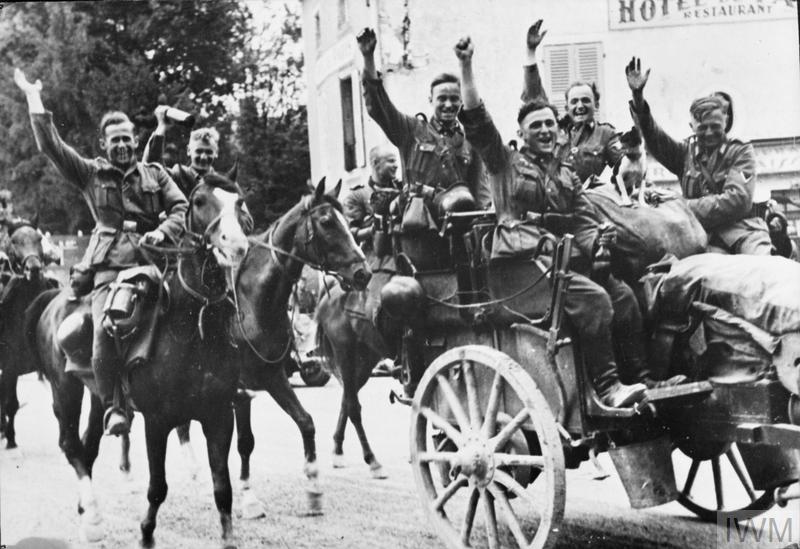
It is the first day of national celebration, with bell-tolling and flag-waving. The government distributes free beer and roast meat on Berlin street corners by order of Propaganda Minister Joseph Goebbels. However, Goebbels rejects a proposal by Labour Minister Robert Ley to provide prostitutes for free.
General Sir Alan Brooke is named to command Southern Command.
The meat ration in the United Kingdom is cut.
The London Times takes umbrage at the continued humiliation of Her Majesty’s Armed Forces by the Germans. It sniffs at the “refined cruelty to UK prisoners at Malines. All helmets are replaced by top hats, bowlers, bonnets, berets to make the POWs appear clownish.”
A message from Hitler urges Mussolini to capture the Suez Canal.
Turkish government declares non-belligerency.
Ali Mansur becomes Prime Minister of Iran.
In Moscow, Molotov meets with the Rumanian ambassador and demands Bessarabia and northern Bukovina from Bucharest.
Adolf Hitler suggested the Rumanian government to give in and satisfy the Soviet demands as Hitler was fearful that Rumanian resistance might lead to a Soviet occupation of the entire Rumania, which would threaten the oil and fodder that the German military was dependent upon.
The Presidium of the Supreme Soviet in Moscow, Russia called for a 7-day work week and banned the quitting of jobs without official authorization. Also, being late to work for more than 20 minutes was now a criminal offense punishable by prison terms of two to six months. These draconian measures are somewhat curious, as the USSR is not at war with anybody. The official justification is to ward off “capitalist aggression.” However, the only somewhat-capitalist country nearby of any power happens to be Germany, supposedly an ally.
RAF Bomber Command dispatches 13 Blenheims to attack targets in Germany during the day. 12 bombing, 1 reconnaissance — but only 3 bombed various targets. 1 aircraft lost.
RAF Bomber Command dispatches 107 Hampdens, Wellingtons and Whitleys to multiple targets and minelaying overnight in Germany, Belgium and the Netherlands. 3 Hampdens are lost from the operations of this night 1 of them being from the minelaying force.
The Luftwaffe’s night raids against Great Britain continue. KG 27 sends about 100 aircraft against northern England and southern Scotland. In addition, about three Heinkel 111s attack the docks at Avonmouth and Portishead. Some others attack the train station at Bristol. The Luftwaffe loses one bomber.
The Luftwaffe is withdrawing many of its fighter units to their home bases in Germany for rest and refit. JG 26 returns to its home bases on the Rhine, but before it does, it loses ace Lt. Otto-Heinrich Hillecke of II./JG 26 in a dogfight.
A major Luftwaffe conference is held at The Hague to discuss the new strategies necessary for a war against England. In attendance are: Generalfeldmarschall Göring, Generalluftzeugmeister Ernst Udet, General Albert Kesselring, Chief of Personnel General Kastner, General Bruno Lörner and ZG 1 Gruppenkommandeur Hptm. Wolfgang Falck. Goering instructs Falck to set up a Nachtjagdgeschwader (NJG) force, initial formation designated NJG 1, which will have two groups: one of Bf 110s, and the other of Bf 109s. Falck chooses Macki Steinhoff to lead the second group.
Italian raids on Malta continue. The raids come from both Libya and Sicily for the first time. The British air raid warning system fails to give alerts due to overnight storms which topple a radar mast, leading to 37 civilian deaths.
The German U-boat U-A, commanded by Kapitänleutnant Hans Cohausz, sank Norwegian steamer Crux in 36 53N, 14W. At 02.28 hours on 26 June 1940 the Crux (Master Einar Hansen), detached from convoy OG-34 the day before, was hit by one torpedo from UA about 300 miles west of Cape St. Vincent. The torpedo struck on the starboard side, abaft the engine room near #4 hatch and caused her to sink with a heavy port list after 10 minutes. The crew abandoned ship in two lifeboats and was questioned by the Germans. Twenty minutes after the crew left the ship, a southbound ship passed by very near, but did not see them in the dark. They did not use their flashes to make themselves known, because they thought that the U-boat was still near them. The survivors were picked up by the British steam merchant Brutus the following day. The 3,828-ton Crux was carrying patent fuel and was headed for Rio de Janeiro, Argentina.
U-29, commanded by Kapitänleutnant Otto Schuhart, sank Greek steamer Dimitris (5254grt) in 44 23N, 11 41W. At 15.30 hours on 26 June 1940 the unescorted Dimitris was stopped a shot across her bow by U-29 off Cape Finisterre. The ship was sunk by gunfire after the crew abandoned ship in two lifeboats. The 5,254-ton Dimitris was carrying cereals and was headed for Liverpool, England.
Battleship HMS Valiant and destroyers HMS Forester, HMS Foresight, and HMS Escort departed Scapa Flow at1900 for Gibraltar where they arrived on the 30th.
Destroyer HMS Ashanti departed Scapa Flow at 0940 to search for a Gladiator of 804 Squadron down two miles southeast of Pentland Skerries. The search was unsuccessful and the destroyer returned to Scapa Flow at 1410. Temporary Lt (A) H.C. Maudslay RNVR, was lost in the aircraft.
French submarine Rubis, which departed Dundee on the 20th, laid mines at 0300 in Trondheimsfjord in minelaying mission FD.20.
French submarine Narval (Lieutenant de Vaisseau F. Drogou) of the 11th Submarine Division, refusing to be demilitarized at Bizerte, arrived at Malta to join British forces.
Italian submarine Gugliemotti ran aground on a shoal in the Red Sea. The grounding left Gugliemotti badly damaged, but she was soon salved.
German armed merchant cruiser Widder captured Norwegian tanker Krossfonn (9323grt) at 21 55N, 45 00W on the Trinidad-Azores track in the South Atlantic. Two crew members of the tanker were made prisoners of war. The tanker was renamed Spichern for German use.
Italian submarine Glauco attacked an allied steamer off Cape Corbelin in the Mediterranean.
Italian steamer Loasso (5968grt) was sunk on a mine laid by submarine HMS Rorqual on the 14th off Testa del Gargano, north of Brindisi in the Adriatic.
Italian steamer Rina Croce (569grt) was lost on a mine two and half mines off Brindisi on 25 September on this minefield.
RMS Queen Mary, with 5,000 British troops aboard, sets sail for the Middle East.
Convoy FS.205 departed the Tyne, escorted by sloops HMS Lowestoft, HMS Stork, and HMS Weston and patrol sloop HMS Sheldrake. Destroyer HMS Amazon was in the convoy and as she could not steam more than 15 knots was not considered an escort. The convoy arrived at Southend on the 28th.
Convoy MT.96 departed Methil, escorted by destroyer HMS Vimeria and sloop HMS Londonderry. The convoy arrived in the Tyne the next day.
The War at Sea, Wednesday, 26 June 1940 (naval-history.net)
Battleship VALIANT and destroyers FORESTER, FORESIGHT, and ESCORT departed Scapa Flow at1900 for Gibraltar where they arrived on the 30th.
Destroyer ASHANTI departed Scapa Flow at 0940 to search for a Gladiator of 804 Squadron down two miles southeast of Pentland Skerries.
The search was unsuccessful and the destroyer returned to Scapa Flow at 1410. Temporary Lt (A) H.C. Maudslay RNVR, was lost in the aircraft.
Destroyer MASHONA departed Scapa Flow for Rosyth.
Destroyers FERNIE and ATHERSTONE arrived in the Clyde.
Destroyers FURY, VANSITTART, JACKAL, and JAGUAR arrived at Rosyth.
Destroyers FURY and VANSITTART escorting minelayers PORT NAPIER and PORT QUEBEC departed Rosyth for Loch Alsh, where they arrived on the 28th.
Destroyer IMOGEN and submarine TALISMAN departed Liverpool for the Clyde, arriving at 1030/27th.
Submarine STURGEON departed Blyth on patrol.
French submarine RUBIS, which departed Dundee on the 20th, laid mines at 0300 in Trondheimsfjord in minelaying mission FD.20.
Convoy FS.205 departed the Tyne, escorted by sloops LOWESTOFT, STORK, and WESTON and patrol sloop SHELDRAKE. Destroyer AMAZON was in the convoy and as she could not steam more than 15 knots was not considered an escort. The convoy arrived at Southend on the 28th.
Convoy MT.96 departed Methil, escorted by destroyer VIMERIA and sloop LONDONDERRY. The convoy arrived in the Tyne the next day.
French submarine NARVAL (Lieutenant de Vaisseau F. Drogou) of the 11th Submarine Division, refusing to be demilitarized at Bizerte, arrived at Malta to join British forces.
Italian submarine GUGLIEMOTTI ran aground on a shoal in the Red Sea.
The grounding left GUGLIEMOTTI badly damaged, but she was soon salved.
German armed merchant cruiser WIDDER captured Norwegian tanker KROSSFONN (9323grt) at 21‑55N, 45‑00W on the Trinidad-Azores track in the South Atlantic.
Two crew members of the tanker were made prisoners of war.
The tanker was renamed SPICHERN for German use.
U-A sank Norwegian steamer CRUZ (3828grt) in convoy OG.34 in 36‑53N, 14W.
The entire crew was rescued.
U-29 sank Greek steamer DIMITRIS (5254grt) in 44‑23N, 11‑41W.
The entire crew was rescued.
U-62 sank British trawler CASTLETON (211grt) off the Orkneys.
Italian submarine GLAUCO attacked an allied steamer off Cape Corbelin in the Mediterranean.
Italian steamer LOASSO (5968grt) was sunk on a mine laid by submarine RORQUAL on the 14th off Testa del Gargano, north of Brindisi in the Adriatic.
Italian steamer RINA CROCE (569grt) was lost on a mine two and half mines off Brindisi on 25 September on this minefield.
The Republican “streamlined” convention sped through a rapid schedule which resulted in adoption of a platform without dissent and the proposing of four candidates for the Presidential nomination in a seven-hour session which ended late tonight.
The name of Wendell Willkie, dark-horse turned serious contender, was placed before the Republican National Convention tonight to an accompanying bedlam of applause and boos which indicated the Republican presidential contest was Willkie against the field. Turning to nominations which emphasized peace, assistance to peoples fighting for liberty,” the convention received the names of Thomas E. Dewey, Frank E. Gannett, Senator Robert A. Taft and Willkie.
Any sign of weakening of the candidacies of either Mr. Dewey or Senator Taft will be the signal for an intensive drive for the nomination of Mr. Willkie, whose candidacy received impetus by declarations for him by two important delegates to the convention, Governor Harold E. Stassen of Minnesota, temporary chairman and “keynote” orator, and former United States Senator Daniel O. Hastings of Delaware, member of the executive committee of the national committee.
The Republican party formally pinned upon itself tonight the label of “Americanism, preparedness and peace,” under which it proposed to open a battle for a return to power in Washington. It did so by adopting unanimously a platform of party principles, declaring for non-intervention in foreign wars and bristling with denunciations of the New Deal for “failure” on both the foreign and domestic fronts. The platform sought to label the Democrats as the party of unpreparedness and involvement. The delegates took only a few minutes in approving the work of their Resolutions Committee, which had been in session here since a week ago Monday.
The platform was presented to the national convention late this afternoon after another row over the plank on involvement in war had threatened to divide the drafters and bring the whole controversial war issue to the convention floor. It went before the assembled delegates, however, as a unanimous declaration despite continued bickering among members of the resolutions committee over the strength of the wording of the foreign affairs statement. The declaration was submitted and read by Herbert K. Hyde, chairman of the Resolutions Committee. He moved its adoption without further comment.
In a press conference today amplifying his speech of last night, Herbert Hoover inferentially but quite definitely made it clear that he was a receptive candidate for the Presidency.
A last-hour fight to strengthen wavering lines and capture doubtful votes kept Republican Presidential candidates, their managers and strategists, official and unofficial, moving on the double quick today as delegates to the national convention prepared for the actual task of choosing the nominee. Headquarters of the candidates, to whom the name of former President Herbert Hoover was added by reason of an inferential statement of his own, were packed from the first hour until evening as delegates passed through on their seemingly never-ending “shopping expeditions.”
The United States began bargaining with British and Dutch interests for huge quantities of rubber from the orient for defense purposes today and simultaneously sent more purchasing power and three more naval vessels to South America. Shortly after President Roosevelt had signed a bill authorizing the Reconstruction Finance Corporation to finance acquisition of strategic war materials, Jesse H. Jones announced he was negotiating with the International Rubber Regulating Committee, which controls virtually all rubber production and sale throughout the world.
Ten days after France surrendered to Nazi Germany, Breckinridge Long wrote a memo to other State Department officials laying out the options for stopping all immigration into the United States in the event of a national emergency. Consular officers, he wrote, could “put every obstacle in the way and require additional evidence and to resort to various administrative devices which would postpone and postpone and postpone the granting of visas.” Long’s memo was never put into effect, but a few days later Secretary of State Cordell Hull instructed all State Department officials abroad to take additional caution when screening refugees. If the officials had any doubt about the identity or intentions of a refugee, they were to deny the visa application. After Hull’s order, it became much harder to immigrate from German-occupied areas. In June 1941, the State Department issued a “relatives rule” that denied visas to anyone with close relatives still living in Nazi-occupied territory. They argued that Germany could pressure immigrants to become spies by threatening relatives still held by the Nazis.
Adequate defense, so that America may be ready “to meet force with force,” all possible aid to the Allies short of war, and outlawing of “the fifth column of Nazis and Communists” was urged in an address last night by William Green, president of the American Federation of Labor.
Congress authorized construction of the third NACA laboratory near Cleveland, Ohio, which became Aircraft Engine Research Laboratory. In 1948, it was named for George W. Lewis, NACA Director of Aeronautical Research, 1924-47.
With the withdrawal of the Ford Motor Company as a possible producer of Rolls-Royce airplane engines, negotiations were started by the National Defense Advisory Commission today to substitute the Packard Motor Car Company for the Ford concern in this defense work. Regarding the cancellation of the tentative Ford commitment to make 3,000 Rolls-Royce engines for the War Department and 6,000 for the British Government, Stephen T. Early, White House secretary, explained that the two contracts were “tied together” and added that the motor manufacturer “has a right to say what contracts he will take or won’t take.”
Major League Baseball:
Boston’s Red Sox cut the Tigers down, 3–1, today, a three-run rally in the ninth inning breaking up a pitching duel between Rookie John Gorsica of Detroit and young Jim Bagby of Boston.
The Yankees downed the Indians today, 3–1, in their series finale. Red Ruffing scattered six hits for the win, beating Mel Harder. Joe DiMaggio had two singles to drive in all three Yankee runs.
Chicago’s White Sox pounded three Washington pitchers for fifteen hits today, but had to come from behind with a two-run ninth-inning rally to defeat the Senators, 7–6, and gain an even break in the two-game series.
Sam Chapman is 5-for-5 including a grand slam to lead the A’s to a 9–4 win over the Browns. Dick Siebert also had a good day for the A’s, going 4-for-4. George Caster got the win, only his second this season against eleven defeats.
Johnny McCarthy, the forgotten first baseman of the Giants, was a hero last night at the Polo Grounds. Summoned from the dugout, he struck his first single of the campaign in the tenth inning of the battle between the Giants and the Cardinals and gave New York the victory, 10–9.
The Pirates and Phillies split a doubleheader. Johnny Rizzo got six hits in seven times at bat — including a homer, triple and double — to give the Phillies an even break in a doubleheader with the Pirates today before a ladies’ day crowd of 12,565.
Washington Senators 6, Chicago White Sox 7
New York Yankees 3, Cleveland Indians 1
Boston Red Sox 3, Detroit Tigers 1
St. Louis Cardinals 9, New York Giants 10
Pittsburgh Pirates 2, Philadelphia Phillies 4
Pittsburgh Pirates 11, Philadelphia Phillies 6
Philadelphia Athletics 9, St. Louis Browns 4
Canada announces it will not require visas for visitors from the United States.
M.J. Coldwell, Saskatchewan Cooperative Commonwealth Federation member, demanded in the House of Commons today that the government take into custody all Henry Ford’s industrial interests in Canada. This is in response to Ford’s refusal to make aircraft engines for Great Britain.
The belief that the “future relations of the United States and Brazil will be increasingly good” was expressed yesterday by Dr. Edmundo de Miranda Jordao, former president of the Brazilian Bar Association, who has completed a tour of the United States.
Another cruiser, the new 10,000-ton USS Phoenix, has been ordered to South American waters and is proceeding to Valparaiso, Chile.
Battle of South Kwangsi: Japanese 22nd Army captures Mingchiang without opposition. This gives it control over the border with French Indochina, along which the Japanese have long suspected the French of supplying arms to China. The French already have pledged to discontinue any such shipments.
The thinly disguised Japanese intention eventually to occupy French Indo-China is greatly increasing apprehensions in the Far East. A westward movement of the United States fleet is seen here as the only possible deterrent feature. The French in the Far East are helpless and must submit, even without protest to the presence of a portion of a Japanese fleet in Haiphong harbor and the presence of Army, Navy and diplomatic representatives to check over every parcel of freight for China. This arrogant violation of national rights, coupled with Japanese pressure against Britain for the closure of the Burma highway to all war supplies and cargoes for Chungking, puts an entirely new face on the desperation of General Chiang Kaishek’s cause.
Border bridges at Hong Kong were dynamited and even girls were told to be ready to “consider themselves soldiers” as this British Crown Colony watched Japan tighten the net around French Indo-China today.
Chinese planes bombed Japanese positions at Ichang for the third consecutive day yesterday. The bombings coincide with heavy land attacks that are being made by the Chinese, who are attempting to recapture Ichang. The United States Embassy here has presented a protest to the Chinese Government against the bombing of the Standard Oil waterfront properties at Ichang and the damaging of the Socony river tanker Teilu by Chinese planes on Sunday. The bombs caused fifty civilian casualties and fragments struck and damaged the tanker. A Chinese spokesman in Chungking said today that the objective of the Chinese planes was Japanese fortifications, but he observed that in placing these, the Japanese seem to have got as close as possible to American property.
Japan’s new “Monroe Doctrine for East Asia” will be proclaimed tomorrow or Saturday, the newspaper Asahi announced this morning. It will be a brief statement, implying more than it says. Its substance, as forecast by the newspaper, will assert that East Asia is a region in which Japan’s influence is paramount and Western rights and interests secondary. Its form will extend Japan’s noninvolvement policy to cover all of East Asia. Japan’s dominant responsibility for the defense of this region and her primary claims to its national resources will be implicit in the doctrine. Japan’s relations with the Western powers, whether totalitarian or democratic, will not be mentioned in any important sense.
Dow Jones Industrial Average: 119.73 (-1.32)
Born:
Robert Kramer, American actor and director, in New York, New York (d. 1999).
Naval Construction:
The Royal Navy Flower-class corvette HMS Trillium (K 172) is launched by Canadian Vickers Ltd. (Montreal, Quebec, Canada). She is transferred to the Royal Canadian Navy before completion and enters service as HMCS Trillium (K 172).
The Royal Navy Flower-class corvette HMS Crocus (K 49) is launched by A & J Inglis Ltd. (Glasgow, Scotland); completed by Kincaid.
The Вое́нно-морско́й флот СССР (ВМФ) (Soviet Navy) “K” (Katjusa)-class submarine K-1, lead boat of her class of 11 (plus 1 cancelled), is commissioned.
 History Diaries