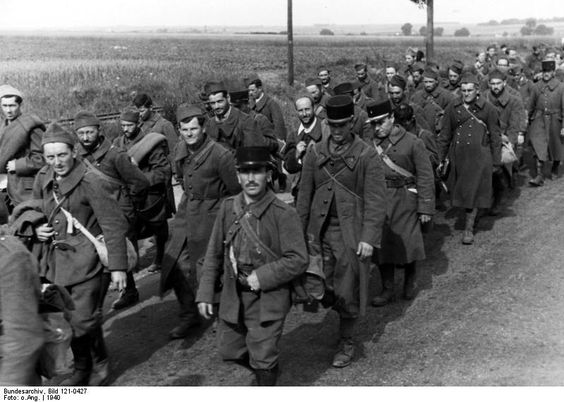
The Franco-German Armistice, signed on 22 June, took effect at 0030 hours. After fighting ceased, French losses totaled 92,000 killed, 250,000 wounded, and 1,500,000 captured. British losses were 68,111 killed, wounded, or captured. German losses were 29,640 killed and 133,573 wounded and missing. Italian losses were 631 killed, 4,782 wounded, and 616 missing. France declared a National day of mourning, while Hitler ordered the flying of flags and pealing of bells in Germany to celebrate “the most glorious victory of all time”.
Hitler addressed the German nation, praising the Wehrmacht for its victory and ordering that all flags be displayed for 10 days and that church bells be rung for a week. Many ordinary Germans, including those in the Wehrmacht, believe that this means that the entire war is over.
As opposed to Hitler’s required celebrations, the French government announces a day of mourning, with flags to be flown at half-mast.
Hitler and two of his WWI comrades tour their old battlefields. Hitler tours some of his old battlefields near the Somme with a couple of his Great War comrades. It is around this time when Hitler supposedly visits Charlotte Lobjoie. She is a French woman who lived near the battlefields with whom he is alleged to have had an affair in 1916 after she saw him sketching while she was cutting hay. While disputed by historians, this affair is claimed to have produced a son, Jean-Marie Loret. Hitler at around this time arranges regular payments to Lobjoie for the remainder of his time in power.
Hitler orders the demolition of the French memorial to the end of the First World War at Compiegne. However, he brings Marshal Foch’s railway carriage, the Alsace-Lorraine Monument depicting a German eagle impaled by a French sword, and the dedication tablet back to Berlin. All that is left at the site is a statue of Marshal Foch, staring out over nothing.
There remain 1.5 million French soldiers in German POW camps.
Maginot Line positions remaining in French hands cease operations.
Prime Minister Winston Churchill solemnly acknowledged today that Britain’s safety was “powerfully though not decisively affected by what happens to the French fleet.” He indicated, and the hope was echoed in the House of Lords, that England still might, somehow, take over the French navy.
The Franco-Italian Armistice came into effect at 12:35 AM. The Italians have not advanced beyond Menton on the coast and had barely advanced at all further north. Italy has suffered 631 killed, 2,631 wounded and 4,494 missing/POWs. France has suffered virtually no casualties during the brief campaign on the Riviera.
Operation AERIAL ended, although it would go on unofficially until August 14. Operation AERIAL ends with over 215,000 servicemen and civilians successfully evacuated from France by the Royal Navy.
Operation COLLAR, the commando raid near Boulogne, ended in minor British success. There were no British casualties.
German troops were issued English phrase books in preparation for an invasion of Britain.
German General Hans Jeschonnek, chief of the German air staff, is asked by the OKW to help prepare invasion plans for Britain. He refuses, telling them, “There won’t be any invasion, and I have no time to waste on planning one.”
British Minister of Health Malcolm MacDonald returned to Dublin, Ireland with a proposal from Winston Churchill for a joint union between Eire and Ulster to afford sanctuary for British troops and Irish ports for Royal Navy use.
Lord Gort departed Britain by flying boat for Rabat, French Morocco to speak with French ministers favoring continuing the fight; political situations would prevent him from successfully meeting with the French.
Technically neutral, Switzerland’s true sympathies are called into question when President Pilet-Golaz broadcasts that he feels “relief” about the “end of the war in Europe.” He announces that there a “new order” in Europe and that it is time for Switzerland to join with its own Führer (using the same word as in German). “The people should follow the government as a sure and devoted Führer who will not always be able to explain, elaborate and give the reasons for his decisions.” He partially demobilizes the army, since in his view there is no longer a threat to Swiss sovereignty. This speech is usually described as “Petainist” and an example of collaboration by another name.
Working together with the Germans, Spain agreed to assist with the German attempt to detain the Duke of Windsor, the former King Edward VIII of the United Kingdom.
Pierre François Boisson was named the Governor-General of French West Africa.
Exiled King Zog of Albania, family, and retinue evacuated from St Jean-de-Luz aboard British vessel Ettrick, bound for UK.
The Nigerian 23rd Infantry Brigade arrives by sea in Kenya.
A new Rumanian government is set up in Bucharest and several (fascist) Iron Legionnaires are given appointments to minor positions.
RAF Bomber Command dispatches 25 aircraft to attack targets in Germany during the day
RAF Bomber Command dispatches 48 aircraft to attack targets in Germany overnight
RAF Fighter Command sweep over Abbeville intercepted by fifteen Me-109 fighters.
Two RAF Fighter Command Spitfires lost intercepting multiple Luftwaffe raids.
U-51, commanded by Kapitänleutnant Dietrich Knorr, sank British steamers Windsorwood (5395grt) in 48 31N, 14 50W and Saranac (12,049grt) in 48 24N, 15 05W. At 1543 hours on 25 June 1940 the Windsorwood (Master George Albert Norton) in convoy OA.172 was hit amidships by one stern torpedo from U-51 about 370 miles west-southwest of Lands End. The ship sank within three minutes after being hit by a coup de grâce at 1619 hours. The master and 39 crew members was picked up by Ainderby and landed at Barry. The 5,395-ton Windsorwood was carrying coal and was headed for Freetown, Sierra Leone.
At 1551 hours the Saranac (Master Vernon Horace Alcock) in convoy OA.172 was hit by one torpedo from U-51 about 270 miles west-southwest of Lands End and was immediately abandoned by the crew. At 1737 hours, the U-boat surfaced and tried to sink the tanker by gunfire, but she sank 15 minutes after being hit by a coup de grâce at 1915 hours. Four crew members were lost. The master and 30 crew members were picked up by HMS Hurricane (H 06) (LtCdr H.C. Simms, RN) and landed at Plymouth. Nine crew members were picked up by the British trawler Caliph and landed at Berehaven, Co. Cork. The 12,049-ton Saranac was carrying ballast and was headed for Aruba.
U-30 refueled from German tanker Max Albrecht (5824grt) at El Ferrol.
At 1535, submarine HMS Snapper fired three torpedoes at a convoy in 58-54N, 5-05. 5E. German auxiliary patrol vessel Vp 1107 (trawler Portland: 295grt) was sunk in this attack. At 1604, submarine Snapper fired three torpedoes at a merchant ship in this convoy, but missed.
Anti-aircraft cruiser HMS Calcutta (Flag Rear Admiral Curteis, 2nd Cruiser Squadron) and Canadian destroyers HMCS Fraser and HMCS Restigouche patrolled off Bordeaux covering the evacuation of St Jean De Luz where troopships Ettrick (11,279grt), Arandora Star (15,501grt), Batory (14,287grt), and Sobieski (11,030grt) were lifting troops from 22 to 24 June. The convoy departed St Jean De Luz at 1300/24th escorted by destroyers HMS Mackay and HMS Wren. Searching for French steamer De Lasalle (8400grt) in the area, Calcutta accidently ran down Fraser (Cdr W. B. Creery, RCN) at 2000 cutting her in half in 45 44N, 1 31W. Calcutta and Restigouche picked up the survivors and a boarding party at 0001/26th scuttled the stern half which had not yet sunk. Forty five Canadian ratings and fourteen British ratings were lost with Fraser. One rating from destroyer Restigouche was lost in the rescue efforts. Eleven officers, including Lt E. P. Tisdall, Lt R. C. Pope, RCNVR, Lt C. A. Rutherford, Lt W. M. Landymore, Lt (E) A. C. K. Layman, RN, Temporary S/Lt A. E. McMurtry, RCNVR, Acting Temporary Surgeon Lt T. B. McLean, RCNVR,which was injured, Gunner (T) B. A. Lewis, one hundred and four ratings were rescued by destroyer Restigouche. Destroyer Restigouche also had Captain CC A. Allen and two other officers embarked in France and six ratings from Calcutta’s whaler. Anti-aircraft cruiser Calcutta rescued three officers, Creery, Acting LCR F. C. Smith, RCNR, Lt H.V. W. Groos, thirty ratings (eight injured) . Destroyer Restigouche arrived at Plymouth at 1715/26th. Cruiser Calcutta and arrived at Plymouth for repairs at 0932/27th. Repairs were completed in late July. Destroyers HMS Harvester and HMS Highlander, also in the area, continued on to search for the French ship.
Destroyer HMS Esk was damaged in a collision with the Sheringham Light Float. The destroyer’s maximum speed was reduced to eighteen knots and the destroyer returned to the Humber for repairs. The destroyer was under repair from 25 June to 8 July.
French auxiliary patrol vessel Saint Marguerite (48grt) was scuttled at Le Verdon.
French Amiral Gensoul was to have bombarded Genoa on this date, but the operation was cancelled on the 24th due to the Armistice.
The first escorted Italian convoy carrying 1,727 Italian troops departed Naples for Tripoli with troopships Esperia (11,398grt) and Victoria (13,098grt) escorted by armed merchant cruiser Ramb II and torpedo boats Orsa and Procione.
Italian submarine Bragadin, which departed Taranto on the 24th, arrived at Tobruk with supplies for the airport.
French battleship Richelieu and destroyer Fleuret departed Dakar for Casablanca but returned when she found that Heavy cruiser HMS Dorsetshire was shadowing her. Seaplane tender HMS Albatross, carrying Admiral D’Oyly Lyon, had departed Freetown for Dakar, but did not arrive until after Richelieu had departed. Aircraft carrier HMS Ark Royal, battlecruiser HMS Hood, and destroyers HMS Faulknor, HMS Fearless, HMS Foxhound, and HMS Escapade departed Gibraltar to intercept towards the Canary Islands. While at sea, aircraft carrier Ark Royal embarked ten Swordfish from Rabat. The British force was ordered back to Gibraltar at 1900/26th, arriving on the 27th. Battleship Richelieu arrived back off Dakar at 0500/27th with French armed merchant cruisers El D’Jezair, El Kantara, El Mansour, and Ville D’Oran and large destroyers Milan and Epervier. However, the battleship and destroyer did not enter port. They turned back north again. They finally arrived at Dakar at 0500/28th.
Light cruiser HMS Dunedin arrived at Martinique to watch the French warships there. Light cruiser HMS Fiji departed Bermuda on the 24th and joined Dunedin. Light cruiser HMS Diomede was also on this patrol. The British ships were ordered to neutralize the French warships in CATAPULT operations, but negotiations averted an armed encounter. Light cruiser FIJI departed Martinique on the 30th to refit at St Lucia. Light cruiser Dunedin remained off Fort de France. After CATAPULT operations in Africa, the British warships were ordered to leave French waters and the patrol was terminated on 12 July.
Dutch light cruiser HNLMS Heemskerck departed Halifax for Falmouth. The cruiser returned to Portsmouth for conversion to an anti-aircraft cruiser, completed on 17 February 1941.
Australian heavy cruiser HMAS Australia, which had just escorted British steamer Ulysses (14,652grt) from Capetown to Durban and returned escorting troopship Stratheden, departed Capetown with troopships Orion (23,371grt), Reina Del Pacifico (17,702grt), Stratheden (23,722grt). All ships arrived at Freetown without event on 3 July. Seaplane carrier HMS Albatros was at Freetown at that time.
Convoy OA.174 departed Southend escorted by corvette HMS Hibiscus from 25 to 27 June. The convoy was escorted by sloop HMS Aberdeen and corvette HMS Calendula on 27 to 28 June. Convoy OA.174 included steamer San Andreas carrying the Norwegian gold to Montreal.
Convoy OB.174 departed Liverpool escorted by sloop HMS Sandwich from 25 to 28 June.
Convoy FN.205 departed Southend, escorted by destroyers HMS Wallace and HMS Wolfhound and patrol sloop HMS Mallard. The convoy arrived at the Tyne on the 27th.
Convoy FS.204 departed the Tyne, escorted by destroyers HMS Vega and HMS Vivien and patrol sloop HMS Guillemot. The convoy arrived at Southend on the 27th.
On 25 June, convoy HX.52 was ordered routed through the Irish Sea to Liverpool. Up to this point, the convoys had been going to Plymouth. Convoy HX.52 arrived on 4 July.
Convoy HX.53 departed Halifax escorted by Canadian destroyers HMCS Assiniboine and HMCS Ottawa. On 26 June, they turned the convoy over to the ocean escort, armed merchant cruiser HMS Alaunia, which was detached on 7 July.
Convoy BHX.53 departed Bermuda on the 24th escorted by ocean escort armed merchant cruiser HMS Comorin. The convoy rendezvoused with HX.53 on the 29th and the armed merchant cruiser was detached. On 7 July, destroyers HMS Sabre and HMS Scimitar, sloop HMS Leith, corvette HMS Clarkia joined the convoy. On 8 July, destroyers HMS Hurricane, HMS Vanquisher, and HMS Winchelsea joined; they were detached the next day. On 10 July, the convoy arrived at Liverpool with the earlier escort ships.
Convoy SL.37 departed Freetown escorted by armed merchant cruiser HMS Mooltan to 9 July. On 9 July, destroyer HMS Walker and sloop HMS Deptford joined the convoy and escorted it to arrival on 12 July.
The War at Sea, Tuesday, 25 June 1940 (naval-history.net)
Light cruiser NEWCASTLE departed Scapa Flow at 0800 for Rosyth where she arrived later the same day.
British repair ship VINDICTIVE departed Scapa Flow for the Clyde, but was recalled before arriving.
Destroyers JACKAL and JAGUAR departed the Humber for Rosyth.
Destroyer FURY departed Sheerness for Rosyth.
Destroyer WINCHESTER departed Rosyth for the Tyne.
Destroyer AMAZON joined convoy FS.5 off the Tyne for passage to Chatham. Because she could not steam more than fifteen knots, she was not regarded as part of the escort.
At 1535, submarine SNAPPER fired three torpedoes at a convoy in 58-54N, 5-05. 5E. German auxiliary patrol vessel V p 1107 (trawler PORTLAND: 295grt) was sunk in this attack.
At 1604, submarine SNAPPER fired three torpedoes at a merchant ship in this convoy, but missed.
Submarine TRIBUNE arrived at Rosyth after patrol.
Submarine PORPOISE arrived at Blyth after patrol.
Submarine SEALION departed Rosyth on patrol.
Submarines SEAWOLF and SHARK exercised in the Firth of Forth.
Rear Admiral F. B. Burgess-Watson DSO Rtd in destroyer BROKE departed Plymouth with destroyers VANQUISHER and WINCHELSEA for Gironde.
Destroyer HIGHLANDER and another destroyer were to join Burgess-Watson’s command.
Anti-aircraft cruiser CALCUTTA (Flag Rear Admiral Curteis, 2nd Cruiser Squadron) and Canadian destroyers HMCS FRASER and HMCS RESTIGOUCHE patrolled off Bordeaux covering the evacuation of St Jean De Luz where troopships ETTRICK (11,279grt), ARANDORA STAR (15,501grt), BATORY (14,287grt), and SOBIESKI (11,030grt) were lifting troops from 22 to 24 June. The convoy departed St Jean De Luz at 1300/24th escorted by destroyers MACKAY and WREN.
Searching for French steamer DE LASALLE (8400grt) in the area, CALCUTTA accidently ran down FRASER (Cdr W. B. Creery, RCN) at 2000 cutting her in half in 45‑44N, 1‑31W. CALCUTTA and RESTIGOUCHE picked up the survivors and a boarding party at 0001/26th scuttled the stern half which had not yet sunk.
Forty-five Canadian ratings and fourteen British ratings were lost with FRASER. One rating from destroyer RESTIGOUCHE was lost in the rescue efforts. Eleven officers, including Lt E. P. Tisdall, Lt R. C. Pope, RCNVR, Lt C. A. Rutherford, Lt W. M. Landymore, Lt (E) A. C. K. Layman, RN, Temporary S/Lt A. E. McMurtry, RCNVR, Acting Temporary Surgeon Lt T. B. McLean, RCNVR, who was injured, Gunner (T) B. A. Lewis, one hundred and four ratings were rescued by destroyer RESTIGOUCHE. Destroyer RESTIGOUCHE also had Captain CC A. Allen and two other officers embarked in France and six ratings from CALCUTTA’s whaler. Anti-aircraft cruiser CALCUTTA rescued three officers, Creery, Acting LCR F. C. Smith, RCNR, Lt H.V. W. Groos, thirty ratings (eight injured). Destroyer RESTIGOUCHE arrived at Plymouth at 1715/26th.
Cruiser CALCUTTA and arrived at Plymouth for repairs at 0932/27th. Repairs were completed in late July.
Destroyers HARVESTER and HIGHLANDER, also in the area, continued on to search for the French ship.
Destroyer ESK was damaged in a collision with the Sheringham Light Float.
The destroyer’s maximum speed was reduced to eighteen knots and the destroyer returned to the Humber for repairs. The destroyer was under repair from 25 June to 8 July.
Convoy OA.174 departed Southend escorted by corvette HIBISCUS from 25 to 27 June. The convoy was escorted by sloop ABERDEEN and corvette CALENDULA on 27 to 28 June. Convoy OA.174 included steamer SAN ANDREAS carrying the Norwegian gold to Montreal.
Convoy OB.174 departed Liverpool escorted by sloop SANDWICH from 25 to 28 June.
Convoy FN.205 departed Southend, escorted by destroyers WALLACE and WOLFHOUND and patrol sloop MALLARD. The convoy arrived at the Tyne on the 27th.
Convoy FS.204 departed the Tyne, escorted by destroyers VEGA and VIVIEN and patrol sloop GUILLEMOT. The convoy arrived at Southend on the 27th.
On 25 June, convoy HX.52 was ordered routed through the Irish Sea to Liverpool.
Up to this point, the convoys had been going to Plymouth.
Convoy HX.52 arrived on 4 July.
French auxiliary patrol vessel SAINT MARGUERITE (48grt) was scuttled at Le Verdon.
U-30 refueled from German tanker MAX ALBRECHT (5824grt) at El Ferrol.
U-51 sank British steamers WINDSORWOOD (5395grt) in 48‑31N, 14‑50W and SARANAC (12,049grt) in 48‑24N, 15‑05W.
The entire crew of the steamer WINDSORWOOD was rescued.
Two crew were killed and two were missing from the steamer SARANAC. Seventeen survivors were rescued by destroyer HURRICANE. The remaining survivors were picked up on the 29th fourteen miles
from Castletown by British steamer AINDERBY (4860grt).
French Amiral Gensoul was to have bombarded Genoa on this date, but the operation was cancelled on the 24th due to the Armistice.
British steamers were seized by French forces at Casablanca. The steamers were renamed for French service.
British name — B. R. T. — French name
STORAA — 1967 — ST EDMOND
PENGREEP — 4806 — STE JACQUELINE
TOUSSIKA — 1828 — ST HUGHES
HILDE — 1595 — ST BENOIT
BELGIEN — 1979 — not renamed
The first escorted Italian convoy departed Naples for Tripoli with troopships ESPERIA (11,398grt) and VICTORIA (13,098grt) escorted by armed merchant cruiser RAMB II and torpedo boats ORSA and PROCIONE.
Italian submarine BRAGADIN, which departed Taranto on the 24th, arrived at Tobruk with supplies for the airport.
French battleship RICHELIEU and destroyer FLEURET departed Dakar for Casablanca but returned when she found that Heavy cruiser DORSETSHIRE was shadowing her.
Seaplane tender ALBATROSS, carrying Admiral D’Oyly Lyon, had departed Freetown for Dakar, but did not arrive until after RICHELIEU had departed.
Aircraft carrier ARK ROYAL, battlecruiser HOOD, and destroyers FAULKNOR, FEARLESS, FOXHOUND, and ESCAPADE departed Gibraltar to intercept towards the Canary Islands.
While at sea, aircraft carrier ARK ROYAL embarked ten Swordfish from Rabat.
The British force was ordered back to Gibraltar at 1900/26th, arriving on the 27th.
Battleship RICHELIEU arrived back off Dakar at 0500/27th with French armed merchant cruisers EL D’JEZAIR, EL KANTARA, EL MANSOUR, and VILLE D’ORAN and large destroyers MILAN and EPERVIER.
However, the battleship and destroyer did not enter port. They turned back north again. They finally arrived at Dakar at 0500/28th.
Light cruiser DUNEDIN arrived at Martinique to watch the French warships there.
Light cruiser FIJI departed Bermuda on the 24th and joined DUNEDIN.
Light cruiser DIOMEDE was also on this patrol.
The British ships were ordered to neutralize the French warships in CATAPULT operations, but negotiations averted an armed encounter.
Light cruiser FIJI departed Martinique on the 30th to refit at St Lucia. Light cruiser DUNEDIN remained off Fort de France.
After CATAPULT operations in Africa, the British warships were ordered to leave French waters and the patrol was terminated on 12 July.
Dutch light cruiser HNMS HEEMSKERCK departed Halifax for Falmouth. The cruiser returned to Portsmouth for conversion to an anti-aircraft cruiser completed on 17 February 1941.
Australian heavy cruiser HMAS AUSTRALIA, which had just escorted British steamer ULYSSES (14,652grt) from Capetown to Durban and returned escorting troopship STRATHEDEN, departed Capetown with troopships ORION (23,371grt), REINA DEL PACIFICO (17,702grt), and STRATHEDEN (23,722grt).
All ships arrived at Freetown without event on 3 July.
Seaplane carrier ALBATROS was at Freetown at that time.
Convoy HX.53 departed Halifax escorted by Canadian destroyers HMCS ASSINIBOINE and HMCS OTTAWA. On 26 June, they turned the convoy over to the ocean escort, armed merchant cruiser ALAUNIA, which was detached on 7 July.
Convoy BHX.53 departed Bermuda on the 24th escorted by ocean escort armed merchant cruiser COMORIN. The convoy rendezvoused with HX.53 on the 29th and the armed merchant cruiser was detached.
On 7 July, destroyers SABRE and SCIMITAR, sloop LEITH, corvette CLARKIA joined the convoy. On 8 July, destroyers HURRICANE, VANQUISHER, and WINCHELSEA joined; they were detached the next day. On 10 July, the convoy arrived at Liverpool with the earlier escort ships.
Convoy SL.37 departed Freetown escorted by armed merchant cruiser MOOLTAN to 9 July.
On 9 July, destroyer WALKER and sloop DEPTFORD joined the convoy and escorted it to arrival on 12 July.
Increased income taxes are introduced in the U.S. to pay for Roosevelt’s armament expenditures and bring in an additional 2.2 million people who never before had been required to pay income taxes. This will partially pay for new armaments spending, with the balance paid by bonds and deficit spending. President Roosevelt signed a bill estimated to raise an additional $4,692,500,000 in the next five years by adding 2,200,000 persons to the list of income tax payers and by increasing the rates of income, profits, excise, gift and inheritance taxes. The money will help to finance the defense program. The President also signed a $918,603,000 agriculture appropriation bill which included increased millions for removal of surplus farm products, a problem made more serious by the loss of foreign markets because of the European war.
The Treasury calculated that the new tax law would increase revenue in the 1941 fiscal year, which begins Monday, from $5,652,300,000 (not counting social security funds, which are now outside the budget) to $6,367,600,000. An extra $994,300,000 was expected in each of the succeeding four years. Next year’s revenue, if realized, will be the largest since 1920, when peak collections were made on World War taxes. The 1942 fiscal year may set a new revenue record of about $7,000,000,000.
President Roosevelt, invoking a plan from the First World War to provide additional officers for the expanding U.S. Naval fleet, announced today that 5,000 young volunteers would be trained for the naval reserve. He disclosed at a press conference that unmarried American-born men between 19 and 26 years of age, who have had two years or more of college work, could begin applying for the training next Friday.
The Daily News, a New York newspaper, in an article tonight said that the United States had mined both entrances to the Panama Canal, had rushed heaviest railroad artillery to the Atlantic side of the Canal Zone, and had placed the zone’s defense forces on virtually a war footing. War department officials said tonight controlled mines were maintained constantly about the entrances of the Panama Canal, but that no new mines had been laid there recently.
Herbert Hoover, in the greatest speech of his career, tonight jolted the Republican convention out of its two-day jitters and swept the delegates and others to their feet in a great cheering demonstration that demanded the end of the New Deal, effective preparation for national defense, and the end of the threat to take this nation into the European war. Whether out of that demonstration will come a demand that Hoover lead the party in November, nobody knows. In fact nobody knows anything about this convention. If Dewey’s and Taft’s angry supporters can halt the steady march of Willkie, the newcomer to Republican ranks, then there may be a deadlock. If there is a deadlock, Hoover could be called back to the leadership of the party.
Harassed “leading candidates” for the Republican Presidential nomination redoubled their efforts to glean convention votes today, in the face of the threat of a new active contender in the person of former President Herbert Hoover.
A last-minute thrust of Eastern and Western foes of intervention today converted the Republican platform plank on foreign policy into a stronger declaration for keeping the United States out of foreign wars and protecting this hemisphere against attacks from abroad than had been intended. In its present status, the platform is strictly a non-candidate document. Up until late tonight none of the leading contenders for the nomination had made a single representation or an important recommendation as to its content and all requests of Resolutions Committee leaders to get them to do so had gone unneeded.
The terms of the platform were finally agreed upon by the Resolutions Committee a few minutes before midnight and turned over to the sub-committee on drafting to be whipped into shape for presentation to the convention tomorrow. Chairman Hyde said the agreement was unanimous. He had full authority to accept the drafters’ report and transmit it in his own good time to the convention. He expressed doubt that it would be disclosed officially before tomorrow night. The preamble to the Foreign Affairs plank as it stood late tonight read as follows: “The Republican party is the party of Americanism, preparedness and peace. We accordingly fasten upon the New Deal full responsibility for our unpreparedness and for consequent danger of our involvement in war.”
Government negotiation with Henry Ford for the mass production of airplane engines collapsed today. William S. Knudsen of the national defense commission announced that Ford’s refusal to manufacture engines for Great Britain had forced cancellation of plans for early mass production of Rolls Royce motors by the Ford Motor company. Refusal of the Ford Motor Company to manufacture Rolls-Royce airplane engines for Great Britain “has necessitated termination of negotiations” for a contract to produce. such engines for the United States, William S. Knudsen, the president of General Motors Corporation, who is in charge of production for the National Defense Advisory Commission, stated tonight. Henry Ford countermanded commitments made by his son, Edsel, president of the company, to provide 6,000 of the motors for Britain as well as 3,000 for the United States, according to Mr. Knudsen’s statement.
In a statement for the Defense! Commission Mr. Knudsen explained that the “combined quantity justified” the order for the engines, for which the British recently granted free rights for production in this country, but that Henry Ford had declared that he would make “any number of Rolls Royce engines for the United States, but none for Britain.” As a result, the statement added, negotiations with the Ford company were ended and “cooperation in the production of this important military equipment will be sought elsewhere.”
[Ed: That work will go to Packard instead…]
An Act of Congress abolished the Construction Corps of the Navy. Constructors were given line officer status designated for Engineering Duty Only (EDO). In addition, the status of those line officers who had previously had been designated for Aeronautical Engineering Duty Only (AEDO) were also redesignated EDO.
Isolationist advertising appeared in the American newspaper New York Times; Germany secretly funded this advertising.
United States Army Major William Lee is assigned to create an U.S. airborne force.
Major League Baseball:
The Cubs score five times in the 13th to beat the Dodgers, 8–3. Claude Passeau pitches 4 innings of no-hit relief for the win. It’s the Dodgers 7th loss in 9 games. The Dodgers tied it in the ninth and then loaded the bases with one out, but Joe Medwick, with a chance to win it, instead hit into a double-play.
Johnny Rizzo blasted a three-run homer today against his former mates from Pittsburgh, but the Phillies never quite caught up and lost the opening game of a series, 9—7.
The Tigers kept their hold on second place in the tight American League race today by splitting a double bill with the Red Sox before a crowd of 26,169. Harold Newhouser scattered four hits in the nightcap to give the Tigers a 5–1 victory after Schoolboy Rowe had suffered his first defeat of the season in the opener, which the Red Sox won, 11–7. The 19-year-old Newhouser, in notching his fifth triumph, pitched brilliantly, striking out seven. He retired the side in the fifth on strikes and in five innings held the Red Sox hitless.
The Cleveland Indians down the Yankees, 5–3, on the strength of two homers by Hal Trosky and another by Roy Weatherly. Al Milnar gets the win for the Indians over Monte Pearson, who left after three innings.
The Senators defeated the White Sox, 7–6, at Comiskey Park tonight behind the nine-hit pitching of Sid Hudson, rookie right-hander. The Sox rallied for four of their runs in the ninth. A crowd of 21,233 watched the game. Singles by Julius Solters and Mike Tresh, Eric McNair’s triple and Larry Rosenthal’s homer with one on gave the Sox their four runs in the final inning before Hudson could retire a batsman. Up to that point, Hudson had allowed only four hits. The Senators collected fifteen hits off John Rigney, Pete Appleton and Clint Brown, with Buddy Myer getting two singles and a double in five trips.
The Browns capped a long uphill battle with five runs in the eighth inning to defeat the Athletics, 12–10, tonight and take fourth place in the American League standings. After getting only one man past first base in five frames while the Athletics were assuming an eight-run lead the Browns drove Nelson Potter from the mound with four tallies in the sixth and garnered three more in the seventh before the eighth inning climax.
Chicago Cubs 8, Brooklyn Dodgers 3
Washington Senators 7, Chicago White Sox 6
New York Yankees 3, Cleveland Indians 5
Boston Red Sox 11, Detroit Tigers 7
Boston Red Sox 1, Detroit Tigers 5
Pittsburgh Pirates 9, Philadelphia Phillies 7
Philadelphia Athletics 10, St. Louis Browns 12
The body of Robert Sheldon Harte of New York, Leon Trotsky’s guard, who disappeared after an attack on the Russian exile’s house on May 24, was discovered last night buried under the floor of a farmhouse kitchen about twenty miles from Mexico City.
U.S. Navy destroyer USS O’Brien departed Buenos Aires, Argentina for Rio Grande du Sol, Brazil.
Admiral Jean Decoux, commanding French naval forces in the Far East, replaces General Georges Catroux as Governor-General of French Indochina (Vietnam). He comes in determined to create infrastructure and make development progress throughout the country. Like his predecessor, Decoux initially wished to continue the fight against the Axis powers, but he swore allegiance to Pétain’s regime after realizing that his meager armed forces were no match for the Japanese. Catroux initially ignored the order, and only resigned on 20 July. He then chose to join de Gaulle, who was by now leader of the Free France movement. As a five-star general, Catroux was the most senior officer of the French Army to transfer allegiance.
The Japanese newspaper Asahi reported today that Japan shortly would issue a sweeping pronouncement amounting to an oriental Monroe Doctrine warning all powers against interference of any kind in all territories in East Asia. The newspaper said Japan now is prepared to establish and guarantee autonomy in East Asia. The proposed pronouncement, it said, would apply to Italy, Germany and Great Britain as well as neutrals in the European conflict. The newspaper reported the new policy would oppose the transfer of territories or alteration of the status quo in East Asia either through cession or actual force.
War Minister General Shunroku Hata assembled the entire staff of the War Office in Tokyo last night to address them on the opportunities that the new international situation offers to Japan. He declared that posterity would never forgive them if they failed to carry out the national policy. “We must not indulge in pendantic words,” he said, “and miss this rare opportunity. Every action must be based on the great spirit of the Imperial way, and, if necessary, Japan must act drastically against the powers who obstruct our policy.”
The meaning of this call to action is indicated by the newspaper Asahi which reports that the government is preparing to issue a new declaration of national policy, proclaiming the autonomy of East Asia. “This policy,” says Asahi, “means that Japan will not allow any foreign power to interfere in East Asia, including Indo-China and the Netherlands Indies, but will secure the peace and welfare of this region in her capacity as the stabilizing power.” This new policy means not merely that Japan abandons her dependence on the democratic or the Axis powers, but is a much broader policy based on the “Imperial way,” according to Asahi. This is because Japan comes forward as an Independent and autonomous leader in East Asia to stabilize that region single-handedly.
Dow Jones Industrial Average: 121.05 (-2.71)
Born:
Clint Warwick [Albert Eccles], English bassist (Moody Blues, 1964-66 – “Go Now”), in Birmingham, England, United Kingdom (d. 2004).
Mary Beth Peil, American operatic soprano (“Summer and Smoke”), stage and screen actress (“The Stepford Wives”; “Dawson’s Creek”; “The Good Wife”), in Davenport, Iowa.
A. J. Quinnell, thriller novelist, in Nuneaton, Warwickshire, England, United Kingdom (d. 2005).
Naval Construction:
The Вое́нно-морско́й флот СССР (ВМФ) (Soviet Navy) “S” (Stalinec)-class (3rd group, Type IX-modified-2) submarines S-22, S-23, S-24, S-25, and S-26 are laid down by Krasnoye Sormovo (Gorkiy, U.S.S.R) / Yard 112.
The Kriegsmarine (German Navy) Type VIIC U-boat U-358 is laid down by Flensburger Schiffsbau-Ges, Flensburg (werk 477).
The Royal Canadian Navy Battle-class trawler HMCS Givenchy, built in 1917, is recommissioned as an accommodation vessel for the Fisherman’s Reserve on the west coast in Esquimalt, British Columbia.
 History Diaries