The Italian invasion of France began with an offensive in the Alps at 5:30 AM amid a freak snowstorm. 32 Italian divisions under the overall command of Crown Prince Umberto attacked 3 French divisions commanded by René Olry, but failed to make much progress. In southern France, the 32 Italian divisions deployed on the French border marched through the Little Saint Bernard Pass in the Alps and along the French Riviera.
The French hold their positions at the Little Saint Bernard Pass in the Alps easily because the mountain passes are extremely easy to defend. The Italians have better luck along the narrow coastal plain on the Riviera/Côte d’Azur. There, they advance about five miles before being stopped by a scratch force composed of a French NCO with 7 men. Mussolini reportedly is embarrassed by the small gains, which he has been trying to wedge in before the signing of the Armistice at Compiegne.
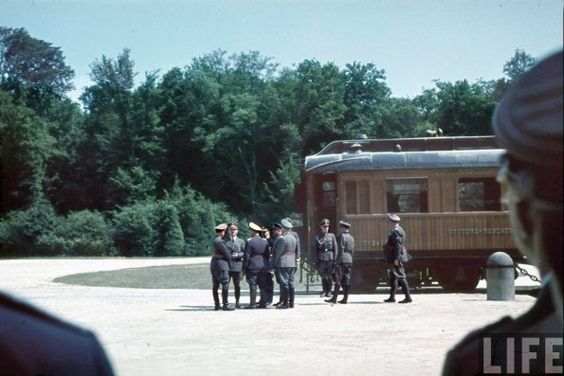
Adolf Hitler is expected to reenact in reverse the scene of the historic armistice of 1918 today by dictating to downtrodden France the hard terms of peace in the forest of Compiègne where French Marshal Foch was master of the armistice at Germany’s expense nearly 22 years ago. Informed Berlin sources said Hitler’s terms probably would be presented formally today at Compiègne where Marshal Foch’s railway car headquarters, in which he received the emissaries of a defeated imperial Germany in November, 1918, has been enshrined by the French and where is erected a monument showing the German eagle vanquished by the French sword. A French plane, painted white as a sign of truce, flew across the German lines yesterday bearing four French plenipotentiaries to learn Hitler’s terms.
At about 3:15 p.m., peace negotiations between France and Germany began at the Glade of the Armistice in the Forest of Compiègne, using the same rail carriage that the Armistice of 11 November 1918 was signed in. A point of contention was the size of the zone that the Germans were to occupy, so the war dragged on for another day. The German armistice delegation includes Ribbentrop, Hess, Keitel, Raeder, and others. Hitler personally attended the negotiation, but at 1530 hours abruptly left the meeting to show disrespect for the French. At 2030 hours, French General Huntzinger called his government and informed that the Germans allowed no room for negotiations and demanded harsh terms; he was told to accept the German terms.
It is difficult to overemphasize the importance of this day on the German psyche of the times. As one Wehrmacht officer notes, “The battle of France is over; it lasted 22 years.”
Hitler is in an excellent mood. It likely is the happiest day of his life. A German diplomat, Erich Tuch, spots him in nearby woods practicing his “moves,” laughing and strutting about, before the ceremony. He spends only about 15 minutes at what he considers to be a largely ceremonial occasion. British newsreels have endless fun looping some video of him which creates the appearance that he dances the jig at one point when in fact he simply lifts one leg high in exuberance as if to imitate dancing in joy.
The meeting itself is an anti-climax. Hitler casually hands the French a map showing his decision on occupation zones. He takes a seat in Foch’s place in the car, listens to his aide General Wilhelm Keitel read out the preamble, and then quickly leaves to show how uninteresting he feels the entire issue has become. The French are given an opportunity to telephone their government to describe the terms of the agreement after he leaves.
Hitler then becomes unreachable, which causes problems. He has ordained that there be a vestigial French state in the south, that the French armed forces be demobilized, and that the French pay huge indemnities at an artificially inflated exchange rate. The French delegation led by General Huntzinger begins quibbling over details despite Hitler’s peremptory attitude. Without Hitler present, General Keitel (who gets in some useful practice at surrenders which will come in handy later) does not feel authorized to make any decision. Thus, the “negotiations” drag on throughout the day in the stifling railway car. During the night, General Weygand, Admiral Darlan, and Prime Minister Petain’s cabinet begin coming up with their own clever ideas about the terms, but caution Huntzinger to get the German signatures on the document one way or the other.
The French government was reported fleeing from Bordeaux amidst an indescribable chaos of refugees, broken armies, exiled governments and heads of governments. The French government was said to be preparing to settle at Biarritz on the Bay of Biscay, its third change since its flight from Paris. Reports received in London said the French government was leaving Bordeaux to spare that city which was bombed Thursday morning with about 150 persons killed and 300 wounded. Premier Marshal Petain, who yesterday urged the French to fight on until peace is official, told them nevertheless there is no hope for continued resistance. France has too few friends, too few allies, too few soldiers, too few guns and planes, he said.
German forces continue to advance all across France. Operations continue all along the front far to the south, though resistance is largely a formality now. There are some battles in the Vosges Forest near Thionville and at Colmar.
Evacuations pursuant to Operation AERIAL continue at St Jean-de-Luz.
The French are still divided over the possibility of further resistance from North Africa. French vessel Massilia sails for North Africa with Minister Georges Mandel, a few members of the French government, and a few members of Parliament.
French refugees terrified of the advancing Germans are stopped at the Spanish border by Franco’s men and not allowed in.
German Grand Admiral Erich Raeder met with Adolf Hitler to discuss the invasion of Britain.
The Polish President arrives in England after being evacuated from southern France.
As the British evacuated from Guernsey, the control of the island was turned over to a Controlling Committee under the presidency of Attorney General Ambrose Sherwill.
Lieutenant-Governor of Jersey James Murray Robert Harrison was withdrawn to Britain, leaving Bailiff Alexander Coutanche the sole civilian leader.
The British War Office announced tonight that a new large contingent of Canadian infantry and airmen, together with a number of planes and other vital war equipment, had landed at a northwest port to join the British.
Everyone is on edge throughout Britain regarding infiltrators and paratroopers. The Times publishes a chart for distinguishing a German paratrooper from a regular British policeman.
German occupiers disband the Dutch States-General/Council of State.
The best-documented mass murder of the Palmiry massacre in Poland took place on 20–21 June 1940 when three transports with 358 inmates were sent from Pawiak to the place of execution near Palmiry. Among the victims was Maciej Rataj (politician, former Marshal of the Sejm and former acting President of Poland). This operation was given the code name AB-Aktion (shortcut from Außerordentliche Befriedungsaktion). It officially lasted from May to July 1940 and claimed at least 6,500 lives.
[Some of the Palmiry murderers were brought to justice. Ludwig Fischer, governor of Warsaw district in 1939–1945, and SS-Standartenführer Josef Meisinger, who occupied the post of SD and SiPo Commander in Warsaw in years 1939–1941, were arrested after the war by Allied forces and handed over to the Polish authorities. Their trial took place between 17 December 1946 and 24 February 1947. On 3 March 1947, the Supreme National Tribunal in Warsaw condemned both of them to death. Meisinger and Fischer were hanged in Mokotów Prison in March 1947.]
King Carol II of Rumania takes complete control of government. A decree issued by the king tonight has transformed Rumania into a totalitarian state and everything points to this country’s joining forces with the Axis. King Carol, who has just pardoned Iron Guard members, forms the National Party for them. Jews are excluded from membership.
A new Estonian government containing only left-wing activists was formed. The Soviet Union arranged for a number of Red Army backed support demonstrations in several cities.
The Estonian Independent Signal Battalion engaged in fighting with Soviet troops at Raua Street in Tallinn, Estonia. The Estonians would be defeated during the night.
The London War Office announced today that British mechanized units, attacking vigorously, had captured Italian General Lastrucci, chief engineer of the Tenth Army in Libya, and routed a powerful concentration of Italian forces near the Eritrean frontier.
The Luftwaffe night raids over southern England continue. There are 50 bombers attacking various targets.
RAF Bomber Command dispatches 10 aircraft to attack targets in Germany during the day.
RAF Bomber Command dispatches 105 aircraft to attack targets in Germany overnight.
R.V Jones, head of British Scientific Intelligence, testifies to a secret committee that the Luftwaffe is using the “Knickebein” (crooked leg) radio beam navigational system to find their targets. This system has proven fairly effective despite being primitive. The British quickly put in motion a method to detect the beams using specially equipped RAF Anson aircraft and work on other counter-measures.
Henry Tizard, who is largely responsible for the British use of the radar detection system, resigns out of frustration at being side-tracked on his advice. His resignation means that Frederick Lindemann (Lord Cherwell), generally considered to be less clever than Tizard, becomes Churchill’s principal scientific advisor.
Italian bombers unsuccessfully attack French warships near the Balearic Islands.
Italian bombers conduct two daylight raids against Bizerte, Tunisia and Malta.
U-28, commanded by Kapitänleutnant Günter Kuhnke, sank special services vessel HMS Cape Howe (X 02) (acting Cdr E. L. Woodhall DSO, MVO), which was disguised as RFA Prunella (4443grt), south of Ireland in 49 45N, 8 47W. At 0846 hours HMS Cape Howe (X 02) (A/Cdr E.L. Woodhall, DSO, MVO, RN), disguised as Prunella, was hit on the starboard side near the bridge by one of two torpedoes fired by U-28 about 100 miles west of the Isles of Scilly. The explosion blew open the hatches of #1 hold, put the Asdic and steering gear out of order and mortally injured two crewmen. The panic party abandoned the now slowly circling ship in two lifeboats but the U-boat did not surface and fired a coup de grâce after about one hour that hit on port side amidships, causing her to slowly settle by the bow until sinking with a list to port at 1230 hours. Woodhall, Surgeon Lt F. H. Williams, LMSSA, LAH, Lt E. J. Ormsby RNR, Probationary Acting Lt A. G. Daniels RNR, S/Lt W. A. Lawrence RNR, Temporary Lt (E) J. Wilkinson RNR, Temporary S/Lt J. B. Bell RNVR, Temporary S/Lt I. R. W. Stileman RNVR, and forty-eight ratings were lost in the British ship. The survivors found themselves in two lifeboats, one jolly boat, two Carley floats and a raft which they tried to keep together until losing touch the next morning in bad weather. Two days after the sinking, the 27 survivors in one of the lifeboats were picked up after being spotted by a Sunderland by the French steam merchant Casamance in 48°10N/08°28W and landed in Falmouth on 25 June. 13 survivors were picked up from a raft by HMS Versatile (D 32) (Cdr J.H. Jauncey, RN) in 48°47N/07°59W on 27 June and landed the next day in Devonport.
U-29 refueled from German tanker Bessel (1878grt) at Vigo.
U-25 attacked French steamer Aragaz (5009grt) in the Bay of Biscay, but without damage.
U-38, commanded by Kapitänleutnant Heinrich Liebe, sank Belgian steamer Luxembourg in 47 25N, 04 55W. At 1753 hours the unescorted Luxembourg (Master Louis Deburges) was hit aft by one G7e torpedo from U-38 and sank west of St. Nazaire. The ship had been bound for Antwerp, but was diverted to Bordeaux and anchored at Le Verdon on 20 June when she was ordered to leave to Falmouth. Five men were killed and one wounded of the 46 crew members on board. The 5,809-ton Luxembourg was carrying general cargo, including boiled beef, maize, and sunflower seed and was headed for Falmouth, England.
U-43, commanded by Kapitänleutnant Wilhelm Ambrosius, sank steamer Yarraville from convoy 65.X in 39 40N, 11 34W. At 1636 hours the Yarraville (Master William Alexander Beveridge) in convoy 65.X was hit by one torpedo from U-43, caught fire and sank southwest of Figueira da Foz, Portugal. Five crew members were lost. The master and 44 crew members (seven of them wounded) were picked up by the French trawler Marie Gilberte and landed at Gibraltar. The 8,627-ton Yarraville was carrying ballast and was headed for Beaumont, Texas.
U-47, commanded by Kapitänleutnant Günther Prien, made attacks on three steamers in convoy HX.49. San Fernando was badly damaged in 50 20N, 10 24W, but the other two were unharmed. At 2007 hours, U-47 fired a torpedo at a tanker in the middle of convoy HX.49 about 50 miles south-southwest of Cape Clear and hit the San Fernando. The U-boat then fired two torpedoes at 2008 and 2010 hours but could not observe the results because they dived to 100 metres to avoid a steamer that was on collision course with the U-boat. Prien assumed that he had hit two 7000 grt steamers, but this is not confirmed in Allied reports. The San Fernando (Master Arthur Richard Buckley) was taken in tow by tugs but sank the next day. The master and 48 crew members were picked up by HMS Fowey (L 15) (Cdr H.B. Ellison, RN) and HMS Sandwich (L 12) (Cdr M.J. Yeatman, RN) and landed at Plymouth. The 13,056-ton San Fernando was carrying crude oil and fuel oil and was headed for Liverpool, England.
U-52, commanded by Kapitänleutnant Otto Salman, sank Finnish steamer Hilda in 45 46N, 03 17W, after she had been damaged by German bombing on the 19th. At 0411 hours the unescorted Hilda (Master Antti Vene) was hit by one torpedo from U-52 and sank in a few minutes in the Bay of Biscay. The master and ten crew members sailed 150 miles in their lifeboats until they landed two days later at Castro Urdiales, Spain. The 1,144-ton Hilda was carrying grain and was headed for Spain.
The unescorted Dutch steam merchant Berenice was torpedoed and sunk by the U-65, commanded by Kapitänleutnant Hans-Gerrit von Stockhausen, in the Bay of Biscay in the eastern Atlantic Ocean. At 0817 hours the unescorted Berenice (Master A. Huygens) was torpedoed and sunk by U-65. The Berenice had left Bordeaux at 1330 hours on 20 June with 22 passengers on board (mostly Dutch and Belgians refugees), among them the poet H. Marsman and his wife and the Dutch painter T. Bottema. The ship sailed together with the Dutch steamer Orpheus, the coasters Nettie and Ary Scheffer and the tug Seine, but they got dispersed in the following night and only the Nettie was in visual range. The Berenice was hit by one torpedo amidships, causing her to sink within three minutes. The coastal vessel picked up nine survivors, including the master and Marsman’s wife, the only surviving passenger. On 22 June, they were landed at Falmouth but the master already died of wounds aboard. According to the KTB of U-65, they sighted a big steamer, identified as Champlain (28,124 grt), at 545 hours, which was shadowed until 735 hours, when the U-boat lost contact in fog. A short time later the ship was sighted again and attacked with a spread of three torpedoes at 817 hours. Allied sources reports that the Champlain went to the bottom after being damaged by an air laid magnetic mine off La Pallice at 0930 hours on 17 June. In knowledge of these sources, the torpedo report of U-65 claims the Champlain as his own success, but date, time and position are well fitting with the loss of the Berenice. The 1,177-ton Berenice was carrying manganese ore and passengers and was headed for the United Kingdom.
U-122, commanded by Korvettenkapitän Hans-Günther Looff, made an attack on a convoy off North Channel on the 21st, but was not heard from again after making her report. The Type IXB submarine was lost with all 48 crew in an accident, possibly in 48-33N, 10-26W. During its career under Korvettenkapitän Looff the U-122 sank 1 merchant ship for a total of 5,911 tons.
Greek steamer Corinthian (3701grt) reported she was attacked by a U-boat in 51-47N, 6-24W. Destroyers HMS Wanderer and HMS Witherington were ordered to search for her. Sister ship HMS Wren departed Milford Haven at 0335 to join them, and another sister ship, HMS Whirlwind also left Milford at 0530 for the same duty. When Wren and Whirlwind arrived in the area, Wanderer and Witherington were ordered to the Clyde with all dispatch.
Italian submarine Morosini attacked an allied merchant ship without result sixty five miles off Cape Palos.
Throughout the bulk of the Norwegian Campaign, the Swordfish squadrons from HMS Glorious had been operating from various FAA and RAF airfields, engaging primarily in minelaying operations. Mid-June saw both 821 and the surviving elements of 823 Squadrons based at HMS Sparrowhawk (RNAS Hatston) when word came in that the damaged German battlecruiser Scharnhorst had sortied south from Trondheim under heavy escort, intent on returning to Germany. At 1150 ACOS (Acting Captain C. L. Howe, RN) instructed the combined squadrons to prepare a striking force. The short notice, combined with the need for the aircraft to be fitted with both long range tanks and torpedo couplings limited the available effort to a paltry six Swordfish, one sub-flight of three from each squadron. Lieutenant J. H. Stenning, RN of 821 was the strike commander, Lieutenant J. C. Reed, RN led the 823 sub-flight. There would be no escort. At 1245 the six aircraft departed Hatston with orders to fly to a designated point 40 miles off the Norwegian coast, turn northwards to search for the enemy fleet, and to return to RAF Sumburgh in the Shetlands. The intended point was reached at 1445, and a short search begun which resulted in the enemy force being sighted ahead at 1458, Scharnhorst in the center of a circular screen with one escort ahead, one astern, and two on either beam. The attackers approached from the port bow. The attack commenced at 1508 with a diving attack from 8,000 feet. The long-range AA fire, opened at as the Swordfish descended through 4,000 feet, was considered inaccurate, but the close range Flak from Scharnhorst was both heavy and effective, downing two from 823 4M shot down in flames (Sub-Lieutenant (A) Maurice Phillip White, RN (P), Naval Airman first class Charles Herbert Arthur G. Hull (AG)) while 4R was seen to make a controlled force-landing nearby (Sub-Lieutenant (A) Leonard Beale Cater, RN (P), Leading Airman Frederick Walter Davis (AG)), but in the event, neither crew was recovered from the cold North Sea waters. During the withdrawal Sub-Lieutenant (A) O. A. G. Oxley’s of 821 sighted four approaching Bf-109s. He continued climbing and escaped after dragging his “Stringbag” into the cloudbank at 13,000 feet! Oxley, separated from the remainder of the striking force, and without an observer on board, managed to navigate his way back to Hatston. The other three survivors managed a safe return to RAF Sumburgh as planned. Unfortunately for the British cause, none of the six torpedoes dropped hit home in this, the last act of the Norwegian Campaign.
An German Ar 196 aircraft from battlecruiser Scharnhorst mistook German U-boat U-99 for an enemy submarine and damaged her with a bomb. U-99 was already en route back to Wilhelmshaven, Germany with a sick sailor; she would now require a longer time to complete repairs.
Canadian destroyers HMCS Skeena, HMCS St Laurent, HMCS Restigouche, and HMCS Fraser arrived at Plymouth at 0640 after TC.5 escort duty. Battleship HMS Revenge arrived at Plymouth at 0645.
Aircraft carrier HMS Illustrious departed Devonport for working up at Bermuda escorted by destroyers HMS Imogen, HMS Griffin, and HMCS St Laurent.
Minelayers HMS Teviotbank and HMS Plover and destroyers HMS Esk, HMS Intrepid, and HMS Icarus departed the Humber on minelaying mission BS.17 during the night of 21/22 June. The British ships arrived back in the Humber on the 22nd.
Destroyer HMS Hurricane (Lt Cdr H.C. Simms) was completed. She arrived at Plymouth on the 30th for working up and joined 9th Destroyer Flotilla operating in the Western Approaches.
British drifter HMS Charde (99grt) was sunk in a collision at Portsmouth.
Anti-submarine yacht HMS Viva II (502grt), escorting a transport in the Bay of Biscay, attacked a submarine contact in 46 28N, 3 51W.
At 1810, submarine H-44 sank Danish steamer Alfa (844grt) off Texel.
Canadian destroyer HMCS Fraser departed Plymouth with Captain CC A Allen and beach and communications parties for evacuation of St Jean de Luz.
A German convoy was reported near the Frisian Islands. Eight British Albacores of the 826 Squadron from HMS Peregrine and nine Hudsons from Coastal Command were sent to intercept the convoy. The convoy was not located. Six Albacores attacked the DeKooy airfield and Willemsoord. Two Albacores were lost and with pilot Lt (A) J. L. Mackenzie Bell, Acting S/Lt F. B. Hookins, Naval Airman R. G. Poole of one aircraft killed. The crew of the other Albacore was captured. Pilot S/Lt (A) W. S. Butterworth survived as a prisoner of war, observer S/Lt V. J. Dyke died of wounds. Leading Airman R. J. Jackson died as a POW on 18 January 1945.
In an attack by nine British Hudson aircraft of 206 Squadron, dismantled old Dutch coastal battleship Vliereede was sunk at Den Helder. The ship was later salved as German Ariadne in 1941.
French steamer Biscarosse (1937grt) was scuttled at Le Havre.
French steamer Mecanicien Principal Carvin (4282grt) was sunk by German bombing at Le Verdon.
French auxiliary patrol vessel Mercedita was beached after mining off Le Verdon and scuttled.
British steamer Luffworth (279grt) was abandoned at Brest. She was later taken in prize by German forces.
Destroyer HMS Wrestler departed Gibraltar to meet French convoy 7 P, which departed Marseille, Sete, Port Vendres on the 19th with eighteen ships escorted by destroyers Boulonnais and Typhon and armed patrol vessels Sidi Okba and Cyrnos. Also, large destroyers Tigre and Lynx covered the convoy. The Destroyer was to escort the Atlantic bound ships to Gibraltar. Convoy 7 P arrived at Oran on the 22nd.
French armed merchant cruiser Massilia departed the Gironde with French ministers and Members of Parliament. When she arrived at Casablanca on the 24th, the Vichy authorities arrested them.
German motor torpedo boats S.21 and S.32 were sunk on a mine 15 miles south of Dungeness. S.31 and S.35 picked up the survivors, but OzS Toniges and six crewmen were lost. S.21 was salved in 1941 and returned to service.
French cruisers El Djezair, El Kantara, El Mansour, Ville d’Oran, and Ville d’Alger arrived at Casablanca, French Morocco with 1,200 tons of French gold.
Convoy OG.34 was formed from convoys OA.171G, which departed Southend on the 19th escorted by sloop HMS Aberdeen from 19 to 21 June, OB.171G, which departed Liverpool on the 19th escorted by sloop HMS Leith, with twenty-eight ships. Sloops HMS Leith and HMS Wellington escorted the convoy from 21 June to 3 July. The convoy arrived Gibraltar on 3 July.
Convoy OA.172 departed Southend escorted by corvette HMS Gladiolus from 21 to 24 June.
Convoy OB.172 departed Liverpool escorted by destroyers HMS Volunteer and HMS Whirlwind from 21 to 24 June. The convoy was dispersed on the 26th.
Convoy FN.201 departed Southend, escorted by destroyers HMS Vivien and HMS Vega and patrol sloop HMS Shearwater. The sloop was detached to convoy FS.102 when met. The convoy arrived in the Tyne on the 23rd.
Convoy FS.201 departed the Tyne, escorted by destroyer HMS Valorous and sloop HMS Egret. The convoy arrived at Southend on the 23rd.
Convoy MT.93 departed Methil, escorted by destroyers HMS Wallace and HMS Wolfhound. The convoy arrived at the Tyne the next day.
Convoy HX.52 departed Halifax escorted by Canadian destroyers HMCS Assiniboine and HMCS Ottawa and auxiliary patrol vessels HMCS Acadia and HMCS French. On 22 Jul, the destroyers turned the convoy over to the ocean escort, armed merchant cruiser HMS Aurania, which was detached on 2 July.
Convoy BHX.52 departed Bermuda on the 20th escorted locally by sloop HMS Penzance and ocean escort armed merchant cruiser HMS Rajputana. The convoy rendezvoused with HX.52 on the 25th and the armed merchant cruiser was detached. On 2 July, destroyers HMS Hurricane and HMS Wolverine, sloop HMS Scarborough, and corvette HMS Gardenia joined the convoy. Destroyer Hurricane was detached later that day. The remaining escorts were with the convoy until it arrived at Liverpool on 6 July.
Convoy HG.35 departed Gibraltar with twenty one ships escorted by destroyers HMS Watchman and HMS Vidette. Destroyer Watchman was detached on the 22nd and destroyer Vidette was detached on the 25th. Sloop HMS Deptford escorted the convoy from 22 June to 1 July. The convoy was joined in Home Waters by destroyer HMS Witherington on the 28th from convoy OG.35 and remained with the convoy until 1 July. The convoy arrived at Liverpool on 1 July.
The War at Sea, Friday, 21 June 1940 (naval-history.net)
German battlecruiser SCHARNHORST departed Trondheim escorted by destroyers STEINBRINCK, LODY, SCHOEMANN, and GALSTER and torpedo boats GREIF, KONDOR, FALKE, and JAGUAR.
On the 21st off Utsire, three Swordfish with Lt J. H. Stenning and Lt V. A. Smith, RAN, Lt W. A. F. Fryer and Acting Petty Officer G. L. Taylor, S/Lt (A) O. A. G. Oxley and Naval Airman E. D. Milsom of the 821 Squadron, three Swordfish with Lt J. C. Reed and S/Lt (A) P. Winter, S/Lt (A) M.P. White and Naval Airman C. H.A. G. Hull, S/Lt (A) L.B. Cater and Leading Airman F. W. Davis of the 823 Squadron, six Hudsons of 233 Command, nine Beauforts of 42 Squadron of the RAF unsuccessfully attacked the German ships.
S/Lt (A) L.B. Cater and Petty Officer Airman F. W. Davis and S/Lt (A) M.P. White and Naval Airman C. H.A. G. Hull were lost when two Swordfish were shot down. Three Beauforts and one Hudson were also shot down and a Sunderland of 204 Squadron was damaged.
At 1120, aircraft reported one battlecruiser and six destroyers in 61-00N, 4-14E on course 190 at 25 knots.
Battlecruisers RENOWN (VA Battlecruisers) and REPULSE with destroyers FORESTER, ESCORT, ZULU, INGLEFIELD (D.3), and DIANA departed Scapa Flow at 1220/21st.
Destroyers MAORI and MASHONA, which had departed the Faroes at 0620/21st, joined the force at sea.
On the 21st, light cruisers MANCHESTER (CS 18), SHEFFIELD, and BIRMINGHAM, heavy cruiser YORK, and destroyer GALLANT departed Rosyth to join Heavy cruiser SUSSEX and light cruiser NEWCASTLE in 58 50N, 00 20E, then meet the Battlecruiser Squadron.
At 1850, the operation was cancelled when the German ships were reported inside the Fjords in the vicinity of Haugesand.
At 0240/22nd, failing to make contact with the German force, the British ships withdrew to westward.
Battlecruisers RENOWN and REPULSE and destroyers INGLEFIELD (D.3),ZULU, FORESTER, ESCORT, and DIANA arrived at Scapa Flow at 1120/22nd.
Light cruiser NEWCASTLE and heavy cruiser SUSSEX arrived at Scapa Flow an hour after the RENOWN group.
Light cruisers BIRMINGHAM, MANCHESTER, and SHEFFIELD, heavy cruiser YORK, and destroyer GALLANT arrived back at Rosyth on the 22nd.
The German ships put into Stavanger Fjord. They departed the next day and arrived safely at Kiel on the 23rd. Battlecruiser SCHARNHORST was repairing at Kiel until 19 October 1940.
There was a reorganization of the destroyers under Rear Admiral Destroyers, Home Fleet.
3rd Destroyer Flotilla – Destroyers INGLEFIELD (D.3), ISIS, IMOGEN, DELIGHT, DIANA, HOTSPUR, ECLIPSE, and ELECTRA.
23rd Destroyer Division of the 3rd Destroyer Flotilla: Destroyer ATHERSTONE and other HUNT destroyers as completed.
4th Destroyer Flotilla: Destroyers COSSACK (D.4), SIKH, ZULU, MAORI, ESCAPADE, ECHO, ESCORT, and ENCOUNTER.
6th Destroyer Flotilla: Destroyers TARTAR (D.6), ASHANTI, MATABELE, MASHONA, BEDOUIN, PUNJABI, ESKIMO, and SOMALI.
8th Destroyer Flotilla: Destroyers FAULKNOR (D.8), FURY, FORESTER, FEARLESS, FOXHOUND, FAME, FORESIGHT, FORTUNE, and FIREDRAKE.
Canadian destroyers HMCS SKEENA, HMCS ST LAURENT, HMCS RESTIGOUCHE, and HMCS FRASER arrived at Plymouth at 0640 after TC.5 escort duty. Battleship REVENGE arrived at Plymouth at 0645.
French destroyer TRIOMPHANT arrived at Plymouth from Lorient.
Aircraft carrier ILLUSTRIOUS departed Devonport for working up at Bermuda escorted by destroyers IMOGEN, GRIFFIN, and HMCS ST LAURENT.
Minelayers TEVIOTBANK and PLOVER and destroyers ESK, INTREPID, and ICARUS departed the Humber on minelaying mission BS.17 during the night of 21/22 June.
The British ships arrived back in the Humber on the 22nd.
Destroyer FORESIGHT arrived at Rosyth from Harwich.
Destroyer FORESIGHT departed immediately with destroyer WALPOLE for Scapa Flow, arriving at 0545/22nd.
Destroyer WITHERINGTON arrived in the Clyde.
British oiler ROSEWOOD, escorted by aircraft and anti-submarine trawlers CAPE WARWICK and ELM, arrived at Scapa Flow from Sullom Voe.
Destroyer CODRINGTON arrived at Dover at 1420 to join the 1st Destroyer Flotilla.
Auxiliary minesweeper EMPEROR OF INDIA arrived at 2130 at Dover after refitting to join the 10th Mine Sweeping Flotilla.
At 0840, destroyer GREYHOUND observed an underwater explosion two miles 30° from No. 10 Buoy.
The cause was never established.
Destroyer BOREAS during the night of 21/22 June was on patrol in North Goodwins between R Buoy and U Buoy to guard against German battlecruiser SCHARNHORST movement through the Channel.
The rest of the destroyers at Dover were placed at a quarter hour notice.
Destroyer HURRICANE (Lt Cdr H.C. Simms) was completed.
She arrived at Plymouth on the 30th for working up and joined 9th Destroyer Flotilla operating in the Western Approaches.
U-28 sank Special services vessel CAPE HOWE (acting Cdr E. L. Woodhall DSO, MVO), which was disguised as RFA PRUNELLA (4443grt), south of Ireland in 49 45N, 8 47W.
Woodhall, Surgeon Lt F. H. Williams, LMSSA, LAH, Lt E. J. Ormsby RNR, Probationary Acting Lt A. G. Daniels RNR, S/Lt W. A. Lawrence RNR, Temporary Lt (E) J. Wilkinson RNR, Temporary S/Lt J. B. Bell RNVR, Temporary S/Lt I. R. W. Stileman RNVR, forty eight ratings were lost in the British ship.
Twenty-seven crew were rescued on the 24th by French steamer CASAMANCE (5817grt). Thirteen survivors were picked up from a raft by destroyer VERSATILE on the 27th in 48-47N, 7-59W.
British drifter CHARDE (99grt) was sunk in a collision at Portsmouth.
Anti-submarine yacht VIVA II (502grt), escorting a transport in the Bay of Biscay, attacked a submarine contact in 46 28N, 3 51W.
At 1810, submarine H.44 sank Danish steamer ALFA (844grt) off Texel.
Canadian destroyer HMCS FRASER departed Plymouth with Captain CC A Allen and beach and communications parties for evacuation of St Jean de Luz.
Convoy OG.34 was formed from convoys OA.171G, which departed Southend on the 19th escorted by sloop ABDERDEEN from 19 to 21 June, OB.171G, which departed Liverpool on the 19th escorted by sloop LEITH, with twenty-eight ships.
Sloops LEITH and WELLINGTON escorted the convoy from 21 June to 3 July. The convoy arrived Gibraltar on 3 July.
Convoy OA.172 departed Southend escorted by corvette GLADIOLUS from 21 to 24 June.
Convoy OB.172 departed Liverpool escorted by destroyers VOLUNTEER and WHIRLWIND from 21 to 24 June. The convoy was dispersed on the 26th.
Convoy FN.201 departed Southend, escorted by destroyers VIVIEN and VEGA and patrol sloop SHEARWATER. The sloop was detached to convoy FS.102 when met. The convoy arrived in the Tyne on the 23rd.
Convoy FS.201 departed the Tyne, escorted by destroyer VALOROUS and sloop EGRET. The convoy arrived at Southend on the 23rd.
Convoy MT.93 departed Methil, escorted by destroyers WALLACE and WOLFHOUND. The convoy arrived at the Tyne the next day.
Four Skuas and five Rocs of 801 Squadron from SPARROWHAWK, escorted by twelve Hurricanes attacked a new German gun battery at Cap Blanc.
S/Lt (A) A. V. M. Day flying a Roc was killed when he was shot down in the attack. His crewman Naval Airman F. Berry was also lost.
A German convoy was reported near the Frisian Islands. Eight British Albacores of the 826 Squadron from PEREGRINE and nine Hudsons from Coastal Command were sent to intercept the convoy. The convoy was not located. Six Albacores attacked the DeKooy airfield and Willemsoord. Two Albacores were lost, with pilot Lt (A) J. L. Mackenzie Bell, Acting S/Lt F. B. Hookins, Naval Airman R. G. Poole of one aircraft killed.
The crew of the other Albacore was captured. Pilot S/Lt (A) W. S. Butterworth survived as a prisoner of war, observer S/Lt V. J. Dyke died of wounds. Leading Airman R. J. Jackson died as a POW on 18 January 1945.
In an attack by nine British Hudson aircraft of 206 Squadron, dismantled old Dutch coastal battleship VLIEREEDE was sunk at Den Helder. The ship was later salved as German ARIADNE in 1941.
Convoy HX.52 departed Halifax escorted by Canadian destroyers HMCS ASSINIBOINE and HMCS OTTAWA and auxiliary patrol vessels HMCS ACADIA and HMCS FRENCH. On 22 Jul, the destroyers turned the convoy over to the ocean escort, armed merchant cruiser AURANIA, which was detached on 2 July.
Convoy BHX.52 departed Bermuda on the 20th escorted locally by sloop PENZANCE and ocean escort armed merchant cruiser RAJPUTANA. The convoy rendezvoused with HX.52 on the 25th and the armed merchant cruiser was detached.
On 2 July, destroyers HURRICANE and WOLVERINE, sloop SCARBOROUGH, and corvette GARDENIA joined the convoy. Destroyer HURRICANE was detached later that day. The remaining escorts were with the convoy until it arrived at Liverpool on 6 July.
Convoy HG.35 departed Gibraltar with twenty-one ships escorted by destroyers WATCHMAN and VIDETTE.
Destroyer WATCHMAN was detached on the 22nd and destroyer VIDETTE was detached on the 25th.
Sloop DEPTFORD escorted the convoy from 22 June to 1 July. The convoy was joined in Home Waters by destroyer WITHERINGTON on the 28th from convoy OG.35 and remained with the convoy until 1 July.
The convoy arrived at Liverpool on 1 July.
French steamer BISCAROSSE (1937grt) was scuttled at Le Havre.
French steamer MECANICIEN PRINCIPAL CARVIN (4282grt) was sunk by German bombing at Le Verdon.
French auxiliary patrol vessel MERCEDITA was beached after mining off Le Verdon and scuttled.
British steamer LUFFWORTH (279grt) was abandoned at Brest. She was later taken in prize by German forces.
Destroyer WRESTLER departed Gibraltar to meet French convoy 7 P, which departed Marseille, Sete, Port Vendres on the 19th with eighteen ships escorted by destroyers BOULONNAIS and TYPHON and armed patrol vessels SIDI OKBA and CYRNOS. Also, large destroyers TIGRE and LYNX covered the convoy.
The Destroyer was to escort the Atlantic bound ships to Gibraltar. Convoy 7 P arrived at Oran on the 22nd.
French armed merchant cruiser MASSILIA departed the Gironde with French ministers and Members of Parliament. When she arrived at Casablanca on the 24th, the Vichy authorities arrested them.
U-122 made an attack on a convoy off North Channel on the 21st, but was not heard from again after making her report. She may have been lost with all 48 crew in an accident in 48-33N, 10-26W.
German motor torpedo boats S.21 and S.32 were sunk on a mine 15 miles south of Dungeness. S.31 and S.35 picked up the survivors, but OzS Toniges and six crew were lost. S.21 was salved in 1941 and returned to service.
U-29 refueled from German tanker BESSEL (1878grt) at Vigo.
U-25 attacked French steamer ARAGAZ (5009grt) in the Bay of Biscay, but without damage.
U-38 sank Belgian steamer LUXEMBOURG (5809grt) in 47 25N, 04 55W, but the entire crew was saved.
U-43 sank steamer YARRAVILLE (8627grt) from convoy 65X in 39 40N, 11 34W. Five crew were lost, but French trawler MARIE GILBERTE (286grt) arrived at Gibraltar on the 24th with 45 survivors.
U-47 made attacks on three steamers in convoy HX.49. SAN FERNANDO (13,056grt) was badly damaged in 50 20N, 10 24W, but the other two were unharmed. SAN FERNANDO was taken in tow and was still afloat at 2100/22nd. However, she sank before arriving in port. Seventeen survivors were picked up by sloop SANDWICH.
U-52 sank Finnish steamer HILDA (1144grt) in 45 46N, 03 17W, after she had been damaged by German bombing on the 19th. Five crew were killed in the sinking.
U-65 torpedoed French steamer CHAMPLAIN (28,124grt) in La Pallice Roads. However, CHAMPLAIN had already been mined on the 17th and had sunk resting on the sea bed with the most of her still above water.
Greek steamer CORINTHIAN (3701grt) reported she was attacked by a U-boat in 51-47N, 6-24W. Destroyers WANDERER and WITHERINGTON were ordered to search for her. Sister ship WREN departed Milford Haven at 0335 to join them, and another sister ship, WHIRLWIND also left Milford at 0530 for the same duty. When WREN and WHIRLWIND arrived in the area, WANDERER and WITHERINGTON were ordered to the Clyde with all dispatch.
Destroyers NUBIAN and MOHAWK departed Alexandria to intercept Greek steamer ERMOINI (440grt) in the Aegean. No contact was made and they returned to other duties.
Italian submarine MOROSINI attacked an allied merchant ship without result sixty-five miles off Cape Palos.
President Roosevelt was at his home today in Hyde Park, New York.
In Washington, the Senate debated foreign policy for most of the day, debated the House bill to speed up naval expansion, and advanced many pieces of legislation to their final stage in an effort to recess tomorrow night over the period of the Republican National Convention. The Senate recessed at 10:45 PM until 11 AM tomorrow.
The House passed and sent to the White House an amendment to the Neutrality Act permitting the first American Red Cross “mercy” ship to put in at Bordeaux; adopted several conference reports, including those on the relief bill for 1941, the May bill to speed up construction for the Army and acquisition of land for training purposes; refused to recede on several items in the Labor-Security Appropriation Bill. Its conferees on the defense tax bill agreed with those of the Senate. The House adjourned at 6:11 PM until 11 AM tomorrow.
The U.S. Senate approved tonight a proposal to restrict the transfer of army and navy equipment to other countries. The proposal, inserted without dissent in a measure to expedite naval shipbuilding, would require the chief of naval operations or the army chief of staff must certify any equipment released is “surplus” and is not needed for the defense of the United States. Sponsored by Chairman Walsh, Massachusetts Democrat, of the senate naval committee, the amendment grew out of congressional criticism of the navy’s release of 23 “mosquito boats” for sale to the allies.
A demand that President Roosevelt resign lest his foreign policies bring “disaster” upon the country was made in the senate today by Senator Nye, North Dakota Republican, while at Hyde Park the chief executive accused his critics of partisanship. Nye, advocate of aloofness from European affairs, also urged that Harry Woodring, resigned secretary of war, be called before the senate military committee for questioning. He said he would be “very much surprised” if the committee did not learn Woodring had been asked to transfer “national defense secret number 1,” a new bomb sight, to the allies, and that he had been ousted because he refused. This brought from Senator Barkley, Kentucky Democrat, the reply Major General Henry H. Arnold had assured him that “at no time or under any conditions has any consideration been given to revelation of any secret bomb sight.” At Hyde Park the president took cognizance of charges that he was creating a “war cabinet” in appointing Henry L. Stimson to succeed Woodring and Col. Frank Knox, like Stimson a Republican, to the post of secretary of the navy. The chief executive told reporters there are some people who think in terms of patriotic motives and some who think with partisan motives. Knox asserted at Chicago the country was in danger “because we are inadequately prepared” and his only aim was to help “get ready for any emergency” in a wholly non-political way.
A Senate-House conference committee tonight struck from the $1,000,000,000 defense tax bill senate amendments which would have levied immediate increases in excess profits taxes and provided a schedule of high taxes to become effective with a declaration of war. These provisions wore omitted in drafting a compromise between senate and house versions of the measure, designed to finance the expansion of the army and navy. The conferees, however, adopted a resolution asserting it was the “policy of the committee” that an excess profits tax should be enacted later applicable to all taxable years after December 1, 1939 that is making it apply to the current calendar year.
Bipartisan support in Congress for selective compulsory military training was indicated today when Representative James W. Wadsworth, Republican, of New York, introduced in the House an authorizing bill identical with one submitted to the Senate yesterday by Senator Burke, Democrat, of Nebraska. Quick action was promised in the Senate on the measure, which would require the registration of about 40,000,000 persons between the ages of 18 and 65, with those. between 21 and 45 subject to military training and others to home defense. Chairman Sheppard of the Senate Military Affairs Committee said that he had already asked the War Department for its opinion on the bill, a routine step, and that hearings would start “in a few days.”
The Senate Military Affairs Committee today ordered hearings on President Roosevelt’s nomination of Henry L. Stimson to be War Secretary, and Colonel Stimson himself will be called to testify. As a momentous Senate debate over foreign and defense policies shaped up around the Stimson appointment and that of Colonel Frank Knox to be Secretary of the Navy, it appeared there would be no action on confirmation for more. than a week. Chairman Sheppard said that Colonel Stimson would be called for testimony “in a week or so” and it was expected to be at least that long until the naval committee acts on the Knox nomination. The naval group will hold its first meeting on the subject tomorrow. Members of the military committee said that demands for hearings on Colonel Stimson came chiefly from Republicans, but that once such a procedure was decided upon there was no opposition to calling the nominee himself.
After being thrown into something like confusion yesterday by President Roosevelt’s appointment of Henry L. Stimson and Colonel Frank Knox to his Cabinet, the managers of the aspirants for the Republican Presidential nomination and the party leaders who are here for next week’s convention regained their poise today. The most marked development was a revival of the boom for Wendell L. Willkie, which had been. checked at least temporarily by the reaction here to the President’s success in getting two prominent Republicans to consent to enter his Cabinet. The ten subcommittees of the convention committee on resolutions held sessions and reached general agreement on all planks except the important one on foreign relations.
District Attorney Thomas E. Dewey charged last night that this nation would never have a sound government as long as President Roosevelt remained in office.
Major General Smedley D. Butler, 58, who retired from the U.S. Marine corps after fighting half-way round the world and spent much of his later years urging the nation keep its fighting men home, died today in naval hospital. “Old gimlet eye” the name he got in the Mexican campaign because he learned so much of the enemy succumbed at 4 p.m. (E.S.T.) to a gall bladder and liver ailment. He had been in bed a month. Since he retired in 1931, with 30 years of service in the marines, Butler lectured with the same sharp tongue that often brought him public notice during his military and public service. He backed armed force for home defense only. He is one of the few men who was twice awarded the congressional medal of honor, in 1914 for heroism in Vera Cruz, and a year later for storming with three men Fort Rivière in Haiti.
On June 21, 1940, a twenty-six-year-old black man named Jesse Thornton addressed a passing police officer by his name, Doris Rhodes. When the officer, a white man, overheard Mr. Thornton and ordered him to clarify his statement, he attempted to correct himself by referring to the officer as “Mr. Doris Rhodes.” The officer hurled a racial slur at Mr. Thornton while knocking him to the ground and arresting him. Mr. Rhodes then walked Mr. Thornton into the city jail as a mob of white men formed just outside.
Mr. Thornton tried to escape and managed to flee a short distance while the mob quickly pursued, firing gunshots and throwing bricks, bats, and stones at him. Mr. Thornton was injured by gunfire and eventually collapsed. The mob dumped him into a truck and drove to an isolated street where he was dragged into a nearby swamp and shot again. Mr. Thornton’s decomposing, vulture-ravaged body was found a week later by a local fisherman in the Patsaliga River, near Tuskegee Institute.
Dr. Charles A.J. McPherson, a local leader in the Birmingham branch of the National Association for the Advancement of Colored People (NAACP), wrote a detailed report on Mr. Thornton’s lynching. Future United States Supreme Court Justice Thurgood Marshall, then an attorney with the NAACP, provided the Department of Justice with the report and requested a federal investigation. The Justice Department instructed the Federal Bureau of Investigation to determine whether law enforcement or other officials were complicit in the lynching but there is no record that anyone was ever prosecuted for Mr. Thornton’s murder.
Richard Nixon (27) weds Pat Ryan (28) at the Mission Inn in Riverside, California.
General John T. Thompson dies in Great Neck, New York. Thompson was an officer during World War I who worked up the Thompson Machine Gun. The “Tommy Gun” became so ubiquitous during World War II that Wehrmacht troops took to calling Allied soldiers “Tommies.”
The U.S. Navy destroyer USS Herbert (DD-160) arrives at Casablanca, French Morocco.
The U.S. Navy destroyer USS Dickerson (DD-157), attached to Squadron 40-T, departs Lisbon for Bilbao, Spain.
Major League Baseball:
Batting in the lead-off spot, brilliant youngster Pee Wee Reese paced a fifteen-hit assault with a single, double, and triple as the Dodgers beat the Pirates, 10–8, and held first place by a game over the Giants. Round Freddy Fitzsimmons, pitching eight innings, received credit for his sixth triumph of the season and the 198th of his glamorous major league career. Freddy had a 10–7 lead at the end of the eighth and Lippy Leo Durocher decided to insure the victory by sending in Newel Kimball.
Confronted by the Reds’ Paul Derringer and a three-run deficit, the Giants rallied and took advantage of a Cincinnati error in the eighth, and with Bill Jurges, a grand performer all afternoon, delivering the pay-off hit, they pushed across the run that brought a 4–3 decision. When it was all over, the New Yorkers found themselves in second place, 11 percentage points ahead of the Reds. They trail the Brooklyn pace-setters by one game.
The Phillies chalked up their third straight victory today, beating the Cubs, 6–5, behind Ike Pearson’s effective relief pitching. Pearson replaced Si Johnson with two on and no one out in the seventh and yielded only one hit in the last three innings. Lloyd Brown started for the Phils but gave way in the sixth.
Washington rookie Sid Hudson takes a no-hitter into the 9th inning, but the Browns Rip Radcliff hits a pop fly double down the right field line with no outs. A passed ball puts him on 3rd, but Hudson retires 3 for a 1–0 win. He’ll beat the A’s on a one-hit shutout in August. The Senators got the game’s only run in the first inning, and Hudson made it hold up.
The Yankees thrashed the Detroit Tigers in the opener of a three-game series, 12–7. Red Rolfe collected five hits, the last one a double, while Charlie Keller and Frankie Crosetti unloaded homers in a general bombardment that totaled seventeen blows off four Detroit hurlers. Keller also got three singles, in addition to his twelfth homer of the year.
Roy (Beau) Bell produced a dramatic three-run homer in the clutch today to give Cleveland a 7-to-4 comeback triumph over Boston and cement the Indians’ hold on first place. Bell’s eighth-inning shot broke a 4–4 tie. Al Milar (10–2) got the victory for the Indians.
The White Sox, fresh from three straight victories over the Yankees, were easy victims of the Athletics today, bowing by a 12–1 score before Lee Ross’s four-hit pitching. Ross, hurling his fourth straight victory, allowed no runner to reach first until the fifth, when Luke Appling singled. The Sox connected for their only run in the seventh on Taft Wright’s single, a passed ball and Appling’s second hit.
Pittsburgh Pirates 8, Brooklyn Dodgers 10
Philadelphia Athletics 12, Chicago White Sox 1
Boston Red Sox 4, Cleveland Indians 7
New York Yankees 12, Detroit Tigers 7
Cincinnati Reds 3, New York Giants 4
Chicago Cubs 5, Philadelphia Phillies 6
Washington Senators 1, St. Louis Browns 0
Alexander Cambridge, 1st Earl of Athlone became the 16th Governor General of Canada.
Canada passed the National Resources Mobilization Act.
Henry Asbjorn Larsen (1899-1964) sets sail from Vancouver on RCMP patrol vessel St. Roch intending to reach Halifax via Arctic. Makes first successful west to east navigation of Northwest Passage.
The U.S. Navy heavy cruiser USS Wichita (CA-45), with Commander Cruiser Division Seven (Rear Admiral Andrew C. Pickens) embarked, arrives at Rio de Janeiro, Brazil, en route to join the heavy cruiser USS Quincy (CA-39) at Montevideo, Uruguay as part of the American effort to counteract German propaganda in Latin America.
The Chinese Government announced today an agreement with the British Government regarding disposition of the Chinese silver stored in the British Concession at Tientsin and simultaneously revealed that it had made representations to Britain against the British-Japanese agreement for policing the concession and against the British agreement to circulation of North China Federal Reserve Bank notes in the concession. The government emphasized that the arrangement made by the British and Japanese for sealing the silver did not alter its status as property of the Bank of Communications and as part of the reserve of China’s currency. The declaration states the British Government is acting as trustee for the interest of the bank and the Chinese Government regarding the balance of the silver after £100,000 worth had been set aside by the Chinese Government for relief in North China.
Prince Konoye forms a new Japanese Cabinet with General Hideki Tojo as Minister of War, and pro-German Yosuke Matsuoka, as Minister of Foreign Affairs.
Circles close to the Japanese Government indicated today that Japan’s policies were crystallized around a program calling for closer relations with Germany and Italy, possibly direct action in British and French possessions in the Southern Orient and a negative attitude toward any American efforts toward rapprochement. These quarters said Japan’s foreign policy had shifted to this three-point program to meet the rapid turn of events in Europe. Regarding the British and French holdings in the Southern Orient, they said Japan at least would take a “stronger hand,” if not direct action. Hong Kong, British Crown colony, and French Indo-China are the chief possessions of the Allies in the Southern Orient. Japan and the United States have been without formal trade relations since last January 26 when Washington denounced their twenty-nine-year-old commercial treaty. The action placed commercial relations between the two countries on a day-to-day basis, although customs duties remained unchanged.
From this moment, the clock is ticking towards Pearl Harbor.
Dow Jones Industrial Average: 122.61 (+0.26)
Born:
Mariette Hartley, American actress (Polaroid spokesperson, “Genesis II”, “Marooned”), in Weston, Connecticut.
Michael Ruse, British-Canadian philosopher of science (the relationship between science and religion, the creation–evolution controversy), in Birmingham, England, United Kingdom.
Died:
Smedley Butler, 58, U.S. Marine Corps major general. At the time of his death, Butler was the most decorated Marine in U.S. military history. After retiring from the Marine Corps, Butler became an outspoken critic of American foreign policy and military interventions, which he saw being driven primarily by U.S. business interests.
General John T. Thompson, 79, United States Army officer known for being the inventor of the Tommy gun.
Janusz Kusociński, 33, Polish athlete (executed in the Palmiry massacre).
Mieczysław Niedziałkowski, Polish politician and writer (executed in the Palmiry massacre).
Maciej Rataj, 56, Polish politician and writer (executed in the Palmiry massacre).
Tomasz Stankiewicz, 37, Polish track cyclist (executed in the Palmiry massacre).
Édouard Vuillard, 71, French painter and filmmaker.
Naval Construction:
The Royal Navy Dance-class ASW trawlers HMS Cotillion (T 104) and HMS Coverley (T 106) are laid down by the Ardrossan Dockyard (Ardrossan, Scotland); completed by Plenty.
The Royal Navy Bangor-class (Turbine-engined) minesweeper HMS Dunbar (J 53) is laid down by the Blyth Shipbuilding & Drydock Co. Ltd. (Blyth, U.K.); completed by Whites M.E.
The Royal Navy Flower-class corvette HMS Myosotis (K 65) is laid down by J. Lewis & Sons Ltd. (Aberdeen, Scotland).
The Royal Navy Bangor-class (Reciprocating-engined) minesweeper HMS Rhyl (J 36) is launched by Lobnitz & Co. Ltd. (Renfrew, Scotland).
The Marine Nationale (French Navy) Flower-class corvette La Dieppoise is launched by the Smiths Dock Co., Ltd. (South Bank-on-Tees, U.K.). Taken over by the British after the fall of France; commissions as the Royal Navy Flower-class corvette HMS Fleur de Lys (K 122).
The Royal Navy Havant-class destroyer HMS Hurricane (H 06) is commissioned. Her first commanding officer is Lieutenant Commander Hugh Crofton Simms, RN. She was originally laid down as the Brazilian Navy destroyer Japarua.
 History Diaries