Determined to mount a token ground offensive before an armistice could be signed, Mussolini ordered an immediate attack against the French in the Alps. Although the French had already reached out to Rome for peace, the Italians were determined to capture French territory in order to bargain for colonial holdings in North Africa; 32 divisions organized in 2 armies stood ready on the Italian-French border.
There are continued German advances throughout the country. The Maginot Line remains a strong point for the French, despite numerous penetrations, but elsewhere the defense is “fluid.” There is heavy fighting around Thionville.
German troops captured Brest and Lyon.
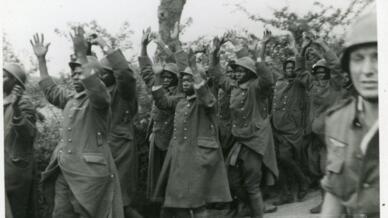
Chasselay massacre: After capturing non-white French POWs during the capture of Lyon on 19 June 1940, German troops took approximately 50 black soldiers to a field near Chasselay, and used two tanks to murder them. After the massacre, local civilians buried the dead in a mass grave despite German warnings not to do so. Vichy official Jean-Baptiste Marchiani ordered the construction of a cemetery for the victims, which opened in 1942. It is believed that between 1,500 and 3,000 soldiers from the French colonies were killed in war crimes carried out by the Wehrmacht in 1940. By 20 June, despite facing unexpectedly heavy resistance, German forces had eliminated all pockets of French resistance, occupying Lyon. The 25th Regiment, which had occupied the small village of Chasselay, surrendered after running out of ammunition.[8] The Germans subsequently rounded up all French prisoners of war, dividing the colonial and non-colonial POWs into two groups. The colonial POWs, of Black soldiers and their white officers, were forcibly moved by German troops down an isolated road to a nearby field.
After they had arrived at the field, the white French officers were led aside and told to lie face down. The Black soldiers were ordered to assemble in front of two German tanks which had escorted them to the field, before being told to run away. As the soldiers began to do so, the tanks opened fire on them with their machine guns, before driving over the dead and wounded. During the massacre, a German soldier walked over to a French officer and shot the man, wounding him; otherwise the white French POWs were left mostly unharmed. Approximately 50 Black soldiers were murdered by the Germans in the massacre. The high command of the German armed forces, the Oberkommando der Wehrmacht, had not specifically issued any order to mistreat captured colonial troops, but did nothing to stop these massacres.
The French prisoners of war which managed to survive capture were sent by the Germans to prisoner-of-war camps. White POWs were sent to camps in Germany, but non-white prisoners remained in France, as the German authorities did not want them to contaminate the “racial purity” of Germany. After the massacre, German officers warned nearby French civilians not to bury the murdered soldiers, with one notice stating that “The German Army Command does not like, and expressly prohibits, the decoration of the graves of black soldiers”. Despite this, local civilians buried them in a mass grave.
The Battle of Saumur ended in German victory. The cadets at the Saumur military academy are forced to surrender when they run out of ammunition. 200 cadets perish. At Montsoreau, after the bridge was blown, it was quiet until dawn on 20 June when the Germans tried a 5:00 AM crossing between Montsoreau and Saumur, and despite losses, managed to obtain a foothold on the south bank at Le Petit-Puy but were held back from advancing on Saumur by the cadets based around the railway viaduct. Three armoured cars patrolled the river road east of Saumur trying to keep the area clear of additional Wehrmacht reinforcements rowing across the river and driving them back to stop them assaulting Saumur. It was not possible to eliminate the Wehrmacht as they could shelter in the troglodyte houses in the cliff.
Aunis farm on the flat plateau 1,800m inland of the Loire River and cliffs was the headquarters of troop leader Captain de St-Blanquat and the troop brigades ordered to protect the gap between the railway bridge at Saumur and Montsoreau and when the Wehrmacht landed on the south side of the river, the unit realized it was in an excellent position to provide a defensible position to block a German breakout and trenches were quickly dug. The position was equally important to the Germans who opened up with artillery from north of the river using an aircraft as a spotter plane. Outlying student units began to attack Wehrmacht mortar positions in the bridgehead that were firing on the farm, causing it to catch fire, suffering casualties in the process. French military infantry officer students from St Maixent had arrived early on 20 June and, initially ordered towards Gennes, were diverted to the eastern sector and sent into a counterattack to relieve the pressure on Aunis, with the backing of the five Hotchkiss tanks of the reserve. The fighting had gone on for six hours with part of the farm on fire and under artillery, mortar, and machine gun fire, with multiple assaults having been made by the Germans, each one beaten back by the students when at 1:00 PM the counterattack from the south was mounted. The German artillery barrage switched to the advancing students and tanks, knocking out two of the tanks. The remaining three tanks pulled back, but the infantry students managed to reach the farm, reinforcing the cavalry cadets. The farm cellar was full of wounded, a second barn caught fire, and the French decided to pull back south before they were surrounded. The Wehrmacht took the farm in the late afternoon. The Germans and their French prisoners then tended to the wounded and collected the dead of both sides that were in the fields around the farm.
9,000 Polish soldiers fighting in France were evacuated from Bayonne aboard the Polish ships Batory and Sobieksi. Operation AERIAL continues at a rapidly dwindling pace, picking up scattered troops in southern France. At La Pallice, a few more Polish troops and assorted embassy and consular staffs are taken off, and the ships proceed south to find more evacuees. At Bordeaux and the nearby ports on the Garonne River in the Gironde départment in Aquitaine, the Polish ships Batory, Sobieski and the Ettrick and Arandora Star complete their operations and head south as well. The main port for evacuation from this point forward is St Jean-de-Luz on the Spanish border.
As Bordeaux is no longer a focus of evacuation, the British destroyer HMS Beagle lands a demolition team to disable the port facilities.
French XLV Corps crosses into Switzerland where the troops are interned.
Petain broadcast: “People of France! I have asked our enemies to put an end to hostilities…” He states that defeat is “inevitable” and references his own experience during World War I, when 185 Allied divisions faced the Germans as compared to 10 in May 1940.
A delegation from the two French legislative chambers approaches Pétain to complain about the desire of President Lebrun to leave for North Africa. There remain wide divisions within the government regarding the possibility of continuing the fight from Algeria and Tunisia.
French delegation led by General Huntziger departs by automobile for armistice negotiations. French plenipotentiaries, led by General Huntziger, leave Bordeaux by car to meet with the Germans at Compiegne. Hitler has chosen that location due to its symbolism as the spot where Germany surrendered to the Allies in World War I. German engineers are sent to a French museum to prepare the same French railway coach for the proceeding.
An undetermined number of persons were killed and wounded this morning as low-flying German planes bombed Bordeaux, provisional capital of beleaguered France. Two of the bombs scored hits on refuge shelters. Important buildings in the city, which the French government has declared an open city, appear to be the main targets. Bordeaux was bombed four times shortly after 1:30 AM (4:30 PM P.S.T. Wednesday). Newspaper correspondents were forced to take refuge in a cellar during the raids. They heard the German planes sweeping over the open city at low altitudes, bombing the streets and buildings jammed with refugees. The bombs came just as the townspeople, waiting for word of an armistice, had begun to hope they had found refuge and were safe. Bordeaux has a normal population of approximately 250,000 but is jammed now with refugees bringing the number it shelters to perhaps five times that many.
Realizing that France is about to surrender, French fighter pilot James Denis loads an Armee de l’Air Farman F.222 at an airbase near Saint-Jean-d’Angély with 20 of his friends. They fly to Great Britain to carry on the fight.
Raeder meets again with Hitler at his Wolfsschlucht headquarters to discuss an invasion of United Kingdom. Admiral Raeder asks Hitler, “And now how about the British?” Hitler’s adjutant, Georg Engel, notes in his diary that “Führer says the UK so weak that, after the bombing, a major invasion will be unnecessary. The army will just move in.”
The Duke of Windsor, widely suspected of having pro-German sympathies, arrives in Barcelona after having fled Paris.
The British Parliament met in a secret joint session to discuss the defense against a potential German invasion.
Luftwaffe bombs fell on Dibden Parish Church in Hampshire. It was not fully restored until 1959
The first Australian and New Zealand troops arrived in the United Kingdom.
Five weeks after the German conquest of the Netherlands, Dutch civilians began to be conscripted as forced laborers. During the war, 431,500 Dutch civilians would meet this fate.
A new Latvian government of Moscow-approved ministers was formed.
Lavrentiy Beria sent Joseph Stalin a list containing names of 232 Soviet prisoners of war returned by Finland and recommended everyone on the list to be executed; in fact, 158 of them had already been killed.
In an effort to gain favor with Hitler, King Carol of Rumania pardons all imprisoned members of the Iron Guard.
General Blamey arrives in Palestine to take command of build-up of Australian troops in the Near East.
An Anglo/French squadron bombards Italian positions at Bardia during the night.
Mussolini asks Italian commander Italo Balbo to make more progress in the region. Balbo, the long-time commander in the region, responds, “We have no trucks, no anti-tank guns; it’s steel versus flesh.”
General Mittelhauser, commanding French forces in the Levant, informs General Wavell at British headquarters in Cairo that he will join the Free France movement and remain an ally.
British mechanized troops in Sudan make raids across the Eritrean border.
British RAF bombers attacked the German-controlled Boos airfield at Rouen, France.
The RAF raids Diredawa, Abyssinia. It also bombs Italian positions across the Libyan frontier.
RAF Bomber Command dispatches 56 aircraft to attack targets in Germany overnight.
Italian aircraft bomb Calvi, Corsica.
An Italian attack against Bizerte, Tunisia is launched with six CANT Z.506 bombers.
U-30, commanded by Kapitänleutnant Fritz-Julius Lemp, sank British steamer Otterpool from convoy HG-34F in 48 45N, 08 13W. Twenty two crewmen and a gunner were lost with the British steamer. The survivors were rescued by sloop HMS Scarborough at 0157/21st. Earlier that day Otterpool and British steamer Andalusian (3082grt) were attacked by U-51. The 4,876 ton Otterpool was carrying iron ore and was headed for Middlesbrough, England.
U-38, commanded by Kapitänleutnant Heinrich Liebe, sank Swedish steamer Tilia Gorthon in 48 32N, 06 20W. Ten crewmen were missing from the Swedish steamer. The survivors were picked up by sloop Leith. The 1,776 ton Tilia Gorthon was carrying coal and was headed for Nantes, France.
U-48, commanded by Korvettenkapitän Hans Rudolf Rösing, sank Dutch motor tanker Moordrech, a straggler from convoy HX.49, in 43 34N, 14 20W. Twenty five crewmen were lost from the Dutch tanker. The 7,493 ton Moordrecht was carrying fuel oil and was headed for Pasajes, Spain.
U-122, commanded by Korvettenkapitän Hans-Günther Looff, sank British steamer Empire Conveyor in 56 16N, 08 10W. Tug HMS Amsterdam and destroyers HMS Atherstone and HMS Campbell, which received orders at 1316, were sent to assist the steamer, but she sank as the ships arrived. Three crewmen from the British steamer were missing. Destroyer Campbell rescued the thirty eight survivors. Destroyer Campbell remained in the area until 0800/21st before proceeding to Liverpool. After disembarking the survivors at Liverpool, destroyer Campbell proceeded to Sheerness. Destroyer Atherstone at 0045/21st met armed merchant cruiser HMS Montclare in North Channel on passage from the Clyde to Canada. When 13-40W was reached, destroyer Atherstone returned to the Clyde with dispatch. The 5,911 ton Empire Conveyor was carrying wheat and was headed for Manchester, England.
German battlecruiser Gneisenau and heavy cruiser Admiral Hipper departed Trondheim to raid towards Iceland as a diversion so damaged battlecruiser Scharnhorst could make her way home without opposition. However, just outside of Trondheim in 64 43N, 9 53E, submarine HMS Clyde reported she had contacted a German force of one battlecruiser, one battleship, and one destroyer. Submarine Clyde was able to torpedo and badly damage battlecruiser Gneisenau at 2232. A large hole was torn in battlecruiser Gneisenau’s side at the bow and she was later repaired at Kiel completing on 5 November 1940. Due to submarine Clyde’s report, destroyers HMS Zulu, HMS Escort, and HMS Forester returned to Scapa Flow with dispatch arriving at 0800/21st. Destroyers HMS Maori and HMS Mashona reembarked their boarding parties from the Swedish destroyers and proceeded at 0620 with dispatch towards Scapa Flow. The Fleet at Scapa Flow was brought to one hour’s notice. Nevertheless, battlecruiser Scharnhorst arrived safely back at Kiel on the 23rd.
Polish submarine ORP Wilk, which departed Rosyth on the 18th, was damaged in a collision at 0025 while submerged with another submarine in 56 50N, 03 57E. Recent sources indicate that this submarine was Dutch submarine HNLMS O-13 (Lt Cdr E. H. Vorster RNIN), which had departed Aberdeen on patrol on the 11th, which was earlier thought to have been mined. Lt B. E. Greswell, an observer on the submarine, two communications ratings were lost with the entire Dutch crew. There was damage to the propellers and after planes, but the Polish submarine was able to continue patrol. Light cruiser HMS Newcastle and destroyer HMS Echo departed Scapa Flow at 0950/23rd to search for a destroyer reported by aircraft at 0600 in 58-45N, 4-20E. They also covered submarine Wilk’s return. Submarine Wilk arrived at Dundee on the 25th. She went on to Rosyth for repairs arriving on the 26th underwent repairs for this damage. The repairs were completed in early July.
British liner Empress Of Australia (19,665grt) escorted by destroyers HMS Bedouin and HMS Ashanti in the local approaches departed Reykjavik for Halifax.
British troopships Royal Scotsman (3,244grt), Sobieski (11,030grt), Otranto, Orontes, Arandora Star, St Helier, and Ettrick and destroyers HMS Imogen, HMS Punjabi, HMS Griffin, HMS Witch, HMS Harvester, and HMS Viscount departed Plymouth late on the 19th for St Nazaire to embark Polish troops there. Destroyers Imogen, Harvester, and Punjabi were ordered to return to Plymouth very early on the 20th for refueling. Later on the 20th, troopship Sobieski went to Le Verdon and destroyers Imogen, Griffin, Witch, and Viscount to Rade de Coisic. Destroyer Punjabi embarked 409 troops at St Nazaire. Polish troops evacuated from Rade de Coisic were 340 on Witch, 500 on Viscount, 466 on Imogen. Destroyer Griffin with 350 Polish troops returned to Plymouth for refueling later at 1425 hours. Destroyer Viscount escorted British steamer Brittany from Rade de Coisic past Ushant. Destroyers Griffin and Witch escorted steamers Kaipaki and Royal Scotsman. British steamer Alderpool (4313grt) embarked 4,000 Polish troops and British steamer Empire Industry embarked forty British refugees at La Pallice. These ships were sailed to Falmouth. Troopship Royal Ulsterman went to La Pallice and then to Gironde.
Light cruiser HMS Arethusa and destroyer HMS Berkeley evacuated the British Ambassador to Poland and thirty of his staff personnel, the Staff of the British Embassies of Brussels and Paris, the President of Poland from Le Verdon. The two ships sailed at 1120 and safely arrived at Plymouth at 0801 hours.
Destroyer HMS Beagle (Rear Admiral F. B. Watson DSO Rtd aboard) arrived at Bordeaux with a demolition party for the port, but due to the Armistice, the demolition was not carried out and Beagle departed early on the 23rd.
British steamers Biarritz (2388grt) and Malines (2980grt) evacuated the Channel Islands of Guernsey and Jersey, respectively.
French steamer Foucauld (11,028grt) was sunk by German bombing at La Pallice.
French tanker Brumaire (7638grt), which had departed Brest, was sunk by German bombing off Belle Ile. The tanker was beached on the 21st on Ile de Re. Armed yacht Viva II tried unsuccessfully to sink the bows of the tanker above water on the 22nd.
Greek steamer Adamantios (4277grt) was sunk by German bombing at La Rochelle, off Ile de Re. The entire crew was rescued. Steamer Adamantios was later salved and taken in prize by German forces.
French light cruiser Primauguet departed Bordeaux with the last shipment of gold from France and proceeded to Dakar.
British steamer Stesso (2290grt) was sunk by German bombing at Cardiff. The entire crew was rescued. The steamer was later refloated and left Cardiff on 31 December for breaking up at Briton Ferry.
Panamanian tanker James McGee (9859grt) was sunk on a mine 2.4 miles at bearing 208° from Nash Point. The entire crew of the tanker was picked up by destroyer HMS Wolverine.
Italian submarine Diamante was sunk by submarine HMS Parthian off Tobruk in 32 42N, 23 49E.
Italian destroyers Artigliere, Camicia Nera, Aviere, and Geniere of the 11th Destroyer Division departed Augusta on the 19th and arrived with supplies at Benghazi on the 20th.
In operation MD 3, French battleship Lorraine, light cruisers HMS Orion (Flagship), HMS Neptune, and HMAS Sydney with destroyers HMS Hasty, HMS Decoy, HMS Dainty, and HMAS Stuart departed Alexandria at 1130 and bombarded Bardia from 0548 to 0606/21st. Destroyers HMS Hyperion, HMS Havock, HMS Hero, HMS Hereward, and HMS Hostile, which had departed Alexandria at 0800 were sweeping along the Libyan coast. French heavy cruiser Suffren, light cruiser Duguay Trouin, and destroyers HMS Imperial, HMS Ilex, and HMS Nubian departed Alexandria at 1730 and were sweeping in the area on reports of an Italian cruiser and destroyers at Tobruk. Light cruiser Sydney’s Seagull on spotting duty was attacked and damaged by RAF Gladiators. The Seagull was able to return to the light cruiser and Flight Lt T. MacBride, RAAF and Lt J. C. Bacon were not wounded. Italian submarine Sirena attempted to attack the French cruiser force without success and was damaged by depth charges in return. The force arrived back at Alexandria on the 21st.
Destroyer HMS Keppel departed Gibraltar for Port Vendres to transport H.M. Ambassador and a party of nine to a “North African port.” On the 22nd, destroyer Keppel was ordered to Sete.
Australian light cruiser HMAS Perth departed Sydney with British liner Strathmore (23,428grt). The ships arrived at Melbourne on the 22nd. Both ships departed on the 22nd and on the 23rd, light cruiser Perth turned the liner over to Australian heavy cruiser HMAS Canberra. Light cruiser Perth patrolled Bass Strait until 25 June.
Latvian minesweeper Virsaitis is seized by Soviet forces.
Convoy FN.200 departed Southend, escorted by sloops HMS Fleetwood and HMS Weston. The convoy arrived at Rosyth on the 22nd in two sections. One escorted by armed patrol yacht BREDA and the other by the two sloops.
Convoy FS.200 departed the Tyne, escorted by destroyer HMS Vimiera and sloop HMS Londonderry. The convoy arrived at Southend on the 22nd.
Convoy MT.92 departed Methil, escorted by destroyer HMS Valorous and sloop HMS Egret. The convoy arrived in the Tyne the next day.
The War at Sea, Thursday, 20 June 1940 (naval-history.net)
Swedish destroyers PUKE (ex-Italian GIOVANNI NICOTERA, Commodore T. Hagman, RSN) and PSILANDER (ex-Italian BETTINO RICASOLI) and torpedo boats ROMULUS (ex-Italian SPICA) and REMUS (ex-Italian ASTORE) arrived at Skaalefjord in the Faroes on the 19th as they were en route to Sweden from Italy. They were accompanied by depot ship PATRICA (ex-Italian PATRIS II).
Tanker CASTOR (8714grt) of this group was delayed. Earlier on the voyage, she had been captured by a French cruiser and taken to Casablanca. She was soon released and arrived in the Faroes shortly after the arrival of the Destroyers on the 20th.
Destroyers TARTAR (D.6), MASHONA, and MAORI, after departing Scapa Flow at 1930/19th, arrived at Skaalefjord in the Faroes early morning on the 20th to requisition the Swedish warships at 1100.
The crews of the Swedish ships were put aboard depot ship PATRICIA and tanker CASTOR and sailed to Sweden on the 21st.
Care and maintenance parties were placed aboard PSILANDER and ROMULUS and passage crews were placed aboard PUKE and REMUS.
After the reported movement of German warships in the North Sea, destroyers MAORI and MASHONA were ordered to reembark their crew from the passage parties for the Swedish destroyers.
At 0620/21st, destroyers MAORI and MASHONA departed the Faroes to join the Home Fleet at sea.
At 1630/21st, Swedish ships PUKE and REMUS departed Skaalefjord escorted by destroyer TARTAR for Scapa Flow.
Swedish ships PATRICIA and CASTOR returned to the Faroes on the 22nd to demand the return of the Swedish destroyers. The British Naval Officer in Charge of the Faroes reported at 1100/22nd that the Swedish ships had returned to Thorshavn and were demanding the release of the Swedish warships.
Destroyers MASHONA was ordered to the Faroes where she arrived at 2230/22nd.
Destroyer MAORI departed Scapa Flow at 1345/22nd to assist D 6. En route, she joined the screen of destroyer PUKE.
On the 22nd, PUKE broke down in 61 15N, 6 06W and was taken in tow by armed boarding vessel KINGSTON PERIDOT. Tug SAUCY departed Kirkwall at 0340/22nd to join the Swedish destroyer. The tug attempted to get a line aboard but collided with PUKE in the progress.
Destroyer MAORI was able to take the destroyer in tow. Despite heavy weather and continued problems, PUKE was brought into Scapa Flow in tow of the tug BUCCANEER, at 1200/23rd, escorted by destroyer MAORI.
Destroyers TARTAR and REMUS arrived at Scapa Flow at 0115/23rd.
The two destroyers berthed alongside destroyer depot ship WOOLWICH for repairs.
Escorted by anti-submarine whalers BUTTERMERE and WINDERMERE, British accommodation ship ST MAGNUS (1312grt) departed Scapa Flow on the 22nd with steaming parties for destroyers PSILANDER and ROMOLUS. The parties were drawn from battleships RODNEY and VALIANT.
At 1830/25th, destroyer MASHONA with Swedish destroyers PSILANDER and ROMOLUS departed the Faroes. Also in company was British accommodation ship ST MAGNUS, and anti-submarine whalers BUTTERMERE and WINDERMERE. Destroyer MASHONA was damaged by weather en route to Kirkwall.
Destroyer MASHONA and her group arrived at Kirkwall at 1330/26th.
Destroyer MASHONA went on to Rosyth arriving on the 27th and was drydocked for damage to her hull.
Destroyer BEDOUIN departed Scapa Flow at 0800/30th to escort Swedish destroyers PUKE and REMUS.
Swedish destroyers PUKE and REMUS arrived at Kirkwall on the 30th, depot ship PATRICIA arrived there later the same day.
Destroyer BEDOUIN arrived back at Scapa Flow at 1350/30th.
On 2 July, the Swedish ships were returned to Swedish control and the five ships departed Kirkwall on 5 July. They were joined at sea by tanker CASTOR which had departed from the Faroes.
The Swedish ships were bombed by aircraft of 18 Group, Coastal Command, on 7 July, but no damage was done.
The Swedish ships arrived at Goteborg, via Kristiansand, on 10 July.
Aircraft bombed a submarine at 1030 and brought up oil in 60-32. 5N, 5-18W. Destroyers ZULU, ESCORT, and FORESTER left exercises with submarine L.23 at 1105 joining Anti-submarine whalers BUTTERMERE (560grt) and WINDERMERE (560grt), which had been detached from the Norwegian Thorshaven to Kirkwall convoy, to search in the area to hunt.
Armed boarding vessels KINGSTON TOPAZ and KINGSTON SAPPHIRE were also ordered to search. They returned to Northern Patrol duties at 0500/21st.
The destroyers were ordered back to Scapa Flow on the 21st.
German battlecruiser GNEISENAU and heavy cruiser ADMIRAL HIPPER departed Trondheim to raid towards Iceland as a diversion so damaged battlecruiser SCHARNHORST could make her way home without opposition.
However, just outside of Trondheim in 64 43N, 9 53E, submarine CLYDE reported she had contacted a German force of one battlecruiser, one battleship, one destroyer.
Submarine CLYDE was able to torpedo and badly damage battlecruiser GNEISENAU at 2232.
A large hole was torn in battlecruiser GNEISENAU’s side at the bow and she was later repaired at Kiel completing on 5 November 1940.
Due to submarine CLYDE’s report, destroyers ZULU, ESCORT, and FORESTER returned to Scapa Flow with dispatch arriving at 0800/21st.
Destroyers MAORI and MASHONA reembarked their boarding parties from the Swedish destroyers and proceeded at 0620 with dispatch towards Scapa Flow.
The Fleet at Scapa Flow was brought to one hour’s notice.
Nevertheless, battlecruiser SCHARNHORST arrived safely back at Kiel on the 23rd.
Polish submarine ORP WILK, which departed Rosyth on the 18th, was damaged in a collision at 0025 while submerged with another submarine in 56 50N, 03 57E.
Recent sources indicate that this submarine was Dutch submarine HMNS O.13 (Lt Cdr E. H. Vorster RNIN), which had departed Aberdeen on patrol on the 11th, which was earlier thought to have been mined.
Lt B. E. Greswell, an observer on the submarine, two communications ratings were lost with the entire Dutch crew.
There was damage to the propellers and after planes, but the Polish submarine was able to continue patrol.
Light cruisers SHEFFIELD and BIRMINGHAM and destroyer GALLANT departed Rosyth at 1030/23rd to support WILK. These ships returned to Rosyth before joining the Polish submarine when it was found that WILK could dive.
Light cruiser NEWCASTLE and destroyer ECHO departed Scapa Flow at 0950/23rd to search for a destroyer reported by aircraft at 0600 in 58-45N, 4-20E. They also covered submarine WILK’s return.
Submarine WILK arrived at Dundee on the 25th. She went on to Rosyth for repairs arriving on the 26th underwent repairs for this damage. The repairs were completed in early July.
Destroyer FORESIGHT departed Harwich for Rosyth where she arrived on the 21st.
Destroyer ARROW departed Scapa Flow at 1430 for Harwich to join the Nore Command.
At 1630, submarine SALMON fired two torpedoes at southbound convoy in 58-18N, 05-40E off Lister.
Submarines SHARK and TETRARCH arrived at Rosyth after patrol.
Submarine L.26 arrived at Dundee escorted by sloop WESTON.
The sloop then returned to Rosyth.
Dutch submarines HNMS O.21 and HNMS O.22 and torpedo boat HNMS Z.5 departed Belfast for Dundee, via Stornoway.
British liner EMPRESS OF AUSTRALIA (19,665grt) escorted by destroyers BEDOUIN and ASHANTI in the local approaches departed Reykavik for Halifax.
British troopships ROYAL SCOTSMAN (3244grt), SOBIESKI (11,030grt), OTRANTO, ORONTES, ARANDORA STAR, ST HELIER, and ETTRICK and destroyers IMOGEN, PUNJABI, GRIFFIN, WITCH, HARVESTER, and VISCOUNT departed Plymouth late on the 19th for St Nazaire to embark Polish troops there.
Destroyers IMOGEN, HARVESTER, and PUNJABI were ordered to return to Plymouth very early on the 20th for refueling.
Later on the 20th, troopship SOBIESKI went to Le Verdon and destroyers IMOGEN, GRIFFIN, WITCH, and VISCOUNT to Rade de Coisic.
Destroyer PUNJABI embarked 409 troops at St Nazaire.
Polish troops evacuated from Rade de Coisic were 340 on WITCH, 500 on VISCOUNT, 466 on IMOGEN.
Destroyer GRIFFIN with 350 Polish troops returned to Plymouth for refueling later at 1425.
Destroyer VISCOUNT escorted British steamer BRITTANY from Rade de Coisic past Ushant. Destroyers GRIFFIN and WITCH escorted steamers KAIPAKI and ROYAL SCOTSMAN.
British steamer ALDERPOOL (4313grt) embarked 4000 Polish troops and British steamer EMPIRE INDUSTRY embarked forty British refugees at La Pallice. These ships were sailed to Falmouth.
Troopship ROYAL ULSTERMAN went to La Pallice and then to Gironde.
Light cruiser ARETHUSA and destroyer BERKELEY evacuated the British Ambassador to Poland and thirty of his staff personnel, the Staff of the British Embassies of Brussels and Paris, the President of Poland from Le Verdon. The two ships sailed at 1120 and safely arrived at Plymouth at 0801.
Destroyer BEAGLE (Rear Admiral F. B. Watson DSO Rtd aboard) arrived at Bordeaux with a demolition party for the port, but due to the Armistice, the demolition was not carried out and BEAGLE departed early on the 23rd.
At 0610, Corvette GLADIOLUS, escorting convoy HX.48, picked up two French FAA officers, two petty officers, four ratings from a small boat.
The men were landed at Dover.
Convoy FN.200 departed Southend, escorted by sloops FLEETWOOD and WESTON. The convoy arrived at Rosyth on the 22nd in two sections. One escorted by armed patrol yacht BREDA and the other by the two sloops.
Convoy FS.200 departed the Tyne, escorted by destroyer VIMIERA and sloop LONDONDERRY. The convoy arrived at Southend on the 22nd.
Convoy MT.92 departed Methil, escorted by destroyer VALOROUS and sloop EGRET. The convoy arrived in the Tyne the next day.
Destroyer BOREAS arrived at Dover at 1455 to join the 1st Destroyer Flotilla.
Destroyer VESPER departed Dover at 1552 for Sheerness.
Auxiliary minesweeper SANDOWN arrived at Dover at 1630 after refitting to join the 10th Mine Sweeping Flotilla.
British steamers BIARRITZ (2388grt) and MALINES (2980grt) evacuated the Channel Islands of Guernsey and Jersey, respectively.
French steamer FOUCAULD (11,028grt) was sunk by German bombing at La Pallice.
French tanker BRUMAIRE (7638grt), which had departed Brest, was sunk by German bombing off Belle Ile.
The tanker was beached on the 21st on Ile de Re.
Armed yacht VIVA II tried unsuccessfully to sink the bows of the tanker above water on the 22nd.
Greek steamer ADAMANTIOS (4277grt) was sunk by German bombing at La Rochelle, off Ile de Re.
The entire crew was rescued.
Steamer ADAMANTIOS was later salved and taken in prize by German forces.
French light cruiser PRIMAUGUET departed Bordeaux with the last shipment of gold from France and proceeded to Dakar.
U-30 sank British steamer OTTERPOOL (4876grt) in 48 45N, 08 13W.
Twenty-two crew and a gunner were lost with the British steamer. The survivors were rescued by sloop SCARBOROUGH at 0157/21st.
Earlier that day OTTERPOOL and British steamer ANDALUSIAN (3082grt) were attacked by U-51.
U-38 sank Swedish steamer TILIA GORTHON (1776grt) in 48 32N, 06 20W.
Ten crew were missing from the Swedish steamer. The survivors were picked up by sloop LEITH.
U-48 sank Dutch motor tanker MOORDRECHT (7493grt), a straggler from convoy HX.49, in 43 34N, 14 20W.
Twenty-five crew were lost from the Dutch tanker.
U-122 sank British steamer EMPIRE CONVEYOR (5911grt) in 56 16N, 08 10W.
Tug AMSTERDAM and destroyers ATHERSTONE and CAMPBELL, which received orders at 1316, were sent to assist the steamer, but she sank as the ships arrived.
Three crew from the British steamer were missing. Destroyer CAMPBELL rescued the thirty-eight survivors. Destroyer CAMPBELL remained in the area until 0800/21st before proceeding to Liverpool.
After disembarking the survivors at Liverpool, destroyer CAMPBELL proceeded to Sheerness.
Destroyer ATHERSTONE at 0045/21st met Armed merchant cruiser MONTCLARE in North Channel on passage from the Clyde to Canada. When 13-40W was reached, destroyer ATHERSTONE returned to the Clyde with dispatch.
British steamer STESSO (2290grt) was sunk by German bombing at Cardiff.
The entire crew was rescued.
The steamer was later refloated and left Cardiff on 31 December for breaking up at Briton Ferry.
Panamanian tanker JAMES MCGEE (9859grt) was sunk on a mine 2. 4 miles 208° from Nash Point.
The entire crew of the tanker were picked up by destroyer WOLVERINE.
Italian submarine DIAMANTE was sunk by submarine PARTHIAN off Tobruk in 32 42N, 23 49E.
Italian destroyers ARTIGLIERE, CAMICIA NERA, AVIERE, and GENIERE of the 11th Destroyer Division departed Augusta on the 19th and arrived with supplies at Benghazi on the 20th.
In operation MD 3, French battleship LORRAINE, light cruisers ORION (Flagship), NEPTUNE, HMAS SYDNEY with destroyers HASTY, DECOY, DAINTY, and HMAS STUART departed Alexandria at 1130 and bombarded Bardia from 0548 to 0606/21st.
Destroyers HYPERION, HAVOCK, HERO, HEREWARD, and HOSTILE, which had departed Alexandria at 0800 were sweeping along the Libyan coast.
French heavy cruiser SUFFREN, light cruiser DUGUAY TROUIN, and destroyers IMPERIAL, ILEX, and NUBIAN departed Alexandria at 1730 and were sweeping in the area on reports of an Italian cruiser and destroyers at Tobruk.
Light cruiser HMAS SYDNEY’s Seagull on spotting duty was attacked and damaged by RAF Gladiators. The Seagull was able to return to the light cruiser and Flight Lt T. MacBride, RAAF and Lt J. C. Bacon were not wounded.
Italian submarine SIRENA attempted to attack the French cruiser force without success and was damaged by depth charges in return.
The force arrived back at Alexandria on the 21st.
Destroyer KEPPEL departed Gibraltar for Port Vendres to transport H.M. Ambassador and a party of nine to a “North African port. “
On the 22nd, destroyer KEPPEL was ordered to Sete.
Australian light cruiser HMAS PERTH departed Sydney with British liner STRATHMORE (23,428grt).
The ships arrived at Melbourne on the 22nd.
Both ships departed on the 22nd and on the 23rd, light cruiser PERTH turned the liner over to Australian heavy cruiser HMAS CANBERRA.
Light cruiser PERTH patrolled Bass Strait until 25 June.
Destroyer KHARTOUM refueled at Djibouti.
In Washington this day, President Roosevelt sent to the Senate the nominations of Henry L. Stimson to be Secretary of War and Colonel Frank Knox to be Secretary of the Navy. He conferred with the National Defense Commission and discussed the proposed Pan-American economic union with Sumner Welles, Under-Secretary of State, and Bernard M. Baruch. Tonight the president departed for Hyde Park, where he will spend the weekend.
The Senate passed the $1,777,489,788 Army and Navy appropriation bill, approved the resolution to permit Red Cross mercy ships to enter belligerent ports without obtaining safe-conduct, received the Burke bill providing for compulsory military training and adjourned at 3:41 PM until 11 AM tomorrow. Conferees agreed on the $1,153,000,000 relief bill and the Naval Affairs Committee approved legislation to prevent the sale of Navy torpedo boats to the Allies.
The House approved the resolution extending the Sugar Act and adjourned at 5:14 PM until 11 AM tomorrow.
President Franklin D. Roosevelt appointed two prominent Republicans to his cabinet. Henry Stimson, a conservative statesman and former Secretary of State under Herbert Hoover, became Secretary for War. William “Frank” Knox, the Publisher of the Chicago Daily News and 1936 Republican Vice Presidential candidate, became the Secretary for the Navy. This action strengthened his administration by making the cabinet more bipartisan.
The surprise selection of Colonel Frank Knox and Henry L. Stimson, Republican advocates of unstinted material aid to the allies, to be members of the Roosevelt cabinet as the Secretaries of Navy and War stirred notable debate on Capitol Hill today and prompted Republican leaders assembled at Philadelphia to read the two men out of the party. Henry L. Stimson, who was a member of the Cabinets of two Republican Presidents, and Frank Knox, who was the Republican nominee for Vice President in 1936, were virtually read out of the Republican party today for accepting appointment by President Roosevelt as Secretary of War and Secretary of the Navy. Party leaders, Philadelphia convention delegates and committee members regarded their course as an act of party treachery. President Roosevelt came to the defense of his appointments tonight with a statement saying: “The appointments to the cabinet are in line with the overwhelming sentiment of the nation for national solidarity in time of world crisis and in, behalf of national defense and nothing else.”
A bill for selective compulsory military training and service was introduced in the Senate today by Senator Burke of Nebraska. The measure would require the registration of an estimated 40,000,000 persons between the ages of 18 and 65, of whom those between 21 and 45 would be eligible for military training, and the others for home defense and other tasks incident to an emergency. The bill was sponsored by the recently formed National Emergency Committee of the Military Training Camps Association of the United States. It represented the thoughts and opinions not only of those responsible for the “Plattsburg Idea” of officer-training, but of many prominent persons in various walks of life, an announcement by the association said. Private reaction in most Congressional quarters was favorable to the general idea of selective compulsory military training, although members were cautious in their comments pending study of the bill. Although nothing official has yet been forthcoming from the Army and Navy, its officers have stated many times in private that only a carefully planned, well-executed program of selective compulsory training would give the land and naval forces adequately trained personnel in advance of actual conflict.
Cordell Hull, Secretary of State, told the Harvard commencement audience in Sever Quadrangle today that there was no more fitting site from which to survey the great problems and issues that confront the nation. He added: “These are black days for the human race, ominous days for us in this country.”
A compromise $1,158,000,000 relief appropriation, including $50,000,000 for European war relief, was agreed on today by a joint Senate-House committee. The committee recommended that a $100,000,000 fund voted by the senate for surplus crop disposal be reduced to $50,000,000. The measure provides for non-combatant training for C.C.C. youths.
In 1940, 75 percent of the 19,000 people living in Brownsville, Tennessee, were African-American. African-Americans had been prevented from voting in Brownsville since 1884. In May 1940, members of the Brownsville chapter of the NAACP organized a voting rights drive. One month after the drive began, on June 20, 1940, NAACP leader Elbert Williams was abducted from his home in Brownsville by a group of white men headed by the local sheriff and the night marshal. Three days later, Mr. Williams’s lifeless and brutalized body was found in the Hatchie River. He was thirty-one years old.
A few days prior to Mr. Williams’s lynching, fellow NAACP leader Elisha Davis was abducted from his home by the same posse. Mr. Davis survived the encounter but was ordered to leave Brownsville or face death upon return. In the months following Mr. Williams’s lynching, up to forty more families were permanently driven from the community under threats of violence from the white mob. African Americans who remained in Brownsville were prohibited from meeting in groups, even for church services, and two African American men were beaten to death after being arrested by the same night marshal who had helped to abduct Mr. Williams and Mr. Davis.
Despite investigations launched by local authorities, the Department of Justice, and the FBI, charges were never lodged against the well-known men responsible. According to one contemporary observer, the perpetrators of the abuses and murders “can be seen in Brownsville each day going about their work as though they had killed only a rabbit.” As a result of the harassment, violence, and murder of its leaders, the Brownsville NAACP dissolved in 1940, and a new chapter was not formed until 1961.
Bombs exploded almost simultaneously today outside the New York offices of a German money exchange a floor below Nazi consulate offices, and two miles away in a building which houses national headquarters of the Communist Party. Nine persons wore injured, most of them only slightly, in explosion of the bomb which blew out windows of the Autrage Ruckwanderung Devisenfrangen at 17 Battery place. There were no injuries reported in the explosion at Communist headquarters, 35 East Twelfth Street.
The National Broadcasting Company’s correspondent in London, Fred Bate, reported tonight that an armed guard has been placed around the U- S. embassy in Paris and that Ambassador William C. Bullitt is unable to use the telephone.
The U.S. Navy heavy cruiser USS Vincennes (CA-44), escorted by the destroyers USS Truxtun (DD-229) and USS Simpson (DD-221), arrived at the New York Navy Yard and transferred the Bank of France gold reserves ashore for deposit in U.S. banks.
The light cruiser USS Phoenix (CL-46) departed Lahaina, Maui, Territory of Hawaii for the Panama Canal Zone, on the first leg of her goodwill cruise to the Pacific coast of South America.
The Bureau of Ships was established with Rear Admiral Samuel M. Robinson as chief. The Bureau of Construction and Repair and the Bureau of Engineering were abolished.
The Office of Undersecretary of the Navy was created for the duration of the state of emergency.
Joe Louis TKOs Arturo Godoy in 8 for heavyweight boxing title.
Major League Baseball:
The Pirates dropped the Bees into the National League cellar today by quelling a late rally to gain an even break in the four-game series with an 8–7 victory. Elbie Fletcher collected three hits and four RBIs. Max Butcher got the win.
The Giants score four runs in the sixth inning to overcome an early deficit and go on to beat Larry French and the Cubs, 6–3. Harry Danning had three RBIs ona double and single. Hal Schumacher won for the Giants; French took the loss. Phil Cavarretta homered for the Cubs.
Chuck Klein, hitting in the style that brought him fame as a slugger, knocked the Reds out of first place in the National League today. The veteran outfielder drove in all four runs as the Phillies came from behind to tumble the Reds, 4–3, in a 12-inning game before a ladies’ day crowd of 7,421. Thus the idle Dodgers regained first place, with the Reds going to second. Young Kirby Higbe went the route for the Phils to chalk up his fifth victory of the campaign.
The Yankees lose to the White Sox 1–0 in 11 innings, their 6th straight loss, then protest a “catch” by Sox leftfielder Moose Solters, contending he dropped the ball in the 2nd inning when he was reaching for his cap. Umpire George Quinn apparently missed the error and the protest is upheld. The game will be replayed September 18, but, for several years, all of today’s records count including Monte Pearson’s loss and Johnny Rigney’s win, will count. It is the first time since 1919 that the Yankees have been shut out in extra innings by one pitcher: they lost on May 19, 1935 in extra innings to 2 pitchers, Stewart and Brown.
Boston loses a pair — and the 4 game series — to the Browns, 2–1 and 11–4, and drops out of first place. Harlond Clift hits homers in both games of the twin bill. John Niggeling hurls a five-hitter in the opener for St. Louis.
The Indians take over 1st with a 12–1 drubbing of the Senators, behind Bob Feller’s four-hitter. The Indians scored four in the first inning to control the game from the start. The only Senator run came on a solo homer by Gerald Walker. The new issue of The Sporting News headlines “’I’ll be Nice if I Can,’ says Vitt of Tribe Truce.”
The Athletics snapped the winning streak of the Tigers at six games and shoved the Bengals back into third place in the American League standing today by winning, 6–4, behind good pitching by Lovill (Chubby) Dean and Ed Heusser. The Tigers were held to eight hits, three of which were obtained by Hank Greenberg. Greenberg hit a homer in the fourth.
Pittsburgh Pirates 8, Boston Bees 7
New York Yankees 0, Chicago White Sox 1
Washington Senators 1, Cleveland Indians 12
Philadelphia Athletics 6, Detroit Tigers 4
Chicago Cubs 3, New York Giants 6
Cincinnati Reds 3, Philadelphia Phillies 4
Boston Red Sox 1, St. Louis Browns 2
Boston Red Sox 4, St. Louis Browns 11
The U.S. Navy heavy cruiser USS Quincy (CA-39) reached Montevideo, Uruguay, as part of the American effort to counteract German propaganda in Latin America..
The Japanese Navy has concentrated several units, including an aircraft carrier, off Hainan Island opposite the Indo-China port of Haiphong, it was reliably reported today. There was apprehension that the Japanese were contemplating action at the first favorable moment now that the home government in France was faced with surrender. Unconfirmed reports here say the Japanese are transferring large numbers of troops from the Yangtze Valley to the south, possibly for land action against the French possession on the mainland of Asia. Military quarters estimated the Japanese already had 100,000 troops on Hainan Island for transport in a landing operation if the move should be decided upon. Observers here viewed with increasing concern insistent Japanese accusations from all sides, despite French denials, that Indo-China still was serving as a route of supply to the Chinese Government at Chungking.
In Chungking, however, a military spokesman said the Chinese did not expect an attack on Indo-China by Japan because she was too exhausted by the campaign in China to undertake extensive new operations. He declared that the latest information in Chungking was that the Japanese naval and land forces on Hainan were small. They were put at 3,000 marines, a small force of troops, a destroyer, a gunboat and seven transports.
Governor General Catroux, unable to receive support from France, UK, or USA, agrees to Japanese demands for closing the border with China and allowing control commission into Indochina.
After one year and seven days the Japanese Army’s blockade of the British and French Concessions in Tientsin was formally lifted at 6 o’clock this evening.
Dow Jones Industrial Average: 122.35 (-1.51)
Born:
John Mahoney, English-born American actor (“Fraiser”, “Frantic”, “8 Men Out”), in Blackpool, England, United Kingdom (d. 2018).
Died:
Charley Chase, 46, American comedian, actor, screenwriter and film director, of a heart attack.
Jehan Alain, 29, French organist and composer, dies fighting for the French Army in WWII Battle of Saumur. He was assigned to reconnoiter the German advance on the eastern side of Saumur and encountered a group of Wehrmacht soldiers at Le Petit-Puy. Coming around a curve, and hearing the approaching tread of the Germans, he abandoned his motorcycle and engaged the enemy troops with his carbine, killing 16 of them before being killed himself. He was posthumously awarded the Croix de Guerre for his bravery.
Naval Construction:
The Royal Canadian Navy Bangor-class (VTE reciprocating engined) minesweepers HMCS Quatsino (J 152) and HMCS Clayoquot (J 174) are laid down by Prince Rupert Dry Dock and Shipyards Co. (Prince Rupert, British Columbia, Canada).
The Kriegsmarine (German Navy) Type IXC U-boat U-127 is laid down by AG Weser, Bremen (werk 990).
The Kriegsmarine (German Navy) Type IXC U-boat U-164 is laid down by Deutsche Schiff und Maschinenbau AG, Bremen (werk 703).
The Royal Navy Impetus-class tug HMS Fresco (W 79) is launched by Alexander Hall and Co. Ltd. (Aberdeen, Scotland).
The Royal Navy Flower-class corvette HMS Cyclamen (K 83) is launched by J. Lewis & Sons Ltd. (Aberdeen, Scotland).
The Royal Navy Tree-class minesweeping trawler HMS Acacia (T 02) is commissioned. Her first commanding officer is Commander Ralph Newman, RNZNVR.
The U.S. Navy Fisher 58-foot motor torpedo boat PT-3 is commissioned.
The U.S. Navy Fisher 58-foot motor torpedo boat PT-4 is commissioned.
The Marine Nationale (French Navy) submarine Aurore (Q192), lead boat of her planned class of 15 (only 7 completed), is commissioned.
The Royal Navy “T”-class (First Group) submarine HMS Tigris (N 63) is commissioned. Her first commanding officer is Lieutenant Commander Howard Francis Bone, RN.
The Вое́нно-морско́й флот СССР (ВМФ) (Soviet Navy) Project 26 (Kirov-class) light cruiser Voroshilov is commissioned.
 History Diaries