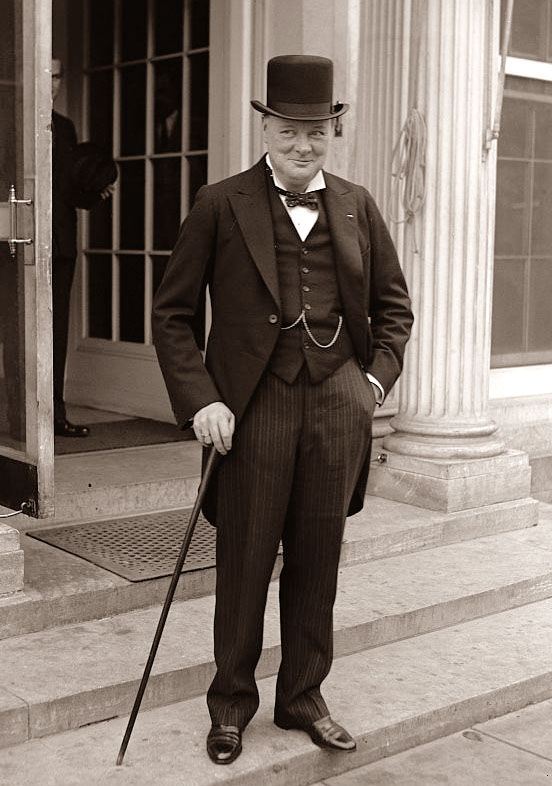
Winston Churchill delivered this speech on June 18, 1940 to the House of Commons in the aftermath of the evacuation of Dunkirk.
Churchill made his Battle of Britain speech to the British House of Commons:
(…) During the first four years of the last war the Allies experienced nothing but disaster and disappointment. That was our constant fear: one blow after another, terrible losses, frightful dangers. Everything miscarried. And yet at the end of those four years the morale of the Allies was higher than that of the Germans, who had moved from one aggressive triumph to another, and who stood everywhere triumphant invaders of the lands into which they had broken. During that war we repeatedly asked ourselves the question: How are we going to win? and no one was able ever to answer it with much precision, until at the end, quite suddenly, quite unexpectedly, our terrible foe collapsed before us, and we were so glutted with victory that in our folly we threw it away.
We do not yet know what will happen in France or whether the French resistance will be prolonged, both in France and in the French Empire overseas. The French Government will be throwing away great opportunities and casting adrift their future if they do not continue the war in accordance with their Treaty obligations, from which we have not felt able to release them. The House will have read the historic declaration in which, at the desire of many Frenchmen-and of our own hearts-we have proclaimed our willingness at the darkest hour in French history to conclude a union of common citizenship in this struggle. However matters may go in France or with the French Government, or other French Governments, we in this Island and in the British Empire will never lose our sense of comradeship with the French people. If we are now called upon to endure what they have been suffering, we shall emulate their courage, and if final victory rewards our toils they shall share the gains, aye, and freedom shall be restored to all. We abate nothing of our just demands; not one jot or tittle do we recede. Czechs, Poles, Norwegians, Dutch, Belgians have joined their causes to our own. All these shall be restored.
What General Weygand called the Battle of France is over. I expect that the Battle of Britain is about to begin. Upon this battle depends the survival of Christian civilization. Upon it depends our own British life, and the long continuity of our institutions and our Empire. The whole fury and might of the enemy must very soon be turned on us. Hitler knows that he will have to break us in this Island or lose the war. If we can stand up to him, all Europe may be free and the life of the world may move forward into broad, sunlit uplands. But if we fail, then the whole world, including the United States, including all that we have known and cared for, will sink into the abyss of a new Dark Age made more sinister, and perhaps more protracted, by the lights of perverted science. Let us therefore brace ourselves to our duties, and so bear ourselves that, if the British Empire and its Commonwealth last for a thousand years, men will still say, “This was their finest hour.”
Adolf Hitler and Benito Mussolini met in Munich to discuss the French armistice request. Mussolini hoped to present Hitler with a list of spoils that Italy wanted to get from the French, but was embarrassed when Hitler displayed no interest in discussing the matter at the time. Hitler also politely but firmly denied Mussolini’s request to sit at the same table to sign the armistice with the French, leaving the Italians to seek out a separate one. Mussolini arrives in Munich with his foreign minister, Count Ciano, to discuss immediate plans with the Fuhrer, and doesn’t like what he hears. Embarrassed over the late entry of Italy in the war against the Allies, and its rather tepid performance since, Mussolini met with Hitler determined to convince his Axis partner to exploit the advantage he had in France by demanding total surrender and occupying the southern portion still free. The Italian dictator clearly wanted “in” on the spoils, and this was a way of reaping rewards with a minimum of risk. But Hitler, too, was in no mood to risk, and was determined to put forward rather mild terms for peace with France. He needed to ensure that the French fleet remained neutral and that a government-in-exile was not formed in North Africa or London determined to further prosecute the war. He also denied Mussolini’s request that Italian troops occupy the Rhone Valley, and that Corsica, Tunisia, and Djibouti (adjacent to Italian-occupied Ethiopia) be disarmed. Hitler allotted Mussolini only a small part of Southern France. Ciano recorded in his diary that Mussolini left the meeting frustrated and “very much embarrassed,” feeling “that his role is secondary.” Ciano also records a newfound respect for Hitler: “Today he speaks with a reserve and perspicacity which, after such a victory, are really astonishing.”
The German 7th Panzer Division under Rommel advanced another 75 miles since the prior date, reaching Cherbourg. Erwin Rommel’s 7th Panzer Division entered Cherbourg at 4:30 PM but found that most of the Allied personnel had already evacuated. Half an hour later Rommel visited the Port Admiral’s office and accepted the city’s surrender. The Allies destroy all the harbor facilities before they depart. French battleship Courbet gives fire support as the last Allied troops leave.
The German 5th Panzer Division occupied Brest. The port facilities at Brest are demolished.
The Germans captured Le Mans, Belfort, Metz and Dijon. The French set up a line along the Loire to defend the sector Tours/La Charité. The Germans establish bridgeheads between Orleans and Nevers. Le Mans, Briare, Le Creusot, Belfort, Dijon and Colmar all are now in German hands.
The Maginot Line has held up well and cracking it has become a chore for the Wehrmacht. Small penetrations are made, though, and the Germans capture the fortress of Belfort.
The Wehrmacht faces declining French resistance. All cities over 20,000 inhabitants are declared open cities, like Paris. This is a popular decision that saves many lives.
There are strong rumors that the advancing German troops have been murdering any black African French troops that they take prisoner. There is a German propaganda campaign that these French troops themselves are committing atrocities.
The cabinet continues to debate whether to evacuate to North Africa. New Prime Minister Pétain refuses to go, but President Lebrun and the two presidents of the Chambers of Parliament, Édouard Herriot and Jeanneney, want to go. The weight of opinion is to stay in France.
The Battle of Saumur began. The French cavalry school at Saumur vows to fight together as a unit, instructors and cadets. Officer cadets from the Cavalry School at Saumur, led by superintendent Colonel Charles Michon, made a defensive stand along the Loire River at Saumur, Gennes, and Montsoreau. For two days the Cavalry School, and other assorted units which had fallen back before the German Wehrmacht advance, held off a German attack. Since the battle occurred after the message by Marshal Pétain which called for an end to fighting (on 17 June 1940), the event is often considered one of the first acts of the French Resistance.
The Battle of Saumur was fought on the 125th anniversary of the Battle of Waterloo and acquired a special name, La Haie Sainte (The Sacred Line) after the farm La Haye Sainte in the centre of the Belgian battlefield. The Wehrmacht entered Saumur on the morning of 21 June, the students retreated, with many burying their weapons before they were captured. The German commander, General Kurt Feldt, praised the resistance of the students in his after action report, in which he was the first to call them “Cadets of Saumur”. Of the 560 student officers from Saumur, 79 were killed and 47 wounded. In total 250 French were killed or wounded. Two tanks were destroyed. The Germans lost 132 killed, hundreds wounded and 7 armoured vehicles were destroyed.
The 218 students captured by the Germans were released in the following days instead of being interned. The cadets marched south, in the heat of summer, covering 43 km on 4 July, 35 km the next day as they passed St. Maixent, then on the 8th they arrived in sight of the Demarcation Line, after cleaning their uniforms and polishing their boots they marched, singing, across the line to the Free Zone between lines of German soldiers standing at attention. They would be joined by other students as they acquired the opportunity to escape.
The school was Mentioned in Despatches at the Order of the Army by General Maxime Weygand. The school became Stalag 181, holding French prisoners of war from October 1940 until June 1942. During the war the town became a centre for resistance; unable to capture some of the troublemakers, the town was fined FF 500,000 by the Germans, but after the war, it was awarded the Croix de Guerre with palm, the citation referring to the town being a symbol of French patriotism. The bridges were repaired under orders from the Germans, until in 1944 when Allied bombers destroyed them again in an attempt to isolate the Normandy battlefields by destroying all routes over the Loire River. The town of Saumur would remain occupied until the liberation of the town on 30 August 1944 by the forces of an ex-student of the school, U.S. General George S. Patton, who had been studying there in 1912 under the then-Colonel Maxime Weygand.
Elsewhere, the Allies completed the Operation AERIAL evacuation of La Pallice and Saint-Nazaire, but all the heavy equipment was left behind in the latter location. The Admiralty announces that nearly all British troops have been evacuated. At La Pallice, for instance, the Royal Navy completes its evacuation of 10,000 British soldiers, leaving behind their vehicles. There are continued evacuations, but they primarily are of allies. At St. Nazaire, the evacuation also concludes, with the British leaving behind their equipment.
General Sikorski arrives London from France by aircraft sent by the British, confers with Churchill, and agrees to evacuation of Polish forces to UK so they can continue the fight.
Charles de Gaulle made the “Appeal of June 18” speech, asking the French people to resist German occupation. General Charles de Gaulle became the leader of “Free France.” He refused to acknowledge Vichy France as a government. The BBC broadcast a speech by Charles de Gaulle. “Must we abandon all hope?,” de Gaulle asked the French people. “Is our defeat final and irremediable? To those questions I answer – No! Speaking in full knowledge of the facts, I ask you to believe me when I say that the cause of France is not lost. The very factors that brought about our defeat may one day lead us to victory … I, General de Gaulle, now in London, call on all French officers and men who are at present on British soil, or may be in the future, with or without their arms; I call on all engineers and skilled workmen from the armaments factories who are at present on British soil, or may be in the future, to get in touch with me. Whatever happens, the flame of French resistance must not and shall not die.”
De Gaulle has no official authority to make any claim to be a French spokesman and is no longer even in the government (though for the time being he remains a General). De Gaulle’s sole source of power is that he has British backing due to his willingness to continue the fight. De Gaulle also has a large cache of French gold given to him by former Prime Minister Reynaud which will tide him over, though it is insufficient to form an army or anything like that. He certainly is an inspirational figure for many French citizens, though the legitimate French government does not think so and feels he is being counter-productive. De Gaulle returns the favor and pointedly refuses to recognize any French government under German domination, which creates a chasm between him and the “legitimate” Petain government. He no longer has any official reason to be in London and is “flying solo,” at great risk to himself, creating an entire movement out of whole cloth. The course de Gaulle is taking practically defines the term “leader.”
There is a tortuous story behind de Gaulle’s speech. He was the one, along with Churchill, who came up with the “union” idea of France and the UK joining as one country. He flew back to France to argue for it and thought that Petain would agree with him, and was stunned when instead Petain surrendered. Returning immediately to England, de Gaulle asked to give this speech on 17 June, but the BBC required him to wait until 18 June – the anniversary of the French defeat at Waterloo.
General Legentilhomme, the French commander in Somaliland, quickly announces his support for de Gaulle, but few others do. It is easy to maintain that martial spirit when you are far from the panzers, not so much when the front that protects you is collapsing.
The Ministry of Information (United Kingdom) issued more than 14 million copies of an advisory leaflet If the Invader Comes, written by Kenneth Clark with Harold Nicolson.
The British War Office placed an order for 300 Canal Defence Light (CDL) tanks, Matilda tanks mounting a large searchlight in the turret that had been suggested by a Mr. Mitzakis in September 1939.
Bulgaria issues demand to Rumania for annexation of southern Dobruja.
Soviet representative presents list of ministers who will form new Latvian government.
Sweden and Germany signed a treaty allowing transit of German soldiers from Norway using Swedish territory. Sweden allowed passage of German troops between Oslo, Norway, and Trelleborg, Sweden, on Swedish rail lines, with the only demand being that the number of troops coming from Germany must equal to the number being evacuated, so that it could not be said that Sweden was helping Germany reinforce the front lines.
French positions in French Somaliland are bombarded by Italian artillery across the border.
Troops of the King’s African Rifles raid the Italian border post at El Uach, Italian Somaliland.
RAF Bomber Command dispatches 69 aircraft to attack targets in Germany overnight, including Bremen and Hamburg.
RAF withdraws its last aircraft from France.
The remnants of the RAF Hurricane squadrons in France evacuated their bases, having provided cover for the final Allied retreat from France. The last to leave were Nos. 1 and 73 Squadrons, which had been the first to arrive in 1939. The fighting in France cost the RAF a total of 1,029 aircraft and over 1,500 personnel.
Luftwaffe bombers conduct night attacks against Cambridge, Southend, and other targets with RAF fighters scrambling to intercept. The Luftwaffe sends a massive raid of 76 bombers against eastern England (Cambridge, Southend, the Thames estuary region) during the night. There are 11-12 dead and 30 injured. This is the first of a series of such nightly raids and could be counted as the unofficial start of the Battle of Britain. Meanwhile, the history books state that the Battle of Britain does not begin for another couple of months. The Luftwaffe incurs light losses during this period.
U-28, commanded by Kapitänleutnant Günter Kuhnke, sank Finnish steamer Sarmatia (2417grt) in 49 04N, 12 05W. At 1200, the Sarmatia was stopped by a shot across her bow by U-28 and the crew immediately abandoned ship. The U-boat had missed with one torpedo at 1100 and then surfaced to stop the ship. She sank vertical by the stern three minutes after being hit in the engine room by a coup de grâce at 1210. The Germans questioned the survivors and gave them cigarettes, a bottle of rum and the course for land before leaving the area. The survivors were picked up by the Spanish trawlers Felix and Pastor Montenegro and landed at Vigo on 21 June. Of the ship’s complement, all 23 survived. The 2,417-ton Sarmatia was carrying ballast and was headed for Sheet Harbour, Nova Scotia.
U-32, commanded by Oberleutnant zur See Hans Jenisch, badly damaged Norwegian steamer Altair (1522grt) in 49 39N, 11 15W, and sank Spanish trawlers Salvora (108grt) and Nuevo Ons (108grt) in 49 39N, 11W. At 1750 hours on 18 June 1940, U-32 tried to stop the unescorted and unarmed Altair (Master Johannes Pedersen) with a shot across her bow south of Ireland, after one torpedo had missed at 1722 hours. She did not stop and was then shelled by the U-boat until the crew began to abandon ship in two lifeboats. At 1902 hours, the ship was hit amidships by a coup de grâce and settled with a heavy list, but remained afloat on her cargo of lumber. At 1912 hours, U-32 then sighted the two Spanish trawlers Sálvora and Nuevo Ons and sank them because they were outside of the allowed area of fishing. The entire crews of the steamer Altair and trawler Salvora were rescued. Five of the crewmen of the trawler Nuevo Ons were lost with the trawler and one died later. Seven of the crew was rescued. Steamer Altair was sunk by the gunfire of HMS Cape Howe on the 20th at position 49 36N, 11 22W. The 1,522-ton Altair was carrying lumber and was headed for Kings Lynn, England.
Battlecruiser HMS Hood with Canadian destroyers HMCS St Laurent, HMCS Fraser, HMCS Restigouche, and HMCS Skeena and destroyer HMS Wanderer departed the Clyde at 0400. At 0520, destroyer HMS Atherstone departed the Clyde and relieved destroyer Wanderer. A Swordfish from HMS Ark Royal crashed into the sea on the 18th and destroyer Atherstone rescued the crew. When the battlecruiser Hood group and the aircraft carrier Ark Royal group met, the Canadian destroyers were detached to meet convoy TC.5 and destroyer Atherstone proceeded to Liverpool.
French battleship Richelieu (Capitaine de Vaisseau P. J. Marzin) completed trials and put to sea from Brest escorted by destroyers Fougueux and Frondeur. The destroyers were detached at Casablanca. Battleship Richelieu arrived at Dakar on the 23rd.
French battleship Paris with hurried repairs of her 11 June aerial bombing damage departed Brest for Plymouth, escorted by French auxiliary patrol vessels Heureux and Groenland.
French depot ship Jules Verne and submarines Casabianca and Sfax of the 2nd Submarine Division, Persee, Poncelet, and Ajax of the 6th Submarine Division, Circe, Thetis, and Calypso of the 13th Submarine Division, Sibylle, Amazone, Antiope, and Orphee of the 16th Submarine Division, Meduse and Amphitrite of the 18th Submarine Division departed Brest for Casablanca.
Submarine Surcouf (Capitaine de Corvette P. Martin), which was unable to depart with the Jules Verne group, departed Brest for Plymouth, where she arrived on the 20th.
French submarines Minerve in the tow of French tug Zeelew and Junon in the tow of French tug Nessus departed Brest, escorted by auxiliary patrol vessels Pessac and Sauterne. They later were taken in tow by tugs Queens Cross and Watercock. Off Ushant, they were joined by destroyer HMS Broke, which departed Brest at 0030/19th after the demolition of the port with the XD. O demolition party.
Carrying 1200 tons of French gold, French armed merchant cruisers El D’Jezair, El Mansour, El Kantara, Ville D’Alger, and Ville D’Oran departed Brest escorted by French destroyers Milan and Epervier.
French armed merchant cruiser Victor Shoelcher, carrying 200 tons of Belgian gold and 75 tons of Polish gold, departed Lorient on the 17th escorted by destroyer Epee. Victor Schoelcher joined the armed merchant cruisers from Brest for the voyage to Casablanca where they arrived on the 21st. Destroyer Epee was detached and went to St Nazaire to escort battleship Jean Bart.
French cruiser Emile Bertin arrives in Halifax with $305 million in gold from the Bank of France; gold released after the war.
Scuttled at Brest to prevent their capture were the incomplete battleship Clemenceau, damaged destroyer Cyclone, repairing submarines Pasteur and Achille of the 2nd Submarine Division and Ouessant and Agosta of the 8th Submarine Division, sloops Etourdi and Vauquois, auxiliary patrol vessel Mouette, auxiliary minelayer Alexis De Tocqueville (1256grt), auxiliary minesweepers Ingenieur Reibel (675grt) and Roche Noire (208grt), tugs Athlete and Lutteur, tanker Dordorgne (7333grt), and steamer Capitaine Maurice Eugene (4499grt). The British demolition party for Brest was XD.O (Cdr G. C. Congreve). When Brest fell on the 19th to German forces, the only naval vessel left afloat was the old six stack cruiser Jeanne De Arc (1899).
British demolition party XD.P (Cdr R. W. Stirling Hamilton) departed Plymouth at 0115 on armed yacht HMS Cutty Sark for Lorient. The yacht was damaged by German bombing at 1245. The party arrived back at Plymouth at 1232/19th. Destroyer HMS Viscount carried XD.P to Lorient.
French submarine La Creole had only been launched on the 8th and towed by tug Mammouth from Le Havre on the 9th, escorted by patrol vessel Ramier. They arrived at La Pallice on the 11th. The submarine departed La Pallice under the tow of French tug Abeille 21 on the 22nd. They both safely arrived at Swansea.
French naval vessels scuttled at Lorient were sloop Enseigne Henry, auxiliary minesweepers Kergroise (261grt) and Pluvoise (150grt), water carrier Ondine II, tug La Valette (100grt).
Destroyers HMS Sabre and HMS Fernie took off the last of the evacuees, 800 troops and fifty naval demolition personnel, from Cherbourg.
French auxiliary minesweeper Marquitta (74grt) and tug Goury (179grt) were scuttled at Cherbourg and French auxiliary minesweeper Gaulois (301grt) was scuttled at St Servan.
French steamers Pierre L.D. (5795grt), San Antonio (6013grt), and Indochinois (6500grt), which had just arrived from Halifax with American aircraft, departed St Nazaire on the 18th for Casablanca where they safely arrived on the 23rd.
Also departing St Nazaire were steamers Royal Ulsterman, City Of Lancaster, Beltoy, Maurice Rose, Glanlea, Harpathian, Gelndenning, Pollux, and Lechistan, carrying troops, with hospital ship Robert E. Holt, oiler Caspia, Polish steamer Lewant, trawlers HMS St Melante, HMS Cloughton Wyke, HMS Osama, and HMS Armena, and destroyers HMS Highlander and HMS Wren.
French steamers Marguerite Finaly, Ville De Havre, Bourgogne, Groix, Maris Stella, Tadorne, Pierre Claude, Maurice Delmar, and Carimare departed Le Verdon in convoy for Dakar.
British steamers Hester (1199grt) and Ronwyn (1766grt) and Norwegian steamer Jacob Christensen (3594grt) were damaged and abandoned after scuttling at Rochefort. Steamer Hester was taken in prize by German forces and used under the same name for German service. Steamer Ronwyn was renamed Hochheimer for German use. Steamer Jacob Christensen was renamed Baldur for German use.
British steamer Dido (3554grt) was damaged and abandoned at Brest. The British steamer was salved by German forces and renamed Dorpat for their use.
Minelayers HMS Teviotbank and HMS Plover and destroyers HMS Esk and HMS Intrepid departed the Humber on minelaying mission BS.16. The minefield was laid during the night of 18/19 June. The ships arrived back in the Humber on the 19th.
Destroyers HMS Vesper and HMS Vivacious engaged German motor torpedo boats without result off Dungeness.
German minesweeper M.5 and Swedish steamer Sonja (1828grt) were sunk on mines laid by submarine Porpoise in minefield FD.18 off Fro Havet, southeast of Fiskolmnes Light in 63-30N, 8-12E, on the 14th. Twelve crewmen were lost on the Swedish steamer. Nine crewmen were rescued by Norwegian steamer Inger (1409grt).
Italian submarine Galilei stopped Yugoslavian trawler Drava (199grt) in the Red Sea but released her after inspection. That night, submarine Galilei was surprised on the surface by destroyer HMS Kandahar, but was able to escape in the darkness without damage.
Italian steamer Reno (1002grt) was sunk on a mine 28° from Faro Monte Cappuccino, eleven miles off Arcona in the Adriatic.
Convoy FN.199 departed Southend, escorted by sloops HMS Lowestoft and HMS Weston. Submarine L.26 departed Harwich and traveled with this convoy for Dundee. The convoy arrived in the Tyne on the 19th.
Convoy FS.198 departed the Tyne, escorted by destroyers HMS Vivien and HMS Vega. The convoy arrived at Southend on the 20th.
Convoy MT.90 departed Methil, escorted by sloops HMS Black Swan and HMS Hastings. The convoy arrived in the Tyne the next day.
Convoy OA.170 departed Southend escorted by corvette HMS Hibiscus from 18 to 20 June.
Convoy OB.170 departed Liverpool escorted by destroyer HMS Warwick from 18 to 21 June. The destroyer was detached to convoy SL.35. The convoy dispersed on the 23rd.
The War at Sea, Tuesday, 18 June 1940 (naval-history.net)
Battlecruiser HOOD with Canadian destroyers HMCS ST LAURENT, HMCS FRASER, HMCS RESTIGOUCHE, and HMCS SKEENA and Royal Navy destroyer WANDERER departed the Clyde at 0400.
At 0520, destroyer ATHERSTONE departed the Clyde and relieved destroyer WANDERER.
A Swordfish from ARK ROYAL crashed into the sea on the 18th and destroyer ATHERSTONE rescued the crew.
When the battlecruiser HOOD group and the aircraft carrier ARK ROYAL group met, the Canadian destroyers were detached to meet convoy TC.5 and destroyer ATHERSTONE proceeded to Liverpool.
Destroyer FOXHOUND called at Milford Haven to refuel.
Light cruiser GALATEA and destroyers IMOGEN and GRIFFIN were ordered to Plymouth from Portsmouth with all dispatch.
French battleship RICHELIEU (Capitaine de Vaisseau P. J. Marzin) completed trials and put to sea from Brest escorted by destroyers FOUGUEUX and FRONDEUR.
The destroyers were detached at Casablanca. Battleship RICHELIEU arrived at Dakar on the 23rd.
French battleship PARIS with hurried repairs of her 11 June aerial bombing damage departed Brest for Plymouth, escorted by French auxiliary patrol vessels HEUREUX and GROENLAND.
French depot ship JULES VERNE and submarines CASABIANCA and SFAX of the 2nd Submarine Division, PERSEE, PONCELET, and AJAX of the 6th Submarine Division, CIRCE, THETIS, and CALYPSO of the 13th Submarine Division, SIBYLLE, AMAZONE, ANTIOPE, and ORPHEE of the 16th Submarine Division, and MEDUSE and AMPHITRITE of the 18th Submarine Division departed Brest for Casablanca.
Submarine SURCOUF (Capitaine de Corvette P. Martin), which was unable to depart with the JULES VERNE group, departed Brest for Plymouth, where she arrived on the 20th.
French submarines MINERVE in the tow of French tug ZEELEW and JUNON in the tow of French tug NESSUS departed Brest, escorted by auxiliary patrol vessels PESSAC and SAUTERNE. They later were taken in tow by tugs QUEENS CROSS and WATERCOCK. Off Ushant, they were joined by destroyer BROKE, which departed Brest at 0030/19th after the demolition of the port with the XD. O demolition party.
Destroyer STURDY took over the tow of submarine JUNON as her tug was short of coal.
Destroyer BROKE and the submarines arrived at Plymouth on the 20th.
French submarines ORION and ONDINE also departed Brest under tow and safely arrived at Portsmouth.
French sloop VAUQUOIS hit a mine leaving the channel from Brest off Le Conquet. She returned to Brest Channel and scuttled herself.
Carrying 1200 tons of French gold, French armed merchant cruisers EL D’JEZAIR, EL MANSOUR, EL KANTARA, VILLE D’ALGER, and VILLE D’ORAN departed Brest escorted by French destroyers MILAN and EPERVIER.
French armed merchant cruiser VICTOR SHOELCHER, carrying 200 tons of Belgian gold and 75 tons of Polish gold, departed Lorient on the 17th escorted by destroyer EPEE. VICTOR SCHOELCHER joined the armed merchant cruisers from Brest for the voyage to Casablanca where they arrived on the 21st. Destroyer EPEE was detached and went to St Nazaire to escort battleship JEAN BART.
Destroyer OURAGAN (CC E. P. Brunet) departed Brest under the tow of French tug ABEILLE 22 and escorted by auxiliary patrol vessel POMEROL, which had engine problems.
On the 20th, destroyers IMOGEN and GRIFFIN were ordered to take over the tow of the destroyer in 48-57N, 5-03W.
They safely arrived at Plymouth at 2100/19th.
Scuttled at Brest to prevent their capture were the incomplete battleship CLEMENCEAU, damaged destroyer CYCLONE, repairing submarines PASTEUR and ACHILLE of the 2nd Submarine Division and OUESSANT and AGOSTA of the 8th Submarine Division, sloops ETOURDI and VAUQUOIS, auxiliary patrol vessel MOUETTE, auxiliary minelayer ALEXIS DE TOCQUEVILLE (1256grt), auxiliary minesweepers INGENIEUR REIBEL (675grt) and ROCHE NOIRE (208grt), tugs ATHLETE and LUTTEUR, tanker DORDORGNE (7333grt), and steamer CAPITAINE MAURICE EUGENE (4499grt).
The British demolition party for Brest was XD.O (Cdr G. C. Congreve).
When Brest fell on the 19th to German forces, the only naval vessel left afloat was the old six stack cruiser JEANNE DE ARC (1899).
Destroyer MACKAY and steamer ROYAL SCOTSMAN arrived at Plymouth from Brest.
Destroyer MACKAY carried forty-nine naval and military ratings and thirty-nine ratings and other ranks.
British demolition party XD.P (Cdr R. W. Stirling Hamilton) departed Plymouth at 0115 on Armed yacht CUTTY SARK for Lorient.
The yacht was damaged by German bombing at 1245.
The party arrived back at Plymouth at 1232/19th. Destroyer VISCOUNT carried XD.P to Lorient.
French submarine LA CREOLE had only been launched on the 8th and towed by tug MAMMOUTH from Le Havre on the 9th, escorted by patrol vessel RAMIER. They arrived at La Pallice on the 11th. The submarine departed La Pallice under the tow of French tug ABEILLE 21 on the 22nd. They both safely arrived at Swansea.
French naval vessels scuttled at Lorient were sloop ENSEIGNE HENRY, auxiliary minesweepers KERGROISE (261grt) and PLUVOISE (150grt), water carrier ONDINE II, and tug LA VALETTE (100grt).
Destroyers SABRE and FERNIE took off the last of the evacuees, 800 troops and fifty naval demolition personnel, from Cherbourg.
French auxiliary minesweeper MARQUITTA (74grt) and tug GOURY (179grt) were scuttled at Cherbourg and French auxiliary minesweeper GAULOIS (301grt) was scuttled at St Servan.
French steamers PIERRE L.D. (5795grt), SAN ANTONIO (6013grt), and INDOCHINOIS (6500grt), which had just arrived from Halifax with American aircraft, departed St Nazaire on the 18th for Casablanca where they safely arrived on the 23rd.
Also departing St Nazaire were steamers ROYAL ULSTERMAN, CITY OF LANCASTER, BELTOY, MAURICE ROSE, GLANLEA, HARPATHIAN, GELNDENNING, POLLUX, and LECHISTAN carrying troops, hospital ship ROBERT E. HOLT, oiler CASPIA, Polish steamer LEWANT, trawlers ST MELANTE, CLOUGHTON WYKE, OSAMA, and ARMENA, and destroyers HIGHLANDER and WREN.
French steamers MARGUERITE FINALY, VILLE DE HAVRE, BOURGOGNE, GROIX, MARIS STELLA, TADORNE, PIERRE CLAUDE, MAURICE DELMAR, and CARIMARE departed Le Verdon in convoy for Dakar.
British steamers HESTER (1199grt) and RONWYN (1766grt) and Norwegian steamer JACOB CHRISTENSEN (3594grt) were damaged and abandoned after scuttling at Rochefort.
Steamer HESTER was taken in prize by German forces and used under the same name for German service.
Steamer RONWYN was renamed HOCHHEIMER for German use. Steamer JACOB CHRISTENSEN was renamed BALDUR for German use.
British steamer DIDO (3554grt) was damaged and abandoned at Brest.
The British steamer was salved by German forces and renamed DORPAT for their use.
Destroyer ZULU departed Scapa Flow at 1200 for Aberdeen.
Off Aberdeen, the destroyer met British steamer LOCHNAGAR which she escorted from Aberdeen to Lerwick.
Destroyer WARWICK arrived at Liverpool.
Minelayers TEVIOTBANK and PLOVER and destroyers ESK and INTREPID departed the Humber on minelaying mission BS.16.
The minefield was laid during the night of 18/19 June.
The ships arrived back in the Humber on the 19th.
British steamers CORMINSTER and BALTEAKO, escorted by anti-submarine trawlers LEICESTER CITY and COVENTRY CITY, departed Scapa Flow.
British troopship EMPIRE TROOPER (13,615grt) towed by tugs SCOTSMAN, SEAMAN, and PRIZEMAN and escorted by destroyers GALLANT and WALPOLE departed Rosyth for the Tyne.
Destroyer VESPER at 0114 on patrol reported an enemy motor boat near No. 10 Buoy, 23 miles 160° from Dungeness.
Destroyers VESPER and VIVACIOUS engaged German motor torpedo boats without result off Dungeness.
Destroyer ANTHONY, en route from Portsmouth to Harwich, anchored at Dover at 2053. The destroyer departed to continue at 0612/19th.
Anti-submarine trawler ELM departed Scapa Flow to escort oiler ROSEWOOD from Sullom Voe for onward routing to Curacao.
Submarines SPEARFISH and NARWHAL arrived at Blyth after patrols.
Submarines SUNFISH, TRIDENT, and TRITON and Polish submarine ORP WILK departed Rosyth on patrol.
Convoy FN.199 departed Southend, escorted by sloops LOWESTOFT and WESTON. Submarine L.26 departed Harwich and traveled with this convoy for Dundee. The convoy arrived in the Tyne on the 19th.
Convoy FS.198 departed the Tyne, escorted by destroyers VIVIEN and VEGA. The convoy arrived at Southend on the 20th.
Convoy MT.90 departed Methil, escorted by sloops BLACK SWAN and HASTINGS. The convoy arrived in the Tyne the next day.
German minesweeper M.5 and Swedish steamer SONJA (1828grt) were sunk on mines laid by submarine PORPOISE in minefield FD.18 off Fro Havet, southeast of Fiskolmnes Light in 63-30N, 8-12E, on the 14th.
Twelve crew were lost on the Swedish steamer. Nine crew were rescued by Norwegian steamer INGER (1409grt).
Convoy OA.170 departed Southend escorted by corvette HIBISCUS from 18 to 20 June.
Convoy OB.170 departed Liverpool escorted by destroyer WARWICK from 18 to 21 June. The destroyer was detached to convoy SL.35. The convoy dispersed on the 23rd.
U-28 sank Finnish steamer SARMATIA (2417grt) in 49 04N, 12 05W.
The entire crew of the Finnish steamer were rescued.
U-32 badly damaged Norwegian steamer ALTAIR (1522grt) in 49 39N, 11 15W and sank Spanish trawlers SALVORA (108grt) and FARO-ONS (108grt) in 49 39N, 11W.
The entire crews of the steamer ALTAIR and trawler SALVORA were rescued.
Five of the crew of the trawler FARO-ONS were lost with the trawler and one died later. Seven of the crew were rescued.
Steamer ALTAIR was sunk by the gunfire of HM ship on the 21st in 49 36N, 11 22W.
U-99 sailed from Kiel on her first mission, passed through the Kiel Canal and reached Brunsbuttel on the 19th. Heading for Bergen she was mistaken for a British boat and attacked at 1623 on the 21st by a German Arado flying from SCHARNHORST. U-99’s attack periscope jammed, the lens broken and both compasses put out of action. After being repaired at Wilhelmshaven, she left for her patrol.
Italian submarine GALILEI stopped Yugoslavian trawler DRAVA (199grt) in the Red Sea but released her after inspection.
That night, submarine GALILEI was surprised on the surface by destroyer KANDAHAR, but was able to escape in the darkness without damage.
British steamer NIAGARA (13,415grt) was sunk on a German mine in 35 53S, 174 54E in Hauraki Gulf, near Auckland, New Zealand.
New Zealand light cruiser HMNZS ACHILLES departed Auckland. The light cruiser towed the lifeboats of the steamer from Maro Tiki towards Hauraki Bay.
There were 201 crew and fifty-three passengers on the steamer. All were rescued.
The light cruiser arrived back at Auckland on the 24th after searching the area near Kermadec Islands.
The steamer NIAGARA was carrying gold bullion. £2,379,000 sterling was recovered from the sunken vessel.
German armed merchant cruiser ORION captured Norwegian steamer TROPIC SEA (5781grt) in 28 43S, 166 08W.
Steamer TROPIC SEA was sent back to France as a prize and was scuttled on 3 September 1940 as she arrived off Bordeaux when intercepted by submarine TRUANT.
At the time of her loss, steamer TROPIC SEA had twenty-four crew from the British steamer HAXBY intercepted by ORION on 24 April.
Italian steamer RENO (1002grt) was sunk on a mine 28° from Faro Monte Cappuccino, eleven miles off Arcona in the Adriatic.
Today in Washington, President Roosevelt conferred with Secretary Wallace on the plan for an economic union of Western Hemisphere nations and with William S. Knudsen on the airplane production program. At a press conference he said he would. recommend to Congress soon a program of universal compulsory government service.
The Senate completed Congressional action on the conference report on the $222,718,715 War Department Civil Functions Bill, considered the bill increasing taxes and raising the debt limit, defeating amendments to terminate foreign purchases of silver and providing for a general cut in non-defense governmental expenses, considered the resolution to permit ships carrying Red Cross supplies to enter belligerent ports without safe-conduct papers and recessed at 6:30 PM until noon tomorrow.
The House passed the $64,809,600 Second Deficiency Bill, passed the resolution providing for nonrecognition of transfer of Western Hemisphere territory among non-American nations and adjourned at 6:55 PM until noon tomorrow. The Naval Affairs Committee reported favorably a bill for a 70 per cent increase in naval strength.
Admiral Harold R. Stark, chief of naval operations, today recommended to the House Naval Affairs Committee a $4,000,000,000 naval expansion bill designed to give this country a navy adequate to defend each of its coasts and all of its possessions, and six hours later the committee, acting by unanimous vote, sent such a bill to the House. Dramatically and without previous announcement of his plans, the Admiral laid before the committee a program which would authorize the building by 1946 of a navy larger than any world power ever has possessed. It would represent some 750 fighting ships of a total of 3,760,000 tons.
In approving Admiral Stark’s program, which would involve a 70 percent increase in the nation’s sea strength, the committee scrapped a bill which its chairman, Representative Vinson, introduced only yesterday. The latter would have authorized a 24 percent naval expansion at a cost of $1,200,000,000. The speed with which naval officials and the House committee acted was regarded as representing a sudden new realization of the need of even greater measures to implement the military and economic defense of the Western Hemisphere to the end that the armed might and the political theories of totalitarian governments shall not prevail against the ideals of the countries of the North and South American continents.
The Navy’s abrupt change of front was one of several indications that the full import of the French situation had struck the national capital, and that plans for the military and economic defense of the Western hemisphere would be promptly doubled and perhaps redoubled. It appeared that all thought of intervention in the European war had disappeared overnight in favor of strengthening lines closer to home.
The House itself, while its Naval Affairs Committee was voting to provide a two-ocean navy which could defend the Western Hemisphere against any probable combination, joined the Senate in warning non-American powers that the United States would not recognize any transfer of sovereignty of Western Hemisphere possessions to other than an American power. The Senate adopted this resolution yesterday by 76 to 0 and the House followed suit today by 383 to 8.
President Roosevelt said today that he would soon recommend to Congress a comprehensive program calling for some form of universal compulsory government service for this country’s youth. President Roosevelt, at his press conference, contributed a thought to the possible implications of the enormous defense program, which seems to be now only in its beginning, by discussing the question of compulsory government service, not necessarily military, for all Americans when they reach a certain age. He indicated that a plan was under study and would be submitted to Congress within the next few weeks.
At the War Department, officers’ discussions centered on hemisphere defense to the exclusion of European fighting. There were estimates that 20 percent of the total national production might be kept busy for years in supplying only the arms, ammunition and implements of war needed for the defense of the Western Hemisphere.
Immediate adoption of a system of compulsory universal military training is imperative to provide men for the operation of the planes and military equipment for which Congress has voted appropriations, said Henry L. Stimson, former Secretary of State.
U.S. Secretary of State Hull directs Deputy U.S. Ambassador to France Anthony J. Drexel Biddle, Jr., to inform the French government that if France failed to keep its fleet out of German hands, France would “permanently lose the friendship and goodwill of the Government of the United States.” Although those sentiments “deeply pained” the French, Minister for Foreign Affairs Baudouin reiterated that the French fleet “would never be surrendered to Germany.”
An overwhelming majority of American voters — 87% — favors sending armed forces to aid Canada if she is attacked, a national survey by the American Institute of Public Opinion, completed just prior to the French capitulation, reveals, according to Dr. George Gallup, the institute’s director.
An order was reportedly being placed with Ford Motor Co. for the licensed production of 6,000 Rolls-Royce Merlin aircraft engines.
Funds for maintaining a closer check on aliens seeking to enter this country at border points or at ports were provided in a measure adopted today by the House.
Senate consideration of the emergency tax bill to finance the armament program broke out today into angry debate over routine federal expenditures. The debate was halted only by a recess taken late this evening after a session of seven and one-half hours.
Wendell L. Willkie, who is seeking the Republican nomination for the Presidency, told an enthusiastic audience of 1,200 persons yesterday afternoon in Brooklyn that the United States could serve the cause of democracy best by keeping out of the European war.
The Republican Resolutions Committee, meeting yesterday in Philadelphia to prepare a platform for consideration by the national convention next week, chose Alfred M. Landon as chairman of a sub-committee which will draft a plank on foreign policy and national defense. Mr. Landon is an open advocate of “all proper aid to the Allies” short of involving this country in war. Another sub-committee, headed by ex-Senator Pepper of Pennsylvania, ardent advocate of all possible aid to the Allies, was named to draft a specific plank on foreign and other policies.
Republican leaders were reported to believe that Wendell L. Willkie was the “man they had to beat.” Dewey forces were confident of the nomination of their candidate.
John L. Lewis defended Herbert Hoover’s administration, asserting it had been blamed by “self-seeking politicians” for a long depression for which the New Deal was responsible. He said the Roosevelt Administration had brought about a chronic condition of depression.
Major League Baseball:
Joe Medwick, in the Dodger lineup for 6 days after his trade from the Cardinals, is beaned by St. Louis pitcher Bob Bowman at Ebbets Field in the 2nd game of a doubleheader. Allegedly, Medwick had been tipped off by third base coach Chuck Dressen, who had stolen the sign, to expect a curve. A mob of Dodgers led by their manager, Leo Durocher, charged the mound and had to be restrained from going after Bowman by the other Cardinals and the umpires. The Cards win their 6th straight in 11 innings 7–5, as Bowman is escorted from the park by policemen. Hospitalized, Medwick will return to the lineup after several days, but he is never again a major power hitter. Larry MacPhail wants Bowman banned for life. The night before, Bowman allegedly got into an argument with Medwick and Leo Durocher in a hotel elevator. Both the New York DA and baseball commissioner Ford Frick eventually decide there is no evidence that the beaning was intentional.
Shortstop Bob Bragan hit two homers tonight and accounted for all the Phillies’ runs as they beat the Reds, 3–1, before 10,361 spectators at Shibe Park. Despite the loss, the Reds continued to lead the National League, as Brooklyn lost to St. Louis. Bragan broke up the game in the ninth with one out after Merrill May had been walked. The shortstop drove Bucky Walters’s offering into the left-field bleachers, giving the Phils their first victory in six games.
The Cubs pound Giants’ starter Bill Lohrman for three runs in the first inning and go on to win, 6–1. Bill Nicholson contributed a two-run homer for Chicago. Chicago scored again to make it 4–0 in the third and Lohrman was done for the day. Jake Mooty went the distance for the Cubs and had a shutout until two men were out in the ninth.
The Yankees have taken to stumbling along the trail again, and not even gorgeous homers by Joe DiMaggio and Charlie Keller could do a thing about it. For the White Sox also hit a couple of home runs, one by Mike Kreevich, the other by Julius Solters. What is more, they did a number of other things, such as routing Atley Donald in less than four innings, and so stalked off with the opening clash of a three-game series, 5–3. The left-handed Edgar Smith stopped the Bombers today when they were not stopping themselves. Keller’s homer, his eleventh of the year, came in the first inning with the bases empty. DiMaggio’s No. 10 of the season and third in as many games came with one on in the ninth.
The Browns top the Red Sox 11–7 in St. Louis when Johnny Berardino cracks a grand slam off Jim Bagby in the 10th inning. George McQuinn opened the tenth by working Jim Bagby for a base on balls. Harlond Clift doubled, McQuinn pulling up at third. Lyn Lary batted for Bill Trotter, the winning pitcher, and was passed intentionally. Berardino then came through with the grand slam.
Roy Weatherly doubled and Rollie Hemsley singled in the ninth inning tonight to give the Indians a 2–1 victory over the Senators. Southpaw Al Smith notched his seventh victory in beating Washington before 12,000. The decision put the Indians in a tie with Detroit for second place.
St. Louis Cardinals 7, Brooklyn Dodgers 5
New York Yankees 3, Chicago White Sox 5
Washington Senators 1, Cleveland Indians 2
Chicago Cubs 6, New York Giants 1
Cincinnati Reds 1, Philadelphia Phillies 3
Boston Red Sox 7, St. Louis Browns 11
Mackenzie King, head of the Liberal government in Canada, introduced to the Canadian House of Commons the National Resources Mobilization Act. The legislation authorized for national registration and conscription for home defense.
U.S. Minister in Uruguay Edwin C. Wilson reports that Uruguayan government had arrested eight Nazi leaders and that Uruguay’s Chamber of Deputies, in a secret session the day before, has begun considering a report on Nazi activities in their country.
Informed Argentine sources declared today that the South American nations, dependent on substantial export trade balances for financial and political stability, needed material aid from the United States to avert domination by totalitarian powers in Europe.
The Battle of Tsaoyang-Ichang reaches its conclusion with the Japanese 11th Army holding Ichang and Tangyang and the Chinese 5th War Area on the defensive.
News of the French collapse overshadowed all else in the Chinese capital today—even the relentless Japanese air raids and the strong Chinese counter-attack on the Ichang front.
The Japanese warning for foreigners to leave Chungking, which has been under repeated aerial bombings, has been circulated to Americans, but Secretary of State Cordell Hull said today that Japan would be held responsible for any injuries. When military forces are advancing and send notice to the general public located in their way, Mr. Hull explained, the public exercises its judgment as to what it does. Information of this character is always transmitted by the United States to Americans in such places of possible danger, he added, but international law holds any one operating in the military area responsible for injuries and that applies in the present circumstances.
After ten months of the war, New Zealand’s Government moved today to mobilize all available resources in support of Great Britain’s stand against Germany. Compulsory army service for men 16 and up begins today.
British steamer Niagara (13,415grt) was sunk on a German mine in 35 53S, 174 54E in Hauraki Gulf, near Auckland, New Zealand. New Zealand Division light cruiser HMS Achilles departed Auckland. The light cruiser towed the lifeboats of the steamer from Maro Tiki towards Hauraki Bay. There were 201 crewmen and fifty three passengers on the steamer. All were rescued. The light cruiser arrived back at Auckland on the 24th after searching the area near Kermadec Islands. The steamer Niagara was carrying gold bullion. £2,379,000 sterling was recovered from the sunken vessel.
German armed merchant cruiser Orion captured Norwegian steamer Tropic Sea (5781grt) in 28 43S, 166 08W. Steamer Tropic Sea was sent back to France as a prize and was scuttled on 3 September 1940 as she arrived off Bordeaux when intercepted by submarine HMS Truant. At the time of her loss, steamer Tropic Sea had twenty four crew from the British steamer Haxby intercepted by Orion on 24 April.
Dow Jones Industrial Average: 123.21 (+0.41)
Born:
Michael Sheard, Scottish actor (“Star Wars: Episode V – The Empire Strikes Back”; “Grange Hill”), in Aberdeen, Scotland, United Kingdom (d. 2005).
Jim Albus, American golfer (Senior Players Championship 1991), in Staten Island, New York.
Harry Crump, AFL fullback (Boston Patriots), in Framingham, Massachusetts (d. 2020).
Naval Construction:
The Royal Navy “U”-class (Third Group) submarine HMS P-33 is laid down by Vickers Armstrong (Barrow-in-Furness, U.K.).
The Royal Canadian Navy Flower-class corvettes HMCS Algoma (K 127) and HMCS Rosthern (K 169) are laid down by the Port Arthur Shipbuilding Co. (Port Arthur, Ontario, Canada).
The Royal Navy Flower-class corvettes HMS Freesia (K 43) and HMS Orchis (K 76) are laid down by Harland & Wolff Ltd. (Belfast, Northern Ireland).
The Royal Navy Hunt-class (Type II) escort destroyer HMS Southwold (L 10) is laid down by J.S. White & Co. (Cowes, U.K.).
The Nihon Kaigun (Imperial Japanese Navy) light cruiser HIJMS Agano (阿賀野), lead ship of her class of 4, is laid down by the Sasebo Naval Arsenal (Sasebo, Nagasaki Prefecture, Japan).
The Royal Navy Flower-class corvette HMS Erica (K 50) is launched by Harland & Wolff Ltd. (Belfast, Northern Ireland).
The Nihon Kaigun (Imperial Japanese Navy) Kagerō-class destroyer HIJMS Hagikaze (萩風, Clover Wind) is launched by the Uraga Dock Company (Uraga, Yokosuka, Kanagawa Prefecture, Japan).
The Royal Navy Flower-class corvette HMS Camellia (K 31) is commissioned. Her first commanding officer is Lieutenant Commander Eric Morrison Mackay, RNR.
 History Diaries