At 3:00 AM, Pétain’s request to open peace negotiations reached Hitler’s headquarters near Sedan. Hitler’s aides were unsure whether to wake Hitler up, but his valet eventually did so and gave him the cable. Hitler was not surprised and had been expecting such a message for several days.
The cabinet of Marshal Philippe Pétain took office. Maxime Weygand became Minister of Defense. They announced that they were asking Germany for armistice terms. It was the understanding by the British government that the terms would only be accepted on the condition that the French Fleet would not fall into German hands.
At 12:30 PM Pétain took to the radio to deliver his first message to the nation:
“Frenchmen, having been called upon by the President of the Republic, I today assume the leadership of the government of France. Certain of the affection of our admirable army that has fought with a heroism worthy of its long military traditions against an enemy that is superior in number and in weapons, certain that by its magnificent resistance it fulfilled its duties to its allies, certain of the support of veterans that I am proud to have commanded, I give to France the gift of my person in order to alleviate her suffering.
“In these painful hours, my thoughts go out to the unfortunate refugees who, in an extreme penury, are furrowing our roads. I express to them my compassion and my concern. It is with a broken heart that I say to you today that the fighting must stop.
“I spoke last night with the enemy and asked him if he is ready to seek with us, soldier to soldier, after the honorable fight, the means to put an end to the hostilities. May all Frenchmen rally to the government over which I preside during this difficult ordeal and calm their anxieties, so that they can better listen only to the faith they have in the destiny of the fatherland.”
However, fighting went on in some sectors.
Prime Minister Philippe Pétain ordered the French Army to stop fighting and sued for an honorable peace as the Germans crossed the Loire River near Orleans, France. While the French government wants an armistice, Petain is careful not to say in his speech how the Germans have responded. In fact, the German government is not ready to stop its wildly successful troops. Operations continue, with German troops advancing all along the front against largely nominal resistance. The French fortress of Metz surrenders.
The streets of Paris echoed again today to the sound of French military boots, on the third day of the German occupation. They were the boots of exhausted French prisoners of war.
Taking advantage of the initial demoralizing effect and confusion this caused, the German 7th Panzer Division under Erwin Rommel advanced 125 miles toward Cherbourg; to the east, tanks under Heinz Guderian reached the Swiss border at Pontalier, encircling 17 French divisions on the Maginot Line.
The French 3rd Army Group is surrounded and collapsing. News during the night of Petain’s decision to negotiate robs the French troops of motivation. There also is massive confusion about whether the French government even wants its troops to continue fighting. Discipline disappears in some formations, with reports of looting by French troops. There are many luxuries, such as expensive champagne, to nullify the pain — and besides, the Germans will only take it themselves later.
French Foreign Minister Paul Baudouin asks Franco to serve as intermediary for negotiations with Germany and Italy.
Minister Georges Mandel arrested by Petain for ostensibly planning a coup, but subsequently released with an apology.
De Gaulle departs Bordeaux for UK by airplane with General Spears, not to return to France for four years. General Charles de Gaulle arrives in London with no authority and no troops. However, he has one thing the others in the French government do not have: British backing. He also has 100,000 French francs in gold, provided by (now former) PM Reynaud. One thing de Gaulle is certain of: he will not be serving any French governments on occupied French soil.
The Germans bombed a railway complex at Rennes that was crowded with both military personnel and refugees trying to escape the fighting. A munitions train exploded during the attack and a total of 800 people were killed.
Meanwhile, the Allied evacuation operation, Operation AERIAL, continued in Cherbourg, Saint-Malo, Brest, and Saint-Nazaire. General Alan Brooke continued supervising the embarkation of his forces using the French telephone system to talk with subordinate commanders. That afternoon he learned from London that a French-German armistice might be concluded at any moment and the he and his troops might be interred under terms of that armistice. In the evening at St. Nazaire he, and his party of 14, embarked on H.M.T. Cambridgeshire which was to be part of a convoy escort. On the 19th he landed at Plymouth. With him he brought out nearly 150,000 British troops, more than 300 guns and another 47,000 Allied servicemen. On the 20th he went straight to the War Office where he was asked why he had not brought out more vehicles and equipment. Brooke had been sent to France on a fool’s errand to buck up French morale but it is fortunate that he was on the scene to bring out the British troops under his command. He brought order to a disordered situation and saved many valuable British soldiers for the fight ahead.
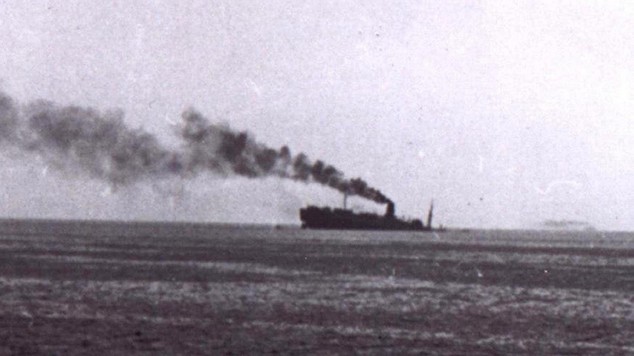
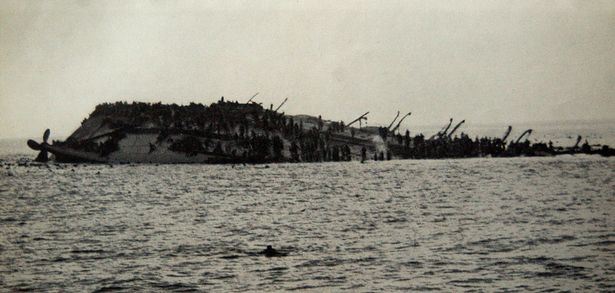
In the Loire estuary near Saint-Nazaire, British passenger liner RMS Lancastria, with 4,000 to 9,000 British civilians and military personnel on board, was sunk by three bombs by Ju 88 aircraft. Modern estimates suggest that between 4,000 and 7,000 people died during the sinking. There were 2,477 survivors. It was the worst maritime loss in British history. Churchill ordered that news of the sinking be kept secret from the British public. Many families of the dead knew only that they died with the British Expeditionary Force (BEF); the death toll accounted for roughly a third of the total losses of the BEF in France.
The ship sank at 16:12, within twenty minutes of being hit, which gave little time for other vessels to respond. Many of those in the water drowned because there were insufficient life jackets, or died from hypothermia, or were choked by fuel oil. According to Jonathan Fenby in his book The Sinking of the Lancastria, the German aircraft strafed survivors in the water.
Elsewhere, the evacuation proceeds smoothly. Men of the 1st Canadian Division are taken off at St. Malo. In a mini-repeat of Dunkirk, private boats of the Royal Channel Islands Yacht Club of Jersey arrive to help ferry troops to the larger British ships.
At Cherbourg, the Beauman Division and Norman Force, both improvised BEF formations, leave in the evening. They are not too far ahead of advancing German forces.
At Brest, mostly RAF ground crew are taken off. With the evacuation completed, the French troops wreck the port facilities with assistance from British demolition squads.
Evacuations also take place from Nantes. It is 50 miles (80 km) up the Loire. There is a large fleet of destroyers and some larger ships available, but the British troops need time to get there. The RAF provides vital air cover to protect numerous vulnerable transports.
At Bordeaux and nearby ports on the Garonne River and nearby, Polish and Czech soldiers and civilians board the British destroyers after the Admiralty gives permission. There also are certain VIPs such as the President of Poland who embark here.
Winston Churchill announced to the British people that the United Kingdom would continue to fight until Adolf Hitler was removed from power. Churchill makes a short radio speech: “We have become the sole champions now in arms to defend the world cause…We shall defend our Island home, and with the British Empire we shall fight on unconquerable until the curse of Hitler is lifted from the brows of mankind. We are sure that in the end all will come right.”
British unemployment figure decreased by 114,000 in May 1940 to a new low of 767,000.
General Sikorski issues declaration that Polish forces and government-in-exile intend to continue the fight.
General Warlimont, Jodl’s assistant at OKW, records that Hitler had not yet expressed interest in invading Britain. “Therefore even at this time, no preparatory work has been carried out at OKW.
The deposed German Emperor Wilhelm II sent a congratulatory telegram to Adolf Hitler regarding the victory over France.
Franco instructs his ambassador in France to demand transfer of some French territories in Northwest Africa to Spain.
At 9:00 PM Benito Mussolini, Count Ciano and other functionaries boarded a train to go to Munich at Hitler’s invitation.
The German occupiers ration bread in Holland.
Soviet Foreign Minister Vyacheslav Molotov sent German Ambassador Friedrich Werner von der Schulenburg a message of congratulations for the successful German conquest of France.
Nikita Khrushchev is with Stalin as news of the French decision to seek terms arrives. He later recalls that Stalin is furious that France “rolled over for Hitler” — even though he purportedly is Hitler’s ally. Khrushchev also states that while the rest of the world tries to figure out who is winning, Stalin just adds the German and French casualties together to see if he is winning. A quick German win is not what he wants.
Soviet troops occupy Latvia and Estonia. Soviet troops entered Latvia and Lithuania with little resistance. In Estonia, although a Signal Battalion would resist in Tallinn until 21 June, the government, along with the Army and the Estonian Defence League militia organization, surrendered to Soviet occupation. NKO Commissar Semyon Timoshenko ordered the disbanding of the military organizations of the Baltic States, leaving the task of border protection to NKVD troops. In North America, the United States refused to recognize the Soviet occupation of the two Baltic countries.
Prime Minister of Lithuania Antanas Merkys assigned Justas Paleckis as new Prime Minister. Merkys was subsequently arrested, after one day in office, by Soviet authorities.
British ambush and patrols kill or capture almost 200 Italian troops, including a general, without loss, in the Western Desert of Libya.
RAF Bomber Command dispatches 139 aircraft to attack attack oil installations and other industrial targets in the Rhineland, Ruhr and northwest Germany overnight.
RAF Fighter Command patrol over Abbeville, France.
Italian aircraft attack Buq Buq, Libya.
U-46, commanded by Oberleutnant zur See Engelbert Endrass, sank Greek steamer Elpis (3651grt) in 43 46N, 14 06W. At 0130 hours the neutral and unescorted Elpis (Master D. Christides) was missed by one G7a torpedo from U-46 while steaming at 8 knots about 220 miles west-northwest of Cape Finisterre. The torpedo went straight to the bottom due to a malfunction and the U-boat was shortly thereafter spotted on the surface by a lookout aboard the ship when turning away on the port beam in a distance of only 150 meters. The master immediately stopped the engines and told the crew to prepare the two lifeboats for launching. The Germans asked for identification by morse lamp and this was correctly answered, but they made no mention of not using the wireless so the master ordered the most crew members to abandon ship in the lifeboats and to remain alongside while the wireless operator sent out distress signals. This provoked Endrass to order his crew to prepare the deck gun, however before fire was opened the lifeboats were seen to get away from the ship so another G7a torpedo was fired as coup de grâce at 0155 hours. The torpedo struck on the port side amidships in the engine room only three minutes after the last men had abandoned ship in the starboard lifeboat and caused the Elpis to sink within a few minutes after breaking in two. The U-boat then left the area without questioning the survivors. HMS Punjabi (F 21) (Cdr J.T. Lean, RN) and HMS Harvester (H 19) (LtCdr M. Thornton, RN) were sent to assist the steamer after her distress signals were received, but the destroyers did not locate the U-boat or the lifeboats which had remained at the sinking position for a while before sailing towards the Spanish coast in deteriorating weather. Around noon on 18 June, the survivors were picked up by the British steam merchant Merkland in position 40°10N/12°20W and were landed at Falmouth. The 3,651 ton Elpis was carrying wheat and was headed for Avonmouth, England.
Destroyers HMS Foxhound and HMS Diana departed Scapa Flow at 0130 for the Clyde, but were recalled to escort aircraft carrier HMS Ark Royal. Ark Royal with destroyers HMS Faulknor (D.8), HMS Fearless, and HMS Escapade departed Scapa Flow at 1545 for the Clyde. Destroyer Foxhound joined the screen outside Scapa Flow. Destroyer Diana entered Scapa Flow.
Armed merchant cruiser HMS Canton on Northern Patrol reported she was attacked by a German submarine.
In support of the Cotentin Peninsula (Cherbourg area), French battleship Courbet, Anti-aircraft ship Amiens, submarine chasers CH.13 and CH.43 operated off the east coast and large destroyer Leopard, torpedo boats Branlebas, Flore, and Incomprise, and sloop Savorgnan De Brazza operated off the west coast. On the 19th, these ships proceeded to Portsmouth.
French steamers Saumur (2955grt), Enseigne Maurice Prechac (4578grt), Vulcain (4362grt), Paul Emile Javary (2471grt), Armenier (914grt), and Sainte Clair (3824grt) departed the Clyde for Brest escorted by British trawlers.
Destroyer HMS Westcott was damaged in a collision with British steamer Nyroca (786grt) at Brest. The destroyer could steam only eight knots and returned to Plymouth, where she was under repair from 18 to 30 June.
A convoy of twenty six ships departed Quiberon Bay escorted by destroyer HMS Wolverine for Bristol Channel.
At St Nazaire on the 17th was the British liner RMS Lancastria (16,243grt). She was joined by British liners Ulster Prince (3791grt), Ulster Monarch (3791grt), Royal Scotsman (3244grt), and Royal Ulsterman (3244grt). In the Loire anchorage was British tanker Cymbula (8033grt) and British steamers Clan Ferguson (7347grt), Baharistan (5479grt) Floristan (5478grt), Glenaffaric (7782grt), and John Holt (3815grt), Teiresias (7405grt). Destroyers HMS Highlander, HMS Havelock, and HMS Beagle worked in the anchorage.
British steamer Teiresias (7405grt) was badly damaged by German bombing in 47 07N, 02 23W. One crewman killed on the British steamer. The steamer was abandoned one mile northwest Wreck Buoy off the entrance to St Nazaire. British steamer Holmside (3433grt) rescued the survivors.
A convoy was arriving from the Bristol Channel. It was composed of British steamers Robert L. Holt (acting commodore, 2918grt), City of Lancaster (3041grt), David Livingston (4022grt), Fabian (3059grt), and Glenlea (4252grt).
British troopship Lancastria (16,243grt), while evacuating troops at St Nazaire, was sunk by German bombing in Charpentier’s Roads. Anti-submarine trawler Cambridgeshire (443grt) rescued 1009 survivors and transferred them to British steamer John Holt (3815grt) in harbor. 829 survivors on steamer John Holt were sailed for England on the 17th. Destroyer HMS Highlander, tanker Cymbula (8033grt), steamers Fabian (3059grt), Glenaffaric (7782grt), Oronsay (20,043grt), Robert L. Holt (2918grt), Ulster Prince (3791grt) were also involved in rescue efforts. The RMS Lancastria was a Cunard ocean liner that was taking part of Operation Ariel, the evacuation of Allied forces from northwest France after it became apparent that France was beaten by the Germans. At about 4 PM she was bombed by Dornier Do 17 aircraft south of Chémoulin Point near St. Nazaire. Four hits caused the ship to sink within twenty minutes. Only 2,477 survivors out of the passengers and crew on Lancastria were rescued. Sixty six crew and several thousand troops and refugees were lost. This accounted for roughly a third of the total losses of the BEF in France. The immense loss of life was such that the British government banned any public announcements of the disaster through the D-notice system. The story was broken by the New York Times on July 26, 1940.
At 0630/18th, British steamers Olive, Royal Ulsterman, Ulster Prince, Floristan, Baharistan, Clan Macpherson, Dundrum Castle, David Livingstone, Fabian, City Of Mobile, and Glenaffaric departed St Nazaire, escorted by destroyers HMS Vanoc and HMS Beagle. Steamers Clan Ferguson, Ulster Prince, Baharistan each carried 3000 troops, David Livingston carried 800 troops, destroyer Beagle carried 600 troops.
Minesweeping trawler HMS Murmansk (348grt) was accidently grounded and abandoned at Brest. The entire crew was rescued. Trawler Murmansk was later salved by German forces. She was placed into service in 1941 as auxiliary minesweeper KFK.76 which was later renumbered as FB.06. The trawler did not survive the war.
French steamer Champlain (28,124grt) was badly damaged on a mine off the entrance to La Pallice and settled to the sea bed. Eleven crewmen were lost on the French steamer. Three hundred and fifty nine crew and passengers were rescued.
Norwegian steamer Komet (1147grt) was sunk by German bombing in the English Channel. The Master of the Norwegian steamer was lost.
German light cruiser Nurnberg and two steamers took the 2nd Infantry Regiment and an artillery regiment of the 3rd Mountain Division from Trondheim to Narvik and Tromsø. The light cruiser arrived in Harjangsfjord on the 17th.
Destroyer HMS Diamond was near missed and slightly damaged by Italian bombing at Malta, but remained in service.
French sloop La Curieuse, which with sloop Commandant Bory was escorting French convoy IR.2F to North Africa, damaged and captured Italian submarine Provana thirty miles north of Cape Palos near Oran. However, Provana sank in tow before she could be gotten into port.
Aircraft carrier HMS Hermes, returning from patrol off the Canary Islands to Dakar, was ordered to Freetown due to the peace terms. The order was then cancelled at 0245/18th.
Convoy HX.51 departed Halifax escorted by Canadian destroyers HMCS Assiniboine and HMCS Ottawa and auxiliary patrol vessels HMS Acadia and HMS French. On 8 June, the destroyers turned the convoy over to the ocean escort, armed merchant cruiser HMS Jervis Bay, which was detached on the 28th. The convoy carries cargo including 150 U.S. aircraft originally bound for France.
Convoy BHX.51 departed Bermuda on the 16th escorted locally by sloop HMS Penzance and ocean escort armed merchant cruiser HMS Ascania. The convoy rendezvoused with HX.51 on the 21st and the armed merchant cruiser was detached. On 29 June, destroyers HMS Versatile and HMS Vivacious and sloop HMS Sandwich joined the convoy. Destroyer Versatile was detached on 1 July. The other escorts were detached on 2 July when the convoy arrived at Liverpool.
Convoy OG.34F was formed at sea from convoy OA.168GF which departed Southend on the 15th escorted by corvette HMS Periwinkle, convoy OB.168GF which departed Liverpool on the 15th, escorted by sloop HMS Deptford. Sloop Deptford escorted the convoy from 17 to 22 June. The convoy arrived at Gibraltar on the 24th.
Convoy OA.169 departed Southend escorted by sloop HMS Fowey from 17 to 20 June. The sloop was detached to convoy HX.49.
Convoy OB.169 departed Liverppol escorted by sloop HMS Sandwich from 17 to 20 June. The sloop was detached to convoy HX.49.
Convoy FN.198 departed Southend, escorted by destroyers HMS Wallace, HMS Wolfhound, and HMS Valorous. The convoy arrived in the Tyne on the 18th.
Convoy FS.197 departed the Tyne, escorted by destroyer HMS Woolston and sloop HMS Fleetwood. Destroyer HMS Encounter traveled in this convoy en route for refit. The convoy arrived at Southend on the 19th.
Troop Convoy US.3, carrying troops from New Zealand and Australia, departs from Suez.
The War at Sea, Monday, 17 June 1940 (naval-history.net)
Destroyers FOXHOUND and DIANA departed Scapa Flow at 0130 for the Clyde, but were recalled to escort aircraft carrier ARK ROYAL.
Aircraft carrier ARK ROYAL with destroyers FAULKNOR (D.8), FEARLESS, and ESCAPADE departed Scapa Flow at 1545 for the Clyde.
Destroyer FOXHOUND joined the screen outside Scapa Flow. Destroyer DIANA entered Scapa Flow.
Destroyers BEDOUIN and ASHANTI were sent at 0047 to hunt for a German submarine reported off Reykavik in 64-09N, 22-16W.
Destroyers BEDOUIN and ASHANTI arrived off Reykavik on the 18th and maintained an anti-submarine patrol off Reykavik of one destroyer and one trawler.
The destroyers were then to escort British troopship EMPRESS OF AUSTRALIA from Iceland to Halifax.
Heavy cruiser DEVONSHIRE was sent to Halifax to escort troopship EMPRESS OF AUSTRALIA on her return voyage to Iceland with Canadian troops.
Armed merchant cruiser CANTON on Northern Patrol reported she was attacked by a German submarine.
Destroyers HAMBLEDON and WITHERINGTON arrived in the Clyde.
Destroyer VISCOUNT departed the Clyde for Plymouth.
Destroyers KASHMIR and JUPITER departed the Tyne for the Humber where they arrived later the same day.
Destroyers GALLANT and WALPOLE arrived at Rosyth from the Humber.
Minelayer PORT NAPIER arrived at Rosyth from the Tyne.
Submarine SALMON departed Rosyth on patrol.
Destroyer BRILLIANT arrived at Dover to join the 1st Destroyer Flotilla.
Destroyer WILD SWAN, en route from Portsmouth to Harwich, spent the night at Dover. The destroyer arrived at 2208/17th and departed the next morning at 0535.
On patrol, destroyer VESPER rescued three British officers, one British NCO, five French soldiers and took them to Dover.
Destroyer VIVACIOUS, en route from Portsmouth to Harwich, reported sighting enemy boats seven miles east of Dungeness late on the 17th.
Destroyer VIVACIOUS soon reported a torpedo missed ahead.
In support of the Cotentin Peninsula (Cherbourg area), French battleship COURBET, Anti-aircraft ship AMIENS, submarine chasers CH.13 and CH.43 operated off the east coast and large destroyer LEOPARD, torpedo boats BRANLEBAS, FLORE, and INCOMPRISE, and sloop SAVORGNAN DE BRAZZA operated off the west coast.
On the 19th, these ships proceeded to Portsmouth.
French steamers SAUMUR (2955grt), ENSEIGNE MAURICE PRECHAC (4578grt), VULCAIN (4362grt), PAUL EMILE JAVARY (2471grt), ARMENIER (914grt), and SAINTE CLAIR (3824grt) departed the Clyde for Brest escorted by British trawlers.
Destroyer WESTCOTT was damaged in a collision with British steamer NYROCA (786grt) at Brest.
The destroyer could steam only eight knots and returned to Plymouth, where she was under repair from 18 to 30 June.
A convoy of twenty-six ships departed Quiberon Bay escorted by destroyer WOLVERINE for Bristol Channel.
At St Nazaire on the 17th was the British liner LANCASTRIA (16,243grt). She was joined by British liners ULSTER PRINCE (3791grt), ULSTER MONARCH (3791grt), ROYAL SCOTSMAN (3244grt), and ROYAL ULSTERMAN (3244grt).
In the Loire anchorage was British tanker CYMBULA (8033grt) and British steamers CLAN FERGUSON (7347grt), BAHARISTAN (5479grt) FLORISTAN (5478grt), GLENAFFARIC (7782grt), JOHN HOLT (3815grt), and TEIRESIAS (7405grt).
Destroyers HIGHLANDER, HAVELOCK, and BEAGLE worked in the anchorage.
British steamer TEIRESIAS (7405grt) was badly damaged by German bombing in 47 07N, 02 23W.
One crewman killed on the British steamer. The steamer was abandoned one mile northwest Wreck Buoy off the entrance to St Nazaire.
British steamer HOLMSIDE (3433grt) rescued the survivors.
British steamer DUNDRUM CASTLE (5259grt) had been diverted from Dunkirk and was waiting in St Nazaire to discharge her military cargo.
Hospital ship SOMERSET (8790grt) was also at St Nazaire.
A convoy was arriving from the Bristol Channel. It was composed of British steamers ROBERT L. HOLT (acting commodore, 2918grt), CITY OF LANCASTER (3041grt), DAVID LIVINGSTON (4022grt), FABIAN (3059grt), and GLENLEA (4252grt).
Destroyers HAVELOCK and HIGHLANDER were involved in ferrying troops to the evacuating ships in the harbour.
Destroyer HAVELOCK had her starboard engine out of action and was to return to Plymouth with troopship LANCASTRIA.
British troopship LANCASTRIA (16,243grt) while evacuating troops at St Nazaire was sunk by German bombing in Charpentier’s Roads.
Anti-submarine trawler CAMBRIDGESHIRE (443grt) rescued 1009 survivors and transferred them to British steamer JOHN HOLT (3815grt) in harbour. 829 survivors on steamer JOHN HOLT were sailed for England on the 17th.
Destroyer HIGHLANDER, tanker CYMBULA (8033grt), steamers FABIAN (3059grt), GLENAFFARIC (7782grt), ORONSAY (20,043grt), ROBERT L. HOLT (2918grt), and ULSTER PRINCE (3791grt) were also involved in rescue efforts.
Only 2477 survivors out of 5310 passengers and crew on LANCASTRIA were rescued. Sixty six crew and 2833 troops and refugees were lost.
Destroyer WREN and armed yacht ZAZA were ordered to St Nazaire to assist destroyer HIGHLANDER.
At 0630/18th, British steamers OLIVE, ROYAL ULSTERMAN, ULSTER PRINCE, FLORISTAN, BAHARISTAN, CLAN MACPHERSON, DUNDRUM CASTLE, DAVID LIVINGSTONE, FABIAN, CITY OF MOBILE, and GLENAFFARIC departed St Nazaire, escorted by destroyers VANOC and BEAGLE.
Steamers CLAN FERGUSON, ULSTER PRINCE, and BAHARISTAN each carrying 3000 troops, DAVID LIVINGSTON carrying 800 troops, destroyer BEAGLE carried 600 troops.
Destroyer STURDY was ordered to join destroyer MACKAY at Brest.
At 1704, destroyers IMOGEN and GRIFFIN were ordered towards Brest for anti-submarine patrols.
At 2041, destroyers PUNJABI and HARVESTER were ordered to patrol between Ushant and the Loire.
Minesweeping trawler MURMANSK (348grt) was accidently grounded and abandoned at Brest.
The entire crew was rescued.
Trawler MURMANSK was later salved by German forces. She was placed into service in 1941 as auxiliary minesweeper KFK.76 which was later renumbered as FB.06. The trawler did not survive the war.
French steamer CHAMPLAIN (28,124grt) was badly damaged on a mine off the entrance to La Pallice and settled to the sea bed.
Eleven crew were lost on the French steamer. Three hundred and fifty-nine crew and passengers were rescued.
Norwegian steamer KOMET (1147grt) was sunk by German bombing in the English Channel.
The Master of the Norwegian steamer was lost.
Convoy OG.34F was formed at sea from convoy OA.168GF which departed Southend on the 15th escorted by corvette PERIWINKLE, convoy OB.168GF which departed Liverpool on the 15th, escorted by sloop DEPTFORD.
Sloop DEPTFORD escorted the convoy from 17 to 22 June. The convoy arrived at Gibraltar on the 24th.
Convoy OA.169 departed Southend escorted by sloop FOWEY from 17 to 20 June. The sloop was detached to convoy HX.49.
Convoy OB.169 departed Liverppol escorted by sloop SANDWICH from 17 to 20 June. The sloop was detached to convoy HX.49.
Convoy FN.198 departed Southend, escorted by destroyers WALLACE, WOLFHOUND, and VALOROUS. The convoy arrived in the Tyne on the 18th.
Convoy FS.197 departed the Tyne, escorted by destroyer WOOLSTON and sloop FLEETWOOD. Destroyer ENCOUNTER traveled in this convoy en route for refit. The convoy arrived at Southend on the 19th.
German light cruiser NURNBERG and two steamers took the 2nd Infantry Regiment and an artillery regiment of the 3rd Mountain Division from Trondheim to Narvik and Tromsø. The light cruiser arrived in Harjangsfjord on the 17th.
U-46 sank Greek steamer ELPIS (3651grt) in 43 46N, 14 06W.
The entire crew of the Greek steamer was rescued.
Destroyers PUNJABI and HARVESTER were ordered to the area.
Destroyer DIAMOND was near missed and slightly damaged by Italian bombing at Malta, but remained in service.
French sloop LA CURIEUSE, which with sloop COMMANDANT BORY was escorting French convoy IR.2F to North Africa, damaged and captured Italian submarine PROVANA thirty miles north of Cape Palos near Oran.
However, PROVANA sank in tow before she could be gotten into port.
Submarine PARTHIAN unsuccessfully attacked Italian destroyer NEMBO off Tobruk.
Italian submarine ADUA attacked a French convoy between Marseilles and Toulon. A detonation was heard but there is no confirmation on damage.
Convoy HX.51 departed Halifax escorted by Canadian destroyers HMCS ASSINIBOINE and HMCS OTTAWA and auxiliary patrol vessels HMCS ACADIA and HMCS FRENCH. On 8 June, the destroyers turned the convoy over to the ocean escort, armed merchant cruiser JERVIS BAY, which was detached on the 28th.
Convoy BHX.51 departed Bermuda on the 16th escorted locally by sloop PENZANCE and ocean escort armed merchant cruiser ASCANIA. The convoy rendezvoused with HX.51 on the 21st and the armed merchant cruiser was detached.
On 29 June, destroyers VERSATILE and VIVACIOUS and sloop SANDWICH joined the convoy. Destroyer VERSATILE was detached on 1 July. The other escorts were detached on 2 July when the convoy arrived at Liverpool.
Aircraft carrier HERMES, returning from patrol off the Canary Islands to Dakar, was ordered to Freetown due to the peace terms. The order was then cancelled at 0245/18th.
The U.S. Government moved swiftly today to bar economic or military encroachment of the totalitarian countries. in the Western Hemisphere. President Roosevelt projected a great economic union between North and South America, and identical bills were introduced in both houses of Congress calling for expansion of the Navy by eighty-four more ships, at a cost of $1,200,000,000. Simultaneously the President signed recently completed legislation authorizing an 11 per cent increase in naval tonnage and providing for twenty-two fighting ships and auxiliaries.
Meanwhile the Senate unanimously adopted a joint resolution proclaiming this nation’s refusal to recognize any change in sovereignty over American possessions of European countries. Legislation warning that the United States would not “acquiesce” in the transfer of western hemisphere colonies from one non-American nation to another was hustled through the Senate unanimously today a few hours after word came that France was asking peace with Germany. The House planned to act on the same legislation tomorrow when Hitler and Mussolini meet to decide what peace terms will be imposed on France. The Senate approved the legislation by a 76 to 0 vote after Senator Connally, Texas Democrat, had insisted such a declaration of policy was imperative and that “cognizant of our own safety, the United States cannot tolerate the transfer of these possessions either by negotiation or by the sword.”
The economic union of North and South America would be effected under a $2,000,000,000 Inter-American Export Corporation. The plans. for the union came as an answer of Western Hemisphere nations to a German economic pincer movement reported to have asserted itself in several countries to the south.
As outlined in preliminary discussions between State, Treasury, Agriculture and Commerce Department officials, the plan envisages an almost totalitarian control over exports of surplus commodities of North and South American countries to prevent German dictation of the terms on which the Reich will purchase Western Hemisphere products. In addition to the top corporation financed entirely with United States capital and dominated by a board of seven out of ten governing members, the plan contemplates at least twenty-two subsidiary corporations representing each of the participating nations and an undetermined number of subsidiary groups for each of the more major export commodities.
The plan is to be presented to Congress by President Roosevelt with a request for authorizing legislation as soon as all details have been perfected and then submitted to the various countries frankly on the basis of “enlightened self-interest.” Officials conversant with the plan made no secret today of the fact that the latter term included military and naval as well as economic considerations. It was discussed in considerable detail this afternoon at a conference called by the President at which the Secretaries of State, Treasury. Agriculture and Commerce and other officials were present. Mr. Roosevelt did not take part, but made it clear that he expected the group to submit formal recommendations carrying out the idea in the near future.
National defense preparations went ahead on all fronts. The House rushed through another measure to increase the authorized strength of the Army from 250,000 to 400,000 men. Democratic Congressional leaders abandoned hope of inducing an early adjournment and concentrated on a compromise with the Republican leadership providing for the longest possible recess.
After a conference with Treasury and State Department officials the President issued a proclamation “freezing” French assets in the United States estimated between $500,000,000 and $1,000,000,000 so as to prevent their use by Germany under whatever peace terms the French might accept.
Great Britain moved to obtain release of $500,000,000 in war materials originally destined for France under orders placed by the Allied purchasing mission.
Chief of U.S. Naval Operations Admiral Harold R. Stark asked the U.S. Congress for $4 billion to construct the “Two-Ocean Navy.”
Senator Pepper, Florida Democrat, suggested in the senate today that President Roosevelt be granted “full war-time power to prepare and defend America.” He recommended that the chief executive be empowered to suspend laws and governmental rules and regulations when he believed they interfered “with the maximum speed in the production, transportation or manufacture of defense material.”
French representatives in the United States allow the British to take over the arms orders the French had made under the “Cash and Carry” rules.
French Minister for Foreign Affairs Paul Baudouin privately informed Deputy U.S. Ambassador to France Anthony J. Drexel Biddle, Jr., that the fleet “would never be surrendered to Germany.” To guarantee that pledge, Boudouin informed Biddle that Admiral François Darlan has been appointed as Minister of Marine.
In an atmosphere heavily clouded by the crisis in the allied cause, the advance guard of the Republican convention met today in Philadelphia to write its 1940 platform. Unanimously it elected a Dewey man Herbert K. Hyde of Oklahoma as its temporary chairman, while one of the party’s most intense anti-Deweyites, Kenneth Simpson, New York national committeeman was telling friends that in his opinion the Dewey boom had “collapsed.” The first thought of nearly everyone was for the war situation and what the Republicans as a party should say and do about it. “We are standing at the crossroads of civilization,” Hyde said in accepting. “Half the world is in flames.” He added that “as our distinguished president has said ” ‘in our own country a third of the nation is ill-fed, ill-housed and ill-clothed,’ ” and asked “why is it that after seven years this vital question has not been solved by this administration?” Unless the United States can solve its domestic problems, he said “it is unlikely that we can defend ourselves against attack from abroad.” In an interview later he declared: “I do not believe the United States should undertake to guarantee the political integrity or territorial independence of any nation in Europe or Asia.”
A strong current toward a declaration of sympathy for the forces still battling Nazi domination of Europe, as well as for all possible material aid “short of war,” developed quickly among the forty-odd members of the Republican Resolutions Committee as it convened informally today to begin drafting a platform to be presented to the national convention next week. Led openly by Alfred M. Landon of Kansas, Presidential nominee in 1936, and Walter E. Edge, former Senator from New Jersey and later Ambassador to France, the so-called “Aid-to-the-Allies” movement pushed into the background, for the time being at least, any serious agitation for a restatement of the traditional isolation policy for which the Republican Party has been noted in recent years. The committee gave no consideration to either in its organization meetings today, but informal checks among the members showed that the newly proposed policy was gaining widespread support.
Two U.S. Army bombers collided a half mile above a residential section of Queens Borough, New York, today, burst into flames and carried 11 army fliers to death in the burning wreckage. Two homes were fired by flaming gasoline, but what seemed like a miracle no civilians in the thickly populated area were killed. One woman was burned. All aboard the two bombers were killed.
Boeing is allocated $85,652 by the Army Air Corps for further design and wind tunnel tests of Model 345, basis for the B-29 bomber.
Civilian contractors began working on the expansion of the U.S. Navy airfield on Maui, U.S. Territory of Hawaii.
Major League Baseball:
Clyde Shoun of the Cardinals holds the Dodgers to four singles, strikes out six, and walks just two as the Cardinals win, 3–1. Vito Tamulis takes the tough loss as two unearned runs in the 4th inning provide the winning margin for St. Louis.
The Reds jumped back into first place in the National League today by beating the Phillies, 6–2, while Brooklyn bowed to St. Louis. Eddie Joost’s homer and a fine relief pitching performance by Lloyd Moore lift Cincinnati to victory.
Not a single assist is recorded by any of the Boston Bee infielders in the first game of a doubleheader versus Pittsburgh. Boston wins, 5–3, then takes the nitecap, 5–1. Bill Posedel wins the first game with 11 strikeouts, yielding only six hits. Al Plechota gets the win in the nitecap.
Paul Dean spins a six-hitter and gives the Giants a 2–1 win over the Cubs. Billy Jurges hits a wind-aided homer in the seventh that provides the winning run, even after Stan Hack answers with his own solo shot for the Cubs in the 8th.
Citing upset nerves, Cleveland catcher Frank Pytlak quits the team. Pytlak, who had been a holdout all spring training, will be dealt to the Red Sox in December. The Indians bring up young Jim Hegan from Wilkes-Barre.
St. Louis Cardinals 3, Brooklyn Dodgers 1
Pittsburgh Pirates 3, Boston Bees 5
Pittsburgh Pirates 1, Boston Bees 5
Chicago Cubs 1, New York Giants 2
Cincinnati Reds 6, Philadelphia Phillies 2
Canada will meet the present crisis in France with further assistance to the United Kingdom and increased measures of home defense, Prime Minister William Lyon Mackenzie King told the House of Commons this afternoon. His declaration was made amid resounding applause after the Opposition leader, R. B. Hanson had asked if he had anything to say to the House and the country at this juncture. “While not minimizing the seriousness of the blow to the cause of the Allies. I can say with confidence,” said Mr. Mackenzie King, “that the fate of France will strengthen rather than weaken Canada’s determination to intensify her war effort.”
The heavy cruiser USS Quincy (CA-39) departed Rio de Janeiro, Brazil for Montevideo, Uruguay as part of the American effort to counteract German propaganda in Latin America.
Battle of Tsaoyang-Ichang: Chinese 5th War Area temporarily recaptures Ichang. The Central News (official Chinese) Agency asserted today that Chinese forces had retaken Ichang, important port on the middle Yangtze River, which Japanese took a week ago.
Battle of Tsaoyang-Ichang: Japanese 11th Army promptly recovers Ichang.
The fifth Japanese bombing raid in eight days in a drive to pulverize the nerve center of Generalissimo Chiang Kai-shek’s Chinese Nationalist forces was directed at the Chungking area tonight. Four squadrons of Japanese bombers blasted the suburbs of the city at 7 PM. There were 100 planes in all, The Associated Press reported.
Battle of South Kwangsi: Japanese 22nd Army captures Suilou west of Nanning on the road to French Indochina.
Two news items today aroused great disquietude in American and Allied quarters in Shanghai and elsewhere in the Far East. They were taken to indicate that Japan might take an active part in general worldwide hostilities. The first item comes from Canton, where the Japanese military spokesman independently undertook to warn French Indo-China bluntly that if shipments of arms and supplies to Generalissimo Chiang Kai-shek did not cease and if Indo-China refused to “reconsider herself” the Japanese Army “must undertake to wean Indo-China away from hostility toward Japan.”
It is feared that on capitulation of the French armies Japan will make an abrupt move against unprotected Indo-China even before moving against the Netherlands Indies. The second disturbing item was a cable from Rome reporting that Premier Mussolini had received a message from Japan’s War Minister, General Shunroku Hata, and Field Marshal Prince Kohohito Kanin, Chief of the Japanese Imperial General Staff, saying that the senders wished “from the depths of our hearts that the Italian armed forces, loyal to their glorious tradition, may win the most overwhelming and grandiose victories.” This cable from Japan’s military heads, sent without the co-signatures of the Premier and other heads of government, is interpreted here as showing that the Japanese Army again is undertaking independently to dictate national policies.
The Tokyo newspaper Nichi Nichi said today that Japan “greatly concerned” and will oppose “joint control of French Indo-China which now is reported to be a subject of negotiations among France, Britain and the United States.” Owing to the “miserable defeats” which the allies have suffered, the newspaper said, the British and American governments have just concluded a secret agreement for the joint defense of British and French colonies in the south Pacific, including Australia, New Caledonia and the Netherlands East Indies as well as Indo-China.
Dow Jones Industrial Average: 122.8 (-0.56)
Born:
Bobby Bell, College (College Football Hall of Fame, inducted 1991; University of Minnesota) and AFL and NFL linebacker (Pro Football Hall of Fame, inducted 1983; AFL Champions, Super Bowl IV-Chiefs, 1969; AFL Champions-Chiefs, 1966 [lost Super Bowl I]; AFL All-Star, 1964-1969; Pro Bowl, 1970, 1971, 1972), in Shelby, North Carolina.
Bookie Bolin, NFL guard (NFL Champions-Vikings, 1969 [lost Super Bowl I]; New York Giants, Minnesota Vikings), in Hamilton, Alabama.
Bill Garner, ABA center (Anaheim Amigos), in East St. Louis, Illinois.
George Akerlof, American economist (“The Market for Lemons”) and Nobel laureate (2001), in New Haven, Connecticut.
Tony Marlow, British Conservative Party politician, in Greenwich, London, England, United Kingdom.
Alan Murray, Australian golfer, in Sydney, New South Wales, Australia (d. 2019).
Chuck Rainey, American jazz and session bassist (Steely Dan; Quincy Jones; Aretha Franklin; Mose Allison), in Cleveland, Ohio
Alton Kelley, American graphic artist, known for concert posters and album cover art (Grateful Dead -“Workingman’s Dead”; Steve Miller Band – “Book of Dreams”), in Houlton, Maine (d. 2008).
Died:
Arthur Harden, 74, British biochemist and Nobel laureate (1929).
Naval Construction:
The Kriegsmarine (German Navy) Type VIIC U-boat U-206 is laid down by F. Krupp Germaniawerft AG, Kiel (werk 635).
The Kriegsmarine (German Navy) Type IXB U-boat U-106 is launched by AG Weser, Bremen (werk 969).
The U.S. Navy motor torpedo boat USS PT-9, sole ship of her class (built by British Power Boat), is commissioned. She is transferred to the Royal Navy in April 1941, being renamed MTB 258.
The Koninklijke Marine (Royal Netherlands Navy) minelayer HrMs (HNMS) Soemenep is commissioned. Her first and only commanding officer is Luitenant ter zee 2e klasse (Lt.) Tobias Jellema, RNN.
 History Diaries