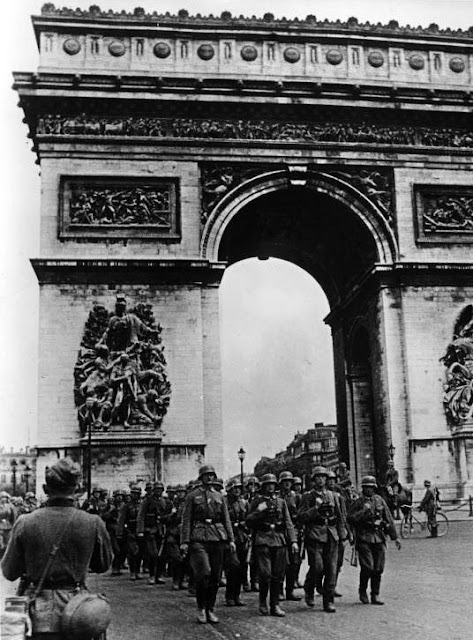
General Aubert Frere and the French 7th Army left Paris without fighting allowing the German Army to enter Paris. French General Frere follows orders and pulls his French 7th Army out of Paris.
Since the city is not defended, all of its businesses – such as the Renault tank factory at Billancourt and Schneider-Creusot armament works – are intact and ready to churn out weapons for the German conquerors. General Henri Dentz surrenders Paris at the Hotel Crillon.
The Germans entered Paris unopposed. The city was eerily silent since 2 million Parisians had already fled and all shops and businesses were closed. Troops of the German Army enter Paris. German troops capture the open city of Paris, France without any meaningful opposition. At 10 AM, the Germans enter the City of Light. The Minister of the Interior orders the police to hand over their arms to their superiors. The air of gloom and silence that has descended over the city is only broken by the occasional distant explosion as the French blow up munitions factories. The only resistance has come from some workers near the Porte d’Aubervilliers, who punched passing soldiers, who ignored them. The Germans posted machine-gunners in key positions as they marched through near-empty streets, and a senior officer drove to M Laingeron, the chief of the Paris police to tell him to remain in office until further notice and to be responsible for keeping public order. The swastika now flies from the Eiffel Tower and from German HQ, established in one of the city’s most luxurious hotels, Hôtel Majestic, 29, rue Dumont d’Urville. Major General Bogislav von Studnitz leads the German 87th Infantry Division in a victory march through the city. General von Bock, commander of Army Group B, flies into the “open city” of Paris and stands at the Arc de Triomphe just in time to take the salute of the first combat troops into the city. It is a parade, not a battle, and the German army quickly occupies Paris.
The final broadcast of French radio before the occupation is a recording of French National Anthem, La Marseillaise.
The French operators of the Eiffel Tower cut the elevator cables. Wehrmacht troops climb 900+ steps to hang the Swastika flag.
The German occupation forces settle comfortably into Paris immediately. Overall, the Wehrmacht does not discourage fraternization with the locals, many of whom reciprocate.
The Wehrmacht sets up headquarters at the finest hotels in St. Germain and elsewhere, including most notoriously the Hotel Ritz. The draw up a “Parisian campaign map” that shows the best cafes, restaurants and other assorted amusements.
On the whole, the occupation troops act with restraint. However, inevitably there are instances of troops acting with cruelty, taking without paying, and the like. Troops accustomed to rough life in the field are somewhat over-awed with the varied decadent opportunities in Paris and often lose the edge off their military discipline.
The Wehrmacht imposes a 20:00 curfew in Paris using loudspeakers on trucks.
The French Army is still fighting south of the city. France’s main armies fell back tonight far below abandoned, German-invaded Paris in a fighting retreat that may be their last war movement.
The German spearheads approach Romilly and St. Dizier to the east of Paris.
To the north, the coastal city of Le Havre fell under German control.
1st Panzer Division pushes to Chaumont and German 12th Army threatens to surround entire the French 2nd Army Group.
The Wehrmacht’s Army Group C (von Leeb) sends its 24 divisions against the Maginot Line. The attack is led by the 7th Army against the French 8th Army and has mixed success, scoring some advances in some areas. German 1st Army (Erwin von Witzleben) breaks through at Saarbrücken. To support those attacks, Panzer Group Guderian and other troops swing east to encircle the French positions.
In the morning, Weygand told General Alan Brooke that the Inter-Allied Council had ordered that a line be held at the base of the Brittany peninsula. (Brooke would learn that the British government had not agreed to this.) Brooke estimated that this would require at least 15 divisions and there were not five divisions available. On returning to Le Mans Brooke called Dill and told him that the situation was hopeless and that troops coming to France should be held in Britain. Later in the evening Dill called from 10 Downing Street. He put Churchill on the line. The PM told Brooke that it was important for the British to make the French feel that they were supporting him. Brooke’s reply was that it was impossible to make a corpse feel and that the French Army was dead. Brooke told Churchill that the British should be evacuated and after 30 minutes of talk Churchill agreed and told him to bring all the British troops back to the U.K. This, less than 48 hours after Brooke had arrived in France.
The 3rd Squadron of the French Navy bombarded Genoa. 9 civilians were killed but damage was otherwise light.
Two German corps under Guderian swung to the east to cut off any attempt by the Maginot Line garrisons to retreat.
Hitler, at his Wolfsschlucht headquarters, issues Führer Directive No. 15 regarding the war in the West and the advance on the Loire:
The Leader And Supreme Commander Of The Armed Forces.
The Leader’s Headquarters. 14th June, 1940. 6 copies
Directive No. 15
- The enemy, compelled by the collapse of his front, is evacuating the Paris area, and has also begun the evacuation of the fortified triangle Epinal-Metz-Verdun behind the Maginot Line. Paris has been declared an open city by means of posters. It is not inconceivable that the main body of the French Army may withdraw behind the Loire.
- Our relative strength and the condition of the French Army now make it possible to pursue henceforward two objectives at the same time: (a) To prevent enemy forces withdrawing from the Paris area, and those on the lower Seine from establishing a new front. (b) To destroy enemy forces in the areas facing Army Groups A and C, and to bring about the collapse of the Maginot Line.
- I therefore issue the following orders for the further conduct of the operations of the Army: (a) Enemy forces on the lower Seine and in the Paris area will be vigorously pursued by the advance of the right flank of the Army along the coast towards the Loire Estuary and by a turning movement from the Chateau-Thierry area towards the Loire above Orleans. Paris will be occupied in force as soon as possible. The naval bases of Cherbourg and Brest, and also Lorient and St Nazaire, will be occupied. (b) Forces at the centre, up to approximately the area of Châlons, will continue, for the time being, in the general direction of Troyes; their armoured and motorized divisions will thrust forward in the direction of the plateau of Langres. Infantry divisions will first reach the area northeast of Romilly-Troyes. Preparations will be made for their later use in the central Loire area. (c) Orders for other formations of the Army remain unchanged. They will destroy the enemy in the enclosed area of northeastern France, ensure the collapse of the Maginot Line, and prevent the withdrawal of forces there towards the southwest. (d) The Saarbrucken Shock Group will move to the attack across the Maginot Line on 14th June in the general direction of Lunéville. The timing for Attack Upper Rhine will be decided as soon as possible.
- The Air Force has the following tasks: (a) To keep up the momentum of our advance towards the Loire by means of air attacks. At the same time the advancing troops are to be supported by antiaircraft artillery and protected against air attack. The enemy’s retreat by sea is to be made impossible by smashing ports and shipping on the north coast of France. The withdrawal of the enemy facing Army Groups A and C is to be held up. The focal point in this respect is in front of the tanks on the right flank of Army Group A. Enemy transport by rail running southwest towards and beyond the line Neuchâteau-Belfort is to be prevented. At the same time the breach of the Maginot Line by Army Group C is to be supported. Antiaircraft artillery is to facilitate the attack by the right flank of Army Group A and, in particular, the penetration of French fortifications.
(signed) Adolf Hitler.
French Prime Minister Paul Reynaud’s government leaves General Weygand’s headquarters at Briare for Bordeaux.
French and Polish codebreakers, who have been working on cracking the Wehrmacht’s Enigma codes, flee south toward Toulouse with their Enigma machines.
General Charles De Gaulle departs for London.
Francoist Spain took advantage of the German invasion of France by occupying the international zone at Tangier.
The first inmates of Auschwitz and Theresienstadt concentration camp arrived. 728 Poles are marched through Tarnow to Auschwitz.
The Soviet ultimatum to Lithuania was delivered. The Occupation of the Baltic states began. Stalin, like Franco, sees a golden opportunity to clean out his inventory of invasions while the western powers are otherwise occupied. His overall objective is to restore the pre-1918 Tsarist borders, which included both Estonia and Lithuania.
Accordingly, the Soviets decide to issue an ultimatum to Lithuania. It demands unrestricted access to the country by the Red Army, with the proviso that these troops would form a pro-Soviet government. This is done pursuant to the “secret protocols” of the Ribbentrop/Molotov Pact of 23 August 1939.
The president of Lithuania, Antanas Smetona, proposes to stand and fight. However, the rest of the government has a somewhat more realistic view of the situation and decides to capitulate, so Smetona goes into exile rather than be used to legitimate the takeover.
As part of its emphasis that “Stalin means business,” two Soviet DB-3T torpedo bombers shoot down a French-owned Junkers Ju 52 “Kaleva” being used on a Finnish route from Tallinn to Helsinki. All 9 onboard perish. The French government does not lodge any diplomatic protest due to its tenuous military situation. Soviet submarine ShCh-301 surfaces and does not rescue anyone, but does fish French diplomatic mail out of the wreckage.
Queen Elizabeth of Great Britain, in a broadcast in French to the women of France, declared tonight that “a nation defended by such men and loved by such women must sooner or later attain victory. I who have always loved France so warmly, share your suffering today and feel it,” the queen said. She addressed her broadcast “to women of France of heroic and glorious France, which is defending at this moment not only her own soil but the liberty of the whole world.”
Polish codebreakers depart from Paris with Enigma machines.
The Italian Fort Capuzzo in Italian Libya near the Libyan-Egyptian border was captured by a British force consisting of the 7th Hussars, less one squadron, a company of the Kings Royal Rifle Corps and a Troop of the Royal Engineers, all under the command of Lt. Colonel G. Fielden of the 7th Hussars. This operation was completely successful and took only a few hours. Sixteen Italian officers and over 200 othes were taken prisoner and the Fort demolished.
About 3,000 Spanish Moroccan troops occupy Tangiers, heretofore an “International Zone” condominium under joint Spanish, French and British administration. Franco is counting on his “partners” being distracted by larger events, such as the fall of Paris, and he is correct. True to his nature, however, Franco does not actually annex the territory as many in his government urge but instead announces that this is only a temporary wartime measure.
The Vatican’s semi-official newspaper L’Osservatore Romano announces it will no longer publish military reports. From this time on it will adhere to a strictly neutral line.
The Soviet Union gave an ultimatum to Lithuania to form a new government and allow free access for the Red Army. The president of Lithuania, Antanas Smetona, proposed armed resistance. Failing to secure support from the government or the armed forces, he decided to leave the country, so that he could not be used to legalize the occupation.
Soviet aircraft and warships blockade the Estonian coast.
Two Soviet bombers shoot down the Finnish commercial Ju-52 passenger airliner “Kaleva” which is on its normal route from Tallinn, Estonia to Helsinki. After the aircraft crashes into sea, killing all on board (a Finnish crew of two, two French diplomatic couriers, an American diplomatic courier, two German businessmen, one Finn and a Swede), Soviet submarine ShCh-301 picks up the diplomatic mail Kaleva is carrying. (Note: the incident takes place when Finland and the Soviet Union are at peace).
Turkey reaffirmed yesterday her mutual assistance pledges with Britain and France, waving aside as worthless Italy’s offer to respect her neutrality, while Egypt put all her air and naval bases and ports at Britain’s disposal, promising the “greatest possible assistance.” The Turkish government’s action did not mean an immediate entrance into the war; the plan was to await developments in the Eastern Mediterranean, not taking an active part if that area unexpectedly remains quiet. As a matter of fact, Turkey only Thursday signed a new commercial agreement with Germany, underlining her desire to remain nonbelligerent as long as possible. The Mediterranean was astir from Palestine to Port Said with preparations for the worst.
In German-occupied Poland the first inmates arrived at the Auschwitz concentration camp. They were a group of 728 Polish political prisoners from Tarnów.
Elements of German 2nd Mountain Division meet elements of German 3rd Mountain Division near Narvik, completing cross-country march from Sorfold. The event, of course, is of little consequence due to the Allied evacuation. The two divisions now form Mountain Korps Norway under the command of Dietl, who has become one of Hitler’s favorite Generals due to his deft handling of his troops when the outlook was very dark.
General Dietl assumes command of German Mountain Korps Norway.
RAF Fighter Command patrols over northern France
First air-to-air combat between Italian fighters and RAF fighters in North Africa
RAF Bomber Command dispatches aircraft to attack German troops and lines of communication during the day. The RAF attacks German ammunition dumps in the St. Michel area, the Boulogne docks, and Dunkirk Flushing and Ostend.
RAF Bomber Command dispatches 43 aircraft to attack various targets overnight in France, Belgium, and the Netherlands.
RAF Bomber Command dispatches 29 aircraft to attack the Ruhr and other targets overnight
RAF aircraft support raids on Fort Capuzzo and Maddalena
British Fleet Air Arm Swordfish aircraft from “a training squadron” (later to become No. 830 Squadron on Malta) made the first air attack on Italy, hitting Genoa with French bombs.
The giant French Farman F.220 bomber “Jules Verne” attacked Italian oil storage tanks at Porto Marghera, Venice, Italy. Eight bombs were dropped and at least one oil tank was seen to be set on fire.
The seaport town of Berbera in the Gulf of Aden was bombed by Italian aircraft. Little damage occurred.
First flight is made of the Soviet I-301, prototype of the improved LaGG-3 fighter.
U-38, commanded by Kapitänleutnant Heinrich Liebe, sank Greek steamer Mount Myrto (5403grt) in 50 03N, 10 05W. At 1911 hours, the Mount Myrto was missed by two stern torpedoes from U-38, which had followed her for five hours. The U-boat then surfaced and shelled the ship with 53 rounds. After the shelling, the U-boat accidentally dived, leaving six men of the gun crew in the water, which were picked up after 10 minutes. At 1958 the ship was hit by a coup de grâce near the bridge, but the ship did not sink due her load of timber and Liebe decided to leave the wrecked vessel because Convoy HX-47 came in sight some minutes later. Four crewmen were killed; twenty-four survived. The 5,403 ton Mount Myrto was carrying general cargo and timber and was headed for London, England.
U-47, commanded by Kapitänleutnant Günther Prien, sank steamer Balmoralwood (5834grt), a straggler from convoy HX.48, in 50 19N, 10 28W. At 1944, the Balmoralwood was torpedoed & damaged by U-47 about 70 miles SSW of Cape Clear. Balmoralwood (Master Frank H. Chilton), a straggler from convoy HX.47, was hit amidships by one stern torpedo from U-47 and sank after two hours about 70 miles south-southwest of Cape Clear. The master, 39 crew members and one gunner were picked up by Germanic and landed at Liverpool. The 5,834 ton Balmoralwood was carrying wheat and four aircraft as deck cargo and was headed for Falmouth, England.
U-101, commanded by Kapitänleutnant Fritz Frauenheim, sank Greek steamer Antonis Georgandis (3557grt) northwest of Cape Finisterre, in 42-45N, 16-20W. At 0854 hours on 14 June 1940 the unescorted Antonis Georgandis was stopped with two rounds from the 20mm AA gun by U-101 northwest of Cape Finisterre. The ship had been missed by a G7e torpedo at 0820 hours. The crew abandoned ship before the Germans had controlled the papers, which showed anyway that they were transporting cargo for Britain. The U-boat then sank the ship with 91 rounds from the deck gun. The entire crew was lost.. The 3,557 ton Antonis Georgandis was carrying maize and wheat and was headed for Limerick, Ireland.
Operation “VADO” was the French bombardment of Genoa on Cape Vado. On the 13th, the French ships departed Toulon. 3rd Squadron (Vice Amiral Emile Duplat) was divided into two groups. Group 1 was comprised of heavy cruisers Algerie (Flagship Duplat) and Foch with destroyers Vauban, Lion, and Aigle of the 1st Large Destroyer Division and Tartu, Chevalier Paul, and Cassard of the 5th Large Destroyer Division. Group 2 consisted of heavy cruisers Dupleix (Flagship Contre Amiral Edmond Derrien) and Colbert with destroyers Albatros and Vautour of the 7th Large Destroyer Division and Guepard, Valmy, and Verdun of the 3rd Large Destroyer Division. French submarines Iris, Venus, Pallas, and Archimede operated in the area of Savona in support.
Early on the 14th, VADO was conducted. French destroyer Albatros was the only casualty when an Italian 152 mm shell exploded in a fireroom and ten men were burnt to death. In response to the operation, Italian torpedo boat Caltafimi and MAS Squadron 13 (MAS.535, MAS.539, MAS.534, MAS.538) sortied from Spezia to attack the French force. After a brief encounter with the Italian ships, the French units retired and returned to Toulon. Italian Torpedo Boat Division 11 (torpedo boats Altair, Andromeda, Antares, and Aldebaran) departed Trapani and proceeded to Spezia. Italian submarines Neghelli and Veniero were at sea and submarines Iride and Scire Departed Spezia, but none contacted the French force.
The British Mediterranean Fleet and the French forces in the Eastern Mediterranean arrived at Alexandria.
French submarine Nautilus laid mines off Tripoli.
From 0349 to 0405, Italian destroyers Turbine, Nembo and Aquilone of the 2nd Destroyer Division shelled Sollum.
Italian submarine Cappelini was damaged by a anti-submarine trawler HMS Arctic Ranger (493grt) near Gibraltar. Destroyer Vidette joined to assist, but Cappelini was able to escape and arrive at Ceuta on the 15th. After emergency repairs, she departed on the 24th.
Aircraft carrier HMS Hermes and light cruiser HMS Delhi were ordered to leave their patrol off the Canary Islands when fuel necessitated and proceed independently to Dakar.
Aircraft carrier HMS Ark Royal arrived at Scapa Flow escorted by destroyers HMS Kelvin, HMS Escort and HMS Campbell.
Aircraft carrier HMS Furious departed the Clyde at 2030, carrying £18,000,000 of gold bullion to Halifax for safekeeping. She was accompanied by heavy cruiser HMS Devonshire and destroyers HMS Hambledon, HMS Echo and HMS Witherington to 15W. Devonshire was detached for Iceland and arrived at Halifax on the 23rd. The destroyers detached at the same time; Echo arrived at Scapa Flow and Hambledon and Witherington in the Clyde. Furious safely arrived at Halifax on the 21st.
Minelayers HMS Teviotbank and HMS Plover and destroyers HMS Express and HMS Intrepid departed the Humber on minelaying operation BS.15, carried out during the night of 14/15 June. The ships arrived back in the Humber on the 15th.
Submarine HMS Porpoise laid minefield FD.18 at 1448 in 63-30N, 08-12E, and then then patrolled off Fro Havet. German minesweeper M.5 and Swedish steamer Sonja (1828grt) were lost on this minefield on the 18th.
French sloop D’entrecasteaux captured Italian steamer Fortunata (4786grt) in the Atlantic and took her to Port Lyautey.
Minesweeping trawler HMS Myrtle (550grt, Chief Skipper W. G. Cleveland, RD RNR) of the 2nd Minesweeping Group was sunk on a mine in the Thames Estuary. Cleveland, Temporary Skipper W. H. Winter RNR, Cdr S. G. Spickernell Rtd and eighteen ratings were lost on the trawler. There were no survivors.
Convoy FN.195 departed Southend, escorted by sloops HMS Black Swan and HMS Hastings. On the 15th, the convoy became separated in fog. Black Swan took one section and Hastings the second. The convoy arrived at Rosyth on the 16th. Black Swan’s section, together with minesweeper HMS Sharpshooter arrived during the early afternoon. Hastings section arrived hours later.
Convoy FS.195 departed the Tyne, escorted by destroyers HMS Wallace and HMS Wolfhound. The convoy arrived at Southend on the 16th.
Convoy FF.2 of British troopships Franconia (20,175grt), Lancastria (16,243grt), Oronsay (20,043grt) and Ormonde (14,982grt) departed the Clyde for Brest escorted by destroyers HMS Vanoc, HMS Wolverine and HMS Whirlwind.
The War at Sea, Friday, 14 June 1940 (naval-history.net)
Operation “VADO” was the French bombardment of Genoa on Cape Vado. On the 13th, the French ships departed Toulon. 3rd Squadron (Vice Amiral Emile Duplat) was divided into two groups.
Group 1 – heavy cruisers ALGERIE (Flagship Duplat) and FOCHwith destroyers VAUBAN, LION, and AIGLE of the 1st Large Destroyer Division and TARTU, CHEVALIER PAUL, and CASSARD of the 5th Large Destroyer Division.
Group 2 – heavy cruisers DUPLEIX (Flagship Contre Amiral Edmond Derrien) and COLBERT with destroyers ALBATROS and VAUTOUR of the 7th Large Destroyer Division and GUEPARD, VALMY, and VERDUN of the 3rd Large Destroyer Division.
French submarines IRIS, VENUS, PALLAS, and ARCHIMEDE operated in the area of Savona in support.
Early on the 14th, VADO was conducted. French destroyer ALBATROS was the only casualty when an Italian 152 mm shell exploded in a fireroom and ten men were burnt to death.
In response to the operation, Italian torpedo boat CALTAFIMI and MAS Squadron 13 (MAS.535, MAS.539, MAS.534, and MAS.538) sortied from Spezia to attack the French force. After a brief encounter with the Italian ships, the French units retired and returned to Toulon.
Italian Torpedo Boat Division 11 (torpedo boats ALTAIR, ANDROMEDA, ANTARES, and ALDEBARAN) departed Trapani and proceeded to Spezia. Italian submarines NEGHELLI and VENIERO were at sea and submarines IRIDE and SCIRE departed Spezia, but none contacted the French force.
The British Mediterranean Fleet and the French forces in the Eastern Mediterranean arrived at Alexandria.
French submarine NAUTILUS laid mines off Tripoli.
From 0349 to 0405, Italian destroyers TURBINE, NEMBO, and AQUILONE of the 2nd Destroyer Division shelled Sollum.
Italian submarine CAPPELINI was damaged by a anti-submarine trawler ARCTIC RANGER (493grt) near Gibraltar. Destroyer VIDETTE joined to assist, but CAPPELINI was able to escape and arrive at Ceuta on the 15th. After emergency repairs, she departed on the 24th.
Light cruiser ARETHUSA departed Gibraltar for Verdon, where she arrived on the 16th.
Aircraft carrier HERMES and light cruiser DELHI were ordered to leave their patrol off the Canary Islands when fuel necessitated and proceed independently to Dakar.
Light cruiser CARDIFF arrived at Sheerness on the 14th.
On the 14th, steamers PORT MONTREAL (5882grt) and EURYADES (5801grt) departed Falmouth in the morning for Brest. Steamers BAHARISTAN (5479grt) and FLORISTAN (5478grt) also departed Falmouth, in the afternoon for Nantes.
Aircraft carrier ARK ROYAL arrived at Scapa Flow escorted by destroyers KELVIN, ESCORT, and CAMPBELL.
Aircraft carrier FURIOUS departed the Clyde at 2030 with £18,000,000 of gold bullion for Halifax for safekeeping. She was accompanied by heavy cruiser DEVONSHIRE and destroyers HAMBLEDON, ECHO, and WITHERINGTON to 15W. DEVONSHIRE was detached for Iceland and arrived at Halifax on the 23rd. The destroyers detached at the same time; ECHO arrived at Scapa Flow and HAMBLEDON and WITHERINGTON in the Clyde. FURIOUS safely arrived at Halifax on the 21st.
Destroyer HIGHLANDER departed the Clyde at 0400 for Plymouth.
Minelayers TEVIOTBANK and PLOVER and destroyers EXPRESS and INTREPID departed the Humber on minelaying operation BS.15, carried out during the night of 14/15 June. The ships arrived back in the Humber on the 15th.
Sloops LOWESTOFT and WESTON departed Rosyth for the Tyne.
Convoy FN.195 departed Southend, escorted by sloops BLACK SWAN and HASTINGS. On the 15th, the convoy became separated in fog. BLACK SWAN took one section and HASTINGS the second. The convoy arrived at Rosyth on the 16th. BLACK SWAN’s section, together with minesweeper SHARPSHOOTER arrived during the early afternoon. HASTINGS section arrived hours later.
Convoy FS.195 departed the Tyne, escorted by destroyers WALLACE and WOLFHOUND. The convoy arrived at Southend on the 16th.
Sloop STORK departed Scapa Flow at 1930 to join the Commander in Chief, Rosyth, and arrived at Rosyth on the 15th.
Anti-submarine trawlers ELM, HAZEL, WINDERMERE, and ST LOMAN escorted cable ship MONARCH laying cable in Fair Isle Channel.
Submarine H.28 departed Blyth on patrol.
Submarine PORPOISE laid minefield FD.18 at 1448 in 63-30N, 08-12E, and then then patrolled off Fro Havet. German minesweeper M.5 and Swedish steamer SONJA (1828grt) were lost on this minefield on the 18th.
Convoy FF.2 of British troopships FRANCONIA (20,175grt), LANCASTRIA (16,243grt), ORONSAY (20,043grt), and ORMONDE (14,982grt) departed the Clyde for Brest escorted by destroyers VANOC, WOLVERINE, and WHIRLWIND.
French sloop D’ENTRECASTEAUX captured Italian steamer FORTUNATA (4786grt) in the Atlantic and took her to Port Lyautey.
Minesweeping trawler MYRTLE (550grt, Chief Skipper W. G. Cleveland, RD RNR) of the 2nd Minesweeping Group was sunk on a mine in the Thames Estuary. Cleveland, Temporary Skipper W. H. Winter RNR, Cdr S. G. Spickernell Rtd and eighteen ratings were lost on the trawler. There were no survivors.
U-38 sank Greek steamer MOUNT MYRTO (5403grt) in 50‑03N, 10‑05W. Four crew were killed.
U-47 sank steamer BALMORALWOOD (5834grt), a straggler from convoy HX.48, in 50‑19N, 10‑28W. The entire crew was rescued by Greek steamer GERMAINE (5217grt) and taken to Liverpool.
U-101 sank Greek steamer ANTONIS GEORGANDIS (3557grt) northwest of Cape Finisterre, in 42-45N, 16-20W. The entire crew was lost.
President Roosevelt today openly scoffed at any Hitler pledge to refrain from invading the western hemisphere, while his aides announced plans for training 10,600 men annually for the huge army air force of the future. President Roosevelt replied today to Adolf Hitler’s reported denial of territorial aspirations in the Western Hemisphere with a reference to the German Chancellor’s record of broken pledges to respect the integrity of European nations over a considerable period of time. As a part of the same answer the President said the United States was doing and would continue to do everything in its power to give aid to the Allies. He said, in effect, that Chancellor Hitler’s statement in an interview that he would confine his activities to Europe was to be taken with considerable quantities of salt.
The President followed up this with an announcement of plans to mobilize American scientific genius in the interest of national defense. “That brings recollections,” the President said when asked at his press conference for his reaction to statements credited to the German Chancellor in an interview published in Hearst newspapers today. Reporters were not permitted to quote directly the rest of the President’s statement, in which he said his observation might be enlarged upon with dates and nations going back over quite a period of years.
Mr. Roosevelt’s press conference remark was the high point of a day in which Washington was thick with rumors of the formation of a new French Cabinet without Premier Reynaud, that France would soon seek a separate peace with the Germans and that the President had been asked by France or Great Britain to propose a declaration of war against the Nazi government. Both the White House and State Department denied that any proposal had been received from the Allied governments that the United States declare war.
Secretary Hull was asked in connection with the French situation whether the question of a declaration of war by the United States had been projected or raised in any way. He replied that so far as he knew nothing was involved beyond the sale of supplies, under terms and conditions that everyone knew. The question was asked of the Secretary of State at his press conference, which was held at 1 o’clock. Mr. Hull said the appeal Premier Reynaud made to President Roosevelt was then being decoded, that he had not seen it, but he understood it was the same that the French Premier gave by radio last night. Later the French Ambassador, Count de Saint-Quentin, said he assumed it was that or its equivalent.
These other developments in the legislative and executive branches during the day stood out:
- The President let it be known, by inference, that no accumulation of circumstances in the European war would alter this country’s determination to arm to the teeth.
- The House passed and sent to the Senate a bill authorizing the Reconstruction Finance Corporation to organize and lend money to corporations for plant expansion and acquisition of strategic materials for national defense.
- State Department officials made no secret of their belief that France would soon undertake negotiations with Germany looking to a separate peace and that reorganization of the French Government probably would be attempted with this in mind.
- Administration sources said legislation would be introduced next week to embargo exports of scrap iron as a measure of national defense.
- Attorney General Jackson said immigration policy had been revised to exclude all aliens unable to show that their admission was in the interest of the nation, this policy to be backed up with increased vigilance at borders and the registration and fingerprinting of all aliens admitted.
- President Roosevelt announced he had signed the $1,823,000,000 Army appropriation bill with its provisions for an increase in Army personnel to 280,000 men, the purchase of 2,566 military planes and the acquisition of anti-aircraft guns, tanks, artillery and munitions. Secretary Woodring, meanwhile, told of plans to train 7,000 Army pilots and 3,600 bombardiers and navigators annually.
The German army is “inside the gates of Paris,” Ambassador William C. Bullitt informed the State Department early today. “The city was quiet,” Bullitt’s message said. He had telephoned Ambassador Anthony J. Drexel Biddle, United States envoy to the Polish government now at Tours, France. Biddle relayed the message to Washington. Bullitt, who has remained at his post in Paris, sent the notification at 7 p.m. Paris time Thursday but it was nearly 1 A.M. (E.S.T.) today before Biddle got word to the State Department.
In the U.S., President Roosevelt signs the “Eleven Percent Naval Expansion Act” which authorizes the increase of USN warship tonnage by 167,000 tons, auxiliary ship tonnage by 75,000 tons and the total number of USN aircraft to 4,500 planes.
The House of Representatives passed and sent to the Senate today a bill to amend the Reconstruction Finance Act in several particulars, including a change granting authority to finance government or private plants for the production of arms.
Amid Flag Day ceremonies that included a parade of New Jersey National Guard units and United States Marines from the Navy Yard in Brooklyn, the Wright Aeronautical Corporation today dedicated a new 540,000-square-foot aircraft engine manufacturing plant in Paterson, New Jersey that was built from foundation to roof in only fifty-seven working days. The new unit, which covers ground equivalent to eight city blocks, brings the engine company’s total floor space up to 2,300,000 square feet. One year ago the company was using slightly more than 1,000,000 square feet.
The American people must act immediately to stop President Roosevelt from leading the nation into war, John Gates, keynote speaker at the opening session of the third annual New York State convention of the Young Communist League, declared last night.
[Ed: Marxist scumbag. Like most, he’ll be all for war once his precious beloved USSR is attacked in Hitler’s betrayal of Stalin.]
A German consul general in New Orleans, Louisiana, predicting an early German victory over France, today said his government “will not forget that when she was fighting bitterly for her very life, the United States gave every material aid to her enemies.” The statement was made by Baron Edgar von Spiegel, consul for eight southern states and Puerto Rico and the Virgin islands, in an interview with a New Orleans States’ reporter. He later said he had not meant to talk for publication. Meanwhile, police said a 24-hour, one-man guard had been stationed at Von Spiegel’s home. It could not be learned immediately, however, whether the police action was a result of the consul’s statements.
Alfred M. Landon condemned tonight the President’s Charlottesville speech promising aid to the Allies “as a course taken on his own responsibility that is in the direction of a war for which the nation is utterly unprepared and to which a vast majority of people are opposed.”
No President should lead the United States into war unless and until the people demand such action, Wendell L. Willkie told more than 8,000 Massachusetts Republicans tonight. If he is elected to the Presidency, Mr. Willkie added, he will be guided by that principle.
The motion picture “The Mortal Storm” is released in the U.S. This drama, directed by Frank Borzage and starring Margaret Sullivan, James Stewart, Robert Young, Frank Morgan, Robert Stack, Bonita Granville, Dan Dailey and Ward Bond, is about a university professor and his family who live in the south German Alps in 1933 when the Nazis come to power and the subsequent upheaval in the family and friends.
Major League Baseball:
Luke Hamlin holds the Reds to two hits and Brooklyn wins, 2–0, to take over first place from the Reds. New Dodger Joe Medwick’s single drives in the first run, and Vosmik Joe adds another.
In the Bees 4–2 win over the Cubs, Boston first baseman Buddy Hassett fouls out in the 8th inning after hitting safely in 10 straight at bats over 3 games. He walked once in the streak. Before the game, Boston sends catcher Al Lopez to Pittsburgh for catcher Paul Burris and cash.
In his first appearance as Ray Blades successor, new Cardinal manager Billy Southworth wins a 6–2 verdict over the Phillies. New Card Ernie Koy has two hits to lead a 9 hits attack for Bob Bowman.
For just one inning at the Polo Grounds yesterday it appeared the Pirates would upset expectations and beat the Giants. They routed the towering Cliff Melton in the seventh with a four-run blasting that sent them into a one-run lead. But the Giants responded with three runs in the bottom of the fram and went on to win, 8–6. Vince DiMaggio hit two homers for Pittsburgh.
Gordon Cobbledick breaks the story in the Cleveland Plain Dealer about the players’ mutiny against Oscar Vitt. Vitt meets with owner Bradley but declines to comment on the mutiny. He will stay on and today the players hand him an 8–0 win over Detroit. Johnny Allen tosses a two-hitter.
The Yankees crushed the St. Louis Browns, 12–3. Charlie Keller led the Yankee attack with two home runs, a triple, and a single, driving in four of the New York runs. Monte Pearson (6–2) got the victory.
The Red Sox scored a 5–1 victory over the White Sox tonight behind Denny Galehouse’s steady, seven-hit pitching before 40,104 in Chicago’s first night game of the season at Comiskey Park. Galehouse was never in serious trouble after his mates gave him a two-run lead in the fourth inning. The White Sox scored their run in the fifth on Eric McNair’s double and Mike Tresh’s single.
Five-hit pitching by Harold Newhouser and an attack of thirteen hits enabled the Tigers to beat the Senators, 10–1, today in their opening game of a long home stand. Washington made four errors.
Cincinnati Reds 0, Brooklyn Dodgers 2
Chicago Cubs 2, Boston Bees 4
Boston Red Sox 5, Chicago White Sox 1
Philadelphia Athletics 0, Cleveland Indians 8
Washington Senators 1, Detroit Tigers 10
Pittsburgh Pirates 6, New York Giants 8
St. Louis Cardinals 6, Philadelphia Phillies 2
New York Yankees 12, St. Louis Browns 3
In a prepared statement read to Parliament this afternoon Prime Minister W.L. Mackenzie King pledged to Great Britain and France the “unwavering support” of Canada in the present crisis.
The Japanese are continuing their aerial assault on Chiang Kai-shek’s capital of Chungking. They advise the British, American, Russian and German diplomatic communities to seek safer quarters. The Japanese Government tonight requested all powers having citizens residing in Chungking, Chinese Government capital, to remove them to places of safety on the south bank of the Yangtze to avoid risks of bombing, and it was intimated that Tokyo would not accept responsibility for damage inflicted as a result of any disregard of this warning. The notification was conveyed to the United States, Britain, France, Belgium, Russia, and Germany. Foreign Minister Hachiro Arita declared that, to create trouble, the Chungking government had built military establishments and erected anti-aircraft guns near third-power properties. As Japanese are continually bombing those military objectives, the powers named were requested to remove their nationals to prevent untoward incidents.
“Japan is not prepared to support the Nanking regime in its demand that European belligerent powers remove their armed forces and naval vessels from Shanghai and other cities in Japanese-occupied territories in China.” That is the gist of guarded statements obtained today from high Japanese diplomatic and army circles in Shanghai despite the fact that yesterday’s statement by the Wang Ching-wei regime must have had secret Japanese approval.
The first shipload of refugees from Ichang reached here today on the British steamer Wanhsien. The small river vessel carried 1,000 passengers, who choked every available space. Some had traveled standing throughout the five-day trip.
Dow Jones Industrial Average: 122.27 (+2.36)
Born:
Ben Davidson, NFL and AFL defensive end (NFL Champions-Packers, 1961; AFL Champions-Raiders, 1967; AFL All-Star, 1966-1968; Green Bay Packers, Washington Redskins, Oakland Raiders) and actor (“Rhino-Ball Four”, “Code R”), in Los Angeles, California (d. 2012).
Jim Thibert, AFL linebacker (Denver Broncos), in Toledo, Ohio.
Jack Bannon, American actor (Art in “Lou Grant”, “Trauma Center”), in Los Angeles, California (d. 2017).
William P. Baker, American politician (Member of the U.S. House of Representatives from California), in Oakland, California.
Bob Feldman, American pop songwriter and record producer (“My Boyfriend’s Back”, “I Want Candy”), in Brooklyn, New York, New York (d. 2023).
Dary John Mizelle, American avant garde classical and jazz composer (“I Was Standing Quite Close to Process”), in Stillwater, Oklahoma.
Died:
Henry W. Antheil Jr., 27, American diplomat (killed in the shooting down of the Kaleva).
Naval Construction:
The U.S. Navy destroyer USS Gleaves (DD-423), lead ship of her class of 66, is commissioned. Her first commanding officer is Lieutenant Commander Edward Harris Pierce, USN.
 History Diaries