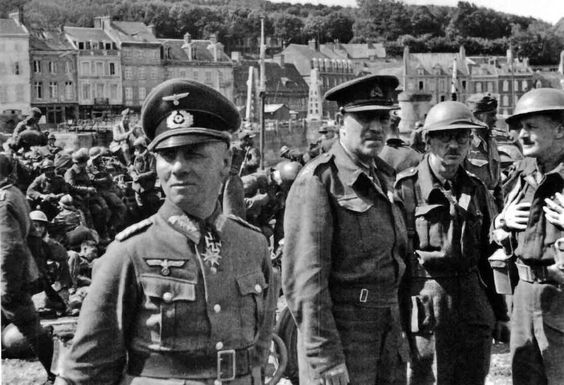
The situation is darkening rapidly for the Allies on 12 June 1940. General Weygand bows to reality and orders a general withdrawal.
After a last stand, the outflanked 51st Highland Division and French 9th Army Corps surrendered to Rommel at Saint-Valery-en-Caux. After a brilliant defense, especially by the British General Fortune’s 51st Infantry Division, the garrison at Saint-Valery-en-Caux surrenders. The Germans take 40,000 prisoners, of which 10,000 are British and 12 generals. Rommel’s 7th Panzer “Ghost” Division captures the remaining 40,000 or so Allied troops of the 51st (Highland) Division and French IX Corps at St.Valery-en-Caux, north of Le Havre (the British officially admit to losing 6,000 of their soldiers there). The blow to the Allies is greater than at Dunkirk, with no corresponding salve of a propaganda victory. There are RAF patrols over the area that accomplish little.
The greatest number of troops were removed from Le Havre on the night of 12/13 June and the evacuation was completed by dawn; of the 11,059 British troops evacuated, 9,000 men of A Brigade of the Beauman Division were taken to Cherbourg and the 154th Infantry Brigade sailed via Cherbourg to England. A “small flotilla of ships” in the early morning light takes off about 3,000 Allied soldiers, but that is it. It is one of Rommel’s greatest if least publicized victories.
German 6th Army and 9th Army push across the Marne near La Ferte and Chateau Thierry.
German tanks under Guderian crossed the Marne River at Chalons-sur-Marne, 80 miles east of Paris, France. Chalons-sur-Marne falls to Guderian during his continued rapid advance.
The deficiencies of the hedgehog defense of the Weygand Line are coming into sharp relief, as once the crust is penetrated, there are no mobile reserves to stop the attacking spearheads. The panzers are crossing the Langres plateau in the Champagne sector.
Germany occupies Rheims and Rouen.
The French ‘Havas News Agency’ reported on the military situation: “The enemy is continuing his grand efforts to force a swift decision. The German Luftwaffe has bombed French airfields and connections leading to Paris. French aircraft have bombed various German industrial cities and also took parts in the battles in France.”
The Supreme Allied War Council meeting at Briare concludes. The French are promising to keep their fleet out of German hands. Otherwise, not much is accomplished, but the lines on the map showing the front continue getting readjusted closer.
Churchill and the British delegation return to London.
General Brooke arrives Cherbourg to take command of British troops in France.
A final tranche of soldiers sailing from Narvik reaches the Clyde. The French are immediately transshipped to Brest and Lorient in the south of France.
BR.20s of the Regia Aeronautica bombed the southern French cities of Toulon, Hyères and Saint-Raphaël, as well as the Corsican communes of Calvi and Bastia and the Tunisian city of Bizerte. Not much damage was done, however, as French anti-aircraft fire kept the warplanes from attacking effectively.
Britain replied swiftly to Italy’s declaration of war today with RAF and SAAF bombers striking at Italian aircraft on the ground, petrol depots and ammunition dumps in Libya and East Africa. The Italians were caught by surprise, according to official sources, and only light anti-aircraft fire was met. The RAF claimed that the raids had crippled Italy’s striking power in the Middle East.
The British and Italians engage in skirmishes along the Egyptian/Libyan border. The British take 62 Italian prisoners.
A British cruiser squadron bombards Tobruk. The Italian fleet sorties to defend the port, but the British withdraw. The attack is only marginally successful, with Italian cruiser San Giorgio in the harbor surviving the attack.
The Italian government temporarily bans the Vatican’s newspaper, Osservatore Romano, for publishing British and French war communique.
Meanwhile, in the French capital, U.S. Ambassador William Bullitt, the last ambassador of a major nation left in the city, was named the provisional governor of Paris as the French government moved to Tours.
Friedrich-Wilhelm Müller was awarded the Iron Cross 2nd Class medal.
Britain ordered a complete blockade of Italy
Under British pressure, Cairo severs diplomatic relations with Italy.
Turkey broke off commercial relations with Italy.
British transports of Group II arrived in the Clyde, Scotland at 2300 hours with troops evacuated from Narvik, Norway. The French troops evacuated were later sent to Brest and Lorient to join the fight against the invading German forces.
The Commander-in-Chief of Home Defense of the United Kingdom Edmond Ironside completed a plan for defense against a potential German invasion.
Sir Stafford Cripps arrives in Moscow to take up his appointment as ambassador from Britain.
The Soviet Baltic Fleet received orders to blockade Estonia.This is part of a planned invasion of Estonia and Lithuania.
The Soviets issue an ultimatum to Lithuania demanding territory and the establishment of a new government.
RAF Fighter Command patrols over Le Havre.
RAF Bomber Command dispatches aircraft to attack German troops and lines of communication during the day. On 13 June, the RAF made a maximum effort to help the French armies that had been broken through on the Marne. The Germans were across the Seine in the west and the French armies near Paris fell back, dividing the Tenth Army, part on the channel coast and the rest retiring towards Paris. The German advance threatened the airfields of the AASF, which was ordered to retreat towards Nantes or Bordeaux, while supporting the French armies for as long as they kept fighting. The AASF flew armed reconnaissance sorties over the Seine from dawn and German columns were attacked by a force of 10 Battles, then a second formation of 15 Battles and then 15 Blenheims. On the Marne, 12 Battles attacked a concentration of German troops and tanks, followed by an attack by 26 Battles, which lost six shot down and then a third attack by 15 Blenheims from Bomber Command that lost another four. RAF attacks continued through the night, with 44 sorties over the Seine, 20 north of Paris, 41 on the Marne and 59 against road and rail communications and against woods reported by the French to be full of German troops. Fighter sorties had been hampered by bad weather and were limited to coastal patrols
RAF Bomber Command dispatches 29 aircraft to attack various targets overnight.
RAF bombers unsuccessfully attack Italian cruiser San Giorgio and shipping in Tobruk harbor.
Italian bombers again attack British base at Aden.
Italian aircraft bomb 1st King’s African Rifles outpost at Moyale, Kenya.
Bombs were dropped on the port of Valetta on the island of Malta in the second of two more air raids last night. Heavy anti-aircraft fire was heard. There have now been eight air raids on this important British naval base in the Mediterranean.
HMS Ark Royal, having entered a storm from at noon on the 11th, turns Eastward and takes up a course for Trondheim. Word having arrived that the German capital ships that sank Glorious, Acasta, and Ardent, including both Scharnhorst and Gneisenau, as well as a Hipper class cruiser are in Trondheim and, on orders from CinC Home Fleet, Vice-Admiral Air Wells plans to strike them.
However, unlike the April operation that sank Konigsberg in Bergen, this operation has little chance of coming off by surprise. First, in April there the day was roughly half light and half-darkness, so the attackers could arrive under the cover of darkness and attack at dawn. Second, Bergen Harbour is located fairly close to the North Sea coasts, so the attackers had to spend little time over land before the attackers struck. Finally, Bergen is not located near an operation airfield.
Trondheim will be a much tougher nut to crack. First, at this latitude, June contains virtually 24 hours of daylight. Second, the main harbor where the warships were anchored is some 45 miles from the coastline. Finally, Trondheim was home to the largest airfield in Norway, on which were stationed numerous single-engine and twin-engined fighters within only a few miles of the warship anchorage.
Recognizing these problems, the powers that be had come up with a three pronged attack plane. First, the new Beaufort torpedo-bombers of Coastal Command’s 22 Squadron, RAF, would make a low level attack on Vaernes airfield to keep the German fighters grounded before the attack unfolded. Second, Blenheim fighters of 254 Squadron, RAF would rendezvous with the Fleet Air Arm strike force over Ark Royal, and then provide fighter cover over the harbor itself. Finally, while the Blenheims distracted any Luftwaffe fighters that did get in the air, the Skua striking force of 800 and 803 Squadrons, FAA would execute a dive-bombing attack on the warships and then high-tail it for the ship.
In its original form, the plan had called the Swordfish torpedo bombers of 810 and 820 Squadrons to launch torpedo attack on the German warships simultaneous to the dive-bombing attack. However, the weather was simply not cooperating. The Southeasterly wind was stiff enough to severely hamper the ground speed of the Swordfish. This, combined with the nearness of the German fighter forces was such that all involved realized is was a suicidal option. Thus, the final plan called for the dive-bombing attack alone.
Exactly what their lordships actually hoped to accomplish is unclear.
The largest bombs that the Skua could carry (and the largest bombs Ark Royal’s ordnance magazines contained) was the 500 pound Semi-Armour Piercing (SAP) bomb which, even with the added impetus of the diving aircraft could not generate enough velocity to penetrate the armour decks of the primary targets, the two German battleships.
Certainly these facts were recognized by Commander Flying, Commander F. M. Stephenson, RN when he summoned each of the squadron commanders, Lt.Cdr. J. Casson, RN (803) and Capt. R. T. Partridge, RM (800), to separate interviews with Vice-Admiral L. V. Wells CB, DSO, RN where he gave each “the word.”. It would be an understatement to say that both were less than enthusiastic about the mission’s chances.
Partridge, although junior to Casson, was by now perhaps the most experienced dive-bomber pilot in the Royal Navy. He recalled bluntly that his first reaction was one “Whoever thought this one up must be absolutely bonkers, I’m not going and neither are any of my Squadron!”.
But, of course, he could not and did not. However, he took great pains to ensure that no one was mistakenly comparing this operation to the April Bergen mission. He pointed out that the key to success then, a surprise dawn attack [see above], simply would not happen here. Later, he found that Casson had, prophetically, predicted 50% losses.
However, to coin a phrase, “Theirs not to reason why, theirs but to do and die”, both set to work on the mission details and the briefings necessary for the crews involved. For this one, both agreed that only the crews with the most dive-bomber experience, regardless of seniority or assignment, should participate. Limited by the available flight deck to space to fifteen aircraft, they ultimately settled on a composition of nine Skuas in three sections from of 803 Squadron, and six in two sections from 800.
Meanwhile, around 1600, Ark broke out of the weather front and, at 1630, launched a fighter patrol of three Skuas from 800 Squadron, led by Lt. G. R. Callingham, RN. While none of the pilots was slated to fly the attack, in the event the section observer, PO(A) W. Crawford would. Later that evening, at 2230, a second patrol went up, this time with just two Skuas. While they orbited the carrier, the fifteen Skuas of the striking force were brought up and spotted. The crews manned there aircraft shortly before midnight for what would be, save one, the closing act of the Norwegian Campaign.
At 0200, Italian heavy cruisers Zara, Fiume, and Gorizia of the 1st Cruiser Division and light cruisers Abruzzi and Garibaldi of the 8th Cruiser Division with destroyers Alfieri, Carducci, Gioberti, and Oriani of the 9th Destroyer Division and Da Recco, Usodimare, and Pessagno (Tarigo did not sail) of the 16th Destroyer Division departed Taranto to patrol in the Ionian Sea while two other destroyer divisions operated between Sicily and Malta. During the operations of Cruiser Divisions 1 and 8, British submarines made five attacks on these ships without causing any damage. HMS Orpheus sighted three cruisers escorted by destroyers southeast of Syracuse, but was unable to attack. In three sweeps by destroyers and one by torpedo boats, submarine HMS Odin was sunk on the 13th.
Italian submarine Bagnolini sank light cruiser HMS Calypso (Captain H. A. Rowley) southwest of Crete in 33 45N, 24 32E at about 0200. One officer, Lt A. W. Whitfield RNR, and thirty-eight ratings were lost. Light cruiser HMS Caledon and destroyer HMS Dainty in company picked up the twenty four officers and three hundred and ninety four rating survivors and took them to Alexandria.
Italian submarine Nereide torpedoed and badly damaged Norwegian tanker Orkanger (8029grt), en route from Suez to Malta, in 31 42N, 28 50E at 0503. Italian submarine Naiade then torpedoed and sank her at 2157. Four crew were killed.
Early on the 12th, Italian submarine Micca laid mines off Alexandria.
Aircraft carrier HMS Argus departed Gibraltar to join heavy cruisers HMS Shropshire, HMS Cumberland, and HMS Dorsetshire with convoy US.3. She was given local protection by destroyers HMS Velox and HMS Watchman and French aircraft. The destroyers arrived back at Gibraltar on the 12th.
The French Raiding Force departed Mers el Kebir in response to a rumor that German battleships Scharnhorst and Gneisenau were preparing to enter the Mediterranean through Gibraltar. French light cruisers Marseillaise, La Galissonniere, and Jean De Vienne and destroyers Brestois and Boulonnais were operating together when they were attacked by Italian submarine Dandolo on the 13th. The torpedo fired passed between Jean De Vienne and La Galisonniere.
British cruisers steering west were sighted by Italian aircraft south of Crete. Italian cruisers Bolzano, Pola, and Trento of the 3rd Cruiser Division and destroyers Artigliere, Camicia Nera, Aviere, and Geniere of the 11th Destroyer Division and Lanciere, Carabiniere, Corazziere, and Ascari of the 12th Destroyer Division were sent to investigate, but no contact was made.
Light cruisers HMS Liverpool and HMS Gloucester supported by aircraft carrier HMS Eagle aircraft, sank small Italian gunboat Giovanni Berta off Tobruk at 0400 off Tobruk in an action with Italian gunboats Palmaiola, Grazioli, Lante, and Giovanni Berta and coastal defense ship San Giorgio. San Giorgio was damaged by air bombing from British 202 Squadron which was operating in conjunction with the British ships.
Light cruisers HMS Orion and HMAS Sydney were sweeping off Benghazi at dawn on the 12th.
Italian steamer Romolo (9780grt) departed Brisbane on the 5th. Australian armed merchant cruiser HMAS Manoora intercepted her in Torres Strait, and she scuttled herself at 1915/12th.
Battlecruiser HMS Hood and Canadian destroyers HMCS Restigouche, HMCS St Laurent, and HMCS Skeena departed Liverpool for US.3 convoy escort duty.
Destroyers HMS Fortune and HMS Foresight joined convoy FN.94, escorted by destroyer HMS Woolston, as far as Outer Dowsing. The two destroyers then proceeded to the Humber for stores. Sloop HMS Fleetwood joined the convoy when the destroyers were detached. HMS Fortune and HMS Foresight then proceeded to patrol between Smith’s Knoll and Outer Gabbard.
Convoy “Hebrew” departed Scapa Flow at 0600 with British steamers Dromore Castle (5242grt), Rutland (1437grt), Heron (2374grt), Lombardy (3379grt), Cyprian Prince (1988grt), and St Clair (1637grt), tanker Invershannon (9154grt), and French steamers Alberte Le Borge (3921grt), Paul Emile Javary (2471grt), and Vulcain (4362grt). The convoy was escorted by destroyers HMS Atherstone and HMS Encounter and anti-submarine trawlers HMS Le Tigre (516grt) and HMS Leicester City (422grt).
On the 12th, destroyers HMS Viscount, HMS Wolverine, HMS Vanoc, HMS Witherington, and HMS Whirlwind departed Sullom Voe at 0200 to relieve the escort north east of Cape Wrath. French steamers Armenier (914grt) and British steamer Nailsea Lass (4289grt) joined the convoy off Stornoway on the 13th. These two steamers had to be escorted independently by destroyer Witherington. The convoy and Nailsea Lass arrived at Greenock at 0630/14th. Witherington and steamer Armenier arrived at Greenock at 0915.
Submarine HMS Narwhal laid minefield FD.19 in 56-26N, 5-10E at 2119. She then patrolled off Utsire to intercept German transports. Norwegian steamer Jaederen (908grt) was lost on this minefield and German patrol boat NB 15 (trawler Biene (178grt) damaged on 16 August. Norwegian fishing trawler Arild (128grt) was sunk on this minefield on 26 August. German auxiliary minesweepers (former Norwegian fishing vessels) Gnom 7 (50grt), Kobold 1 (50grt), and Kobold 3 (50grt) were sunk on 13 October.
French submarine Saphir torpedoes and sinks Italian freighter Alicantino off Sardinia.
French light cruiser Emile Bertin departed Brest, escorted by destroyer Gerfaut for Halifax. She arrived on the 18th with 300 tons of gold, but the gold was not disembarked.
Light cruiser HMS Cardiff departed Dover at 1235 to cover the evacuation near St Valery en Caux.
Steamer Baron Saltoun (3404grt) was sunk in mining in the outer roads of Cherbourg. One crewman was lost.
Steamer Train Ferry No. 6 (2678grt), after damage from shore batteries, was beached and abandoned at St Valery en Caux. Two crewmen were killed and twelve were missing.
Steamers Swallow (209grt) and Innisulva (264grt) were beached and abandoned in the River Seine in Paris. There was a crew of five on the Innisulva; one crewman survived and was made a prisoner. She was later salved by German forces and used under that name for German service. There was a crew of six on the Swallow. These were all saved. She was also later salved by German forces and renamed Schwable.
French auxiliary sloop Cerons was sunk by German gunfire off Fecamp/Veule des Roses.
French auxiliary minesweeper Granville (511grt) was sunk by German shore guns off St Valery/Fecamp.
Steamers St Briac (2312grt), Amsterdam (4220grt), Tynwald (2376grt), Theems (553grt), and Emerald (736grt) departed St Valery for Cherbourg during the night of 12 / 13 June with 4000 troops, including the rear guard. Steamer Lowick (586grt) carried the beach party. They were escorted by destroyers HMS Fernie and HMS Vega.
Steamer Roebuck (776grt) was damaged by German gunfire off St Valery.
French auxiliary patrol vessel Etienne Rimbert (197grt) was scuttled at Dieppe.
Minesweeping trawler HMS Sisapon (326grt, Temporary Skipper F. A. Henson RNR), minesweeping with minesweeping trawler HMS Lord Irwin, was sunk on a mine near Cork Light Vessel, Harwich. Henson, Probationary Temporary S/Lt W. T. McCalla, ten ratings were lost in the trawler.
Tug Twente (239grt) was lost in mining in the North Sea.
Belgian steamer Yvonne (668grt) was lost in mining two miles north of Goodwin Knoll Buoy. Ten crew were killed, and two rescued.
Dutch coastal steamer Prinses Juliana (198grt) was sunk on a mine 1½ cables 50° from Beacon Training Bank, Poole. Two crewmen were killed.
U-46, commanded by Oberleutnant zur See Engelbert Endrass, sank British steamers Barbara Marie (4223grt, at 1938 hours) and Willowbank (5041grt, at 1946 hours) of convoy SL.34 in 44 16N, 13 54W. At 1938 hours, U-46 fired a stern torpedo at a ship in convoy SL-34 about 220 miles west-northwest of Cape Finisterre and missed the intended target, but hit the Barbara Marie that broke in two and sank. At 1946 hours, another torpedo was fired which hit the forward part of Willowbank and caused the ship to sink by the bow. Thirty two crewmen were lost on Barbara Marie, but the entire crew of Willowbank was rescued. Sloop HMS Leith, escorting SL.34B and steamer Swedru (4124grt) from convoy SL.34B, rescued survivors on the 14th. The 4,223-ton Barbara Marie was carrying iron ore and was headed for Workington, England. The 5,041-ton Willowbank was carrying maize and was also headed for Workington, England.
U-101, commanded by Kapitänleutnant Fritz Frauenheim, sank British steamer Earlspark (5250grt) of convoy OG.33F in 42 26N, 11 33W at 1208 hours. Earlspark (Master Evan James Williams) was hit underneath the bridge by one G7e torpedo from U-101 and sank northwest of Cape Finisterre. The master and six crew members were lost. 31 crew members were picked up by HMS Enchantress (L 56) (Cdr A.K. Scott-Moncrieff, RN). The 5,250-ton Earlspark was carrying coal and was headed for Bordeaux, France.
U-38 landed an agent on the Irish coast.
Convoy FN.194 departed Southend, escorted by destroyer HMS Woolston. Sloop HMS Fleetwood was to have been in the escort, but was not ready. She was ordered to depart when ready and overtake the convoy. The convoy was joined by destroyers HMS Fortune and HMS Foresight as far as Outer Dowsing when the destroyers proceeded to the Humber. The convoy arrived in the Tyne on the 14th.
Convoy MT.87 escorted by destroyer HMS Valorous and armed patrol yacht HMS Breda departed Methil. The convoy arrived in the Tyne the next day.
Convoy FS.193 departed the Tyne, escorted by destroyer HMS Vimiera and sloop HMS Londonderry. The convoy arrived at Southend on the 14th.
The War at Sea, Wednesday, 12 June 1940 (naval-history.net)
At 0200, Italian heavy cruisers ZARA, FIUME, and GORIZIA of the 1st Cruiser Division and light cruisers ABRUZZI and GARIBALDI of the 8th Cruiser Division with destroyers ALFIERI, CARDUCCI, GIOBERTI, and ORIANI of the 9th Destroyer Division and DA RECCO, USODIMARE, and PESSAGNO (TARIGO did not sail) of the 16th Destroyer Division departed Taranto to patrol in the Ionian Sea while two other destroyer divisions operated between Sicily and Malta.
During the operations of Cruiser Divisions 1 and 8, British submarines made five attacks on these ships without causing any damage. ORPHEUS sighted three cruisers escorted by destroyers southeast of Syracuse, but was unable to attack. In three sweeps by destroyers and one by torpedo boats, submarine ODIN was sunk on the 13th.
Italian submarine BAGNOLINI sank light cruiser CALYPSO (Captain H. A. Rowley) southwest of Crete in 33‑45N, 24‑32E at about 0200. One officer, Lt A. W. Whitfield RNR, and thirty-eight ratings were lost. Light cruiser CALEDON and destroyer DAINTY in company picked up the twenty-four officers and three hundred and ninety-four rating survivors and took them to Alexandria.
Italian submarine NEREIDE torpedoed and badly damaged Norwegian tanker ORKANGER (8029grt), en route from Suez to Malta, in 31‑42N, 28‑50E at 0503. Italian submarine NAIADE then torpedoed and sank her at 2157. Four crew were killed.
Early on the 12th, Italian submarine MICCA laid mines off Alexandria.
Light cruiser DELHI departed Gibraltar to patrol off the Canary Islands. On termination of patrol, she was to proceed to Dakar for refueling and join the South Atlantic Station.
Aircraft carrier ARGUS departed Gibraltar to join heavy cruisers SHROPSHIRE, CUMBERLAND, and DORSETSHIRE with convoy US.3. She was given local protection by destroyers VELOX and WATCHMAN and French aircraft. The destroyers arrived back at Gibraltar on the 12th.
French destroyer FLEURET departed Toulon. She passed Gibraltar on the 14th and arrived at Casablanca on the 15th.
New Zealand light cruiser LEANDER departed Port Sudan, and arrived at Aden on the 13th.
The French Raiding Force departed Mer El Kebir in response to a rumor that German battleships SCHARNHORST and GNEISENAU were preparing to enter the Mediterranean through Gibraltar. French light cruisers MARSEILLAISE, LA GALISSONNIERE, and JEAN DE VIENNE and destroyers BRESTOIS and BOULONNAIS were operating together when they were attacked by Italian submarine DANDOLO on the 13th. The torpedo fired passed between JEAN DE VIENNE and LA GALISONNIERE.
British cruisers steering west were sighted by Italian aircraft south of Crete. Italian cruisers BOLZANO, POLA, and TRENTO of the 3rd Cruiser Division and destroyers ARTIGLIERE, CAMICIA NERA, AVIERE, and GENIERE of the 11th Destroyer Division and LANCIERE, CARABINIERE, CORAZZIERE, and ASCARI of the 12th Destroyer Division were sent to investigate, but no contact was made.
Light cruisers LIVERPOOL and GLOUCESTER supported by aircraft carrier EAGLE aircraft, sank small Italian gunboat GIOVANNI BERTA off Tobruk at 0400 off Tobruk in an action with Italian gunboats PALMAIOLA, GRAZIOLI, LANTE, and GIOVANNI BERTA and coastal defense ship SAN GIORGIO.
SAN GIORGIO was damaged by air bombing from British 202 Squadron which was operating in conjunction with the British ships.
Light cruisers ORION and HMAS SYDNEY were sweeping off Benghazi at dawn on the 12th.
Italian steamer ROMOLO (9780grt) departed Brisbane on the 5th. Australian armed merchant cruiser HMAS MANOORA intercepted her in Torres Strait, and she scuttled herself at 1915/12th.
Destroyer INTREPID arrived in the Humber.
Battlecruiser HOOD and Canadian destroyers HMCS RESTIGOUCHE, HMCS ST LAURENT, and HMCS SKEENA departed Liverpool for US.3 convoy escort duty.
Light cruiser SOUTHAMPTON arrived in the Clyde.
Destroyer VOLUNTEER departed Scapa Flow for Devonport.
Destroyer FORESTER departed Scapa Flow to rendezvous with destroyers VETERAN, CAMPBELL, and MASHONA, which departed Sullom Voe at 0400/13th, in 63N on the 13th.
Destroyers FORTUNE and FORESIGHT joined convoy FN.94, escorted by destroyer WOOLSTON, as far as Outer Dowsing. The two destroyers then proceeded to the Humber for stores. Sloop FLEETWOOD joined the convoy when the destroyers were detached. FORTUNE and FORESIGHT then proceeded to patrol between Smith’s Knoll and Outer Gabbard.
Destroyer HAMBLEDON and steamer KYLE FISHER (520grt) arrived in the Clyde.
Destroyers HIGHLANDER and ASHANTI arrived at Scapa Flow at 1600 to refuel. HIGHLANDER departed Scapa Flow at 2200 for Plymouth to join the Commander in Chief, Western Approaches. En route, she was detached to assist damaged armed merchant cruiser SCOTSTOUN on the 13th.
Destroyer AMAZON departed Sullom Voe at 1700 for Scapa Flow where she arrived at 0500/13th.
Destroyer ATHERSTONE arrived at Scapa Flow at 1645.
Destroyer ENCOUNTER arrived at Scapa Flow at 1745.
Minelayer PORT QUEBEC escorted by sloop LOWESTOFT departed Tees for Rosyth where they arrived that day.
Convoy “Hebrew” departed Scapa Flow at 0600 with British steamers DROMORE CASTLE (5242grt), RUTLAND (1437grt), HERON (2374grt), LOMBARDY (3379grt), CYPRIAN PRINCE (1988grt), ST CLAIR (1637grt), tanker INVERSHANNON (9154grt), French steamers ALBERTE LE BORGE (3921grt), PAUL EMILE JAVARY (2471grt), and VULCAIN (4362grt). The convoy was escorted by destroyers ATHERSTONE and ENCOUNTER and anti-submarine trawlers LE TIGRE (516grt) and LEICESTER CITY (422grt) .
On the 12th, destroyers VISCOUNT, WOLVERINE, VANOC, WITHERINGTON, and WHIRLWIND departed Sullom Voe at 0200 to relieve the escort northeast of Cape Wrath.
French steamers ARMENIER (914grt) and British steamer NAILSEA LASS (4289grt) joined the convoy off Stornoway on the 13th.
These two steamers had to be escorted independently by destroyer WITHERINGTON. The convoy and NAILSEA LASS arrived at Greenock at 0630/14th. WITHERINGTON and steamer ARMENIER arrived at Greenock at 0915.
French tanker TARN departed the Clyde for Brest.
Submarine NARWHAL laid minefield FD.19 in 56-26N, 5-10E at 2119. She then patrolled off Utsire to intercept German transports. Norwegian steamer JAEDEREN (908grt) was lost on this minefield and German patrol boat NB 15 (trawler BIENE (178grt) damaged on 16 August. Norwegian fishing trawler ARILD (128grt) was sunk on this minefield on 26 August. German auxiliary minesweepers (former Norwegian fishing vessels) GNOM 7 (50grt), KOBOLD 1 (50grt), and KOBOLD 3 (50grt) were sunk on 13 October.
Submarines TAKU and TRIAD arrived at Rosyth after patrol.
Submarines H.31 and H.28 with submarine tender WHITE BEAR were exercising off Blyth.
Submarines TRUANT and TRIDENT were exercising in the Forth of Forth.
Submarine THAMES arrived at Campbeltown.
French submarine RUBIS arrived at Dundee after minelaying operation FD.17.
French light cruiser EMILE BERTIN departed Brest, escorted by destroyer GERFAUT for Halifax. She arrived on the 18th with 300 tons of gold, but the gold was not disembarked.
Light cruiser CARDIFF departed Dover at 1235 to cover the evacuation near St Valery en Caux.
Convoy FN.194 departed Southend, escorted by destroyer WOOLSTON. Sloop FLEETWOOD was to have been in the escort, but was not ready. She was ordered to departed when ready and overtake the convoy. The convoy was joined by destroyers FORTUNE and FORESIGHT as far as Outer Dowsing when the destroyers proceeded to the Humber. The convoy arrived in the Tyne on the 14th.
Convoy MT.87 escorted by destroyer VALOROUS and armed patrol yacht BREDA departed Methil. The convoy arrived in the Tyne the next day.
Convoy FS.193 departed the Tyne, escorted by destroyer VIMIERA and sloop LONDONDERRY. The convoy arrived at Southend on the 14th.
Early on the 12th, Trinity House Vessel PATRICIA, covered by anti-submarine trawler GRIMSBY TOWN was lifting buoys B to H between the indicator loops and the deep minefield.
Trinity House Vessel STRATHEARN, escorted by anti-submarine trawler KINGSTON GALENA, replaced the Lydd Light Vessel with a float.
Steamers BAHARISTAN (5479grt) and FLORISTAN (5478grt) departed Falmouth for Brest.
Steamer BARON SALTOUN (3404grt) was sunk in mining in the outer roads of Cherbourg. One crewman was lost.
Steamer TRAIN FERRY No. 6 (2678grt), after damage from shore batteries, was beached and abandoned at St Valery en Caux. Two crew were killed and twelve were missing.
Steamers SWALLOW (209grt) and INNISULVA (264grt) were beached and abandoned in the River Seine in Paris. There was a crew of five on the INNISULVA; one crewman survived and was made a prisoner. She was later salved by German forces and used under that name for German service. There was a crew of six on the SWALLOW. These were all saved. She was also later salved by German forces and renamed SCHWABLE.
French auxiliary sloop CERONS was sunk by German gunfire off Fecamp/Veule des Roses.
French auxiliary minesweeper GRANVILLE (511grt) was sunk by German shore guns off St Valery/Fecamp.
Steamers ST BRIAC (2312grt), AMSTERDAM (4220grt), TYNWALD (2376grt), THEEMS (553grt), and EMERALD (736grt) departed St Valery for Cherbourg during the night of 12 / 13 June with 4000 troops, including the rear guard. Steamer LOWICK (586grt) carried the beach party. They were escorted by destroyers FERNIE and VEGA.
Steamer ROEBUCK (776grt) was damaged by German gunfire off St Valery.
French auxiliary patrol vessel ETIENNE RIMBERT (197grt) was scuttled at Dieppe.
Minesweeping trawler SISAPON (326grt, Temporary Skipper F. A. Henson RNR), minesweeping with minesweeping trawler LORD IRWIN, was sunk on a mine near Cork Light Vessel, Harwich. Henson, Probationary Temporary S/Lt W. T. McCalla, ten ratings were lost in the trawler.
Tug TWENTE (239grt) was lost in mining in the North Sea.
Belgian steamer YVONNE (668grt) was lost in mining two miles north of Goodwin Knoll Buoy. Ten crew were killed, and two rescued.
Dutch coastal steamer PRINSES JULIANA (198grt) was sunk on a mine 1½ cables 50° from Beacon Training Bank, Poole. Two crew were killed.
U-46 sank British steamers BARBARA MARIE (4223grt) and WILLOWBANK (5041grt) of convoy SL.34 in 44‑16N, 13‑54W. Thirty-two crew were missing on BARBARA MARIE, but the entire crew of WILLOWBANK was rescued. Sloop LEITH, escorting SL.34B and steamer SWEDRU (4124grt) from convoy SL.34B, rescued survivors on the 14th.
U-101 sank British steamer EARLSPARK (5250grt) of convoy OG.33F in 42‑26N, 11‑33W. There were four dead and three missing.
U-38 landed an agent on the Irish coast.
In Washington, President Roosevelt conferred on various phases of the defense program with Senator Walsh, chairman of the Senate Naval Affairs Committee, and Representative Vinson, chairman of the House Naval Affairs Committee; Jesse Jones, Federal Loan Administrator, and Sidney Hillman, labor member of the Advisory Defense Commission.
The Senate considered the relief bill, defeating an amendment providing military training for the Civilian Conservation Corps, received the Downey resolution to create a Senatorial coordination committee to advise the President while Congress is not in session, heard Senators Holt, Nye, Wheeler and others criticize the Administration’s foreign policy and recessed at 5:23 PM until noon tomorrow.
The House passed the $1,706,053,908 supplemental National Defense Appropriation Bill, approved the conference report on the bill reorganizing naval construction bureaus and adjourned at 5:50 PM until noon tomorrow.
President Roosevelt’s order for “full speed ahead” on aid to the Allies and complete rearmament at home showed results today in the release of eighty more Army attack bombers. The War Department told the White House it was making “excellent progress” in finding more surplus war materials for exchange and resale to the British and French. A brief announcement by Stephen T. Early, White House secretary, included the further information that by turning over government-owned machinery to private munitions makers the department was increasing its store of vital military supplies. These were described in blanket fashion as “sizable quantities” of smokeless powder, ammonia and small arms ammunition.
With the Administration already in the role of non-belligerent supporters of the Allies, the legislative and executive branches were competing for first place in the preparedness drive. The House passed and sent to the Senate a $1,706,053,508 supplemental defense appropriation providing for 3,000 more airplanes and an increase of 95,000 enlisted men for the Regular Army. Last of the President’s emergency defense requests, the measure provided for $1,381,917,147 of actual outlay and contractual authority of $324,136,761, thereby exceeding the President’s national defense estimate by $319,731,898.
Meanwhile, the Navy Department announced that contracts had been signed and work allotted for two 45,000-ton battleships and twenty other warships and auxiliaries within an hour after President Roosevelt signed the $1,308,171,000 Naval Appropriations Bill. Acting Secretary Compton said thirteen of the vessels, including the two superdreadnaughts, would be built in eight Navy yards. The other nine ships will be constructed in private shipbuilding plants.
With authority already in hand to place the naval building program on a twenty-four hour basis, the President went over plans for full time operation in Navy yards and arsenals. He discussed with Chairmen Walsh and Vinson of the Senate and House Naval Affairs Committees this idea, as well as new legislation to make him the arbiter of overtime disputes that may arise under the speed-up program. Although no voice was raised in protest against specific White House proposals on national defense, a division among Senate Democrats over what they construed as the Administration’s war policy flared into the open in Congress as Senator Wheeler threatened to bolt the Democratic party if it became the “war party.”
Voting 401 to 1, the U.S. House of Representatives quickly approved today an extraordinary $1,706,053,908 bill providing funds for 3,000 new planes, 68 warships, 95,000 additional men for the army, a far-flung system of naval air bases and other defense measures. Last of a series of big defense appropriations to start through congress, the measure went to the senate with only Moscow-leaning Representative Marcantonio, of New York dissenting. It raises the session’s total defense program to $5,021,619,622. It finances training 87,000 civilian air pilots under the civil aeronautics authority, and primary, secondary and “refresher” training for old pilots. The bill also provides an unspecified number of tanks and other mechanized equipment.
Administration forces in the legislative and executive branches kept up their drive today to push the Defense Finance Bill through Congress with record speed, in time for Congress to adjourn June 22.
A group of senators angrily assailed what they termed steps in the direction of war. “Every move is being made to take us down the road to war,” Senator Wheeler, Montana Democrat, thundered on the senate floor. “We have seen this country led away from neutrality to non-belligerency,” said Senator Holt West Virginia Democrat, “and if certain individuals in the government have their way we will strike out the ‘non’ and be belligerent before the snow flies.” Wheeler also asserted should the Democratic Party become a “war party,” he would unhesitatingly “break with it.”
The Chicago Tribune in a dispatch tonight from its Washington correspondent said William C. Bullitt, American ambassador to France, has advised the state department that France is considering conclusion of a separate peace with Adolf Hitler. Bullitt reported that only one man stands in the way of surrender on the grounds that further resistance against Nazi mechanized death is hopeless. He is Paul Reynaud, premier of France, who replaced Edouard Daladier last March, Reynaud was called to take the helm of the French state in the hope that he would press the war and still the mounting anti-war sentiment in France. At a recent meeting of his cabinet as the Germans neared Paris. Bullitt reported, Reynaud found that he alone favored continuance of the struggle. His colleagues voted to abandon their ally, Britain, and make the best peace possible. Further resistance, the army general staff is said to have agreed, is without a hope of success, because France cannot manufacture the defensive arms she needs or hope to get them from Britain or the United States in time to make a decisive stand. The general staff’s stand was taken before Italy’s entrance into the war and the information has been in President Roosevelt’s hands for several days, it was learned.
Dr. Vannevar Bush, president of the Carnegie Institution of Washington, met with U.S. President Franklin D. Roosevelt and proposed the creation of the National Defense Research Committee. Roosevelt agreed with Bush’s proposal. Bush would be appointed the head of the committee on June 15, 1940. The NDRC would officially be created as part of the Council of National Defense, which had been created during 1916 to coordinate industry and resources for national security purposes, by an order of Roosevelt on Junee 27, 1940.
An invitation to join the “new strong powers” and to cooperate with Germany is extended to the United States today by Das Schwarze Korps, organ of the Blackshirt Elite Guard (SS).
Wendell L. Willkie, president of the Commonwealth and Southern Corporation, said today that he considered good his prospects of winning the Republican nomination for President on an early ballot.
Major League Baseball:
The first place Red Sox club veteran Indians’ pitcher Mel Harder for a 9–5 win, handing the Tribe their 8 loss in 13 games. Cleveland’s Ossie Vitt, in lifting Harder, snarls, “It’s about time you won one, the money you’re making.” The criticism, plus the same type of remarks made earlier about Feller, will prompt Harder to request a meeting with Cleveland owner Alva Bradley tomorrow morning in Cleveland.
The Yankees spotted the Tigers a four-run lead yesterday, but they did not find that too inordinate an advantage as they rode to victory on the wings of a three-run homer by Charlie Keller, 7–5, at Yankee Stadium before 10,036.
Thornton Lee, veteran White Sox southpaw, held the Athletics to three hits today but two of them were home runs by Bob Johnson and Sam Chapman which gave the Philadelphians a 3–2 victory.
Ken Chase today broke the Browns’ five-game winning streak — their longest since 1930 — by pitching the Senators to a 3–2 victory. The Washington southpaw walked five, but allowed only six hits and his mates helped him with three double plays. Washington won the game in the seventh as Jimmy Bloodworth led off with a triple to left. Chase fanned, but George Case laid down a beautiful bunt to squeeze Bloodworth home.
Big Paul Derringer hung up his fifth straight victory tonight for the champion Reds, outlasting Kirby Higbe and Si Johnson for a 2–1 decision over the Phillies. Derringer scattered eight hits and walked only one.
The Dodgers held their slight grip on the National League lead tonight by coming from behind to beat Frankie Frisch’s Pirates, 5—4, before a Forbes Field crowd of 20,179. Joe Gallagher’s 8th inning double provides the winning run.
In a sweet trade for Brooklyn, GM Larry MacPhail perfects his outfield and gets one pitcher: Joe Medwick and 37–year-old Curt Davis, a 22–game winner last year, are acquired from the Cardinals for Ernie Koy, pitcher Carl Doyle, minor leaguers Bert Haas and Sam Nahem, and $125,000. Medwick is hitting .338.
Cleveland Indians 5, Boston Red Sox 9
Philadelphia Phillies 1, Cincinnati Reds 2
Detroit Tigers 5, New York Yankees 7
Chicago White Sox 2, Philadelphia Athletics 3
Brooklyn Dodgers 5, Pittsburgh Pirates 4
St. Louis Browns 2, Washington Senators 3
Dutch Princess Juliana and daughters Beatrix and Irene arrive in Canada.
A responsible government source reported tonight that the Mexican Government had requested Arthur Dietrich, chief of the press bureau of the German Legation and a director of German propaganda in Mexico, to leave the country as soon as possible.
Heavy cruiser USS Quincy (CA-39) arrives at Rio de Janeiro, Brazil, for a port visit while she is en route to Montevideo, Uruguay (see 17 June).
The Anglo-Thai Non-Aggression Pact was concluded in Bangkok.
The Japan-Thailand Non-Aggression Pact was announced.
Battle of Tsaoyang-Ichang: Japanese 11th Army captures Ichang. Japanese forces are within 400 miles of the Chinese Nationalist capital, Chungking, after capturing the gateway city of Ichang today. The taking of Ichang – the westernmost city to fall to the Japanese – is the culmination of a three-month campaign by Japan’s China Expeditionary Army to put the Nationalists back on the defensive after their success at Wuyuan and their continuing guerrilla attacks on Japanese units. Japan’s response has been to hit back with a massive invasion of the Nationalist-held provinces in south and west central China. So far the price has been high. In the see-saw battle for Tsaoyang in May the Japanese suffered 45,000 wounded or killed, and they had to pull in reinforcements from Manchukuo before taking Ichang.
The Japanese Air Command today sent 154 bombing planes in four squadrons to Chungking to carry out the year’s most damaging air attack at 1200 hours; Chinese fighters claimed 5 Japanese aircraft shot down. Casualties were estimated at 1,500.
The Tientsin dispute between Japan and Britain, which has caused extreme inconvenience to foreign residents there for almost a year, was definitely settled today.
Dow Jones Industrial Average: 121.46 (+5.49)
Born:
Del Bates, MLB catcher (Philadelphia Phillies), in Seattle, Washington (d. 2009).
Naval Construction:
The Navy Department of the United States placed contracts for 22 new warships, including the Iowa-class battleships USS Missouri (BB-63, Brooklyn Navy Yard) and USS Wisconsin (BB-64, Philadelphia Naval Shipyard).
The Royal Navy Bangor-class (Turbine engined) minesweeper HMS Cromarty (J 09) is laid down by Blyth Shipbuilding & Drydock Co. Ltd. (Blyth, U.K.); completed by Whites M.E.
The Kriegsmarine (German Navy) Type IXC U-boat U-505 is laid down by Deutsche Werft AG, Hamburg (werk 295). She will be captured on 4 June 1944 off Mauritania, French West Africa, in position 21.30N, 19.20W, by the warships of Task Force 22.3. Now on display in Chicago.
The Royal Navy Hunt-class (Type II) escort destroyer HMS Calpe (L 71) is laid down by Swan Hunter and Wigham Richardson Ltd. (Wallsend-on-Tyne, U.K.); completed by Wallsend.
The Nihon Kaigun (Imperial Japanese Navy) destroyer Yūgumo (夕雲, “Evening Clouds”), first of her class of 19, is laid down by the Maizuru Naval Arsenal (Maizuru, Kyoto Prefecture, Japan).
The Kriegsmarine (German Navy) Type VIIC U-boat U-94 is launched by F. Krupp Germaniawerft AG, Kiel (werk 599).
The Royal Navy auxiliary minelayer HMS Port Napier (M 32) is commissioned. Her first and only commanding officer is Captain (retired) John Norman Tait, DSC, RN.
 History Diaries