Hitler, at his Wolfsschlucht headquarters, issues Führer Directive No. 14 regarding war in the West:
The Leader And Supreme Commander Of The Armed Forces.
The Leader’s Headquarters. 8th June, 1940. 5 copies
Directive No. 14
- The enemy is offering stiff resistance on our right flank and in the centre of 6th Army.
- Therefore, according to the proposal of Commander In Chief Army, I approve the orders given this morning by Army Group B, namely: (a) Merely to hold down the enemy on the 6th Army front. (b) To transfer XIV Corps to the left flank Of 4th Army. (c) To strike a crushing blow at the strong enemy forces on the 6th Army front by increasing the pressure exerted by the bulk of 4th Army southeastwards and by the left flank of 6th Army southwestwards.
- I further order: (a) The basic intention, as laid down in Directive No. 13, namely: to destroy enemy forces in the Château-Thierry-Metz-Belfort triangle, and to bring about the collapse of the Maginot Line, remains valid. However, since Phase I of the operation is not yet ended and extremely strong resistance is being offered north of Paris, stronger forces must be employed on the lower Seine and against Paris than had originally been contemplated. (b) Army Group A will move to the attack on 9th June south-southwestwards as ordered in Directive No. 13. (c) 9th Army will thrust southwards towards the Marne. It will be reinforced as soon as possible by XVI Army Corps (including attached SS units and the SS Death’s Head Division). Strong reserve forces must back up the juncture of the two Army Groups. (d) I reserve to myself the decision as to the direction of any further thrust by 9th Army, or whether it is to be left with Army Group B or put under command of Army Group A.
- The task of the Air Force, in addition to what has been laid down in Directive No. 13, is as follows: (a) To support the concentric attack on the flanks of the main enemy forces facing Army Group B. (b) To keep under observation and under strong fighter cover the coast on the right flank of Army Group B and the area southwest of the Bresle sector. (c) To help the advance of Army Group A at the focal point.
(signed) Adolf Hitler.
Once again, on the third day of Fall Rot, the German Army relied on the Luftwaffe to provide decisive assistance in silencing French guns and enabling the German infantry to inch forward. German progress was made only late on the third day of operations, finally forcing crossings. The French Air Force attempted to bomb them, but failed. German sources acknowledged the battle was “hard and costly in lives, the enemy putting up severe resistance, particularly in the woods and tree lines continuing the fight when our troops had pushed passed the point of resistance”. However, south of Abbeville, the French 10th Army under General Robert Altmayer had its front broken and it was forced to retreat to Rouen and south along the Seine river. The rapid German advances were the sign of a weakening enemy.
German 5th and 7th Panzer Divisions reach the Seine River near Rouen. The 5th Panzer Division captured Rouen. To the east, the 14th Panzer Corps broke through at Amiens, but the 16th Panzer Corps continued to be held down in Péronne by hedgehogs manned by troops of the French 7th Army.
Rommel breaks through the British defenses on the Bethune and Andelle rivers, and heads for Elbeuf.
French 10 Army is now cut in two. The left part withdraws towards Le Havre and the right to Pontoise, southwards. This means that the whole of the Seine, between Vernon and its mouth is uncovered.
With French 10th Army irretrievably split apart, divisions of German 4th Army pour through the gap. French 10th Army is in tatters. British 51st (Highland) Division on the coast is bypassed and its lines of communication cut.
Weygand now orders General Duffour, commanding Third Region at Rouen, to organise some sort of local defence. At the same time he turns the Military Government of Paris into the “Army of Paris” which under General Hering, is to hold the Seine from Vernon to Pontoise, and the Oise as far as Boran.
Back on the Somme, XIV Panzer Corps breaks through the French artillery block at Amiens. French 7th Army at Péronne continues to hold 16th Panzer Division to a standstill, which must be extremely frustrating as they watch the breakthrough to Rouen. It is a typical hedgehog campaign, with some strong points holding, but others failing and allowing strong breakthroughs.
The Germans push the French 7 Army south of Amiens back as far as Saint-Just-en-Chaussee. The 7th Army is then ordered to cover the eastern approaches to Paris as far as the river Ourcq.
Destroyers HMS Vesper and HMS Wanderer, which had departed Dover on the 7th, bombarded German targets on the roadway between Abbeville and Treport, east of Dieppe on the 8th, before arriving at Dover later that same day. Light cruiser HMS Cardiff at 1715/8th and Vesper and Wanderer later arrived at Dover to stand by for operations off Dieppe.
The air over the front is full of swirling planes. Captain Wuillame of Groupe de Chasse (Fighter Group) I/2 is flying a Morane-Saulnier MS406. He claims three Bf 109E fighters in only 15 seconds over the Somme sector. Despite this victory, the lack of adequate French air cover is becoming a major problem for the Allied ground forces.
French bombers attack factories near Berlin before dawn.
The Germans executed the naval offensive in Norway codenamed Operation Juno.
Operation Alphabet ended with the completion of the Allied evacuation from Norway. Last British troops leave Narvik, Norway. The Allies conclude their evacuation of troops from Narvik and Harstad, taking off a final tranche of 24,000 men. Before departing, they render the port facilities useless to the Germans until repaired — which they soon are.
French and Polish troops left dummies on the front lines to trick their German foes and fell back into Narvik, Norway for evacuation. British Group II troop transports took on the final 4,600 Allied troops and departed Narvik, escorted by carrier HMS Ark Royal, cruisers HMS Southampton and HMS Coventry, and 11 destroyers. German aircraft conducted nearly continuous attacks on the convoy, while German troops on land quickly realized the situation and moved into Narvik again. There are still Norwegian troops in the area, but they have no Allied support whatsoever and are out-matched by the Wehrmacht troops.
Mobile Naval Base Ship HMS Mashobra, bombed and badly damaged by German bombing on 25 May and ran aground to prevent sinking, was scuttled to prevent her capture near Harstad.
Tanker Oleander (7048grt), bombed and badly damaged by German bombing on 26 May and ran aground to prevent sinking near Harstad, was scuttled to prevent her capture.
At 0045, with the Royal Navy carriers in position 70.05N, 15.52E, the RAF fighters began taking off Bardufoss landing ground: 10 Gladiator IIs of 263 Squadron and 7 Hurricane Is of 46 Squadron.
RAF No. 46 and No. 263 Squadrons evacuate Bardufoss, landing fighters aboard RN aircraft carrier Glorious.
At 0100, Ark launched a relief fighter patrol for Narvik, two 803 Squadron Skuas (OC-Lt.Cdr. J. Casson, RN). Fifteen minutes later, the RAF fighters were sighted. With little ado, Glorious again worked up to full speed and the 17 RAF fighters landed aboard as if the entire effort was simply routine. Following behind the Swordfish guides and a 701 Squadron Walrus which landed aboard with several important communications. Its mission accomplished, it took off for Ark Royal at 0207, the last aircraft to takeoff the ill-fated Glorious.
At 0130, two further two-plane patrols from 803 departed for Risoy and Bardufoss (Lt. C. H. Filmer, RN and S-Lt. J. R. Callander, RN) as well as a relief A.D.A. patrol. At 0300 two three-plane patrols were sent over the transports at Reisen and Risoy (803, Lt. C. W. Peever, RN, and 800, Lt. G. R. Callingham, RN). These were followed at 0515 by another six 800 Squadron Skuas (Lts. G. E. D. Finch-Noyes, RN and K. V. V. Spurway, RN) and another A.D.A patrol. This later patrol reported the embarkation at Reisen complete.
Meanwhile, at 0253, having requested and received permission for his ship to return forthwith to Scapa Flow to for the purpose of making preparations for impending courts martial, Capt, Guy D’Oyly-Hughes DSO+bar, DSC, RN ordered Glorious and her two attendant destroyers, HMS Acasta (Cdr. Charles Galsfurd, RN) and HMS Ardent (Lt.Cdr. J. F. Barker, RN) to set a course westward towards home.
Meanwhile, back on Ark, the next fighter patrol (three Skuas, Lt. D. C. E. F. Gibson, RN, 803) left for Risoy at 0805. This was the first patrol to actually sight an enemy aircraft, chasing off an He-111 that escaped into the low clouds. This was followed by an A.D.A. patrol at 0815. At 1000, in response to the sighting of a snooper from the bridge, a pair of 803 Squadron Skuas was led aloft by Lt. C. H. Filmer, RN, but they were unable to locate it.
Word having been received that the embarkation was complete, Ark now shifted her air cover to the retiring transports. Three-plane Fighter patrols were sent aloft at 1050, 1330, 1515, 1715, and 1915. By that point, Ark Royal had closed with the convoy such that her A.D.A. patrols could cover both forces. The days flying ended at 2205 with a two Swordfish A.D.A. patrol.
British Troopship Group I and battleship HMS Valiant and her destroyers rendezvoused at 0100, and Valiant remained with the convoy until it was west of the Faroes. Valiant and her destroyers then left Group I and picked up Group II on the 10th. The convoy was continually bombed. Valiant remained with Group II until they reached 59N, and then proceeded to Scapa Flow. Group I arrived in the Clyde at 0600/10th with her escorts of repair ship HMS Vindictive and destroyers HMS Viscount, HMS Witherington, HMS Wolverine, HMS Antelope and HMS Atherstone. Troopship Georgic went directly to Brest arriving on the 14th to disembark her French troops. Battlecruiser HMS Renown and destroyers HMS Zulu and HMS Kelvin departed Icelandic waters for refueling at Scapa Flow, where they arrived at 0515 and 520, respectively, on the 9th.
Tanker Oil Pioneer (5666grt) and escorting trawler HMS Juniper (Lt Cdr G. S.Grenfell (emcy) of the 19th Anti-Submarine Striking Force, which had departed Tromsø on the 7th were attacked and sunk off Jan Mayen Island in 67 20N, 04 10E by German heavy cruiser Admiral Hipper and the four destroyers of the JUNO operation. The Master and nineteen crew of the tanker were lost. Twenty five survivors from the tanker and four from Juniper were picked up by the German ships. Grenfell, Probationary Temporary Lt R. C. B. A. Daniel RNVR, Probationary Temporary Lt N. L.Smith RNVR, and the rest of the crew of the trawler were lost. Troopship Orama (19,840grt) was also located in 67 44N, 03-52E and sunk by the German ships which had sunk Oil Pioneer and Juniper, but her companion, hospital ship Atlantis, was not molested. Of a crew of 297 men and two gunners, eighteen crewmen were missing and one died of injuries. Admiral Hipper and the four destroyers were then ordered to Trondheim for refueling. Destroyer Steinbrinck arrived at Trondheim on the 10th with one engine operating. The defects were corrected by 10 June.
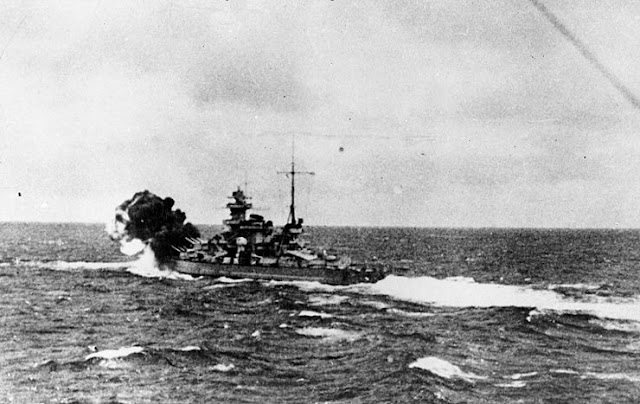
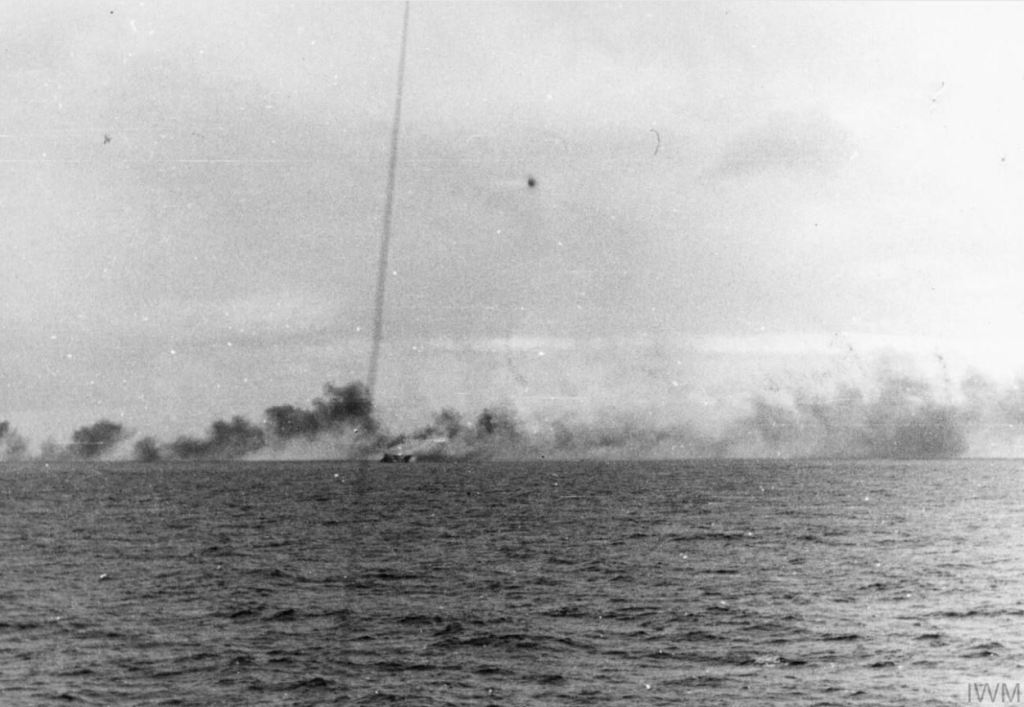
HMS Glorious was sunk by German battlecruisers Scharnhorst and Gneisenau.
German battlecruisers Scharnhorst and Gneisenau encountered aircraft carrier HMS Glorious (Captain G. D’Oyly Hughes) with destroyers HMS Acasta (Cdr C. E. Glasfurd) and HMS Ardent (Lt Cdr J. E. Barker) at 1600 west of the Lofoten Islands in 68 45N, 4 30E. HMS Glorious had been detached from the Narvik evacuation covering force and was proceeding independently to Scapa Flow. All three British ships were sunk west of Narvik, but not before Acasta was able to torpedo Scharnhorst and badly damage her, putting an end to Marschall’s operation. She had her center and starboard engine room flooded, the after turret out of action, and speed reduced to twenty knots. Two officers and forty six ratings were killed. On 11 June, Lt Cdr R. C. O. Hill, FAA Petty Officer Pilot R. T. Leggott of 802 Squadron and officers S/Lt I. V. MacLachlan and Midshipman E. Baldwin of the 823 Squadron, RAF officers Squadron Leader K. B. B. Cross and Flight Lt P. C. Jameson, thirty ratings from Glorious, two ratings from Acasta, a RAF noncommissioned officer were picked up by Norwegian trawler Borgund (303grt) which landed them in the Faroes on the 13th. One Glorious survivor died before arriving, and one Glorious survivor and one Acasta survivor died shortly after arriving. Destroyers HMS Veteran and HMS Forester were detached from the Commander in Chief on the 14th to call at the Faroes on the 16th and pick up these men, taking them to Scapa Flow. Another five ratings, of whom one died, from Glorious were picked up by Norwegian trawler Svalbard 2 (270grt). The trawler returned to Tromsø, arriving on the 14th and was captured by German forces. Two ratings from destroyer Ardent, of whom one died, were picked up by a German seaplane and made prisoners of war. Norwegian steamer Marita (1136grt) picked up five bodies from Glorious on the 10th and landed in the Faroes. One other rating, who soon died, from Ardent was picked up by Faroes fishing boat Rokur. Lost on the three British ships were 1474 officers and ratings of the Royal Navy and 59 RAF personnel.
Early on, Luftwaffe reconnaissance reports that the Allies are evacuating from Harstad. This robs Operation Juno of its strategic impact. Admiral Wilhelm Marschall aboard the Gneisenau, however, decides on his own initiative not to waste the opportunity – Kriegsmarine surface sorties are rare opportunities for aggressive commanders and not to be wasted. He turns the mission into a pure naval raid, disregarding his orders to avoid enemy action.
He has plenty of opportunities. With the Allies pulling out of Narvik, the sea lanes between there and Scapa Flow are crowded with Royal Navy vessels. First, heavy cruiser Admiral Hipper comes upon largely empty troopship HMS Orama, tanker Oil Pioneer and minesweeping trawler Juniper – and dispatches all three. The Orama is a modern (1924) Orient Line passenger liner which had been impressed into Royal Navy service. She goes to the bottom about 300 miles west of Narvik, but thankfully she is not full of troops and only 19 men lose their lives. The Admiral Hipper takes aboard 280 prisoners. To the Admiral Hipper’s credit, there is an accompanying hospital ship, the Atlantis, which has obeyed the rules of war by not radioing its position – and the Admiral Hipper lets her go. After this, Admiral Marschall detaches the Admiral Hipper with a couple of destroyers to make port in Trondheim.
The sinking of the Orama and the others, however, is just the appetizer. Royal Navy aircraft carrier HMS Glorious ((77) Captain Guy D’Oyly-Hughes) leaves Harstad at 03:00 bound for Scapa Flow, accompanied by destroyers HMS Arden and Acasta. Glorious is serving as a transport vessel and has onboard all of the Gladiators and Hawker Hurricanes from Bardufoss and a smaller-than-usual complement of its own planes. The Hurricanes are not equipped for naval landings and their pilots are not trained in operating from carriers, so the planes just get in the way. In fact, D’Oyly-Hughes all stowed all of the planes below decks for some reason despite being in a war zone. This makes aircraft carrier Glorious vulnerable, and D’Oyly-Hughes requests, and receives, permission, to return to Scapa Flow independently at full speed. Much is made of this decision in the critical commentaries on the incident, but during World War II it is a well-regarded theory that the best protection for any ship is speed.
Accompanied by the destroyers, Glorious heads south. D’Oyly-Hughes made some critical mistakes: he failed to keep any aircraft in the air as a constant Combat Air Patrol, and he failed to post any lookouts in his crow’s nest. The former error is somewhat understandable because he only had nine Sea Gladiators and five Swordfish on board (in addition to the land planes); failure to post lookouts, though, smacks of incompetence.
The Scharnhorst and the Gneisenau spot HMS Glorious and her escorts about 180-200 miles west of Norway at around 16:30. Admiral Marschall opens fire at maximum range and incredibly scores a hit on his third salvo with his 11-inch shells at 24 km. Hits at such a range ar devastating because the shells come down almost vertically and plunge through the decks, “plunging fire” is the favorite tactic of the “Battleship Admirals.” This damage, only 6 minutes into the encounter, prevents the Glorious from launching any aircraft and essentially seals her fate.
The two Royal Navy destroyers, Ardent and Acasta, lay smoke and closed on the two pocket battleships. This is a desperate maneuver, and everyone in the Royal Navy has the memory of HMS Glowworm in the back of their minds. The suicide mission pays off in part when one of Acasta’s torpedoes (it launches four) hits the Scharnhorst, causing serious damage and killing 50 German sailors. The destroyers’ 120 mm guns, however, cause little damage on the larger German ships, and both Ardent (151 dead, 2 survivors) and Acasta (161 dead, 1 survivor) soon are on the bottom (the former at 17:50, the latter at 19:20).
The rumble of distant gunfire becomes noticeable in Paris, though the government reassures the populace that is is just nearby anti-aircraft artillery.
French Prime Minister Reynaud instructs General de Gaulle in his new capacity as member of the French cabinet to travel to England to confer with Churchill.
France took drastic action tonight against fifth columnists and spies. Nine spies were sentenced to death and seven received long prison terms. Preparations were made for a mass trial of thirty-three Communists charged with distributing literature.
Increasingly irrelevant in a world at war, the League of Nations lays off 75% of its staff.
The U.S. State Department issues an advisory for U.S. citizens in England and Ireland to depart next week on the liner Washington in order to avoid a possible German invasion.
One of the most drastic passport regulations any British government has ever imposed will become operative Tuesday, when all persons, including British subjects, wishing to leave Ireland for Britain must get special United kingdom visas or travel permit cards.
There is a media blackout in the UK. George Orwell writes, “In the midst of a fearful battle, one has the impression there’s no news.” There is indeed news, but none of it is good for the Allies.
Italian warships conduct further minelaying operations in the Mediterranean.
A pointed warning that five English cities would be bombed for every Italian city attacked by allied bombers should Italy enter the war was published today by the Rome newspaper II Giomale d’Italia. Foreign observers expressed belief Italy would enter the conflict next week.
Rumania, with more than 1,500,000 men already under arms in the greatest peacetime mobilization in her history, called up five more classes of reserves today in a preparedness measure reported to be connected with Italy’s possible entry into the European war.
The Egyptian Government today suddenly sent 6,000 children and aged men and women from Alexandria to the interior as all Italian ships in the Mediterranean were reported to have received orders to return immediately to Italy.
Hungarian public opinion was aroused against the Nazis today because of a bill introduced in Parliament by Koloman Hubay, Hungarian Nazi leader, proposing that all minorities in Hungary receive full autonomy with the right to elect their ministers, local officials and judges.
Sir Samuel Hoare, the new British Ambassador, this morning presented his credentials to Generalissimo Francisco Franco in the former Royal Palace. Many police were stationed in the square in front of the palace.
The text of a letter that Fritz Thyssen, German industrial leader, sent to his employes last Christmas, explaining why he became an exile and calling upon the German people to overthrow Adolf Hitler, was made public yesterday by the American Jewish Congress.
RAF Fighter Command patrols over northern France.
RAF Bomber Command dispatches aircraft to attack German troops and lines of communication.
Polish submarine ORP Orzeł, mined and sunk on 25 May, was declared lost after failing to return from her second Norwegian war patrol. Lt K D’O Nott, a British observer and two British communications ratings were lost with the Polish crew.
Battleship HMS Nelson with destroyers HMS Warwick, HMS Witch, and HMS Amazon arrived in the Clyde at 1115. Amazon departed the Clyde at 1830 for Scapa Flow.
Anti-submarine trawler HMS Stoke City ran around south of Duncansby Head, but was refloated.
Escort destroyer HMS Hambledon was completed. Following working up at Milford Haven, she was attached to the Home Fleet.
British steamer Hardingham (5415grt), detached from convoy FS.89, struck a mine in 51-34N, 01-37E, and sank in 51-39N, 01-40E. Two crewmen were lost.
Swedish steamer Kjell Billner (1106grt) was seized by German forces at Stavanger. She was renamed Helga Schroder for German service. The crew was returned to Gotenburg.
Convoy BC.40 departed Bristol Channel, escorted by anti-submarine trawler HMS Agate. The convoy arrived at Loire on the 10th.
Convoy FN.191 departed Southend, escorted by destroyers HMS Wolfhound and HMS Valorous. The convoy arrived at the Tyne on the 10th.
Convoy HG.33 departed Gibraltar with twenty three ships. Destroyers HMS Douglas and HMS Vidette escorted the convoy from 8 to 10 June. Sloop HMS Aberdeen from convoy OG.32 escorted the convoy from 10 to 17 June. It arrived at Liverpool on the 18th.
Troop convoy US 3 departed Freetown escorted by aircraft carrier HMS Hermes and heavy cruisers HMS Cumberland and HMS Shropshire. Hermes was detached on the 10th and heavy cruiser HMS Dorsetshire accompanied the convoy on 12 to 14 June. US 3 was joined off Gibraltar by battlecruiser HMS Hood, which departed the Clyde on the 12th, aircraft carrier HMS Argus, destroyers HMS Broke, HMS Wanderer, and HMS Westcott, and Canadian destroyers HMCS St Laurent, HMCS Restigouche, and HMCS Skeena which joined Dorsetshire, Cumberland, and Shropshire on the 14th. The fourth Canadian destroyer in Home Waters, HMCS Fraser, had arrived at Plymouth on the 3rd and was repairing defects; she did not return to service until 11 June. Dorsetshire conducted a patrol off the Canary Islands and arrived at Gibraltar on the 16th. On 23 June, she departed for Dakar, changed in view of Armistice to Freetown. On 15 June, the convoy was joined by destroyers HMS Warwick and HMS Witch. On 16 June, the convoy, Cumberland, Shropshire and escorts safely arrived in the Clyde, Shropshire to refit, completing at the beginning of August. From 12 to 16 June, German submarines U-29, U-43, U-46, U-48, and U-101 were involved in an unsuccessful attempt to intercept the convoy.
Light cruiser HMS Delhi arrived at Gibraltar, sailed the next day with important RAF stores, but was recalled to Gibraltar, arriving back on the 11th.
Convoy SL.35 departed Freetown escorted by armed merchant cruiser HMS Dunnottar Castle to 22 June. On that date, destroyer HMS Warwick and corvette HMS Clarkia joined the convoy and escorted it to arrival on the 25th.
The War at Sea, Saturday, 8 June 1940 (naval-history.net)
Mobile Naval Base Ship MASHOBRA, bombed and badly damaged by German bombing on 25 May and ran aground to prevent sinking, was scuttled to prevent her capture near Harstad.
Tanker OLEANDER (7048grt), bombed and badly damaged by German bombing on 26 May and ran aground to prevent sinking near Harstad, was scuttled to prevent her capture.
British Troopship Group I and battleship VALIANT and her destroyers rendezvoused at 0100, and VALIANT remained with the convoy until it was west of the Faroes. VALIANT and her destroyers then left Group I and picked up Group II on the 10th. The convoy was continually bombed. VALIANT remained with Group II until they reached 59N, and then proceeded to Scapa Flow.
Group I arrived in the Clyde at 0600/10th with her escorts of repair ship VINDICTIVE and destroyers VISCOUNT, WITHERINGTON, WOLVERINE, ANTELOPE, and ATHERSTONE. Troopship GEORGIC went directly to Brest arriving on the 14th to disembark her French troops.
Battlecruiser RENOWN and destroyers ZULU and KELVIN departed Icelandic waters for refueling at Scapa Flow, where they arrived at 0515 and 520, respectively, on the 9th.
Tanker OIL PIONEER (5666grt) and escorting trawler JUNIPER (Lt Cdr G. S.Grenfell (emcy) of the 19th Anti-Submarine Striking Force, which had departed Tromsø on the 7th were attacked and sunk off Jan Mayen Island in 67‑20N, 04‑10E by German heavy cruiser ADMIRAL HIPPER and the four destroyers of the JUNO operation. The Master and nineteen crew of the tanker were lost. Twenty-five survivors from the tanker and four from JUNIPER were picked up by the German ships. Grenfell, Probationary Temporary Lt R. C. B. A. Daniel RNVR, Probationary Temporary Lt N. L.Smith RNVR, and the rest of the crew of the trawler were lost.
Troopship ORAMA (19,840grt) was also located in 67‑44N, 03-52E and sunk by the German ships which had sunk OIL PIONEER and JUNIPER, but her companion, hospital ship ATLANTIS, was not molested. Of a crew of 297 men and two gunners, eighteen crew were missing and one died of injuries.
ADMIRAL HIPPER and the four destroyers were then ordered to Trondheim for refueling. Destroyer STEINBRINCK arrived at Trondheim on the 10th with one engine operating. The defects were corrected by 10 June.
German battlecruisers SCHARNHORST and GNEISENAU encountered aircraft carrier GLORIOUS (Captain G. D’Oyly Hughes) with destroyers ACASTA (Cdr C. E. Glasfurd) and ARDENT (Lt Cdr J. E. Barker) at 1600 west of the Lofoten Islands in 68‑45N, 4‑30E. GLORIOUS had been detached from the Narvik evacuation covering force and was proceeding independently to Scapa Flow.
All three British ships were sunk west of Narvik, but not before ACASTA was able to torpedo SCHARNHORST and badly damage her, putting an end to Marschall’s operation. She had her center and starboard engine room flooded, the after turret out of action, and speed reduced to twenty knots. Two officers and forty-six ratings were killed.
On 11 June, Lt Cdr R. C. O. Hill, FAA Petty Officer Pilot R. T. Leggott of 802 Squadron and officers S/Lt I. V. MacLachlan and Midshipman E. Baldwin of the 823 Squadron, RAF officers Squadron Leader K. B. B. Cross and Flight Lt P. C. Jameson, thirty ratings from GLORIOUS, two ratings from ACASTA, a RAF noncommissioned officer were picked up by Norwegian trawler BORGUND (303grt) which landed them in the Faroes on the 13th. One GLORIOUS survivor died before arriving, and one GLORIOUS survivor and one ACASTA survivor died shortly after arriving. Destroyers VETERAN and FORESTER were detached from the Commander in Chief on the 14th to call at the Faroes on the 16th and pick up these men, taking them to Scapa Flow.
Another five ratings, of whom one died, from GLORIOUS were picked up by Norwegian trawler SVALBARD 2 (270grt). The trawler returned to Tromsø, arriving on the 14th and was captured by German forces. Two ratings from destroyer ARDENT, of whom one died, were picked up by a German seaplane and made prisoners of war. Norwegian steamer MARITA (1136grt) picked up five bodies from GLORIOUS on the 10th and landed in the Faroes. One other rating, who soon died, from ARDENT was picked up by Faroes fishing boat ROKUR.
Lost on the three British ships were 1474 officers and ratings of the Royal Navy and 59 RAF personnel:
With GLORIOUS were Captain D’Oyly Hughes, Cdr A E F Lovell, Lt Cdr J R F Newnham, Lt Cdr C H Wells, Lt Cdr R W J Pringle-Nicholson, Lt Cdr W G D Blakeney, Lt Cdr A Malcouronne, Lt Cdr A N R Keene Rtd, Lt Cdr J R de la H Marett Rtd, Lt D V Whinney, Captain M N Humphreys, RM, Temporary Lt H W Brooks RNVR, Probationary Lt G R Gibb RNVR, Probationary Temporary Acting S/Lt T J Earle RNVR, S/Lt H Dann RNVR, Cdr (E) J M Goodman, Lt Cdr (E) D E Smeeton, Lt (E) W H Forbes, Lt (E) C Howlett, Lt (E) A T Noble, Lt (E) R H Woodifield, Probationary Temporary S/Lt (E) P M Blunt RNVR, Probationary Temporary S/Lt (E) D L McIntyre RNVR, Reverend J B King, Instructor Lt G Steel, Surgeon Lt T A M Maunsell, Surgeon Cdr C H Egan, MRCS, LRCP, Surgeon Lt (D) G P Pearse, LDS, Surgeon Lt Cdr H A Lockhart RNVR, Paymaster Cdr C S Bishop, Paymaster Cdr H A Gibbons, Paymaster Lt Cdr C C Elliot, Paymaster S/Lt E J L Wright, Temporary Paymaster S/Lt A G Bailey RNVR, Commissioned Electrician A J Abraham, Gunner E G Meadows, Commissioned Gunner (T) H P Scott, Commissioned Gunner L J Werran, Signal Boatswain C Rogers, Warrant Telegraphist R R Clark, Warrant Engineer A E W Elliott, Warrant Engineer H E E May, Warrant Engineer J H Longman, Warrant Shipwright B B Cole, Warrant Air Mechanic L P Ayres, Acting Warrant Shipwright J H Hoppins, Acting Warrant Engineer F B T Cusse, Warrant Writer R C V C Roberts, Warrant Supply Officer F G Penny, Warrant Supply Officer J L Porter, Acting Boatswain P J Caddy, Schoolmaster H G Hallum, 1086 ratings, 18 RAF pilots of 46 and 263 Squadrons and 41 RAF ground personnel.
Lt Cdr E H P Slessor, Lt Cdr W H Parkin Rtd, Lt Cdr J D Watson, Lt (A) B P Hart, Probationary S/Lt (A) E A Phillips RNVR, of the air staff were lost in GLORIOUS.
Lt J F Marmont (Squadron CO), Lt D N H Ogilvy, Lt N E Ward, Lt G D D’E Lyver, Captain R J W Nott, RM, Captain J R Owens, RM, Lt (A) G H J Feeny, Lt (A) R J B Miles of 802 Squadron, and Lt Cdr C J T Stephens (Squadron CO), Lt J L Hallewell, Lt S F W Hebblethwaite, Lt G Starkey, Lt B J C Wise, S/Lt (A) J H Radclift, S/Lt (A) G P Ritchie, Acting S/Lt (A) J M Franklin, S/Lt (A) J F Shillitoe RNVR, of 823 Squadron were lost in GLORIOUS.
With ACASTA were Cdr Glasfurd, Lt C F S Robinson, Lt S L Haydock, Lt B Pares, Lt (E) F J Boyland, Probationary Temporary Surgeon Lt H J Stammers, MRCS, LRCP, MC, BS RNVR, S/Lt R J D Law, Probationary Temporary S/Lt J H Hide RNVR, Acting Gunner (T) A Sharpe, 152 ratings. One rating survived.
With ARDENT were Lt Cdr Barker, Lt G L de Pury, Temporary Surgeon Lt D H T Duggan, MD, BCH, BAO RNVR, S/Lt D P Robertson, S/Lt G V R Read-Davis, Probationary S/Lt K S Wood RNVR, Commissioned Engineer B G Clynick, Acting Gunner (T) G H Moses, Probationary Midshipman J F Hawkins RNR, 142 ratings. Two ratings, one of whom died in captivity, were rescued.
Polish submarine ORP ORZEŁ, mined and sunk on 25 May, was declared lost after failing to return from her second Norwegian war patrol. Lt K D’O Nott, a British observer and two British communications ratings were lost with the Polish crew.
Battleship NELSON with destroyers WARWICK, WITCH, and AMAZON arrived in the Clyde at 1115. AMAZON departed the Clyde at 1830 for Scapa Flow.
Destroyer INGLEFIELD (D.3) arrived at Scapa Flow at 2215 after refitting at Devonport.
Anti-submarine trawler STOKE CITY ran around south of Duncansby Head, but was refloated.
British steamer CORMINSTER arrived at Scapa Flow from Harstad.
A German submarine was reported by a British aircraft at 0840 in 55-52N, 2-40E.
Escort destroyer HAMBLEDON was completed. Following working up at Milford Haven, she was attached to the Home Fleet.
Swedish steamer KJELL BILLNER (1106grt) was seized by German forces at Stavanger. She was renamed HELGA SCHRODER for German service. The crew were returned to Gotenburg.
Destroyers VESPER and WANDERER, which had departed Dover on the 7th, bombarded German targets on the roadway between Abbeville and Treport, east of Dieppe on the 8th, before arriving at Dover later that same day. Light cruiser CARDIFF at 1715/8th and VESPER and WANDERER later arrived at Dover to stand by for operations off Dieppe.
British steamer HARDINGHAM (5415grt), detached from convoy FS.89, struck a mine in 51-34N, 01-37E, and sank in 51-39N, 01-40E. Two crew were lost.
Convoy BC.40 departed Bristol Channel, escorted by anti-submarine trawler AGATE. The convoy arrived at Loire on the 10th.
Convoy FN.191 departed Southend, escorted by destroyers WOLFHOUND and VALOROUS. The convoy arrived at the Tyne on the 10th.
Convoy HG.33 departed Gibraltar with twenty-three ships. Destroyers DOUGLAS and VIDETTE escorted the convoy from 8 to 10 June. Sloop ABERDEEN from convoy OG.32 escorted the convoy from 10 to 17 June. It arrived at Liverpool on the 18th.
Troop convoy US 3 departed Freetown escorted by aircraft carrier HERMES and heavy cruisers CUMBERLAND and SHROPSHIRE. HERMES was detached on the 10th and heavy cruiser DORSETSHIRE accompanied the convoy on 12 to 14 June.
US 3 was joined off Gibraltar by battlecruiser HOOD, which departed the Clyde on the 12th, aircraft carrier ARGUS, destroyers BROKE, WANDERER, and WESTCOTT, and Canadian destroyers HMCS ST LAURENT, HMCS RESTIGOUCHE, and HMCS SKEENA which joined DORSETSHIRE, CUMBERLAND, and SHROPSHIRE on the 14th. The fourth Canadian destroyer in Home Waters, HMCS FRASER, had arrived at Plymouth on the 3rd and was repairing defects; she did not return to service until 11 June.
DORSETSHIRE conducted a patrol off the Canary Islands and arrived at Gibraltar on the 16th. On 23 June, she departed for Dakar, changed in view of Armistice to Freetown.
On 15 June, the convoy was joined by destroyers WARWICK and WITCH. On 16 June, the convoy, CUMBERLAND, SHROPSHIRE and escorts safely arrived in the Clyde, SHROPSHIRE to refit, completing at the beginning of August.
From 12 to 16 June, U-29, U-43, U-46, U-48, and U-101 were involved in an unsuccessful attempt to intercept the convoy.
Light cruiser DELHI arrived at Gibraltar, sailed the next day with important RAF stores, but was recalled to Gibraltar, arriving back on the 11th.
Convoy SL.35 departed Freetown escorted by armed merchant cruiser DUNNOTTAR CASTLE to 22 June. On that date, destroyer WARWICK and corvette CLARKIA joined the convoy and escorted it to arrival on the 25th.
The Ways and Means Committee voted today to report a $1,004,000,000 supplementary tax measure to finance extra defense expenditures President Roosevelt has proposed. At the same time, the committee planned for legislation imposing excess profits taxes to prevent the creation of “war millionaires.” Representative Doughton of North Carolina, chairman of the committee, gave out that portion of the report dealing with excess profits taxes and stressed its importance. The paragraphs, which had the approval of the entire committee, according to the chairman, read as follows:
“During the executive sessions there have been discussions to provide special amortization for national defense industries and to provide for the imposition of excess profits taxes. These two measures — each in itself requiring a complicated and exhaustive legislative project — must be considered together.
“It is the desire of this committee, which is favorably reporting a bill which will enable a larger proportion of our citizens to participate in the responsibility of providing an adequate national defense than has ever been the case before, that there shall not be an opportunity for the creation of war millionaires or the further substantial enrichment of already wealthy persons because of the rearmament program.
“Accordingly, we have instructed our technical assistants and the appropriate Treasury officials to accelerate their work in these two fields so that bills will be prepared for submission not later than the opening of the next session of Congress which, if passed by the Congress, may become retroactive and apply to income earned during the calendar year of 1940 or may become upon any other date which the Congress, in the light of the information it then possesses, may deem advisable.”
An overwhelming majority of American men of military age — 86% — are prepared to volunteer for the defense of this country if it should ever be attacked, a new survey by the American Institute of Public Opinion has revealed, according to Dr. George Gallup, its director.
Despite talk of a possible deadlock over the selection of a Presidential nominee, the committee on arrangements for the Republican National Convention has made tentative provisions for only a five-day meeting in Philadelphia.
The “overwhelming” sentiment throughout the nation for the granting of all possible aid, short of war, to the Allies precludes any possibility that an isolation plank will be included in the Republican platform adopted at the national convention, Wendell L. Willkie, utilities executive, said yesterday.
The Republican leaders for the last month have been trying to doubleshush the isolationists who want to wave the flag in the platform, to denounce the President’s foreign policy, and to write a declaration that will stop aid in any form to the Allies.
Governor Lloyd C. Stark of Missouri said yesterday that there had been a great reversal of popular sentiment recently in the Middle West and that the people of that section were overwhelmingly in favor of adequate preparation for the national defense.
Representative Joseph W. Martin, Republican leader of the House, in a radio address broadcast tonight over the Columbia network, warned against “hysterical” spending for national defense nd stated his belief that Congress should remain in session during the present critical period.
Secretary of State Hull, who has several times disclaimed interest in running for the Presidency, declared in a letter made public today he considers himself “out of politics.”
Senator Thomas, chairman of the Senate Labor Committee, said today that it would be “virtually impossible” for the Senate to act on the amendments to the Wagner Labor Relations Act if Congress adjourned on June 22, as leaders have planned.
Miss Harriet Elliott, appointed to the National Defense Commission by President Roosevelt as the representative of consumers, promised the country’s housewives today that food prices would be watched against undue rising and that standards of living would be protected during the emergency period.
About 100 heavily armed attack planes, especially designed to harass enemy troops from low altitudes, have earmarked by the War Department for possible fighting in France, under the Administration’s “trade-in” arrangement for Army and Navy planes.
Minority stock interests of the Pan American Petroleum and Transport Company won a major victory in the State Supreme Court yesterday in an accounting and damage suit against the Standard Oil Company of Indiana, majority stockholder. The plaintiffs estimated that $50,000,000 to $70,000,000 was involved in the damages.
Bus Driver Jay P. Pilchcr, 39, of Flagstaff, Arizona, died in a hospital today of a fractured skull a few hours after a fight with men police identified as members of the Brotherhood of Railroad Trainmen, which is striking against Pacific Greyhound lines. Booked on suspicion of murder were four striking drivers, W. W. Cadle, 43, Huntington Park; George Bisbee, 39, B. M. Boeppler, 36, and H. P. McElreath, 33, all of Los Angeles.
The discovery of element 93, neptunium (symbol Np), a decay product of uranium-239, was announced by Edwin M. McMillan and Philip H. Abelson working at the University of California at Berkeley. Neptunium was named after the planet Neptune and, at the time, was the first element heavier than uranium. The second such element, number 94, will be far more fateful for the world.
The motion picture “Brother Orchid” is released in the U.S.
72nd Belmont: Fred A. Smith aboard Bimelech wins in 2:29.6, finishing half a length ahead of Your Chance.
Major League Baseball:
Tall Johnny Gorsica chalked up his first major league victory today as his Tiger teammates thumped the Red Sox for the second successive day, 4–2. Hank Greenberg provided the winning runs with an eighth-inning homer.
Al Milnar pitches a two-hitter as the Indians shut out the Yankees, 3–0. Milnar struck out four and walked two. The Yankees never got a runner as far as second base. Beau Bell homered for the tribe.
Roy Cullenbine, who was traded to St. Louis by Brooklyn because he wasn’t hitting, drove in six runs today with a homer and double to lead the Browns to a 15–1 victory over the Athletics behind Elden Auker’s five-hit pitching.
The White Sox clung to fifth place today, trampling Washington, 12–6. Chicago took a 9–0 lead before the Senators produced three runs in the seventh, another in the eighth and two in the ninth.
At Cincinnati, reliever Carl Doyle of the Dodgers gives up 16 hits and 14 runs in just 4 innings, as the Reds pound out 27 hits in a 23–2 win, regaining 1st place. Cincy is paced by Harry Craft, who hits for the cycle, scores 4 runs and drives in 7. Craft does not bat in the 1st or the 9th but goes to the plate in the 2nd through the 8th. Results: double, triple, single, home run, hit-by-pitch, walk, single. Teammate Frank McCormick scores 5 runs. Doyle also manages to throw 2 wild pitches and hit 4 Cincinnati batters in the game to help set a bitter tone to the Cincinnati-Dodgers rivalry, which will continue through the decade. Doyle won’t be around though as Brooklyn ships him to the Cards in four days. His 4 hit batsmen ties an National League record. However, the loser is Fred Fitzsimmons (4–1).
The Giants swept a doubleheader from the Cardinals, winning 4–2 and 5–2. Walter Brown made key relief appearances in both games to quell Cardinal rallies.
Although outhit, twelve to eight, the Pirates beat the Phillies 6–5, today, for their fourth consecutive victory. Vince DiMaggio scored the winning run on a sacrifice fly in thhe seventh inning.
Vern Olsen, freshman southpaw, pitched and batted Chicago to a 3–1 victory over the Boston Bees today, giving the Cubs their fifth straight triumph. Olsen allowed eight hits but only Chet Ross’ solo homer generated a run.
Detroit Tigers 4, Boston Red Sox 2
Boston Bees 1, Chicago Cubs 3
Brooklyn Dodgers 2, Cincinnati Reds 23
Cleveland Indians 3, New York Yankees 0
St. Louis Browns 15, Philadelphia Athletics 1
Philadelphia Phillies 5, Pittsburgh Pirates 6
New York Giants 4, St. Louis Cardinals 2
New York Giants 5, St. Louis Cardinals 2
Chicago White Sox 12, Washington Senators 6
An Argentine Ministry of War communique announced tonight that four persons had been arrested today after an armed attack on an ammunition dump in a suburb of Buenos Aires.
Japanese envoys to the nations of North America, Central America and Northern South America will meet in Washington, starting June 18, to discuss the improvement of trade between those countries and Japan, an official of the Japanese Embassy said today.
Sir Keith Murdoch, a newspaper magnate, becomes the Australian Minister of Information.
Dow Jones Industrial Average: 115.36 (-0.31)
Born:
Nancy Sinatra, American singer (“These Boots Are Made for Walkin’”; “Something Stupid”), and daughter of Frank Sinatra, in Jersey City, New Jersey.
Sherman Garnes, American rock vocalist (Frankie Lymon & The Teenagers), born in New York, New York (d. 1977).
Dave Crossan, NFL center (Washington Redskins), in Philadelphia, Pennsylvania.
Died:
Frederick Converse, 69, American composer (The Pipe of Desire).
Naval Construction:
The Royal Navy “S”-class (Third Group) submarine HMS Satyr (P 214) is laid down by the Scotts Shipbuilding & Engineering Co. (Greenock, Scotland).
The Kriegsmarine (German Navy) Type VIIC U-boats U-571 and U-573 are laid down by Blohm & Voss, Hamburg (werk 547 and 549).
The U.S. Navy Tangier-class seaplane tender USS Pocomoke (AV-9) is launched as C3 merchant ship SS Exchequer by the Moore Dry Dock Co. (Oakland, California, U.S.A.).
The Marine Nationale (French Navy) Aurore-class submarine Créole (Q 193) is launched by Chantiers et Ateliers Augustin Normand, Le Havre (Le Havre, France).
The Nihon Kaigun (Imperial Japanese Navy) Type B1 (I-15-class) submarine I-25 is launched by the Mitsubishi Kobe Yard (Kobe, Japan).
The Kriegsmarine (German Navy) Type VIIC U-boat U-93 is launched by F. Krupp Germaniawerft AG, Kiel (werk 598).
The Royal Navy Hunt-class (Type I) escort destroyer HMS Hambledon (L 37) is commissioned. Her first commanding officer is Commander Stephen Hope Carlill, RN.
 History Diaries