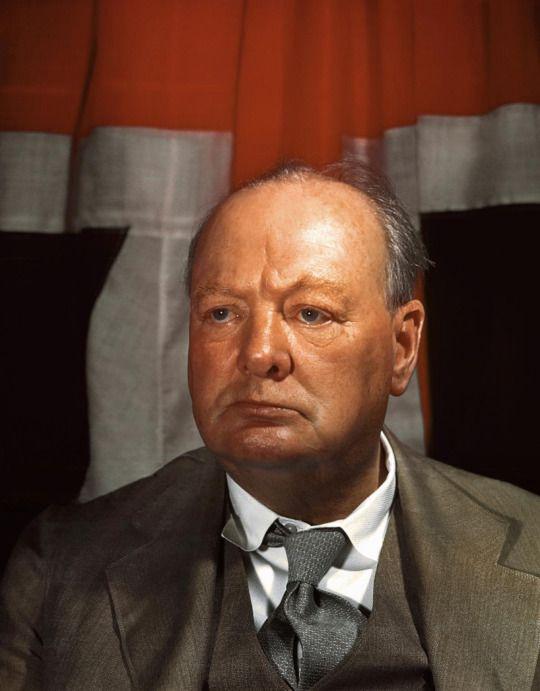
“Turning once again, and this time more generally, to the question of invasion, I would observe that there has never been a period in all these long centuries of which we boast when an absolute guarantee against invasion, still less against serious raids, could have been given to our people. In the days of Napoleon, of which I was speaking just now, the same wind which would have carried his transports across the Channel might have driven away the blockading fleet. There was always the chance, and it is that chance which has excited and befooled the imaginations of many Continental tyrants. Many are the tales that are told. We are assured that novel methods will be adopted, and when we see the originality of malice, the ingenuity of aggression, which our enemy displays, we may certainly prepare ourselves for every kind of novel stratagem and every kind of brutal and treacherous manœuvre. I think that no idea is so outlandish that it should not be considered and viewed with a searching, but at the same time, I hope, with a steady eye. We must never forget the solid assurances of sea power and those which belong to air power if it can be locally exercised.
“I have, myself, full confidence that if all do their duty, if nothing is neglected, and if the best arrangements are made, as they are being made, we shall prove ourselves once more able to defend our island home, to ride out the storm of war, and to outlive the menace of tyranny, if necessary for years, if necessary alone. At any rate, that is what we are going to try to do. That is the resolve of His Majesty’s Government – every man of them. That is the will of Parliament and the nation. The British Empire and the French Republic, linked together in their cause and in their need, will defend to the death their native soil, aiding each other like good comrades to the utmost of their strength.
“Even though large tracts of Europe and many old and famous States have fallen or may fall into the grip of the Gestapo and all the odious apparatus of Nazi rule, we shall not flag or fail. We shall go on to the end. We shall fight in France, we shall fight on the seas and oceans, we shall fight with growing confidence and growing strength in the air, we shall defend our island, whatever the cost may be. We shall fight on the beaches, we shall fight on the landing grounds, we shall fight in the fields and in the streets, we shall fight in the hills; we shall never surrender. And even if, which I do not for a moment believe, this island or a large part of it were subjugated and starving, then our Empire beyond the seas, armed and guarded by the British Fleet, would carry on the struggle, until, in God’s good time, the New World, with all its power and might, steps forth to the rescue and the liberation of the Old.”
The Dunkirk Evacuation ends during the early morning hours. The Battle of Dunkirk ended with the overnight evacuation of 26,175 French troops. At 10:20 a.m. the Germans occupied the city and captured the 30–40,000 remaining French soldiers. 338,226 British and French soldiers were evacuated during Operation DYNAMO. The British and French navies lost at least 80 merchant ships as well as many small vessels. Nine destroyers were sunk. 80 RAF pilots were killed in the operation. At 1020 hours, German troops occupied the city and also captured 2,000 British field guns, and 60,000 British vehicles.
The RAF played an important part in the evacuation and lost 80 pilots KIA and 106 aircraft during the seven days of the evacuation; the Luftwaffe 150 aircraft. Because most of the aerial combat took place above the clouds out of sight of the men at Dunkirk, there was a general feeling among the troops that the RAF had done far less. Churchill set out to make clear their contribution in his speeches.
The Battle of Abbeville ended in German victory. In the Abbeville sector on the Somme River, there is a largely unsuccessful attack by French 2nd Armored Division, French 31st Infantry Division, and British 51st Infantry Division. Both the French divisions were put under command of General Fortune’s 51st Division. They had just moved into the area; indeed, some units of the 31st Division only arrived there an hour and a half before the attack was timed to begin. Reconnaissance on the previous afternoon was consequently sketchy. Few and inadequate air photographs were available and there was but little opportunity to explain to the troops the tasks they were immediately to undertake. Few of the positions held by the enemy’s troops and artillery had been identified, and as no aircraft were there to report enemy movement to the artillery our gunners could only shoot at what seemed to be likely positions for German guns, or for the massing of German troops. The attack was to start at three o’clock in the morning.
On that morning a low summer mist overhung the valley of the lower Somme, shrouding the tanks and troops from distant observation without hampering their movements. Ten minutes before zero hour the quiet of the morning was broken. A barrage, planned to cover the French tank attack in the right center, came down on the woods round Bienfay and Villers where there were known to be enemy posts. After ten minutes the barrage lifted, and though the heavy French tanks did not appear, the 2nd Seaforth set about their task of clearing enemy posts in the forward edge of the woods. In this they succeeded, but when the tanks arrived they had missed the cover of the barrage and as they advanced between the Blangy–Abbeville road and the woods near Villers they came, first, upon an undetected minefield and, shortly after, under heavy fire from field and anti-tank guns well sited and dug in. A number of tanks were blown up or set on fire in the minefield and subsequent casualties from gunfire were severe, but some reached the base of the Mont de Caubert ridge and some Mesnil Trois Foetus, from which they drove the enemy.
The 4th Seaforth Highlanders, meanwhile, who were to follow up the attack supported by light tanks, waited till three of the latter arrived and then went forward on the southeastern side of the Villers woods. They soon came under withering machine-gun fire from Mont de Caubert, but in spite of mounting casualties strove vainly to reach the heavy tanks. Both they and the tanks they sought to reach had shot their bolt. The latter had suffered crippling losses, and when they were ordered to retire to the position held in the morning six out of thirty heavy tanks reported, and only 60 out of 120 of the light tanks.
The 4th Camerons also failed to capture their objective south of Caubert. The whole position was too well covered by dug-in German machine guns. At one point advancing German infantry were encountered and there was hard fighting in the standing corn. Two platoons under Second Lieutenant Ross did indeed succeed in fighting their way into Caubert but they could not be supported and were cut off. (Two days later Ross succeeded in leading his party, most of whom were wounded, back through the enemy’s lines to rejoin at Martainneville le Bus.) The 152nd Brigade had lost 20 officers and 543 other ranks.
Things had gone no better in the left center. They only regiment of the French 31st Division to be employed could make but little progress, being held almost from the start by enemy dug-in in the woods west of Mesnil Trois Foetus.
Only the 153rd Brigade’s attack on the left flank was more successful. There the 1st Black Watch, who were holding the line of the Cahon valley when the attacked opened, pushed forward and established themselves in the Petit Bois to cover the flank of the 1st Gordons. The latter meanwhile issued from Gouy, drove the enemy out of the Grand Bois, and by noon reached the high ground at the eastern side. This was their objective, and heaving done all that they were ordered to do they were yet anxious to go on. But while the high ground overlooking the Somme north-west of Caubert remained in enemy hands, it was impracticable to hold the ground won by the Gordons’ attack, much less to extend it. To their great disappointment they were ordered to give up their gains and return to their starting point.
The bridgehead which the Anglo-French forces had sought to wrest from the enemy in this attack was strong one. The Germans had been holding it for the past fortnight and their troops had had ample time to site their defenses and dig themselves in. The Allied troops had had no opportunity for adequate preparation. The Gordons and their supporting artillery had arranged a system of signals by Very light which worked admirably and was a potent factor in the reduction of German machine-gun positions. But in the rest of the battle no similarly successful cooperation was achieved, and in its absence had much to do with the failure of tanks and infantry to overcome the enemy defense in the center and on the right flank. For the rest, insufficient preparation and consequent faults in the coordination of forces largely account for the failure of the action. But chiefly it was due to the fact that, notwithstanding all that had gone before, the strength of the German bridgeheads was still underestimated.
The Germans immediately re-deploy their forces for an operation south towards Paris. The new attack will be Operation Fall Rot (“Case Red”).
The positions the Allies held when, in the early morning of the 5th, Operation ‘Red’ began and the German divisions assembled on the north of the Somme went over from the defensive to the attack, lay back from the river on a line running from Caumont south of Abbeville to Sallenelle near the sea.[
The French 4th Army Group is formed under command of General Huntziger.
Weygand’s request for twenty RAF fighter squadrons is officially refused.
The refugee crisis is increasing, and it becomes known as L’Éxode (“The Exodus”). Tens of thousands of French citizens inhabiting northern French cities such as Chartres and Lille are heading south, while southern French cities such as Marseilles and Bordeaux are swelling in size.
Approximately 4,900 Allied troops from Narvik area board evacuation vessels at Harstad. First Allied evacuation convoy departs Narvik area with six transports escorted by RN training cruiser Vindictive, arriving Scapa Flow on 8 June.
As a result of a terrific German air bombardment Narvik was destroyed by fire over the weekend, the Norwegian Telegram Bureau announced today.
German Admiral Wilhelm Marschall launched Operation Juno, sending a large naval force for Norway to disrupt the Allied supply lines to Narvik.
For operation JUNO, German forces under Admiral Marschall departed Kiel at 0800 hours to operate off Harstad with battleships Scharnhorst and Gneisenau, heavy cruiser Admiral Hipper, destroyers Lody, Steinbrinck, Schoemann, and Galster. This force was screened through the Kattegat by German torpedo boats Jaguar and Falke, barrage breaker Sperrbrecher 4 (steamer Oakland: 6757grt), tender Hai, and some R boats. The torpedo boats remained with the force through the Skagerrak.
A Convoy, consisting of British steamers Arbroath (553grt), Ngakoa (507grt), and Yewmount (869grt), and Norwegian steamer Marita (1931grt) arrived off Vestfjord, escorted by destroyer HMS Veteran. The convoy was ordered to Tromso, arriving on the 5th, destroyer Veteran was ordered to Harstad.
For the Narvik evacuation, Operation ALPHABET, the aircraft on HMS Ark Royal commenced around the clock operations to cover the fleet during the Norwegian evacuation in the now perpetual daylight of the Arctic. Ark Royal was escorted by destroyers HMS Ardent and HMS Acasta. They were relieved by HMS Diana and HMS Acheron, and aircraft carrier HMS Glorious with destroyer HMS Highlander operated to seaward to support the evacuation.
Destroyers HMS Havelock, HMS Beagle, HMS Campbell, HMS Delight, HMS Echo, HMS Firedrake, HMS Fame, HMS Arrow, HMS Walker, HMS Vanoc, and HMS Veteran operated in an around the Harstad area for the protection of the anchorage and to ferry troops to the troopships.
One hundred and eighty miles from the Norwegian coast, fifteen British troopships went to one of two designated rendezvous. There they were met by anti-aircraft cruiser HMS Coventry and given instructions.
British Group I for the evacuation of Narvik was troopships Monarch Of Bermuda (22,424grt), Batory (14,287grt), Sobieski (11,030grt), Franconia (20,175grt), Lancastria (16,243grt), and Georgic (27,759grt). Destroyers HMS Wren and HMS Volunteer, which had escorted these troopships to Harstad, had been detached and arrived in the Clyde on the 5th. The troopships arrived in turn at Andfjord over the next three nights covered by aircraft from aircraft carrier HMS Ark Royal. On 4 June 4700 troops were embarked, on the 5th 4900 were embarked, on the 6th 5100 troops were embarked on Group I troopships. As the troopships completed embarkation, they were escorted by destroyer HMS Arrow and sloop HMS Stork to the ocean rendezvous where they were met by repair ship HMS Vindictive. When the last ship of Group I arrived at the ocean rendezvous, repair ship Vindictive gave them ocean escort to the Clyde. En route they were joined on the 8th by destroyers HMS Viscount, HMS Witherington, HMS Wolverine, HMS Antelope, and HMS Atherstone which came out from Scapa Flow. The destroyers raised steam to join the convoy at 1800/7th. This was cancelled and status reverted to one hour’s notice until 2300/7th when they departed Scapa Flow.
The London Daily Telegraph reports that measures to oppose the expected air invasion of England, are virtually completed. These include digging trenches through park grounds, sports palaces and fields, and the erection of road barricades. Furthermore, armed patrols have been organized and all road signs and place designations removed.
The United Kingdom banned any recreational camping within 10 miles of the east and southeastern coasts, including the Isle of Wight.
Irish government sets the size of the Irish army at 40,000 officers and men.
The Daily Keynote from the Reich Press Chief [Otto Dietrich]: “The German bomb assault on Paris must be depicted as a military operation that does not violate international law, and the description of its effects must be disseminated as widely as possible via the translating and interpreting service, especially in broadcasts to England and France.” He is referring to the bombing yesterday.
İsmet İnönü, President of Turkey, met with Franz von Papen, German Ambassador to Turkey.
General Andrei Eremenko becomes the leader of the Soviet 3rd Mechanized Corps, while Konstantin Rokossovsky takes over the Soviet 5th Cavalry Corps.
In order to maintain the vital link with North America, British Overseas Airways Corporation commenced a twice-weekly air service between Heston, Middlesex, England, United Kingdom and Lisbon, Portugal, to connect with the scheduled Pan-American Airways New York-Lisbon route.
French l’Armee d’Aire attacked München (Munich) and Frankfurt in Germany in response to the German bombing of Paris, France on the previous day.
RAF Bomber Command dispatches 57 aircraft to attack targets in Germany overnight
RAF 4 Group bombs oil plants at Kamen-Buer and Gelsenkirchen. RAF 58 Squadron sends seven aircraft to Kamen-Buer. All bombed. RAF 77 Squadron sends four aircraft to Gelsenkirchen. Three bombed, one failed to return. RAF 102 Squadron sends six aircraft to Gelsenkirchen, all bombed.
Douglas Bader, while attacking a German Do 17 aircraft, nearly collided with the target.
The Luftwaffe bombs the port of Le Havre.
The French 10th Submarine Flotilla at Dundee with depot ship Jules Verne and submarines Casablanca, Sfax, Sybille, Antiope, Amazone, Thetis, Circe, and Calypso, which had been recalled to Brest for transfer to the Mediterranean, departed Dundee escorted by destroyers HMS Bedouin and HMS Ashanti as far as the Butt of Lewis.
U-8, which departed Wilhelmshaven on patrol on 19 May, was attacked by aircraft in 58-06N, 1-45W. The submarine’s commanding officer was severely wounded.
Battleship HMS Valiant with destroyers HMS Zulu, HMS Maori, and HMS Foxhound departed Scapa Flow for firings west of the Orkneys. The battleship returned to Scapa Flow at 1345 and the destroyers joined heavy cruiser HMS Sussex.
Heavy cruiser HMS Sussex departed Scapa Flow for firings east of the Orkneys. She was joined by destroyers HMS Zulu, HMS Maori, and HMS Foxhound. All three arrived back at Scapa Flow at 1815.
Battleship HMS Resolution departed Scapa Flow at 1312 for Gibraltar escorted by destroyers HMS Wolverine, HMS Witherington, and HMS Viscount. The destroyers escorted the battleship to 13W and then returned to Scapa Flow, arriving at 1501/6th. Destroyer HMS Velox departed Gibraltar on the 5th with convoy HG.33F and joined battleship HMS Resolution on the 8th. On 7 June, destroyer HMS Active departed Gibraltar and met the battleship and destroyer Velox. The ships arrived at Gibraltar on the 10th.
Anti-submarine trawlers HMS Le Tiger and HMS Elm departed Scapa Flow escorting oilers Athelsultan and British Governor to the Clyde and Birkenhead, respectively.
Hospital ship Aba arrived at Scapa Flow from the Narvik area.
Destroyer HMS Keppel departed Gibraltar to act as additional escort for aircraft carrier HMS Argus, which departed Toulon on the 4th and Hyeres on the 5th for Gibraltar. On departing Hyeres, the aircraft carrier flew off her Swordfish of 767 Squadron to Polyvestre for operations. On 17 June, eighteen Swordfish departed Polyvestre for Bone in Algeria. On 20 June, twelve Swordfish flew, via Medjez el Bab in Tunisia for refueling, to Malta, arriving on the 22nd. The remaining Swordfish proceeded to Gibraltar for duty in aircraft carrier HMS Ark Royal. The aircraft carrier arrived at Gibraltar on the 7th, escorted by destroyers HMS Sturdy and HMS Keppel.
Minesweeper HMS Speedwell was damaged in a collision off Dover. The minesweeper was repaired at Devonport from 7 June to 20 June.
German motor torpedo boats attacked Patrol sloops of the 1st Anti-submarine Flotilla near West Hinder early on the 4th.
Italian submarines begin deploying in the Mediterranean. Italian submarine Micca departed La Spezia to lay mines off Alexandria’s approaches on the first night of the war between Italy and England. All submarine minelaying by the Italian Navy during the war netted most insignificant results.
Convoy FN.188 departed Southend, escorted by sloops HMS Londonderry and HMS Egret. The convoy arrived at the Tyne on the 6th.
The War at Sea, Tuesday, 4 June 1940 (naval-history.net)
The French 10th Submarine Flotilla at Dundee with depot ship JULES VERNE and submarines CASABIANCA, SFAX, SYBILLE, ANTIOPE, AMAZONE, THETIS, CIRCE, and CALYPSO, which had been recalled to Brest for transfer to the Mediterranean, departed Dundee escorted by destroyers BEDOUIN and ASHANTI as far as the Butt of Lewis.
U-8, which departed Wilhelmshaven on patrol on 19 May, was attacked by aircraft in 58-06N, 1-45W. The submarine’s commanding officer was severely wounded.
Destroyer ESCORT departed Scapa Flow at 0600 to investigate this contact off Moray Firth.
Destroyer ENCOUNTER was dispatched at 0915.
Destroyers TARTAR and MASHONA departed Scapa Flow at 1300 to join.
Destroyer FORESTER departed Scapa Flow at 1415 and destroyer ELECTRA departed Scapa Flow at 1635.
However, no further contacts were made.
Battleship VALIANT with destroyers ZULU, MAORI, and FOXHOUND departed Scapa Flow for firings west of the Orkneys. The battleship returned to Scapa Flow at 1345 and the destroyers joined heavy cruiser SUSSEX.
Heavy cruiser SUSSEX departed Scapa Flow for firings west of the Orkneys. She was joined by destroyers ZULU, MAORI, and FOXHOUND. All three arrived back at Scapa Flow at 1815.
Battleship RESOLUTION departed Scapa Flow at 1312 for Gibraltar escorted by destroyers WOLVERINE, WITHERINGTON, and VISCOUNT.
The destroyers escorted the battleship to 13W and then returned to Scapa Flow, arriving at 1501/6th.
Destroyer VELOX departed Gibraltar on the 5th with convoy HG.33F and joined battleship RESOLUTION on the 8th.
On 7 June, destroyer ACTIVE departed Gibraltar and met the battleship and destroyer VELOX.
The ships arrived at Gibraltar on the 10th.
Anti-submarine trawlers LE TIGER and ELM departed Scapa Flow escorting oilers ATHELSULTAN and BRITISH GOVERNOR to the Clyde and Birkenhead, respectively.
Hospital ship ABA arrived at Scapa Flow from the Narvik area.
Destroyer KEPPEL departed Gibraltar to act as additional escort for aircraft carrier ARGUS, which departed Toulon on the 4th and Hyeres on the 5th for Gibraltar.
On departing Hyeres, the aircraft carrier flew off her Swordfish of 767 Squadron to Polyvestre for operations. On 17 June, eighteen Swordfish departed Polyvestre for Bone in Algeria. On 20 June, twelve Swordfish flew, via Medjez el Bab in Tunisia for refueling, to Malta, arriving on the 22nd. The remaining Swordfish proceeded to Gibraltar for duty in aircraft carrier ARK ROYAL.
The aircraft carrier arrived at Gibraltar on the 7th, escorted by destroyers STURDY and KEPPEL.
Light cruiser FIJI, which was completed on 17 May 1940, departed the Clyde for working up in the Caribbean.
Cruiser FIJI arrived at Bermuda on the 10th. On completion of her working up, she arrived back at Greenock on 23 July.
For operation JUNO, German forces under Admiral Marschall departed Kiel to operate off Harstad with battleships SCHARNHORST and GNEISENAU, heavy cruiser ADMIRAL HIPPER, destroyers LODY, STEINBRINCK, SCHOEMANN, and GALSTER. This force was screened through the Kattegat by German torpedo boats JAGUAR and FALKE, barrage breaker SPERRBRECHER 4 (steamer OAKLAND: 6757grt), tender HAI, some R boats. The torpedo boats remained with the force through the Skagerrak.
A Convoy, consisting of British steamers ARBROATH (553grt), NGAKOA (507grt), YEWMOUNT (869grt), and Norwegian steamer MARITA (1931grt) arrived off Vestfjord, escorted by destroyer VETERAN. The convoy was ordered to Tromsø, arriving on the 5th, destroyer VETERAN was ordered to Harstad.
For the Narvik evacuation, Operation ALPHABET, aircraft carrier ARK ROYAL with destroyers ARDENT and ACASTA which were relieved by DIANA and ACHERON and aircraft carrier GLORIOUS with destroyer HIGHLANDER operated to seaward to support the evacuation.
Destroyers HAVELOCK, BEAGLE, CAMPBELL, DELIGHT, ECHO, FIREDRAKE, FAME, ARROW, WALKER, VANOC, and VETERAN operated in an around the Harstad area for the protection of the anchorage and to ferry troops to the troopships.
One hundred and eighty miles from the Norwegian coast, fifteen British troopships went to one of two designated rendezvous. There they were met by anti-aircraft cruiser COVENTRY and given instructions.
British Group I for the evacuation of Narvik was troopships MONARCH OF BERMUDA (22,424grt), BATORY (14,287grt), SOBIESKI (11,030grt), FRANCONIA (20,175grt), LANCASTRIA (16,243grt), and GEORGIC (27,759grt).
Destroyers WREN and VOLUNTEER, which had been involved in escorting these troopships to Harstad, had been detached and arrived in the Clyde on the 5th.
The troopships arrived in turn at Andfjord over the next three nights covered by aircraft from aircraft carrier ARK ROYAL.
On 4 June 4700 troops were embarked, on the 5th 4900 were embarked, on the 6th 5100 troops were embarked on Group I troopships.
As the troopships completed embarkation, they were escorted by destroyer ARROW and sloop STORK to the ocean rendezvous where they were met by repair ship VINDICTIVE. When the last ship of Group I arrived at the ocean rendezvous, repair ship VINDICTIVE gave them ocean escort to the Clyde.
En route they were joined on the 8th by destroyers VISCOUNT, WITHERINGTON, WOLVERINE, ANTELOPE, and ATHERSTONE which came out from Scapa Flow. The destroyers raised steam to join the convoy at 1800/7th. This was cancelled and status reverted to one hour’s notice until 2300/7th when they departed Scapa Flow.
Submarines TRIDENT and TRITON arrived at Rosyth after patrol.
Submarine CLYDE departed the Rosyth for patrol off Stadlandet to relived submarine SEVERN on patrol off Stadlandet.
Submarine PORPOISE was docked at Rosyth for repairs to her anti-submarine installation.
Minesweeper SPEEDWELL was damaged in a collision off Dover.
The minesweeper was repaired at Devonport from 7 June to 20 June.
Convoy FN.188 departed Southend, escorted by sloops LONDONDERRY and EGRET. The convoy arrived at the Tyne on the 6th.
German motor torpedo boats attacked Patrol sloops of the 1st Anti-submarine Flotilla near West Hinder early on the 4th.
Italian submarine MICCA departed La Spezia to lay mines off Alexandria’s approaches on the first night of the war between Italy and England.
All submarine minelaying by the Italian Navy during the war netted most insignificant results.
In Washington today, President Roosevelt accepted the resignation of Charles Edison as Secretary of the Navy, conferred with William Green, president of the American Federation of Labor, and with Governor Sam Jones of Louisiana, sent to Congress details of his recommendations for new defense appropriations totaling $1,277,741,170 and the renomination of W. S. Alexander to be head of the Federal Alcohol Administration, signed the Congressional resolution approving the transfer of the Bureau of Immigration and Naturalization from the Labor to the Justice Department, and announced that William S. Knudsen had been given charge of defense activities involving coordination of production of aircraft motors and airplane tools.
The Senate approved the bill for the expansion of the Naval Air Corps and the bill reorganizing the Naval Construction Bureau, considered the conference report on the Army Promotion Bill, returned the War Department Civil Functions Bill to conference, received the Vandenberg resolution to renounce Finland’s June 15 war debt payment and recessed at 6:04 PM until noon tomorrow.
The House approved the conference report on the Navy Appropriation Bill, approved a rule for consideration of amendments to the National Labor Relations Act, sent the War Department Appropriation Bill to conference and adjourned at 6:10 PM until noon tomorrow. The Military Affairs Committee heard General George C. Marshall testify on proposed defense measures and the Ways and Means Committee approved a bill to authorize an increase in the national debt limit and increasing taxes.
The extraordinary U.S. defense tax bill was boosted to around $1,000,000,000 a year today, while the administration pressed forward with its arms program, including the controversial request for authority for President Roosevelt to mobilize the National Guard in an emergency. The tax measure, originally intended to raise about $656,000,000 a year, was revamped by the House Ways and Means Committee in view of recent additions to the defense program. The committee also approved a plan to raise the national debt limit from $45,000,000,000 to $49,000,000,000. The new ceiling would be $1,000,000,000 higher than has been contemplated up to now. A high official asserted that President Roosevelt’s request for power to call out the guard was based upon a possibility that the militiamen might be needed, at short notice, to relieve regular army units who might be sent to emergency trouble spots.
Informed U.S. legislators predicted tonight that Congress, in its quest for funds to finance the defense program, would lower exemptions on this year’s taxable incomes to reach workers whose salaries are not now taxed. Likewise, it was said that those who are paying taxes on incomes in the lower brackets probably would find their 1941 tax bills substantially increased over this year. The House Ways and Means Committee was understood to have considered today proposals to broaden the income tax base. One formula would lower the exemptions of married persons from $2,500 to $1,800 and those for single persons from $1,000 to $800. This would have the effect not only of increasing the number of taxpayers, but of boosting the amount of taxable income for all taxpayers. No decision was reached, however.
Mrs. Dwight W. Morrow, widow of a onetime U.S. senator and ambassador to Mexico, appealed tonight for immediate United States aid to Britain and France “as a matter of self-interest” because, she said, a Nazi victory would mean that “our peaceful way of life will be endangered for a generation at least.” “Short of actually declaring war, she said, “I believe that everything we have which wo could give without impairing our own safety ‘all that is within us’ should go to help them win on the field of battle.” Thus again she differed with her son-in-law, Col. Charles A. Lindbergh, on this country’s policy in the European conflict.
Testimony by U.S. Army Chief of Staff General George C. Marshall before a House committee, delivered for the most part in secret, gave new strength to reports that some undefined trouble was pending in Latin America. Senator Walsh stated on the Senate floor that the Administration was making arrangements for air bases in South America, President Roosevelt and the State Department denied knowledge that any such negotiations were under way.
The ultimate objectives of the national defense program will not be fully realized in less than two years, which is “a long time, especially in an era of blitzkriegen,” said Louis Johnson, Assistant Secretary of War, in an address today before 1,200 business executives at a national defense luncheon.
Secretary Hull, in a letter to Representative Bloom, asserted that traditional policy forbids the transfer of areas in this hemisphere from one European nation to another, but he approved a resolution for a Congressional declaration of policy. This country would even bar the transfer of Greenland to Britain or Canada.
When the Nazis began their invasion of Holland, Belgium and France on May 10, sentiment for a third term for President Roosevelt rose sharply, surveys by the American Institute of Public Opinion have shown, according to Dr. George Gallup, its director. Support for a third term for FDR jumped from 47% to 57% after the German offensive began.
The C.I.O. executive board pledged cooperation on the defense program, and opposed all shades of “isms,” including “black shirts, white shirts and Ku Klux Klan.”
Supporters of the Smith Committee to Investigate the National Labor Relations Board won an easy victory in the House today by the adoption of a rule, 292 to 106, which forces consideration of amendments to the Labor Act. Immediately after this vote the House laid aside the Labor Act amendments to consider the conference report on the Navy Appropriation Bill, but the former legislation will be put before the body again. Thursday under plans to complete consideration then. More than half the Democratic membership joined an almost solid Republican group to adopt the rule, after a preliminary debate which presaged a stiff fight when consideration is resumed.
President Roosevelt accepted today the resignation of Charles Edison as Secretary of the Navy, effective June 24. He congratulated him on his nomination for the Governorship of New Jersey and said he hoped Mr. Edison would be elected.
Edward R. Stettinius Jr. submitted his resignation yesterday as chairman of the board of directors of the United States Steel Corporation, with a salary reputedly $100,000, to serve as a member of the National Defense Commission appointed last week by President Roosevelt.
Six persons were killed and at least eight were missing and believed drowned in a cloudburst that sent a 10-foot wall of water roaring through a Omaha creek in Nebraska.
Major League Baseball:
Extra base hitting by rookies Bob Elliott and Maurice Van Robays behind the five-hit pitching of Joe Bowman tonight helped Pittsburgh to rout the Bees, 14–2 in the first night game at Pittsburgh’s Forbes Field. 20,319 Pirate fans attended.
At Sportsman’s Park, the Cardinals play their first home night game, losing 10–1 to the Dodgers. The Browns lost their 1st home night game at Sportsman’s Park 10 days earlier. Brooklyn scores 5 in the first inning, led by Pete Coscarart’s three-run homer. Ducky Medwick goes 5–for-5 for the Cardinals.
Carl Hubbell won his fifth in a row and the Giants defeated the Reds, 5–4. Reds’ starter Whitey Moore was knocked out by three New York runs in the first inning.
Threatened with a slide into the second division, the Cubs turned on a fifteen-hit attack to defeat the Phils today, 12–6, in their series opener. Stan Hack delivered a double and a triple for the Cubbies.
After spotting Tommy Bridges five runs in the first two innings, the Athletics came back to rout the Detroit pitcher in the fourth and defeat the Tigers, 8–6, today.
The last-place Browns broke a seven-game losing streak by toppling the league-leading Red Sox, 5–3, today when their underhanded-tossing Elden Auker returned to Fenway Park to plague his former teammates.
Red Ruffing’s control was perfect today. He walked not a man and hit virtually every White Sox bat that was waved at him. Big Red yielded three homers, two doubles, six singles and, in his spare time, the ball game as the Chicagoans stopped the Yankee winning streak at four straight with a 7-to-3 victory at Yankee Stadium. Joe Kuhel hit two of the White Sox homers. Joe Smith got the win. Joe DiMaggio hit his sixth home run of the season for the losing Yankees.
The second-place Indians moved within a half game of the league-leading Red Sox today as they split a double-header with the Senators while Boston was losing to the Browns. The Senators won 7–2, then lost the nitecap, 3–2.
St. Louis Browns 5, Boston Red Sox 3
Philadelphia Phillies 6, Chicago Cubs 12
New York Giants 5, Cincinnati Reds 4
Chicago White Sox 7, New York Yankees 3
Detroit Tigers 6, Philadelphia Athletics 8
Boston Bees 2, Pittsburgh Pirates 14
Brooklyn Dodgers 10, St. Louis Cardinals 1
Cleveland Indians 2, Washington Senators 7
Cleveland Indians 3, Washington Senators 2
Canadian Prime Minister W.L. Mackenzie King told an applauding House of Commons today that in the present emergency overseas Canada had placed her military, naval, and air forces at the complete disposal of the British Government.
Battle of Tsaoyang-Ichang: Chinese 5th War Area counterattacks and recovers Nanchang and Yicheng.
Chiang Kai-shek sends representatives to Macau to discuss peace terms with Japanese representatives. There is no progress.
Dow Jones Industrial Average: 115.79 (+1.06)
Born:
Ludwig Schwarz, Roman Catholic bishop, in Most pri Bratislave, Slovak Republic.
Dorothy Rudd Moore, African-American composer (“Songs from the Dark Tower”; “Dirge and Deliverance”), in New Castle, Delaware.
Gerrit Terpstra, Dutch economist and 2nd Chamber member (CDA), in Buitenpost, Netherlands.
Naval Construction:
The Kriegsmarine (German Navy) Type VIIC U-boat U-404 is laid down by Danziger Werft AG, Danzig (werk 105).
The Royal Australian Navy Bathurst-class minesweeper-corvette HMAS Burnie (J 198) is laid down by the Morts Dock & Enginering Co. Ltd. (Sydney, New South Wales, Australia).
The Royal Canadian Navy Flower-class corvette HMCS Shawinigan (K 136) is laid down by George T. Davie & Sons Ltd. (Lauzon, Quebec, Canada).
The Вое́нно-морско́й флот СССР (ВМФ) (Soviet Navy) “ShCh” (ShChuka)-class (6th group, Type X-modified) submarines ShCh-407 and ShCh-408 are launched by A. Marti (Leningrad, U.S.S.R.) / Yard 194.
The Royal Navy Flower-class corvette HMS Peony (K 40) is launched by Harland & Wolff Ltd. (Belfast, Northern Ireland).
The Royal Navy British Power Boat 63-foot motor anti-submarine boat HMS MA/SB 40 is commissioned.
The Royal Navy British Power Boat 63-foot motor anti-submarine boat HMS MA/SB 40 is commissioned.
The Royal Navy Vosper 70-foot motor torpedo boat HMS MTB 70 is commissioned. Her first commanding officer is Lieutenant John Bassett King-Church, RN.
The Royal Navy Flower-class corvette HMS Heartsease (K 15) is commissioned. Her first commanding officer is Lieutenant Commander Edward John Robert North, RNR.
 History Diaries