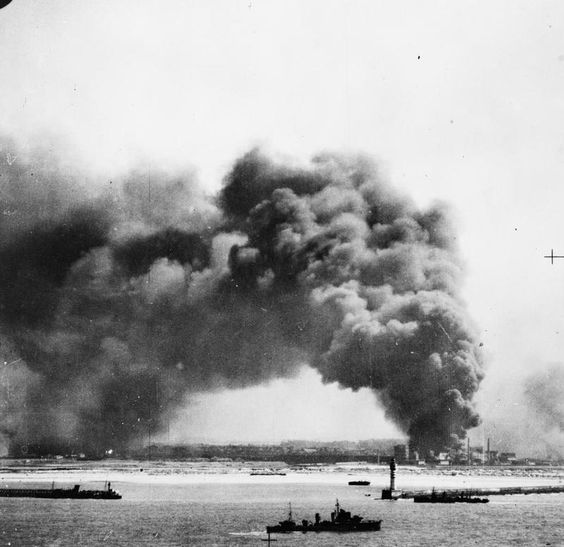
It is the Eighth and Last Full Day of the Dunkirk Evacuation. The last group of British troops at Dunkirk, France was evacuated before the break of dawn. At 1050 hours, Royal Navy Captain William Tennant signaled the completion of Operation DYNAMO, but he was overruled by his superiors as there were still some French troops in Dunkirk. During the day, the British Admiralty acknowledged that 222 British naval vessels and 665 other craft were employed for the Dunkirk evacuation; 6 destroyers, 24 small armed vessels, and 226 other ships were lost. British ships returned to Dunkirk after night fall. By this time, German troops were only 2 miles away. At night, 26,175 men were evacuated. The last ship of Operation Dynamo left at 3:40 a.m. on June 4th. Only 40,000 men remained behind to be captured by the Germans.
There were 26,175 men taken off during the night of 3/4 June, which is about what the Admiralty has been led to believe is the total number of men remaining – but in fact, there are tens of thousands of Allied men more than that. Stragglers appear from basements and under the quays, from every which way, as the front-line troops approach the harbor. Many of the stragglers are in very poor shape, suffering from battle fatigue and PTSD.
The shrinking bridgehead at Dunkirk as of 3 June 1940 has been the focus of most land operations for the past week, but that is rapidly changing. The obvious next move is for the Wehrmacht to head south toward Paris, as the Maginot Line is holding up well – buttressed by the overwhelming majority of French troops sitting idly behind it. French General Georges readies a spoiling attack against the most advanced German positions along the Somme, but his preparations are disorganized and, despite having had several days to prepare, not all of the troops are near their launch points yet.
The Germans launched Operation PAULA, an attempt to destroy the French Air Force. However, British intelligence had warned the French of the impending attack and the operation failed to achieve its strategic goals. The operational phase of Operation Paula was launched by the Luftwaffe. Launched in 3 waves, over 1,000 Luftwaffe aircraft bombed 3 French Air Force bases, 22 train stations, and 15 factories in the Paris area. Operation Paula’s targets were factories in the Paris suburbs its surrounding airfields with the objective of reducing French war production, panic the civilian population, and deliver a knockout blow to the enemy air force all at once. Although the Germans believed that Operation Paula was a resounding success The Germans believed they had struck a mortal blow against the ALA. German post-operation analysis indicated a resounding success with 75 French aircraft being destroyed in the air and 400 on the ground the actual damage was only 15 fighters shot down in aerial combat and 20 French aircraft destroyed on the ground. Six of the 16 airfields hit reported serious damage, while 15 factories reported slight damage. All the French airfields were back in operation 48 hours later. The French shot down 10 German aircraft, including four bombers. French casualties on the ground were heavy. German aerial bombing of Paris killed 45 people. Total French casualties included 254 dead and 652 injured.
The RAF carried out 171 reconnaissance missions, 651 bombing and 2,739 fighter sorties on the last day of Operation Dynamo. During the operation, the RAF lost 177 aircraft, including 106 fighters and the attrition is such that the first-line strength of Fighter Command stood at 331 Hurricanes and Spitfires with only 36 fighters in reserve.
RAF Bomber Command dispatches 18 aircraft to attack German positions around Dunkirk during the day.
RAF Bomber Command dispatches more aircraft to attack German positions around Dunkirk overnight.
Destroyers HMS Esk embarked 611 troops at Dunkirk, HMS Whitshed embarked 444, HMS Venomous embarked 1200, HMS Vanquisher embarked 414, HMS Malcolm embarked 736, HMS Sabre embarked 592, HMS Shikari embarked 383, minesweepers HMS Kellet embarked 30, HMS Albury embarked 400, HMS Halcyon embarked 501, HMS Leda embarked 500, patrol sloop HMS Guillemot embarked 460, and gunboat HMS Locust embarked 196.
Destroyer HMS Esk was damaged by the near miss of a German air bomb at Dunkirk. The destroyer departed Dover at 1300/4th for repairs at Portsmouth completing in eight days.
Destroyer HMS Sabre ran aground leaving Dunkirk and lost her asdic dome. After the operation, destroyer Sabre departed Dover at 1300/4th for repairs at Portsmouth.
Destroyers HMS Malcolm, HMS Venomous, and HMS Vanquisher departed Dover at 1300/4th for repairs at Portsmouth.
Gunboat HMS Locust departed Dover at 1621/4th for Sheerness.
Minesweeper HMS Kellet ran aground at the western breakwater and was too damaged to embark more than thirty troops.
British steamer Royal Daffodil (2060grt) was damaged by German bombing at 0131 off Dunkirk in 51 13N, 02 00E. Steamer Royal Daffodil was further damaged at 0600 in a collision.
British steamer Ben My Chree was damaged in a collision at 0600 as she was setting out for Dunkirk.
Patrol sloop HMS Kingfisher was damaged in a collision with a French fishing vessel at 0014/4th. Sloop Kingfisher had embarked 200 troops at Dunkirk. The troops were transferred to a trawler off Dunkirk. Sloop HMS Kingfisher also collided with British steamer King George V (801grt) at Margate. Patrol sloop Kingfisher was repaired at Lowestoft completing on 8 July.
French Amirals Jean Abrial, Charles Platon, Marcel LeClerc and General Marie B. A. Fagalde departed Dunkirk on French motor torpedo boats VTB.25 and VTB.26 early on the 4th.
French trawler Marechal Foch (103grt) was sunk in a collision with minesweeper HMS Leda off Dunkirk at 0429/4th. Minesweeper Leda sustained damage to her stem. Minesweeper HMS Albury stood by to assist.
French motor torpedo boat VTB.25 damaged her propellers rescuing Marechal Foch’s survivors and was towed to Dover by destroyer HMS Malcolm.
Destroyer HMS Shikari, motor torpedo boat MTB.107, anti-submarine motor boat MA/SB 10 left the Downs with blockships Gourko (1975grt), Moyle (1791grt), and Pacifico (687grt) to complete the Dunkirk channel blocking in Operation CK. En route, blockship Gourko was sunk in a collision with a French personnel ship off Dunkirk and MTB.107 picked up seven crew and MA/SB 10 picked ten. Blockship Pacifico (Lt Cdr G. H.F. Owles in charge of the operation) was sunk in place at 0340/4 June and the port of Dunkirk was blocked. Destroyer Shikari was the last allied ship to leave Dunkirk.
Destroyer HMS Shikari arrived at Dover later on the 4th, but departed at 1140/4th for Portsmouth.
At 0615/4th, French auxiliary minesweeper Emil Deschamps (348grt) was sunk on a mine five miles east, northeast of Foreness, three miles 336°from Elbow Buoy in 51-24N, 1-1-29E, with five hundred French troops from Dunkirk on board. The survivors were picked up by minesweeper HMS Albury and French auxiliary minesweepers Sainte Elisabeth (39grt) and Marie Anne (51grt).
At the completion of DYNAMO, of ninety four destroyers in Home Waters, only forty three were in service. A certain amount of restructuring was under taken in the Destroyer Flotillas. On 27 May as a result of DYNAMO operations and transfers to the Mediterranean Fleet, the 5th and 7th Destroyer Flotillas were merged into the 5th Destroyer Flotilla. The 15th Destroyer Flotilla was disbanded and with various units completing repairs and unattached destroyers were formed into the 21st and 22nd Destroyer Flotillas.
The Allies know that their position at Narvik is untenable in the long run. They now prepare to evacuate their troops there pursuant to Operation Alphabet. French, Polish and Norwegian troops continue to harass General Dietl’s mountain troops near the Swedish border – he has no idea how close he is to relief and is seriously considering crossing the Swedish border to be interned.
The Allies began evacuating Narvik. After nightfall, the Allies began to evacuate Narvik, Norway. Through the night and the following day’s daybreak, British destroyers and Norwegian fishing boats ferried Allied personnel to six troop transports in various fjords nearby. Approximately 4,700 Allied troops from the Narvik area board evacuation vessels at Harstad and environs.
Elements of German 3rd Mountain Division hold out between Narvik and the Swedish border.
Destroyer HMS Firedrake embarked troops at Ballangen and took them to Andfjord for evacuation to England.
British troopship Royal Scotsman (3244grt) escorted by destroyer HMS Whirlwind arrived at Scapa Flow at 2350 from Harstad.
British trawler Margaret (260grt) departed Narvik in the tow of British trawler Ben Rossal (260grt) and escorted by minesweeping trawlers HMS Newhaven (193grt) and HMS Strathderry (193grt). The trawlers, without Margaret, which was scuttled in bad weather, arrived safely at Thorshavn on the 9th.
The British carrier force arrived off Narvik, position 71.00 N, 12.56 E, at 1600, and commenced air operations immediately with Air Defensive Area (A.D.A.) patrols around the task force. Earlier sorties off Norway had established that the weather inshore, which seldom matched that at sea, was the overriding factor. With daylight now spanning virtually the entire 24 hours each day, Wells intended to ensure that his Squadrons knew the weather in advance before departure. Henceforth, Ark Royal would dispatch a single Swordfish inshore at regular intervals each day to verify the current weather before any fighter patrols or strike missions were dispatched. The days’ activity saw A.D.A. patrols depart at 1600 (two Swordfish of 820 Squadron), 1835 (two Swordfish of 820 Squadron), 2050 (one from 820 Squadron), and 2337 (one from 820 Squadron). The first weather flights left at 2050 and 2337. Having determined that the weather was acceptable, the first fighter patrol was flown off for Narvik at 2337, two Skuas of 800 Squadron under the newly returned (having spent several days in Norway and then getting back to Scapa, he had missed the ship’s second voyage off Norway) OC, Acting Major R. T. Partridge, RM. His wingman was forced to return immediately with a stuck undercarriage, so Partridge continued alone. He met no aerial opposition and returned safely.
German physical chemist Dr. Paul Harteck failed to observe neutron multiplication with his uranium oxide-dry ice reactor In Hamburg. His 185 kilograms of uranium were inadequate and German theoretical physicist Dr. Werner Heisenberg’s group in Dahlem refused to share more of the available uranium.
Soviet troops began the preparation for the invasion of the Baltic States of Latvia, Estonia, and Lithuania.
British Prime Minister Winston Churchill requests war supplies from President Roosevelt to replace the vast equipment stocks lost at Dunkirk. Roosevelt immediately sets in motion plans to send rifles, machine guns, field guns, and ammunition.
Winston Churchill ordered the formation of commando units for raiding occupied Europe.
The British government banned aliens and stateless persons in Britain from leaving home between 2230 hours and 0600 hours.
Pierre Fournier, President of the Bank of France, oversees the continued evacuation of French gold in cooperation with U.S. Ambassador William Bullitt. French armed merchant cruiser Ville D’Oran is loaded with 212 tons of French gold from the reserves at Pauillac and sets off for Casablanca.
A German bomb falling in Paris today narrowly missed United States Ambassador William C. Bullitt. Mr. Bullitt’s life was saved because the bomb failed to explode.
The Italian Government today announced the indefinite postponement of the Universal Exposition (World’s Fair) that was to be held in Rome in 1942.
The Allies today pushed new military measures in the Mediterranean and North Africa in the belief the “zero hours” of Italy’s plunge into the war would come any time after Wednesday. While not abandoning hope that Italy may remain outside the conflict, the Allies are making no further diplomatic efforts to influence Premier Mussolini’s decision. It is generally expected that he will strike between June 5 and June 10. Therefore, it was said, the Allies have completed preparations in the Mediterranean and along the land frontiers with Italy and Libya, her North African colony.
A report neutral diplomats here received from Madrid that Generalissimo Francisco Franco had rejected Premier Mussolini’s request for facilities at strategic points in Spanish territory. According to reports, Signor Mussolini, through his diplomatic representatives, asked General Franco the first time three months ago and again more recently for bases in Algeciras, La Linea, the Balearic Islands and Spanish Morocco. The first time General Franco reportedly temporized, and the second time flatly refused.
With the shadow of war steadily drifting nearer, tension increased today as Egypt faced the future, but at the same time resolution was evident. An Italian broadcast saying that the fateful hour is about to strike brings home to Egyptians the realization that they may soon be involved in the war.
RAF Bomber Command dispatches 142 aircraft to attack targets in Germany overnight. RAF No. 4 Group bombs oil plants at Hamburg and Gelsenkirchen. RAF No. 10 Squadron sends eight aircraft to Hamburg. All bombed against heavy opposition, one crashed on return. RAF No. 51 Squadron sends eight aircraft to Hamburg. All bombed. RAF No. 58 Squadron sends eight aircraft to Kamen. Four bombed the primary target, four bombed alternatives. RAF No. 77 Squadron sends eleven aircraft to Gelsenkirchen. All bombed, one aircraft crashed on return. RAF No. 102 Squadron sends eleven aircraft to Gelsenkirchen. Two aborted early, nine bombed the target.
At a Cabinet meeting, Air Chief Marshal Hugh Dowding, Air Officer Commanding RAF Fighter Command, explains to Prime Minister Churchill that at present rate of wastage, within two weeks Fighter Command will have no more Hurricane fighters.
The first operational Blackburn B.26 Botha reconnaissance and torpedo aircraft are delivered to RAF No. 608 Squadron. They are quickly seen to be underpowered, with poor lateral stability and also poor visibility to either side or the rear because of the location of their engines, making them useless for reconnaissance. It was soon decided to withdraw the type from front-line service. At this point, the Air Staff decided to transfer the surviving aircraft to training units, which inevitably resulted in further casualties. Some Bothas were converted to target tugs and re-designated TT Mk.I. The type was finally retired in September 1944. In total, 580 aircraft were built.
The Fairey Fulmar fighter begins carrier takeoff trials aboard HMS Illustrious. The first squadron to be fully equipped with the Fulmar was No. 806 Squadron Fleet Air Arm in July 1940, and this squadron began operating from HMS Illustrious shortly afterwards. The Fulmar was not well matched with land-based fighters. The Navy had specified a two-seat machine, feeling that a navigator was needed to cope with the challenges of navigating over the open ocean. As a result, the Fulmar was far too large and unwieldy when it came into contact with single-seat, land-based opposition, as it did in the Mediterranean Theatre. Yet its long range was useful at times as evidenced in the 1941 chase of the German battleship Bismarck, where Fulmars acted as carrier-borne spotters, tracking and trailing the fleeing battleship. Although its performance (like that of its Battle antecedent) was lacking, the Fulmar was a reliable, sturdy aircraft with long range and an effective eight machine gun armament. A total of 600 were built by Fairey Aviation at its Stockport factory between January 1940 and December 1942.
By 1942, the Fulmar was being replaced by single-seat aircraft adapted from land fighters such as the Supermarine Seafire or by American single seat fighters such as the Grumman Martlet. It saw useful service in night time roles as a convoy escort and intruder and was used to train crews for the Fairey Barracuda. At one time, 20 squadrons of the FAA were equipped with the Fulmar. It flew from eight fleet aircraft carriers and five escort carriers. No. 273 Squadron RAF operated them for some months in 1942 from China Bay, Ceylon, seeing action against Japanese forces during the raid on 9 April 1942; though about half the squadron personnel were Navy. Fulmars destroyed 112 enemy aircraft, which made it the leading fighter type, by aircraft shot down, in the Fleet Air Arm during the Second World War. The Fulmar ended its front line operational career on 8 February 1945, when a Fulmar MK II night-fighter from No. 813 Squadron had a landing accident at the safety barrier on HMS Campania and was written off. Approximately 100 Fulmars were converted to a night fighter variant, but had limited success in this role. Some of the early marks of the aircraft were operated from CAM ships.
Destroyers HMS Wanderer, HMS Vesper, and HMS Vega, repairs completed, arrived at Dover at 2230 for operations.
Drifter Ocean Lassie (96grt) was sunk on a mine 2¾ cables 55° from Outer Ridge Buoy, Harwich. Six crew were lost and three rescued.
French armed merchant cruiser Ville D’Oran, with 212 tons of gold from the French reserves, departed from Pauillac, France.
French patrol boat Purfina (603grt) was sunk on a mine in LeHavre Roads.
Greek steamer Perrakis L.Cambanis (3584grt) was sunk by German bombing at Dieppe. Steamer Perrakis L.Cambanis was later salved by German forces and renamed Herta Engeline Fritzen for German service.
The British Home Fleet units at Scapa Flow available on this date were battleships HMS Valiant and HMS Rodney, battlecruisers HMS Renown and HMS Repulse, heavy cruiser HMS Sussex, light cruiser HMS Newcastle, and destroyers HMS Tartar, HMS Mashona, HMS Bedouin, HMS Ashanti, HMS Maori, HMS Zulu, HMS Forester, HMS Foxhound, HMS Kelvin, HMS Inglefield, HMS Electra, HMS Encounter, and HMS Escort.
The other units were either repairing or detached for duty elsewhere. A number of ships were operating in the Harstad area and destroyers HMS Fortune, HMS Foresight, and HMS Fury of the 8th Flotilla had been detached on 28 May to reinforce the Nore Command and operate under the command of the 18th Cruiser Squadron.
Anti-submarine trawler HMS Cape Portland departed Scapa Flow towing anti-submarine trawler Guava to Belfast for repairs.
Submarine HMS Narwhal completed minefield FD.16 at 1937 off the Jaederens in 58 46N, 05-25E. German minesweeper M.11 was sunk on the 5th on this minefield. German steamer Palime (2863grt) was damaged on this minefield on the 5th. The steamer was run aground a total loss at Jaederens. On 28 September, German steamer Clara L.M. Russ (1600grt) was damaged on this minefield.
Submarine tender Warrior II (1266grt) departed Portsmouth escorting submarines H.34, H.49, H.50, H.44 to Harwich.
Submarine tender White Bear (1822grt) departed Portsmouth escorting submarines H.28, H.31, O 13 for Blyth and Dundee.
U-37, commanded by Kapitänleutnant Victor Oehrn, sank Finnish steamer Snabb (2317grt) three hundred miles off Cape Finisterre. Of the Snabb’s complement, 1 died and 20 survivors were picked up by the Greek steam merchant Kyriakoula. The 2,317 ton Snabb was carrying ballast and was headed for Daka, Senegal. Kyriakoula (4340grt) landed the crew at Queenstown.
Light cruiser HMS Liverpool departed Aden and arrived at Alexandria on the 10th for duty with the Mediterranean Fleet.
HMS Illustrious departed the Clyde for Devonport. She was destined to remain there until 21 June, at which point she departed for her shakedown cruise to the West Indies. Her commissioning deprived Coastal Command of three squadrons – 806 Squadron, still equipped with Skuas but expecting the imminent arrival of the first productions versions of the Fleet’s new 8-gun fighter, the Fulmar I, as well as 815 and 819 Squadrons, each equipped with Swordfish TSRs.
Convoy OA.161G departs Southend.
Convoy OB.161 departs Liverpool.
Convoy FN.187 departed Southend, escorted by destroyer HMS Walpole. Dutch warships HNLMS Nautilus and HMNLS Jan Van Brakel were in the convoy. When the convoy was delayed by fog, sloop HMS Black Swan relieved destroyer Walpole on the 4th. The convoy arrived at the Tyne on the 5th.
Convoy MT.81 departed Methil, escorted by destroyer HMS Wallace. The convoy arrived in the Tyne later that day.
Convoy FS.187 departed the Tyne, escorted by destroyer HMS Wallace. The convoy arrived at Southend on the 5th.
The War at Sea, Monday, 3 June 1940 (naval-history.net)
Destroyers ESK embarked 611 troops at Dunkirk, WHITSHED embarked 444, VENOMOUS embarked 1200, VANQUISHER embarked 414, MALCOLM embarked 736, SABRE embarked 592, SHIKARI embarked 383, minesweepers KELLET embarked 30, ALBURY embarked 400, HALCYON embarked 501, LEDA embarked 500, patrol sloop GUILLEMOT embarked 460, and gunboat LOCUST embarked 196.
Destroyer ESK was damaged by the near miss of a German air bomb at Dunkirk.
The destroyer departed Dover at 1300/4th for repairs at Portsmouth completing in eight days.
Destroyer SABRE ran aground leaving Dunkirk and lost her asdic dome.
After the operation, destroyer SABRE departed Dover at 1300/4th for repairs at Portsmouth.
Destroyers MALCOLM, VENOMOUS, and VANQUISHER departed Dover at 1300/4th for repairs at Portsmouth.
Gunboat LOCUST departed Dover at 1621/4th for Sheerness.
Minesweeper KELLET ran aground at the western breakwater and was too damaged to embark more than thirty troops.
British steamer ROYAL DIAFFODIL (2060grt) was damaged by German bombing at 0131 off Dunkirk in 51 13N, 02 00E.
Steamer ROYAL DIAFFODIL was further damaged at 0600 in a collision.
British steamer BEN MY CHREE was damaged in a collision at 0600 as she was setting out for Dunkirk.
Patrol sloop KINGFISHER was damaged in a collision with a French fishing vessel at 0014/4th.
Sloop KINGFISHER had embarked 200 troops at Dunkirk. The troops were transferred to a trawler off Dunkirk.
Sloop KINGFISHER also collided with British steamer KING GEORGE V (801grt) at Margate.
Patrol sloop KINGFISHER was repaired at Lowestoft completing on 8 July.
French Amirals Jean Abrial, Charles Platon, and Marcel LeClerc, and General Marie B. A. Fagalde departed Dunkirk on French motor torpedo boats VTB.25 and VTB.26 early on the 4th.
French trawler MARECHAL FOCH (103grt) was sunk in a collision with minesweeper LEDA off Dunkirk at 0429/4th.
Minesweeper LEDA sustained damage to her stem. Minesweeper ALBURY stood by to assist.
French motor torpedo boat VTB.25 damaged her propellers rescuing MARECHAL FOCH’s survivors and was towed to Dover by destroyer MALCOLM.
The minesweeper was involved in another collision at 0454 one mile from North Goodwin Buoy with a skoot.
The minesweeper was repaired at Sheerness from 6 to 12 June.
S/Lt W. B. L. Tower on loan from destroyer SOMALI, under repair, on yacht ROSAURA was lost on the 3rd.
Destroyer SHIKARI, motor torpedo boat MTB.107, and anti-submarine motor boat MA/SB 10 left the Downs with blockships GOURKO (1975grt), MOYLE (1791grt), and PACIFICO (687grt) to complete the Dunkirk channel blocking in Operation CK.
En route, blockship GOURKO was sunk in a collision with a French personnel ship off Dunkirk and MTB.107 picked up seven crew and MA/SB 10 picked ten.
Blockship PACIFICO (Lt Cdr G. H.F. Owles in charge of the operation) was sunk in place at 0340/4 June and the port of Dunkirk was blocked.
Destroyer SHIKARI was the last allied ship to leave Dunkirk.
Destroyer SHIKARI arrived at Dover later on the 4th, but departed at 1140/4th for Portsmouth.
At 0615/4th, French auxiliary minesweeper EMIL DESCHAMPS (348grt) was sunk on a mine five miles east, northeast of Foreness, three miles 336°from Elbow Buoy in 51-24N, 1-1-29E, with five hundred French troops from Dunkirk on board.
The survivors were picked up by minesweeper ALBURY and French auxiliary minesweepers SAINTE ELISABETH (39grt) and MARIE ANNE (51grt).
During the night of 3/4 June, the last day of DYNAMO, 26,175 troops were evacuated.
At the completion of DYNAMO, of ninety-four destroyers in Home Waters, only forty-three were in service.
A certain amount of restructuring was under taken in the Destroyer Flotillas.
On 27 May as a result of DYNAMO operations and transfers to the Mediterranean Fleet, the 5th and 7th Destroyer Flotillas were merged into the 5th Destroyer Flotilla.
The 15th Destroyer Flotilla was disbanded and with various units completing repairs and unattached destroyers were formed into the 21st and 22nd Destroyer Flotillas.
Destroyers WANDERER, VESPER, and VEGA, repairs completed, arrived at Dover at 2230 for operations.
Drifter OCEAN LASSIE (96grt) was sunk on a mine 2¾ cables 55° from Outer Ridge Buoy, Harwich. Six crew were lost and three rescued.
French patrol boat PURFINA (603grt) was sunk on a mine in LeHavre Roads.
Greek steamer PERRAKIS L. CAMBANIS (3584grt) was sunk by German bombing at Dieppe.
Steamer PERRAKIS L. CAMBANIS was later salved by German forces and renamed HERTA ENGELINE FRITZEN for German service.
The British Home Fleet units at Scapa Flow available on this date were battleships VALIANT and RODNEY, battlecruisers RENOWN and REPULSE, heavy cruiser SUSSEX, light cruiser NEWCASTLE, and destroyers TARTAR, MASHONA, BEDOUIN, ASHANTI, MAORI, ZULU, FORESTER, FOXHOUND, KELVIN, INGLEFIELD, ELECTRA, ENCOUNTER, and ESCORT.
The other units were either repairing or detached for duty elsewhere: a number of ships were operating in the Harstad area and destroyers FORTUNE, FORESIGHT, and FURY of the 8th Flotilla had been detached on 28 May to reinforce the Nore Command and operate under the command of the 18th Cruiser Squadron.
Light cruiser NEWCASTLE arrived at Scapa Flow from Rosyth at 2035.
Destroyer FIREDRAKE embarked troops at Ballangen and took them to Andfjord for evacuation to England.
Destroyers BEDOUIN and ASHANTI departed Scapa Flow at 1800 for Rosyth.
The destroyers with steamers ST MAGNUS and ALSTER arrived at Rosyth during the forenoon of 4 June.
British steamers DROMORE CASTLE and JACINTH and French steamer ALBERT LE BOURGNE, escorted by anti-submarine trawlers LADY ELSA and ST KEENAN arrived at Scapa Flow from the Narvik area.
British troopship ROYAL SCOTSMAN (3244grt) escorted by destroyer WHIRLWIND arrived at Scapa Flow at 2350 from Harstad.
British trawler MARGARET (260grt) departed Narvik in the tow of British trawler BEN ROSSAL (260grt) and escorted by minesweeping trawlers NEWHAVEN (193grt) and STRATHDERRY (193grt).
The trawlers, less MARGARET scuttled in bad weather, arrived safely at Thorshavn on the 9th.
British steamers MARINA (5088grt), BLACKHEATH (4637grt), OLIGARCH (6897grt), and HARMATTAN (4558grt), escorted by destroyer CAMPBELL, arrived at Harstad at 1730.
Anti-submarine trawler CAPE PORTLAND departed Scapa Flow towing anti-submarine trawler GUAVA to Belfast for repairs.
Submarine NARWHAL completed minefield FD.16 at 1937 off the Jaederens in 58 46N, 05-25E.
German minesweeper M.11 was sunk on the 5th on this minefield.
German steamer PALIME (2863grt) was damaged on this minefield on the 5th. The steamer was run aground a total loss at Jaederens.
On 28 September, German steamer CLARA L.M. RUSS (1600grt) was damaged on this minefield.
Submarine SPEARFISH departed Blyth on patrol.
Submarines SALMON, SEALION, and SNAPPER arrived at Rosyth after patrol.
Submarine tender WARRIOR II (1266grt) departed Portsmouth escorting submarines H.34, H.49, H.50, H.44 to Harwich.
Submarine tender WHITE BEAR (1822grt) departed Portsmouth escorting submarines H.28, H.31, O 13 for Blyth and Dundee.
Convoy FN.187 departed Southend, escorted by destroyer WALPOLE. Dutch warships NAUTILUS and JAN VAN BRAKEL were in the convoy. When the convoy was delayed by fog, sloop BLACK SWAN relieved destroyer WALPOLE on the 4th. The convoy arrived at the Tyne on the 5th.
Convoy MT.81 departed Methil, escorted by destroyer WALLACE. The convoy arrived in the Tyne later that day.
Convoy FS.187 departed the Tyne, escorted by destroyer WALLACE. The convoy arrived at Southend on the 5th.
U-37 sank Finnish steamer SNABB (2317grt) three hundred miles off Cape Finisterre.
One crew was killed on the steamer. Greek steamer KYRIAKOULA (4340grt) picked up the crew and landed them at Queenstown.
Light cruiser LIVERPOOL departed Aden and arrived at Alexandria on the 10th for duty with the Mediterranean Fleet.
Today in Washington, President Roosevelt sent to Congress requests for an additional $2,518,000 for expansion of the Coast Guard personnel and $236,000 for the Bureau of Marine Inspection and Navigation to combat “Fifth Column” activities in the Merchant Marine; summoned William Green, president of the American Federation of Labor, to the White House tomorrow in what appeared an effort to appease the AFL in the appointment of Sidney Hillman, a CIO official, as a labor member of the Advisory Defense Commission. He conferred with Budget Director Harold D. Smith and Secretary Morgenthau over cutting all non-defense expenditures.
The Senate passed the Houseapproved bill authorizing an 11 per cent increase in naval strength; heard a debate on the Pepper resolution to sell air force material to the Allies and on Senator Tydings’ plea for increased taxes to finance defenses; received the Pittman resolution to implement the Monroe Doctrine to prevent the transfer of any possessions in this hemisphere to any nation other than an American nation and adjourned at 5:14 PM until noon tomorrow.
The House received the Bloom resolution with that of Senator Pittman; passed a bill to authorize Federal road-aid allotments for the next two years; completed action on a resolution to make effective June 30, the fifth governmental reorganization order transferring the immigration service to the Department of Justice; passed the Jones farm credit bill; passed a $24,823,000 rivers and harbors authorization bill, and adjourned at 2:28 PM, until noon tomorrow.
A strengthening of the Monroe doctrine to forestall any attempt by a victorious Germany to claim title to British, French, Dutch or Danish possessions in the western hemisphere appeared in the making tonight with administration backing. Chairman Pittman, Nevada Democrat, of the senate foreign relations committee and Chairman Bloom, New York Democrat, of the house foreign affairs committee introduced resolutions in congress toward this end; Bloom said the measure had the support of Secretary Hull. The resolution declared the United States “would not recognize any transfer and would not acquiesce in any attempt to transfer any geographical region of the western hemisphere from one non-American power to another non-American power.”
British Prime Minister Winston Churchill appealed to the U.S. government for war materials, after the British disaster in northern France. The British army lost most of its supplies and equipment in northern France, leaving Britain open to a German invasion. The U.S. War Department immediately released outdated rifles, machine guns, field guns, and ammunition, shipping $43 million worth of munitions in June alone.
A bill authorizing an 11 percent increase in the U- S. navy’s combat fleet was passed by the senate and sent along to the house for action on minor senate amendments. This measure also raises the maximum legal limit on the naval air force to 4,500 planes and clears the path for a $35,000,000 appropriation to hasten shipbuilding. The measure, which was returned to the House for action on minor Senate amendments, provides for future construction of twenty-two new warships of 167,000 “combatant tons,” to cost $372,750,000; twenty-two auxiliary vessels of 75,000 tons, estimated at $183,000,000, and 1,011 airplanes, to cost $99,152,270. This action ended a Congressional day devoted almost exclusively to consideration of the war, its impact on the defense problems of the United States and legislation which touched on them. The Navy Bill was passed without direct discussion or amendment beyond changes inserted by the Committee on Naval Affairs, although the Senate previously had consumed five hours in debate, theoretically devoted to the measure but actually consisting of clashes of personalities with differing viewpoints on the defense program.
President Roosevelt moved to reduce expenditures by all government departments by an average of 10 percent, excepting outlays for the national defense, to help meet the cost of the defense program. Sentiment developed in Congress for raising more revenue for armament by broadening the tax base.
Secretary Morgenthau put William S. Knudsen, president of General Motors, in charge of coordinating the machine-tool industry for the defense program.
The Civil Aeronautics Authority announced that its enlarged program called for giving primary training to 45,000 and secondary training to 9,000 student pilots by January 1.
The U.S. Supreme Court decided Minersville School District v. Gobitis. School children must salute the American flag if state laws require, the Supreme Court ruled today, because the flag symbolizes a national unity which transcends all internal differences religious or otherwise. In an 8 to 1 decision, the court implied that the flag salute is a means of evoking “that unifying sentiment without which there can ultimately be no liberties, civil or religious.” Associate Justice Harlan F. Stone dissented. The court upheld the action of a Pennsylvania school board which expelled two children from their classes for refusing, on religious grounds, to salute the American flag. The children, Lillian and William Gobitis of Minersville, Pennsylvania, are members of the religious cult, Jehovah’s Witnesses, which teaches that saluting the flag violates the second commandment a prohibition against the worship of images. The decision concluded an eight-month session by the court, which adjourned until October. It came as members of the cult were being run out of Texas, California, and Oklahoma towns for refusing to salute the flag and for distributing pamphlets. Justice Felix Frankfurter, in the court’s majority opinion, said: “Conscientious scruples have not, in the course of the long struggle for religious toleration, relieved the individual from obedience to a general law not aimed at the promotion or restriction of religious beliefs.” The mere possession of religious convictions which contradict the relevant concerns of a political society does riot relieve the citizen from the discharge of political responsibilities.” In a sharply-worded dissent Stone charged that the attitude taken toward legislatures in this case “seems to me no more than the surrender of the constitutional protection of the liberty of small minorities to the popular will.”
A conference of House Republicans unanimously demanded today that Congress stay in session, “as long as the interest of the country requires.” Representative Martin of Massachusetts, House Republican leader, who announced the resolution, said that one of the reasons behind it was “so we wouldn’t have to give so much power to bureaucrats.” Mr. Martin said he offered the resolution himself. “It was the opinion of the gathering,” he added, “that there are plenty of problems before Congress that require us to stay here for some time.” He mentioned defense plans and taxes, asserting there was sentiment that “the tax system should be given careful consideration.” Mr. Martin declined to predict how long it would be necessary for Congress to remain in session.
United States exports to the Soviet Union in the first seven months of the war have been 81 percent greater than is the equivalent period in 1938-1939, and the increase has been greatest in such potential war materials as ferro-alloys and copper.
An organized campaign to enlist popular support for immediate peacetime conscription was announced yesterday by the national officers of the Military Training Camps Association of the United States, originators of the preparedness movement known in 1915 as the “Plattsburg Idea.”
At her press conference today Mrs. Franklin D. Roosevelt advocated a “compulsory training service” program to prepare all young people for any national emergency, including war. She cautioned that this idea was not to be confused with compulsory military training, to which she was opposed.
In support of the President’s request for authority to call units of the National Guard where and when necessary, New York Governor Lehman ordered some 500 men to duty for the protection of armories and government properties in New York State.
Joseph M. Schenck, chairman of the board of Twentieth Century Fox Film Corporation and one of the builders of the motion-picture industry, was named in two indictments handed up yesterday by a Federal grand jury in New York. He was accused of perjury in connection with a $100,000 loan to William Bioff, West Coast movie union leader, and of tax frauds amounting to more than $400,000.
Major League Baseball:
The Cubs get waivers from all 15 teams and send Dizzy Dean to Tulsa (Texas League). Dean has submitted to a number of treatments, including teeth extraction, but his arm has not responded, and the Cubs hope the Texas League sun will help. He will pitch moderately well and is a great ticket seller.
Chicago loses to Brooklyn, 3–2, when Dolph Camilli homers off Claude Passeau. Hugh Casey got the complete game win for Brooklyn, allowing just five hits to even his record at 3–3.
The Giants defeated the Pirates today to win the deciding encounter of the three-games series, 4–3. The Pirates ralied for two in the bottom of the ninth, but Joe Bowman, racing home with the tying run, tripped and fell ten feet short of the plate and was tagged out to end the game.
Lou Fette pitched three-hit relief ball for seven innings today but it was not enough to best Paul Derringer as the league-leading Reds defeated the Boston Bees, 3–2. All the scoring was done in the first inning.
Atlee Donald spins a five-hitter as the Yankees thump the St. Louis Browns, 7–1. It’s the 7th loss in a row for the Browns. Among the eight Yankees hits was a homer by Joe Gordon, and a triple by Joe DiMaggio.
The White Sox made all but three of their hits account for runs today as they evened the four-game series with the Red Sox by shelling Lefty Fritz Ostermueller for a 7–4 victory. The Red Sox, meanwhile, banged out 14 hits, but did not do enough with them on the scoreboard.
Al Milnar, Cleveland left-hander, scored his seventh victory of the season today by blanking the Athletics, 4–0. It was the first time this year the A’s had lost by a shut-out.
Featuring home runs by Gerald Walker and Jimmy Bloodworth, the Senators smothered Detroit, 9–3, today as Dutch Leonard, portly knuckleballer, gained his sixth victory of the season.
Chicago White Sox 7, Boston Red Sox 4
Brooklyn Dodgers 3, Chicago Cubs 2
Boston Bees 2, Cincinnati Reds 3
St. Louis Browns 1, New York Yankees 7
Cleveland Indians 4, Philadelphia Athletics 0
New York Giants 4, Pittsburgh Pirates 3
Detroit Tigers 3, Washington Senators 9
Battle of Tsaoyang-Ichang: Japanese 11th Army captures Nanchang and Yicheng.
Chinese reports do not confirm a claim by the Japanese that their troops have captured Slangyang, strategic city on the west bank of the Han River in Hupeh Province, 200 miles northwest of Hankow. The Chinese communiqué today announces the recapture of Tsaoyang, fifty miles to the east in Northern Hupeh, which the Japanese had occupied in their offensive in the Hupeh-Honan border region during May. Chinese military officials admitted a Japanese threat to Siangyang yesterday, revealing that Japanese troops had crossed the Han at three points near Ichang and pushed northward to within a few miles of Siangyang.
Reports today indicate that the Japanese offensive in the Tsungfa sector of Kwangtung, northeast of Canton, is making no appreciable headway. Apparently both sides are suffering heavy casualties.
Premier Admiral Mitsumasa Yonai, in an arranged interview with the press, stated tonight that on all major issues now before Japan, including settlement of the China war by the recognition of Wang Ching-wei, non-involvement in the European war and the maintenance of the status quo in the Netherlands Indies, the Japanese Government’s policies policies remained unchanged. Admiral Yonai specially denied rumors that Japan intended to negotiate with Generalissimo Chiang Kai-shek.
Plans for settling the “China affair” are steadily proceeding along the lines agreed upon on December 30 last between the founders of the Japanese-sponsored Nanking regime and the Japanese authorities in China, he said. Basic proposals are about to be formally adopted here and Admiral Yonai is convinced that negotiations will progress smoothly. While he avoided direct answers, Admiral Yonai declared that the recognition of Mr. Wang and the signature of basic treaties with him would be completed simultaneously.
Dow Jones Industrial Average: 114.73 (-0.94)
Naval Construction:
The Royal Canadian Navy “C”-class destoyer HMCS Fraser (formerly the Royal Navy HMS Crescent) arrived at Devonport for refit. One bank of torpedo tubes is removed for AA guns.
The Royal Navy Bar-class boom defense vessel HMS Baronia (Z 87) is laid down by Charles Hill & Sons (Bristol, U.K.).
The U.S. Navy submarine tender USS Otus (AS-20), sole ship of her class, is laid down as the merchant ship Fred Morris by the Federal Shipbuilding & Drydock Co. (Kearny, New Jersey, U.S.A.) for Lykes Brothers Steamship Company of New Orleans. The Fred Morris was acquired by the Navy on 1 March 1941 and commissioned as USS Otus (AS–20) on 19 March 1941.
The Royal Navy “P”-class destroyer HMS Partridge (G 30) is laid down by the Fairfield Shipbuilding & Engineering Co. (Govan, Scotland).
The U.S. Navy submarine USS Tambor (SS-198), lead boat of her class of 6, is commissioned. Her first commanding officer is Lieutenant Commander John Williams Murphy, Jr., USN.
 History Diaries