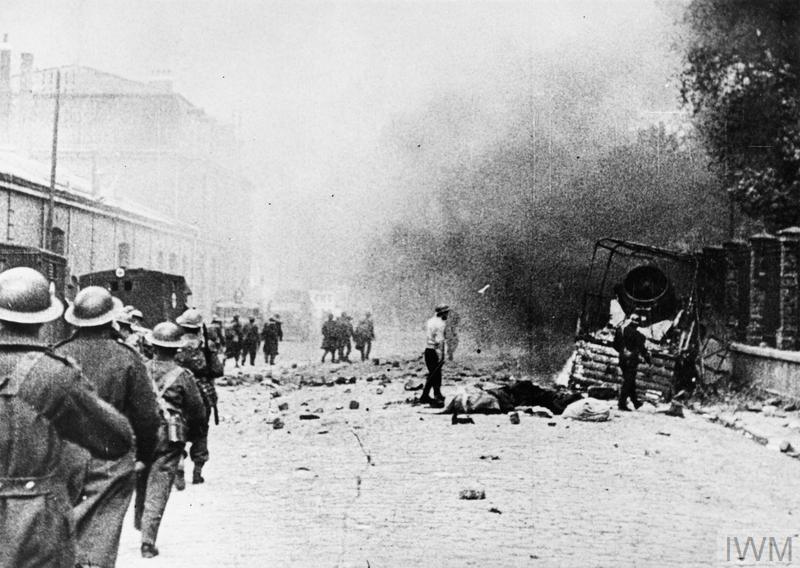
It is Day Six of the Dunkirk Evacuation. On 1 June, 64,429 troops were evacuated from Dunkirk. German bombers sank the French destroyer Foudroyant off Dunkirk as the evacuation from there continued.
The Germans broke through the defensive perimeter along the canals at Bergues and forced retreats in other sectors.
Overnight, British troops pulled out of the defensive line around Dunkirk, France and headed for the ships, leaving French troops to hold a reduced perimeter.
British orders have been to allow only British troops on board. There is only about 25% or less of the BEF left in the beachhead. The French high command expects all these British soldiers to be routed back to Cherbourg. So far, that is not happening, but it is early. The British are leaving almost all their equipment behind, so they would have little to fight with anyway.
During the night the British authorities decided that the air attacks had made the Dunkirk evacuation too dangerous to continue by day.
Under a heavy German air raid at Dunkirk, France, Sergeant George Benton, RAMC, was carrying wounded men on stretchers to a ship at the East Mole when a bomb blew a hole in the walkway. Unflinching, he calmly placed a stretcher over the gap and carried on with the evacuation of the wounded.
The German panzer divisions are resting and refitting in preparation for further operations against the Somme-Oise-Aisne line to the South.
Heinz Guderian was named the commander of Panzer Group Guderian.
A war correspondent writes from the air over France: “Seen from the air from a French plane at night, the entire northern front of France looks like a flaming torch. I have just made a long night reconnaissance flight over the northern battlefields. The red glow from the flaming cities and towns gave the low-hanging night clouds the appearance of a late summer sunset. Far below along the battle lines on the Somme and Aisne rivers, flashes of artillery fire looked like matches flaring. To the north and east there was an almost continuous line of burning towns Cambrai, St. Quentin, Arras, Peronne, Valenciennes linked by smoldering fires in the little villages between. Most of these were fired by incendiary bombs and torch-bearing parachutists days ago, but still the flames rise. It was at nightfall that the night bombing squadron, of which I was a guest, received its orders: ‘Attack in force against Cambrai airport and the crossroads south of Abbeville where important German troop concentrations have been observed’.”
There are still BEF forces in action to the south. The 51st Highland Division, the Composite Regiment and 1st Support Group assume the defense against the Germans’ Abbeville–St. Valery bridgehead. The 153rd Infantry Brigade also is standing in reserve on the Bresle from Blangy to Senarpont. An improvised British formation, the Beauman Division, holds a 55-mile (89 km) section of the line from Pont St. Pierre, an 11-mile section southeast of Rouen to Dieppe, and 55 miles of the Andelle–Béthune line.
General Georges continues to plan a major effort on 4 June.
The fury of Germany’s air might fell heavily on southern France today in one of the biggest aerial forays of the war, leaving a path of death and destruction in a half dozen towns and cities down through the rich industrial Rhone valley. At least 46 persons were killed, 30 of them here and in the harbor of this second largest city in France. The wounded numbered around 100. Latest Paris reports said 56 German planes were destroyed or damaged by the French air force during the day with 16 French craft missing. French authorities said only that a “certain number” of the Nazi raiders were brought down in Rhone valley.
Britain’s men who helped hold the fields of Flanders until the last and then withdrew in the most spectacular retreat of modern history still were coming home tonight to an exultant welcome from a rarely emotional people. The success of the withdrawal one made across the English Channel in a gale of fire from every weapon at the Nazis’ command was illustrated by estimates from various sources that of the original British expeditionary force of 175,000 men, from 100,000 to 140,000 had been brought safely back. Too, it was stated unofficially that every division, or its remnant, save one, had been disembarked. This British division and two French divisions remained to hold off the attacking Germans. Beneath the cheering, tear- drenched reception ran the somber undercurrent of preparations to evacuate school children and spread England’s population outside packed cities. For Britain awaits the next blow, long-threatened invasion, and hell from the heavens by Nazi bombers.
The RAF sorties 8 large patrols over Dunkirk. Heavy air combat continues above the Dunkirk perimeter and evacuation fleet. It launches 8 large aerial patrols that provide excellent cover, but the Luftwaffe has success in between them.
The RAF also launches raids against Dutch harbors being used by German surface raiders.
French industrial targets in the Rhône Valley were bombed by the German Luftwaffe. The Luftwaffe is not just active over the evacuation area, but also is implementing a strategic bombing effort against France. Luftwaffe bombers attack Marseilles. German planes bomb the Lyons-Marseilles railway line that is the main north-south route and also sink the 20,000-ton British passenger liner Orford in Marseilles. Cities all along the Rhône valley are raided, along with Marseilles and Lyon. Altogether, 46 people perish and over 100 are injured.
RAF fighter pilot Douglas Bader claims his first victory of the war near Dunkirk, which was a German Bf 109 fighter.
RAF Bomber Command dispatches 56 aircraft to attack German positions around Dunkirk during the day.
RAF Bomber Command dispatches 16 aircraft to attack German positions around Dunkirk overnight.
Charles Lightoller’s 61-foot yacht Sundowner, requisitioned by the Admiralty, leaves the Port of Ramsgate at 10:00 in the company of five other boats. They spot the motor cruiser Westerly, which has broken down and is on fire. When he arrives at Dunkirk, Lightoller realizes that the piers are too high, so he moves next to destroyer HMS Worcester and takes on passengers from it. He squeezes a total of 75 men below deck and 55 topside. Lightoller then returns to Ramsgate with his 130 men, dodging Luftwaffe attacks on the way. After depositing the soldiers, Sundowner is prevented from returning to Dunkirk because daylight operations from slower vessels have been banned. Sundowner is retained by the Admiralty for other operations as a coastal patrol boat.
Anti-aircraft cruiser HMS Calcutta departed Sheerness late on 31 May escorted by patrol sloops HMS Mallard and HMS Shearwater and operated off Dunkirk near Bray.
Destroyer HMS Ivanhoe was badly damaged at 0805 by German bombing at Dunkirk. Destroyer HMS Havant and minesweeper HMS Speedwell took off her wounded and part of the crew, and Tug Persia (165grt) towed Ivanhoe back to England. Twenty six ratings were killed. She repaired at Chatham completing on 24 August.
Destroyer HMS Keith was damaged by the near miss of an air bomb at Dunkirk. Later, before leaving Dunkirk, she was bombed again by German aircraft at 0915 and sunk. Lt (E) W. H. Kenward, Acting Gunner (T) C. J. Brown, Surgeon Lt R. H.A. Turner, MRCS, LRCP Rtd, thirty three ratings were lost, and Captain E. L. Berthon and Lt Cdr R. S.Miller RNR, wounded. The survivors, seven officers and one hundred and twenty three ratings were picked up by tugs HMS St Abbs, Vincia, and Servia and Dutch steamer Hilda. Minesweeper HMS Salamander rescued seven ratings. Tug HMS St Abbs was lost later on the 1st with the survivors still on board and one hundred navy and army personnel were lost in the tug.
Destroyer HMS Havant was badly damaged at 0905 in German bombing off Dunkirk. She was taken in tow, but sank five miles from West Buoy. Lt (E) E. S.Stribley MBE Rtd and seven ratings were lost. Minesweeper HMS Saltash scuttled her after taking off the crew.
Destroyer HMS Basilisk was immobilized by near misses from German bombing at 0800. She was then badly damaged by German bombing at Dunkirk at 1258. Gunner (T) E. G. Francis Rtd and eight ratings were lost. Six officers and seventy one ratings were picked up by small French trawler Le Jolie Mascotte. Destroyer HMS Whitehall picked up two officers and fifty two ratings, while other survivors got away in the motor boat and a whaler. The surviving officers were Cdr M.Richmond, Lt Cdr W. G. Boaks, Lt (E) C. W. Treweeks, Probationary Lt J. M.Sowry RNVR, S/Lt P. B. de B. Jeayes, S/Lt W. H.Ellis, S/Lt W. B. G. Galbraith, Temporary Surgeon A. W. Lt McHaffie MB, CHB RNVR, Probationary Midshipman I. McEvoy RNR. Basilisk was later scuttled by destroyer Whitehall, which was damaged herself by near misses.
Minesweeper HMS Skipjack of the 6th Minesweeping Flotilla was sunk by five direct hits from German bombing at Dunkirk. She had two hundred and seventy five men on board her at this time, most of whom were below decks and lost. Probationary Temporary S/Lt Cowley RNVR, was lost.
French destroyer Foudroyant, which departed Dover at 0800/1st, was sunk in German air bombing off Dunkirk. One hundred and fifty survivors were picked up by French trawler Bernadette (302grt), and patrol trawler Gava (256grt) and motor yacht Naiad Errant also rescued a number of survivors. A total of one hundred and thirty seven crew and eighty three soldiers were rescued.
Minesweeper HMS Hebe was damaged by the near miss of German air bombs at Dunkirk, but was not put out of action. She departed Dover at 0925/3rd for Portsmouth.
Minesweeper HMS Halcyon was machine gunned by a German aircraft at Dunkirk. Lt N. V. B. Thurston was mortally wounded.
Gunboat HMS Mosquito was badly damaged at 1030 by German bombing off Dunkirk, and was scuttled by gunboat HMS Locust on the 3rd. Lt A. H. Manwaring and a number of ratings were lost; Lt D. H.P. Gardiner and S/Lt E. S.Flint RNR, were wounded.
Patrol sloop HMS Kingfisher was damaged by the near miss of German air bombs at Dunkirk.
Destroyer HMS Worcester was badly damaged by German bombing at Dunkirk. S/Lt N. L.Humphreys, Warrant Engineer T. Smillie, and a number of ratings were lost, and Acting Gunner E. F. Wheeler wounded. Returning to Dover, she was damaged in a collision with steamer Maid Of Orleans (2386grt) which was badly damaged. Worcester departed Dover at 1404/3rd for Tilbury, and was repaired at London, returning to service on 11 July.
Destroyer HMS Harvester was damaged by near misses of air bombs and forced to return to Sheerness. At 1409/3rd, she departed Dover for Chatham for repairs to her furnace.
Destroyers HMS Venomous, HMS Vimy, and HMS Vivacious and minesweeper HMS Salamander were damaged by German bombing at Dunkirk. Destroyers Venomous, Vimy, and Vivacious were all repaired at Portsmouth completing on the 13th, within a week, on the 11th, respectively. Destroyer Venomous also damaged her stern at 0040/1st when she collided with the harbor wall. Destroyer Vivacious was temporarily repaired at Chatham in time for port blocking operations on 2/3 June at Dunkirk.
Destroyer HMS Shikari was damaged by German bombing at Dunkirk. Destroyer Shikari departed Dover at 1140 with destroyer HMS Codrington. The destroyer was taken to Plymouth for repairs completed on the 18th.
Motor torpedo boat MTB.100 was damaged by the near miss of air bombs at Dunkirk.
Auxiliary minesweeper HMS Brighton Queen (Temporary Lt A. Stubbs RNR) of the 7th Minesweeping Flotilla was sunk by German shore guns at Dunkirk. The minesweeper’s survivors were rescued by minesweeper HMS Saltash.
French auxiliary minesweepers Denis Papin (309grt), La Moussaillon (38grt), and Venus (264grt) were sunk by German bombing at Dunkirk.
Destroyers HMS Icarus, HMS Vanquisher, and HMS Windsor evacuated three thousand troops from Dunkirk on this date.
Minesweeper HMS Speedwell grounded west of La Panne and embarked troops until towed off by minesweeper HMS Albury.
Destroyers HMS Whitshed, repaired of her damage from the Boulogne evacuation, HMS Esk, HMS Malcolm, HMS Codrington, HMS Sabre, and HMS Winchelsea were also at Dunkirk to lift troops. Off the Bray, destroyer Sabre embarked 451 troops and minesweeper HMS Niger embarked 310 troops.
British steamer Scotia (3454grt) was sunk at 1300 by German bombing off Dunkirk in 51 07N, 02 10E. Thirty two crew members and two to three hundred troops were lost on the steamer Scotia. Her survivors were picked up by destroyer HMS Esk and drifters Fisher Boy, Fidget, and Jaketa.
British troopship Orford (20,043grt) was badly damaged by German bombing at Marseilles. The troopship was set afire and beached. Four crewmen died on the troopship and ten were missing.
Belgian tug Elbe (150grt) was sunk by German bombing at Dunkirk.
Anti-submarine trawler HMS Argyllshire (540grt, S/Lt J. S.Weddle RNR, SO ) of the 11th Anti-Submarine Striking Force and minesweeping trawlers HMS Lord Melchett (347grt) and HMS Stella Rigel (358grt) were on patrol together near Dunkirk. Anti-submarine trawlers Argyllshire and HMS Stella Dorado (550grt, Skipper W. H.Burgess RNR) which was a unit of the 10th Anti-Submarine Striking Force were sunk by German motor torpedo boat S 34 near Dunkirk in the North Sea at 0245 and 0430, respectively. S/Lt Weddle and four other survivors from trawler Argllshire were picked up by trawler Malabar.
Yacht Grive (687grt, Captain the Hon. L.J. O. Lambart DSO Rtd) was sunk in German bombing at Dunkirk Roads at 2355. Captain Lambart, Temporary Lt (E) T. Graham RNR, S/Lt H.B. M.Marr RNVR, Lt M.R. Branwell, which was a Fleet Air Arm passenger,were lost in the yacht. S/Lt J. K. B. Miles RNVR, was wounded in the yacht.
Drifter Fair Breeze (92grt) was sunk after a collision with a wreck in Dunkirk harbor.
Drifter Lord Cavan (96grt, SO Cdr A. J. Cubison Rtd, mine Recovery Flotilla) was sunk by German shore guns at Dunkirk. Her entire crew was rescued by a destroyer.
Tugs HMS St Abbs (550grt), with destroyer HMS Keith survivors aboard, and HMS St Fagan (550grt) were sunk by German bombing at Dunkirk. Lt T. E. Brooker Rtd and eighteen ratings were lost on tug St Abbs in addition to eighty six passengers. Thirty crew and passengers, including Captain E. L.Berthon were rescued. Lt Cdr G. H.Warren MBE, Boatswain D. G. Brown, who was wounded, six ratings of St Fagan were rescued by tug Tanga. The rest of the crew of twenty five were lost.
British sail barges Duchess (72grt) and Lady Roseberry (109grt) were lost three miles east of Dunkirk when the tug they were alongside was blown up on a mine. The entire crew of the barge Duchess was rescued. One crewman was lost on the Lady Roseberry.
British sailing barges Lark (67grt) and Royalty (101grt) were beached and abandoned at Dunkirk and Malo les Bains, respectively. Three crew and six soldiers were rescued from barge Royalty.
British sailing barge Doris (83grt) were sunk on mines three miles east of Dunkirk.
British sailing barges Barbara Jean (144grt) and Ethel Everand (190grt) were blown up and abandoned at Dunkirk. Sailing barge Aidie was blown up and abandoned between Dunkirk and La Panne. Sailing barge Ethel Everand was blown up and abandoned at La Panne. Three crew were saved from barge Barbara Jean, the entire crew was saved from Aidie, the entire crew was saved from Ethel Everand.
The British and French tell the Norwegians that they are about to begin their evacuation. They have delayed giving this information on the grounds of security but by doing so they have encouraged the Norwegians to openly resist the Germans, which can only be costly when the Allies leave. While the British and French have been planning Operation Alphabet, the evacuation of their forces from Norway, for some time, they only tell the remaining Norwegian troops today (British ambassador to Norway, Sir Cecil Dormer, informs King Haakon VII). The Allied evacuations are intended to be a gradual process but a complete operation, with no troops left anywhere in the country. The Norwegians have no real alternatives and continue attacking the German forces despite the ephemeral nature of any successes in the long run. The King and government consider whether to leave the country.
The Actions in Nordland ended in German victory. During three consecutive nights starting on the night of 29/30 May, the British force at Bodø was evacuated by destroyers. To avoid alerting the Germans, no noisy demolitions were carried out but vehicles and items of equipment which could not be removed were disabled and thrown into the sea. All military and civilian petrol stocks in the area were removed or destroyed. There was no serious pressure from the German troops, and low cloud prevented the Luftwaffe interfering. Gubbins left on the last destroyer on the night of 31 May/1 June. The Norwegian 1st battalion, 15th Regiment, was also evacuated, by small boats, to the Lofoten Islands.
Elements of German 2nd Mountain Division enter Bodø, Norway.
British troops at Narvik, Norway began evacuating to reinforce Britain itself from a potential invasion. British ambassador to Norway Sir Cecil Dormer informed Norwegian King Haakon VII of the news and recommended the royal family and the government to evacuate as well.
Under General Dietl, elements of German 3rd Mountain Division, naval troops, and miscellaneous reinforcements hold out between Narvik and the Swedish border.
British troopships Ormonde and Orama departed Scapa Flow at 2100 for Harstad escorted by destroyer HMS Foxhound. When this group met the troopships departing the Clyde on 31 May off Cape Wrath, destroyer Foxhound returned to Scapa Flow where she arrived at 1230/2nd.
Destroyer HMS Whirlwind escorting British troopship Royal Scotsman (3244grt) departed Harstad at 0400 for Scapa Flow where they arrived at 2350/3rd.
The Norwegian coaster Sivert Nielsen was bombed and sunk in the Vestfjorden by Luftwaffe aircraft with the loss of one crew member.
A secret agreement between Greece and Italy designed to keep Greece from becoming a battleground if Italy enters the European war was believed in allied and Yugoslav circles tonight to have been reached by Premier Gen. John Metaxas and the Italian government. To avoid a possible lightning Italian attack, observers said, the Greek government is ready to let the Italians occupy strategic points of Crete and other islands with only a formal protest as a token of resistance provided Italy spares the remainder of Greece. Most Greeks declare they want to resist Italy, but that General Metaxas fears Greece would suffer Holland’s fate by an Italian blitzkrieg which would end his dictator ship with scant chance of restoration, irrespective of the war’s outcome.
The Italians break off negotiations with Britain for a new contraband agreement.
Signposts were taken down throughout Britain to prevent use by possible enemy parachutists.
General Ironside, in charge of the Home Forces, considers a proposal by General Wingate to form “special night squads” for operations against German sabotage within England.
The British unemployment figure decreased by 92,000 in May 1940, to 881,000.
Lord Gort was made the aide-de-camp to King George VI.
Major General Bernard Montgomery returns to London.
Coffee & tea are rationed in occupied Holland.
Nazi occupiers kick Jews out of Dutch air guard.
New UK ambassador Sir Samuel Hoare arrives in Madrid.
Slovakia established diplomatic relationship with the Japanese-sponsored puppet state of Manchukuo.
In the Soviet Union, General Zhukov, having returned from the Far East, where he led the successful defense at Khalkin Gol, takes command of the Kyiv Special Military District.
Gold Coast 4th Infantry Brigade arrives by sea in Kenya.
RAF Bomber Command dispatches 65 aircraft to attack targets in Germany overnight.
The first production cannon-armed Spitfires are delivered to No 19 squadron this month. With an unreliable 60-round ammunition drum, this version is unpopular. The unit is fully equipped with Mk. IBs in August, but later exchanges them again for old Mk. IAs.
Also this month, the shadow factory at Castle Bromwich starts producing Spitfires at last (Mk. II models). Construction of this plant had begun in the summer of 1938.
Destroyer HMS Whitehall departed Dover at 2308/1st for Plymouth. The destroyer was repaired and reboilered at Plymouth, not returning to service until 26 August.
Minesweeper HMS Salamander departed Dover on the 2nd for Sheerness.
Patrol sloop HMS Widgeon near South Falls reported she was attacked by a German motor torpedo boat, but no damage was done.
Yacht Amulree (89grt) was sunk at 0200 in a collision with destroyer HMS Vimy in the Dover Strait. Destroyer Vimy was out of action. The destroyer departed Dover at 0610/2nd for Cardiff for repairs.
Hospital ship St David, at anchor off Dover, was damaged at 0845/1st by the spontaneous explosion of a mine.
In the tow of two tugs, British fishing vessel Renown (9grt) was sunk on a mine near Sandettie Light Vessel. Four crew were lost on the fishing vessel.
British steamer Prague (4220grt) was damaged at 0927 by German bombing 13 miles 115° from North Foreland. Steamer Prague was assisted by destroyer HMS Shikari, sloop HMS Shearwater, auxiliary minesweeper HMS Queen Of Thanet. The steamer was towed in and beached on Sandwich Flats. Steamer Prague was refloated and anchored in the Downs on the 6th to await tugs to take her to London.
Destroyer HMS Forester arrived at Scapa Flow at 1600. She soon departed with destroyer HMS Maori for Aberdeen to escort two troopships to Lerwick and then return to Scapa Flow. At 0510 on 2 May, destroyer Maori dropped depth charges on a contact in 59-10N, 1-10W of Lerwick. Destroyer Forester proceeded on to Lerwick with the convoy. At 1150, destroyer Forester was ordered to rejoin Maori to hunt the submarine. Both destroyers arrived at Scapa Flow after this operation at 0400/3rd.
Destroyer HMS Amazon arrived in the Clyde at 2130 after being relieved by destroyer HMS Wren in the destroyer HMS Eskimo escort.
Submarine HMS Narwhal arrived at Immingham and departed the same day for minelaying mission FD.16 on the 3rd off Jaederens.
Submarine HMS Truant arrived at Rosyth after patrol.
Submarines HMS Triton, HMS Trident, HMS Salmon, HMS Snapper, HMS Sealion, and HMS Sunfish departed patrol areas to return to base.
Submarines HMS Triad, HMS Seawolf, HMS Sturgeon were still at sea. Polish submarine ORP Orzel (already lost) was ordered by radio to relieve submarine HMS Trident’s billet. She did not respond.
U-48, commanded by Kapitänleutnant Herbert Kuppisch, badly damaged chartered boom carrier HMS Astronomer (8401grt), en route from Rosyth to Scapa Flow, escorted by anti-submarine trawlers HMS Stoke City and HMS Leincester City, at 58 01N, 02 12W. A mine was suspected. The report of the damage to the boom carrier was received at 0100/2nd. Destroyer HMS Kelvin was sent from Scapa Flow. Destroyer HMS Mashona departed Scapa Flow at 0215/2nd to assist destroyer Kelvin. Anti-submarine trawlers HMS Peter Hendricks and HMS Paul Rykens were ordered to the area and tug HMS St Mellons departed Scapa Flow to assist, but returned on the 2nd when the ship was lost. Destroyer Kelvin reported a second explosion on the boom carrier Astronomer at 0345 and Astronomer sank soon thereafter. The 8,401 ton HMS Astronomer was carrying naval stores and was headed for Scapa Flow, Scotland. Anti-submarine trawler Leincester City (422grt) reported a submarine contact in the vicinity at about the time of the second explosion on Astronomer. Four crewmen were lost on the boom carrier. Trawler Leincester City picked up fifty five survivors and trawler Stoke City rescued fifty four survivors. The survivors were taken to Aberdeen, arriving on the 2nd. Anti-submarine trawler Stoke City dropped depth charges on a contact without result. At 0640, an aircraft bombed a submarine contact in 57-25N, 0-56W, twenty five miles south of Astronomer’s position. Destroyers Mashona and Kelvin set off to search, but were unsuccessful. At 1100/2nd, destroyers HMS Encounter and HMS Atherstone departed Rosyth. Destroyer Atherstone proceeded to Scapa Flow where she later arrived at 2200/2nd. Destroyer Encounter was to join the search for the submarine contact near Astronomer. At 1800/2nd, destroyer Atherstone, still en route to Scapa Flow, reported a line of mines near where boom carrier Astronomer sank. Boom defense vessel HMS Barbican, escorted by anti-submarine trawler HMS Elm, proceeded to the area. They recovered the mooring buoys, covered by destroyers Mashona and Encounter, took them to Scapa Flow arriving on the 3rd. Destroyer Kelvin arrived at Scapa Flow at 0315/3rd. Destroyers Mashona and Encounter arrived at Scapa Flow at 1127/3rd.
A straggler from Convoy HG.32F, the Greek steam merchant Ioanna was torpedoed and sunk by the U-37, commanded by Kapitänleutnant Victor Oehrn, about 120 miles west of Cape Finisterre off the west coast Spain in the eastern Atlantic Ocean (43° 09’N, 11° 55’W). Ioanna (Master Vasilis Laskos), a straggler from convoy HG.32F since the night of 29/30 May, was stopped by three shots across her bow by U-37 about 120 miles west of Cape Finisterre. At 2225 hours, the U-boat had fired a G7a torpedo that was a circle runner. The crew immediately abandoned ship and were questioned by the Germans. The master told them that he was a former Greek submarine commander and he left the papers behind because it was clear for him that his ship would be sunk. He also offered the Germans the provisions that could be found on board, but the U-boat left after firing one G7a torpedo as coup de grâce at 2304 hours, which struck the drifting Ioanna on starboard side and caused her to sink after 10 minutes. The entire crew was landed at Vigo by Spanish steamer Cabo Razo (2879grt). The 950 ton Ioanna was carrying onions and was headed for Newcastle, England.
British trawler Slasher (195grt) was sunk by German bombing seventy miles northeast, one half mile east of the Spurn Light Vessel in 54-35N, 1-16E. One crewman was killed on the British trawler.
Armed merchant cruisers HMS Carinthia and HMS Asturias departed Gibraltar to return to England. Armed merchant cruiser HMS Derbyshire on patrol off the Spanish ports was ordered to leave her patrol area and return to the Clyde. Armed merchant cruiser HMS Patroclus was ordered to depart Casablanca and patrol in the Tenerife area.
The German auxiliary schooner Hertha Johanne sank in the Baltic Sea south of Falster, Sjælland, Denmark.
Convoy OA.159 departed Southend escorted by corvette HMS Clarkia.
Convoy OB.159 departed Liverpool escorted by sloop HMS Sandwich from 1 to 4 June. The sloop was detached to convoy HX.45.
Convoy MT.79 departed Methil, escorted by sloop HMS Londonderry. The convoy arrived in the Tyne later that day.
Convoy FS.185 departed the Tyne, escorted by sloop HMS Londonderry. The convoy arrived at Southend on the 3rd.
The War at Sea, Saturday, 1 June 1940 (naval-history.net)
Anti-aircraft cruiser CALCUTTA departed Sheerness late on 31 May escorted by patrol sloops MALLARD and SHEARWATER and operated off Dunkirk near Bray.
Destroyer IVANHOE was badly damaged at 0805 by German bombing at Dunkirk. Destroyer HAVANT and minesweeper SPEEDWELL took off her wounded and part of the crew, and Tug PERSIA (165grt) towed IVANHOE back to England. Twenty six ratings were killed. She repaired at Chatham completing on 24 August.
Destroyer KEITH was damaged by the near miss of an air bomb at Dunkirk. Later, before leaving Dunkirk, she was bombed again by German aircraft at 0915 and sunk. Lt (E) W. H. Kenward, Acting Gunner (T) C. J. Brown, Surgeon Lt R. H.A. Turner, MRCS, LRCP Rtd, thirty-three ratings were lost, and Captain E. L. Berthon and Lt Cdr R. S.Miller RNR, wounded. The survivors, seven officers and one hundred and twenty-three ratings were picked up by tugs ST ABBS, VINCIA, SERVIA and Dutch steamer HILDA. Minesweeper SALAMANDER rescued seven ratings.
Tug ST ABBS was lost later on the 1st with the survivors still on board and one hundred navy and army personnel were lost in the tug.
Destroyer HAVANT was badly damaged at 0905 in German bombing off Dunkirk. She was taken in tow, but sank five miles from West Buoy. Lt (E) E. S.Stribley MBE Rtd and seven ratings were lost. Minesweeper SALTASH scuttled her after taking off the crew.
Destroyer BASILISK was immobilized by near misses from German bombing at 0800. She was then badly damaged by German bombing at Dunkirk at 1258. Gunner (T) E. G. Francis Rtd and eight ratings were lost. Six officers and seventy-one ratings were picked up by small French trawler LE JOLIE MASCOTTE. Destroyer WHITEHALL picked up two officers and fifty-two ratings, while other survivors got away in the motor boat and a whaler. The surviving officers were Cdr M. Richmond, Lt Cdr W. G. Boaks, Lt (E) C. W. Treweeks, Probationary Lt J. M. Sowry RNVR, S/Lt P. B. de B. Jeayes, S/Lt W. H. Ellis, S/Lt W. B. G. Galbraith, Temporary Surgeon A. W. Lt McHaffie MB, CHB RNVR, Probationary Midshipman I. McEvoy RNR. BASILISK was later scuttled by destroyer WHITEHALL, which was damaged herself by near misses.
Destroyer WHITEHALL departed Dover at 2308/1st for Plymouth. The destroyer was repaired and reboilered at Plymouth, not returning to service until 26 August.
Minesweeper SKIPJACK of the 6th Minesweeping Flotilla was sunk by five direct hits from German bombing at Dunkirk. She had two hundred and seventy-five men on board her at this time, most of whom were below decks and lost. Probationary Temporary S/Lt Cowley RNVR, was lost.
French destroyer FOUDROYANT, which departed Dover at 0800/1st, was sunk in German air bombing off Dunkirk. One hundred and fifty survivors were picked up by French trawler BERNADETTE (302grt), and patrol trawler GAVA (256grt) and motor yacht NAIAD ERRANT also rescued a number of survivors. A total of one hundred and thirty-seven crew and eighty-three soldiers were rescued.
Minesweeper HEBE was damaged by the near miss of German air bombs at Dunkirk, but was not put out of action. She departed Dover at 0925/3rd for Portsmouth.
Minesweeper HALCYON was machine gunned by a German aircraft at Dunkirk. Lt N. V. B. Thurston was mortally wounded.
Gunboat MOSQUITO was badly damaged at 1030 by German bombing off Dunkirk, and was scuttled by gunboat LOCUST on the 3rd. Lt A. H. Manwaring and a number of ratings were lost; Lt D. H.P. Gardiner and S/Lt E. S. Flint RNR, were wounded.
Patrol sloop KINGFISHER was damaged by the near miss of German air bombs at Dunkirk.
Destroyer WORCESTER was badly damaged by German bombing at Dunkirk. S/Lt N. L. Humphreys, Warrant Engineer T. Smillie, and a number of ratings were lost, and Acting Gunner E. F. Wheeler wounded. Returning to Dover, she was damaged in a collision with steamer MAID OF ORLEANS (2386grt) which was badly damaged. WORCESTER departed Dover at 1404/3rd for Tilbury, and was repaired at London, returning to service on 11 July.
Destroyer HARVESTER was damaged by near misses of air bombs and forced to return to Sheerness. At 1409/3rd, she departed Dover for Chatham for repairs to her furnace.
Destroyers VENOMOUS, VIMY, and VIVACIOUS and minesweeper SALAMANDER were damaged were damaged by German bombing at Dunkirk. Destroyers VENOMOUS, VIMY, and VIVACIOUS were all repaired at Portsmouth completing on the 13th, within a week, on the 11th, respectively.
Destroyer VENOMOUS also damaged her stern at 0040/1st when she collided with the harbour wall.
Destroyer VIVACIOUS was temporarily repaired at Chatham in time for port blocking operations on 2/3 June at Dunkirk.
Minesweeper SALAMANDER departed Dover on the 2nd for Sheerness.
Destroyer SHIKARI was damaged by German bombing at Dunkirk.
Destroyer SHIKARI departed Dover at 1140 with destroyer CODRINGTON. The destroyer was taken to Plymouth for repairs completed on the 18th.
Motor torpedo boat MTB.100 was damaged by the near miss of air bombs at Dunkirk.
Auxiliary minesweeper BRIGHTON QUEEN (Temporary Lt A. Stubbs RNR) of the 7th Minesweeping Flotilla was sunk by German shore guns at Dunkirk.
The minesweeper’s survivors were rescued by minesweeper SALTASH.
French auxiliary minesweepers DENIS PAPIN (309grt), LA MOUSSAILLON (38grt), and VENUS (264grt) were sunk by German bombing at Dunkirk.
Destroyers ICARUS, VANQUISHER, and WINDSOR evacuated three thousand troops from Dunkirk on this date.
Minesweeper SPEEDWELL grounded west of La Panne and embarked troops until towed off by minesweeper ALBURY.
Destroyers WHITSHED, repaired of her damage from the Boulogne evacuation, ESK, MALCOLM, CODRINGTON, SABRE, and WINCHELSEA were also at Dunkirk to lift troops.
Off the Bray, destroyer SABRE embarked 451 troops and minesweeper NIGER embarked 310 troops.
British steamer SCOTIA (3454grt) was sunk at 1300 by German bombing off Dunkirk in 51 07N, 02 10E.
Thirty-two crew members and two to three hundred troops were lost on the steamer SCOTIA.
Her survivors were picked up by destroyer ESK and drifters FISHER BOY, FIDGET, and JAKETA.
British troopship ORFORD (20,043grt) was badly damaged by German bombing at Marseilles.
The troopship was set afire and beached.
Four crew died on the troopship and ten were missing.
Belgian tug ELBE (150grt) was sunk by German bombing at Dunkirk.
Anti-submarine trawler ARGYLLSHIRE (540grt, S/Lt J. S. Weddle RNR, SO ) of the 11th Anti-Submarine Striking Force and minesweeping trawlers LORD MELCHETT (347grt) and STELLA RIGEL (358grt) were on patrol together near Dunkirk.
Anti-submarine trawlers ARGYLLSHIRE and STELLA DORADO (550grt, Skipper W. H. Burgess RNR) which was a unit of the 10th Anti-Submarine Striking Force were sunk by German motor torpedo boat S 34 near Dunkirk in the North Sea at 0245 and 0430, respectively.
S/Lt Weddle and four other survivors from trawler ARGLLSHIRE were picked up by trawler MALABAR.
Patrol sloop WIDGEON near South Falls reported she was attacked by a German motor torpedo boat, but no damage was done.
Yacht AMULREE (89grt) was sunk at 0200 in a collision with destroyer VIMY in the Dover Strait.
Destroyer VIMY was out of action.
The destroyer departed Dover at 0610/2nd for Cardiff for repairs.
Hospital ship ST DAVID, at anchor off Dover, was damaged at 0845/1st by the spontaneous explosion of a mine.
Yacht GRIVE (687grt, Captain the Hon. L.J. O. Lambart DSO Rtd) was sunk in German bombing at Dunkirk Roads at 2355.
Captain Lambart, Temporary Lt (E) T. Graham RNR, S/Lt H.B. M. Marr RNVR, Lt M.R. Branwell, which was a Fleet Air Arm passenger, were lost in the yacht. S/Lt J. K. B. Miles RNVR, was wounded in the yacht.
Drifter FAIR BREEZE (92grt) was sunk after a collision with a wreck in Dunkirk harbour.
Drifter LORD CAVAN (96grt, SO Cdr A. J. Cubison Rtd, mine Recovery Flotilla) was sunk by German shore guns at Dunkirk.
Her entire crew were rescued by a destroyer.
Tugs ST ABBS (550grt), with destroyer KEITH survivors aboard, and ST FAGAN (550grt) were sunk by German bombing at Dunkirk.
Lt T. E. Brooker Rtd and eighteen ratings were lost on tug ST ABBS in addition to eighty-six passengers. Thirty crew and passengers, including Captain E. L. Berthon were rescued. Lt Cdr G. H. Warren MBE, Boatswain D. G. Brown, who was wounded, six ratings of ST FAGAN were rescued by tug TANGA. The rest of the crew of twenty-five were lost.
British sail barges DUCHESS (72grt) and LADY ROSEBERRY (109grt) were lost three miles east of Dunkirk when the tug they were alongside was blown up on a mine.
The entire crew of the barge DUCHESS was rescued. One crewman was lost on the LADY ROSEBERRY.
British sailing barges LARK (67grt) and ROYALTY (101grt) were beached and abandoned at Dunkirk and Malo les Bains, respectively.
Three crew and six soldiers were rescued from barge ROYALTY.
British sailing barge DORIS (83grt) were sunk on mines three miles east of Dunkirk.
British sailing barges BARBARA JEAN (144grt) and ETHEL EVERAND (190grt) were blown up and abandoned at Dunkirk. Sailing barge AIDIE was blown up and abandoned between Dunkirk and La Panne. Sailing barge ETHEL EVERAND was blown up and abandoned at La Panne.
Three crew were saved from barge BARBARA JEAN, the entire crew was saved from AIDIE, the entire crew was saved from ETHEL EVERAND.
In the tow of two tugs, British fishing vessel RENOWN (9grt) was sunk on a mine near Sandettie Light Vessel.
Four crew were lost on the fishing vessel.
British steamer PRAGUE (4220grt) was damaged at 0927 by German bombing 13 miles 115° from North Foreland.
Steamer PRAGUE was assisted by destroyer SHIKARI, sloop SHEARWATER, auxiliary minesweeper QUEEN OF THANET. The steamer was towed in and beached on Sandwich Flats.
Steamer PRAGUE was refloated and anchored in the Downs on the 6th to await tugs to take her to London.
On 1 June, 64,429 troops were evacuated from Dunkirk.
Destroyer TARTAR (D.6) departed Liverpool for Scapa Flow where she arrived at 1700/2nd.
Destroyer FORESTER arrived at Scapa Flow at 1600. She soon departed with destroyer MAORI for Aberdeen to escort two troopships to Lerwick and then return to Scapa Flow.
At 0510 on 2 May, destroyer MAORI dropped depth charges on a contact in 59-10N, 1-10W of Lerwick. Destroyer FORESTER proceeded on to Lerwick with the convoy.
At 1150, destroyer FORESTER was ordered to rejoin MAORI to hunt the submarine.
Both destroyers arrived at Scapa Flow after this operation at 0400/3rd.
Destroyer AMAZON arrived in the Clyde at 2130 after being relieved by destroyer WREN in the destroyer ESKIMO escort.
Sloop FLEETWOOD, which had only arrived at 0425, departed Scapa Flow for Rosyth at 1400 after destroyer ESKIMO escort duty.
British oiler BRITISH GOVERNOR arrived at Scapa Flow at 0415 from Harstad.
British steamers CYPRIAN PRINCE, RUTLAND, and GUNVOR MAERSK, escorted by anti-submarine trawlers INDIAN STAR and ANGLE, arrived at Scapa Flow from the Narvik area.
Submarine NARWHAL arrived at Immingham and departed the same day for minelaying mission FD.16 on the 3rd off Jaederens.
Submarine TRUANT arrived at Rosyth after patrol.
Submarines TRITON, TRIDENT, SALMON, SNAPPER, SEALION, and SUNFISH departed patrol areas to return to base.
Submarines TRIAD, SEAWOLF, and STURGEON were still at sea.
Polish submarine ORP ORZEL (already lost) was ordered to relieve submarine TRIDENT’s billet.
Submarine L.26 departed Harwich for Sheerness arriving later the same day.
Submarine L.26 was docked the next day.
British troopships ORMONDE and ORAMA departed Scapa Flow at 2100 for Harstad escorted by destroyer FOXHOUND. When this group met the troopships departing the Clyde on 31 May off Cape Wrath, destroyer FOXHOUND returned to Scapa Flow where she arrived at 1230/2nd.
Destroyer WHIRLWIND escorting British troopship ROYAL SCOTSMAN (3244grt) departed Harstad at 0400 for Scapa Flow where they arrived at 2350/3rd.
British repair ship VINDICTIVE departed Scapa Flow at 2116 for the Harstad area.
U-48 badly damaged chartered boom carrier ASTRONOMER (8401grt), en route from Rosyth to Scapa Flow, escorted by anti-submarine trawlers STOKE CITY and LEINCESTER CITY, in 58 01N, 02 12W. A mine was suspected.
The report of the damage to the boom carrier was received at 0100/2nd. Destroyer KELVIN was sent from Scapa Flow.
Destroyer MASHONA departed Scapa Flow at 0215/2nd to assist destroyer KELVIN.
Anti-submarine trawlers PETER HENDRICKS and PAUL RYKENS were ordered to the area and tug ST MELLONS departed Scapa Flow to assist, but returned on the 2nd when the ship was lost.
Destroyer KELVIN reported a second explosion on the boom carrier ASTRONOMER at 0345 and ASTRONOMER sank soon thereafter.
Anti-submarine trawler LEINCESTER CITY (422grt) reported a submarine contact in the vicinity at about the time of the second explosion on ASTRONOMER.
Four crew were lost on the boom carrier. Trawler LEINCESTER CITY picked up fifty-five survivors and trawler STOKE CITY rescued fifty-four survivors. The survivors were taken to Aberdeen, arriving on the 2nd.
Anti-submarine trawler STOKE CITY dropped depth charges on a contact without result.
At 0640, an aircraft bombed a submarine contact in 57-25N, 0-56W, twenty-five miles south of ASTRONOMER’s position. Destroyers MASHONA and KELVIN set off to search, but were unsuccessful.
At 1100/2nd, destroyers ENCOUNTER and ATHERSTONE departed Rosyth.
Destroyer ATHERSTONE proceeded to Scapa Flow where she later arrived at 2200/2nd.
Destroyer ENCOUNTER was to join the search for the submarine contact near ASTRONOMER.
At 1800/2nd, destroyer ATHERSTONE, still en route to Scapa Flow, reported a line of mines near where boom carrier ASTRONOMER sank.
Boom defense vessel BARBICAN, escorted by anti-submarine trawler ELM, proceeded to the area. They recovered the mooring buoys, covered by destroyers MASHONA and ENCOUNTER, took them to Scapa Flow arriving on the 3rd.
Destroyer KELVIN arrived at Scapa Flow at 0315/3rd.
Destroyers MASHONA and ENCOUNTER arrived at Scapa Flow at 1127/3rd.
British trawler SLASHER (195grt) was sunk by German bombing seventy miles northeast, one half mile east of the Spurn Light Vessel in 54-35N, 1-16E.
One crewman was killed on the British trawler.
Convoy OA.159 departed Southend escorted by corvette CLARKIA.
Convoy OB.159 departed Liverpool escorted by sloop SANDWICH from 1 to 4 June. The sloop was detached to convoy HX.45.
Convoy MT.79 departed Methil, escorted by sloop LONDONDERRY. The convoy arrived in the Tyne later that day.
Convoy FS.185 departed the Tyne, escorted by sloop LONDONDERRY. The convoy arrived at Southend on the 3rd.
Armed merchant cruisers CARINTHIA and ASTURIAS departed Gibraltar to return to England. Armed merchant cruiser DERBYSHIRE on patrol off the Spanish ports was ordered to leave her patrol area and return to the Clyde.
Armed merchant cruiser PATROCLUS was ordered to depart Casablanca and patrol in the Teneriffe area.
U-37 sank Greek steamer IOANNA (950grt) 120 miles off Cape Finisterre.
The entire crew was landed at Vigo by Spanish steamer CABO RAZO (2879grt).
Amid mounting opposition in congress to President Roosevelt’s request for authority to call the National Guard to active duty, the army high command contended today the possibility of “dangerous developments” in this hemisphere made it essential the request be granted. General George C. Marshall, U.S. Army chief of staff, issued a formal statement supporting the president’s proposal after, opposition among senators had reached formidable proportions. Mr. Roosevelt already had authority to call the guard into service, General Marshal said, “but under that call it would be impossible to send any units of the National Guard to assist a regular division in any one of the possible situations which might arise in this hemisphere.” “It is necessary that more troops be made available, trained, and seasoned, to enable missions to be carried out without denuding this country of ground troops in a state of sufficient preparation to meet unexpected eventualities in some other direction.”
The Chief of Staff did not say what the possible “dangerous developments” in this hemisphere might be. But Senator Minton of Indiana, the Democratic whip, had expressed belief to newsmen previously the president might have in mind the possibility of having to occupy British, French, and Dutch possessions in the new world if the allies were defeated. If need for such action arose, Minton said, regular troops would have to be used and the national guard called out to man defenses in the continental United States. General Marshall’s statement failed to quiet criticism of the presidential request among senate members. On hearing it, Senator Wheeler, Montana Democrat, declared. “It isn’t any wonder that I am getting many telegrams asking if it is the intention of the president and congress to get us into war when statements are issued indicating it may be necessary between now and the time congress returns that the National Guard be called to active duty.
Congressional misgivings over President Roosevelt’s request for additional authority to call out the National Guard and reservists “to maintain our position of neutrality” persisted today among the few members who appeared at the Capitol. The defense of the plan by General George C. Marshall, Chief of Staff, apparently did not allay this feeling. The extent of these misgivings is as yet undetermined and they may evaporate as Army officials appear next week before the House Appropriations Deficiency subcommittee in executive session to explain the reasons behind the Chief Executive’s recommendations in his message of yesterday.
A new exchange of messages between President Roosevelt and Premier Mussolini was reported tonight while Italy’s war-like motions multiplied, especially near the French border. The messages, reported by a source usually competent, were described as “courteous” although their exact nature was not divulged. The impression prevailed in diplomatic circles, however, that the reported exchange had not retarded Italian war measures. The Fascist party’s national council tonight adopted a resolution asking Mussolini to break “the foreign stranglehold” on Italy’s commerce and give her “freedom of the seas.”
President Roosevelt embarked on the yacht Potomac at the Navy Yard late today for an overnight cruise and rest from labors occasioned by the war in Europe. Unusual precautions were taken to guard him on the short route from the White House to the Navy reservation in the southeastern section of the city. Departing from custom, motorcycle police not only rode ahead, but on both sides of his car, which was closed despite the bright Summer day. Two Secret Service cars were immediately behind. Guests of the Chief Executive on the cruise were Senator Byrnes of South Carolina and Mrs. Byrnes, Secretary Hopkins, and Miss Marguerite LeHand, the President’s personal secretary.
The Philadelphia Inquirer, departing from its isolationist policy, will print on its first page tomorrow morning an editorial headed: “America Must Help Allies to Beat Hitler.” Asserting that the country “is sternly set against sending an army into Europe’s holocaust,” the editorial will say that “one thing we can do is to make available quickly to France and Britain, without stint or hindrance, all the material resources we can spare.”
Senator Robert A. Taft of Ohio attacked the Administration tonight for what he called a complete lack of planning in the effort to expand the nation’s national defenses.
Creation of a “national defense investigation” counter-espionage unit was announced today by the Federal Bureau of Investigation.
Richard W. Leche, Louisiana’s governor from 1936 until he resigned under fire last June 26, was convicted today of using the mails to defraud the state of $31,009, and faced a possible maximum sentence of 15 years in prison. The government charged he pocketed the money through a deal involving purchase of highway trucks. Sentence was deferred until June 11 to permit arguments on motion for a new trial. The maximum penalty is five years in prison and $1,000 fine on each of three counts on which he was convicted.
A sudden wind, rain and electrical storm enabled officers in Odessa, Texas, to rescue 50 religious sect workers from an angry crowd tonight which had threatened them for refusal to salute the flag. The group had taken refuge in a ranch house after the irate citizenry broke up attempts to distribute literature on the streets. Several fist fights occurred. The literature was seized and burned. The rescued sect members were brought to the county jail here where 20 others had been held since the earlier disturbance. County Attorney O. G. Gorron said the 70 would be held “until they salute the American flag.” No formal charges have been filed. A flag was produced during the street fighting, but members of the sect refused to salute it.
Sheriff Reeder Webb and deputies intervened, and most of the group was marched to the courthouse where County Judge A. H. Dennison lectured them on citizenship. The judge called for a flag salute but a spokesman for the sect said they could not salute anything man made. Ten men and ten women were placed in jail and the others were escorted out of town by state and county officers. They went to a ranch house about a mile from town. After dusk the crowd formed again. Sheriff’s deputies rushed to the scene, a gravel pit, and talked to the crowd. The windstorm blew up, causing an electrical power breakdown that plunged the city into darkness. Then Sheriff Webb and deputies managed to bring the group to jail. Most of the crowd dispersed but a few still were on the streets late tonight.
Michael Limatalo, 37 years old, of New York, and two stepdaughters, Frances Carro and Ray Carro, 18 and 19, respectively, were held yesterday for possessing and passing counterfeit quarters that have been circulated in large numbers in Greenwich Village in recent months.
U.S. freighter Charles R. McCormick, the American flag displayed prominently, departs Bergen, Norway, for the United States.
The Minor Landing and Base Defense Exercise at San Clemente Island, which began on May 25, 1941, concluded. This was the first time one of the newly organized USMC Defense Battalions carried out the mission of defending an advanced base against a landing force supported by aircraft and ships.
The 35,000-ton battleship USS Washington (BB-56) slid majestically down the ways at Philadelphia Navy Yard today. She is the first American battleship launched since USS West Virginia (BB-48) on November 19, 1921. “I christen you, Washington,” cried pretty 15-year-old Virginia Marshall of Spokane, Washington, descendant of John Marshall, great Chief Justice of the U. S. Supreme Court, as she smashed a bottle of champagne across the sleek gray prow of the $80,000,000 ship. To the cheering of 30,000 persons, the Washington coasted slowly down the runway, split the waters of the Delaware River and nosed upstream. A dozen tugs quickly steamed alongside and snubbed the mighty dreadnaught, because it had been feared the 720-foot-long vessel might glide across the 2.300-foot channel and ground on the New Jersey shore.
Major League Baseball:
Filling in for Leo Durocher, rookie Pee Wee Reese gets beaned by Cubs pitcher Jake Mooty. Chicago edges the Dodgers, 4–3, in 12 innings, on a homer by Al Todd. Mooty is the winner over Tot Pressnell.
The Reds trounced the Bees, 3–2, today behind Gene Thompson’s threehit pitching, but the Bees completed the game under protest as the result of a second-inning incident.
The Phillies defeated the Cardinals, 5–4, today behind the four-hit pitching of Hugh Mulcahy. Morrie Arnovich’s pinch-hit single in the eighth inning was the clincher.
Behind the seven-hit pitching of young Mickey Harris, the Boston Red Sox opened their second home stand of the season today by edging out a 2–1 victory over the Chicago White Sox on the strength of a fourth-inning home run by Jimmy Foxx.
The Yankees bang out a dozen hits and down the St. Louis Browns, 8–5. George Selkirk’s three-run homer in the fifth inning after two other runs were in provided the final margin.
Pitching one of the best games of his career, Lee (Buck) Ross yielded only two hits today in leading the Athletics to a 6-to-1 victory over the Indians.
Detroit swamped the Senators, 12–3, today as Buck Newsom went the route for the Tigers to gain his sixth pitching victory of the season.
Chicago White Sox 1, Boston Red Sox 2
Brooklyn Dodgers 3, Chicago Cubs 4
Boston Bees 2, Cincinnati Reds 3
St. Louis Browns 5, New York Yankees 8
Cleveland Indians 1, Philadelphia Athletics 6
Philadelphia Phillies 5, St. Louis Cardinals 4
Detroit Tigers 12, Washington Senators 3
U.S. Undersecretary of State Sumner Welles, commenting on U.S. Minister in Uruguay Wilson’s suggestion to send 40 or 50 naval vessels to South American waters, suggested “if some way can be found by which at least three or four heavy cruisers and a reasonable number of destroyers can be kept on the East Coast [of South America] this summer.” That same day, Welles informed U.S. Ambassador to Brazil Jefferson Caffery that the heavy cruiser Quincy (CA-39) was en route to Rio de Janeiro and Montevideo “to furnish a reminder of the strength and the range of action of the armed forces of the United States.”
Europe’s war of nerves has reached South America. Rumors of an alarming nature, most of which undoubtedly are false, are keeping the people nervously jumpy and ready to believe even the most improbable whispers. Governments are rushing to rearm against any eventuality.
Battle of Tsaoyang-Ichang: Japanese 11th Army captures Hsiangyang.
Dow Jones Industrial Average: 115.67 (-0.55)
Born:
René Auberjonois, actor (“Star Trek: Deep Space Nine”, “God of War”) and singer, in New York, New York (d. 2019).
Kip Thorne, American Physicist (Nobel Prize 2017, LIGO), in Logan, Utah.
Died:
Alfred Loisy, 83, French Roman Catholic priest, professor and theologian.
Naval Construction:
The Kriegsmarine (German Navy) Type IXC U-boat U-126 is laid down by AG Weser, Bremen (werk 989).
The Kriegsmarine (German Navy) Type VIIC U-boat U-654 is laid down by Howaldtswerke Hamburg AG, Hamburg (werk 803).
The Kriegsmarine (German Navy) Type 37 torpedo boat T18 is launched by F. Schichau, Elbing, East Prussia (werk 1406).
The U.S. Navy North Carolina-class battleship USS Washington (BB-56) is launched by the Philadelphia Navy Yard (Philadelphia, Pennsylvania, U.S.A.).
The Marine Nationale (French Navy) Le Hardi-class torpilleur d’escadre (squadron destroyer) Le Hardi is commissioned.
The Marine Nationale (French Navy) Le Hardi-class torpilleur d’escadre (squadron destroyer) Casque is commissioned.
The Marine Nationale (French Navy) Le Hardi-class torpilleur d’escadre (squadron destroyer) Epee is commissioned.
The Marine Nationale (French Navy) Le Hardi-class torpilleur d’escadre (squadron destroyer) Fleuret is commissioned.
The Marine Nationale (French Navy) Le Hardi-class torpilleur d’escadre (squadron destroyer) Lansequenet is commissioned.
The Marine Nationale (French Navy) Le Hardi-class torpilleur d’escadre (squadron destroyer) Le Corsaire is commissioned.
The Marine Nationale (French Navy) Le Hardi-class torpilleur d’escadre (squadron destroyer) Le Flibustier is commissioned.
The Marine Nationale (French Navy) Le Hardi-class torpilleur d’escadre (squadron destroyer) Mameluk is commissioned.
 History Diaries