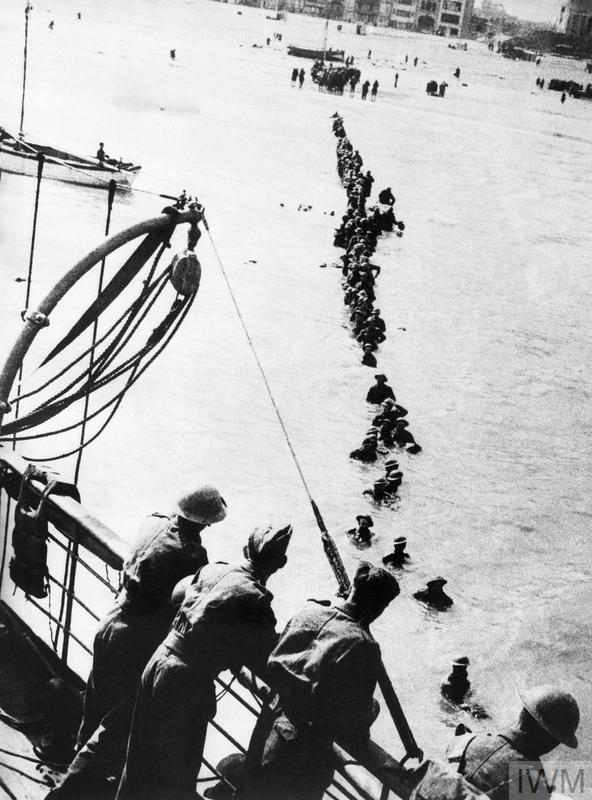
It is Day Three of the Dunkirk Evacuation.
Dunkirk (1942)
Will came back from school that day,
And he had little to say.
But he stood a long time looking down
To where the gray-green Channel water
Slapped at the foot of the little town,
And to where his boat, the Sarah P,
Bobbed at the tide on an even keel,
With her one old sail, patched at the leech,
Furled like a slattern down at heel.
He stood for a while above the beach,
He saw how the wind and current caught her;
He looked a long time out to sea.
There was steady wind, and the sky was pale,
And a daze in the east that looked like smoke.
Will went back to the house to dress.
He was half way through, when his sister Bess
Who was near fourteen, and younger than he
By just two years, came home from play.
She asked him, “Where are you going, Will?”
He said, “For a good long sail.”
“Can I come along?”
“No, Bess,” he spoke.
“I may be gone for a night and a day.”
Bess looked at him. She kept very still.
She had heard the news of the Flanders rout,
How the English were trapped above Dunkirk,
And the fleet had gone to get them out
But everyone thought that it wouldn’t work.
There was too much fear, there was too much doubt.
She looked at him, and he looked at her.
They were English children, born and bred.
He frowned her down, but she wouldn’t stir.
She shook her proud young head.
“You’ll need a crew,” she said.
They raised the sail on the Sarah p,
Like a penoncel on a young knight’s lance,
And headed the Sarah out to sea,
To bring their soldiers home from France.
There was no command, there was no set plan,
But six hundred boats went out with them
On the gray-green waters, sailing fast,
River excursion and fisherman,
Tug and schooner and racing M,
And the little boats came following last.
From every harbor and town they went
Who had sailed their craft in the sun and rain,
From the South Downs, from the cliffs of Kent,
From the village street, from the country lane.
There are twenty miles of rolling sea
From coast to coast, by the seagull’s flight,
But the tides were fair and the wind was free,
And they raised Dunkirk by fall of night.
They raised Dunkirk with its harbor torn
By the blasted stern and the sunken prow;
They had reached for fun on an English tide,
They were English children bred and born,
And whether they lived, or whether they died,
They raced for England now.
Bess was as white as the Sarah’s sail,
She set her teeth and smiled at Will.
He held his course for the smoky veil
Where the harbor narrowed thin and long.
The British ships were firing strong.
He took the Sarah into his hands,
He drove her in through fire and death
To the wet men waiting on the sands.
He got his load and he got his breath,
And she came about, and the wind fought her.
He shut his eyes and he tried to pray.
He saw his England were she lay,
The wind’s green home, the sea’s proud daughter,
Still in the moonlight, dreaming deep,
The English cliffs and the English loam
He had fourteen men to get away,
And the moon was clear, and the night like day
For planes to see where the white sails creep
Over the black water.
He closed his eyes and prayed for her;
He prayed to the men who had made her great,
Who had built her land of forest and park,
Who had made the seas an English lake;
He prayed for a fog to bring the dark;
He prayed to get home for England’s sake.
And the fog came down on the rolling sea,
And covered the ships with English mist.
The diving planes were baffled and blind.
For Nelson was there in the Victory,
With his one good eye, and his sullen twist,
And guns were out on The Golden Hind,
Their shot flashed over the Sarah P.
He could hear them cheer as he came about.
By burning wharves, by battered slips,
Galleon, frigate, and brigantine,
The old dead Captains fought their ships,
And the great dead Admirals led the line.
it was England’s night, it was England’s sea.
The fog rolled over the harbor key.
Bess held to the stays, and conned him out.
And all through the dark, while the Sarah’s wake
Hissed behind him, and vanished in foam,
There at his side sat Francis Drake,
And held him true, and steered him home.
By Robert Nathan, American writer, 1894 – 1985.
h/t to my friend Scott Palter, who posted this a decade ago. I miss Scott. He died too soon.
It has been an incredibly long and exhausting ordeal at sea for the Allies, and the price paid has been heartbreakingly high. But it has borne fruit: On the 29th, 47,310 troops were evacuated from Dunkirk, 33,558 men from the harbor at Dunkirk, France and 13,752 from the nearby beaches. The evacuation is hitting its stride, and begins to offer hope that it may exceed all realistic expectations by a considerable margin. What some will call a miracle is beginning.
The French on 29 May 1940 are beginning to realize how much trouble they are in now that the Belgians have surrendered. While the Maginot Line is holding as designed for the most part, the BEF and accompanying French forces are taking a royal beating to the north. French counterattacks along the Somme are not going well, either. In a sign of this growing pessimism, the French load auxiliary cruiser Ville d’Oran with 200 tons of Gold from the French reserve and send it to Casablanca, Morocco – where it will be available for transfer to the United States if necessary.
There are endless lines of BEF troops on the beaches and hiding in the dunes, but the Wehrmacht is assaulting the British line on the and banging it in. By the end of the day, the British troops are behind the final line of canals. A weak spot is developing at Nieuport, but there are endless amounts of British reinforcements from the hundreds of thousands of men trapped in the pocket. The British have nowhere to retreat to, so it is stand and fight, or die. So far, the line is holding.
The BEF troops wait patiently in the surf. Discipline remains strong, with lines of men stretching out into the deep water waiting for expected ships. The tide, of course, rolls in and out, the waves crash about, and the men are attired in heavy uniforms. They stand still, waiting, risking drowning (some indeed drown), knowing that if they break ranks and return to the beach, they will lose their spot and perhaps not get back to England at all.
BBC newsreader Alan Howland broadcasts an extraordinary and deliciously British understated appeal to the nation:
A number of appeals for recruits have been issued today. The Admiralty want men experienced in marine internal combustion engines for service as engine-men in yachts or motorboats. Others who have had charge of motorboats and have good knowledge of coastal navigation are needed as uncertified second hands. Application should be made to the nearest registrar, Royal Naval Reserve, or to the Fishery Officer.
No explanation as to why these men are suddenly needed is given, perhaps not to give the Germans a propaganda coup.
The fighting at Lille comes to an end, with the capitulation of the 40,000 French Troops who have been drawing Wehrmacht attention away from the beachhead. French General Alphonse Juin is captured and his French 15th Infantry Division destroyed around Lille. The Germans captured Lille, Ostend and Ypres. German forces continued to press all around the contracting Dunkirk perimeter. By the end of the day most of the remaining British troops and a large proportion of the French were inside the final canal positions. General Rommel’s 7th Panzer Division is prominent in the final stages, surrounding five French divisions.
General Prioux of the French 1st Army is captured at Steenwerck.
The French were beginning to allow their troops to be evacuated and sent some ships to assist.
Brigadier General Charles de Gaulle attacks the German positions near Abbeville again with the French 4th Armoured Division (4e Division cuirassée). There also are some tanks of the British 1st Armoured Division in support roles. The main German defense is formed by over a dozen 88 mm Flak guns of Flak-Abteilung 64. There also are some 105 mm howitzers. The smaller anti-tank weapons, which have been found to be useless against the French tanks, are withdrawn to other purposes.
Seeking the high ground, the French tanks attack Mont de Caubert with initial success. They get to a plateau near the summit before running into serious opposition. There, the French Char B1s suddenly find themselves facing the German artillery near the summit at point-blank range and withdraw with casualties. Another group of French R35 tanks had more success on a different route and caused unreliable Wehrmacht troops of the 57th Infantry Division (Lieutenant-General Oskar Blümm) to flee across the Somme in a panic. Seeing this, General de Gaulle believes that the battle is won and orders a general advance, but the German artillery on Mont de Caubert is still intact and firing down on the French.
Faced with a potential disaster, Generalleutnant Erich von Manstein, the XXXVIII Corps commander in Abbeville, rallies his troops, who soon return to their positions. He uses his artillery to pick off more Char B1 tanks, which are the heart of the French attack. The French tanks are capable but vulnerable to the German artillery fired at close range. German infantry then counterattacks around Cambron, pushing back the 51st (Highland) Division. The day ends with the French giving the Germans a severe fright, but the positions of the two sides barely changed.
King Leopold of Belgium is placed under house arrest by German authorities.
Arthur Seyss-Inquart was installed as the Reich Commissioner of the Netherlands. In his inaugural speech he said “We Germans have not come to subjugate this country and its people, nor do we seek to impose our political system on them.”
Friedrich Christiansen became the commanding officer of the German military in the Netherlands.
RAF Bomber Command dispatches 51 aircraft to attack German positions around Dunkirk during the day.
RAF Bomber Command dispatches 15 aircraft to attack German positions around Dunkirk overnight.
The cynosure of everyone’s eyes is the Dunkirk defense and evacuation. The Luftwaffe is able to move more aircraft close to the battlefield, increasing the number of sorties. RAF Bomber Command maintains constant pressure on the encroaching panzers, with 51 sorties during the day and 15 at night.
However, with the RAF giving iron priority to the beachhead, the rest of France is wide open to the Luftwaffe. It establishes aerial dominance, and on a beautiful, cloudless day it shoots “anything that moves.”
No. 264 Squadron RAF based at Manston, England, United Kingdom claimed no less than thirty-eight enemy aircraft destroyed in a single day. The Luftwaffe fighter pilots having mistaken No. 264 Squadron’s two-seat Defiant fighters for Hurricane fighters and had dived on the supposedly defenceless tails of the British fighters only to be greeted by a withering concentration of fire. By the end of the month No. 264 Squadron’s Defiant fighters would have claimed some sixty-five kills, but the German pilots had learned from their mistakes and adopted new tactics to deal with the Defiant fighters.
The Luftwaffe increased the strength of its attacks despite the efforts of the RAF to give protection.
Three destroyers were sunk and 7 others damaged off Dunkirk. At least 15 other vessels were sunk. Because of the destroyer losses and the demand for them in other operations the Admiralty decided that the more modern types needed to be withdrawn.
Destroyer HMS Mackay, en route to Bray, ran aground at 0136 at Zuydcote Pass with heavy damage to her propellers. She was able to get herself off at high tide and returned to Sheerness. Destroyer Mackay departed Dover on the 30th for docking in the Thames. New destroyer HMS Harvester had arrived from the yards without charts. She had been ordered to follow destroyer Mackay. Destroyer Harvester continued to Dunkirk after destroyer Mackay’s accident.
German schnellboote S.25 (SO), S.30, and S.34 departed Wilhelmshaven during the afternoon of 28 May to operate off Dunkirk. Destroyers HMS Wakeful and HMS Grafton left the beaches at the same time after embarking troops at Dunkirk late on the 28th. Patrol sloop HMS Shearwater at 0120 south of Fairy Bank was attacked by two German motor torpedo boats.
Destroyer HMS Wakeful, with 600 troops on board, was torpedoed and sunk at 0136 by German schnellboote S.30 of the 2nd Torpedo Boat Flotilla close to North Kwinte Buoy in 51-20N, 2-45E. S/Lt J. S. Percival Jones, S/Lt W. L.Cranefield, Probationary S/Lt W. P. Creak, Warrant Engineer H.J. Tucker, Probationary Temporary Surgeon Lt DG Walker, MB, CHB RNVR, ninety two ratings, one NAAFI personnel, 650 troops were lost on the destroyer Wakeful. Midshipman M. M. Patterson RNR, was wounded. Destroyer Wakeful’s twenty five crew and one soldier which survived were picked up by destroyer HMS Grafton, minesweeper HMS Gossamer, drifters Nautilus (64grt) and Comfort (60grt).
At 0420 destroyer HMS Grafton was torpedoed and badly damaged by U-62, commanded by Kapitänleutnant Hans-Bernhard Michalowski, at position 51 22N, 02 45E. The submarine thought she had torpedoed a merchant ship. Cdr Robinson, Lt H.C. C. Tanner, fourteen ratings were lost on the destroyer Grafton. At 0430, arriving destroyers HMS Javelin, HMS Icarus, HMS Vanquisher, HMS Intrepid, and HMS Ivanhoe encountered the Grafton wreck. Destroyer Intrepid, after taking off the survivors, scuttled Grafton by firing three shells into the destroyer’s hull. British steamer Malines (2980grt) also rescued survivors from the destroyer. On the 30th, patrol sloop HMS Sheldrake proceeded to the area of the Kwinte Bank and destroyed the anti-submarine gear on the capsized wreck of destroyer Wakeful with gunfire and depth charges. After the loss of destroyer Grafton, ships were ordered not to stop to assist a ship in distress.
British drifter HMS Comfort (60grt, Temporary Skipper J. D. Mair RNR) was rammed and sunk off Dover by minesweeper HMS Leda which believed her to be a German S-boat. Four crew, including Mair, from the drifter were lost. Only two survivors were picked up.
Destroyer HMS Wolsey damaged her propellers on debris at Dunkirk.
Destroyer HMS Wolfhound damaged her propellers on debris at Dunkirk and required docking.
Sloop HMS Bideford of the 1st Sloop Division of the Western Approaches Command arrived at Dover on the 28th from Gibraltar with HG.31F. She was to pick up convoy OA.158GF for convoy OG.32F. Sloop Bideford went over to Dunkirk where she was struck by a German bomb on her quarter deck and had forty feet of her stern blown off. Lt P. A. Stewart, S/Lt A. B. Wood, S/Lt S. E. Edmundson, RNR,and thirteen ratings were lost on the sloop; two officers and eighteen ratings were wounded. Of the passengers, Probationary Temporary S/Lt R. O. Wilcoxon, RNVR, another officer and ten ratings were killed and two officers wounded. Sloop Bideford was beached to prevent sinking. Minesweeper HMS Kellet came alongside and took off the passengers. Tugs HMS Lady Brassey (362grt) and HMS Foremost 87 (163grt) were sent over on the 30th to retrieve Bideford but could not locate her. Sloop Bideford was later gotten off and towed towards Dover by Gunboat HMS Locust. Locust was relieved off Dover by tugs HMS Simla (144grt) and HMS Gondia (200grt) and all arrived safely on the 31st after thirty six hours in tow. Sloop Bideford departed Dover at 0615 on 4 June in tow and escorted by anti-submarine trawlers HMS Topaze and HMS Olvina. Repaired at Portsmouth, sloop HMS Bideford did not return to service until 15 April 1941 when she sailed for Greenock.
Destroyers HMS Gallant, HMS Grenade, and HMS Jaguar were plotting a new route for DYNAMO. They were sent to test the strength of shore batteries at Gravelines. They drew no fire, but they were attacked by German bombers. At 1129 destroyer Gallant was near missed and damaged. Destroyer Gallant departed Dover at 1620/31st for repairs in the Humber, but was able to return to duty in one week.
Anti-aircraft cruiser HMS Calcutta, escorted by patrol sloop HMS Mallard off La Panne, evacuated 1,856 men which were ferried out to her by minesweepers HMS Salamander and HMS Sutton, tug HMS Java, and eight smaller ships. Also at La Panne were destroyers HMS Shikari, HMS Harvester, HMS Anthony, HMS Sabre, and HMS Greyhound and minesweepers HMS Emperor Of India, HMS Gracie Fields, HMS Halycon, HMS Hebe, HMS Oriole, HMS Princess Elisabeth, and HMS Waverley. French destroyers Mistral, Cyclone, and Sirocco began the evacuation of French troops from Dunkirk. However, destroyer Mistral was bombed and badly damaged along the east mole and did not embark troops. Her commanding officer Capitaine de Corvette Lavene was fatally wounded and Lieutenant de Vaisseau J. D. J. Guillanton assumed command. Destroyer Cyclone lifted 733 passengers, including 158 men from the Sloop HMS Bideford, and Sirocco lifted 509 men.
Along the east mole, destroyer HMS Grenade was sunk at 1602 by German bombing. Fourteen ratings were killed and four more dying of wounds.
Destroyer HMS Jaguar, alongside Grenade outboard, was badly damaged at 1600 by German bombing. Destroyer Jaguar was hit by one bomb. One boiler room out of action, her hull was holed, there was damage to oil tanks and her engine room. Thirteen ratings were killed and nineteen crew, including Lt F. Bruen, were wounded. The troops on destroyer Jaguar were transferred to other ships. Destroyer HMS Express towed Jaguar out into the channel. Destroyer Jaguar was able to make most of the voyage back to Dover on her own, but off Dover she was joined by tug HMS Simla (144grt) which towed her into Dover. Destroyer Jaguar departed Dover at 1620/31st in company of destroyer HMS Gallant and was repaired at Immingham in sixteen days.
Destroyer HMS Intrepid was badly damaged at 1830 by German bombing off La Panne with two ratings killed and nineteen wounded. One engine room was out of action and one was damaged. The destroyer returned under her own power. Destroyer Intrepid was repaired at Middlesborough completing in two weeks.
At 1321 Polish destroyer ORP Blyskawica, operating in 51-19N, 2-07E in the Channel in a division of four destroyers, was near missed by torpedoes from U-60. U-60 was depth charged in return, but sustained no damage.
Destroyer HMS Greyhound was badly damaged at 1628 by a near miss off La Panne. Probationary Midshipman W. S. Underwood RNR, Probationary Temporary S/Lt M. H.Matthews RNVR, eighteen ratings were lost on the destroyer. After emergency repairs, destroyer Greyhound was towed by Polish destroyer Blyskawica towards Dover. Off the North Goodwins Light Ship, Blyskawica was relieved by tug HMS Lady Brassey which took Greyhound into Dover. Destroyer Greyhound departed Dover at 1419/31st for Sheerness. The destroyer was repaired at Chatham, returning to service in three weeks.
Destroyers HMS Saladin, HMS Malcolm, and HMS Wolfhound were all moderately damaged by German bombing at Dunkirk. All three were returned to service after minor repairs at Chatham. Destroyer Saladin was damaged by a near miss and was under repair for eleven days and was completed on 9 June. Destroyer Wolfhound was under repair for this damage and her propeller damage for ten days. Destroyer HMS Verity was damaged in a collision with a sunken drifter off Dunkirk. Destroyer Verity returned to service on 15 June after repairs at Portsmouth.
Destroyers HMS Codrington, HMS Express, HMS Harvester, HMS Icarus, HMS Ivanhoe, HMS Keith, HMS Sabre, HMS Scimitar, HMS Winchelsea, and HMS Wolsey were also at Dunkirk on the 29th. Destroyer Icarus was damaged by near misses and sustained one rating killed and twenty five men wounded. On the 29th, the following destroyers made one round trip to lift troops: HMS Anthony, HMS Codrington, HMS Esk, HMS Express, HMS Greyhound, HMS Harvester, HMS Intrepid, HMS Ivanhoe, HMS Javelin, HMS Malcolm, HMS Sabre, HMS Scimitar, HMS Shikari, HMS Vanquisher, HMS Verity, HMS Wolsey, and HMS Worcester. Destroyer Icarus made two round trips. Minesweepers HMS Albury, HMS Duchess Of Fife, HMS Emperor Of India, HMS Fitzroy, HMS Halcyon, HMS Hebe, HMS Leda, HMS Marmion, and HMS Sharpshooter lifted troops from the beaches on the 29th.
The British Admiralty ordered all the H, I, and J class destroyers (destroyers HMS Harvester, HMS Havant, HMS Icarus, HMS Impulsive, HMS Intrepid, HMS Ivanhoe, and HMS Javelin) out of DYNAMO due to severe losses. All the G-class destroyers were already out of the operation due to loss or damage. This left only fifteen old destroyers, HMS Esk, HMS Express, HMS Anthony, HMS Keith, HMS Codrington, HMS Malcolm, HMS Whitehall, HMS Winchelsea, HMS Worcester, HMS Windsor, HMS Verity, HMS Vanquisher, HMS Sabre, HMS Scimitar, and HMS Shikari to continue DYNAMO. Destroyers HMS Saladin, HMS Whitehall, and HMS Winchelsea were ordered to Dover for DYNAMO operations.
Auxiliary minesweeper HMS Gracie Fields (393grt, Temporary Lt N. Larkin RNR) of the 10th Minesweeping Flotilla was sunk by German bombing at Dunkirk, three miles west of Middelkerk Buoy. S/Lt A. J. Glover RNVR, was lost in the minesweeper. Temporary Lt N. Larkin RNR, Temporary Lt (E) R. W. Daish RNR, were wounded. Minesweeper Gracie Fields’s survivors were picked up by minesweeper HMS Pangbourne after an unsuccessful attempt to tow her out of the area.
Minesweeper Pangbourne was damaged by German bombing at Dunkirk. Probationary Temporary S/Lt I.F. Buckley RNVR and Lt G.MacClelland were wounded. The minesweeper was repaired at Grimsby in June.
Auxiliary minesweeper HMS Waverley (537grt, Lt S.F. Harmer-Elliot RNVR) of the 12th Minesweeping Flotilla was sunk at 1800 by German bombing at Dunkirk. Some three hundred and sixty crew and passengers were lost in the minesweeper. French destroyer Cyclone, auxiliary anti-air craft ship HMS Golden Eagle, a tug, two drifters picked up the survivors.
Auxiliary anti-aircraft ship HMS Crested Eagle (1110grt, Temporary Lt Cdr B. R. Booth (probationary) RNR) was sunk by German bombing at 1850 at Dunkirk. Anti-aircraft ship Crested Eagle’s survivors were rescued by minesweeper HMS Pangbourne. Temporary Probationary Lt C. S. Elliott RNR, Temporary Lt (E) E. Jones RNR, Temporary S/Lt (E) A. W. Turnbull RNR, were wounded.
Minesweeping trawler HMS Polly Johnson (290grt, Skipper Lt F. Padley RNR) was badly damaged by German bombing off Dunkirk and later scuttled. Acting Skipper J. M. Greengrass RNR, was lost in the trawler.
Minesweeping trawler HMS Calvi (363grt, Temporary Skipper B. D. Spindler RNR) of Minesweeping Group 51 was sunk by German bombing in Dunkirk Harbor. The survivors were picked up by minesweeping trawler HMS John Cattling. Temporary S/Lt Everitt RNVR, which died of wounds on 12 June, two ratings were lost.
French steamers Monique Schiafffino (3236grt) and Mars (721grt) were sunk by German bombing at Dunkirk.
French steamer Saint Octave (5099grt) was scuttled at Dunkirk, but was later salved by German forces and renamed Ilse Fritzen for German service.
French auxiliary minesweeper Joseph Marie (41grt) was sunk by German bombing at Dunkirk.
Belgian tugs Vulcain (200grt), Max (177grt) and Thames (144grt) were sunk by German bombing at Dunkirk.
French steamer Douaisien (2954grt) was bombed and badly damaged by German bombing off Dunkirk. Three passengers were killed in the bombing. Steamer Douaisien was sunk in further attacks on 1 June.
British steamer Clan Macalister (6787grt) was set on fire by German bombing at Dunkirk, off No. 6 Buoy, Dunkirk East Buoy. The steamer was abandoned. Eighteen lives were lost on the steamer. Steamer Clan Macalister’s survivors were picked up by destroyer HMS Malcolm and minesweeper HMS Pangbourne.
British steamer Mona’s Queen (2756grt) was sunk by a mine off Dunkirk, one half mile east of Dunkirk Pier Head. Twenty six lives were lost on the steamer. Steamer Mona’s Queen’s survivors were rescued by destroyer HMS Vanquisher and taken to Dover. British steamer Lorina (1578grt) was sunk by German bombing in Dunkirk Roads. Eight lives were lost on the steamer.
British steamer Fenella (2376grt) was sunk by German bombing off Dunkirk. The steamer was set on fire by the bombing and was abandoned. The steamer was observed sinking on the 30th. Fifteen lives were lost on the steamer.
Flare drifter Yorkshire Lass (111grt) was escorted back to Dover in an unseaworthy condition after she passed close to a steamer when it struck a mine.
French steamer Mars (721grt) was sunk by German bombing at Dunkirk. British drifter Nautilus (64grt) was lost at Dunkirk.
In operations by RAF No. 825 Squadron over Dunkirk, five Swordfish were shot down by German fighters. Leading Airman L.P. Gardner were killed when his Swordfish was shot down; Lt R. H.G.Grey was taken prisoner, but died as a POW on 29 August 1941. Lt Cdr J. B. Buckley and Lt R. G.Wood were taken prisoner when their Swordfish crashed landed. Buckley died in POW camp on 21 March 1943. S/Lt C.F. S. Hogg and Leading Airman H.K. Murrin was killed when their Swordfish crashed. S/Lt (A) J. T. Nicholson and Naval Airman V. S. A. Moore were taken prisoner when their Swordfish crashed. Lt A. D. Neely and Naval Airman F. G. Rumsey were taken prisoner when their Swordfish was shot down. Two other Swordfish of the Squadron were also lost, but their crews were able to return to England through Dunkirk.
First group of British forces is evacuated by sea from Bodø, Norway, to Scapa Flow.To avoid attracting attention, the departure is done without explosive detonations. The weather keeps the Luftwaffe away, and the 2nd Mountain Division is having to take the long road around the fjord and remains far to the south.
Luftwaffe conducts raid on Allied shipping off Narvik, with three aircraft downed by RAF fighters.
Luftwaffe transports drop 125 troops of 1st Fallschirmjaeger Regiment to reinforce German forces around Narvik.
General Dietl has been evicted from Narvik, but his force remains intact and morale is high. During the day, the Luftwaffe drops another 125 paratroopers to help him. He is on the rail line to Sweden, watching and waiting for any pursuers.
The areas around Bodø and Hopen in Norway were evacuated on three consecutive nights by two destroyers. Nine hundred and seventy six troops, ferried by destroyers HMS Havelock and HMS Arrow, embarked on British repair ship HMS Vindictive early on the 30th and taken directly to Scapa Flow, arriving on 1 June at 0057. On the second on 30/31 May, destroyers HMS Fame, HMS Firedrake, and HMS Beagle departed Bodø after embarkation at 0102/31st. On the 31st/1 June, destroyers HMS Arrow, HMS Delight, and HMS Echo embarked troops. Fifteen hundred troops were embarked each night on the destroyers and taken to Harstad. Hopen was completely evacuated of allied troops by 30 May. On the third night, destroyer HMS Vanoc was added, but the evacuation was completed prior to her arrival. By the end of 31 May, Bodø was clear of allied troops. Destroyer HMS Firedrake picked up the demolition parties at Bodø and took them to Harstad.
Light cruiser HMS Southampton bombarded German positions on the Ankenes Peninsula.
French steamer Saint Claire (3824grt) was sunk by German bombing at Tjeldsundet, Norway.
German auxiliary patrol boat Vp.1109 (trawler Antares, 291grt) was sunk on minefield FD.12 laid by submarine HMS Narwhal in 62-58N, 06-48E.
The New York Times reports:
“Development of a process that speeds up by 11,000 times the extraction of U-235, the element recently discovered to possess 5,000,000 times the power output of coal, promising to make it possible to utilize atomic energy as a new source of enormous power for all purposes, and to place in the hands of the nations at war, especially Germany, the most powerful fuel ever to be discovered, is to be announced in the forthcoming issue of Nature, leading British scientific weekly. Germany, more than any other European nation, has been concentrating on developing this power. If the tests succeed the Allied blockade could be materially offset. The new process for extracting U-235 that promises to revolutionize methods of power production and to usher in a new civilization based on the utilization of atomic power, was developed by Professor Wilhelm Krasny-Ergen of the Wenner-Grens Institute, Stockholm, Sweden, one of the leading scientific research institutions in Europe.”
[Ed: All public discussion of atomic power will soon disappear from the media, as the researcha nd workers are drawn into ‘black’ secret programs (Tube Alloys and the Manhattan Project).
The debate in the British Cabinet continues, with Foreign Secretary Lord Halifax urging negotiation and Prime Minister Churchill wishing to fight on. Churchill gives a rousing speech to the cabinet in the evening which stops any talk of “surrender.”
Further tightening of regulations governing the movements of aliens—even Americans—together with a frank speech by Harold Nicolson, writer and disciple of Prime Minister Winston Churchill, who is the new Parliamentary secretary of the Ministry of Information, emphasized tonight how real the expectation, though not fear, of a German invasion has become in the last few days.
Sir Samuel, 1st Viscount Templewood, flies to take up his position as the British Ambassador to Spain.
Sixteen American volunteers arrived from the United States by way of Italy today to join the third section of volunteer drivers sponsored unofficially by American Legion headquarters in Paris.
The Swedish Home Guard was created.
Civilians in Rome began taking over some posts left by men called to arms today as the Belgian collapse on the northern front heightened Italy’s war fervor and made active Italian intervention appear to be only a question of days. Young Fascists served as traffic police, and helmeted women and girls of Rome were seen in uniforms astride motorcycles equipped for anti-air raid duties. At the same time the Italian press indicated that any chance the French and British ever had of obtaining continued Italian non-belligerency by relaxing their blockade probably had been lost. Spain also returned to Italian headlines with reports of anti-English demonstrations, together with reminders that Spain might see a chance now to recover Gibraltar.
Italy still teetered tonight on the brink of war. Many foreign and Italian observers expected her to take the plunge within a few days, but in the Mediterranean and southward rather than directly against France. In “event of an act of aggression leading to war in the Mediterranean area,” according to the Allied-Turkish treaty of alliance, Turkey, guardian of the Dardanelles, is pledged to enter the war on the side of Britain and France.
Tension between Italy and Yugoslavia has been slackening for the past few days. Now it is learned that troop concentrations on the common frontier near Postonja are being reduced, presumably as a sign of mutual good faith.
Mussolini formally announces to his military chiefs of staff that Italy will enter the war on Germany’s side.
New envoy Bernardo Attolico presented his credentials to the Pope this morning in a ceremony of the utmost simplicity. There was no outward hint of the strained relations that have arisen between the Vatican and the Italian Government over the squelching of the Osservatore Romano, the Vatican newspaper, and the Italian Intervention policy, but for the first time on such an occasion there was no speech by the Pope.
Rumania moves toward closer relations with Germany.
Every day of intense warfare waged with tanks, motorized troops and aircraft in the west increases the importance to Germany of the Ploesti district of Rumania, for this is the oil area. The nearest and most convenient petroleum source of supply for Germany will now have to give up all that it has not been possible to deliver for many months past owing to the transportation problem. The oil war is only just beginning and here in the Rumanian territory Germans and Allies stand face to face in bitter economic conflict.
Russia administered a stunning rebuff to Britain with a curt “not acceptable” attitude toward the mission of Sir Stafford Cripps, left wing member of the British parliament en route to Moscow for an effort to untangle the bogged down Russian-British trade negotiations. Moscow said Britain must adopt a friendlier attitude and conduct negotiations through her ambassador if she really wanted an agreement.
London indicated it would comply with the Soviet demands by appointing Sir Stafford to succeed Ambassador Sir William Seeds, absent “on leave” from his Moscow post since January. Richard Austen Butler, Under-Secretary of State for Foreign Affairs, informed the Soviet Ambassador, Ivan M. Maisky, tonight that Britain had given the status of Ambassador to Sir Stafford Cripps, who is now enroute to Moscow. His ostensible mission is to negotiate a new trade treaty.
Premier-Foreign Minister Vyacheslav Molotov was reported today to have warned Lithuania that the Soviet Government would take action unless the alleged kidnapping of Soviet soldiers stationed on Lithuanian soil was stopped.
Sir Samuel Hoare departs for Spain by air via Bordeaux and Lisbon.
The RAF signs the contract ordering the first 320 Mustang fighters from North American Aviation.
Werner Mölders was awarded the Knight’s Cross of the Iron Cross, the first fighter pilot to receive this award.
French armed merchant cruiser Ville D’oran (10,172grt) was ordered to embark two hundred tons of gold at Pauillac and take it to Casablanca. The gold was embarked and the armed merchant cruiser departed on 3 June and arrived at Casablanca on 7 June. Early negotiations were for American warships to embark the gold at Saint Jean de Luz, but the threat of air attack in the open harbor caused modification of plans. American heavy cruiser USS Vincennes (CA.44) and destroyers USS Truxton (DD.229) and USS Simpson (DD.221) arrived at Casablanca at 1100 on 9 June and embarked this gold for transshipment to the United States. The American Force departed Casablanca at 2030 on 10 June and arrived at New York on 20 June.
The Kriegsmarine submarine U-37, commanded by Kapitänleutnant Victor Oehrn, sank the French steamer Marie Jose forty miles northwest of Vigo near Salvora Island. U-37 tried to stop the unescorted Marie Jose by a shot across her bow about 40 miles northwest of Vigo, but the ship turned away and sent radio messages. The U-boat opened fire, hitting the Marie Jose several times and soon the crew abandoned ship. The burning ship was hit by a G7a torpedo coup de grâce at 06.57 hours and sank within 15 minutes. The 2,477 ton Marie José was carrying general cargo and was bound for Bordeaux, France.
U-37 also badly damaged the British motor tanker Telena at position 42 25N, 09 08W. At 0714 hours U-37 fired three warning shots across the bow of the unescorted Telena (Master Harold Fitch Gosling) off Muros, Cape Finisterre and opened fire with the deck gun when the ship used its radio. Soon her cargo caught fire and the crew was forced to abandon ship which went aground in shallow water. The master and 17 crew members were lost. 18 crew members were picked up by the Spanish trawlers Buena Esperanza and Jose Ignacio de C. and landed at Mari and El Grove near Vigo. Later the wreck was seized by Spain, salvaged and brought into the harbor of Vigo, where 7,400 tons of oil was salvaged. On 17 Aug 1940 the tanker arrived in Bilbao and was repaired at the Seatoa Naval Yard. On 7 Oct 1940 she was sold to Compañía Española de Petroles, Madrid and renamed Gerona. In May 1975 the Gerona was broken up by Desguaces Cataluna S.A., Barcelona. The 7,406 ton Telena was carrying crude oil and was bound for Pauillac, France.
The Marine Nationale (French Navy) tug Samson struck a mine in the Mediterranean Sea and sank off the coast of Gard.
At 0015, destroyer HMS Montrose collided with tug Sun V, towing eleven naval cutters, off Cape de Griz and sustained heavy damage to her bow. Destroyer Montrose’s stem was broken and a piece ten feet long was completely taken out. Destroyer Montrose was run aground to prevent sinking and later in the day was towed back to Dover stern first by tugs HMS Lady Brassey (362grt) and HMS Simla (144grt). Destroyer Montrose departed Dover on the 30th for the Thames for docking. The destroyer was repaired at Woolwich and returned to duty on 24 June.
Convoy OG.31 made formed from convoys OA.155G, which departed Southend on the 26th escorted by destroyer HMS Whitehall, OB.155G, which departed Liverpool on the 26th escorted by destroyer HMS Mackay and sloop HMS Wellington, with forty ships. The convoy was escorted by destroyer Whitehall on the 29th. Sloop Wellington escorted the convoy from 29 May to 2 June when she was detached to convoy HG.32. Destroyer HMS Douglas escorted the convoy from 31 May to 4 June. Destroyer HMS Watchman from convoy HG.32 escorted the convoy from 2 to 3 June. The convoy arrived at Gibraltar on 3 June.
Convoy BC.39 with six steamers, including Baron Carnegie, Baron Nairn, Dunkwa (Commodore), and Marslew departed Bristol Channel escorted by anti-submarine trawlers HMS Huddersfield Town and HMS York City. The convoy arrived at Loire on 1 June.
Convoy FN.183 departed Southend, escorted by destroyer HMS Valorous. The convoy arrived at the Tyne on the 31st.
Convoy SA.43 of one steamer arrived at St Malo from Southampton.
Convoy AXF.6 departed Southampton for St Malo.
The War at Sea, Wednesday, 29 May 1940 (naval-history.net)
Light cruiser SOUTHAMPTON bombarded German positions on the Ankenes Peninsula.
The areas around Bodø and Hopen were evacuated on three consecutive nights by two destroyers. Nine hundred and seventy-six troops, ferried by destroyers HAVELOCK and ARROW, embarked on British repair ship VINDICTIVE early on the 30th and taken directly to Scapa Flow, arriving on 1 June at 0057.
On the second on 30/31 May, destroyers FAME, FIREDRAKE, and BEAGLE departed Bodø after embarkation at 0102/31st. On the 31st/1 June, destroyers ARROW, DELIGHT, and ECHO embarked troops. Fifteen hundred troops were embarked each night on the destroyers and taken to Harstad.
Hopen was completely evacuated of allied troops by 30 May.
On the third night, destroyer VANOC was added, but the evacuation was completed prior to her arrival.
By the end of 31 May, Bodø was clear of allied troops. Destroyer FIREDRAKE picked up the demolition parties at Bodø and took them to Harstad.
Destroyer VOLUNTEER with Polish troopships BATORY (14287grt) and SOBIESKI (11,030grt) departed Greenock at 1230 for Harstad.
The destroyer was detached on the 30th to join the destroyer ESKIMO force.
Destroyer ELECTRA departed Scapa Flow at 1030 for exercises.
However, fog forced cancellation of the exercises. The destroyer remained at sea during the night.
French steamer SAINT CLAIRE (3824grt) was sunk by German bombing at Tjeldsundet.
German auxiliary patrol boat Vp.1109 (trawler ANTARES, 291grt) was sunk on minefield FD.12 laid by submarine NARWHAL in 62-58N, 06-48E.
Minelayers TEVIOTBANK and PLOVER departed Scapa Flow, escorted by destroyer ATHERSTONE, for Rosyth.
Convoy OG.31 made formed from convoys OA.155G, which departed Southend on the 26th escorted by destroyer WHITEHALL, OB.155G, which departed Liverpool on the 26th escorted by destroyer MACKAY and sloop WELLINGTON, with forty ships. The convoy was escorted by destroyer WHITEHALL on the 29th.
Sloop WELLINGTON escorted the convoy from 29 May to 2 June when she was detached to convoy HG.32.
Destroyer DOUGLAS escorted the convoy from 31 May to 4 June.
Destroyer WATCHMAN from convoy HG.32 escorted the convoy from 2 to 3 June. The convoy arrived at Gibraltar on 3 June.
Convoy BC.39 with six steamers, including BARON CARNEGIE, BARON NAIRN, DUNKWA (Commodore), and MARSLEW departed Bristol Channel escorted by anti-submarine trawlers HUDDERSFIELD TOWN and YORK CITY. The convoy arrived at Loire on 1 June.
Convoy FN.183 departed Southend, escorted by destroyer VALOROUS. The convoy arrived at the Tyne on the 31st.
French armed merchant cruiser VILLE D’ORAN (10,172grt) was ordered to embark two hundred tons of gold at Pauillac and take it to Casablanca. The gold was embarked and the armed merchant cruiser departed on 3 June and arrived at Casablanca on 7 June.
Early negotiations were for American warships to embark the gold at Saint Jean de Luz, but the threat of air attack in the open harbour caused modification of plans.
American heavy cruiser USS VINCENNES (CA-44) and destroyers USS TRUXTON (DD-229) and USS SIMPSON (DD-221) arrived at Casablanca at 1100 on 9 June and embarked this gold for transshipment to the United States.
The American Force departed Casablanca at 2030 on 10 June and arrived at New York on 20 June.
Lt R. J. Hyland was killed when his RAF Hind of RAF No. 1 Flying Training School at Netheravon crashed three miles east, northeast of Netheravon.
U-37 sank French steamer MARIE JOSE (2477grt) forty miles northwest of Vigo near Salvora Island and badly damaged British steamer TELENA (7406grt) in 42 25N, 09 08W.
There were eighteen dead on steamer TELENA. The steamer was abandoned, but it was later towed to Vigo by Spain. Steamer TELENA was sold to Spain and on 7 October was renamed GERONA.
Destroyer VEGA was searching for a submarine from daylight between South Falls and the Whistle Buoy near Kwinte Bank.
Destroyer VEGA made an attack at 0707 on a submarine contact in 51-22N, 02-45E.
At 0015, destroyer MONTROSE collided with tug SUN V, towing eleven naval cutters, off Cape de Griz and sustained heavy damage to her bow.
Destroyer MONTROSE’s stem was broken and a piece ten feet long was completely taken out.
Destroyer MONTROSE was run aground to prevent sinking and later in the day was towed back to Dover stern first by tugs LADY BRASSEY (362grt) and SIMLA (144grt).
Destroyer MONTROSE departed Dover on the 30th for the Thames for docking. The destroyer was repaired at Woolwich and returned to duty on 24 June.
Destroyer MACKAY, en route to Bray, ran aground at 0136 at Zuydcote Pass with heavy damage to her propellers. She was able to get herself off at high tide and returned to Sheerness.
Destroyer MACKAY departed Dover on the 30th for docking in the Thames.
New destroyer HARVESTER had arrived from the yards without charts. She had been ordered to follow destroyer MACKAY. Destroyer HARVESTER continued to Dunkirk after destroyer MACKAY’s accident.
German schellboote S.25 (SO), S.30, and S.34 departed Wilhelmshaven during the afternoon of 28 May to operate off Dunkirk.
Destroyers WAKEFUL and GRAFTON left the beaches at the same time after embarking troops at Dunkirk late on the 28th.
Patrol sloop SHEARWATER at 0120 south of Fairy Bank was attacked by two German motor torpedo boats.
Destroyer WAKEFUL, with 600 troops on board, was torpedoed and sunk at 0136 by German schnellboote S.30 of the 2nd Torpedo Boat Flotilla close to North Kwinte Boy in 51-20N, 2-45E.
S/Lt J. S. Percival Jones, S/Lt W. L. Cranefield, Probationary S/Lt W. P. Creak, Warrant Engineer H.J. Tucker, Probationary Temporary Surgeon Lt DG Walker, MB, CHB RNVR, ninety-two ratings, one NAAFI personnel, 650 troops were lost on the destroyer WAKEFUL. Midshipman M. M. Patterson RNR, was wounded.
Destroyer WAKEFUL’s twenty-five crew and one soldier which survived were picked up by destroyer GRAFTON, minesweeper GOSSAMER, drifters NAUTILUS (64grt) and COMFORT (60grt).
At 0420 destroyer GRAFTON was torpedoed and badly damaged by U-62 in 51 22N, 02 45E.
The submarine thought she had torpedoed a merchant ship.
Cdr Robinson, Lt H.C. C. Tanner, fourteen ratings were lost on the destroyer GRAFTON.
At 0430, arriving destroyers JAVELIN, ICARUS, VANQUISHER, INTREPID, and IVANHOE encountered the GRAFTON wreck.
Destroyer INTREPID, after taking off the survivors, scuttled GRAFTON by firing three shells into the destroyer’s hull. British steamer MALINES (2980grt) also rescued survivors from the destroyer.
On the 30th, patrol sloop SHELDRAKE proceeded to the area of the Kwinte Bank and destroyed the anti-submarine gear on the capsized wreck of destroyer WAKEFUL with gunfire and depth charges.
After the loss of destroyer GRAFTON, ships were ordered not to stop to assist a ship in distress.
British drifter COMFORT (60grt, Temporary Skipper J. D. Mair RNR) was rammed and sunk off Dover by minesweeper LEDA which believed her to be a German S boat.
Four crew, including Mair, from the drifter were lost. Only two survivors were picked up.
Destroyer WOLSEY damaged her propellers on debris at Dunkirk.
Destroyer WOLFHOUND damaged her propellers on debris at Dunkirk and required docking.
Sloop BIDEFORD of the 1st Sloop Division of the Western Approaches Command arrived at Dover on the 28th from Gibraltar with HG.31F. She was to pick up convoy OA.158GF for convoy OG.32F.
Sloop BIDEFORD went over to Dunkirk where she was struck by a German bomb on her quarter deck and had forty feet of her stern blown off.
Lt P. A. Stewart, S/Lt A. B. Wood, S/Lt S. E. Edmundson RNR, and thirteen ratings were lost on the sloop; two officers and eighteen ratings were wounded. Of the passengers, Probationary Temporary S/Lt R. O. Wilcoxon RNVR, another officer and ten ratings were killed and two officers wounded.
Sloop BIDEFORD was beached to prevent sinking. Minesweeper KELLET came alongside and took off the passengers.
Tugs LADY BRASSEY (362grt) and FOREMOST 87 (163grt) were sent over on the 30th to retrieve BIDEFORD but could not locate her.
Sloop BIDEFORD was later gotten off and towed towards Dover by Gunboat LOCUST. LOCUST was relieved off Dover by tugs SIMLA (144grt) and GONDIA (200grt) and all arrived safely on the 31st after thirty-six hours in tow.
Sloop BIDEFORD departed Dover at 0615 on 4 June in tow and escorted by anti-submarine trawlers TOPAZE and OLVINA.
Repaired at Portsmouth, sloop BIDEFORD did not return to service until 15 April 1941 when she sailed for Greenock.
Destroyers GALLANT, GRENADE, and JAGUAR were plotting a new route for DYNAMO. They were sent to test the strength of shore batteries at Gravelines. They drew no fire, but they were attacked by German bombers.
At 1129 destroyer GALLANT was near missed and damaged.
Destroyer GALLANT departed Dover at 1620/31st for repairs in the Humber, but was able to return to duty in one week.
Anti-aircraft cruiser CALCUTTA, escorted by patrol sloop MALLARD off La Panne, evacuated 1856 men which were ferried out to her by minesweepers SALAMANDER and SUTTON, tug JAVA, eight smaller ships.
Also at La Panne were destroyers SHIKARI, HARVESTER, ANTHONY, SABRE, and GREYHOUND and minesweepers EMPEROR OF INDIA, GRACIE FIELDS, HALYCON, HEBE, ORIOLE, PRINCESS ELISABETH, and WAVERLEY.
French destroyers MISTRAL, CYCLONE, and SIROCCO began the evacuation of French troops from Dunkirk.
However, destroyer MISTRAL was bombed and badly damaged along the east mole and did not embark troops. Her commanding officer Capitaine de Corvette Lavene was fatally wounded and Lieutenant de Vaisseau J. D. J. Guillanton assumed command.
Destroyer CYCLONE lifted 733 passengers, including 158 men from the Sloop BIDEFORD, SIROCCO lifted 509 men.
Along the east mole, destroyer GRENADE was sunk at 1602 by German bombing. Fourteen ratings were killed and four more dying of wounds. Destroyer JAGUAR, alongside GRENADE outboard, was badly damaged at 1600 by German bombing.
Destroyer JAGUAR was hit by one bomb. One boiler room out of action, her hull was holed, there was damage to oil tanks and her engine room. Thirteen ratings were killed and nineteen crew, including LtF. Bruen, were wounded.
The troops on destroyer JAGUAR were transferred to other ships.
Destroyer EXPRESS towed JAGUAR out into the channel.
Destroyer JAGUAR was able to make most of the voyage back to Dover on her own, but off Dover she was joined by tug SIMLA (144grt) which towed her into Dover.
Destroyer JAGUAR departed Dover at 1620/31st in company of destroyer GALLANT and was repaired at Immingham in sixteen days.
Destroyer INTREPID was badly damaged at 1830 by German bombing off La Panne with two ratings killed and nineteen wounded.
One engine room was out of action and one was damaged. The destroyer returned under her own power.
Destroyer INTREPID was repaired at Middlesborough completing in two weeks.
At 1321 Polish destroyer BŁYSKAWICA, operating in 51-19N, 2-07E in the Channel in a division of four destroyers, was near missed by torpedoes from U-60. U-60 was depth charged in return, but sustained no damage.
Destroyer GREYHOUND was badly damaged at 1628 by a near miss off La Panne.
Probationary Midshipman W. S. Underwood RNR, Probationary Temporary S/Lt M. H. Matthews RNVR, eighteen ratings were lost on the destroyer.
After emergency repairs, destroyer GREYHOUND was towed by Polish destroyer BŁYSKAWICA towards Dover. Off the North Goodwins Light Ship, BŁYSKAWICA was relieved by tug LADY BRASSEY which took GREYHOUND into Dover.
Destroyer GREYHOUND departed Dover at 1419/31st for Sheerness. The destroyer was repaired at Chatham, returning to service in three weeks.
Destroyers SALADIN, MALCOLM, and WOLFHOUND were all moderately damaged by German bombing at Dunkirk.
All three were returned to service after minor repairs at Chatham. Destroyer SALADIN was damaged by a near miss and was under repair for eleven days and was completed on 9 June. Destroyer WOLFHOUND was under repair for this damage and her propeller damage for ten days.
Destroyer VERITY was damaged in a collision with a sunken drifter off Dunkirk.
Destroyer VERITY returned to service on 15 June after repairs at Portsmouth.
Destroyers CODRINGTON, EXPRESS, HARVESTER, ICARUS, IVANHOE, KEITH, SABRE, SCIMITAR, WINCHELSEA, and WOLSEY were also at Dunkirk on the 29th.
Destroyer ICARUS was damaged by near misses and sustained one rating killed and twenty-five men wounded.
On the 29th, the following destroyers made one round trip to lift troops:
ANTHONY, CODRINGTON, ESK, EXPRESS, GREYHOUND, HARVESTER, INTREPID, IVANHOE, JAVELIN, MALCOLM, SABRE, SCIMITAR, SHIKARI, VANQUISHER, VERITY, WOLSEY, and WORCESTER.
Destroyer ICARUS made two round trips.
Minesweepers ALBURY, DUCHESS OF FIFE, EMPEROR OF INDIA, FITZROY, HALCYON, HEBE, LEDA, MARMION, and SHARPSHOOTER lifted troops from the beaches on the 29th.
The British Admiralty ordered all the H, I, J class destroyers (destroyers HARVESTER, HAVANT, ICARUS, IMPULSIVE, INTREPID, IVANHOE, and JAVELIN) out of DYNAMO due to severe losses. All the G-class destroyers were already out of the operation due to loss or damage.
This left only fifteen old destroyers, ESK, EXPRESS, ANTHONY, KEITH, CODRINGTON, MALCOLM, WHITEHALL, WINCHELSEA, WORCESTER, WINDSOR, VERITY, VANQUISHER, SABRE, SCIMITAR, and SHIKARI to continue DYNAMO.
Destroyers SALADIN, WHITEHALL, and WINCHELSEA were ordered to Dover for DYNAMO operations.
Auxiliary minesweeper GRACIE FIELDS (393grt, Temporary Lt N. Larkin RNR) of the 10th Minesweeping Flotilla was sunk by German bombing at Dunkirk, three miles west of Middelkerk Buoy.
S/Lt A. J. Glover RNVR, was lost in the minesweeper. Temporary Lt N. Larkin RNR, Tempary Lt (E) R. W. Daish RNR, were wounded.
Minesweeper GRACIE FIELDS’s survivors were picked up by minesweeper PANGBOURNE after an unsuccessful attempt to tow her out of the area.
Minesweeper PANGBOURNE was damaged by German bombing at Dunkirk. Probationary Temporary S/Lt I.F. Buckley RNVR, Lt G. MacClelland were wounded.
The minesweeper was repaired at Grimsby in June.
Auxiliary minesweeper WAVERLEY (537grt, Lt S.F. Harmer-Elliot RNVR) of the 12th Minesweeping Flotilla was sunk at 1800 by German bombing at Dunkirk. Some three hundred and sixty crew and passengers were lost in the minesweeper.
French destroyer CYCLONE, auxiliary anti-air craft ship GOLDEN EAGLE, a tug, two drifters picked up the survivors.
Auxiliary anti-aircraft ship CRESTED EAGLE (1110grt, Temporary Lt Cdr B. R. Booth (probationary) RNR) was sunk by German bombing at 1850 at Dunkirk.
Anti-aircraft ship CRESTED EAGLE’s survivors were rescued by minesweeper PANGBOURNE.
Temporary Probationary Lt C. S. Elliott RNR, Temporary Lt (E) E. Jones RNR, Temporary S/Lt (E) A. W. Turnbull RNR, were wounded.
Minesweeping trawler POLLY JOHNSON (290grt, Skipper Lt F. Padley RNR) was badly damaged by German bombing off Dunkirk and later scuttled.
Acting Skipper J. M. Greengrass RNR, was lost in the trawler.
Minesweeping trawler CALVI (363grt, Temporary Skipper B. D. Spindler RNR) of Minesweeping Group 51 was sunk by German bombing in Dunkirk Harbour.
The survivors were picked up by minesweeping trawler JOHN CATTLING.
Temporary S/Lt Everitt RNVR, which died of wounds on 12 June, two ratings were lost.
French steamers MONIQUE SCHIAFFFINO (3236grt) and MARS (721grt) were sunk by German bombing at Dunkirk.
French steamer SAINT OCTAVE (5099grt) was scuttled at Dunkirk, but was later salved by German forces and renamed ILSE FRITZEN for German service.
French auxiliary minesweeper JOSEPH MARIE (41grt) was sunk by German bombing at Dunkirk.
Belgian tugs VULCAIN (200grt), MAX (177grt), and THAMES (144grt) were sunk by German bombing at Dunkirk.
French steamer DOUAISIEN (2954grt) was bombed and badly damaged by German bombing off Dunkirk.
Three passengers were killed in the bombing.
Steamer DOUAISIEN was sunk in further attacks on 1 June.
British steamer CLAN MACALISTER (6787grt) was set on fire by German bombing at Dunkirk, off No. 6 Buoy, Dunkirk East Buoy. The steamer was abandoned.
Eighteen lives were lost on the steamer.
Steamer CLAN MACALISTER’s survivors were picked up by destroyer MALCOLM and minesweeper PANGBOURNE.
British steamer MONA’S QUEEN (2756grt) was sunk by a mine off Dunkirk, one half mile east of Dunkirk Pier Head.
Twenty-six lives were lost on the steamer.
Steamer MONA’S QUEEN ‘s survivors were rescued by destroyer VANQUISHER and taken to Dover.
British steamer LORINA (1578grt) was sunk by German bombing in Dunkirk Roads.
Eight lives were lost on the steamer.
British steamer FENELLA (2376grt) was sunk by German bombing off Dunkirk.
The steamer was set on fire by the bombing and was abandoned. The steamer was observed sinking on the 30th. Fifteen lives were lost on the steamer.
Flare drifter YORKSHIRE LASS (111grt) was escorted back to Dover in an unseaworthy condition after she passed close to a steamer when it struck a mine.
French steamer MARS (721grt) was sunk by German bombing at Dunkirk.
British drifter NAUTILUS (64grt) was lost at Dunkirk.
In operations by 825 Squadron over Dunkirk. Five Swordfish were shot down by German fighters.
Leading Airman L.P. Gardner were killed when his Swordfish was shot down; Lt R. H.G. Grey was taken prisoner, but died as a POW on 29 August 1941.
Lt Cdr J. B. Buckley and Lt R. G. Wood were taken prisoner when their Swordfish crashed landed. Buckley died in POW camp on 21 March 1943.
S/Lt C.F. S. Hogg and Leading Airman H.K. Murrin was killed when their Swordfish crashed.
S/Lt (A) J. T. Nicholson and Naval Airman V. S. A. Moore were taken prisoner when their Swordfish crashed.
Lt A. D. Neely and Naval Airman F. G. Rumsey were taken prisoner when their Swordfish was shot down.
Two other Swordfish of the Squadron were also lost, but their crews were able to return to England through Dunkirk.
On the 29th, 47,310 troops were evacuated from Dunkirk.
Escort destroyer FERNIE was completed. Following a brief working up at Portland, she was employed in the evacuation of the French north coast.
Submarine H.43 was patrolling with Anti-submarine trawler MANOR (314grt) off Dingle Bay to sink U boats and inspect merchant ships outside Irish territorial waters.
Submarines TRIAD and SEAWOLF departed Rosyth to relieve submarines L.23 and L.26 on patrol off the Dutch coast.
Submarine SALMON was ordered to a new billet to allow submarine L.26 to return to port.
Submarine CLYDE departed Dundee and arrived at Rosyth later that day.
Submarine TETRARCH at Rosyth was docked. She was undocked the next day.
Convoy SA.43 of one steamer arrived at St Malo from Southampton.
Convoy AXF.6 departed Southampton for St Malo.
French submarine CENTAURE, escorted by sloop COMMANDANT BORY, passed Gibraltar, en route from Brest for Bizerte, where she arrived on 1 June.
In Washington today, President Roosevelt discussed the defense program with Secretaries Morgenthau and Woodring and other officials and technical experts of the Treasury and the War Department, conferred with Marriner S. Eccles, chairman of the Federal Reserve Board, and Count de Saint-Quentin, French Ambassador, and sent to the Senate the reappointments of Albert G. Black as governor of the Farin Credit Administration and Edward C. Eicher as a member of the Securities and Exchange Commission.
The Senate considered bills on its consent calendar, confirmed the nomination of Sumner Pike to be a member of the SEC, and recessed at 4:20 PM until noon tomorrow. The Finance Committee considered proposals for financing the defense program.
The House rejected certain items in the conference report on the Interior Department Appropriation bill and returned it to the Senate, received many bills designed to strengthen national defense and recessed at 5:59 PM until 8 PM, when it reconvened to consider bills on the private calendar. The Rules Committee approved a bill for the deportation of Harry Bridges, the Ways and Means Committee considered methods of financing the defense program and the Military Affairs Committee tabled the bill to reimburse States for taxes lost because of the Tennessee Valley Authority.
On the eve of his first meeting with the reconstituted Council of National Defense, President Roosevelt was putting finishing touches today on a new request for $750,000,000 as a supplemental appropriation for further expansion and mechanization of the military establishment to take account of European war developments since he sent his preparedness message to Congress two weeks ago. The projected increase in funds for the Army, over and above the omnibus $3,300,000,000 defense program already pending, was mapped by the President in a White House conference with Treasury and War Department officials. It was the President’s plan to send up the supplemental request in a few days. Subject to additions, the new program contemplates placing orders immediately for the following:
- About 3,000 new pursuit and bombing planes.
- Between 1,500 and 2,000 tanks.
- About 500 heavy howitzers.
- A supply of aerial bombs of various sizes, to cost between $20,000,000 and $30,000,000.
- Other modern weapons of war which have been developed in Army laboratories, but not yet put into actual production.
There was no official announcement on the results of the meeting, and Secretary Woodring, who acted as spokesman for the group, said only that they had reviewed “the whole military situation.” From others present, however, it was learned that the nation’s military establishment had been reappraised in the light of Germany’s advances in Western Europe since the President’s preparedness message was first submitted to Congress. Other developments in the national defense program were:
- The Senate Naval Affairs Committee brought out a measure increasing the air force limit of the Navy to 10,000 planes and 16,000 pilots, with a report warning that the “country at this time is facing the possibility that the Allies may be defeated and that we may have to defend ourselves in both oceans at the same time.”
- Senate leaders were planning to take up tomorrow the $1,500,000,000 bill providing an 11 per cent. increase in under-age surface tonnage, with indications that the measure would be disposed of without delay.
- Secretary Morgenthau named Donald M. Nelson, executive vice president of Sears, Roebuck & Co., as director of the Treasury’s Procurement Division, thereby adding another business executive to the list of those on whom the administration is relying for the success of the defense program.
- Administration-Congressional plans for placing emergency rearmament financing on a “pay-as-you-go” basis gathered momentum, with an announcement by Representative Doughton, chairman of the House Ways and Means Committee, that he would introduce. tomorrow a measure raising the statutory debt limit by $3,000,000,000 and imposing upward of $656,000,000 in new defense taxes.
- Secretary Hull modified aviation restrictions under the Neutrality Act to permit the delivery of American planes by American pilots to Halifax, N. S., thereby removing the ban on through deliveries over the Maritime Provinces.
- White House sources explained that there would be the closest possible relations between President Roosevelt and the advisory commission of industrial, agriculture and labor experts on the Council of National Defense, which Mr. Roosevelt named yesterday to coordinate all such economic forces behind the preparedness drive.
Military lessons learned from Germany’s blitzkrieg led President Roosevelt today to rush preparation of a request that Congress add a large sum — probably $750,000,000 — to the extraordinary defense fund. General George C. Marshall, Army Chief of Staff, was reported to have told a House appropriations subcommittee that $750,000,000 would be necessary to buy more powerful anti-tank guns, a new type of light machine gun, additional mechanized equipment and other weapons.
Committee members said the general testified that the relentless march of German troops already had demonstrated the comparative ineffectiveness of the 37-millimeter anti-tank guns. “That is why the French were forced to use their 75-millimeter field guns at point blank range,” one member of Congress said. “We may have to develop a 90-millimeter weapon, the same size as our newest anti-aircraft guns, to meet the situation.” Members said the European war also demonstrated the need for a light machine gun which soldiers could strap on and fire at any angle in front of them. One member mentioned a gun capable of firing 400 shots a minute. They said German parachute troops and other units used such guns with deadly effect.
The possibility of defeat of the Allies in the European war was advanced today by the Senate Naval Affairs Committee as the compelling cause for expanding and strengthening the Navy’s forces on the surface and in the air. It was the first time that any official document of Congress had openly stated such a reason.
With more than sixty attachés abroad, most of them in Europe, the Army and Navy are watching the war closely for lessons that may be of value in bolstering United States defenses.
Advocating “immediate aid to the Allies,” President James Bryant Conant of Harvard University in a nationwide radio address over the Columbia network tonight urged that the United States release Army and Navy airplanes to England and France, repeal laws which prevent American citizens from volunteering to serve in foreign armies, control exports to avoid leaks to Germany and cooperate through our Maritime Commission to expedite the sending of supplies and munitions to the Allies.
The movement for “pay-as-you-go” financing of the new defense program gained headway today with the announcement by Chairman Robert L. Doughton of the Ways and Means Committee, that he would introduce a bill in the House tomorrow to raise the national debt limit by $3,000,000,000 and levy at least $656,000,000 in new taxes with which to amortize this increase over the next five years. The present statutory debt limit is $45,000,000,000. Representative Doughton disclosed his intentions after a two-hour session by his committee at which, he said, it was unanimously agreed to “go forward with consideration of the tax program.”
The House Judiciary Committee reported favorably today the Hatch “clean politics” bill. The vote was 16 to 8 for reversing its previous action in tabling the measure. Several amendments were added by the committee, but members expressed the belief that Representative Dempsey of New Mexico, the sponsor, could induce the House to take them out, if he found that they circumvented the aims of the bill. The measure amends the original Hatch act and extends its terms to State employees paid wholly or in part with Federal funds.
The House Rules Committee reported unanimously a bill directing the Secretary of Labor to arrest and deport Harry Bridges, West Coast C.I.O. leader, who was born in Australia.
The Civil Service Commission stated it would not certify the name of any Communist or Nazi for a position with the government.
U.S. Secretary of State Hull announced diplomatic discussions are in progress on the feasibility of receiving numbers of Belgian refugees into this country. Suggestions have been made to the State Department by diplomatic representatives of the Allies that the United States might find it possible to give a haven in this country to European war refugees.
United States Embassy officials said tonight that after the liner President Roosevelt sailed Saturday there still would be more than 1,000 Americans seeking to go home who could not because they were unable to pay the minimum fares being charged.
Senator Taft declared tonight that if the American people wanted a national administration to carry out an effective program of national defense, there was no possible argument for the present administration.
The U.S. Navy XF4U-1 prototype Vought Corsair makes its maiden flight. Vought-Sikorsky Aircraft Division test pilot Lyman A. Bullard, Jr. took the U.S. Navy’s new prototype fighter, the XF4U-1, Bu. No. 1443, for its first flight at the Bridgeport Municipal Airport, Bridgeport, Connecticut. Designed by Rex Buren Beisel, the prototype would be developed into the famous F4U Corsair. The plane has some difficulty with its elevator trim tabs but lands safely. The plane has been in development since June 1938, when the U.S. Navy signed a contract with Vought for the prototype.
The F4U Corsair is a single-place, single-engine fighter, designed for operation from the U.S. Navy’s aircraft carriers. The XF4U-1 prototype was 30 feet (9.144 meters) long with a wing span of 41 feet (12.497 meters) and overall height of 15 feet, 7 inches (4.750 meters). It had an empty weight of 7,576 pounds (3,436 kilograms) and gross weight of 9,374 pounds (4,252 kilograms).
The XF4U-1 was first powered by an experimental air-cooled, supercharged, 2,804.4-cubic-inch-displacement (45.956 liters) Pratt & Whitney R-2800 X-2 (Double Wasp A2-G), and then an R-2800 X-4 (Double Wasp SSA5-G), both two-row 18-cylinder radial engines. The R-2800 X-4 was an X-2 with an A5-G supercharger. The R-2800 X-2 had a compression ratio of 6.65:1 and was rated at 1,500 horsepower at 2,400 r.p.m. at 7,500 feet (2,286 meters). The X-4 was rated at 1,600 horsepower at 2,400 r.p.m. at 3,500 feet (1,067 meters); 1,540 horsepower at 2,400 r.p.m. at 13,500 feet (4,115 meters); 1,460 horsepower at 2,400 r.p.m. at 21,500 feet (6,553 meters); and 1,850 horsepower at 2,600 r.p.m for takeoff. The engine drove a 13 foot, 4 inch (4.064 meter) diameter, three-bladed, Hamilton Standard Hydromatic constant-speed propeller through a 2:1 gear reduction. The X-4 had a compression ratio of 6.66:1 and used a two-speed, two-stage supercharger. This was the most powerful engine and largest propeller used on any single engine fighter up to that time. The R-2800 X-4 was 4 feet, 4.50 inches (1.334 meters) in diameter and 7 feet, 4.81 inches (2.256 meters) long. It weighed 2,500 pounds (1,134 kilograms).
The size of the propeller was responsible for the Corsair’s most distinctive feature: the inverted gull wing. The width of the wing (chord) limited the length of the main landing gear struts. By placing the gear at the bend, the necessary propeller clearance was gained. The angle at which the wing met the fuselage was also aerodynamically cleaner.
Major League Baseball:
With Pitcher Lon Warneke hitting a three-run homer and his battery mate, Mickey Owen, driving in four runs with a pair of doubles, the St. Louis Cardinals routed the Chicago Cubs, 8–2, today in the third and deciding game of their series.
Bucky Walters, converted third baseman, pitched, batted and fielded his way to his eighth straight victory today as the Reds trounced the Pirates, 4–0, to win three of four games at Forbes Field.
Manager Casey Stengel, who has had few such opprtunities this season, gloated over a second consecutive splendid pitching performance today as Dick Errickson, aided by a lusty seventh-inning rally, hurled the Boston Bees to a 3–1 victory over the Phillies.
Faced with the loss of fifth place, the Chicago White Sox rallied with three runs in the eighth inning today and defeated the sixth-position Browns, 4–3. Elden Auker, pitching for the Browns, was sailing along behind a 3–1 lead when the Sox found the range. Joe Kuhel’s single, a walk to Mike Kreevich, Taft Wright’s double and a single by Larry Rosenthal added up to the trio of runs and the game.
Bob Feller was below his best form today, but, aided by the Indians’ fourteen-hit attack, had enough to trim Detroit, 7–4, for his seventh triumph of the season.
Six-foot six-inch Wilburn Butland made his major-league pitching debut with the first-place Boston Red Sox today by whipping Philadelphia, 8–3.
Atley Donald, in his first start of the season, pitched a gorgeous four-hitter that stretched the Yankees’ winning streak to five in a row. The ailing sophomore right-hander turned back the Senators, 2–1.
Philadelphia Phillies 1, Boston Bees 3
St. Louis Cardinals 8, Chicago Cubs 2
Detroit Tigers 4, Cleveland Indians 7
Washington Senators 1, New York Yankees 2
Boston Red Sox 8, Philadelphia Athletics 3
Cincinnati Reds 4, Pittsburgh Pirates 0
Chicago White Sox 4, St. Louis Browns 3
Developments have shown that last week’s Canadian war effort speed-up order in Ottawa is being made effective far more rapidly than had been thought possible. From all quarters is coming evidence of a mighty effort to produce quick results.
Diego Rivera, internationally known Mexican murals painter and former friend of Leon Trotsky, late today sought an injunction to prevent Mexican authorities from placing him under arrest. Rivera, missing from his home since last night, said he had information President Lazaro Cardenas, whose policies he has often criticized, had ordered his arrest. The artist disappeared from his modernistic home last night a few hours before police raided it, arrested his chauffeur and seized a station wagon. Colonel Salazar, chief of the secret police, said officers were checking on “reliable information” that the station wagon was used by the machine-gun band which attempted to assassinate Leon Trotsky last week.
The Uruguayan Government is frankly alarmed over Nazi fifth column activities.
The Japanese Naval Air Force is planning daily bombardments of Chungking, provisional capital of China, until its “spirit of resistance is broken,” a naval spokesman declared today. The statement was offered in explanation of daily raids on Chungking which began last Sunday, when ninety-nine planes attacked the city in waves for four hours.
It was estimated by the Chinese that 300 persons were killed in the capital yesterday. While acknowledging that Chungking is not an objective of present land operations, the spokesman declared that the city contained “military objectives” and was dotted with anti-aircraft guns. He said Chungking “had to be attacked,” regardless of its status. Japanese authorities, he said, “guarantee” the safety of third-power property there, “provided military objectives are not situated in the vicinity.”
Japanese bombing planes continued to spread destruction and frightfulness in Chungking today. Two squadrons of twenty-seven each bombed the west district of the city along the Chengtu Highway during a three-hour raid. They wrecked a number of important buildings in the area and added several hundred more to the dead or injured casualty toll already caused by this week’s daily bombings. In an attack on a residential center where three universities are situated, Chungking University’s Science Building and other structures were badly damaged.
The Associated Press reported that fifty bombs had struck Chungking University. Other buildings were demolished in a wide area and many fires raged in the district for hours afterward. The presidents of Fuhtan, Central and Chungking Universities today addressed an appeal to the people of the United States to deprive Japan of the materials that are being used to bomb and destroy universities and hospitals. Local Americans are drafting a similar appeal, which will be cabled to President Roosevelt.
There is wide belief here for the story that the Japanese have announced by radio that they plan a ten-day bombardment of Chungking, intended as far as possible to destroy the city and wipe out its industrial, governmental, and educational institutions. That is believed to be the Japanese aim and a daily continuation of these smashing air attacks is expected.
Foreign Minister Hachiro Arita’s policy of watchful waiting in respect to the European war is changing rapidly into one of intent alertness and determination to play a role fitting Japan’s conceptions of her destiny. The Netherlands Indies situation remains ostensibly where it was left by the Japanese, American and Allied declarations in support of the status quo, plus Germany’s statement of non-interest, which was interpreted by some Japanese as a “blank power of attorney.” But Japan’s interests are not sleeping.
Yesterday evening Masayuki Tani, the Vice Foreign Minister, sent for General J. C. Pabst, the Netherlands Minister, to request information regarding German charges that the Netherlands Indies Government was maltreating German residents. General Pabst undertook to obtain first-hand information. It has not been announced that Japan is taking care of German interests in the Netherlands Indies and the motive for the Foreign Office action has not been explained. It at least indicates that the Japanese Government intends to display an active interest in all international questions that might affect the Netherlands Indies.
Dow Jones Industrial Average: 115.24 (+0.98)
Born:
Farooq Leghari, 8th President of Pakistan, in Choti Zareen, Punjab, British India (d. 2010).
Died:
Mary Anderson, 80, American stage and film actress.
Naval Construction:
The U.S. Navy Barnegat-class small seaplane tender USS Mackinac (AVP-13) is laid down by the Puget Sound Navy Yard (Bremerton, Washington, U.S.A.).
The Royal Navy Hunt-class (Type II) escort destroyer HMS Bicester (L 34) is laid down by Hawthorn Leslie & Co. (Hebburn-on-Tyne, U.K.).
The Royal Navy British Power Boat 70 foot-type motor anti-submarine boat HMS MA/SB 9 is commissioned.
The Royal Navy Hunt-class (Type I) escort destroyer HMS Fernie (L 11) is commissioned. Her first commanding officer is Lieutenant Commander Ronald McClellan Powning Jonas, RN.
 History Diaries