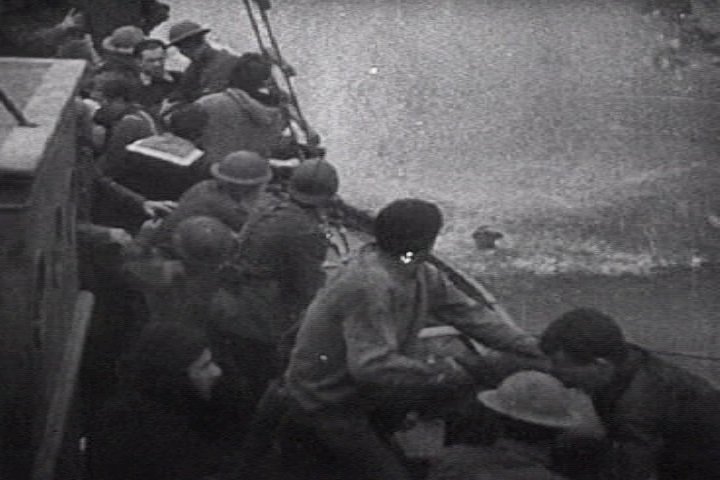
It is Day Two of the Dunkirk Evacuation.
17,804 were evacuated from Dunkirk. In France, 11,874 Allied personnel were evacuated from Dunkirk harbor and 5,930 from the nearby beaches; the latter was possible due to the arrival of many small fishing boats and pleasure craft. This was better than the previous day, but still far short of a miracle. However, numerous small British private vessels begin arriving to rescue as many of the trapped soldiers as they can.
Within Dunkirk, things are getting desperate. One arriving Naval captain sent ashore reports that there are drunken mobs of men pillaging the port. Ammunition is running short in some sectors. However, despite all the problems – the perimeter holds.
The panzers press forward at Cassel and Poperinge, compressing the beachhead toward the sea.
King Leopold III of Belgium ordered the Belgian Army to cease fighting. Belgium surrendered unconditionally to Germany at 4 AM. The Belgian Army lays down its weapons at 04:00 on 28 May 1940, pursuant to the agreement reached on the 27th by King Leopold, who announces:
“Exhausted by an uninterrupted struggle against an enemy very much superior in numbers and material, we have been forced to surrender. History will relate that the Army did its duty to the full. Our Honour is safe.”
The Belgians had fought hard, losing 7,550 men killed and 15,850 men wounded. A few scattered units continue fighting for a while, at least until they receive news of the surrender at 18:00. This decision comes as a surprise both to the Allies and to Leopold’s own government.
The Belgian capitulation raises an immediate problem for the BEF. The Belgian Army had been holding a 20-mile section of the front on the left flank of the Dunkirk beachhead, from Ypres to Dixmude. Fortunately for the British, though, they literally have hundreds of thousands of fully equipped men in the pocket. Everybody knows the stakes, and ad hoc British formations (including some armored cars of the 12th Lancers) waiting for evacuation establish a new line in the Nieuport area against the German 256th Division of the German 18th Army. The hasty redeployment of the British and French forces after the Belgian capitulation prevented the Germans from reaching Nieuport and the Dunkirk beaches. The Wehrmacht occupies Bruges, Zeebrugge, and Ostend.
A corps of French 1st Army (40,000 men) left in the lurch by the British retreat to the Dunkirk perimeter is surrounded by seven German Divisions (3 armored) of the Sixth Army at Lille. General Erwin Rommel’s 7th Panzer Division is one of the besieging formations. The French position may be hopeless, but it is drawing off elite Wehrmacht forces that could be better employed at the beachhead.
A bad-tempered Paul Reynaud announced in a radio address that day that “France can no longer count on the Belgian Army” and said the surrender had been made without consulting the British or French governments. Speaking for the Belgium government, now located in Paris, Belgian Premier Hubert Pierlot declared the action “unconstitutional.” King Leopold III ordered the Belgian army to cease fighting. Unlike his father, King Albert, who refused to surrender to the Germans in World War I, Leopold decided to end the fighting on Belgian soil.
Members of the Belgian government, who had moved to France, declared that Leopold was deposed from the throne. King Leopold’s decision to surrender also exposed the British Expeditionary Force to German attack. Prime Minister Hubert Pierlot announces that the King acted on his own, against the wishes of the rest of the government and outside of his constitutional authority, and “henceforth he has no power to govern.” The Belgian cabinet – in exile – now assumes all governmental functions, and it places all resources at the service of the Allies. The Belgian King, for all intents and purposes, is deposed – but he remains in Belgium and retains loyalty there, though with growing resentment from the populace.
The Belgian surrender did not stop the carnage in Vinkt. Nine hostages were shot after the capitulation. In a style that would subsequently become all too familiar on the Eastern Front, the last five victims had to dig their own graves first. Over the four days ending May 28th, the 225th Division murdered between 86 and 140 civilian victims. On the Western Front, the Vinkt massacre was not only the first major infraction of the Geneva Convention by the German army, but also unique in that it was committed by an ordinary Wehrmacht (Regular German Army) unit, and not by a special SS unit, not even by the Waffen SS. It may be the only notable war crime of the Wehrmacht committed on the Western Front before 1944. Although largely ignored outside Belgium, it did not go entirely unpunished. The German officers were tried in an after war trial.
The German 18th Army occupies Bruges, Zeebrugge, and Ostend, threatening flank of Anglo-French Dunkirk perimeter.
The Wormhoudt massacre (or Wormhout Massacre) took place with the mass murder of 80 British and French POWs by Waffen-SS soldiers from the 1st SS Division Leibstandarte SS Adolf Hitler during the Battle of France in May 1940. Eighty British prisoners of the 2nd Warwickshire Regiment, the Cheshire Regiment, and the Royal Artillery were murdered by members of No. 7 Company, 2nd Battalion SS Liebstandarte at Wormhoudt, France. After their surrender, a large group of soldiers from the 2nd battalion Royal Warwickshire Regiment, 4th battalion Cheshire Regiment, and Royal Artillery as well as French soldiers in charge of a military depot were taken to a barn in La Plaine au Bois near Wormhout and Esquelbecq on 28 May 1940. The Allied troops had become increasingly alarmed at the brutal conduct of the SS soldiers en route to the barn, which included the shooting of a number of wounded stragglers. On arrival at the barn the only British officer in the group, Captain James Lynn-Allen, protested but was immediately rebuked by an SS soldier. The British officer was then shot. When there were nearly 100 men inside the barn, soldiers from the Leibstandarte SS Adolf Hitler, threw stick-grenades into the building killing many POWs. The grenades failed to kill everyone, largely due to the bravery of two British NCOs, Sergeant Stanley Moore and CSM Augustus Jennings, who hurled themselves on top of the grenades using their bodies to suppress the force of the explosion and shield their comrades from the blast. Upon realizing this, the SS called for two groups of five to come out. The men came out and were shot. Despite being shot, Gunner Brian Fahey survived, unknown to the SS men at the time. Concluding that these methods were too slow, the SS troopers simply fired into the barn with their weapons.
Several British prisoners were able to escape, while a few others, like Fahey, were left for dead. A total of 80 men were killed. After a couple of days, Fahey and several others were found by regular German Army medics and taken to hospital. Their wounds were treated before they were sent to prisoner of war camps in occupied Europe. The Waffen-SS regiment (later division), Leibstandarte SS Adolf Hitler was under the overall command of Oberstgruppenführer Sepp Dietrich. It was alleged from post-war testimony that it was specifically soldiers of the 2nd Battalion under the command of then Hauptsturmführer Wilhelm Mohnke that carried out the atrocity. However, Mohnke never had to face a trial for any alleged part in the war crimes based on these hors de combat killings. Mohnke strongly denied the accusations against him, telling historian Thomas Fischer, “I issued no orders not to take English prisoners or to execute prisoners.” Mohnke died in August 2001. In 1947, a number of survivors of the massacre returned to the scene accompanied by officials from the War Crimes Interrogation Unit, following investigations undertaken by the office of the Judge Advocate General. It proved impossible to construct a sufficiently strong case to bring prosecutions. A number of alleged key witnesses were reported to have died on the Eastern Front, while others invoked the “SS Oath” and refused to talk. In 1988, after a campaign by British MP Jeff Rooker, the case was reopened but a German prosecutor came to the conclusion that there was insufficient evidence to bring charges.
The Siege of Lille and the Battle of Abbeville began. At Lille, seven German Divisions trapped the 40,000-strong French First Army. German 6th Army enters Lille and further compresses Dunkirk perimeter.
The German radio in a French-language broadcast called upon the French forces in the “death” pocket to ‘lay down their arms immediately or face annihilation.’
The Battle of the Lys ended in German victory.
There was fierce fighting around Cassel and Poperinghe where Colonel General Gerd von Rundstedt’s troops again pressed forward.
The French 4th Armoured Division under Brigadier General De Gaulle attacks Abbeville, capturing some German outposts and reaching the Somme. However, they fail to take Abbeville or St. Valery. The French armour makes some initial progress, then falls back. The French infantry occupies about half the distance into the bridgehead, but there is massive confusion on both sides as to what is going on. The French take 200 prisoners and appear to be breaking through, but De Gaulle breaks off the attack so that he can regroup his panzers and try another full-scale assault on the 29th.
At Abbeville, the crew of French Char B1 Bis tank “Jeanne d’Arc” gallantly fought on against a German attack despite receiving 90 hits.
RAF Bomber Command dispatches 48 aircraft to attack German positions around Dunkirk during the day.
RAF Bomber Command dispatches 47 aircraft to attack German positions around Dunkirk overnight.
Luftwaffe aircraft attack Allied evacuation fleet off Dunkirk. There is intense aerial activity over Dunkirk. The British claim to have shot down 79 Luftwaffe aircraft on the 27th.
The French send LeO-451 bombers, escorted by Hawker Hurricanes, against Germans lines of communication in the Aubigny sector.
French battleships Courbet (Capitaine de Vaisseau A. M. J. Croiset) and Paris (Capitaine de Vaisseau P. L.Guillerm) of the 3rd Battleship Division arrived at Cherbourg after a ninety six hour refit at Brest which included the installation of anti-aircraft guns. These two battleships had been demilitarized, as had their sister ship Jean Bart (renamed Ocean) for use as training ships in 1931. Battleships Courbet and Paris were to be used against the Germans as expendable gun platforms to extend the Dunkirk perimeter.
At 0131/28th, destroyers HMS Wakeful, HMS Montrose, HMS Worcester, and HMS Mackay arrived at Dover from the Western Approaches for DYNAMO duty.
Destroyers HMS Codrington, HMS Grenade, HMS Javelin, and HMS Jaguar on patrol together in the North Sea were ordered to Dunkirk to pick up troops.
British steamer Abukir (694grt) departed Ostend at 2300/27th after evacuating Ostend. The steamer was sunk in 51 29N, 02 16E by German motor torpedo boat S.34 at 0130. There was a crew of 21 and 210 passengers on steamer Abukir. Sixteen crew and 189 passengers were lost on steamer Abukir. Destroyers Codrington, Jaguar, and Javelin en route to Dunkirk picked up her thirty three survivors.
At 0205, a French patrol boat struck a wreck near Deal Bank Buoy. British drifter Comfort was sent from Dover to locate and tow back the patrol boat.
British diesel channel ferry Queen of the Channel (1162grt) was sunk by German bombers at 0425 in 51-15N, 2-40E after she had embarked 920 men at Dunkirk. There were no casualties on the ship Queen Of The Channel. With the Queen of the Channel in serious distress the nearby coaster Dorrien Rose under Captain W Thompson and carrying military stores approached bow to bow and within thirty five minutes had taken off the troops from the sinking ship. Also taken in tow were four of the Queen of the Channel’s lifeboats, though two would later come adrift. The Dorrien Rose would reach Dover at about 2pm with its valuable cargo.
Destroyer HMS Windsor, which had been ordered to Dunkirk from Goodwins patrol, was near missed by German bombing at South Goodwin Light. The destroyer had one boiler room damaged and there were twenty to thirty casualties on the destroyer. Destroyer Windsor returned to Dover with several hundred troops on board. She spent no time out of service.
Destroyers HMS Anthony and HMS Codrington, which embarked 1600 men in two trips, HMS Esk, HMS Express, and HMS Gallant, which brought back 681 men, HMS Grenade, which brought back 700 men, HMS Harvester, which brought back 700 men, HMS Jaguar, HMS Javelin, HMS Mackay, HMS Malcolm, HMS Montrose, HMS Sabre, HMS Scimitar, HMS Shikari, HMS Verity, and HMS Worcester embarked troops at Dunkirk during the morning of 28 May.
Destroyers Anthony, Codrington, and Javelin, were damaged by German bombing at Dunkirk. The destroyers spent no time out of action.
Destroyer HMS Grafton and Polish destroyer Blyskawica embarked troops from the beach between Malo les Bains and Zuydcoote.
Destroyers Verity, Harvester, Esk, Malcolm, Express, Shikari, and Scimitar were ordered into DYNAMO.
Later in the day, destroyers HMS Intrepid, HMS Ivanhoe, HMS Icarus, and HMS Vanquisher were ordered to Dover for DYNAMO.
Minesweepers HMS Albury, HMS Gossamer, HMS Leda, HMS Kellet, and HMS Sutton operated off the Bray. Minesweepers HMS Salamander, HMS Halcyon, HMS Skipjack, and HMS Waverley operated off La Panne. Minesweepers HMS Ross, HMS Pangbourne, and HMS Lydd were at Dunkirk. Minesweepers HMS Hebe, HMS Sharpshooter, HMS Duchess Of Fife, and HMS Emperor Of India reached Dunkirk during the night of 28/29 May. Minesweepers HMS Oriole and HMS Marmion arrived off the Dunkirk beaches at 0600/29th.
Auxiliary minesweeper HMS Brighton Belle (396grt, Temporary Lt L.K. Perrin RNVR) of the 10th Mine Sweeping Flotilla was sunk in collision with a wreck in the Downs, near the Goodwin Knoll Buoy. The minesweeper was taken in tow, but sank before she got to harbor. Her survivors were rescued by Auxiliary minesweeper HMS Medway Queen.
Minesweeping trawler HMS Thomas Bartlett (290grt, Temporary Skipper J. J. Tomlinson RNR) was sweeping mines off Calais with three other minesweeping trawlers. Trawler Thomas Bartlett struck a mine at 1025 and sank off Calais. Eight crewmen were missing from the trawler.
Anti-submarine trawler HMS Thuringia (550grt, Chief Skipper D. W. L.Simpson DSC, DSM RNR) of the 21st Anti-Submarine Group was sunk on a mine at 0600 in the North Sea. Chief Skipper Simpson was killed. There were only four survivors from trawler Thuringia.
British drifters Boy Roy (95grt) and Paxton (92grt) were damaged by German bombing and were run aground and abandoned at Dunkirk. There were no casualties on either drifter.
French auxiliary minesweeper Marguerite Rose (409grt) was sunk by German bombing at Dunkirk.
British drifter Girl Pamela (93grt) was sunk at 2330 in an accidental collision passing the entrance to Dunkirk harbor on her way to the beaches.
British steamer Marjory H.(84grt) was seized as a prize by German forces near Dunkirk.
Allied forces consisted of British, French, Norwegian, and Polish troops attacked Narvik, Norway across the Rombaksfjord and by land starting at 0015 hours. French 13th Demi-Brigade Legion Etrangere and a Norwegian battalion attack Narvik from the north. Polish Podhale Brigade attacks Narvik from the south. Bad weather grounds the Allied Hurricanes at Bardufoss airfield to the north of Narvik.
German aircraft did not arrive until 0430 hours, but they were able to force the Allied fleet to withdraw after damaging cruiser HMS Cairo (killing 10 and wounding 7). The Stukas have free reign over Narvik for a while, forcing the Allied fleet to withdraw, but the Allied fighters eventually arrive. At 1200 hours, Allied troops captured the city. General Dietl’s German force withdraws from Narvik along rail line toward nearby hills along the Swedish border.
Luftwaffe transports drop 46 troops of 1st Fallschirmjaeger Regiment to reinforce German forces around Narvik.
General Dietl mounts a spirited defense of the city, but it is hopeless. He is aided by the addition of 46 1st Fallschirmjäger Regiment troops dropped during the day. Dietl and his men are forced out by noontime. He and his men head up into the mountains while the Allies occupy Narvik.
Hitler is concerned about the Narvik situation and following it closely, as he does not want to hand the Allies a propaganda victory in Norway while he is achieving his crowning success in France. Dietl thus is determined to do anything necessary to avoid surrendering, including marching his troops across the border to Sweden to be interned if necessary. That, however, is not necessary at this point, though the German troops are badly outnumbered and out-gunned.
With Narvik safely in their hands, the French (13th Demi-Brigade Legion Etrangere), Polish (Podhale Brigade) and a Norwegian battalion consolidate their position. There are attacks by both the small RAF and Luftwaffe forces in the vicinity. The Luftwaffe damages HMS Cairo, an anti-aircraft cruiser.
General Dietl, forced out of Narvik, retreats along the rail line to Sweden.
The British at Bodø prepare to be evacuated by the Royal Navy.
HMS Glorious is detected by a snooper, resulting in one section of 802 Squadron, led by Lt. G. D. D. Lyver, RN, being sent off and ultimately downs one He-111. Thereafter, Glorious is ordered to return to Scapa. She arrives off the harbor at 1600 on the 29th, but is unable to enter due to fog.
Norwegian vessel Blamannen struck a mine laid by French submarine Rubis and sank off Haugesund, Rogaland, with the loss of six crewmen.
The British war cabinet today was split over whether to discuss peace terms with Germany or to continue fighting. Opinion on the side of continuing with the war was led by the prime minister, Winston Churchill, while the side preferring negotiation was led by the Foreign Secretary, Lord Halifax. The disagreement escalated to crisis point and threatened to bring down the Churchill government.
With the British Expeditionary Force in retreat to Dunkirk and the Fall of France seemingly imminent, Halifax believed that the government should explore the possibility of a negotiated peace settlement. His hope was that Hitler’s ally, the still-neutral Italian dictator Mussolini, would broker an agreement. When a memorandum proposing this approach was discussed at the War Cabinet on 27 May, Churchill opposed it and urged his colleagues to fight on without negotiations. He was supported in the war cabinet by its two Labour Party members, Clement Attlee and Arthur Greenwood, and also by the Secretary of State for Air, Sir Archibald Sinclair, who as leader of the Liberal Party was co-opted to the war cabinet for its meetings about the proposed negotiations. Churchill’s biggest problem was that he was not the leader of the Conservative Party and he needed to win the support of ex-Prime Minister Neville Chamberlain, without which he could have been forced to resign by the large Conservative majority in the House of Commons.
On 28 May, Churchill outmaneuvered Halifax by calling a meeting of his 25-member outer cabinet, at which his resolve to fight on was unanimously supported. Halifax then accepted the rejection of his proposal, though he may have been more influenced by the loss of Chamberlain’s support. There is a consensus among historians that Chamberlain’s eventual support for Churchill was a critical turning point in the war.
Prime Minister Churchill, who warned the House of Commons gravely that “hard and heavy tidings” might be expected from a situation of “grievous peril,” kept to himself and his war council the plan for dealing with Belgian capitulation. But in promising a statement “when the result of the intense struggle now going on can be known and measured,” Churchill declared the trapped thousands had and would have “the powerful assistance of the Royal Navy and Royal Air Force.”
Alfred Duff Cooper, British minister of information, told the nation tonight its army stood in great peril, that it would be necessary to withdraw the B.E.F. from the positions it now occupies, but that it was not a “defeated” army which would be withdrawn. “It will be an army whose courage is still high … in which every officer and man still is burning with desire to meet the enemy in com bat,” he said in a broadcast. “The army knows how we have driven the German ships from the sea and how the German Air Force has repeatedly turned tail before us in the air. The army is hungry for the opportunity of meeting German soldiers on the field… Final victory can still be ours. We have not lost the war tonight and assuredly we shall not lose it.” One authoritative London source commenting on the B.E.F.’s predicament said “as long as ammunition lasts we may he sure the B.E.F. will continue the fight.”
Ambassador to France William Bullitt sends a telegram to Secretary of State Cordell Hull. He has a very specific request: that the US sends a cruiser loaded with arms and ammunition to Bordeaux France: “If you cannot send a cruiser of the San Francisco [CA-38] class to Bordeaux, please order the Trenton (CL-11) at Lisbon [Squadron 40-T flagship] to take on fuel and supplies at once for a trip to America and order her today to Bordeaux.” The reason for this odd request is two-fold:
- French fears of a “Communist uprising”; and
- The French and Belgian gold reserves.
The Norwegian gold reserves previously were sent to England, but this time the gold is to be sent across the Atlantic.
President Roosevelt approves the ambassador’s request, and the US Navy sends heavy cruiser USS Vincennes (CA-44) from Hampton Roads, accompanied by destroyers USS Truxtun (DD-229) and USS Simpson (DD-221). They will take the gold first to the Azores, then to New York. As to the expected Communist uprising, that is deemed a French concern.
Bullitt also suggests sending the Atlantic Fleet to the Mediterranean as “one of the surest ways” to keep the French and British fighting the Germans so that the United States will not have to. This suggestion is not taken up.
Air raid sirens droned ominously all over Dublin at noon and again tonight. This was a rehearsal staged by Dublin’s civic air raid precautions authorities to test the system of alarms.
U.S. Army Air Force Colonel Carl Spaatz arrives in Genoa aboard the liner Manhattan on his way to London.
King Carol informs his cabinet that Rumania will disavow neutrality in favor of closer relations with Germany.
British steamer Carare (6878grt) was sunk on a mine in 51 18N, 03 44W. The steamer was carrying a crew of 97 and 29 passengers. Seven crew and three passengers were lost on the steamer Carare. Armed yacht HMS Rhodora rescued eighty six survivors and anti-submarine trawler HMS Cambridgeshire rescued two survivors.
Dispersed from Convoy 60-XF, the French motor passenger ship Brazza (10,387grt) was torpedoed and sunk by the U-37, commanded by Kapitänleutnant Victor Oehrn, at 0924 hours, about 100 miles west of Oporto, Portugal in the eastern Atlantic Ocean (42, 50N, 10, 40W). Of the ship’s complement and passengers, 379 died and 197 survivors were picked up by the French gunboat Enseigne Henry and the armed merchant cruiser HMS Cheshire. The 10,387 ton Brazza was carrying passengers and general cargo and was bound for New Caledonia.
The 177 ton French steam trawler Julien was shelled and sunk by the U-37 off the coast of Portugal at 1630 hours. Of the ship’s complement, all 10 survived.
The Swedish cargo ship Torsten struck a mine and sank in the Kattegat (57°33’N 11°35’E). All 16 crew were rescued.
Convoy OA.157 departed Southend escorted by corvette HMS Gladiolus.
Convoy OB.157 departed Liverpool escorted by sloop HMS Rochester from 28 to 31 May. The sloop was detached to convoy HX.44.
Convoy FN.182 departed Southend, escorted sloop HMS Londonderry. The convoy arrived in the Tyne on the 30th.
Convoy MT.76 departed Methil, escorted by destroyer HMS Wallace. The convoy arrived in the Tyne later that day.
Convoy FS.182 departed the Tyne, escorted by destroyer HMS Wallace. The convoy arrived at Southend on the 30th.
Convoy HG.32F of thirty two ships departed Gibraltar. Destroyers HMS Active and HMS Watchman escorted the convoy from 28 May. Destroyer Watchman was detached to convoy HG.32 on the 29th. Destroyer Active was detached on 1 June. Sloop HMS Leith escorted the convoy from 29 May to 4 June. Corvette HMS Gladiolus escorted the convoy from 3 to 6 June. The convoy arrived at Liverpool on 6 June.
Convoy HX.46 departed Halifax at 0800 escorted by Canadian destroyer HMCS Saguenay, which was detached on the 29th. Convoy BHX.46 departed Bermuda on the 27th escorted by ocean escort armed merchant cruiser HMS Aurania. The convoy rendezvoused with HX.46 on 2 June and the armed merchant cruiser was detached. Destroyer Saguenay turned over the convoy to armed merchant cruiser HMS Comorin at 2130/28th. Armed merchant cruiser was detached on 2 June. Armed merchant cruiser Aurania departed Bermuda and relieved merchant cruiser Comorin which arrived at Bermuda on 6 June. Armed merchant cruiser Aurania was detached on 9 June. Corvette HMS Clarkia and anti-submarine trawler HMS Huddersfield Town escorted the convoy from 9 to 12 June when the convoy arrived at Liverpool.
The War at Sea, Tuesday, 28 May 1940 (naval-history.net)
Heavy cruiser YORK departed Scapa Flow for Rosyth.
British steamer ROYAL SCOTSMAN (3244grt) escorted by destroyers VANOC and WITHERINGTON departed the Clyde at 0300 for Harstad.
En route, destroyer WITHERINGTON was detached at the Faroes to escort British steamer ULSTER PRINCE (3791grt) at Thorshavn back to the Clyde.
Steamer ULSTER PRINCE departed the Faroes on the 29th escorted by anti-submarine trawlers IMPERIALIST and ALOUETTE. The trawlers were to be relieved by destroyer WITHERINGTON.
Destroyer WITHERINGTON arrived at Thorshavn at 1600/29th.
On the 31st, steamer ULSTER PRINCE and destroyer WITHERINGTON arrived at the Clyde at 0400.
Steamer ROYAL SCOTSMAN and destroyer VANOC arrived at Harstad early on 1 June.
Hospital ship ABA departed Scapa Flow for Harstad, routed west of the Shetlands.
Aircraft carrier GLORIOUS 802 Squadron was operating near Narvik. A flight of Lt (A) G.H. J. Feeny (SO), Lt G.D. D’E. Lyver, Lt G.H. N. Ogilvy shot down a Heinkel near Narvik.
Destroyer WREN recovered a body.
Destroyer CAMPBELL departed Greenock at 1730 with Convoy slow NS 4 of steamers BLACKHEATH (4637grt), HARMATTAN (4558grt), and OLIGARCH (6897grt). British steamer MARINA (5088grt) joined the convoy on the 30th from Scapa Flow.
British troopships MONARCH OF BERMUDA (22424grt), GEORGIC (27759grt), FRANCONIA (20175grt), and LANCASTRIA (16243grt), escorted by destroyer AMAZON departed Greenock at 2300 for Harstad.
On the 31st, destroyer WREN departed Scapa Flow to relieve destroyer AMAZON in 63N. Destroyer AMAZON was ordered to proceed to the Clyde.
Destroyers FURY, FORESIGHT, and FORTUNE proceeded to the Humber to operate under orders of Vice Admiral, 18th Cruiser Squadron.
Destroyers FURY and FORESIGHT arrived in the Humber at 2345.
Destroyer SIKH departed Scapa Flow for refitting in the Clyde.
At 2215/28th, a German submarine was reported by the Coast Guard 10 miles 285° from Strathie Point.
Destroyer SIKH was ordered to search for this submarine.
The destroyer made no contact and left the area at 0600/29th and arrived in the Clyde at 0630.
Destroyer ATHERSTONE at Lerwick was ordered to proceed to hunt for a U boat reported by aircraft in a position twelve miles north of North Foreland.
The search was cancelled when nothing was found. Destroyer ATHERSTONE departed for Scapa Flow at 2330 and arrived at 0600/29th.
Destroyer ESCORT arrived at Greenock at 2212 from Liverpool.
Destroyer ANTELOPE departed Greenock at 2030 escorting Norwegian steamer MARITA (1931grt) and British steamer YEWMOUNT (859grt) for Harstad.
Submarine TRUANT departed Harstad for Rosyth.
Submarine TRIBUNE arrived at Rosyth after patrol.
French submarines ANTIOPE and AMAZONE arrived at Dundee.
Belgium surrendered to German forces.
French battleships COURBET (Capitaine de Vaisseau A. M. J. Croiset) and PARIS (Capitaine de Vaisseau P. L. Guillerm) of the 3rd Battleship Division arrived at Cherbourg after a ninety-six-hour refit at Brest which included the installation of anti-aircraft guns.
These two battleships had been demilitarized, as had their sister ship JEAN BART (renamed OCEAN) for use as training ships in 1931.
Battleships COURBET and PARIS were to be used against the Germans as expendable gun platforms to extend the Dunkirk perimeter.
French Amiral Marcel Landriau was named commander of the “Pas de Calais” Flotilla at Dover.
This force, whose flagship was sloop SAVORGNAN DE BRAZZA at Dover, was composed of large destroyers EPERVIER and LEOPARD, destroyers FOUGUEUX and FRONDEUR of the 2nd Destroyer Division, BOURRASQUE of the 4th Destroyer Division, FOUDROYANT of the 5th Destroyer Division, CYCLONE, MISTRAL, and SIROCCO of the 6th Destroyer Division, torpedo boats BRANLEBAS, L’INCOMPRISE, and CORDELIERE of the 11th Torpedo Boat Division, MELPOMENE, BOUCLIER, and FLORE of the 14th Torpedo Boat Division, sloops ARRAS, AMIENS, EPINAL, and AMIRAL MOUCHEZ, and auxiliary sloops PATRIE, REINA DES FLOTS, ASIE, CERONS, SAUTERNES, PESSAC, LISTRAC, and L’ATLANIQUE, but not all ships were fit for operations.
At 0131/28th, destroyers WAKEFUL, MONTROSE, WORCESTER, and MACKAY arrived at Dover from the Western Approaches for DYNAMO duty.
Destroyers CODRINGTON, GRENADE, JAVELIN, and JAGUAR on patrol together in the North Sea were ordered to Dunkirk to pick up troops.
British steamer ABUKIR (694grt) departed Ostend at 2300/27th after evacuating Ostend. The steamer was sunk in 51 29N, 02 16E by German motor torpedo boat S.34 at 0130.
There was a crew of 21 and 210 passengers on steamer ABUKIR.
Sixteen crew and 189 passengers were lost on steamer ABUKIR.
Destroyers CODRINGTON, JAGUAR, and JAVELIN en route to Dunkirk picked up her thirty-three survivors.
At 0205, a French patrol boat struck a wreck near Deal Bank Buoy. British drifter COMFORT was sent from Dover to locate and tow back the patrol boat.
British personnel ship QUEEN OF THE CHANNEL (1162grt) was sunk by German bombers at 0425 in 51-15N, 2-40E after she had embarked 920 men at Dunkirk.
There were no casualties on the ship QUEEN OF THE CHANNEL.
British steamer DORRIEN ROSE (1039grt) picked up her survivors and was escorted back to Dover by destroyer GREYHOUND.
Destroyer WINDSOR, which had been ordered to Dunkirk from Goodwins patrol, was near missed by German bombing at South Goodwin Light.
The destroyer had one boiler room damaged and there were twenty to thirty casualties on the destroyer.
Destroyer WINDSOR returned to Dover with several hundred troops on board. She spent no time out of service.
Destroyers ANTHONY, CODRINGTON, which embarked 1600 men in two trips, ESK, EXPRESS, GALLANT, which brought back 681 men, GRENADE, which brought back 700 men, HARVESTER, which brought back 700 men, JAGUAR, JAVELIN, MACKAY, MALCOLM, MONTROSE, SABRE, SCIMITAR, SHIKARI, VERITY, and WORCESTER embarked troops at Dunkirk during the morning of 28 May.
Destroyers ANTHONY, CODRINGTON, and JAVELIN, were damaged by German bombing at Dunkirk.
The destroyers spent no time out of action.
Destroyer GRAFTON and Polish destroyer ORP BŁYSKAWICA embarked troops from the beach between Malo les Bains and Zuydcoote.
Destroyers VERITY, HARVESTER, ESK, MALCOLM, EXPRESS, SHIKARI, and SCIMITAR were ordered into DYNAMO.
Later in the day, destroyers INTREPID, IVANHOE, ICARUS, and VANQUISHER were ordered to Dover for DYNAMO.
Minesweepers ALBURY, GOSSAMER, LEDA, KELLET, and SUTTON operated off the Bray.
Minesweepers SALAMANDER, HALCYON, SKIPJACK, and WAVERLEY operated off La Panne.
Minesweepers ROSS, PANGBOURNE, and LYDD were at Dunkirk.
Minesweepers HEBE, SHARPSHOOTER, DUCHESS OF FIFE, and EMPEROR OF INDIA reached Dunkirk during the night of 28/29 May.
Minesweepers ORIOLE and MARMION arrived off the Dunkirk beaches at 0600/29th.
Auxiliary minesweeper BRIGHTON BELLE (396grt, Temporary Lt L.K. Perrin RNVR) of the 10th Mine Sweeping Flotilla was sunk in collision with a wreck in the Downs, near the Goodwin Knoll Buoy.
The minesweeper was taken in tow, but sank before she got to harbour.
Her survivors were rescued by Auxiliary minesweeper MEDWAY QUEEN.
Minesweeping trawler THOMAS BARTLETT (290grt, Temporary Skipper J. J. Tomlinson RNR) was sweeping mines off Calais with three other minesweeping trawlers.
Trawler THOMAS BARTLETT struck a Mine at 1025 and sank off Calais.
Eight crew were missing from the trawler.
Anti-submarine trawler THURINGIA (550grt, Chief Skipper D. W. L. Simpson DSC, DSM RNR) of the 21st Anti-Submarine Group was sunk on a mine at 0600 in the North Sea.
Chief Skipper Simpson was killed. There were only four survivors from trawler THURINGIA.
British drifters BOY ROY (95grt) and PAXTON (92grt) were damaged by German bombing and were run aground and abandoned at Dunkirk.
There were no casualties on either drifter.
French auxiliary minesweeper MARGUERITE ROSE (409grt) was sunk by German bombing at Dunkirk.
British drifter GIRL PAMELA (93grt) was sunk at 2330 in an accidental collision passing the entrance to Dunkirk harbour on her way to the beaches.
British steamer MARJORY H.(84grt) was seized as a prize by German forces near Dunkirk.
On the 28th, 17,804 troops were lifted from Dunkirk.
British operation QUIXOTE, the cutting of the six cables between Bacton and Borkum, continued with Destroyers CODRINGTON, GRENADE, JAVELIN, and JAGUAR escorting minesweeping trawlers CAPE MELVILLE, GRAMPIAN, PELTON, MILFORD QUEEN, MILFORD PRINCESS, and JAMES LAY.
Two Skua aircraft of 806 Squadron were attacked down near Goodwin Sands by French fighters. Lt (A) C. P. Campbell Horsfall and Petty Officer Airman L. Clare were wounded their aircraft shot down. They were picked up by a destroyer. Midshipman (A) G.A. Hogg RNVR, was able to return to base with his badly damaged aircraft, but Naval Airman J. B. Burton later died of wounds.
A third Skua of the Squadron was lost on takeoff from Manston on this date.
A Swordfish of 825 Squadron forced landed on Goodwin Sands. S/Lt P. H.L. Rylands was killed, while Captain W. G.S. Aston RM, unhurt.
Another Swordfish of the Squadron crashed into the sea on takeoff. The crew were unhurt.
British steamer CARARE (6878grt) was sunk on a mine in 51 18N, 03 44W.
The steamer was carrying a crew of 97 and 29 passengers.
Seven crew and three passengers were lost on the steamer CARARE. Armed yacht RHODORA rescued eighty-six survivors and anti-submarine trawler CAMBRIDGESHIRE rescued two survivors.
Convoy OA.157 departed Southend escorted by corvette GLADIOLUS.
Convoy OB.157 departed Liverpool escorted by sloop ROCHESTER from 28 to 31 May. The sloop was detached to convoy HX.44.
Convoy FN.182 departed Southend, escorted sloop LONDONDERRY. The convoy arrived in the Tyne on the 30th.
Convoy MT.76 departed Methil, escorted by destroyer WALLACE. The convoy arrived in the Tyne later that day.
Convoy FS.182 departed the Tyne, escorted by destroyer WALLACE. The convoy arrived at Southend on the 30th.
Convoy HG.32F of thirty-two ships departed Gibraltar.
Destroyers ACTIVE and WATCHMAN escorted the convoy from 28 May. Destroyer WATCHMAN was detached to convoy HG.32 on the 29th. Destroyer ACTIVE was detached on 1 June.
Sloop LEITH escorted the convoy from 29 May to 4 June.
Corvette GLADIOLUS escorted the convoy from 3 to 6 June. The convoy arrived at Liverpool on 6 June.
Convoy HX.46 departed Halifax at 0800 escorted by Canadian destroyer HMCS SAGUENAY, which was detached on the 29th.
Convoy BHX.46 departed Bermuda on the 27th escorted by ocean escort armed merchant cruiser AURANIA. The convoy rendezvoused with HX.46 on 2 June and the armed merchant cruiser was detached.
Destroyer SAGUENAY turned over the convoy to Armed merchant cruiser COMORIN at 2130/28th. Armed merchant cruiser was detached on 2 June.
Armed merchant cruiser AURANIA departed Bermuda and relieved merchant cruiser COMORIN which arrived at Bermuda on 6 June. Armed merchant cruiser AURANIA was detached on 9 June.
Corvette CLARKIA and anti-submarine trawler HUDDERSFIELD TOWN escorted the convoy from 9 to 12 June when the convoy arrived at Liverpool.
American heavy cruiser USS VINCENNES (CA-44, Captain J. R. Beardall) and destroyers USS TRUXTON (DD-229, LCDR B. B. Adell) and USS SIMPSON (DD-221, LCDR H.W. Chanler) departed Norfolk, Virginia to proceed to Lisbon to reinforce Squadron 40-T.
This squadron arrived at Ponta Delgada on 4 June and departed for Casablanca on 6 June.
U-37 sank French steamer BRAZZA (10,387grt) in 42 43N, 11 00W and escorting trawler JULIEN (177grt) in 42 50N, 10 40W.
The entire crew of the trawler, ten men, was safely landed.
Light cruiser DRAGON arrived at Aden, transferring to the 4th Cruiser Squadron.
Light cruiser DRAGON proceeded to Durban for refitting.
The U.S. National Defense Advisory Committee is established, which includes in its membership former automobile manufacturer William S. Knudsen, corporate executive Edward R. Stettinius, labor leader Sidney Hillman, and economist Leon Henderson. There is, however, no head to this group, which only serves to advise President Roosevelt on defense issues.
By a vote of 402 to 1, the U.S. House of Representatives passed and sent to the Senate today a bill authorizing a $1,137,000,000 expansion of the navy’s air force and of its system of aviation bases. The lone dissenting vote was cast by Representative Marcantonio, New York American Labor, who has objected that the current armaments program tends toward involvement in war abroad. The bill carries no funds (actual appropriations being left for later measures) but it sets the minimum of navy planes at 10,000 and the number of pilots at 16.000. The construction and expansion of a far-flung system of naval air bases, authorized by the legislation, would cost approximately $144,132,000. Earlier the chamber, with Marcantonio alone dissenting and 400 members voting “aye,” passed legislation to speed up construction of warships by permitting the navy to slash through what was called “red tape.”
Under this bill, which now goes to the Senate, the competitive bidding system would be replaced by negotiated contracts. Contracts up to $25,000 would be exempt from the present law’s provision limiting profits to 10 percent. Certain labor regulations also would be relaxed. Talk of fortifying Guam, island in the far Pacific, revived during discussion of the air force bill, and Representative Maas, Minnesota Republican, senior minority member of the House Naval Committee, declared that if he had his way “I’d fortify Guam tomorrow.” “One of the worst votes cast in this house was when we rejected the fortification of Guam,” he shouted. “If we had fortified Guam two years ago, we wouldn’t be worrying now about what is going to happen to the Dutch East Indies.”
Marcantonio’s opposition was largely Moscow-directed. He was a socialist who fought against U.S. involvement in the “Imperialist War” until Soviet policy changed with Barbarossa in June 1941, then spent much of the rest of the war following the new Moscow Line by agitating for an early Second Front. He finally lost his seat in Congress in 1950 for his opposition to U.S. involvement in the Korean conflict. He claimed that, in spite of abundant evidence, South Korea had attacked the North.
[Ed: In case you thought Alexandra Ocasio-Cortes was the first Communist idiot elected by New Yorkers…]
The combined forces of the Administration and the leadership of Congress swung solidly today behind the movement to levy about $700,000,000 in new taxes at this session to finance the enlarged program of national defense.
German sources reported today that numerous American ambulances and hospital equipment have fallen into Nazi hands. German wounded are using some of the American hospital facilities provided by the Franklin foundation. The Voelkischer Beobachter said some American non-military personnel had been overtaken in the German advance.
A forecast of President Roosevelt’s renomination was made today by Senator Wheeler. Until today he has steadily insisted that the President would not accept a renomination.
Mrs. Eleanor Roosevelt expressed strong approval of Youth Services, a newly formed self-service employment agency for young people in the Yorkville district, after a visit yesterday to the offices of the center in New York.
Henry Ford, who has been a life-long opponent of war in any form, said today that much as he hated war, “if it became necessary the Ford Motor Company could, with the counsel of men like Lindbergh and Rickenbacker, under our own supervision and without meddling by government agencies, swing into the production of a thousand airplanes of standard design a day.” It would take about six months under those conditions to reach that level of production, he said in an interview.
[Ed: This will lead to the famous Willow Run plant.]
Secretary of the Navy Charles Edison announced tonight that a heavy cruiser and two destroyers are proceeding to Europe to protect “American interests.” The secretary said that the heavy cruiser Vincennes and the destroyers Truxton and Simpson were proceeding from the east coast of the United States to Lisbon, Portugal.
In view of the amount of money the Army has had to spend for routine upkeep since 1925, “it is rather remarkable that we have been able to maintain any mobile ground army at all,” Secretary Woodring said in a formal statement today.
Robert H. Goddard offered all his research data, patents, and facilities for use by the military services at a meeting with representatives of Army Ordnance, Army Air Corps, and Navy Bureau of Aeronautics arranged by Harry Guggenheim. Nothing resulted from this except an expression of possible use of rockets in jet-assisted take-offs of aircraft.
The stage musical “Louisiana Purchase,” satirizing Huey Long’s political power, with music and lyrics by Irving Berlin and book by Morrie Ryskind premiered at the Imperial Theatre on Broadway.
Major League Baseball:
The White Sox, who had won six of their last seven games, ran into a barrage of timely homers and double plays today and dropped a double-header to the Browns, 10–9 and 7–5. The double triumph moved the Browns into sixth place. Browns’ first baseman George McQuinn went five-for-nine on the day; two of them in the opener were two-run homers.
If the Yankees have a slightly dizzy look about them today, it is merely because they find themselves in more rarefied atmosphere. By beating the Senators in both ends of a double-header at the Stadium yesterday, 12–4 and 3–1, they rocketed into the first division, vaulting from sixth to fourth place. The Yankees ponded out 14 hits in the opener; in the nitecap, Marvin Breuer scattered seven hits for the win.
Bunching six of their fourteen hits in the last two innings to break a 1–1 tie, the Red Sox beat the Athletics, 4–1, before 27,151 at Shibe Park tonight. The defeat was the fifth straight setback for Philadelphia.
The Tigers pulled within a game and a half of second-place Cleveland today on Al Benton’s excellent relief twirling. The 8–5 triumph was the Tigers’ second straight over the Indians.
Young Max Lanier limited the Cubs to four singles today for a 5–0 shut-out victory, enabling the Cardinals to even the series at a game apiece. Vern Olsen, Cub rookie southpaw, allowed one scratch hit in the first five innings, but the Cards ganged up on him in the sixth for four runs.
Freddie Fitzsimmons allowed just six hits and his Brooklyn Dodgers beat the Phillies, 4–2. The Dodgers got 11 hits and two critical fielding gems by first baseman Dolf Camilli in the Phillies’ sixth that kept the Philadelphia rally for scoring more.
Holding the Reds to five hits, Max Butcher of the Pirates rang up his first victory of the season today, 5–2. It was the first time this year that Frankie Frisch’s team succeeded in beating the National League champions.
Philadelphia Phillies 2, Brooklyn Dodgers 4
St. Louis Cardinals 5, Chicago Cubs 0
Detroit Tigers 8, Cleveland Indians 5
Washington Senators 4, New York Yankees 12
Washington Senators 1, New York Yankees 3
Boston Red Sox 4, Philadelphia Athletics 1
Cincinnati Reds 2, Pittsburgh Pirates 5
Chicago White Sox 9, St. Louis Browns 10
Chicago White Sox 5, St. Louis Browns 7
A bill authorizing the U.S. Secretary of War and the Secretary of the Navy to assist the twenty sister republics of the United States in adding to their military and naval establishments was sent to President Roosevelt by Congress today as Sumner Welles, Under-Secretary of State, stated that all of the Latin-American nations were prepared to unite against aggression from any quarter in the belief that an attack on any one of them would challenge the security of all. The measure, approved by the House on July 24, 1939, was unanimously passed by the Senate today. The President is expected to sign it promptly. The bill permits the manufacture in factories and arsenals of this country of coast defense and anti-aircraft ordnance, ammunition, vessels, and armaments generally, provided the defense program of the United States is not impeded.
Japanese bombers attacked Chungking, China in multiple waves. Hundreds of new dead and injured and blocks of smashed-up buildings were left in the wake of Japanese bombers that carried out the most tragic and disastrous raid of the year on Chungking. The raiders attacked the chief residential district of the city and their bombs were unloaded, apparently indiscriminately, along the capital’s main thoroughfares. The casualties are expected to exceed 500, of which the majority are dead.
The Soviet, French and Belgian Embassies miraculously escaped direct hits. All were bracketed by bombs exploding from fifteen to fifty yards away, and were extensively damaged. All had their windows knocked out and plaster and fixtures damaged. A rented building adjoining the Soviet Embassy compound, housing the Russian staff, was demolished by a direct hit, but the occupants were safe in the embassy’s impregnable bomb tunnel. On the campus of the American Methodist Mission a bomb leveled the home of a Chinese school superintendent. Slight damage was also done to the nearby Methodist Union Hospital and to the adjacent home of an American missionary.
Not far away a German boarding house, where the German Embassy staff lives, was reduced to a shambles when an adjoining building received a direct hit. A number of bombs fell on the foreign press hotel compound, and the failure of the nearest to explode saved the press men’s home. Bombs also fell on a section of Chungking north of the Kialiang River, but damage there was not extensive.
Dow Jones Industrial Average: 114.26 (-2.09)
Born:
Betty Shabazz, American educator and civil rights activist who was the widow of Malcolm X, in Pinehurst, Georgia.
Maeve Binchy [Snell], Irish novelist (“Light a Penny Candle”), in Dalkey, Ireland (d. 2012).
Tom Petri, American politician (Rep-R-Wisconsin, 1979-2015), in Marinette, Wisconsin.
Died:
Walter Connolly, 53, American film actor (“It Happened One Night”, “Good Earth”), from a stroke.
Randle Ayrton, 70, British actor (“The Manxman”, “Nell Gwyn”).
Prince Frederick Charles of Hesse, 72, King of Finland in 1918.
Naval Construction:
The Kriegsmarine (German Navy) Type IXD2 U-boats U-177, U-178, U-179, and U-180 are ordered from AG Weser, Bremen (werk 1017-1020).
The Royal Canadian Navy Flower-class corvette HMCS Sackville (K 181) is laid down by Saint John Dry Dock and Shipbuilding Co. Ltd. (Saint John, New Brunswick, Canada).
The Вое́нно-морско́й флот СССР (ВМФ) (Soviet Navy) “M” (Malyutka)-class (3rd group, Type XII) submarines M-119 and M-122 are laid down by Krasnoye Sormovo (Gorkiy, U.S.S.R) / Yard 112.
The Вое́нно-морско́й флот СССР (ВМФ) (Soviet Navy) “M” (Malyutka)-class (3rd group, Type XII) submarine M-121 is laid down by Marti Yard (Nikolayev, U.S.S.R.) / Yard 198.
The Royal Navy Fairmile A class motor launch HMS ML 101 is commissioned.
The Royal Navy ASW trawler HMS Lady Rosemary (FY 253) is commissioned. Her first commander is T/Skipper Robert James McCullogh, RNR.
The Kriegsmarine (German Navy) Type IIB U-boat U-121 is commissioned. Her first commanding officer is Kapitänleutnant Karl-Ernst Schroeter.
 History Diaries