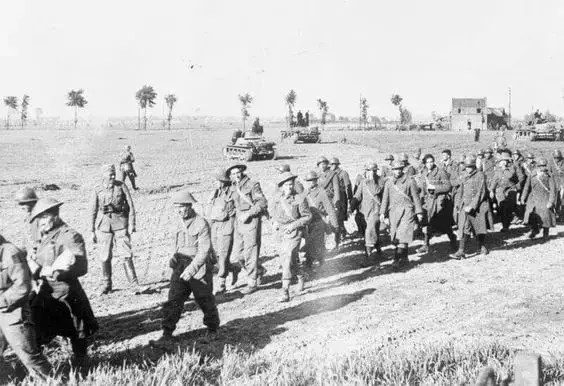
It is Day One of the Dunkirk Evacuation.
The Dunkirk evacuation codenamed Operation DYNAMO began. The British and French begin evacuating Dunkirk. The French, after learning of the scope of the operation, feel they are being abandoned. General Weygand hears about the decision and phones Churchill in a fury, saying “Your decision dishonors Britain.” French troops also will be taken off and transshipped to southern French ports such as Cherbourg as possible, but it is a Royal Navy operation and the priority is BEF soldiers.
By the end of 27 May, 7,669 troops had been evacuated from Dunkirk. Such a pace clearly could not lift off more than a slim fraction of the trapped troops in France.
Late on the 26th, the Admiralty ordered Operation DYNAMO to commence.
Patrols were deployed in the southern North Sea as follows just prior to DYNAMO’s activation. Light cruiser HMS Galatea and Nore destroyers HMS Codrington, HMS Javelin, and HMS Jaguar were south of Inner Gabbard and west of the Galloper to south Falls Buoy in 52-00N, 00-30E. Light cruiser HMS Galatea departed Sheerness at daylight on the 27th, but was recalled. South Fairy Bank to Kwinte Buoy were Dover destroyers HMS Greyhound and HMS Grafton off Yarmouth. On Stations OC.1 and OC.2 was Dover destroyer HMS Grenade. Off the North Goodwins to T Buoy and 51-18N, 2-13E on the Wandelaar searched channel were destroyers HMS Gallant, HMS Vivacious, and ORP Blyskawica. At each end of the R, S, T Buoys were two anti-submarine trawlers. Minesweepers HMS Skipjack and HMS Halcyon and Trinity House Vessel Patricia covered by destroyer HMS Impulsive swept the “X” route to DYNAMO.
Captain Tennant, who was to direct DYNAMO from France, arrived at Dunkirk on destroyer HMS Wolfhound. Destroyer Wolfhound was to have been the communications link with Dover, but she was soon released to carry troops. Destroyers HMS Wolsey and HMS Wolfhound escorted two trawlers back to Dover after embarking troops at Dunkirk. After embarking troops at Dunkirk, armed boarding vessel HMS Mona’s Isle (1688grt) was damaged by German bombing west of Dunkirk, between Gravelines and Les Hemmes. Armed boarding vessel Mona’s Isle was towed by tugs HMS Lady Brassey and HMS Simla and escorted by destroyer HMS Windsor to Dover.
Anti-aircraft cruiser HMS Calcutta, destroyers HMS Anthony, HMS Gallant, HMS Impulsive, HMS Sabre, HMS Vivacious, and HMS Vimy and four minesweepers, including HMS Skipjack and HMS Halcyon, also operated off Dunkirk on the 27th. Destroyer HMS Wakeful arrived at Dover from Plymouth and proceeded immediately to Dunkirk. Anti-aircraft cruiser HMS Calcutta operated off La Panne. Destroyer HMS Impulsive had arrived at Dover for another purpose, but was diverted to DYNAMO operations.
An Anglo-French naval conference is held at Dover to settle details of Dunkirk evacuation.
An Anglo-French military conference is held at Cassel to organize and strengthen Dunkirk perimeter.
At Dunkirk, British Admiralty officers combed nearby boatyards for small craft that could ferry personnel from the beaches out to larger craft in the harbor, as well as larger vessels that could load from the docks. An emergency call was put out for additional help, and by 31 May nearly four hundred small craft were voluntarily and enthusiastically taking part in the effort.
At Calais, Vice-Admiral Bertram Ramsay sends the motor yacht Gulzar to the port to see if it can bring back any remaining BEF troops. After being shot at by German troops who have occupied the town, the yacht sees some British troops on the eastern jetty, takes them aboard, and heads back to Dover. A few more British troops are holding out in the Calais citadel, and the RAF drops some last supplies for them at dawn, losing three Lysanders in the process. German artillery in Calais sinks British vessel Sequacity, discouraging further Royal Navy attempts to approach the port.
The Luftwaffe heavily bombed Dunkirk, both the town and the dock installations. As the water supply was knocked out, the resulting fires could not be extinguished. An estimated thousand civilians were killed, one-third of the remaining population of the town. The Luftwaffe was met by 16 squadrons of the Royal Air Force, who claimed 38 kills on 27 May while losing 14 aircraft. Altogether, over 3,500 sorties were flown in support of Operation Dynamo. The RAF continued to take a heavy toll on the German bombers throughout the week. Soldiers being bombed and strafed while awaiting transport were for the most part unaware of the efforts of the RAF to protect them, as most of the dogfights took place far from the beaches. As a result, many British soldiers bitterly accused the airmen of doing nothing to help. Knowing the truth of it, Churchill made a point of stating in his address in the House on 4 June that the evacuation had been made possible through the efforts of the Air Force.
General Guderian advances from the Aa River toward Dunkirk using his motorized infantry.
There are 4 British Divisions under General Sir Alan Brooke holding the Ypres-Comines canal. This becomes known as the Battle of Wytschaete. The Panzers are closing in and now are within 4 miles of the port facilities. The entire city is within range of German artillery, but naval operations are possible (with losses) despite shelling and Luftwaffe attack. The British line must hold right where it is for the evacuation to succeed, and for several days.
Nobody needs any maps or directions to orient themselves with regard to the port. It is a blazing mess, spewing a huge column of smoke visible for miles. The RAF is attempting to achieve aerial supremacy over the port and is largely succeeding, but the Luftwaffe planes can still get through and cause a lot of damage even if many are shot down.
The Germans drop propaganda leaflets on the shrinking beachhead, urging surrender.
German armor units resumed their attacks in an attempt to cut off the British and French forces around Lille. A desperate defense enabled most of the Allied troops to get away to positions nearer the coast. German tanks and aircraft maintained pressure, however, pushing them back four miles toward the coast and placing Dunkirk within artillery range.
German 18th Army driving remnants of Belgian Army back toward Bruges and Zeebrugge. The Belgian line begins to give way during the morning. The Germans get through the Allied defensive line in multiple spots by 11:00: Maldegem, Ursel, and Thielt/Roeselare. The Chasseurs Ardennais evacuate Vinkt, which the Germans occupy, around 16:00. At 17:00, King Leopold sends a messenger to German headquarters to discuss terms. The messenger returns with the message:
“The Führer demands that arms be laid down unconditionally.”
At Vinkt, Belgium, the Belgian Chasseurs ardennais were still holding and defending the bridge over the Schipdonk Canal against vastly superior odds. For unclear reasons, the German 225th Division now started to execute their hostages, and taking new ones, executing them on the spot. Refugees were taken out at random from the endless columns on the trek south and executed immediately. One priest managed to escape buried under two dead colleagues. He was one of four such victims managing to escape to tell the tale.
King Leopold III of Belgium offered surrender terms to Germany and decided to remain in the country. Germany responded at 2200 hours, demanding an unconditional surrender. At 23:00, King Leopold agrees to a ceasefire as of 04:00 on 28 May, with fighting to continue until then.
Winston Churchill sends a message to Admiral Sir Roger Keyes, regarding the impending capitulation of Belgium: “Belgian Embassy here assumes from King’s decision to remain that he regards the war as lost and contemplates [a] separate peace. It is in order to dissociate itself from this that the constitutional Belgian Government has reassembled on foreign soil. Even if present Belgian Army has to lay down its arms, there are 200,000 Belgians of military age in France, and greater resources than Belgium had in 1914 which to fight back. By present decision the King is dividing the Nation and delivering it into Hitler’s protection. Please convey these considerations to the King, and impress upon him the disastrous consequences to the Allies and to Belgium of his present choice.”
14th Company of the 3rd SS Panzer Totenkopf Division, commanded by Hauptsturmführer Fritz Knöchlein, carried out the Le Paradis massacre, leading captured British soldiers of the Royal Norfolk Regiment to a wall and machine-gunning them. 97 were killed but 2 survived and would give eyewitness testimony after the war that would lead to Hauptsturmführer Fritz Knoechlein being convicted and executed as a war criminal.
The British and French counter-attack against the German bridgehead held by 38 Corps at Abbeville south of the Somme.
RAF Bomber Command dispatches 48 aircraft to attack German positions around Dunkirk during the day.
There is heavy air-to-air combat over Dunkirk, with the RAF claiming over 50 victories.
Werner Mölders claimed his 19th and 20th victories southwest of Amiens, France; the victims were both P-36 fighters.
James Lacey shot down two German He 111 bombers.
At 1418, destroyers HMS Wakeful, HMS Mackay, HMS Worcester, and HMS Montrose from the Western Approaches Command and destroyer HMS Shikari and HMS Scimitar from Portsmouth were ordered to Dover for DYNAMO operations.
French steamer Aden (8033grt) was sunk by German bombing at Dunkirk.
French auxiliary minesweeper La Majo (47grt) was sunk by German bombing at Dunkirk.
British steamer Worthtown (868grt) was sunk by German bombing at Dunkirk. Steamer Worthtown was later salved and renamed Ilse Schulte for German service.
British steamer Biarritz (2388grt) was damaged by German shore guns near Dunkirk.
British drifter Ocean Reward (95grt, Probationary Temporary Lt H.C. Slater RNR) was sunk in a collision with British steamer Isle Of Thanet (2701grt), just arriving from Dunkirk, off Dover. Drifter Ocean Reward sank with no survivors and steamer Isle Of Thanet was seriously damaged. Tug HMS Lady Brassey searched for survivors.
The British cargo ship Atlantic Guide was sunk as a blockship at Zeebrugge, West Flanders, Belgium.
The British refrigerated cargo liner Borodino was also sunk as a blockship at Zeebrugge, West Flanders, Belgium.
The French cargo ship Cap Tafelneh was bombed and sunk at Dunkirk in a Luftwaffe air raid. She was refloated on 13 May 1941, repaired and entered German service as Carl Arp.
HMS Grafton ferried 860 men to Dover and returned the following day to pick up another 800. On passage back to England, Grafton stopped to assist with the rescue of survivors from another destroyer that had been sunk, but while doing so was herself torpedoed by the U-Boat, U-62. Despite being packed with troops, Only 4 people were killed and other vessels took on the remaining troops and ship’s company. HMS Grafton was scuttled by gunfire.
The Luftwaffe bombs and strafes Bodø in the evening. There are 12 deaths, and 5,000 are made homeless. The British troops have broken off contact with the German 2d Mountain Division and are preparing for evacuation.
Royal Navy forces begin bombarding Narvik in preparation for assault.
The first assault wave of Legionnaires and Norwegians embarked well inside Herjangs Fjord, which was concealed from Narvik by high ground behind the town of Oyjord. While every available warship pounded the Narvik-Ankenes area, the first wave swept into and across Rombakken Fjord. Legionnaires poured ashore and cleared a beachhead. HMS Glorious remains off Narvik.
When bad weather at the Bardufoss airfield grounds the Allied fighters, the attack is briefly held up because the ships providing bombardment support have to fight off the Stukas alone.
Luftwaffe transports drop 46 troops of 1st Fallschirmjaeger Regiment to reinforce German forces around Narvik.
The Allies took Narvik the next day.
The final assault on Narvik began at 2340 27 May. Destroyers HMS Havelock, HMS Beagle, HMS Fame, HMS Walker, and HMS Whirlwind operated in Rombaksfjord. Anti-aircraft cruisers HMS Cairo (Flag Lord Cork) and HMS Coventry (Flag Vivian) with destroyer HMS Firedrake were in Ofotfjord. Light cruiser HMS Southampton was in position to bring support to the Ankenes peninsula and sloop HMS Stork protected the landing craft of the operation. Anti-aircraft cruiser Cairo was hit by two bombs at 0620/28th and was badly damaged with nine ratings killed and S/Lt B. H.Moss RNVR, Gunner J. L.Thundercliffe, six ratings wounded. One of the ratings died of wounds. One bomb struck abaft B position, penetrated the deck, exploded among the supply party. The second bomb hit the starboard. 5″ anti-aircraft gun mounting. Light cruiser Southampton was near missed by German bombing and had two ratings killed by bomb splinters. Captain F. H.W. Jeans, CVO, was wounded. Damage to light cruiser Southampton required ten days to repair by local facilities. Anti-aircraft cruiser Coventry was near missed and sustained one rating killed by bomb splinters. Destroyers Havelock, Walker, and Whirlwind all sustained minor damage from near misses of air bombs. Destroyer Walker’s damage required ten days to repair once she returned to England. Destroyers Havelock and Whirlwind had no time out of service.
At 0630, Lord Cork withdrew with his force seaward leaving anti-aircraft cruiser Coventry and destroyers Beagle and Firedrake to support the troops. Destroyers HMS Delight and HMS Echo joined Coventry later in the day. Cruiser Cairo departed Harstad with the survivors from cruiser Curlew and arrived at Scapa Flow at 1700/30th. At Scapa Flow, the Curlew survivors were taken aboard minesweepers HMS Seagull and HMS Speedy and taken ashore. The minesweepers departed Scapa Flow at 0530/31st escorted by destroyer HMS Mashona to Scrabster. Cruiser Cairo departed Scapa Flow on the 31st for the Tyne for repairs completed on 7 August. On 12 August, anti-aircraft cruiser Cairo was back in service. Anti-aircraft cruiser Cairo between 11 May and 28 May in operations near Narvik had fired 5700 rounds of anti-aircraft ammunition. Several of her guns, the rifling in the barrels worn smooth, were out of action. At 2200/28th, Narvik was announced captured by Anglo-French forces.
French submarine Rubis, which departed Dundee on the 23rd, laid minefield FD.15 at 0435 near Haugesand at Bleivik in 59 28N, 05 13E. On the 28th, Norwegian steamer Blammarren (174grt) was lost on this minefield. On the 31st, Norwegian steamer Jadarland (938grt) was lost on this minefield. In October, Norwegian steamer Oyulf (173grt) was lost on a mine in Haugesand. This loss may be from the Rubis minefield. French submarine Rubis safely arrived back at Dundee on the 30th.
British steamer Sequacity (870grt) was sunk by German shore guns one and a half miles from number two buoy to the east of Calais, in 52-04-20N, 1-38-36E. Steamer Sequacity’s thirteen man crew were rescued by British steamer Yewdale (823grt).
British steamer Yewdale (823grt) was damaged by German shore guns off the French Channel Coast at 0400.
There are discussions within the cabinet about whether to pursue peace talks with Mussolini as the mediator. Prime Minister Winston Churchill is a hawk, Foreign Minister Lord Halifax is a dove. There is general agreement, though, that some kind of a deal under the right terms would be acceptable. As Churchill says at one point, “I would be happy to get out of our present difficulties” under the right arrangement.
Italy went on openly preparing for war against the Allies today, but no vital step was taken.
The British sugar ration was reduced from 12 ounces to 8 ounces per person.
The British government abandoned the notion to introduce conscription to Northern Ireland.
The three leading political parties of Ireland united today to preserve the country’s neutrality as the government announced that the army would be placed on a war footing at once.
Erwin Rommel was awarded the Knight Cross medal.
King Carol signs agreement to provide oil to Germany in exchange for captured Polish weapons.
French, British and Turkish representatives begin extended conferences in Haifa regarding what assistance the Allies are willing to offer Turkey.
Sir Stafford Cripps, Laborite member of Parliament, has started for Moscow as head of a small British trade mission that will endeavor to work out the problems of British-Russian trade on the basis—at least as far as the British are concerned—of the fact that Britain is at war with Germany and must regard her trade as one of the weapons in her armory.
RAF Bomber Command dispatches aircraft to attack oil refineries and other targets in Germany overnight.
RAF Bomber Command dispatches aircraft to attack various targets in France and Belgium overnight.
Royal Navy battlecruiser HMS Hood, her refit completed, departed Devonport at 1100 escorted by destroyers HMS Escort, HMS Witch, HMS Wolverine for Liverpool where they arrived on the 28th.
U-37 (Kapitänleutnant Victor Oehrn) sank British steamer Sheaf Mead (5008grt) in 43 48N, 12 38W, straggling behind convoy OG.31F, Argentine steamer Uruguay (3225grt) 160 miles off Cape Villano, at position 43-40N, 12-16W, at 1551 hours. Thirty one of the crewmen from the steamer Sheaf Mead were lost. Seven crewmen were rescued by Greek steamer Frangoula B. Goulandris (6701grt). Fifteen crewmen from the steamer Uruguay were lost. Thirteen survivors were landed at Corunna. The 5,008 ton Sheaf Mead was carrying ballast and was bound for Philadelphia, Pennsylvania.
The unescorted and neutral Argentinean Steam merchant Uruguay was also sunk by the U-37 approximately 160 miles west of Cape Villano off the west coast Spain (43°40’N 12°16’W). At 2112 hours on 27 May 1940, U-37 fired one G7a torpedo at the unescorted and neutral Uruguay (Master Antonio Garcia) about 160 miles west of Cape Villano and missed. Only noticing the neutral markings after firing, the U-boat then surfaced and stopped the ship with a shot across the bow. The Germans examined the papers but found no signature on the sailing order, unknown to them the ship had been bound for Antwerp but due to the German invasion of Belgium was ordered by radio message to Ireland. Oehrn found this suspicious and decided to sink the vessel in accordance with the prize rules, ordering the crew to abandon ship within 20 minutes. A German boarding party went aboard the Uruguay to place four scuttling charges which exploded at 2148 hours. The sinking was hastened with six rounds from the deck gun. The Argentinian crew abandoned ship in two lifeboats and the Germans reported that the men were not angry about the sinking and they even wished good luck to each other when leaving the area. The master and twelve crew members were picked up by the Spanish steam trawler Ramoncin and landed at Corunna, Spain. The other boat with 15 occupants was never found. The 3,425 ton Uruguay was carrying maize, wheat, and flax and was bound for Limerick, Ireland.
French battleships Provence and Bretagne, large destroyers Tigre and Lynx, destroyers Brestois and Boulonnais departed Mer el Kebir on patrol.
HMS Ark Royal remains at Greenock loading stores, ordnance, and ammunition.
Convoy OA.156 departed Southend escorted by corvette HMS Periwinkle from 27 to 29 May.
Convoy OB.156 departed Liverpool escorted by sloop HMS Folkestone from 27 to 30 May. The sloop was detached to convoy SL.32.
Convoy MT.75 departed Methil, escorted by destroyer HMS Valorous. The convoy arrived in the Tyne later that day.
Convoy FS.181 departed the Tyne, escorted by destroyer HMS Valorous. The convoy arrived at Southend on the 29th.
The War at Sea, Monday, 27 May 1940 (naval-history.net)
Battlecruiser HOOD, her refit completed, departed Devonport at 1100 escorted by destroyers ESCORT, WITCH, and WOLVERINE for Liverpool where they arrived on the 28th.
Destroyer ATHERSTONE was at Lerwick to provide local defense protection until shore batteries were erected.
Destroyer ESKIMO was towed by repair ship VINDICTIVE from Skelfjord to Harstad arriving on the 17th.
Destroyer ESKIMO departed Harstad at 0100/27th under the tow of tug BANDIT and escorted by sloop FLEETWOOD. British steamer DEVON CITY (4928grt), cable ship LASSO, and captured German steamer ALSTER (8514grt) accompanied this force.
Destroyer AMAZON joined this group on the 30th.
Destroyer VOLUNTEER left her convoy of troopships BATORY and SOBIESKI, en route to Harstad, to join the ESKIMO group on the 30th.
Sloop FLEETWOOD was relieved on the 31st by destroyer WREN, which departed Scapa Flow on the 31st, FLEETWOOD arrived in Scapa Flow at 0300 on 1 June.
Boom carrier DEVON CITY arrived at Scapa Flow at 2157/31st with her commanding officer, ten other officers, 184 other ranks of a Royal Marine Field Unit.
Steamer ALSTER arrived with her prize crew at Scapa Flow at 2200/31st with passengers embarked of twenty-seven British officers and one hundred and eighty-two other ranks, nine officers and thirty-seven Norwegian, ten officers and sixty-two German prisoners.
Destroyer ESKIMO at 2300 on 1 June was ordered to proceed directly to Barrow and Furness.
Steamer ALSTER arrived at Rosyth during the forenoon of 4 June.
Destroyer ESKIMO arrived at Barrow in Furness at 1130/4 June.
Destroyers WREN and VOLUNTEER returned to the Clyde after the escort duty. They arrived at 1600/4 June.
Destroyer ESKIMO was under repair until late September 1940.
Destroyer ELECTRA departed Greenock at 0030 for Scapa Flow after repairs.
En route, destroyer ELECTRA investigated two suspicious vessels, one in Loch Indaal and one southwest of Ame Island, Islay.
There was nothing to report and the destroyer arrived at Scapa Flow at 2300.
Submarine TRUANT arrived at Harstad.
When a Blenheim aircraft was reported by Wick to be down in the sea off Dunnet Head, anti-submarine trawlers PETER HENDRICKS and PAUL RYKENS were ordered to search. The search was later cancelled when aircraft were unable to locate any survivors.
U-37 sank British steamer SHEAF MEAD (5008grt) in 43 48N, 12 38W, straggling behind convoy OG.31F, and Argentine steamer URUGUAY (3225grt) 160 miles off Cape Villano, in 43-40N, 12-16W.
Thirty-one crew from the steamer SHEAF MEAD were lost. Seven crew were rescued by Greek steamer FRANGOULA B. GOULANDRIS (6701grt).
Fifteen crew from the steamer URUGUAY were lost. Thirteen survivors were landed at Corunna.
French submarine RUBIS, which departed Dundee on the 23rd, laid minefield FD.15 at 0435 near Haugesand at Bleivik in 59 28N, 05 13E.
On the 28th, Norwegian steamer BLAMMARREN (174grt) was lost on this minefield.
On the 31st, Norwegian steamer JADARLAND (938grt) was lost on this minefield.
In October, Norwegian steamer OYULF (173grt) was lost on a mine in Haugesand. This loss may be from the RUBIS minefield.
French submarine RUBIS safely arrived back at Dundee on the 30th.
The final assault on Narvik began at 2340 27 May.
Destroyers HAVELOCK, BEAGLE, FAME, WALKER, and WHIRLWIND operated in Rombaksfjord.
Anti-aircraft cruisers CAIRO (Flag Lord Cork) and COVENTRY (Flag Vivian) with destroyer FIREDRAKE were in Ofotfjord.
Light cruiser SOUTHAMPTON was in position to bring support to the Ankenes peninsula and sloop STORK protected the landing craft of the operation.
Anti-aircraft cruiser CAIRO was hit by two bombs at 0620/28th and was badly damaged with nine ratings killed and S/Lt B. H.Moss RNVR, Gunner J. L.Thundercliffe, six ratings wounded. One of the ratings died of wounds.
One bomb struck abaft B. position, penetrated the deck, exploded among the supply party.
The second bomb hit the starboard. 5″ anti-aircraft gun mounting.
Light cruiser SOUTHAMPTON was near missed by German bombing and had two ratings killed by bomb splinters. Captain F.H.W. Jeans, CVO, was wounded.
Damage to light cruiser SOUTHAMPTON required ten days to repair by local facilities.
Anti-aircraft cruiser COVENTRY was near missed and sustained one rating killed by bomb splinters.
Destroyers HAVELOCK, WALKER, and WHIRLWIND all sustained minor damage from near misses of air bombs.
Destroyer WALKER’s damage required ten days to repair once she returned to England.
Destroyers HAVELOCK and WHIRLWIND had no time out of service.
At 0630, Lord Cork withdrew with his force seaward leaving anti-aircraft cruiser COVENTRY and destroyers BEAGLE and FIREDRAKE to support the troops.
Destroyers DELIGHT and ECHO joined COVENTRY later in the day.
Cruiser CAIRO departed Harstad with the survivors from cruiser CURLEW and arrived at Scapa Flow at 1700/30th.
At Scapa Flow, the CURLEW survivors were taken aboard minesweepers SEAGULL and SPEEDY and taken ashore.
The minesweepers departed Scapa Flow at 0530/31st escorted by destroyer MASHONA to Scrabster.
Cruiser CAIRO departed Scapa Flow on the 31st for the Tyne for repairs completed on 7 August. On 12 August, anti-aircraft cruiser CAIRO was back in service.
Anti-aircraft cruiser CAIRO between 11 May and 28 May in operations near Narvik had fired 5700 rounds of anti-aircraft ammunition. Several of her guns, the rifling in the barrels worn smooth, were out of action.
At 2200/28th, Narvik was announced captured by Anglo-French forces.
French troopships EL KANTARA (5079grt), EL D’JEZAIR (5818grt), EL MANSOUR (5818grt), and VILLE D’ALGER (10172grt) departed the Clyde at 1930 escorted by destroyers HAVANT, SALADIN, and VISCOUNT and French destroyer MILAN for Cherbourg and St Nazaire.
Destroyer SALADIN was detached during the afternoon on the 28th. Destroyer HAVANT was reassigned to the Western Approaches Command after the escort.
Destroyer VISCOUNT arrived in the Clyde at 1200/30th after the escort. She then returned to Scapa Flow.
British oiler OIL PIONEER and steamer CORMINSTER (1703grt) arrived at Harstad from Scapa Flow.
Anti-submarine trawler CAPE PORTLAND departed Scapa Flow escorting oiler OIL RELIANCE to Methil.
With this trawler’s departure, no anti-submarine trawlers remained at Scapa Flow.
British steamer DALLINGTON COURT departed the Clyde, unescorted, for Vaagsfjord.
A British Floating dock, in tow of tug WATERMEYER and escorted by anti-submarine trawlers LE TIGER, LOCH OSKAIG, and WISTARIA, departed Leith for the Sullom Voe seaplane base. They all arrived safely on the 30th.
Light cruisers ARETHUSA and GALATEA arrived at Sheerness.
Anti-aircraft cruiser CALCUTTA departed Harwich at dawn for the Downs.
Destroyers JAGUAR, JAVELIN, and GRENADE departed Harwich at 0042 to a “special operation. “
Destroyer VERITY, escorting British steamers BIARRTIZ and ARCHANGEL to Dunkirk, was damaged by German shellfire six miles east, northeast of Calais and her commanding officer, Cdr A. R. M. Black, was seriously wounded. S/Lt C.F. Alington was also wounded.
Gunboat LOCUST arrived at Sheerness from Portsmouth.
British steamer SEQUACITY (870grt) was sunk by German shore guns one and a half miles from number two buoy to the east of Calais, in 52-04-20N, 1-38-36E.
Steamer SEQUACITY’s thirteen-man crew were rescued by British steamer YEWDALE (823grt).
British steamer YEWDALE (823grt) was damaged by German shore guns off the French Channel Coast at 0400.
Late on the 26th, the Admiralty ordered Operation DYNAMO to commence. Major warships participating in the evacuation of allied troops from the Dunkirk area from 27 May to 4 June were as follows.
Anti-aircraft cruiser – CALCUTTA, 1st Anti-Aircraft Cruiser Squadron (Captain D M Lees)
French large destroyers – EPERVIER, 11th Large Destroyer Division (Capitaine de Fregate J J G Bros), LEOPARD, 2nd Large Destroyer Division (Capitaine de Fregate C A Loisel)
Destroyers – ANTHONY, 16th Flotilla (Lt Cdr N V J T Thew), BASILISK, 19th Flotilla (Cdr M Richmond), CODRINGTON, 1st Flotilla (Captain GF Stevens-Guille, DSO, D.1), ESK, 20th Flotilla (Lt Cdr R J H Couch), EXPRESS, 20th Flotilla (Captain J G Bickford, D.20), GALLANT, 1st Flotilla (Lt Cdr C P F Brown), GRAFTON, 1st Flotilla (Cdr C E C Robinson, Lt H C J McRea after death of Robinson), GRENADE, 1st Flotilla (Cdr R C Boyle), GREYHOUND, 1st Flotilla (Cdr W R Marshall-A’Dean), HARVESTER, 9th Flotilla (Lt Cdr M Thornton), HAVANT, 9th Flotilla (Lt Cdr A F Burnell-Nugent), ICARUS, 20th Flotilla (Cdr C D Maud), IMPULSIVE, 20th Flotilla (Lt Cdr W S Thomas), INTREPID, 20th Flotilla (Cdr R C Gordon), IVANHOE, 20th Flotilla (Cdr P Hadow), JAGUAR, 7th Flotilla (Lt Cdr J F W Hine), JAVELIN, 7th Flotilla (Cdr A F Pugsley), KEITH, 19th Flotilla (Captain E L Berthon DSC, D.19), MACKAY, 11th Flotilla (Cdr G H Stokes), MALCOLM, 16th Flotilla (Captain T E Halsey, D.16), MONTROSE, 17th Flotilla (Cdr C R Parry), SABRE, attached destroyer (Cdr B Dean, ret), SALADIN, 11th Flotilla (Lt Cdr L J Dover), SCIMITAR, 16th Flotilla (Lt R D Franks), SHIKARI, 16th Flotilla (Cdr H N A Richardson), VANQUISHER, 11th Flotilla (Lt Cdr C B Alers-Hankey until the 29th (sick), Cdr W C Bushell after the 30th), VENOMOUS, 16th Flotilla (Cdr J E H McBeath), VERITY, 15th Flotilla (Cdr A R M Black, wounded on the 27th, Lt E L Jones from the 27th), VIMY, 11th Flotilla (Lt Cdr R G K Knowling, lost on the 28th en route to Dunkirk, Lt A P W Northey for the rest of this trip, Lt Cdr M W Ewart-Wentworth from the 30th), VIVACIOUS, 17th Flotilla (Lt Cdr F R W Parish (sick), Cdr E F V Dechaineux RAN on the 30th; this officer was the commanding officer of destroyer EGLINTON under construction), WAKEFUL, 17th Flotilla (Cdr R L Fisher), WHITEHALL, 15th Flotilla (Lt Cdr A B Russell), WHITSHED, 18th Flotilla (Cdr E R Conder), WILD SWAN, 18th Flotilla (Lt Cdr J L Younghusband DSC), WINCHELSEA, 11th Flotilla (Lt Cdr W A F Hawkins), WINDSOR, 18th Flotilla (Lt Cdr P D H R Pelly), WOLFHOUND, Convoy C of Rosyth Command (Lt Cdr J W McCoy), WOLSEY, Convoy C of Rosyth Command (Cdr C H Campbell), WORCESTER 18th Flotilla (Cdr J H Allison)
Polish BŁYSKAWICA 1st Flotilla (Cdr Stanislaw Nahorski ORP)
French destroyers of the 2nd Destroyer Flotilla – BOURRASQUE, 4th Division (Capitaine de Fregate R G A Fouque), CYCLONE, 6th Division (Capitaine de Vaisseau Y F C A M Urvoy de Portzamparc), FOUDROYANT, 5th Division (Capitaine de Corvette P L A Fontaine), MISTRAL, 6th Division (Capitaine de Corvette E R Lavene), SIROCCO, 6th Division (Capitaine de Corvette G P C M J M de Toulouse-Latrec Montfa)
Sloop – BIDEFORD, 1st Sloop Division (Lt Cdr J H Lewes)
Patrol sloops – GUILLEMOT, 2nd Anti-Submarine Striking Force (Lt Cdr H M Darell-Brown), KINGFISHER, Experimental Ship (Lt Cdr G A M V Harrison), MALLARD, 1st Anti-Submarine Striking Force (Cdr The Hon V Wyndham-Quinn), SHEARWATER, 2nd Anti-Submarine Striking Force (Lt Cdr C F Powlett), SHELDRAKE, 1st Anti-Submarine Striking Force (Lt Cdr A E T Christie), WIDGEON, 2nd Anti-Submarine Striking Force (Lt Cdr R Frederick),
French torpedo boats – BOUCLIER, 14th Torpedo Boat Division (Capitaine de Fregate C M H de La Fourniere), BRANLEBAS, 11th Division (Capitaine de Corvette H M de Cacqueray), FLORE, 14th Division (c J M P Roussel de Courcy), L’INCOMPRISE, 11th Division (Capitaine de Corvette A A P Gras)
French sloops – AMIENS (anti-aircraft ship), attached sloop (Capitaine de Corvette M E J Monick), ARRAS, 1st Sloop Squadron (L V J P M Bidal), BELFORT, Naval Aviation Tender (Capitaine de Corvette P A Viel), LA BOUDEUSE, 2nd Sloop Squadron (Capitaine de Corvette M F L Hilly), COMMANDANT DELAGE, 2nd Sloop Squadron (Capitaine de Corvette A R P Froget), COMMANDANT RIVIERE, 2nd Sloop Squadron (Capitaine de Corvette J F U M De Gantes), DILIGENTE, Naval Aviation Tender (L V P H M Le Roux), L’IMPETUEUSE, 2nd Sloop Squadron (Capitaine de Corvette F M J Bachy)
Gunboats – LOCUST (Lt A N P Costobadie), MOSQUITO, both Thames Estuary Defense Flotilla (Lt D H P Gardiner)
Minesweepers – ALBURY, 5th Mine Sweeping Flotilla (Lt Cdr C H Corbet-Singleton), BRIGHTON BELLE, 10th Flotilla (Temporary Lt L K Perrin RNVR), BRIGHTON QUEEN, 7th Flotilla (Temporary Lt A Stubbs RNR), DEVONIA, 7th Flotilla (Temporary Lt J Brotchie RNVR), DUCHESS OF FIFE, 12th Flotilla (Temporary Lt J Anderson RNR), DUNDALK, 4th Flotilla (Lt CdrF A I Kirkpatrick), EMPEROR OF INDIA, 10th Flotilla (Temporary Lt C Pawley RNR), FITZROY, 4th Flotilla (Lt Cdr R A Forbes), GLEN AVON, 8th Flotilla (Temporary Lt B H Loynes RNR), GLEN GOWER, 8th Flotilla (Acting Cdr M A O Biddulph (SO 8th Flotilla), GOSSAMER, 5th Flotilla (Lt Cdr R Ross, SO 5th Flotilla), GRACIE FIELDS, 10th Flotilla (Temporary Lt N Larkin RNR, Temporary Lt A C Weeks RNVR), HALCYON, 6th Flotilla (Lt Cdr J M S Cox DSC with Cdr E P Hinton MVO, SO 6th Flotilla), HEBE, 1st Flotilla (Cdr J S Temple), KELLET, 5th Flotilla (Cdr R C Hasket-Smith), LEDA, 5th Flotilla (Lt Cdr H Unwin), LYDD, 5th Flotilla (Lt Cdr R C D Haig), MARMION, 12th Flotilla (Temporary Lt H C Gaffney RNVR), MEDWAY QUEEN, 10th Flotilla (Temporary Lt A T Cook RNR), NIGER, 4th Flotilla (Cdr St J Cronyn, S O 4th Flotilla), ORIOLE, 12th Flotilla (Temporary Lt E L Davies RNR), PANGBOURNE, 5th Flotilla (CdrF Douglas-Watson), PLINLIMMON, 7th Flotilla (Lt G P Baker RNVR), PRINCESS ELIZABETH, 10th Flotilla (Temporary Lt C J Carp RNVR), QUEEN OF THANET, 7th Flotilla (Temporary Cdr S P Herival RNVR, SO 7th Flotilla), ROSS, 5th Flotilla (Acting CO Lt K A Gadd RNR, Cdr J P Apps Rtd), SALAMANDER, 4th Flotilla (Lt Cdr L J S Ede), SALTASH, 5th Flotilla (Lt Cdr T R Fowke), SANDOWN, 10th Flotilla (Acting Cdr K M Greig DSO Rtd, SO 10th Flotilla), SHARPSHOOTER, 1st Flotilla (Lt A E Doran), SKIPJACK, 6th Flotilla (Lt Cdr F B Proudfoot), SNAEFELL, 8th Flotilla (Temporary Lt F Brett RNVR), SPEEDWELL, 6th Flotilla (Lt Cdr F R G Maunsell), SUTTON, 4th Flotilla (A/Cdr G M Temple, SO 4th Flotilla), WAVERLEY, 12th Flotilla (Lt S F Harmer-Elliot RNVR, SO 12th Flotilla), WESTWARD HO, 7th Flotilla (Temporary Lt A L Braithwaite RNVR), WHIPPINGHAM, unattached (Temporary Lt E Reed RNR)
In the 4th, 5th, 6th Mine Sweeping Flotillas, only the 4th Flotilla’s SELKIRK and ELGIN and 6th Flotilla’s HARRIER and HUSSAR were absent from DYNAMO, all under repairs. The 6th Minesweeping Flotilla’s SPEEDWELL was under repair at Chatham from 26 to 30 May 1940 (naval-history.net)
Motor torpedo boats – MTB.16, 1st Motor Torpedo Boat Flotilla (Lt P F S Gould), MTB.22, 4th Flotilla (Lt A B Cole), MTB.67,10th Flotilla (Lt C G Anderson), MTB.68, 10th Flotilla (Lt R K L Walker RNVR), MTB.102, 3rd Flotilla (Lt C W S Dreyer), MTB.107, 10th Flotilla (Lt J Cameron RNVR)
Motor Launch – ML.100, 3rd Motor Torpedo Boat Flotilla (Lt W L Stephens RNVR)
Motor Anti-Submarine Boats – MA/SB.5 (Lt E M Thorpe), MA/SB.6 (Lt W G Everitt, SO 1st MA/SB Flotilla), MA/SB.7 (S/Lt A Ecclestone), MA/SB.10, all 1st MA/SB Flotilla (Lt R G H G Eyre)
French motor torpedo boats – VTB.23, VTB.24, VTB.25, VTB.26, VTB.27, VTB.28, CH.5 (LV M A Detroyat), CH.6 (EV Desmoutis, CH.7, CH.11 (EV Montillier), 42 (P M T Y Jule), C.106
Patrols were deployed in the southern North Sea as follows just prior to DYNAMO’s activation.
Light cruiser GALATEA and Nore destroyers CODRINGTON, JAVELIN, and JAGUAR were south of Inner Gabbard and west of the Galloper to south Falls Buoy in 52-00N, 00-30E. Light cruiser GALATEA departed Sheerness at daylight on the 27th, but was recalled.
South Fairy Bank to Kwinte Buoy were Dover destroyers GREYHOUND and GRAFTON off Yarmouth.
On Stations OC.1 and OC.2 was Dover destroyer GRENADE.
Off the North Goodwins to T Buoy and 51-18N, 2-13E on the Wandelaar searched channel were destroyers GALLANT, VIVACIOUS, and ORP BŁYSKAWICA.
At each end of the R, S, T Buoys were two anti-submarine trawlers.
Minesweepers SKIPJACK and HALCYON and Trinity House Vessel PATRICIA covered by destroyer IMPULSIVE swept the “X” route to DYNAMO.
Captain Tennant, who was to direct DYNAMO from France, arrived at Dunkirk on destroyer WOLFHOUND.
Destroyer WOLFHOUND was to have been the communications link with Dover, but she was soon released to carry troops.
Destroyers WOLSEY and WOLFHOUND escorted two trawlers back to Dover after embarking troops at Dunkirk.
After embarking troops at Dunkirk, armed boarding vessel MONA’S ISLE (1688grt) was damaged by German bombing west of Dunkirk, between Gravelines and Les Hemmes.
Armed boarding vessel MONA’S ISLE was towed by tugs LADY BRASSEY and SIMLA and escorted by destroyer WINDSOR to Dover.
Anti-aircraft cruiser CALCUTTA, destroyers ANTHONY, GALLANT, IMPULSIVE, SABRE, VIVACIOUS, and VIMY and four minesweepers, including SKIPJACK and HALCYON, also operated off Dunkirk on the 27th. Destroyer WAKEFUL arrived at Dover from Plymouth and proceeded immediately to Dunkirk.
Anti-aircraft cruiser CALCUTTA operated off La Panne.
Destroyer IMPULSIVE had arrived at Dover for another purpose, but was diverted to DYNAMO operations.
By the end of 27 May, 7669 troops had been evacuated from Dunkirk.
At 1418, destroyers WAKEFUL, MACKAY, WORCESTER, and MONTROSE from the Western Approaches Command and destroyer SHIKARI and SCIMITAR from Portsmouth were ordered to Dover for DYNAMO operations.
French steamer ADEN (8033grt) was sunk by German bombing at Dunkirk.
French auxiliary minesweeper LA MAJO (47grt) was sunk by German bombing at Dunkirk.
British steamer WORTHTOWN (868grt) was sunk by German bombing at Dunkirk.
Steamer WORTHTOWN was later salved and renamed ILSE SCHULTE for German service.
British steamer BIARRITZ (2388grt) was damaged by German shore guns near Dunkirk.
British drifter OCEAN REWARD (95grt, Probationary Temporary Lt H.C. Slater RNR) was sunk in a collision with British steamer ISLE OF THANET (2701grt), just arriving from Dunkirk, off Dover.
Drifter OCEAN REWARD sank with no survivors and steamer ISLE OF THANET was seriously damaged.
Tug LADY BRASSEY searched for survivors.
Light cruisers SHEFFIELD, MANCHESTER, and BIRMINGHAM departed Rosyth at dawn and arrived at the Humber to reinforce the Nore command.
Light cruiser CARDIFF departed Portland for Portsmouth for operations with the 2nd Cruiser Squadron.
Convoy OA.156 departed Southend escorted by corvette PERIWINKLE from 27 to 29 May.
Convoy OB.156 departed Liverpool escorted by sloop FOLKESTONE from 27 to 30 May. The sloop was detached to convoy SL.32.
Convoy MT.75 departed Methil, escorted by destroyer VALOROUS. The convoy arrived in the Tyne later that day.
Convoy FS.181 departed the Tyne, escorted by destroyer VALOROUS. The convoy arrived at Southend on the 29th.
French battleships PROVENCE and BRETAGNE, large destroyers TIGRE and LYNX, destroyers BRESTOIS and BOULONNAIS departed Mer el Kebir on patrol.
French large destroyer FANTASQUE arrived at Oran from Lorient.
Indications multiplied tonight that congress might increase taxes before adjournment to pay in part for the big new national defense program. Leaders of both parties in the house were reliably reported to be quietly polling their memberships on the question. The chairmen of the house and senate committees in charge of revenue legislation conferred during the day. The treasury was said to be nearing the completion of a study of the problem and possibly formulating recommendations on it. Meanwhile, $32,000,000 was added to the prospective defense outlay. President Roosevelt asked congress for that sum to train civilian aviation pilots. Accompanying his re quest was a letter from the budget bureau saying that the civil aeronautics authority was prepared to undertake immediately a program contemplating preliminary training for 45,000, secondary training for 9,000, and advanced training for 40,000 within the next fiscal year,
Former U.S. President Herbert Hoover made a radio speech titled “We Have No Good Reason to be Discouraged or Fearful,” arguing in favor of a strong national defense program. “It can be argued that warmakers from overseas have no reason or intention to attack the Western Hemisphere,” Hoover said. “Reasons can be advanced that this war cannot reach American shores. Whatever the outcome in Europe may be, or whatever the intentions of European warmakers may be, that is not the problem I wish to discuss. What America must have is such defenses that no European nation will even think about crossing this three thousand miles of ocean at all. We must make sure that no such dangerous thoughts will be generated in their minds. We want a sign of ‘Keep Off the Grass’ with a fierce dog plainly in sight.”
A “single-headed administrator” to direct the United States’ vast defensive armament program was proposed tonight by former President Herbert Hoover. In a nation-wide radio speech on “National Defense,” he termed boards and political coalitions “foolish” in emergencies and advanced the following program for “real preparedness.” “1. That a munitions administration be created in Washington. 2. It should have a single-headed administrator with assistant heads of labor, agriculture and industry. 3. This administrator should be an industrialist and not a politician. 4. He should have authority to appoint a non-partisan advisory board representing the navy, army, labor, transportation, manufacturing and agriculture. 5. The whole of the purchases and manufacturing for the army and navy from private industry should be done by this administrator. The business of the army and navy is to state what they want. It is for the munitions administrator to deliver it. 6. A research organization should be created to constantly improve these products. 7. All appropriations for such work should be made to this organization.”
Saying a new formula is needed for world peace, a Methodist clergyman proposed that an “army” of a million persons without a single gun challenge the terrifying war machines of today. The Rev. William K. Anderson in his sermon yesterday said the “army” would “go out to meet the foe unarmed except for a New Testament in their hands and a hymn upon their lips.” “If an invading army were met by a million persons, unafraid, who walked up to meet death without seeking to murder, there is no military discipline that could stand against it,” he said, volunteering to be among the “army” to “die without fighting.”
Sweeping U.S. legislation barring Communists and “Nazi bund” members from jobs in interstate industry, and forbidding employers to use “strikebreakers” or resort to other “oppressive” labor practices, was passed by the senate today on a vote of 47 to 20 and sent to the house. Introduced by Senator LaFollette, Wisconsin Progressive, as a result of a long investigation by the senate committee on civil liberties, the measure was originally aimed solely at “abuses” by employers, such as the use of strikebreakers, industrial spies and industrial munitions. However, the current wave of apprehension over “fifth columns” prompted the senate to embrace heartily an amendment by Senator Reynolds, North Carolina Democrat, prohibiting employers in interstate commerce from having Communists or bund members in their employ. The penalties for willful Infraction of this amendment would be a $10,000 fine and five years in prison. No method for detecting whether a prospective employee was a Communist or bund member was stipulated in the legislation.
The U.S. Supreme Court decided United States v. American Trucking Associations, 310 U.S. 534 (1940). It holds that federal agencies may not regulate employees whose duties do not affect safety and operation.
The Supreme Court today denied organized labor’s contention that it was wholly excluded from prosecution under the Sherman Anti-Trust Act but refused the Apex Hosiery Company of Philadelphia the right to collect $711,932 in damages from Local 706, American Federation of Full-Fashioned Hosiery Workers, a Congress of Industrial Organizations affiliate, because of a seven-week sit-down strike in 1937.
A campaign to promote Wendell Willkie, head of Commonwealth & Southern, as a “dark horse candidate” for the Republican presidential nomination opened their headquarters here today in San Francisco. Similar drives are being made In Seattle, Portland, and Los Angeles, a spokesman for the group known as “Willkie Volunteers” said.
In reply to Admiral James O. Richardson’s question from Pearl Harbor, “Why are we here?” U.S. Navy Chief of Naval Operations Admiral Harold R. Stark wrote “Why are you in the Hawaiian area? Answer: You are there because of the deterrent effect which it is thought your presence may have on the Japs going into the East Indies.”
The U.S. Navy orders that six Fletcher-class destroyers under construction, Pringle, Stanly, Hutchins, Stevens, Halford and Leutze, be equipped with catapults and plane handling equipment. While escorting Halifax-bound Convoy ON-154 in the Atlantic in January 1943, USS Pringle becomes the first U.S. destroyer to launch an aircraft with a catapult. Shortcomings in the plane hoisting gear led to removal of the aviation equipment for the first three ships in late 1942 / early 1943. In October 1943, after limited aircraft operations by USS Stevens and USS Halford, aviation equipment was ordered removed from them and plans for installation on Leutze were canceled.
Major League Baseball:
Brooklyn trades outfielder Roy Cullenbine to the Browns for outfielder Joe Gallagher. In 2 days the Dodgers will sell outfielder Gene Moore back to the Boston Bees. The Dodgers remained in first place after Whitlow Wyatt blanked the Phillies, 6–0, at Ebbets Field.
The Boston Bees amass thirteen hits and pummel the New York Giants, 7–1. Tony Cuccinello went four-fpr-four with two doubles, scored twice,a nd drove in three runs.
The Reds won twice from the last-place Pirates today, 2–1 and 7–3. After getting off to an unsteady start in the first game, Mace Brown pitched masterful ball for the Pirates, allowing only two hits in the final eight innings. Jim Turner won the nightcap, holding the Pirates to nine hits, while his teammates gathered eleven off Russ Bauers and Ken Heintzelman.
The Cubs opened a fourteen-game home stand today with a 7–1 victory over the Cardinals behind the seven-hit pitching of Claude Passeau.
The Tigers pounded three pitchers for ten hits tonight, scalping the Indians, 6–1, before 25,718 fans in the first game under lights in Cleveland this season.
The White Sox, whose winning streak had been interrupted by a loss to Detroit Saturday, regained their victorious ways and fourth place by defeating the Browns today, 7–5, behind the veteran Ted Lyons.
Spud Chandler shut out the Senators on four hits as the Yankees rolled to a 5–0 win. Joe Dimaggio and Charlie Keller hit home runs for New York.
Philadelphia Phillies 0, Brooklyn Dodgers 6
New York Giants 1, Boston Bees 7
St. Louis Cardinals 1, Chicago Cubs 7
Detroit Tigers 6, Cleveland Indians 1
Washington Senators 0, New York Yankees 5
Cincinnati Reds 2, Pittsburgh Pirates 1
Cincinnati Reds 7, Pittsburgh Pirates 3
Chicago White Sox 7, St. Louis Browns 5
The greatest recruiting drive that Canada has seen since the outbreak of war was foreshadowed by Prime Minister Mackenzie King in a statement to the House of Commons today in which he made known that five steps had been decided upon to meet the critical situation in Europe and any further developments which might arise from it. The five new measures, which supplement mobilization of a Third Division and recruiting of a veteran Home Guard of 3,000 men, previously announced, are:
- Mobilization of nine rifle battalions, which later will form part of a Fourth Division.
- Calling up of 5,000 recruits for the Royal Canadian Air Force.
- Organization of “reserve companies of veterans who will train with military units for later full-time service.
- Establishment of a special training corps for senior officers of the Canadian active service force and veteran officers, this training to be in the nature of a “refresher” corps.
- Establishment of a special cadre at each district military headquarters made up of veteran officers and non-commissioned officers whose services will be available to the veteran Home Guard companies as required.
160 Japanese bombers attacked Chungking, China in three waves over a six-hour period. The planes in two squadrons bombed an important suburban district. The damage was small, considering the number of planes involved. It is estimated that 100 civilians were killed or injured. Most of them were individuals who failed to take shelter in the district’s plentiful bombproof dugouts.
Dow Jones Industrial Average: 116.35 (+1.6)
Born:
Ed Van Impe, Canadian NHL defenseman (NHL Champions, Stanley Cup-Flyers, 1974, 1975; NHL All Star, 1969, 1974, 1975; Chicago Black Hawks, Philadelphia Flyers, Pittsburgh Penguins) and broadcaster (Flyers, 1980-85), in Saskatoon, Saskatchewan, Canada (d. 2025).
Lindy Infante, College and CFL running back, and NFL offensive coordinator and head coach (Green Bay Packers, Indianapolis Colts), in Miami, Florida.
René Koering, French composer, film producer. theater director, and music promoter (Festival de Radio France et Montpellier), born in Andlau, France
Zack Norman, actor, comedian, writer, producer and film financier, in Boston, Massachusetts (d. 2024).
Naval Construction:
The Kriegsmarine (German Navy) Type VIIC U-boat U-379 is laid down by Howaldtswerke AG, Kiel (werk 10).
The Royal Canadian Navy Flower-class corvette HMCS Galt (K 163) is laid down by the Collingwood Shipyards Ltd. (Collingwood, Ontario, Canada).
The U.S. Navy Atlanta-class light cruiser USS Juneau (CL-52) is laid down by the Federal Shipbuilding & Drydock Co. (Kearny, New Jersey, U.S.A.).
The Royal Canadian Navy patrol yacht HMCS Caribou (S 12; later Z 25) is commissioned. Her first commanding officer is Lieutenant Alexander Keith Young, RCNR.
 History Diaries