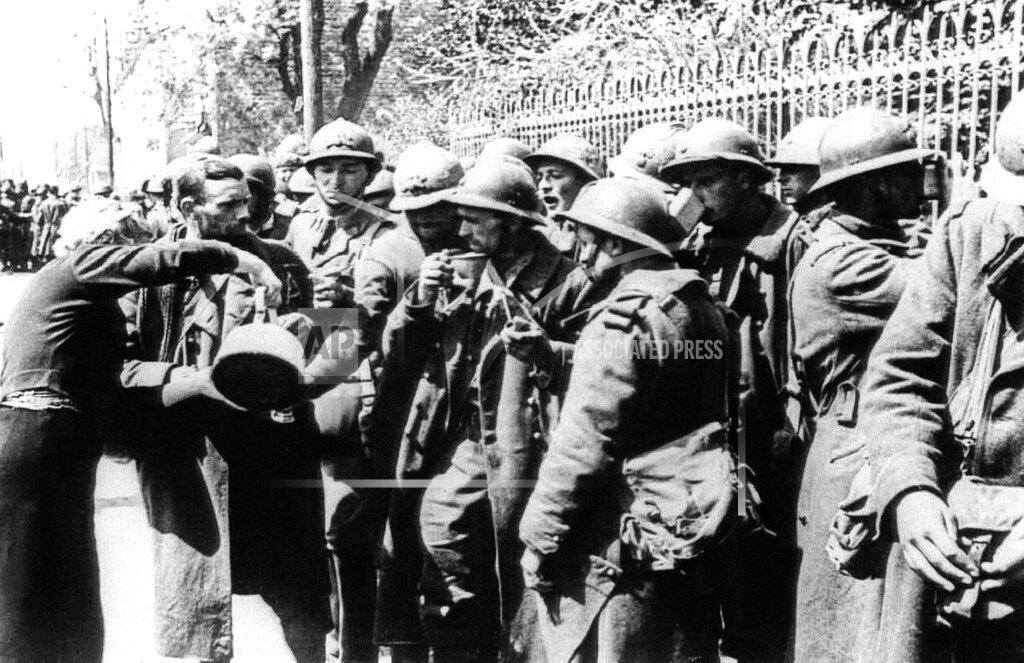
Hitler issues Führer Directive No. 13. The partial halt of the main German armored forces made by Colonel General Gerd von Rundstedt was confirmed by German Chancellor Adolf Hitler. They had reached the Gravelines — Omer — Bethune line. In agreement with a request from Gerd von Rundstedt, Hitler ordered Paul von Kleist to halt his panzer advance only 18 miles from Dunkirk, not wanting to risk the tanks getting bogged down in the Flanders marshes. This decision would prove to be a crucial mistake by the German leadership. Although the ground north of here was not well suited to armed action the Allied defenses were weak. The pause, which lasted until the morning of May 27th, gives the French and British time to strengthen this position and was generally seen as being the move which made the evacuation of the B.E.F. possible.
The Leader And Supreme Commander Of The Armed Forces.
Headquarters. 24th May, 1940. 7 copies
Directive No. 13
- The next object of our operations is to annihilate the French, English, and Belgian forces which are surrounded in Artois and Flanders, by a concentric attack by our northern flank and by the swift seizure of the Channel coast in this area. The task of the Air Force will be to break all enemy resistance on the part of the surrounded forces, to prevent the escape of the English forces across the Channel, and to protect the southern flank of Army Group A. The enemy airforce will be engaged whenever opportunity offers.
- The Army will then prepare to destroy in the shortest possible time the remaining enemy forces in France. This operation will be undertaken in three phases: Phase 1: A thrust between the sea and the Oise as far as the lower Seine below Paris, with the intention of supporting and securing with weak forces the later main operations on the right flank. Should the position and reserves available permit, every effort will be made, even before the conclusion of hostilities in Artois and Flanders, to occupy the area between the Somme and the Oise by a concentric attack in the direction of Montdidier, and thereby to prepare and facilitate the later thrust against the lower Seine. Phase 2: An attack by the main body of the Army, including strong armoured forces, southeastwards on either side of Reims, with the intention of defeating the main body of the French Army in the Paris-Metz-Belfort triangle and of bringing about the collapse of the Maginot Line. Phase 3: In support of this main operation, a well timed subsidiary attack on the Maginot Line with the aim of breaking through the Line with weaker forces at its most vulnerable point between St Avold and Sarreguemines in the direction of Nancy-Lunéville. Should the situation allow, an attack on the upper Rhine may be envisaged, with the limitation that not more than eight to ten divisions are to be committed.
- Tasks Of The Air Force. (a) Apart from operations in France, the Air Force is authorised to attack the English homeland in the fullest manner, as soon as sufficient forces are available. This attack will be opened by an annihilating reprisal for English attacks on the Ruhr Basin. Commander In Chief Air Force will designate targets in accordance with the principles laid down in Directive No. 9 and further orders to be issued by the High Command Of The Armed Forces. The time and plan for this attack are to be reported to me. The struggle against the English homeland will be continued after the commencement of land operations. With the opening of the main operations of the Army in the direction of Reims, it will be the task of the Air Force, apart from maintaining our air supremacy, to give direct support to the attack, to break up any enemy reinforcements which may appear, to hamper the regrouping of enemy forces, and in particular to protect the western flank of the attack. The breakthrough of the Maginot Line will also be supported as far as necessary. (c) Commander In Chief Air Force will also consider how far the air defence of the areas upon which the enemy is now concentrating his attacks can be strengthened by the employment of forces from less threatened areas. In so far as the Navy is involved in any changes of this kind, Commander In Chief Navy is to participate.
- Tasks Of The Navy. All restrictions on naval action in English and French waters are hereby cancelled, and Commanders are free to employ their forces to the fullest extent. Commander In Chief Navy will submit a proposal for the delimitation of the areas in which the measures authorised for the coming siege may be carried out. I reserve to myself the decision whether, and if so in what form, the blockade will be made public.
- I request the Commanders In Chief to inform me, in person or in writing, of their intentions based on this directive.
(signed) Adolf Hitler.
Whether Hitler actually ordered the halt or merely approved Rundstedt’s request is still a matter of controversy. Earlier that same day Hitler had visited Rundstedt’s headquarters and expressed his desire to come to term with the British. Rundstedt told him he wanted to temporarily stop the advance to regroup and prepare for what he saw as the more important task, the turn south and the conquest of the rest of France. On returning to his mountaintop headquarters, Hitler issued a stream of orders halting the advance of every unit now moving toward Dunkirk. After the war, Rundstedt blamed Hitler alone for the halt, telling an interrogator, “At that moment (with panzers less than 20 miles from Dunkirk) a sudden telephone call came from Colonel von Grieffenberg at OKH (Army High Command), saying that Kleist’s forces were to halt on the line of the (Aa) canal. It was the Führer’s direct order — and contrary to General Halder’s view. I questioned it in a message of protest, but received a curt telegram in reply, saying, “The armored divisions are to remain at medium artillery range from Dunkirk” (a distance of eight or nine miles). Permission is only granted for reconnaissance and protective movements.”
This order quite possibly is the most controversial incident of World War II, and not just among historians. The OKH (army high command) led by General von Brauchitsch and General Halder objects at the time. With General Guderian’s XIX Corps only 18 miles from Dunkirk and the Germans already in possession of Boulogne, Hitler expresses concern about the “Flanders marshes” that he recalls as a World War I infantry corporal.
The precise reason for the stop order is fertile ground for conspiracy theorists – was Hitler actually trying to save the BEF for some reason? – but will never be known. It existed only inside the head of Adolf Hitler, though Hermann Goering assures the Fuhrer that his Luftwaffe can prevent any escape. Hitler himself commented on this issue on 26 February 1945, claiming that he allowed the British to escape as a “sporting gesture.” One way or the other, the order is widely believed to have affected the course of World War II.
British Lieutenant Christopher Furness, the son of Viscount Furness, was killed in hand to hand fighting near Arras, France after his Bren gun carrier group engaged a vastly superior enemy force in order to allow a convoy to escape. He was awarded a posthumous Victoria Cross.
At this point Lord Gort made the most crucial strategic decision of his career, which saved the British Expeditionary Force and assured Britain’s continued participation in the war. Since all communications with both French High Command and General Gaston Bilotte, 1st French Army Group commander (Bilotte was actually killed in a car crash the day before and due to the ongoing French communications disaster and general confusion the French High Command never chose anyone to replace him), were severed or very poor, Gort himself made a unilateral decision to pull back the entire BEF from the highly exposed and vulnerable Escaut Line to the Aa Canal and Channel ports, basically preparing his army to withdraw from Continent and positioning to put his back to sea to be ready for evacuation from sea. This rendered any feeble and optimistic French hopes of attacking south impossible; however, the gathering Belgian collapse might have made such an attack a complete disaster. The entire Anglo-French force might have been cut off from the sea if Gort had not pulled back and been in position to hastily cover the Belgian sector when Leopold capitulated.
General von Kleist disobeys orders and crosses the Aa Canal. His forces enter the town of Hazelbrouck, cutting the British and French lines of retreat from Belgium to Dunkirk, and barely miss capturing the commander of the B.E.F., General Lord Gort. Kleist was told in emphatic terms to return to the opposite side of the canal, which he did.
In France, German 18th Army and 6th Army is attacking the Belgian Army and British Expeditionary Force from the Scheldt to Lille. The German Sixth Army concentrates its efforts around the Kortrijk area of the Leie, in Belgium. The Germans managed, against fierce resistance, to cross the river at night and force a one-mile penetration along a 13-mile front between Wervik and Kortrijk. The Germans, with superior numbers and in command of the air, had won the bridgehead. The Belgian Army is reaching the end of its ability to fight.
German 2nd Panzer Division, under the command of Lieutenant-General Rudolf Veiel, attacks the Boulogne citadel. French General Lanquetot, commanding part of the French 21st Division, had established his headquarters within the medieval walls of the Haute Ville (“Old Town”), sometimes called “The Citadel” in British accounts, awaiting the arrival of elements of 23 Division. When he discovered that disaster had befallen his division, he organized his remaining forces to defend the town as best he could. The Royal Navy was active in supporting the British forces in Boulogne and Calais. During the day and later in the night destroyers are used to evacuate 5,000 men, mostly British, but also some French and Belgian, from Boulogne.
By the time that Brigadier Fox-Pitt, commanding part of the 20th Guards Brigade, consisting of the 2nd Battalion, Welsh Guards and 2nd Battalion, Irish Guards, had received orders to evacuate, there were no means of communication with General Lanquetot. The French felt abandoned by this move, not being aware of the pressure the British troops had faced. On the evening of 24 May, the Germans launched two assaults on the town walls at 18:00 and 20:00. The attacks were repulsed and some German tanks were reported to have been destroyed. During the night, a force of one hundred French soldiers attempted to break out towards Dunkirk but failed. The remaining roughly 5,000 troops (mostly French with a small number of British soldiers) now prepared for their last stand.
A party of Welsh Guards also has been left behind in Boulogne. They are congregated down by the docks along with a motley collection of other stragglers. Despite having no hope of rescue, they hold out until the 25th.
The German 10th Panzer Division, commanded by Ferdinand Schall, attacks the British 30th Infantry Brigade and the 3rd Royal Tank Regiment, equipped with cruiser tanks, and a company and a half of French infantry under British command, at Calais. Royal Navy cruisers Arethusa and Galatea and six destroyers plus Polish destroyer Burza support the British 30th Infantry Brigade at Calais. The British reinforcements have just arrived within the last day to hold the port, but now they form a solid defensive line and the Germans make no progress. However, the supply of the Allied troops now is a problem, as they are under constant air and ground attack and going through prodigious amounts of ammunition. General Guderian gives Schaal until the morning of the 26th to take the town, or he will withdraw the panzers and order the Luftwaffe to level it.
Both sides begin artillery fire early, at 04:45. German artillery fire destroys large sections of the docks. Some of the ships are evacuated without having unloaded all of their equipment.
The Allies have consolidated their positions into the heart of the town. The 10th Panzer Division attacks all along the line and makes some progress in the south, but British counterattacks push them back. The panzers try again in the afternoon with better success, and French Fort Nieulay surrenders. The panzers get through the defensive line on the south, aided by German snipers within the town (collaborators). While the 10th Panzer Division retains the southern part of the town, it also reports that it has lost a third of its equipment and half of its tanks.
The British maintain a steady stream of supplies to the town, and British destroyers offshore are bombarding the German positions, but the situation is deteriorating. The Admiralty orders all non-combatants to be evacuated. There is dissension on the Allied side, as the French do not want to evacuate the port. The British refuse to send any more reinforcements. There are reports of a relief column advancing from the north, but it is nowhere in sight. The German artillery and panzer fire destroys the dockside cranes, making the job of evacuating more difficult – especially of the wounded.
The position at Calais is vital for delaying the German advance towards Dunkirk, and the British and French troops there fight very effectively. The Siege of Calais lasts four days, ending only when the Anglo-French forces run short of ammunition. The delaying action comes at a steep price, however: Sixty percent of the Allied troops are killed or wounded.
The Battle of the Lys began in Flanders. German forces attacked the line of the Lys River and around Tournai. This was a major battle between Belgian and German forces during the German invasion of Belgium of 1940 and the final major battle fought by Belgian troops before their surrender on 28 May. The battle was the bloodiest of the 18 Days’ Campaign. The battle was named after the Leie (French: Lys), the river at which the battlefield occurred.
The German Sixth Army under General Reichenau forces the Belgian 1st and 3rd Divisions back at Kortrijk. They take up a defensive position along the Lys River. The Belgian 9th and 10th Divisions soon join the line there, and the Belgian II Army Corps counterattacks and takes 200 prisoners. The Luftwaffe harasses the Belgian positions, and the RAF cannot respond quickly because it is operating out of England. A German attack on Ypres, which threatens to surround the Belgians, is checked with difficulty by the Belgian 2nd Cavalry Brigade and the 6th Infantry Division.
Maubeuge on the banks of the Sambre falls, with 90% of the town destroyed during the fighting. St. Omer also falls.
German troops captured Ghent and Tournai, Belgium.
On 24 May, a heavy German attack forced Allied troops to fall back at Kortrijk over the Lys to the 1st and 3rd Belgian divisions. The Belgians had been persuaded to abandon the Scheldt and withdraw to relieve British troops for an Allied counter-offensive, but that strategically did little to alleviate the situation at the front. With the Allied line facing four German divisions, the 9th and 10th Belgian Divisions rushed in to reinforce the position. The Belgian II Army Corps launched a counter-attack and captured 200 German soldiers. Belgian artillery opened up effectively on the Germans, but Allied lines were subject to numerous bombing raids and strafing runs, with negligible air support of their own. A German division from Menen moved up to Ypres, threatening to cut the Belgian Army off from the British. The Belgians’ 2nd Cavalry Brigade and 6th Infantry Division came in to support the area and managed to hold off the Germans.
King Leopold III met with his ministers for the final time. The ministers urged the King to leave the country with the Government. Prime Minister Hubert Pierlot reminded the King that capitulation was a decision for the Belgian government, not the King. The King indicated that he had decided to remain in Belgium with his troops, whatever the outcome. The ministers took this to mean that he would establish a new government under the direction of Hitler, potentially a treasonous act. Leopold thought that he might be seen as a deserter when he left the country: “Whatever happens, I have to share the same fate as my troops.”
King Leopold III assumed command of the Belgian Army.
RAF Bomber Command dispatches 69 aircraft to attack German positions around Calais during the day.
Luftwaffe pilot Walter Grabmann is liberated by German troops in France.
Late on the 23rd, destroyer HMS Vimiera on her second trip picked up the last of the Boulogne evacuees, some 800 French and Belgian troops. Destroyer HMS Wessex operated off Boulogne but did not enter the harbor. Some two hundred troops had to be left behind and were captured by German forces on the 24th. At 0200, destroyers HMS Vimiera and HMS Wessex arrived at Dover. Destroyers Vimiera and Wessex were the only two undamaged destroyers of the Dover Command.
The French large destroyer Chacal (Capitaine de fregate J. E. N. Estienne), after delivering the demolition party to Calais, arrived off Boulogne, and was sunk off Cape d’ Alprecht by German bombing. French destroyer Fougueux (Capitaine de fregate E. E. Y. Poher) was badly damaged by bombing in the same attack. French submarine chasers CH.5 and CH.42 rescued the twenty one survivors of Chacal. The surviving destroyers of the French 2nd Destroyer Flotilla were ordered withdrawn from Boulogne to Cherbourg.
Vice Admiral Sir James Somerville KCB, DSO, commanded the British Calais support force. Destroyers HMS Grafton and HMS Greyhound and Polish destroyer Burza (Cdr Wojciech Francki), on patrol off Aldeburgh, were ordered to Dover. They then set off to Calais to provide fire support for the British troops ashore. Light cruisers HMS Arethusa (Captain Q. D. Graham) and HMS Galatea (Captain B. B. Schofield) departed Portsmouth to operate in the area in support roles, but returned when they found they could not arrive off Calais before dark. Destroyers HMS Wolfhound and HMS Vimiera departed Dover for Calais at 1000. Off Calais, destroyer HMS Wessex (Lt Cdr W. A. R. Cartwright), which departed Dover at 0700, was sunk by German bombing when she was struck by three bombs between the funnels. Five ratings were killed, one died of wounds, and fifteen were wounded. The survivors were rescued by destroyer Vimiera. Minesweeping trawler John Cattling (276grt) picked up one officer and five ratings from a Carley float.
Polish destroyer ORP Burza was damaged by two bombs exploding in the water very near her bows. The concussion also damaged her superstructure and she could only steam three to four knots stern first. One rating was killed in the destroyer. Destroyer HMS Verity and tug HMS Lady Brassey arrived on the scene to assist Burza, but she was able to proceed under her own power. Destroyer Burza departed Dover on the 25th towed by two tugs and escorted by anti-submarine trawler HMS Kingston Olivine. She was taken to Portsmouth for repairs which were completed on 27 July.
Destroyer Vimiera was bombed and damaged off Calais. Destroyer Vimiera was withdrawn for repairs which were completed in ten days. Destroyer Vimiera arrived at Scapa Flow for escort duties on 9 June.
Minesweeping trawler HMS John Cattling (276grt) was sent to Calais to act as a W/T link.
Destroyers HMS Wolsey and HMS Windsor departed Dover at 0935 with demolition parties for Le Havre. The destroyers were then sent to Calais before returning to Dover.
Destroyers HMS Wolfhound and HMS Verity were ordered at 1339 to bring ammunition to Calais for the British troops encircled there. Destroyer Verity, after assisting Polish destroyer Burza, also landed a Royal Marine Guard to protect the harbor.
Motor torpedo boat MTB.25 proceeded to Calais with primers for the demolition charges.
Tug Dapper (419grt) was sent from Dover at 0830 to assist British steamer Bhutan (6104grt) which had been badly damaged in a collision.
British steamer Brighton (2391grt) was sunk by German bombing at Dieppe Quay. Steamer Brighton had been bombed and badly damaged on the 21st. There was no crew aboard her on the 24th.
French auxiliary minesweeper La Matelot (260grt) was sunk by German bombing and French auxiliary minesweeper Etoile De Nord (317grt) was sunk in mining at Dunkirk.
The Allied Supreme War Council in Paris decided to end its involvement in Norway. They agreed to capture Narvik and destroy the port facilities before they evacuated. Ironically the airfield at Bardufoss has only just received its first complement of British aircraft and already the campaign is seeming less one-sided, showing what might be done. The Norwegians are not yet told of the decision to leave.
Operation ALPHABET, the evacuation of the remaining Allied troops in Norway, was authorized.
German 2nd Mountain Division pushes northward from Mo i Rana toward Bodø, Norway. Gubbins has some of his troops hold a switch position about 10 miles (16 km) south of Rognan. The men of the Irish Guards, Nos. 2 and 3 Independent Companies, and Royal Artillery Battery 203 wait for the Germans, equipped with mortars, machine guns and with 25-pound artillery emplaced to sweep the road. The Germans advancing toward Boddø will be walking into an ambush.
At Bjerkvik, Norway, north of Narvik, three battalions of French alpine troops and a Norwegian battalion land for an assault on Narvik.
At Narvik, the Germans essentially are surrounded, with the Norwegians on the north, the French on the west, and the Poles on the southwest. The RAF is operating Gladiator Glosters out of Bardufoss just to the north. As cover for Operation Alphabet, the British contemplate launching an attack on Narvik, but not right away. French General Béthouart in particular would like to teach the Germans a lesson here, where they are more vulnerable than back in France.
Transported by train via Sweden, forty German troops arrive in the Narvik area.
Luftwaffe transports drop 55 mountain troops with minimal parachute training to reinforce German forces around Narvik.
Luftwaffe seaplanes transport 14 mountain troops to Narvik area.
Light cruiser HMS Enterprise departed Harstad with the remaining nineteen tons of Norwegian gold reserves. Despite two German air attacks en route, the cruiser safely arrived at Scapa Flow at 1740/26th. She then proceeded at 1600/27th to Greenock where the gold was offloaded. Cruiser Enterprise continued on to Plymouth, arriving on the 29th for refitting. The cruiser was under refit from 31 May to 22 June.
HMS Ark Royal arrives off Scapa Flow, but fog delays her entry into harbor until 1940. Meanwhile, at 1315 HMS Glorious departed Scapa escorted by HMS Wren, Arrow & Highlander. Her mission is to finally fly off the Hurricanes of 46 Squadron to Norway. For this trip she has embarked only six Sea Gladiators of 802 squadron for aerial defense and six Swordfish of 823 Squadron for A/S duty.
Royal Norwegian Navy patrol boat Ingrid, formerly the German trawler Wilhelm Reinhold, was sunk by German bombers at Bodø.
The Norwegian troop ship Skjerstad was bombed and sunk in Langsetfjorden by Junekers Ju 87 aircraft of the Luftwaffe. She was declared beyond economic repair in summer 1940.
On Empire Day, King George VI addressed his subjects by radio, saying, “The decisive struggle is now upon us … Let no one be mistaken; it is not mere territorial conquest that our enemies are seeking. It is the overthrow, complete and final, of this Empire and of everything for which it stands, and after that the conquest of the world. And if their will prevails they will bring to its accomplishment all the hatred and cruelty which they have already displayed.”
Sir Samuel Hoare is formally named the British ambassador to Spain.
Bletchley Park begins forwarding Ultra intelligence to British military headquarters. Bletchley Park’s Code and Cypher School has had great success recently in decoding certain (but not all) German Enigma Machine coded messages. It begins routing its finding in close to real-time to the BEF, the RAF and, of course, Prime Minister Winston Churchill. This is all top secret, of course, and the actual source of the information is rarely provided to any but the absolutely most highly placed individuals.
Dutch Queen Wilhelmina speaks on BBC radio. Queen Wilhelmina of the Netherlands told newspapermen in an interview today that she had left her invaded kingdom because the Germans were determined to capture her and hold her as a hostage.
A French Government communiqué disclosed tonight that Allied and Italian representatives had been negotiating in Rome for several days for modification of the Allies’ contraband control system and hinted that a favorable conclusion might be reached soon.
The Italian liner Neptunia, due to sail from Genoa for Central America today, was held in port. The sailing was postponed to June 21.
Heinrich “Heinz” Trettner receives the Knight’s Cross of the Iron Cross. He is a Major on the General Staff and 1a (operations officer) of the 7th Flieger-Division (parachute division). This is a recognition of the fine service of the paratroopers in the war so far.
The Irish government forms a Local Security Force.
In an odd but purely Gallic expression of patriotism, 10 leading Paris fashion houses declare they will not close despite the war. “At this grave hour, couture will continue.” Coco Chanel is making a controversial decision that will only grow with time due to her associations with the occupying government.
General Eugene Mittelhauser takes over command of French forces in the Middle East.
At the same time that it canceled the prolonged country-wide blackout instituted during the recent war crisis, the Swedish Government also announced today that the principal parts of its defense program had been carried out.
Subject to the consent of the Soviet Government, Sir Stafford Cripps, with a group of aides from the Ministry of Economic Warfare and the Foreign Office, will go to Moscow for further talks in connection with Anglo-Russian trade, it was learned today.
RAF Bomber Command strikes the Cologne railroad marshalling yards during the night with 59 bombers.
Luftwaffe bombers attack targets in England.
The newly completed Royal Navy aircraft carrier HMS Illustrious, escorted by destroyers HMS Escort, Vanoc & Witherington departed the Clyde at 0300 for acceptance trials. She returned that afternoon.
The unescorted Greek steam merchant Kyma was torpedoed and sunk by the U-37, commanded by Kapitänleutnant Victor Oehrn, about 300 miles west of Ushant in the eastern Atlantic Ocean (48°30’N 9°30’W) at 0248 hours. Of the ship’s complement, 7 died and 23 survived. The U-boat attacked the ship without warning despite visible neutrality markings because she was heading for a British port within the blockade area. The survivors abandoned ship in a lifeboat, were spotted by an aircraft from St. Eval in the afternoon and reported to HMS Enchantress (L 56) (Cdr A.K. Scott-Moncrieff, RN), which left convoy OA-153GF to pick them up in 49°08N/06°46W at 2200 hours and then rejoined convoy. The 3,994 ton Kyma was carrying maize and trucks and was bound for Avonmouth, England.
Anti-aircraft cruiser HMS Carlisle, destroyers HMS Kandahar, HMS Khartoum, HMS Kimberley, and HMS Kingston, and sloops HMS Auckland and HMS Flamingo arrived at Suez from the Mediterranean as convoy escorts for Red Sea shipping.
French sloops Annamite, Gazelle, Chamois and Surprise, which was escorting steamers Chantilly and Compiegne, passed Gibraltar en route from Brest to Algiers, where they arrived on the 25th.
Australian light cruiser HMAS Hobart arrived at Port Sudan.
Convoy OA.154 departed Southend escorted by sloop HMS Aberdeen.
Convoy OB.154 departed Liverpool escorted by sloop HMS Sandwich from 24 to 27 May. The convoy dispersed on the 28th.
Convoy FN.179 departed Southend, escorted by destroyer HMS Walpole. The convoy arrived at the Tyne on the 26th.
Convoy HX.45 departed Halifax at 1200 escorted by Canadian destroyers HMCS Saguenay, HMCS Skeena, and HMCS St Laurent, which were detached on the 25th. Convoy BHX.45 departed Bermuda on the 23rd escorted locally by sloop HMS Penzance and an ocean escort of armed merchant cruiser HMS Rajputana. The convoy rendezvoused with HX.45 on the 29th and the armed merchant cruiser was detached. The ocean escort for the convoy was armed merchant cruiser HMS Voltaire which joined the convoy at 1830/24th. The armed merchant cruiser was detached on 4 June. On 5 June, sloop HMS Sandwich and corvette HMS Periwinkle joined the convoy. On 6 June, the corvette was detached and the sloop was detached on 7 June. Corvette HMS Hibiscus joined the convoy on 7 June and escorted it to its arrival at Liverpool on 8 June.
The War at Sea, Friday, 24 May 1940 (naval-history.net)
Late on the 23rd, destroyer VIMIERA on her second trip picked up the last of the Boulogne evacuees, some 800 French and Belgian troops. Destroyer WESSEX operated off Boulogne but did not enter the harbour.
Some two hundred troops had to be left behind and were captured by German forces on the 24th.
At 0200, destroyers VIMIERA and WESSEX arrived at Dover.
Destroyers VIMIERA and WESSEX were the only two undamaged destroyers of the Dover Command.
French large destroyer CHACAL (Capitaine de fregate J. E. N. Estienne), after delivering the demolition party to Calais, arrived off Boulogne and was sunk off Cape d’ Alprecht by German bombing.
French destroyer FOUGUEUX (Capitaine de fregate E. E. Y. Poher) was badly damaged by bombing in the same attack.
French submarine chasers CH.5 and CH.42 rescued the twenty-one survivors of CHACAL.
The surviving destroyers of the French 2nd Destroyer Flotilla were ordered withdrawn from Boulogne to Cherbourg.
Vice Admiral Sir James Somerville KCB, DSO, commanded the British Calais support force.
Destroyers GRAFTON and GREYHOUND and Polish destroyer ORP BURZA (Cdr Wojciech Francki), on patrol off Aldeburgh, were ordered to Dover. They then set off to Calais to provide fire support for the British troops ashore.
Light cruisers ARETHUSA (Captain Q. D. Graham) and GALATEA (Captain B. B. Schofield) departed Portsmouth to operate in the area in support roles, but returned when they found they could not arrive off Calais before dark.
Destroyers WOLFHOUND and VIMIERA departed Dover for Calais at 1000.
Off Calais, destroyer WESSEX (Lt Cdr W. A. R. Cartwright), which departed Dover at 0700, was sunk by German bombing when she was struck by three bombs between the funnels.
Five ratings were killed, one died of wounds, fifteen were wounded. The survivors were rescued by destroyer VIMIERA. Minesweeping trawler JOHN CATTLING (276grt) picked up one officer and five ratings from a Carley float.
Polish destroyer BURZA was damaged by two bombs exploding in the water very near her bows. The concussion also damaged her superstructure and she could only steam three to four knots stern first. One rating was killed in the destroyer.
Destroyer VERITY and tug LADY BRASSEY arrived on the scene to assist BURZA, but she was able to proceed under her own power.
Destroyer BURZA departed Dover on the 25th towed by two tugs and escorted by anti-submarine trawler KINGSTON OLIVINE. She was taken to Portsmouth for repairs which were completed on 27 July.
Destroyer VIMIERA was bombed and damaged off Calais.
Destroyer VIMIERA was withdrawn for repairs which were completed in ten days. Destroyer VIMIERA arrived at Scapa Flow for escort duties on 9 June.
Minesweeping trawler JOHN CATTLING (276grt) was sent to Calais to act as a W/T link.
Destroyers WOLSEY and WINDSOR departed Dover at 0935 with demolition parties for Le Havre.
The destroyers were then sent to Calais before returning to Dover.
Destroyers WOLFHOUND and VERITY were ordered at 1339 to bring ammunition to Calais for the British troops encircled there.
Destroyer VERITY, after assisting Polish destroyer BURZA, also landed a Royal Marine Guard to protect the harbour.
Motor torpedo boat MTB.25 proceeded to Calais with primers for the demolition charges.
After bombing southwest of Calais, a Swordfish of 825 Squadron was shot down. Lt M. R. North and Leading Airman C. A. Chichester were killed.
Destroyers GALLANT, JACKAL, JAVELIN, and JAGUAR screened the six minesweeping trawlers, which had also been used in operation QUIXOTE on the 20th, cutting the telegraph cables between Lowestoft, Benacre, Aldeburgh on the East Coast and Zaandvoort and Domburg in Operation QUENTIN.
Tug DAPPER (419grt) was sent from Dover at 0830 to assist British steamer BHUTAN (6104grt) which had been badly damaged in a collision.
Lt K. P. Gurr and Lt R. Carpmael were killed when their Swordfish of 812 Squadron was shot down over the Calais-Gravelines road.
Aircraft carrier ILLUSTRIOUS was completed.
Aircraft carrier ILLUSTRIOUS departed Liverpool on the 24th.
Destroyers ESCORT, VANOC, and WITHERINGTON departed the Clyde at 0300 and rendezvoused with aircraft carrier ILLUSTRIOUS off the Bar Light Vessel at 1400 for acceptance trials.
The British ships arrived in the Clyde at 2030/25th.
Heavy cruiser SUSSEX departed the Clyde after refitting and arrived at Scapa Flow at 1415/25th.
Anti-aircraft cruiser BONAVENTURE was completed. She was the first cruiser of the new DIDO class to be completed.
Light cruiser ENTERPRISE departed Harstad with the remaining nineteen tons of Norwegian gold reserves.
Despite two German air attacks en route, the cruiser safely arrived at Scapa Flow at 1740/26th. She then proceeded at 1600/27th to Greenock where the gold was offloaded.
Cruiser ENTERPRISE continued on to Plymouth, arriving on the 29th for refitting. The cruiser was under refit from 31 May to 22 June.
Destroyers ANTELOPE and BRAZEN arrived at Scapa Flow at 0720 and 1900, respectively, after having been detached from aircraft carrier ARK ROYAL’s screen.
The aircraft carrier was delayed due to fog.
Destroyer ATHERSTONE at Lerwick was ordered to investigate a direction finding reading in 59-55N, 00-00W. Fog hindered the unsuccessful search.
The destroyer arrived back at Scapa Flow at 0430/26th.
Six Tribal destroyers to be joined by destroyer TARTAR (D 6) were designated to form a Striking Force at Rosyth.
The 9th Destroyer Flotilla was returned to the Western Approaches Command.
Destroyers BRAZEN, BASILISK, and BULLDOG were returned to the Nore Command.
Destroyer BULLDOG departed Scapa Flow at 1600 for Harwich to rejoin the Nore Command.
Destroyer BRAZEN departed Scapa Flow at 2230 for Rosyth to boiler clean prior to rejoining the Nore Command.
Destroyers BASILISK and MATABELE departed Greenock at 1130 for Devonport.
Destroyer BASILISK repaired brickwork and boiler cleaned at Devonport. After repairs, the destroyer proceeded to the Nore Command.
Destroyer MATABELE continued on to Falmouth to repair grounding damage.
Destroyer WOLVERINE departed Greenock at 1430 for Plymouth to make good defects.
Submarine SHARK and French submarine SYBILLE arrived Rosyth after patrol.
Submarine SPEARFISH arrived at Blyth after patrol.
French submarine AMAZONE docked at Rosyth.
British steamer BRIGHTON (2391grt) was sunk by German bombing at Dieppe Quay.
Steamer BRIGHTON had been bombed and badly damaged on the 21st. There was no crew aboard her on the 24th.
French auxiliary minesweepers LA MATELOT (260grt) was sunk by German bombing and ETOILE DE NORD (317grt) was sunk in mining at Dunkirk.
Convoy OA.154 departed Southend escorted by sloop ABERDEEN.
Convoy OB.154 departed Liverpool escorted by sloop SANDWICH from 24 to 27 May. The convoy dispersed on the 28th.
Convoy FN.179 departed Southend, escorted by destroyer WALPOLE. The convoy arrived at the Tyne on the 26th.
U-37 sank Greek steamer KYMA (3994grt) in 48 30N, 09 30W.
Seven crew were lost on the Greek steamer. The survivors were picked up in 49-08N, 06-06W.
Anti-aircraft cruiser CARLISLE, destroyers KANDAHAR, KHARTOUM, KIMBERLEY, and KINGSTON, and sloops AUCKLAND and FLAMINGO arrived at Suez from the Mediterranean as convoy escorts for Red Sea shipping.
French sloops ANNAMITE and SURPRISE, which was escorting steamers CHANTILLY and COMPIEGNE, GAZELLE, and CHAMOIS passed Gibraltar en route from Brest to Algiers, where they arrived on the 25th.
Convoy HX.45 departed Halifax at 1200 escorted by Canadian destroyers HMCS SAGUENAY, HMCS SKEENA, and HMCS ST LAURENT, which were detached on the 25th.
Convoy BHX.45 departed Bermuda on the 23rd escorted locally by sloop PENZANCE and an ocean escort of armed merchant cruiser RAJPUTANA. The convoy rendezvoused with HX.45 on the 29th and the armed merchant cruiser was detached.
The ocean escort for the convoy was Armed merchant cruiser VOLTAIRE which joined the convoy at 1830/24th. The armed merchant cruiser was detached on 4 June.
On 5 June, sloop SANDWICH and corvette PERIWINKLE joined the convoy. On 6 June, the corvette was detached and the sloop was detached on 7 June. Corvette HIBISCUS joined the convoy on 7 June and escorted it to its arrival at Liverpool on 8 June.
Australian light cruiser HMAS HOBART arrived at Port Sudan.
In Washington today, President Roosevelt conferred with his Cabinet today, had Admiral Leahy, Governor of Puerto Rico, as a luncheon guest, and a press conference, where he announced plans for training 50,000 air pilots.
The Senate heard a debate on past expenditures for national defense and received the Bridges bill to prohibit aliens from having implements of war. It recessed at 5:55 PM until noon Monday.
The House passed the May bill authorizing unlimited purchase of Army airplanes and the clearing away of legislative restrictions on rapid expansion of defenses. It adjourned at 6:03 PM until noon Monday.
By a vote of 391 to 1, the House today approved unlimited expansion of the army air corps a few hours after President Roosevelt had announced a broad plan to train 50,000 pilots. Meanwhile, however, the senate naval committee imposed a top of 10,000 planes upon the navy’s air strength, in recommending passage of a measure authorizing expenditure of an estimated $2,200,000,000 for the naval air corps and its bases ashore. The maximum was fixed, it was said, so the navy would have to ask congress for approval when the time comes to exceed that number of fighting ships.
The President said that he would ask Congress for funds over and above the $3,300,000,000 Army and Navy appropriations to extend the pilot training course now directed by the Civil Aeronautics Authority. Volunteers between the ages of 18 and 25 will be trained in about fifty-five centers under the expanded program and the graduates included in the organized reserves. The broadened program, Mr. Roosevelt said, would draw men from three sources:
- Schools and colleges, including the 435 where the CAA pilot training courses are now provided.
- A large group of citizens who have private licenses of various sorts but for personal reasons have ceased to fly.
- Men not enrolled in schools or colleges who want to take such training.
The President stressed that about three months could be saved in training military pilots through these courses. He noted that in 1937 at his instigation Congress voted $4,000,000 for a CAA directed training program and that about 10,000 pilots will have completed primary courses by July 1. The CAA also has trained 1,924 pilot-instructors, he remarked. The President said that he did not know how much money would be required for the expanded program.
The alien problem in its relationship to this country’s defense program was debated in the Senate for five hours today and the House also gave it attention. The discussion indicated preponderant sentiment in favor of registering aliens living in the United States. There were a variety of other proposals, including suggestions for combating “fifth column” activities. All of the proposals would set peacetime precedents for the United States. One result of the Senate debate was to sidetrack again the Civil Liberties Bill after it had been drawn into the debate through an amendment by Senator Reynolds to limit to 10 percent the number of aliens who might be employed in any industry operating in interstate commerce. The House, considering defense legislation, approved an aviation-expansion program containing a provision for the dropping of any “fifth column” members who might be discovered in the Army. It also voted to bar payment of federal funds to “Communists, Nazis, or Fascists.”
President Roosevelt spiked talk of a coalition defense cabinet today as Republicans continued to demand he renounce any third term intention. The chief executive, whose re-nomination by the Democrats if he will take it became more certain than ever during the day, told his press conference any idea of a coalition cabinet was cockeyed. He said all speculation about Republicans going into his cabinet was a case of barking up the wrong tree. Republicans attending their state convention in Vermont accused the new deal, meanwhile, of “blundering” and urged the task of building up the nation’s defenses be placed in Republican hands.
Captain Franz von Rintelen, head of German spies in the United States in the last war and the author of “Dark Invader,” was among a number of persons rounded up today as the British drive against Fascists and other possible subversive influences continued. A member of the American Embassy staff was taken into custody tonight as the drive was intensified. Who he was, what his functions were and what charges were made against him were not disclosed. Earlier in the evening, Ambassador Joseph P. Kennedy, reached by telephone, declined to comment. Other members of Mr. Kennedy’s staff either declined to discuss the matter or said they knew nothing about it.
Captain von Rintelen has always described himself as a refugee from the Nazi Government and last week he had a letter in The Times, London, predicting that the Nazis would be beaten. He was picked up at the start of the war but was released because powerful friends pleaded for him. The fact that he has been detained again indicates that Britain is taking no chances on possible “fifth column” activities within her own gates. The lesson of Norway, Belgium and the Netherlands is apparently beginning to sink home here. With the full approval of the people, the authorities are beginning to operate on the principle — a negation of all British law — that it is better for the moment for fifty innocent men to be detained than for one guilty spy or traitor to remain at large. That being the case, it seems obvious that there will be many arrests.
Eleven agents of the Federal Bureau of Investigation described as “experts on sabotage and espionage” were added today to the staff of the Philadelphia FBI office as a drive against possible “fifth columns” in Pennsylvania moved forward on several fronts.
British and French orders for American-built warplanes and accessory equipment now amount to about $725,000,000, G.W. Wynne, spokesman for the Anglo-French Purchasing Commission, said yesterday at a press conference in the commission’s offices at 15 Broad Street.
The New York Council of the American Youth Congress opened a three-day convention with a rally last night at Mecca Temple, 130 West Fifty-sixth Street, at which the central theme was “Keep America Out of the War.” Thirty-five hundred members and friends of the youth group, including 1,500 delegates, attended the rally and loudly cheered speakers who contended that a “small group of warmongers in this nation” were trying to force the country into war. With equal enthusiasm, the audience booed and hissed mention of Martin Dies, chairman of the House un-American activities committee; President Roosevelt’s national defense program, and the assertion of Henry I. Harriman, former president of the United States Chamber of Commerce, a speaker at the meeting, that business must be freed from hampering New Deal restrictions if national recovery is to develop.
[Ed: Yes, Virginia, the “American Youth Congress”, like the country at large, and indeed even the Roosevelt Administration, is peppered with creatures who take their directions solely from Moscow Central and the NKVD. These same vermin will screech, “Second Front Now!” at the top of their insipid lungs as soon as Comrade Stalin and Adolf become enemies in the Summer of 1941. The hypocracy of western communists is sickening.]
Gilded with new shows, new paint, new exhibits and new management, the 1940 Golden Gate International exposition opens tomorrow to help war-depressed Americans find entertainment and relaxation during the summer months. The exposition world’s fair of the west is at the same spectacular stand on Treasure Island in San Francisco Bay, and will run 128 days to September 29 through the peak of the tourist season. Fair officials expect between 100,000 and 200,000 visitors on opening day and about 5,000,000 during the five-month run.
The film “Our Town” starring Martha Scott and William Holden in an adaptation of the Thornton Wilder play of the same name was released.
Major League Baseball:
The Polo Grounds in New York City and Sportsman’s Park in St. Louis hosted their first night games.
Before 22,260, the New York Giants rip the Boston Bees 8–1 in the first night game at the Polo Grounds. Harry Gumbert is the winner.
The Cleveland Indians edge the St. Louis Browns, 3–2, in the first night game at Sportsman’s Park before 24,827, the biggest crowd since 1922. Bob Feller beats Eldon Auker and his first Major League homer is the margin of victory.
John Duncan Rigney set down the Tigers with three hits today for a 2–1 victory, running the White Sox winning streak to five straight games. Rigney struck out seven and walked just one.
Detroit Tigers 1, Chicago White Sox 2
Boston Bees 1, New York Giants 8
Cleveland Indians 3, St. Louis Browns 2
The Canadian Parliament went into recess this evening over the week and after a long and dreary debate over the war estimates which finally were adopted in the total sum asked for— $700,000,000.
Josef Stalin has had it in for old rival Leon Trotsky for some time, and today he does something about it. Trotsky has emigrated to Coyoacán, Mexico, but nowhere is far enough when Stalin wants you dead. Assailants working for the Soviet Union attacked Trotsky at his compound in Coyoacán. Several bombs were detonated and hundreds of machine gun rounds were fired at the bedroom, causing such extensive damage that the attackers left assuming that Trotsky was dead. However, he and wife Natalia had taken cover on the floor beside his bed and escaped serious injury.
President of Panama Augusto S. Boyd addressed diplomatic notes to the government of the Dominican Republic, supporting its position in the Hannover incident of March 8, to the British and German governments, calling attention to their violation of the Pan-American Neutrality Zone, and to the Chairman of the Inter-American Neutrality Committee in Rio de Janeiro, directing that body’s attention to the case.
A series of violent earthquakes rocked Peru today causing a heavy death toll and leaving thousands homeless. Crippled communications obscured the full extent of the disaster but reports trickling in tonight placed the dead at 219 and the injured at more than 3,000. Seventy dead were counted In Lima alone and it was feared additional victims were buried under debris of scores of wrecked buildings.
Dow Jones Industrial Average: 113.94 (-0.77)
Born:
Joseph Brodsky, poet, essayist and Nobel laureate (“Less than One”, Nobel 1987), in Leningrad, Russian SFSR, Soviet Union (d. 1996).
Naval Construction:
The U.S. Navy 70-foot Elco patrol motor torpedo boat USS PT-17 is laid down by the Electric Launch Company Ltd. (Elco), (Bayonne, New Jersey, U.S.A.).
The Royal Navy Flower-class corvette HMS Sunflower (K 41) is laid down by Smiths Dock Co., Ltd. (South Bank-on-Tees, U.K.).
The Kriegsmarine (German Navy) Type 35 torpedo boat T11 is commissioned.
The Royal Navy Flower-class corvette HMS Gardenia (K 99) is commissioned. Her first commanding officer is Lieutenant Commander Trevor Allan Owen Ellis, RD, RNR.
The Royal Navy Dido-class light cruiser HMS Bonaventure (31) is commissioned. Her first commanding officer is Captain Henry Jack Egerton, RN.
 History Diaries