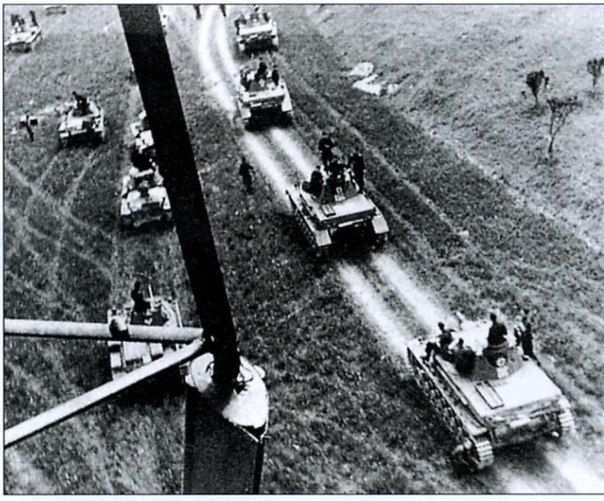
Günther von Kluge proposed that the German 4th Armee, which was poised to continue the attack against the Allied forces at Dunkirk, should “halt and close up”. Colonel General Gerd von Rundstedt, commanding Army Group A, agreed and ordered his tank forces to halt their advance. General Walther von Brauchitsch, commander in chief of the German Army, disagreed with his colleagues and wanted to continue the attack against Dunkirk by putting the 4th Armee under Bock. Bock was busy and Halder agreed with Rundstedt and Kluge to stop action against Dunkirk. The disagreement went to Hitler, who overruled Brauchitsch and agreed with stopping action against Dunkirk. Despite this order the 2nd Panzer Division forces still attacked Boulogne. The German 2nd Panzer Division reaches Boulogne. Royal Navy destroyers evacuate the British 20th Guards Brigade from Boulogne overnight.
French Commander-in-chief General Weygand on 23 May 1940 comes up with a new plan. This one is to hold a pocket on the coast in Flanders indefinitely, the Réduit de Flandres. Theoretically, this could be supplied from Great Britain and hold out indefinitely. In reality, the Allies’ grasp on the region already is extremely tenuous.
General Guderian in charge of XIX Corps in the Channel Ports region is convinced that the only remaining threat is that the British BEF will manage to escape. He orders an immediate assault by the panzers on the fly without waiting for the infantry to catch up. The Allies send 18 French Latecoere seaplanes to bomb the bridges between the Somme and Boulogne to slow Guderian up. The entire scene is a picture of mass confusion, with units intermingled, enemy forces locked into an “embrace,” and nobody quite sure where the front is.
The panzers of 2nd Panzer Division are pressing against Boulogne. At 10:00, it attacks from the south and forces the Irish Guards back into town. The Allies in the port have radio problems and lose communications with headquarters. They are told at noontime by an arriving destroyer, HMS Vimy, that they are expected to hold at all costs. However, by 18:00, the order comes to evacuate.
At Boulogne, Royal Navy ships shot their way into and out of the harbour; French and British destroyers bombarded German positions as wounded and non-combatants were embarked and a navy demolition party landed. During a lull in the afternoon of 23 May, the Luftwaffe bombed the harbour, despite being intercepted by RAF fighters. At 6:30 PM the Guards Brigade was ordered to re-embark; the British destroyers ran the gauntlet of German tanks and artillery to dock. The French defenders above the lower town could not be contacted and only in the morning of 24 May did General Lanquetot realise that the British had gone.
The Royal Navy sends six destroyers to take off as many men from Boulogne as possible. They lose two destroyers, both French, the Jaguar and Drage, but take off 4,360 men. There is a highly unusual land/naval confrontation between the German ground troops, with the Germans firing artillery and tank shells at the British ships. A Panzer IV and one of the destroyers gets into an odd exchange in which the panzer sinks the ship. The panzer crew gets the right to paint a rare “ship” kill on their turret. Overall, though, the British warships provide an extremely effective port defense as they complete the evacuation, though several of the Royal Navy ships are badly damaged. The captains of both HMS Keith and HMS Vimy are killed.
While the RAF fighters have almost all been withdrawn across the channel, they at least are operating from established bases and, at least temporarily, have an advantage along the coast.
Air operations over Boulogne are intense. RAF fighters are needed elsewhere, and the Luftwaffe has free reign over the port for most of the day. The RAF fighters finally arrive at 19:20.
British 30th Infantry Brigade arrives by sea to defend Calais.
German 6th Panzer Division reaches Calais. The Siege of Calais begins.
German 1st Panzer Division’s forward elements reached Calais.
The German 1st Panzer Division is advancing up the Pihen-Les-Guînes road (the Omer road) toward Gravelines. Fierce local battles erupt between the British 3rd Royal Tank Regiment, the 30th Motor Brigade and the panzers, with the British troops forced back into Calais. The 1st Panzer Division, which would have occupied Calais if weakly defended, decides to bypass the port and continue on toward Gravelines/Dunkirk.
The 10th Panzer Division secures the high ground near Calais, while the British 30th Infantry Brigade arrives to help with the defense there. The entire area is a scene of massive confusion, with random British and German units often taking the same roads and one side or the other mistaking the enemy as being friendly forces. The Germans are within sight of Calais, but their line is not continuous, and formations on both sides pass through enemy lines here and there. Tanks of the 10th PD are able to bombard Calais from their position on the overlooking hills.
In France, British General Lord Gort withdrew his troops from Arras. This retreat caused the planned Allied counteroffensive to be postponed. In the early hours of 23 May, Gort ordered a retreat from Arras. By now, he had no faith in the Weygand plan, or in Weygand’s proposal to hold a pocket on the Flemish coast, a so-called Réduit de Flandres. Gort knew that the ports needed to supply such a foothold were already being threatened. That same day, the 2nd Panzer Division had assaulted Boulogne. The British garrison there surrendered on 25 May, although 4,286 men were evacuated by Royal Navy ships. The RAF also provided air superiority over the port, denying the Luftwaffe an opportunity to attack the shipping. It is becoming clear to the British generals in France that an evacuation by sea is probably going to be necessary.
With Arras taken, Rommel’s panzers head west toward Rouen.
British generals begin considering an evacuation by sea from the channel ports.
The French mount local attacks near Peronne and Amiens that accomplish little.
The German 6th Army crossed the Scheldt River in Belgium. The Allies have been holding on the Scheldt River line, but today that cracks. The Germans cross the river and seize Allied supply depots. The BEF goes on half-rations as a result.
German 18th Army captures Ghent.
Göring telephones Hitler and tells him it would be a political mistake to allow the German generals to destroy the Allied army at Dunkirk. Many of the generals were suspected of being unfriendly to the Nazi Party, Göring said, while the Luftwaffe was a true National Socialist fighting force. Göring then promised Hitler the Luftwaffe would wipe out the enemy troops at Dunkirk and have its “finest hour.”
RAF Bomber Command dispatches 27 aircraft to attack targets south of Arras during the day
Destroyer HMS Harvester was completed. Without working up, she proceeded directly to Dunkirk for evacuation duties.
French large destroyer Jaguar (Capitaine de fregate M. J. Adam), after radioing her time of arrival, arrived off Dunkirk at 0020/23rd. She was sunk by German schnellboote S.21 and S.23 near Malo les Bains. Thirteen of her crewmen were lost in the destroyer.
Submarine HMS Tetrarch stopped three Danish fishing vessels in 56 55N, 06 50E. One vessel was sunk and the other two were sent into Leith as prizes. At 1202, Danish fishing vessel Terieven was stopped in 56-55N, 6-50E. Vessel Terieven was scuttled. At 1330, Danish fishing vessel Emmanuel was stopped in 56-59N, 06-58E. At 1730, Danish fishing vessel Jens Hvas was stopped in 57-00N, 07-00E.
At 1254 hours at position 51 29N, 02 38E in the North Sea, U-9 sank German steamer Sigurds Faulbaums (3256grt), which had been taken in prize by Belgian forces at Antwerp on the 10th of May 1940. The ship was in tow of two tugs when torpedoed. The crew abandoned ship in seven lifeboats and was picked up by the tugs shortly thereafter.
Greek steamer Galaxias (4393grt) was sunk by German bombing at Dieppe. The entire crew was rescued.
Destroyer HMS Vimiera (Lt Cdr R. B. N. Hicks) brought British steamers Kohistan (5884grt) and Benlawers (5943grt) to Calais with tanks and motor transport for the troops ashore. Steamer Kohistan got away from Calais the next day with a large number of troops and wounded and arrived at Dover on the 24th. Destroyer HMS Windsor (Lt Cdr P. D. H.R. Pelly) brought the 30th Brigade to Calais on steamers Archangel (2448grt) and Royal Daffodil (2060grt) screened on their trip across the channel by destroyers HMS Keith and HMS Whitshed (Cdr E. R. Conder). Destroyer HMS Venetia (Lt Cdr B. H.de C. Mellor) from the Nore joined the Destroyer Windsor at Calais. Destroyer HMS Verity (Lt Cdr A. R. M. Black) arrived at Dover early on the 23rd from Boulogne with General Brownrigg, the Adjutant General of the B. E.F. and his staff, to clarify the situation. Destroyer Verity departed Dover and arrived at Calais at 2300 bringing the commander of the Canadian Division, Major General A. G.L. McNaughton. The General was to see if it were feasible to keep the B.E.F.’s line of communication open through Calais or Dunkirk. Destroyer Verity returned to Dover on the 24th with two General officers and 150 troops. Destroyer HMS Wolsey escorted two hospital carriers to Calais and remained there on guard duties. Approaching Dover on their return, destroyer Whitshed was ordered to Boulogne.
At Boulogne all day were Destroyers HMS Keith (Captain D. J. R. Simson, Captain D.17), HMS Vimy (Lt Cdr C. G.W. Donald), and HMS Wild Swan (Lt Cdr J. L.Younghusband), bombarding German targets. Additionally off Boulogne was French Destroyer Flotilla 2 (Capitaine de Vaisseau Urvoy de Portzamparc on destroyer Cyclone) with large destroyers Leopard and Chacal and destroyers Cyclone, Fougueux, Bourrasque, Orage, Mistral, Frondeur, Sirocco, and Foudroyant. French destroyer Ouragan of this Flotilla was repairing at Brest and destroyers Boulonnais and Brestois, after operations off Norway, were en route to the Mediterranean. This Flotilla, based at Brest, had already lost large destroyer Jaguar and destroyer L’adroit in the past few days. In late afternoon, destroyers HMS Venetia, HMS Vimiera, and HMS Venomous arrived from Dover to reinforce ships off Boulogne. Destroyer HMS Vimy landed a party of 200 seamen and a detachment of Royal Marines to restore order in the harbor of Boulogne.
The evacuation of Boulogne, Operation BUNGALOW, began with Destroyers HMS Keith and HMS Vimy entering harbor. A bomb exploded on the quay next to HMS Keith which was medium damaged and Captain Simson was killed by machine gun fire. After embarking one hundred and eighty troops, Keith had to back out of the harbor stern first with a fire aft. In addition to Captain Simson, seven ratings were killed and twenty eight men were wounded, including Lt Cdr R. S. Miller RNR. Destroyer VIMY, while embarking troops, sustained medium damage and her commanding officer Lt Cdr C. G W. Donald was mortally wounded. The destroyer was able to embark one hundred and fifty troops. In addition to her commanding officer, Temporary S/Lt D. R. Webster RNVR was killed and several men were slightly wounded.
Backing out of the harbor, destroyer Keith was struck by a mortar shell on her forecastle. Destroyers HMS Whitshed and HMS Vimiera while standing off the harbor were attacked by German bombers. Destroyer Whitshed sustained light damage from the near miss of an air bomb. Gunner (T) W. J. Wilson was killed and S/Lt P. L.K Needham and ten ratings were wounded on destroyer Whitshed. French destroyer Orage (Capitaine de corvette R. V. M. Viennot de Vanblanc) was bombed and set afire four miles west of Boulogne and destroyer Frondeur (Capitaine de corvette H.L. Alix) was badly damaged by German bombing off Boulogne. Twenty eight crewmen were lost in the destroyer. Destroyer Orage was later scuttled. Destroyers Whitshed and Vimiera entered Boulogne harbor next. Embarking troops, both destroyers escaped further damage. Destroyer Whitshed embarked five hundred and eighty troops and destroyer Vimiera embarked one thousand, nine hundred and fifty five troops in two trips.
Destroyers HMS Wild Swan, HMS Venomous, and HMS Venetia entered the harbor after Whitshed and Vimiera left. Destroyers Wild Swan and Venomous ran aground, but were able to get themselves off. Venetia was seriously damaged with a hit on her B-gun platform. Killed were S/Lt M. E. L.Maunsell and twenty ratings. The commanding officer Lt Cdr B. H.de C. Mellor, Lt R. J. R. Wratislaw, eleven ratings were wounded. Venetia ran aground and was brought out of the harbor stern first, under the command of S/Lt D. H.Jones RNR. Destroyer Wild Swan embarked four hundred and three troops. Destroyer Venomous embarked five hundred troops. Destroyer Venetia did not embark any troops. Destroyer HMS Windsor (Lt Cdr P. D. H.R. Pelly), off Calais, was ordered to Boulogne where she picked up six hundred men, including thirty wounded, at about 2030.
German steamer Franz Haniel (2188grt) was sunk on a German defensive minefield near Kiel.
Colonel Gubbins has had enough of Lieutenant Colonel Thomas Byrnand Trappes-Lomax, the commander of the Scots Guards, believing him to be too interested in retreating. Gubbins relieves him during the afternoon. Gubbins orders the entire unit withdrawn to Bodø. The German mountain troops take the high ground overlooking the Viskisnoia River, Gubbins’ proposed stop line, so he has to retreat further. Gubbins now tries to hold Fauske on the north side of the Skjerstadfjorden, which is a key intersection on the road north. While there is a lot of ground left to hold, the British are giving it up in a hurry.
German 2nd Mountain Division pushes northward from Mo toward Bodø, Norway.
Luftwaffe transports drop 65 mountain troops with minimal parachute training to reinforce German forces. The Luftwaffe continues its daily reinforcements of General Dietl’s troops at Narvik, this time dropping 65 mountain troops by parachute from Junkers Ju 52 transport planes. For many of the men, it is their first parachute drop.
The 14 Gladiator Glosters of RAF No. 263 Squadron enter into operation from Bardufoss north of Narvik.
Destroyers HMS Fame and HMS Firedrake were damaged by German bombing near Narvik. Destroyer HMS Firedrake arrived at Harstad for repairs on the 24th, but due to bombing had to make her repairs while constantly underway. Firedrake returned to her patrol station on the 26th.
French large destroyer Milan was damaged by the near miss of two German bombs near Narvik. Milan was forced to return to the Clyde, arriving on the 27th at 0625. She departed the Clyde that day with Contre Amiral Derrien aboard and arrived at Brest for repair and refitting on the 29th.
All three fleet carriers are proceeding to Scapa Flow in thick fog. HMS Ark Royal in company with the destroyers HMS Brazen, Encounter & Volunteer in one force, while HMS Glorious and HMS Furious form the core of a second force. Aircraft carriers HMS Furious and HMS Glorious, escorted by destroyers HMS Veteran, HMS Viscount, HMS Diana, and HMS Amazon, arrived at Scapa Flow at 2134 for refueling. Aircraft carrier Glorious departed the next day at 1315 escorted by destroyers HMS Wren, HMS Arrow, and HMS Highlander to disembark RAF 46 Squadron to a shore aerodrome in Norway.
Destroyers HMS Acasta and HMS Ardent departed Greenock at 1800 escorting British troopship Ulster Prince 3791grt). The troopship carried an army detachment to the Faroes to relieve the Marine Guard brought there by heavy cruiser HMS Suffolk in April. The troops were safely delivered. The destroyers remained at the Faroes to escort a homebound convoy from Narvik.
Submarine HMS Truant unsuccessfully attacked captured German steamer Alster, escorted by anti-submarine whaler Ullswater at 1436 at 71.03N, 24-26E. Submarine Truant fired two torpedoes at the steamer, not knowing she had been captured in April by British forces.
Oswald Mosley and Archibald Maule Ramsay were among a number of Britons arrested under Defence Regulation 18B, a law allowing for the internment of people suspected of being Nazi sympathisers. The former leader of the British Union of Fascists, Sir Oswald Mosley, and 747 other British Union members were arrested (including ninety-six women). Also detained was a Member of Parliament, Captain Archibald Ramsay because he has been connected with the Right Club. Mosley and his wife would spend the duration of the war years in prison or house arrest.
The Treachery Act 1940 received Royal Assent in Britain.
German media applauds the British for implementing the Emergency Powers Act, noting that “At last England has seen sense and abandoned decadent democracy.”
On De Valera’s instructions, Irish representatives secretly meet British officials in London to inform them Ireland will resist if Germany invades, and asking for British assistance if invasion occurs.
The Germans turn their attention to the “Roma” peoples, the Gypsies. Mass round-ups begin, and they are sent to occupied Poland for internment in concentration camps.
The Italians today were watching with apparent confidence in the Germans the great battle for the Channel ports. Until it ends, no one expects Italy will make a move. There are, indeed, no tangible signs of any intention to intervene, even after. However, the country has been psychologically prepared to expect war in the near future. Meanwhile, commentators, including Virginio Gayda, are toning down their predictions and exhorting their readers to be patient.
Signs of uneasiness were stirring the tense peace of the Balkan area tonight. It was reported in Belgrade that anti-Yugoslav demonstrations had been occurring in Albania, where Italian Foreign Minister Count Ciano is now making a visit.
Great Britain is taking immediate steps to improve relations with Soviet Russia, Richard A. Butler, Under Secretary for Foreign Affairs, told Commons tonight.
RAF Bomber Command dispatches aircraft to attack various targets overnight
Battleship HMS Royal Sovereign, light cruiser HMS Caledon, and destroyers HMS Diamond and HMS Vendetta departed Alexandria for Malta. These ships were joined on the 24th by British steamer Nevasa (9213grt). On the 25th, light cruiser HMS Calypso joined.
U-122 encountered an enemy submarine in the North Atlantic, but neither boat attacked.
For the second day in a row, U-101 in the North Atlantic encountered an enemy submarine. The latter fired torpedoes but the U-boat was able to dodge them.
Convoy AB 2 with British steamers Sicilian Prince (3489grt, Commodore Rear Admiral K. E. L.Creighton, MVO Rtd), Lycaon (7350grt), Bellerophon (9019grt), and Dorset Coast (646grt) departed the Clyde for Reykavik escorted by anti-submarine trawlers HMS Ayrshire (540grt), HMS Notts County (541 tons, HMS Norwich City (541grt), and HMS Cape Comorin (504grt). The convoy was met by armed merchant cruiser HMS Salopian south of Iceland and the convoy safely arrived at Reykavik, Iceland, on the 27th.
Convoy FN.178 departed Southend, escorted by destroyer HMS Wallace. French submarine CALYPSO traveled with the convoy. The convoy arrived at Methil on the 25th.
Convoy MT.72 departed Methil, escorted by destroyer HMS Vivien. The convoy arrived at the Tyne later that day.
Convoy FS.178 departed the Tyne, escorted by destroyer HMS Vivien. The convoy arrived at Southend on the 25th.
Convoy HG.31 with twenty two ships departed Gibraltar. The convoy was escorted by destroyer HMS Keppel from 24 May to 2 June. The convoy was given ocean escort by sloop HMS Scarborough from 23 May to 2 June. Corvette HMS Arabis escorted the convoy from 31 May to 2 June. The convoy arrived at Liverpool on 2 June.
Convoy SL.33 departed Freetown escorted by armed merchant cruiser HMS Bulolo to 6 June. On 6 June, sloop HMS Leith and corvette HMS Arabis joined the convoy and escorted it to arrival on 9 June.
The War at Sea, Thursday, 23 May 1940 (naval-history.net)
Destroyers FAME and FIREDRAKE were damaged by German bombing near Narvik.
Destroyer FIREDRAKE arrived at Harstad for repairs on the 24th, but due to bombing had to make her repairs while constantly underway. FIREDRAKE returned to her patrol station on the 26th.
French large destroyer MILAN was damaged by the near miss of two German bombs near Narvik. MILAN was forced to return to the Clyde, arriving on the 27th at 0625. She departed the Clyde that day with Contre Amiral Derrien aboard and arrived at Brest for repair and refitting on the 29th.
Aircraft carriers FURIOUS and GLORIOUS, escorted by destroyers VETERAN, VISCOUNT, DIANA, and AMAZON, arrived at Scapa Flow at 2134 for refueling.
Aircraft carrier GLORIOUS departed the next day at 1315 escorted by destroyers WREN, ARROW, and HIGHLANDER to disembark RAF 46 Squadron to a shore aerodrome in Norway.
Destroyers HIGHLANDER, ASHANTI, and BULLDOG escorted Battlecruiser RENOWN on DG trials on Inchkeith Range.
The destroyers then proceeded to Scapa Flow arriving at 1915/23rd.
Destroyers ACASTA and ARDENT departed Greenock at 1800 escorting British troopship ULSTER PRINCE 3791grt).
The troopship carried an army detachment to the Faroes to relieve the Marine Guard brought there by heavy cruiser SUFFOLK in April.
The troops were safely delivered.
The destroyers remained at the Faroes to escort a homebound convoy from Narvik.
Submarine TRUANT unsuccessfully attacked captured German steamer ALSTER, escorted by anti-submarine whaler ULLSWATER at 1436 at 71.03N, 24-26E. Submarine TRUANT fired two torpedoes at the steamer, not knowing she had been captured in April by British forces.
Prime Minister Churchill asked the Canadian Navy for all available destroyers to aid in operations in Home Waters.
Canadian destroyers HMCS RESTIGOUCHE (Cdr H.N. Lay RCN), HMCS SKEENA (Lt Cdr J. C. Hibbard RCN), and HMCS ST LAURENT (Lt Cdr H.G. DeWolf RCN) departed Halifax on the 24th and arrived at Plymouth on the 31st.
Canadian destroyer HMCS FRASER (Cdr W. B. Creery RCN), on patrol in the Caribbean, set off from Bermuda on the 26th and arrived at Plymouth on 3 June.
Canadian destroyer HMCS ASSINIBOINE, after refitting in April and May at Halifax, arrived at St Johns for docking at the end of May to complete at the end of the first week of June.
Destroyer HMCS OTTAWA, which was damaged in a 10 April collision with Canadian tug HMCS BANSURF, was repairing at Halifax until mid June.
Destroyer HMCS SAGUENAY was long overdue for docking, in poor shape, unable to make the Atlantic crossing.
Light cruiser SHEFFIELD was involved in a minor collision with boom defense vessel MILFORD DUKE (277grt).
Destroyer HARVESTER was completed. Without working up, she proceeded to Dunkirk for evacuation duties.
French large destroyer JAGUAR (Capitaine de fregate M. J. Adam), after radioing her time of arrival, arrived off Dunkirk at 0020/23rd. She was sunk by German schnellboote S.21 and S.23 near Malo les Bains.
Thirteen crew were lost in the destroyer.
Submarine TETRARCH stopped three Danish fishing vessels in 56 55N, 06 50E. One vessel was sunk and the other two were sent into Leith as prizes.
At 1202, Danish fishing vessel TERIEVEN was stopped in 56-55N, 6-50E. Vessel TERIEVEN was scuttled.
At 1330, Danish fishing vessel EMMANUEL was stopped in 56-59N, 06-58E.
At 1730, Danish fishing vessel JENS HVAS was stopped in 57-00N, 07-00E.
At 51 29N, 02 38E in the North Sea, U-9 sank German steamer SIGURDS FAULBAUMS (3256grt), which had been taken in prize by Belgian forces at Antwerp on the 10th 1940.
Greek steamer GALAXIAS (4393grt) was sunk by German bombing at Dieppe.
The entire crew was rescued.
Destroyer VIMIERA (Lt Cdr R. B. N. Hicks) brought British steamers KOHISTAN (5884grt) and BENLAWERS (5943grt) to Calais with tanks and motor transport for the troops ashore.
Steamer KOHISTAN got away from Calais the next day with a large number of troops and wounded and arrived at Dover on the 24th.
Destroyer WINDSOR (Lt Cdr P. D. H.R. Pelly) brought the 30th Brigade to Calais on steamers ARCHANGEL (2448grt) and ROYAL DAFFODIL (2060grt) screened on their trip across the channel by destroyers KEITH and WHITSHED (Cdr E. R. Conder).
Destroyer VENETIA (Lt Cdr B. H.de C. Mellor) from the Nore joined the Destroyer WINDSOR at Calais.
Destroyer VERITY (Lt Cdr A. R. M. Black) arrived at Dover early on the 23rd from Boulogne with General Brownrigg, the Adjutant General of the B. E.F. and his staff, to clarify the situation.
Destroyer VERITY departed Dover and arrived at Calais at 2300 bringing the commander of the Canadian Division, Major General A. G.L. McNaughton. The General was to see if it were feasible to keep the B. E.F. ‘s line of communication open through Calais or Dunkirk.
Destroyer VERITY returned to Dover on the 24th with two General officers and 150 troops.
Destroyer WOLSEY escorted two hospital carriers to Calais and remained there on guard duties.
Approaching Dover on their return, destroyer WHITSHED was ordered to Boulogne.
At Boulogne all day were Destroyers KEITH (Captain D. J. R. Simson, Captain D.17), VIMY (Lt Cdr C. G.W. Donald), and WILD SWAN (Lt Cdr J. L.Younghusband) bombarding German targets.
Also off Boulogne was French Destroyer Flotilla 2 (Capitaine de Vaisseau Urvoy de Portzamparc on destroyer CYCLONE) with large destroyers LEOPARD and CHACAL and destroyers CYCLONE, FOUGUEUX, BOURRASQUE, ORAGE, MISTRAL, FRONDEUR, SIROCCO, and FOUDROYANT.
French destroyer OURAGAN of this Flotilla was repairing at Brest and destroyers BOULONNAIS and BRESTOIS, after operations off Norway, were en route to the Mediterranean.
This Flotilla, based at Brest, had already lost large destroyer JAGUAR and destroyer L’ADROIT in the past few days.
In late afternoon, destroyers VENETIA, VIMIERA, and VENOMOUS arrived from Dover to reinforce ships off Boulogne.
Destroyer VIMY landed a party of 200 seamen and a detachment of Royal Marines to restore order in the harbour of Boulogne.
The evacuation of Boulogne, Operation BUNGALOW, began with Destroyers KEITH and VIMY entering harbour. A bomb exploded on the quay next to KEITH which was medium damaged and Captain Simson was killed by machine gun fire. After embarking one hundred and eighty troops, KEITH had to back out of the harbour stern first with a fire aft.
In addition to Captain Simson, seven ratings were killed and twenty-eight men were wounded, including Lt Cdr R. S. Miller RNR.
Destroyer VIMY, while embarking troops, sustained medium damage and her commanding officer Lt Cdr C. G W. Donald was mortally wounded. The destroyer was able to embark one hundred and fifty troops.
In addition to her commanding officer, Temporary S/Lt D. R. Webster RNVR was killed and several men were slightly wounded.
Backing out of the harbour, destroyer KEITH was struck by a mortar shell on her forecastle.
Destroyers WHITSHED and VIMIERA while standing off the harbour were attacked by German bombers. Destroyer WHITSHED sustained light damage from the near miss of an air bomb.
Gunner (T) W. J. Wilson was killed and S/Lt P. L.K Needham and ten ratings were wounded on destroyer WHITSHED.
French destroyer ORAGE (Capitaine de corvette R. V. M. Viennot de Vanblanc) was bombed and set afire four miles west of Boulogne and destroyer FRONDEUR (Capitaine de corvette H.L. Alix) was badly damaged by German bombing off Boulogne. Twenty-eight crew were lost in the destroyer.
Destroyer ORAGE was later scuttled.
Destroyers WHITSHED and VIMIERA entered Boulogne harbour next. Embarking troops, both destroyers escaped further damage.
Destroyer WHITSHED embarked five hundred and eighty troops and destroyer VIMIERA embarked one thousand, nine hundred and fifty-five troops in two trips.
Destroyers WILD SWAN, VENOMOUS, and VENETIA entered the harbour after WHITSHED and VIMIERA left.
Destroyers WILD SWAN and VENOMOUS ran aground, but were able to get themselves off. VENETIA was seriously damaged with a hit on her B-gun platform. Killed were S/Lt M. E. L.Maunsell and twenty ratings. The commanding officer Lt Cdr B. H.de C. Mellor, Lt R. J. R. Wratislaw, and eleven ratings were wounded. VENETIA ran aground and was brought out of the harbour stern first, under the command of S/Lt D. H. Jones RNR.
Destroyer WILD SWAN embarked four hundred and three troops. Destroyer VENOMOUS embarked five hundred troops. Destroyer VENETIA did not embark any troops.
Destroyer WINDSOR (Lt Cdr P. D. H.R. Pelly), off Calais, was ordered to Boulogne where she picked up six hundred men, including thirty wounded, at about 2030.
Captain S. E. Thomas Rtd of VICTORY was killed by gunfire at Boulogne.
Light cruiser SOUTHAMPTON departed Rosyth for operations off Narvik.
British steamer COXWOLD (1124grt) escorted by anti-submarine trawlers PRESTON NORTHEND (419grt) and LINCOLN CITY (398grt) departed Scapa Flow for Harstad.
British steamers BROOMDALE (8334grt), NARVA (1575grt), META (1578grt), CALUMET (7268grt), MARINA (5088grt) and Norwegian steamer CLIO (556grt) departed Harstad unescorted.
On the 26th, destroyers ACASTA and ARDENT departed the Faroes to join the convoy.
Destroyer MASHONA departed Scapa Flow at 1000/27th to meet the convoy.
All three destroyers could not locate the convoy until 0240/28th after a search in low visibility.
On the 27th, steamers CALUMET and MARINA were detached to Destroyer MASHONA which arrived with them in Scapa Flow at 1600/28th.
The rest of the convoy arrived safely in the Clyde at 1415/29th.
Submarine TRITON stopped a Danish fishing vessel in the North Sea.
The submarine was told to sink the fishing vessel if she could accommodate the crew. If not, she was to release the fishing vessel which she was forced to do.
Submarine TRITON was ordered to release French submarine SFAX on patrol.
Polish submarine ORP ORZEŁ departed Rosyth on patrol.
French submarine SFAX arrived at Dundee after patrol.
Convoy AB 2 with British steamers SICILIAN PRINCE (3489grt, Commodore Rear Admiral K. E. L. Creighton, MVO Rtd), LYCAON (7350grt), BELLEROPHON (9019grt), and DORSET COAST (646grt) departed the Clyde for Reykjavik escorted by anti-submarine trawlers AYRSHIRE (540grt), NOTTS COUNTY (541 tons, NORWICH CITY (541grt), and CAPE COMORIN (504grt). The convoy was met by armed merchant cruiser SALOPIAN south of Iceland and the convoy safely arrived at Reykjavik on the 27th.
Convoy FN.178 departed Southend, escorted by destroyer WALLACE. French submarine CALYPSO traveled with the convoy. The convoy arrived at Methil on the 25th.
Convoy MT.72 departed Methil, escorted by destroyer VIVIEN. The convoy arrived at the Tyne later that day.
Convoy FS.178 departed the Tyne, escorted by destroyer VIVIEN. The convoy arrived at Southend on the 25th.
Convoy HG.31 with twenty-two ships departed Gibraltar. The convoy was escorted by destroyer KEPPEL from 24 May to 2 June. The convoy was given ocean escort by sloop SCARBOROUGH from 23 May to 2 June.
Corvette ARABIS escorted the convoy from 31 May to 2 June. The convoy arrived at Liverpool on 2 June.
Battleship ROYAL SOVEREIGN, light cruiser CALEDON, destroyers DIAMOND and VENDETTA departed Alexandria for Malta.
These ships were joined on the 24th by British steamer NEVASA (9213grt).
On the 25th, light cruiser CALYPSO joined.
German steamer FRANZ HANIEL (2188grt) was sunk on a German defensive minefield near Kiel.
British troopships ORONSAY arrived at Gibraltar from Malta, escorted by destroyers DOUGLAS and WISHART. She departed the next day for Liverpool, escorted by destroyer DOUGLAS.
Destroyer DOUGLAS was detached and joined British steamer WINDSOR CASTLE on the 26th. The steamer arrived at Gibraltar on the 28th, escorted by destroyers DOUGLAS and WISHART. Steamer WINDSOR CASTLE then departed and proceeded to Freetown.
French large destroyer LION departed Malta escorting British troopships OTRANTO and ORFORD to Toulon, arriving on the 24th.
Convoy SL.33 departed Freetown escorted by armed merchant cruiser BULOLO to 6 June.
On 6 June, sloop LEITH and corvette ARABIS joined the convoy and escorted it to arrival on 9 June.
French submarine REDOUTABLE departed Casablanca escorted by armed patrol vessel PASCAL PAOLI.
The submarine arrived at Bizerte on the 27th.
In Washington, President Roosevelt conferred with members of the Business Advisory Council, Norman H. Davis of the Red Cross and Governor Lloyd C. Stark of Missouri. He sent to the Senate the nomination of Ambrose O’Connell, now second assistant postmaster general, to be first assistant and of Smith W. Purdum, now fourth assistant, to succeed Mr. O’Connell. The White House announced that the President would discuss the defense program in a radio address Sunday night.
The Senate passed and sent to conference the $1,473,756,728 Navy Appropriation Bill, considered the La Follette Civil Liberties Bill and recessed at 5:35 PM until noon tomorrow.
The House passed the $1,111,754,916 Relief Bill, received the Dies resolution for an additional $100,000 for the un-American activities investigation and adjourned at 7:10 PM until noon tomorrow.
From the White House came word Mr. Roosevelt would give the nation on Sunday night a “straightforward and factual report” on the progress of his defense plans. Broadcast at 6:30 p.m. (P.S.T.), by three nationwide chains, it will be the president’s first radio “fireside chat” since opening war days.
U.S. President Roosevelt wins the Democratic primary in Vermont and is now certain to receive his party’s nomination for the November elections.
Prominent U.S. industrialists pledged President Roosevelt their utmost cooperation in pushing through the huge defense program today, while the Senate heard an appeal that Adolf Hitler be told American resources are dedicated “to his destruction as a force in the affairs of decent men.” With a unanimity born of fateful times, the Senate approved an appropriation of $1,473,756,728 for the navy and its air force by a vote of 78–0.
Despite this early evidence of unanimous support of the Administration’s plans, many highly placed officials are angered by repeated charges that the New Deal has “poured money down a rathole” during the seven years it has directed the national defense. It was announced today that President Roosevelt would make a radio address on the subject of national defense at 10:30 o’clock Eastern Daylight Time Sunday night, and it is generally expected here that he will undertake in his discussion of the defense program to refute that line of argument.
On the side of industrial defense, Secretary of the Treasury Morgenthau announced plans by which the government hopes to introduce mass production methods into the aircraft and engine industry to a point where the 50,000-plane capacity demanded by President Roosevelt could be reached reasonably soon. These include acquisition of manufacturing licenses for selected types of airplanes and engines, which are to be standardized enough to permit their manufacture by any licensees the government might select.
By a vote of 354 to 21 the House passed and sent to the Senate today the $1,111,754,916 Relief Bill for the next fiscal year, containing a $975,650,000 WPA fund which may be spent in eight months. On that basis the fund will care for an average of 1,950,000 persons a month. Of the nearly 100 amendments offered to the measure, one, requested by President Roosevelt and offered by Representative Jed Johnson of Oklahoma, struck out the Appropriations Committee proposal that the Federal contribution to any WPA construction project could not exceed $50,000. The second, offered by Representative Walter of Pennsylvania, prohibits employment of Communists and members of Nazi bunds on WPA projects and requires affidavits from applicants that they are neither.
Minor approved amendments included one increasing the allocation of funds for federal buildings from $20,000,000 to $40,000,000 and another providing that WPA workers without dependents be limited to sixty-five hours’ work a month instead of the 130 hours required generally. The House gave two days to general debate on the measure last week and took it up again for amendment on Tuesday. House leaders yesterday planned to put it aside today to take up the new defense bills, but, after debate for amendment had failed to bring the measure to a vote, changed the program today.
Thus far, 2,300 of the 6,100 American-built warplanes ordered in this country by France and England since the war started have been delivered, and American aircraft plants are now ahead of all delivery, schedules, it was learned yesterday from authoritative aviation sources.
Mass production of aircraft engines planned and directed by the Federal Government in cooperation with private industry to meet President Roosevelt’s call for a 50,000-plane air fleet and an aircraft industry having an annual output of 50,000 units was outlined today by Secretary Morgenthau at his press conference.
Registration of the 3,500,000 aliens in the United States as a defense measure to combat the activities of a “fifth column” was proposed by Attorney General Jackson today in connection with the transfer of the Immigration and Naturalization Service to the Department of Justice. Whether aliens here would be fingerprinted was not discussed, but the Attorney General said he was sure they would be “very willing” to carry identification cards and he favored prints for aliens abroad before visas were issued.
It was not disclosed whether Mr. Jackson believed that legislation would be necessary for registration, but Justice Department officials indicated that Congress might be asked to loosen the stringent laws against use of wiretapping evidence. Independently of Mr. Jackson’s announcement, Senator Byrd called for registration and fingerprinting of aliens and possession of identification cards by them.
Alfred M. Landon, titular leader of the Republican party, conferred with Secretary Hull for fifty minutes today and said afterward that he believed the United States should participate in the economic settlement in Europe at the close of the war.
Mrs. Robert A. Taft, wife of the Ohio senator who is campaigning for the Republican presidential nomination, today in the GOP-friendly city of San Francisco predicted victory for the party in the November election. Mrs. Taft, addressing a tea in her honor, said during her current tour of 25 states she had found Republicans on the march. She is promoting the campaign of her husband, who is unable to leave Washington except on weekends, because of congressional business.
Former President Herbert Hoover asserted in s speech here tonight that “here in America was the last chance of making the system of liberty vital to men.” He added that this country had the double duty of repairing democracy’s failures and of constantly rebuilding it.
The musical revue “Keep Off the Grass” starring Jimmy Durante, Ray Bolger, Jane Froman, Virginia O’Brien and Ilka Chase premiered at the Broadhurst Theatre on Broadway.
Frank Sinatra records “I’ll Never Smile Again” (written by Ruth Lowe) with Tommy Dorsey and his Orchestra, backing vocals by the Pied Pipers (including Jo Stafford). The single will become number one on Billboard’s first “National List of Best Selling Retail Records” — the first official national music chart — on July 27, 1940. It will stay at the top spot for 12 weeks, until October 12, 1940. This is considered Sinatra’s major breakthrough and begins his rise to legendary status.
Major League Baseball:
In front of just 793 paid customers in St. Louis, the Browns trip the Senators, 8–7, in 12 innings. Jimmy Bloodworth’s 2–run home run gives the Nats the lead in the top of the 12th, but the George McQuinn’s 2nd homer of the day, a single, and a triple by Rip Radcliff, who scores on a sac fly gives St. Louis the win over Sid Hudson.
A wind-tossed fly ball sent the Yankees down to defeat at the hands of the Tigers today at Briggs Stadium, snapped their latest winning streak of two straight games and dropped the would-be champions back into the American League’s cellar. The fly, struck by Billy Sullivan, came with one out in the ninth inning, the score 2–2, the bases full and the infield and the picket line of the champions drawn in. It was just deep enough to let Rudy York score from third, with the run that gave Del Baker’s band the day’s spoils, 3–2.
The White Sox operated on the “one-big-inning” system today to come from behind and overwhelm the Athletics, 13–4, for their fourth straight victory. In the eighth inning the Sox scored ten runs, getting seven hits, including Taft Wright’s homer with one on, while Philadelphia made four errors before Johnny Babich and Ed Heusser finally got the side out. Until then the Athletics had a 4–3 lead.
Doubles by Bill Nicholson and Al Todd and a single by Bob Mattick gave the Cubs two runs and a 4–3 victory over the fighting Phillies in a thirteen-inning game at Shibe Park tonight.
Philadelphia Athletics 4, Chicago White Sox 13
New York Yankees 2, Detroit Tigers 3
Chicago Cubs 4, Philadelphia Phillies 3
Washington Senators 7, St. Louis Browns 8
British Prime Minister Churchill asked the Canadian Navy for all available destroyers to aid in operations in Home Waters. Canadian destroyers HMCS Restigouche (Cdr H.N. Lay RCN), HMCS Skeena (Lt Cdr J. C. Hibbard RCN), and HMCS St Laurent (Lt Cdr H.G.DeWolf RCN) departed Halifax on the 24th and arrived at Plymouth on the 31st. Canadian destroyer HMCS Fraser (Cdr W. B. Creery RCN), on patrol in the Caribbean, set off from Bermuda on the 26th and arrived at Plymouth on 3 June. Canadian destroyer HMCS Assiniboine, after refitting in April and May at Halifax, arrived at St Johns for docking at the end of May to complete at the end of the first week of June. Destroyer HMCS Ottawa, which was damaged in a 10 April collision with Canadian tug HMCS Bansurf, was repairing at Halifax until mid-June. Destroyer HMCS Saguenay was long overdue for docking, in poor shape, unable to make the Atlantic crossing.
Canada, like Britain, is at last awakening to what this war really means. Today, in response to pressure in and outside of Parliament, a speed-up order went to all fronts of the war effort. Yesterday recruiting started for the 4,000 extra men required by the growing Canadian Navy. Enlistment for the third division of the army is expected to begin next week and important announcements regarding the air force are foreshadowed. No conscription of wealth and labor, such as Britain has ordered, is yet in sight here for both political parties are pledged against military conscription in consequence of the qualms of Quebec. It is even now possible to conceive that the situation may arise in the near future in which no such pledges could stand and universal conscription of all resources would become a reality.
“There are no so-called “fifth column activities in Mexico,” the Mexican Ambassador, Francisco Castillo Najera, asserted in a statement tonight in reply to allegations that subversive elements were active in that country on behalf of both Nazi Germany and Communist Russia.
Reinforced Japanese forces in the Tsaoyang area of northern Hupeh again took the offensive and advanced to the Honan border this week, a Chungking military spokesman admitted Thursday in a review of military developments. He said the Japanese had been withdrawn to positions around Tsaoyang after having been in sight of the strategic twin cities of Fancheng and Hsiangyang, subjecting these cities to artillery fire.
He asserted that the Chinese armies had evaded the new Japanese drive and again had surrounded the enemy. The Japanese have reoccupied Tsaoyang, he said. Strengthened by 15,000 soldiers from Hankow the Japanese forces in the Tsaoyang area had been increased to 50,000, the spokesman added. He declared the Chinese were confident of the final victorious outcome of the battle resulting from the Japanese offensive in Northern Hupeh and South Honan started May 1. Rains have halted the daily and nightly Japanese bombing raids in Szechuan.
Australian Premier R. G. Menzies has announced measures to accelerate the war program. They include the raising of a third division for service abroad, the appointments of Essington Lewis as Director General of Munitions Supply and Brigadier General H. W. Lloyd as Director General of Recruiting and the expansion of the Australian Navy. State Premiers will meet every four to six weeks for more effective cooperation on defense and to facilitate mobilization of financial resources. Mr. Menzies said that Mr. Lewis was empowered not only to use the government’s resources but also factories in reorganizing munitions supply. Australia will continue her support of Britain in “this terrible hour,” said Mr. Menzies.
Dow Jones Industrial Average: 114.71 (-0.04)
Born:
Cora Sadosky, Argentine mathematician, in Buenos Aires, Argentina (d. 2010).
Died:
Gaston Billotte, 65, French military officer (car accident).
Paul Nizan, 35, French philosopher and writer (killed in action).
Naval Construction:
The Royal Navy Shakespeare-class minesweeping trawlers HMS Juliet (T 136) and HMS Laertes (i) (T 137) are laid down by Cook, Welton & Gemmill (Beverley, U.K.); completed by Holmes.
The U.S. Navy Mackerel-class submarine USS Marlin (SS-205) is laid down by the Portsmouth Navy Yard (Kittery, Maine, U.S.A.).
The Royal Canadian Navy Flower-class corvette HMCS Amherst (K 148) is laid down by the Saint John Dry Dock and Shipbuilding Co. Ltd. (Saint John, New Brunswick, Canada).
The Royal Navy rescue tug HMS Assurance (W 59), lead ship of her class of 21, is launched by Cochrane & Sons Shipbuilders Ltd. (Selby, U.K.).
The Royal Navy Impetus-class tug HMS Flamer (W 31) is launched by Alexander Hall and Co. Ltd. (Aberdeen, Scotland).
The Royal Navy minesweeper (Diesel engined) HMS Bangor (J 00), name ship of her class of 111, is launched by Harland & Wolff Ltd. (Govan, Scotland).
The U.S. Navy prototype (163-foot steel hull) submarine chaser USS PC-451 is launched by the Defoe Shipbuilding Co. (Bay City, Michigan, U.S.A.).
The Marine Nationale (French Navy) Le Fier-class torpedo boat L’Agile is launched by Ateliers et Chantiers de Bretagne, France. She is captured by Germany during the collapse of France and enters service as the Kriegsmarine TA2.
The Royal Navy corvette HMS Campanula (K 18) is launched by Fleming & Ferguson Ltd. (Paisley, Scotland).
The Royal Navy Havant-class destroyer HMS Harvester (H 19) is commissioned. Her first commanding officer is Lieutenant Commander Mark Thornton, RN.
 History Diaries