Stressing the continued danger of growing Soviet military strength despite the encouragement of détente, the defense ministers of the North Atlantic Treaty Organization agreed today on the basis for long‐term alliance plans. The two major changes in the “ministerial guidance” that they approved for the alliance and for their own defense establishments were, first, to lengthen the period of planning beyond the current six or seven years, and, second, to try to share their arms purchases more effectively. The two‐day annual spring meeting of defense ministers was a prelude to next week’s NATO summit meeting. Participants said that, despite some difficulties, the defense ministers’ session reflected an increased sense of the importance of the alliance for the member nations’ security in a period of rapid political and military changes in the world.
The United States Secretary of Defense, James R. Schlesinger, told a news conference after the session that there could be “no question about the continuation of America’s commitment” to Europe’s defense “provided only one thing — that the Europeans continue to be serious about providing and supporting the necessary force structures and strategy.” A German military spokesman summed up his sense of the meeting by saying: “It amounts to this — those who are prepared to defend themselves will be defended.”
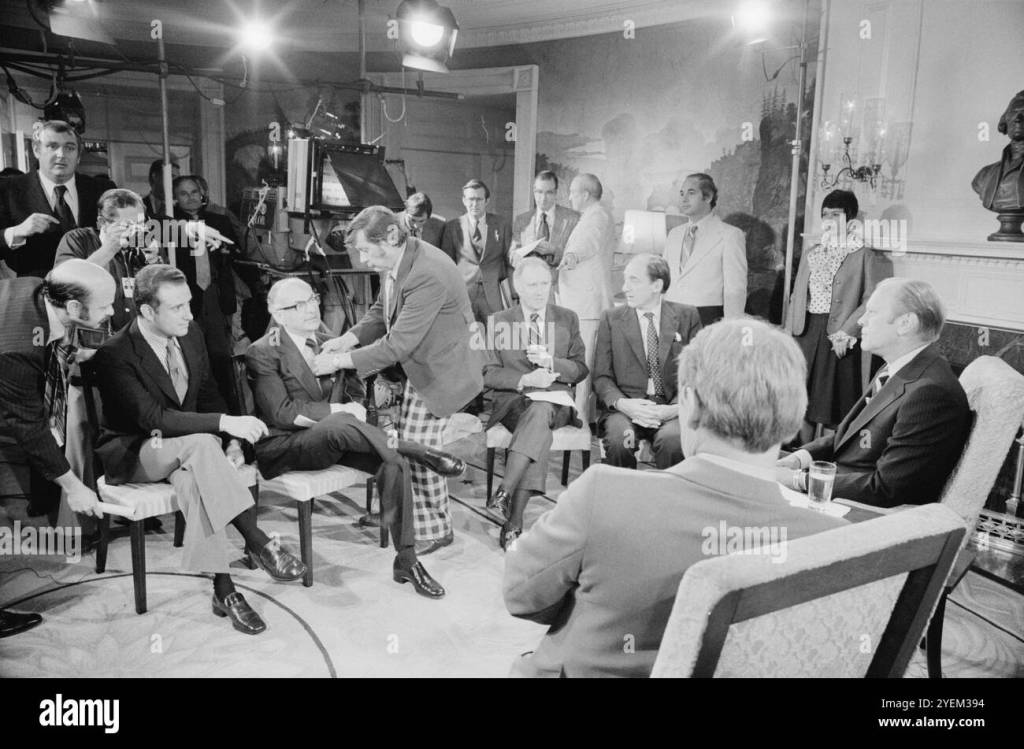
President Ford said today that he will ask the leaders of the North Atlantic Treaty Organization to consider whether Portugal’s leftist government should remain a partner. “I don’t see how you can have a Communist element significant in an organization that was put together for the purpose of meeting a challenge by Communist elements from the East,” he told five foreign news correspondents who interviewed him at the White House. He stopped short, however, of suggesting the removal of Portugal from NATO.
Portugal’s military rulers met separately with leaders of the Socialist and Communist parties in what may be a last effort to maintain civilian political participation in the government. The Armed Forces Council was reportedly still inclined to keep intact the four-party coalition that shares government posts with the Council’s own men, but there was no indication that it was willing to make concessions called for by the Socialist party, which had threatened to resign if they were not forthcoming. There were indications that the key council leaders were leaning more and more to setting up an all-military cabinet without the four parties that hold ministerial posts.
Secretary of State Kissinger met with Turkish leaders today but reportedly failed to persuade them to agree to any concessions toward a settlement of the Cyprus conflict. Before leaving for Washington, ending a tour that began in Vienna last Sunday, Mr. Kissinger told reporters that he thought there was a “basis for making progress.” But a source who was present at one of the meetings said the Secretary of State had failed in his main task in Turkey — to persuade former Premfer Bulent Ecevit, who ordered the invasion of Cyprus last July, to support the present shaky Turkish coalition government in offering concessions for a settlement. In reply to Mr. Kissinger’s appeal for moves that might help restore peace between the Greek and Turkish communities of Cyprus, Mr. Ecevit, now the Opposition leader, was quoted as having said: “Let the government first agree among its partners. Then let them announce their Cyprus policy, and only then can I say if my party can support this policy.”
The Netherlands Cabinet decided conditionally late last night to buy the American F‐16 jet fighter instead of the competing French‐made Mirage to replace its squadrons of F‐104 Starfighters. But the purchase will be made only on the stipulation that Denmark, Norway and Belgium, which have formed a consortium with the Netherlands for the purchase, also buy the same aircraft. The Dutch want to buy 102 of the planes, which are built by the General Dynamics Corporation of St. Louis, and the group as a whole needs 350. The value of such a sale is estimated at $2‐billion. While Norway and Denmark have already said they prefer the F‐16, which a panel of experts from the four countries has declared both a better bargain and technically superior to the Mirage, Belgium has recently leaned toward the French plane.
The Spanish Government, pressured by Arab neighbors and fearful of a guerrilla war, announced today that it was ready to give independence to the Spanish Sahara “in the shortest period possible.” Spain declared last August that she would free the colony in northwest Africa and asked the United Nations to organize a referendum to determine the wishes of the 76,000 inhabitants, many of them nomads. After a meeting of Generalissimo Francisco Franco and his Cabinet today, however, the Government announced, “Spain will not try in any way to prolong its presence in the Sahara, and never intended to take any advantage, political or material.”
The Soviet and Israeli Ambassadors to the United States have held several unpublicized meetings in Washington in recent months to discuss relations between their countries, which were broken off in 1967. There have been rumors for some time of meetings between the Soviet Ambassador, Anatoly Dobrynin, and the Israeli Ambassador, Simcha Dinitz. The meetings were confirmed by well-placed sources only after President Ford said — apparently inadvertently — in a televised interview that the Russians “have been meeting officially, diplomatically, with representatives from Israel,” surprising some State Department officials.
Michael Tzur, until recently a major power in Israel’s economy, was sentenced today in Tel Aviv to 15 years in prison. He pleaded guilty on May 9 to 14 counts of fraud, bribery, larceny and breaches of foreign currency regulations. Mr. Tzur has served as director general of the Ministry of Commerce and Industry and also as the Finance Ministry’s official in charge of financing exports and imports.
A military government was appointed to lead Lebanon, with Brigadier General Nureddine Rifai as the interim Prime Minister, and a cabinet with only one civilian member. The administration of Lebanon’s “first military premier” ended when he resigned after only three days. President Suleiman Franjieh appointed the first military cabinet in Lebanon’s history in an attempt to restore order in the country. The announcement was made minutes after a new cease-fire was declared in the fighting between right-wing Phalangists and Palestinian guerrillas. A cease-fire arranged Thursday night failed.
The Soviet Union has agreed to sell Libya $800‐million worth of military equipment including planes and missiles, informed Communist‐bloc sources here said today. The sources strongly denied that the arrangement, which was signed last week by Premier Aleksei N. Kosygin and Colonel Muammar el‐Qaddafi, the Libyan leader, included an agreement for Soviet military bases in Libya, as was reported in today’s issue of the Cairo paper Al Ahram. The sources ridiculed Al Ahram’s assertion that the value of the arms accord was $4‐billion. An official at the Libyan Embassy here confirmed that a new Soviet‐Libyan arms agreement had been concluded, but he added that the Al Ahram report was “wrong in the details.”
King Khalid of Saudi Arabia has told Senator Edward M. Kennedy, who is visiting Riyadh, that the Arab countries cannot relieve energy problems for the United States until there is a “just” solution to the Middle East conflict with Israel.
The Premier of Laos, Prince Souvanna Phouma, said that in an effort to prevent a new civil war he had ordered right-wing government troops not to resist when Pathet Lao forces moved into their territory. In an interview in Vientiane he discussed a variety of subjects, including his view of a socialist rather than a Communist Laos, and of his desire for continued friendly relations with the United States and, above all, the continuation of its aid.
The Mayaguez arrived in Hong Kong tonight and her owners opened six sealed cargo containers at the request of newsmen seeking to learn if the vessel was carrying military equipment when it was seized by a Cambodian patrol boat last week. The six containers, selected at random by the newsmen, contained automobile parts, fertilizers, butane gas, paint, office equipment and toilet paper. All the cargo was consigned from Oakand, California, to U Tapao Air Base in Thailand from where United States military Units launched an assault May 13 to recover the Mayaguez and rescue her crew. The Cambodians said they seized the Mayaguez because she was conducting espionage activities off Cambodia. Prince Norodom Sihanouk, the Cambodian Chief of State, also maintained that the 10,485‐ton freighter was loaded with plastic bombs and radio‐electronic equipment.
President Ferdinand E. Marcos said today that the United States and the Philippines must build a new relationship based on a realistic view of whether there is need for either the American instalations here or the mutual defense treaty. Referring to the new power balance in Asia as he has been doing since Cambodia and South Vietnam were taken over by Communists, Mr. Marcos said, that defense arrangements with the United States were “now under a cloud of uncertainty.”Pert of the reason, he said, is that the security arrangements “are apparently dependent not on legal commitment but on the mood” of the United States at a given historical period. Mr. Marcos spoke today before a national conference of the Philippine Chamber of Commerce. The 400 businessmen present applauded him loudly and adopted a resolution calling on every Filipino “to stand squarely with his President in striving to keep our country from being a battleground for international forces.”
In a letter to Representative Peter Rodino, chairman of the House Judiciary Committee, Attorney General Edward Levi said that between 1960 and 1971, the Federal Bureau of Investigation conducted five previously undisclosed counterintelligence programs against domestic political organizations, including one intended to turn organized crime against the American Communist party. In addition to that effort, termed “Operation Hoodwink,” Mr. Levi said that separate programs bad been aimed at harassing and confusing members of unidentified Puerto Rican independence groups and three unidentified organizations with foreign connections. In a letter seat today to Representative Rodino, Mr. Levi said that the five programs, part of the effort known collectively within the FBI as “Cointelpro,” had recently been uncovered in the course of an internal F.B.I. review.
A Justice Department study ordered by William B. Saxbe, Mr. Levi’s predecessor and now American Ambasgador to India, reported that Cointelpro had consisted of only seven separate programs, including those aimed at the American Communist party, the Socialist Workers party, black militant groups, “white hate groups” and the New Left. An FBI spokesman, asked how the five newly disclosed programs had been overlooked at the time of Mr. Saxbe’s public report on the departmental study last November, would say only, “We stand on the Attorney General’s statement” of today. But one FBI official said, “I’m not sure there’s anybody in the FBI who can tell you how we missed these things.”
The Central Intelligence Agency prepared “contingency” plans for the assassination of Cuban Premier Fidel Castro as a result of White House discussions, former agency officials have told the Rockefeller Commission, which is looking into Federal intelligence operations. According to a former senior intelligence official, the commission was told that this “contingency” planning included “feelers” being put out to two organized crime figures, Sam Giancana and John RoseIli. The plans, one source said, were examined after top‐level officials in the White House of President Kennedy indicated a desire to have the question of assassinating Mr. Castro examined as one possible solution to the growing Cuban problem in 1961 and 1962. McGeorge Bundy, then assistant to the President for national security affairs, told newsmen several weeks ago that White House officials did have discussions of “how nice it would be if this or that leader” were not around any more. The former intelligence official, who declined to be identified, said this sort of informal White House thoughts had resulted in “contingency planning at C.I.A.”
The Indochina Migration and Refugee Assistance Act of 1975 was signed into law by U.S. President Ford, providing for resettlement of South Vietnamese and Cambodian refugees into the United States. The Act would be amended on June 21, 1976 to include refugees from Laos.
In a policy shift, the Justice Department decided today to review its defense of the new Federal election law after a top official questioned the law’s constitutionality. A spokesman said that the Solicitor General, Robert H. Bork, who argues the government’s cases before the Supreme Court, got Attorney General Edward H. Levi to agree to prepare briefs in opposition to the new law, which was passed in the wake of the Watergate campaign money scandals. The law establishes the Federal Election Commission to enforce campaign laws, limits Federal campaign donations and spending and provides partial public financing for Presidential campaigns.
Dave Beck, former President of the Teamsters International, was given an unconditional pardon by U.S. President Ford. The man who succeeded Beck, Jimmy Hoffa, would disappear two months later.
Auto producers reported today that sales of domestic new cars for mid‐May fell 27.7 percent below 1974 to a 14‐year low. However, analysts saw some signs of a late spring upturn, because sales climbed more than usual from the first third of the month and, for the first time since March, all domestic car and truck assembly and manufacturing plants will operate next week.
Alfred C. Baldwin 3d, the former Federal Bureau of Investigation agent who monitored the Watergate wiretaps in 1972 insists that he used and meant the initials “C.I.A.” in a recorded interview later given to United States District Court, his attorney said today. Federal prosecutors told the court when the interview Was submitted that the “C.I.A.” references in the transcript should have read “C.R.P.,” meaning the Committee for the Re‐election of the President, and that Mr. Baldwin had told them that he misspoke in using “C.I.A.” Mr. Baldwins attorney, Robert C. Mirto of New Haven, said in a telephone interview that he knew “for a fact” that no one from the United States Attorney’s office here had consulted Mr. Baldwin about the purported discrepancy. Asked whether Mr. Baldwin has used the initials C.I.A. intentionally In the interview, Mr. Mirto replied, “Of course.”
The Environmental Protection Agency proposed today new standards to protect the public from radiation released by nuclear reactors and by the processing of uranium used to power reactors. Russell E. Train, head of the agency, said at a news conference that the proposed standards would result in a reduction of more than 1,000 cases of cancer and serious genetic damage over the next 25 years. Mr. Train said that most of the 55 reactors operating in the United States had already met the standards, although some improvement would be required to protect people living in the vicinity of milling and other fuel‐processing plants situated primarily in Wyoming, New Mexico, Texas, Colorado, Utah and Washington.
The Council on Wage and Price Stability recommended today that the Federal Government finance a program to install airbags in 100,000 small cars for field testing before American automobile manufacturers are required to make them standard equipment. George Eads, assistant director of government operations and research for the council, presented the recommendation at the final day of hearings on airbags held by the National Highway Traffic Safety Administration. The recommendation may reflect White House thinking since the council monitors wage and price developments for the White House. The council became involved in consideration of the pending regulation for mandatory airbags because of the economic impact of such a move.
Connecticut Governor Ella T. Grasso agreed today, subject to the approval of the General Assembly, to pay Connecticut’s state employes the raises they were to have been denied in the coming fiscal year, by diverting $5.3‐million that the state had earmarked for the State Employes Retirement Fund. To get the state’s 40,000 employes to drop some of their other demands, along with their lingering threat to strike, Mrs. Grasso told the eight union representatives who met with her in her office this morning that she would sign a bill permitting state employees to engage in politics.
Declaring that a democratic society cannot “cage inmates like animals in a zoo,” a federal judge yesterday ordered the reduction within a year of the inmate population at state prisons to a total described as an “emergency capacity.” This emergency capacity is now exceeded by more than 2,600 convicts.
A three-judge federal court has ruled that a church seeking to hold services for homosexual prison inmates is a bonafide church and must be guaranteed freedom of religion.
28th Cannes Film Festival: “Chronicle of the Years of Fire” directed by Mohammed Lakhdar-Hamina wins the Palme d’Or.
Counted out two weeks ago, the Golden State Warriors took a stranglehold on the National Basketball Association championship tonight by beating the Washington Bullets, 109–101, for a 3–0 lead in the four-of-seven game series. With Rick Barry scoring 38 points, 25 in the first half, and all the other freely substituted Warriors gathering momentum through the last 15 minutes of a bruising game, the Warriors produced their fifth consecutive remarkable performance. On May 8, when they lost a home game to the Chicago Bulls in the semifinal round, they fell behind, 3‐2, in that series, and were expected to be eliminated in the next game at Chicago.
Major League Baseball:
It still bothers Jon Matlack that he hasn’t pitched a complete game this season, but the Mets’ left-hander wasn’t complaining about his 3–1 victory tonight over the Braves. Matlack needed help from Bob Apodaca in the eighth after he had put two men on with two out. But neither pitcher allowed an extra‐base hit, and Apodaca retired all four batters he faced.
The Reds downed the Phillies, 5–2. ony Perez hit a two‐run homer and Mery Rettenmund contributed a two‐run single to help Gary Nolan win his third game in six decisions, with late relief from Clay Carroll. Perez’s seventh homer came after a first‐inning double by Johnny Bench. Cesar Geronimo doubled home George Foster with another run in the second. A single by Dave Conception and Foster’s double preceded Rettenmund’s hit in the fourth. Carroll relieved in the seventh and earned his third save.
Dave Roberts pitched a six‐hitter and Greg Gross and Roger Metzger each drove in a run with triples as the Astros won their sixth straight, beating the Expos, 4–2.
The Padres edged the Pirates, 4–3. Fred Kendall lined a single to left field with one out in the ninth inning to score Dave Winfield with the winning run. Pittsburgh tied the game, 3–3, in the sixth when Al Oliver singled and Willie Stargell hit his seventh homer of the season. Tito Fuente hit a homer in the fourth for the Padres with a man on base.
The Cardinals beat the Dodgers, 4–3. Ted Sizemore and Luis Melendez each drove in a run in the eighth inning to bring St. Louis from behind. The Dodgers scored single runs in the fourth and sixth innings on homers by Steve Garvey, his fifth, and Jimmy Wynn, his seventh. Melendez homered for the Cardinals in the sixth.
The Giants defeated the Cubs, 3–2. Glenn Adams, a pinch‐hitter, tripled home the tie-breaking run as San Francisco scored twice in the eighth inning. The Cubs had pulled into a 1–1 tie in the top of the inning on George Mitterwald’s home run. Pete Falcone (4–3) was the winning pitcher.
Catfish Hunter got his sixth victory in his last seven starts, this time by 11–7, as the Yankees downed the Texas Rangers at Shea Stadium. Graig Nettles socked two home runs and drove in three runs; Chris Chambliss collected two hits and a sacrifice fly and knocked in three runs; Ed Herrmann drove in two with a double, and Bobby Bonds hit his sixth homer. Even though Hunter had an 11–2 lead going into the ninth and seemed a cinch to complete his seventh straight start, he wound up needing help from Sparky Lyle after six straight Rangers reached base—five on singles and one on a walk.
Nolan Ryan went against the Red Sox in Boston’s Fenway Park last night. He went to the mound with an 8–1 won‐lost record. Now he’s 8–2, a 6–1 loser to Boston and the victim of three home runs, equaling his total in his previous nine starts. Carl Yastrzemski hit a two‐run shot, and Bernie Carbo and Dwight Evans hit homers with the bases empty. Ryan left trailing, 5–1, after six innings despite seven strike‐outs. The Red Sox added another home run, this one by Fred Lynn in the eighth inning off Chuck Dobson.
The A’s shut out the Indians, 3–0. The A’s snapped a four‐game losing streak on the home‐run hitting of Bert Campaneris and Joe Rudi and the combined three‐hit pitching of Sonny Siebert and Jim Todd. Campaneris hit his first homer of the season in the third off Gaylord Perry (5–6) and Rudi connected in the fourth. The A’s added their final run in the ninth on a single by ClaudeII Washington. Siebert (4–2) made his first start for the A’s and posted the triumph. He went five innings, allowed one hit, struck out three and walked none. Todd yielded two hits over the last four innings to pick up his fifth save.
Deron Johnson, the designated hitter, singled across two runs to highlight a four‐run rally in the sixth inning that carried Chicago and Terry Forster to a 6–1 victory over the Tigers. Forster, in relief of Wilbur Wood, gained the victory, his third in six decisions. The loser was Lerrin LaGrow (3–4). LaGrow suffered his fourth straight loss although sloppy fielding by his teammates contributed to his defeat.
Eric Soderholm and Tom Kelly produced run‐scoring singles in the ninth inning to back the four‐hit pitching of Bert Blyleven as the Twins rallied to win, 2–1, in Milwaukee. The Brewers held a 1–0 lead in the ninth when Tony Oliva and Larry Hisle singled off Ed Sprague. Toni Murphy replaced Sprague and Soderholm and Kelly followed with decisive hits. Blyleven walked three and fanned seven, winning his fourth game in a row to bring his record to 5–1.
The Royals routed the Orioles, 10–1. Harmon Killebrew hit two‐run homers in his first two plate appearances and Buck Martinez hit a bases‐loaded triple in a rout that sent the Orioles to their sixth defeat in the last seven games. Behind the slugging, Al Fitzmorris scattered seven hits in winning his sixth game in nine decisions. Killebrew now has seven homers this season and 566 in his career.
New York Mets 3, Atlanta Braves 1
California Angels 1, Boston Red Sox 6
Detroit Tigers 1, Chicago White Sox 6
Philadelphia Phillies 2, Cincinnati Reds 5
Oakland Athletics 3, Cleveland Indians 0
Montreal Expos 2, Houston Astros 4
Baltimore Orioles 1, Kansas City Royals 10
St. Louis Cardinals 4, Los Angeles Dodgers 3
Minnesota Twins 2, Milwaukee Brewers 1
Texas Rangers 7, New York Yankees 11
Pittsburgh Pirates 3, San Diego Padres 4
Chicago Cubs 2, San Francisco Giants 3
The stock market, spurred by a cut in the prime interest rate by the First National City Bank, posted a broad advance yesterday in continued active trading. The Dow Jones industrial average, which had lost 18.70 points in the preceding four sessions, advanced 12.99 yesterday and closed at 831.90, its high for the day. The stock market will be closed Monday in observance of Memorial Day.
Dow Jones Industrial Average: 831.90 (+12.99, +1.59%)
Born:
Jon Fogarty, American racing driver, in Palo Alto, California.
Died:
Moms Mabley (Loretta Aiken), 81, African-American comedian.
 History Diaries