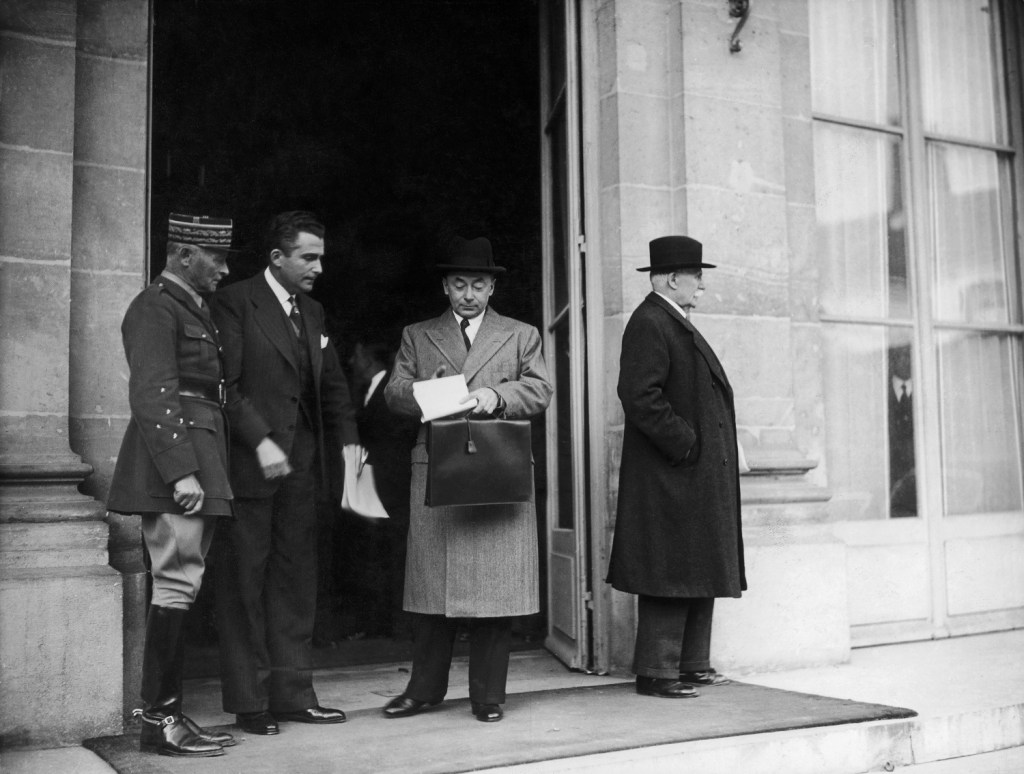
The first German troops reach the Atlantic coast at the port of Abbeville. France is now cut in two, with a large portion of its army and the BEF, which is actually almost the entire British Army, cut off and surrounded.
German Major General Erwin Rommel bypassed Arras, France and advanced west toward the English Channel. British General John Vereker Lord Gort launched a counterattack on Rommel’s 7th Panzer Division at Arras. The Battle of Arras was fought when Allied forces commanded by Major-General Harold Franklyn mounted a counterattack in northeast France. The Allies made initial gains but then withdrew to avoid being encircled.
Major-General Harold Franklyn, commanding two tank battalions, had moved into the Arras area. Franklyn was not aware of a French push north toward Cambrai, and the French were unaware of a British attack heading south, out of the pocket, toward Arras. Ignorant as to the importance of the operation, Franklyn assumed he was to relieve the Allied garrison at Arras and to sever German communications in the immediate area. He did not therefore want to risk throwing his main units, the 5th and 50th Infantry Divisions into the fight, especially if the objectives were limited. He also had the French 3rd DLM available from the French 1st Army. It had caused the German armor severe trouble at the Battle of Hannut with its SOMUA S35 heavy tanks. They were given no more than a flank protection role. Only two infantry battalions and two tank battalions were made available for the attack. British armor numbers had dwindled owing to mechanical failures. However they still fielded 74 Matilda tanks and 14 light tanks.
The resulting Battle of Arras achieved surprise and initial success against the overstretched German forces, but it still failed. Radio communication between tanks and infantry was poor and there was little combined arms coordination as practiced by the Germans. In the end, hastily set up German defenses (including 88-mm (3.46-inch) FlaK guns and 105-mm (4.1-inch) field guns) stopped the attack. In addition, Rommel’s penchant for stringing out his forces — which so panics his tradition-minded superiors — pays massive dividends. Rommel is able to recall an advanced panzer regiment which returns and takes the advancing British in a devastating flank attack. The French inflicted heavy losses on German armor as they retreated, but the Luftwaffe broke up the counterattacks. Just 28 of the 88 British tanks survived.
The British tanks falter, then retreat, harassed by the Luftwaffe all the way. The British lose 60 of their 88 tanks, while Rommel only loses 89 killed, 110 wounded and 173 missing. It is a huge tactical defensive victory for the Wehrmacht. However, the attack greatly impresses the German OKW high command — and particularly Hitler. It might have made some real impact if coordinated with de Gaulle’s abortive attack from the south on 19 May.
The Battle of Arras has long-lasting effects. One theory of German tank development is that this encounter at Arras so impresses Hitler with the superiority of heavily armored British tanks that he puts in place the design program that ultimately leads to the Panzer VI Tiger Tank of 1942. The battle also is when the Allies begin to speak of “German 88s” with respect. The failure of the attack makes the senior British leadership — if not the French — even leerier about the BEF’s prospects on the Continent. Finally, the ferocity of the attack is giving the top German brass second thoughts about pressing home the attack against the quickly contracting First Army Group as it bellies up beside the sea.
An Allied conference is held at Ypres with General Weygand, General Billotte, and King Leopold attending. General Maxime Weygand, commander of the French Army, visited the commanders of the northern armies at Ypres to try to coordinate attacks from north and south of the German corridor to the coast. By a series of accidents he missed seeing British General Lord Gort. Weygand has given the fullest explanation of his plans to General Gaston Bilotte. The Belgian position on any offensive move was made clear by King Leopold. As far as he was concerned, the Belgian Army could not conduct offensive operations as it lacked tanks and aircraft; it existed solely for defense. The king also made clear that in the rapidly shrinking area of Belgium still free, there was only enough food for two weeks. Leopold did not expect the BEF to jeopardize its own position in order to keep contact with the Belgian Army, but he warned the British that if it persisted with the southern offensive, the Belgians would be overstretched and their army would collapse. King Leopold suggested the best recourse was to establish a beachhead covering Dunkirk and the Belgian channel ports.
General Gaston Billote, commander of the French First Group of Armies, was fatally injured when his driver crashed into a truck returning from the Ypres conference. Gort’s Chief of Staff, not one to mince words, observes caustically, “With all respect, he’s no loss to us in this emergency” – which is a bit unfair because Billotte was the key to the counterattack, which now does not take place. General Blanchard, heretofore in charge of French 1st Army, takes over as Cinc of 1st Army Group.
Lord Gort doubted the French Army’s ability to prevail in the offensive.
General Guderian’s panzers consolidate their hold on the Somme. German 1st Panzer Division, 2nd Panzer Division, and 10th Panzer Division are establishing bridgeheads across the Somme River. These will be quite handy when the time comes to head south.
The Germans besiege Maubeuge, west of Dinant on the River Sambre. The French Ninth Army, having lost its commander General Giraud when captured by German troops, is in a state of collapse.
In Paris, France, General Robert Altmayer, a retired cavalry general who had retired four years earlier as Inspector-General of Cavalry, was summoned by Maxime Weygand to take command of Group A (later renamed Tenth Army) consisting of the 9th Corps, 10th Corps and 3rd Division Legere Mecanique. He was also told that all BEF troops south of the Somme (1st Armoured Division and 51st Highland Division) would also come under his orders.
The Belgian government evacuates to Bruges.
The evacuation of the remaining RAF squadrons in Belgium was completed. The evacuation had begun on May 19 and this action was taken in response to the rapid German advance. Air cover over the BEF henceforth will originate from either France or England. This is not optimal for the gun-carrying infantry still trying to hold tenuous lines that keep shifting back toward the coast.
RAF Bomber Command dispatches 124 aircraft to attack road and rail targets overnight in Namur, Dinant, and Aachen, as well as the German troops outside Arras.
RAF Bomber Command dispatches 61 aircraft to attack targets in northern France.
German bombers attacked British ports on the English Channel while RAF bombers attacked refineries near Rotterdam, the Netherlands.
There are many anecdotal reports of Luftwaffe fighters and Stukas strafing refugees on the roads. Doing so would both block the roads and sow terror about the chilling new aerial weapons of the Luftwaffe – the Stukas have had air horns installed specifically to enhance the terror effect. These types of incidents are extremely difficult to prove, and they may not necessarily be intentional war crimes. However… intentionally targeting civilians in such a manner most definitely is a war crime.
Destroyer HMS Keith was damaged by the near miss of a German air bomb at Dunkirk. Destroyer Keith evacuated one hundred and fifty British refugees and returned to Dover.
A group of French merchant ships were ordered away from Dunkirk. However, heavy German bombing began before the ships even left port. French tanker Salome (13,291grt) was badly damaged by bombing before she could even be towed into the channel. French steamer Pavon (4128grt), with 1500 Dutch troops aboard for evacuation to England, was badly damaged by German bombing between Gravelines and Calais. The steamer was run aground a total loss near Calais. French destroyers Cyclone, Sirocco, and Mistral rescued the survivors of these sunken ships. French destroyer L’adroit (Capitaine de Corvette H.M. A. Dupin de Saint-Cyr), waiting to escort this convoy, was bombed and beached in a sinking condition at Malo les Bains before ever joining the convoy. French submarine chaser CH.9, also waiting to escort the convoy, was bombed and badly damaged off Dunkirk. She was run aground a total loss to prevent sinking and abandoned. To give the destroyers relief from constant bombing, French destroyers Cyclone, Mistral, Sirocco, Fougueux, and Frondeur departed Dunkirk and arrived in the Downs that evening.
British steamer Bawtry (835grt) was sunk by German bombing in the Dunkirk docks. The crew of thirteen and one naval gunner were saved and returned to England. The steamer was later raised by German forces, salved, renamed Rival for German service.
Panamanian tanker Clairy (5838grt) was sunk by German bombing eight to nine miles off Boulogne. The tanker was abandoned on fire on the 22nd. The entire crew was rescued.
French auxiliary minesweepers Saint Bernoit (315grt), Notre Dame De Lorette (339grt), Rien Sans Peine (142grt), Jacques Coeur (285grt), and Saint Joachim (192grt) were sunk by German bombing at Dunkirk.
French tug Tumulte (370grt) was sunk by German bombing at Dunkirk.
Mine destructor ship HMS Corburn (3060grt, Lt Cdr M. E. Welby) was sunk by German motor torpedo boat S.32 off Le Havre.
British steamer Firth Fisher (574grt) was sunk by mining one half mile east of Boulogne Pier. Seven crewmen were lost. The pilot and three crewmen were rescued by British steamer Sparta (708grt).
Belgian steamer Antverpia (4932grt), which had been damaged by German bombing on the 20th in Boulogne Roads, was run aground to prevent sinking. The entire crew was rescued. The steamer was set afire by incendiary bombs on the 23rd.
French tugs Orme (340grt) and Barfleur (330grt) were scuttled at Boulogne.
French auxiliary minesweepers Leopold Soubler (215grt) and Christiane Cecile (146grt) were scuttled at Boulogne.
British steamer Hubbastone (873grt) was sunk by German bombing in Dieppe Dock. The entire crew of the steamer was rescued. The steamer was damaged again on the 23rd and abandoned. Steamer Hubbastone was later salved by German forces and renamed Jurgensby for German service.
Hospital carrier Maid Of Kent (2693grt) was damaged by German bombing at in the Paris Basin at Dieppe. The steamer was abandoned in a sinking condition. Thirty seven men were lost.
Belgian fishing vessel De Normandie (137grt) was sunk on a mine fifty meters outside Dieppe Harbor. Five crew and eight refugees were killed.
Belgian trawler Nelly Suzanne (151grt) and fishing vessels Independence (96grt), Georgette Simone (11grt), and Ernestine Gabrielle (12grt) were sunk by German bombing at Dieppe.
Italian steamer Fidelitas (5740grt) was damaged by German bombing at Antwerp.
Destroyer HMS Venomous at Calais was attacked by German bombers, but was not damaged. The destroyer arrived at Dover on the 21st with 200 refugees and the crew and stores from the Sangette loop station.
Destroyer HMS Wild Swan on North Goodwins Patrol was attacked by German bombers, but was not damaged. Destroyer Wild Swan proceeded to Boulogne and embarked 150 British refugees. These refugees were taken to Dover.
French light cruisers Jeanne D’arc and Emile Bertin departed Brest on the 21st with 200 tons of gold to be taken to Halifax. French large destroyers Jaguar and Gerfaut were assigned as escort, but both were reassigned before they joined. On the 25th in 31-30N, 22-38W, the French light cruisers joined French aircraft carrier Bearn, carrying gold from Toulon. The French ships safely arrived at Halifax on 1 June.
The French, Polish and Norwegian forces moving in on Narvik advance another stage and gain positions on the northern side of Rombaksfiord.
German 2nd Mountain Division pushes northward from Mo i Rana toward Bodø, Norway. The German 2nd Mountain Division continues advancing past Mo i Rana toward Bodø and takes up positions on the north shore of the Rombaksfiord. Colonel Gubbins plans to mount a defense at Storjord, 20 miles (32 km) south of Rognan — if he can get the Scots Guards under Lieutenant Colonel Thomas Byrnand Trappes-Lomax to stop their retreat.
British Royal Air Force 263 Squadron (flying off aircraft carrier HMS Furious to Bardufoss north of Narvik) and 46 Squadron arrived in Narvik, Norway with 18 Gladiator and 18 Hurricane aircraft to provide additional, but still not adequate, protection for Allied warships in the area.
The Royal Navy Hawkins-class heavy cruiser HMS Effingham, which ran aground on a reef in the Norwegian Sea near Bodø, Nordland, Norway (67°17’N 13°58’E) and was abandoned on 17 May, was subsequently scuttled by gunfire and torpedoes from HMS Matabele.
An official British Admiralty communiqué noted that “[t]he Secretary of the Admiralty regrets to announce that as the result of damage sustained through striking an uncharted rock off the Norwegian coast, HMS Effingham (Captain JM Howson, RN), has become a total loss”.
Aircraft carrier HMS Ark Royal, escorted by destroyers HMS Antelope, HMS Brazen, HMS Encounter and HMS Volunteer, departed her patrol area near Narvik. Destroyer Antelope which lost touch in thick fog arrived at Scapa Flow at 0720/24th. After being delayed by fog, the aircraft carrier arrived for refuelling at Scapa Flow at 1940/24th with destroyers Encounter and Volunteer.
Aircraft carrier HMS Furious flew off the Gladiator aircraft of the 263 Squadron ashore to Bardufoss airfield, northeast of Narvik. One Swordfish of the 818 Squadron escorting the Gladiators crashed on a mountainside at Gryllefjord, Seja Island. S/Lt J. A. Welply, S/Lt G.P. Simpson, Leading Airman H.H. Simpson were injured, but later returned to the ship. Aircraft carrier HMS Glorious was unable to disembark her RAF Hurricanes of the 46 Squadron. The aircraft carriers with destroyers HMS Veteran, HMS Diana, HMS Amazon, and HMS Viscount departed their patrol area near Narvik for refuelling at Scapa Flow. Both aircraft carriers arrived for refueling at 2100/23rd.
Anti-submarine trawlers HMS Cape Passaro (510grt, Lt Cdr M. B. Sherwood Rtd of the 15th Anti-Submarine Striking Force and HMS Melbourne (466grt, Lt Cdr A. J. C. Pomeroy RNVR) of the 23rd Anti-Submarine Group were sunk by German bombing near Narvik. Four ratings were killed on the trawler Cape Passaro. There were no casualties on trawler Melbourne.
French Premier Paul Reynaud told the French Senate that the setback France had experienced in the war was due to its failure to understand changes in the methods of modern warfare. Reynaud appeared before his parliament and blamed the military “disaster” on “incredible faults” in the French high command that he said would “be punished.” Reynaud dramatically proclaimed, “France cannot die! If a miracle is needed to save France, I believe in miracles because I believe in France!.”
The British government announced that over 250,000 men had enrolled in the Local Defence Volunteers organization within the first 24 hours of its existence.
From their new Minister of Information, Alfred Duff Cooper, British radio listeners tonight heard that now the battle is being brought close to these shores and that soon the home folk, as well as the troops. in the front lines, will be taking part in it. Yet one would never guess that this was the capital of a nation fighting in the gravest crisis of its life.
Evacuation to U.K. of all families of British military personnel at Gibraltar begins. Nobody knows Francisco Franco’s intentions, and Gibraltar would be indefensible if Spain joins the Axis.
AVRO chairman Willem Vogt, leader of a leading radio broadcaster in the Netherlands, fired all his Jewish employees.
In a conference in Berlin Grand Admiral Erich Raeder mentioned to German Chancellor Adolf Hitler for the first time that it may be necessary to invade Britain. The German navy had made some preliminary studies on the subject but they had not been based on the availability of French bases. Little though is given to this possibility at the time because Hitler is concentrating on the defeat of the French. Hitler agrees with the proposal but also tells Commander-in-chief Brauchitsch and his chief of staff Halder that he wants to do a deal with Great Britain.
Fresh fears that Italy might be girding to strike into the Balkans were stirred tonight by reports filtering across the Yugoslav-Albanian frontier, suddenly closed by Italy, that munitions were being rushed to Albania. The closing of the border was announced today in Rome as the Italian Foreign Minister, Count Ciano, left for Albania. Yugoslav military staff along the frontier heard that barracks, storehouses and arsenals were being built on twenty-four-hour shifts in Albania, where Italy is reported to have only 70,000 troops, and that vast shipments of war materials were being speeded across the Adriatic from Italy.
It was said, too, that Italians were circulating propaganda maps to excite Albanian ambitions. The maps were described as depicting a “greater Albania,” which would embrace parts of Southern Serbia. In some Yugoslav quarters it was suggested Italy might be preparing to guard her “back door” in Albania against an Allied counterblow while she entered the war with a main attack upon France. Italy’s purpose in Albania, above all, would be to prevent the Allies from debarking troops at Salonika, Greece, for a counter blow.
This view seemed supported by reports from Fiume, near the northern Yugoslav frontier, that big Italian troop concentrations there were being reduced and apparently moved in the direction of the French border.
Italy has protested informally to the Yugoslav Government against military reinforcement of this country, reliable diplomatic sources said tonight. Mobilization continued slowly and steadily. Official sources estimated that at least two-thirds of the Yugoslav Army already was under arms.
Greek Dictator George Metaxas conferred tonight with his Council of Generals, then went to see King George II. The Greek-Albanian frontier remained open. Officials said they had no reason to believe an attack from Italian-“protected” Albania was imminent but that the Greek public, strongly pro-Ally, was dismayed by the news from the Western Front. Considerable tension was evident.
Swedes heard and read with amazement the news from the Western Front today. The effect was to increase the already growing doubts that the Allies could rally their forces or get help from America in time to check the blitzkreig, which seemed to be sweeping all before it.
In the Soviet Union, General Alexander Vasilevsky becomes 1st Deputy Head of Operations Directorate of the Stavka.
The German auxiliary cruiser / raider Orion rounded Cape Horn and entered the South Pacific.
French cruiser Émile Bertin completed her repairs at Brest, France.
In the North Sea, German U-boat U-8 encountered an enemy submarine, but neither boat attacked
French Large Destroyer Division 2 was ordered from Brest to Cherbourg where they arrived without incident. At Cherbourg, large destroyer Chacal embarked a demolition party for the port of Calais, Leopard for Boulogne, Jaguar for Dunkirk.
Convoy OB.152 departed Liverpool escorted by sloop HMS Rochester from 21 to 23 May. The sloop was detached to convoy HX.42.
Convoy FS.176 departed the Tyne, escorted by destroyer HMS Walpole. The convoy arrived at Southend on the 23rd.
The War at Sea, Tuesday, 21 May 1940 (naval-history.net)
Destroyer KEITH was damaged by the near miss of a German air bomb at Dunkirk.
Destroyer KEITH evacuated one hundred and fifty British refugees and returned to Dover.
A group of French merchant ships were ordered away from Dunkirk. However, heavy German bombing began before the ships even left port. French tanker SALOME (13,291grt) was badly damaged by bombing before she could even be towed into the channel.
French steamer PAVON (4128grt), with 1500 Dutch troops aboard for evacuation to England, was badly damaged by German bombing between Gravelines and Calais.
The steamer was run aground a total loss near Calais.
French destroyers CYCLONE, SIROCCO, and MISTRAL rescued the survivors of these sunken ships.
French destroyer L’ADROIT (Capitaine de Corvette H.M. A. Dupin de Saint-Cyr), waiting to escort this convoy, was bombed and beached in a sinking condition at Malo les Bains before ever joining the convoy.
French submarine chaser CH.9, also waiting to escort the convoy, was bombed and badly damaged off Dunkirk. She was run aground a total loss to prevent sinking and abandoned.
To give the destroyers relief from constant bombing, French destroyers CYCLONE, MISTRAL, SIROCCO, FOUGUEUX, and FRONDEUR departed Dunkirk and arrived in the Downs that evening.
British steamer BAWTRY (835grt) was sunk by German bombing in the Dunkirk docks.
The crew of thirteen and one naval gunner were saved and returned to England.
The steamer was later raised by German forces, salved, renamed RIVAL for German service.
Commander in Chief, Nore, offered to place two destroyers at disposal of Vice Admiral Submarines for Operation LAMP, the cutting of the cable off Amsterdam.
Panamanian tanker CLAIRY (5838grt) was sunk by German bombing eight to nine miles off Boulogne.
The tanker was abandoned on fire on the 22nd.
The entire crew was rescued.
French auxiliary minesweepers SAINT BERNOIT (315grt), NOTRE DAME DE LORETTE (339grt), RIEN SANS PEINE (142grt), JACQUES COEUR (285grt), and SAINT JOACHIM (192grt) were sunk by German bombing at Dunkirk.
French tug TUMULTE (370grt) was sunk by German bombing at Dunkirk.
Mine destructor ship CORBURN (3060grt, Lt Cdr M. E. Welby) was sunk by German motor torpedo boat S.32 off Le Havre.
Destroyers VIMY, WINDSOR, and VENETIA departed the Nore for Dover to assist in various duties.
Destroyer VIMIERA arrived at Dover after taking the WHITLEY crew to Portsmouth.
British steamer FIRTH FISHER (574grt) was sunk by mining one half mile east of Boulogne Pier.
Seven crew were lost. The pilot and three crew were rescued by British steamer SPARTA (708grt).
Belgian steamer ANTVERPIA (4932grt), which had been damaged by German bombing on the 20th in Boulogne Roads, was run aground to prevent sinking.
The entire crew was rescued.
The steamer was set afire by incendiary bombs on the 23rd.
French tugs ORME (340grt) and BARFLEUR (330grt) were scuttled at Boulogne.
French auxiliary minesweepers LEOPOLD SOUBLER (215grt) and CHRISTIANE CECILE (146grt) were scuttled at Boulogne.
British steamer HUBBASTONE (873grt) was sunk by German bombing in Dieppe Dock.
The crew of the steamer were all rescued.
The steamer was damaged again on the 23rd and abandoned.
Steamer HUBBASTONE was later salved by German forces and renamed JURGENSBY for German service.
Hospital carrier MAID OF KENT (2693grt) was damaged by German bombing at in the Paris Basin at Dieppe.
The steamer was abandoned in a sinking condition.
Thirty-seven men were lost.
Belgian fishing vessel DE NORMANDIE (137grt) was sunk on a mine fifty meters outside Dieppe Harbour.
Five crew and eight refugees were killed.
Belgian trawler NELLY SUZANNE (151grt) and fishing vessels INDEPENDANCE (96grt), GEORGETTE SIMONE (11grt), and ERNESTINE GABRIELLE (12grt) were sunk by German bombing at Dieppe.
Italian steamer FIDELITAS (5740grt) was damaged by German bombing at Antwerp.
Destroyer VENOMOUS at Calais was attacked by German bombers, but was not damaged.
The destroyer arrived at Dover on the 21st with 200 refugees and the crew and stores from the Sangette loop station.
Destroyer WILD SWAN on North Goodwins Patrol was attacked by German bombers, but was not damaged.
Destroyer WILD SWAN proceeded to Boulogne and embarked 150 British refugees.
These refugees were taken to Dover.
French light cruisers JEANNE D’ARC and EMILE BERTIN departed Brest on the 21st with 200 tons of gold to be taken to Halifax.
French large destroyers JAGUAR and GERFAUT were assigned as escort, but both were reassigned before they joined.
On the 25th in 31-30N, 22-38W, the French light cruisers joined French aircraft carrier BEARN, carrying gold from Toulon.
The French ships safely arrived at Halifax on 1 June.
French Large Destroyer Division 2 was ordered from Brest to Cherbourg where they arrived without incident.
At Cherbourg, large destroyer CHACAL embarked a demolition party for the port of Calais, LEOPARD for Boulogne, JAGUAR for Dunkirk.
French General Weygand left on Dunkirk on French torpedo boat FLORE for Cherbourg, via Dover.
The torpedo boat arrived safely at Cherbourg at dawn on the 22nd.
Convoy OB.152 departed Liverpool escorted by sloop ROCHESTER from 21 to 23 May. The sloop was detached to convoy HX.42.
Convoy FS.176 departed the Tyne, escorted by destroyer WALPOLE. The convoy arrived at Southend on the 23rd.
Aircraft carrier ARK ROYAL, escorted by destroyers ANTELOPE, BRAZEN, ENCOUNTER, and VOLUNTEER, departed her patrol area near Narvik.
Destroyer ANTELOPE which lost touch in thick fog arrived at Scapa Flow at 0720/24th.
After being delayed by fog, the aircraft carrier arrived for refueling at Scapa Flow at 1940/24th with destroyers ENCOUNTER and VOLUNTEER.
Aircraft carriers FURIOUS flew off the Gladiator aircraft of the 263 Squadron ashore to Bardufoss airfield, northeast of Narvik.
One Swordfish of the 818 Squadron escorting the Gladiators crashed on a mountainside at Gryllefjord, Seja Island. S/Lt J. A. Welply, S/Lt G.P. Simpson, Leading Airman H.H. Simpson were injured, but later returned to the ship.
Aircraft carrier GLORIOUS was unable to disembark her RAF Hurricanes of the 46 Squadron.
The aircraft carriers with destroyers VETERAN, DIANA, AMAZON, and VISCOUNT departed their patrol area near Narvik for refueling at Scapa Flow.
Both aircraft carriers arrived for refueling at 2100/23rd.
Destroyer ICARUS departed Scapa Flow.
Anti-submarine trawlers CAPE PASSARO (510grt, Lt Cdr M. B. Sherwood Rtd of the 15th Anti-Submarine Striking Force and MELBOURNE (466grt, Lt Cdr A. J. C. Pomeroy RNVR) of the 23rd Anti-Submarine Group were sunk by German bombing near Narvik.
Four ratings were killed on the trawler CAPE PASSARO. There were no casualties on trawler MELBOURNE.
Anti-submarine trawlers JUNIPER and HAZEL of the 19th Anti-Submarine Striking Force departed Scapa Flow escorting oiler BRITISH JUSTICE and steamer BALTONIA to the Clyde. The trawlers were then to patrol in position 59-10N, 5 to 7 W.
French destroyers BASQUE and FORTUNE departed Bizerte escorting steamers PRESIDENT DOUMER and PROVIDENCE to Beirut, arriving on the 25th.
These destroyers replaced large destroyers TIGRE and LYNX of Amiral Godfrey’s command.
Destroyer BASQUE had been repairing at Brest. She departed on the 13th, escorting the two steamers to Casablanca, arriving 16 May. The three ships passed Gibraltar on the 16th and arrived at Bizerte on the 19th.
Destroyer FORTUNE had been repairing at Oran. She departed on the 16th and arrived at Bizerte on the 17th.
Today in Washington, President Roosevelt conferred on the naval defense program with Senator Walsh, Representative Vinson and Admirals Stark, Towers, and Moreell; asked Congress to remove the $60,000 limit on Federal contributions to WPA projects; vetoed the $109,985,450 Rivers and Harbors Bill, and, at a press conference, told of German machine-gunning of helpless French refugees and announced a program to prevent profiteering, labor disturbances or weakening of social legislation here. He was host and Mrs. Roosevelt hostess tonight at the annual dance for the Washington newspaper correspondents.
The Senate considered the Army Appropriation Bill providing increased funds for national defense, received the bill authorizing purchase of 10,000 naval planes and expansion of air facilities, received the Pepper resolution authorizing sale of air force equipment to certain recognized governments and recessed at 4:50 PM until noon tomorrow.
The House considered the Relief Appropriation Bill, approved a $20.000 appropriation for its committee to investigate the migrant labor problem and adjourned at 5:58 PM until 11 AM tomorrow. The Dies committee heard testimony on Soviet espionage in the United States, the Judiciary Committee approved amendments to the Hatch bill, and the Naval Affairs Committee approved a bill relaxing certain labor restrictions on naval shipbuilding.
Grimly describing events in Europe as a world disaster, President Roosevelt today laid down this two-fold policy to govern America’s vast rearmament program. 1. Not a single war millionaire should be created in the United States. 2. Labor unions should not (and he expressed confidence they would not) take tactical advantage of the emergency to strike for special wages or privileges withheld from the rest of labor. At the same time, the president struck out in his press conference at Germany’s war methods, although he did not mention that country by name, Enemy planes, ha said, were sweeping down the roads of France with machine-guns wide open, taking a death toll of refugees the like of which has never been seen before. As the president spoke, congress was in a whirlwind of activity pushing his recent defense recommendations through toward passage. The senate made rapid progress with a $1,820,841,000 army appropriation bill, in which were included the funds asked by the president last week for that branch of the service. Meanwhile, the chairmen of the House and Senate Naval Committees introduced legislation to authorize a force of 10,000 planes and 16,000 pilots for the naval air corps.
Efforts to bring the navy to peak efficiency at the earliest possible date culminated today in an unprecedented aviation program designed to provide 10,000 air planes and 16,000 pilots.
In a secret order to J. Edgar Hoover, Roosevelt authorizes the FBI to begin wiretapping individuals suspected of subversive activities, including embassies and consulates. This is in part prompted by the Tyler Kent Affair. This includes members of foreign embassies and consulates. This is a highly controversial decision that is of dubious legality — especially with the US not at war with anyone.
Congressional consideration of President Roosevelt’s plans for speeding up the country’s national defenses revolved principally about the question of air power today. As the debates proceed, the emphasis shifts more and more to air defenses and it is obvious that this phase of the European war has captured the imagination of Congress. On the Senate floor, Senator Pepper introduced a resolution authorizing President Roosevelt to sell for immediate use to any European country “subject to unprovoked invasion” any military airplanes he might see fit, from the existing equipment of the army and the navy. On the other side of the question, Senator Danaher urged that all military airplane production be diverted to the use of the United States until this country’s needs are satisfied. The Senate’s discussion of airplane strength came during its consideration of the War Department Appropriation Bill, now increased to almost $1,500,000,000 in cash grants and close to $325,000,000 in contract authorizations.
President Roosevelt vetoed a $109,985,450 rivers and harbors bill today because, he told congress, the war department should devote its energies to “military preparedness” rather than non-military activities. The measure would have authorized 151 projects for the improvement of rivers, harbors and other navigation facilities and would have required the army engineers to make surveys of 149 other projects. Mr. Roosevelt asserted that available authorizations for all these purposes now totaled $132,973,750, which he described as “a sufficient backlog.”
A personal telephone call from President Roosevelt to Alf M. Landon cleared up today uncertainty over the Republican leader’s invitation to the white house and made it definite that he and Mr. Roosevelt will meet at luncheon tomorrow. Although the white house gave out details of a misunderstanding through which Landon was informed the conference scheduled for tomorrow had been canceled, there still was no official word on the purpose of the meeting between the president and his Republican opponent of the 1936 campaign. Generally it was believed the meeting was designed to swing further bipartisan support for the administration’s defense program and foreign policy.
Members of the House Committee on Un-American Activities asserted today that they were shocked to learn of revelations concerning the extent of espionage activities of the Soviet Government in the United States.
Former President Herbert Hoover registered his opposition tonight to the creation of a coalition government or adjournment of partisanship in the United States, maintaining that both the Republican and Democratic parties must carry on as “a fundamental necessity to free government.”
More than $1,000,000 has been contributed by the American public to the appeal for a $10,000,000 war relief fund, the American Red Cross reported today. Already the organization has sent $600,000 to relief organizations in France.
The American public has been in favor of a bigger air force, army, and navy for the last five years, a survey by the American Institute of Public Opinion shows, according to Dr. George Gallup, its director.
Police drove several thousand Communists and their sympathizers from crowd-choked Times Square tonight after they had touched off a quietly planned “peace demonstration.” Because the normal complement of Times Square patrolmen was unable to handle the surprise demonstration, about 200 police and 50 mounted officers were summoned and they squelched the disturbance about a half hour after it began. Crowds disgorging into the square from theaters at the time of the demonstration added to the confusion as the police drove the line of demonstrators, 10-blocks-long, into side streets. Fist fighting between police and demonstrators broke out when officers attempted to confiscate banners and flags. Police put the number of demonstrators at 4,500. Marching two abreast, they blocked pedestrian traffic on Broadway between Forty-second and Forty-seventh streets. They carried placards hearing such words as “Roosevelt, Dewey and Hoover are united for war” and shouted “No sir, the Yanks are not coming,” “Let God save the king,” “We want peace” and “Keep America out of war.”
Major League Baseball:
Jimmie Foxx hits a grand-slam home run for the second day in a row against Detroit in an 11–8 Red Sox win. Only Ruth, twice, and Dickey have slammed in consecutive days in the American League. Williams, Doerr, and Roger Cramer also homer for Boston. Greenberg and York homer for the Bengals, while Wally Moses has a pair of triples and 2 singles.
The Yankees beat Ossie Vitt’s Indians, 10–2, bowling over Al Milnar, who had won four straight, And in scoring their first victory of the year over the Indians the champions accumulated runs in double figures for the first time this season. They missed climbing out of the cellar only because the White Sox were contrary enough to down the Senators in Chicago while all this was going on at League Park. Charley Keller belted a homer inside the park. George Selkirk banged out two doubles and a single, driving in four runs and carrying two more across.
Against his old teammates, Chicago first baseman Joe Kuhel has 5 hits, including 2 doubles and a home run, to help the White Sox beat Washington 9–8. Larry Rosenthal drew a bases-loaded walk in the bottom of the ninth to force in the winning run.
Frankie Hayes of the Athletics hit a grand slam off Browns pitcher Bob Harris in the top of the fifth inning. But the game was rained out after 4 ½ innings with Philadelphia leading 6–0.
A typical ninth-inning Brooklyn rally, with Lady Luck, Jupe Pluvius, lots of hustle and a smashing base hit by Dolf Camilli enhancing the set-up, snapped a three-game losing streak and brought the Dodgers a 4–3 triumph over the Cubs at Ebbets Field yesterday in the only National League encounter of the day.
The Phillies sign pitcher Cy Blanton when he is made a free agent by the Pirates on orders from Commissioner Landis.
Chicago Cubs 3, Brooklyn Dodgers 4
Washington Senators 8, Chicago White Sox 9
New York Yankees 10, Cleveland Indians 2
Boston Red Sox 11, Detroit Tigers 8
News of the Allied reverses in France brought depression in Canada, but the initial effect hardened quickly into renewed determination to increase the Dominion’s war contribution in every conceivable way. Parliament heard the details from Prime Minister W. L. Mackenzle King at the opening of the session in the House of Commons this afternoon. The House listened in deep silence.
The specter of a German victory in Europe again unnerved Wall Street today and gave the stock market its most violent setback of the war period. Leading issues tumbled $2 to $13 to the lowest general level in two years, but thanks to a last-minute comeback, which cancelled about a quarter of the declines in many instances, the loss for the day on the average was no worse than last Tuesday’s. Commodities were also subject to heavy squalls of selling, wheat at Chicago fluctuating a few cents above the Saturday’s final prices, below which exchanges have ruled no sales may be made. Wall Street investment circles said the collapse of stock prices reducing the total quoted value of listed shares by about $9,000,000,000 in less than two weeks reflected general uneasiness over what a German victory, with sweeping extension of Nazi economics into world affairs, would do to the American economy.
Dow Jones Industrial Average: 114.13 (-8.3)
Born:
Tony Sheridan, rock singer-songwriter and guitarist who collaborated with the pre-fame Beatles (“My Bonnie”), in Norwich, Norfolk, England, United Kingdom (d. 2013).
Ed O’Bradovich, NFL defensive end (NFL Champions-Bears, 1963; Chicago Bears), in Hillside, Illinois.
Jimmy Saxton, AFL halfback (AFL Champions-Texans, 1962; Dallas Texans), in Bryan, Texas (d. 2014).
John Martin-Dye, British freestyle swimmer (Olympics, 1960, 1964), in Shepherd’s Bush, London, England, United Kingdom.
Naval Construction:
The Kriegsmarine (German Navy) Type VIIC U-boats U-569 and U-570 are laid down by Blohm & Voss, Hamburg (werk 545 and 546). U-570 was captured by Britain on 27 August 1941 and subsequently commissioned by the Royal Navy as HMS Graph (P 715).
The Royal Navy Dance-class ASW trawler HMS Hornpipe (T 120) is launched by Cook, Welton & Gemmill (Beverley, U.K.); completed by Holmes.
The U.S. Navy Tambor-class submarine USS Trout (SS-202) is launched by the Portsmouth Navy Yard (Kittery, Maine, U.S.A.).
The Royal Navy Tree-class minesweeping trawler HMS Chestnut (T 110) is commissioned. Her first commander is T/Skipper Henry Norman Rogers, RNR.
The Royal Navy Flower-class corvette HMS Hibiscus (K 24) is commissioned. Her first commander is Lieutenant Commander Reginald Phillips, RNR. In 1942 she will be transferred to the U.S. Navy under reverse lend-lease and become the USS Spry (PG-64).
 History Diaries