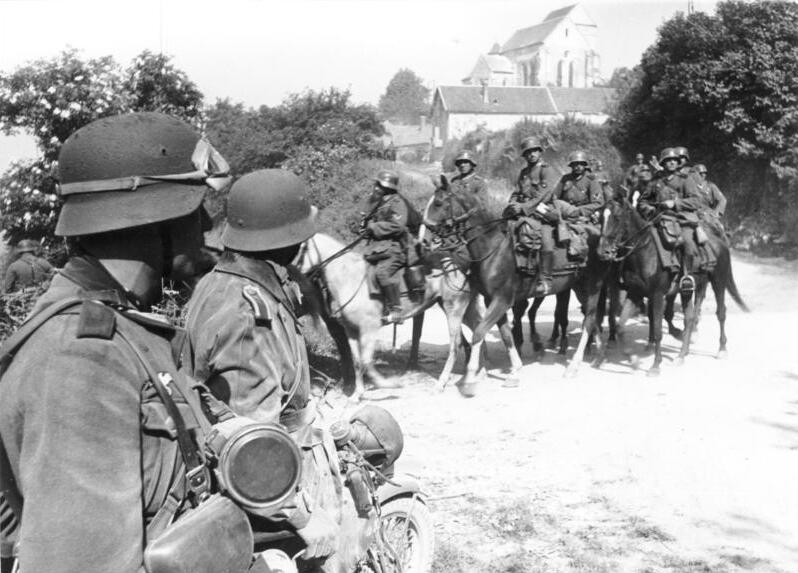
The German 18th Army captured Antwerp. The German 18th Army under command of General Georg von Küchler, pierced the outer ring of fortresses of Antwerp, Belgium, in two places and quickly captured the city. The legions of Adolf Hitler hoisted the German battle flag today on the city hall of Antwerp, fortified North Sea anchor of the whole allied line, and swept west and south toward the heart of France and English channel ports needed for frontal assault on the British isles. Antwerp fell to the German motor columns in 9 days, 57 days ahead of the World war schedule. The German government re-incorporated into its borders the territory that Germany ceded to Belgium per the Versailles Treaty.
Rommel’s 7th Panzer Division captured Cambrai through deception. Rommel ordered his tanks and self-propelled guns to drive across the open fields and create as much dust as possible, creating the illusion that the advancing force was much larger than it actually was. The defenders abandoned the town without firing a shot. Rommel’s German 7th Panzer Division reached Cambrai where it halted to consolidate his supply lines; in the past 5 days the division advanced 85 miles and captured 10,000 French prisoners and tanks, suffering only 150 casualties. Rommel is over halfway to the English Channel. He pauses to refuel, resupply and plan his next axis of attack. The French called the German 7th Panzer Division the “Ghost Division” for its ability to strike in unexpected and vulnerable places. Elsewhere in France, German troops captured Petonne and Amiens.
Guderian’s 2nd Panzer Division captured Saint-Quentin. The 1st Panzer Division troops reach the vicinity of Péronne in their drive toward Amiens.
Brigadier General de Gaulle regroups after his failure of 17 May and prepares for another flank attack on the German spearhead with his French 4th Armoured Division.
Belgian Army, French 1st Army and 7th Army, and British Expeditionary Force continue retreating.
Morale in the BEF is low, because they are being told to retreat despite giving a good account in every battle they have fought. The problem is not their military skill, but the German eruptions to the south that threaten their lines of communication.
French General Giraud and his staff are captured by German troops.
The Battle of Zeeland ended in German victory. By late afternoon on 17 May, it was clear that the Germans had conquered the whole of Zeeland apart from Zeelandic Flanders. The battle around the Sloedam was still raging, but Dutch units in western Walcheren were inquiring at the Dutch staff office whether or not capitulation was feasible. When many local commanders failed to reach the staff, which was indeed hard to do, especially due to the ongoing bombardment of Middelburg, local capitulation initiatives soon developed. Dutch commander Henrik Van der Stad was repeatedly queried by his officers and the mayor of Middelburg about when the capitulation of Walcheren would be offered to the Germans. He made it perfectly clear that this could never be the case as long as French troops were still fighting the Germans.
Late in the evening, a radio transmission was broadcast stating that Dutch forces in Walcheren and Zuid-Beveland would surrender. Half an hour later, Lieutenant-Colonel Karel himself went to the road east of Middelburg along which German troops were heading southward. He was transported to a hotel near Vlissingen, close to the sluices, where he officially informed SS-Standartenführer Steiner — commander of the SS Regiment — of the capitulation of the Dutch forces on Walcheren and Zuid-Beveland. Noord-Beveland was officially not part of the armistice, but on the morning of the 18th a German officer was sent over under a flag of truce, he brought the news of the Dutch surrender elsewhere. Upon this news the Dutch forces — isolated from all the rest — surrendered as well.
RAF Bomber Command dispatches 13 aircraft to attack German columns around Le Cateau
RAF Advanced Air Striking Force withdraws from northeastern France
RAF Fighter Command squadrons based in England operating through forward French airfields
Walter Grabmann, flying a Bf 110 heavy fighter, was shot down by British Hurricane fighters over Douai, France; he parachuted to safety but was captured.
The Dutch fishing vessel Pia (304grt) was towing the yacht Albatross III (Netherlands) when she struck a mine in the North Sea off Gravelines, Nord, France. with the loss of six of her seven crew. Four people were killed aboard Albatross III, which rescued the sole survivor from Pia. The yacht proceeded to Boulogne and later to Folkestone.
The Belgian dredger Vlaanderen I (1218grt) was bombed and sunk at Calais, Pas-de-Calais, France by Luftwaffe aircraft.
Destroyers HMS Impulsive, HMS Intrepid, HMS Esk, HMS Express, and HMS Ivanhoe of the 20th Flotilla and minelayer HMS Princess Victoria (2197grt) departed the Humber to lay mines off the Dutch coast in operation BS.5 during the night of 18/19 May. Patrol sloop HMS Puffin rendezvoused with the minelayers at 1340/18th and dropped buoys after the minelaying was completed. Returning after the minelaying, minelayer Princess Victoria (Captain J. B. E. Hall), escorted by destroyers Express and Ivanhoe, was sunk by a mine at the entrance to the Humber early on the 19th. Destroyers HMS Grafton, HMS Gallant, and HMS Foresight were ordered to assist. Captain Hall, Lt Cdr L.A. Lambert, Temporary S/Lt (E) H.Proudfoot RNR, thirty four ratings were missing after the loss of minelayer Princess Victoria. Paymaster Lt F. A. K. Betty RNVR, Lt Cdr P. M. B. Chavasse, LtF. B. Fisher, Temporary S/Lt W. D. Gray RNR, Temporary S/Lt (E) E. R. Jones RNR, Lt H.A. Kirby, four ratings were wounded. On 21/22 destroyers Impulsive, Intrepid, Icarus, Esk, Express, and Ivanhoe laid minefield BS.6 off the Dutch coast. All six destroyers returned on 23/24 May for BS.7, on 25/26 May for BS.8, on 27/28 May for BS.9. After minelaying BS.9, the 20th Destroyer Flotilla was ordered to Portsmouth.
Minelaying from aircraft of Channel ports began with minelaying off Texel. This continued on the 21st off Ijmuiden, of Terschelling Gat on the 31st, off Flushing on 5 June, off Dunkirk and Boulogne on 26 June.
Motor torpedo boat MTB.25 departed Harwich with at 1445 with Vice Admiral Ramsay for Dunkirk. The motor torpedo boat returned that evening.
Hitler issues Führer Directive No. 12 regarding Prosecution of the Attack in the West. The text of Directive No. 12 is not available. It probably did not go beyond the High Command Of The Army. Its character can be deduced from two entries in the diaries of Jodl and Halder for 18th May. According to Jodl:
“The High Command Of The Army has failed to carry out the intention to build up a southern flank with the utmost speed. Infantry divisions have continued to move westward instead of switching to the southwest. Thus 10th Armoured Division and 2nd and 29th Motorized Divisions are still tied down protecting the flank. Commander In Chief Army and General Halder were immediately called in and were ordered in the sharpest manner to take the necessary steps at once … I also issued an amending order to the Directive. This order switches 1st Mountain Division and the rear elements of 4th Army to the attacks in the south and southwest.”
Halder’s account is fuller:
“The Leader has an unnecessary anxiety about the southern flank ….. He is absolutely opposed to the continuation of operations towards the west, let alone the southwest, and still clings to the northwestern idea. This led to a difference of opinion in The Leader’s Headquarters between The Leader on the one hand and the Commander In Chief and myself on the other. A Directive was issued on this occasion which is a confirmation in writing of our conversation which took place at 1000 hrs. Conversations between the Commander In Chief and Colonel General von Rundstedt, and my conversation with Salmuth, produced the effects which The Leader desired (sharp switch of forward divisions to the southwest, main body of motorized forces to be ready to move to the west).”
Colonel Gubbins arrives at Mo i Rana. He has orders from Lieutenant General Claude Auchinleck to defend Mo i Rana. However, the local commander, Lieutenant Colonel Thomas Byrnand Trappes-Lomax of the Scots Guards, tells him that he cannot hold out without reinforcement – of which none is available. Gubbins thus, against orders but based on the best available information, authorizes a withdrawal. In Gubbins’ opinion, the Scots Guards withdraws “precipitately” toward the ferry terminus at Rognan and leaves behind much valuable equipment. The German 2nd Mountain Division approaches the town, though Gubbins leaves behind some skeleton forces.
In Norway, the British No. 1 Independent Company, battalion of Scots Guards, and Norwegian troops withdraw northward from Mo i Rana toward Bodø.
The German 2nd Mountain Division enters Mo i Rana.
Luftwaffe transports drop 16 troops of 1st Fallschirmjaeger Regiment to reinforce German forces around Narvik.
Luftwaffe seaplanes transport 15 mountain troops to Narvik area.
The Swedish Government rejects Berlin’s request for transit of military supplies to German troops in Norway.
The Germans ban the celebration of Norwegian Constitution Day, which typically includes traditional children’s parades.
The Norwegian cargo ship Torgtind was bombed and sunk in the Norwegian Sea off Bratland, Lurøy by Luftwaffe aircraft.
Norwegian steamer Sirius (944grt) was sunk by German bombing off Senja (Finlandsnes). Seven crew were lost on the Norwegian steamer.
Royal Norwegian Navy submarine B.6, destroyer HNoMS Troll, and torpedo boat HNoMS Snogg were surrendered at Floro to German Schiff 18. The crews of these ships had deserted on the 2nd when they refused to sail to the Shetlands. Destroyer Troll and torpedo boat Snogg were used by German forces under the names of Troll and Zack, respectively. Submarine B.6 was recommissioned on 20 October 1940 as UC 2.
HMS Ark Royal continued to maintain the fighter patrols over her convoy, dispatching sections at 0030 and 0300 hours. The former, three Skuas of 800 Squadron, damaged a He-111, the only interception of the entire affair. At 1700, Ark Royal reached position 70.06 N, 13.16 E. At 1710 and 1830 she dispatched Skua sections to patrol the Narvik area, but neither sighted enemy aircraft. Meanwhile, at 1810 hours, the three Royal Navy carriers, HMS Ark Royal, HMS Glorious and HMS Furious, joined forces, the first time in the war that three carriers had operated together. HMS Glorious then flew off the remaining five Walrus amphibians of 701 Squadron to Flag Officer Narvik at Harstad, while Ark Royal sent off a single Swordfish to photograph the conditions at Bardufoss landing ground
Returning from the Fleet Air Arm’s first mining sortie in Norwegian waters Operation BOTTLE, a Swordfish of the 823 Squadron from aircraft carrier HMS Glorious was lost and Acting S/Lt (A) H D.Mourilyan and Naval Airman First Class E Parkinson were killed. Destroyer HMS Atherstone unsuccessfully searched for the aircraft. A second Swordfish of the Squadron was forced to land off Isle of Eday. Lt A T Easton and the Naval Airman were rescued.
French Prime Minister Paul Reynaud announced he was recalling the ambassador to Spain Philippe Pétain to make him Vice Prime Minister. General Maurice Gamelin was removed from his post as commander of the French armed forces by French Premier Paul Reynaud. Prime Minister Paul Reynaud shakes up the cabinet. Former PM Daladier switches to Foreign Minister, Philippe Pétain becomes Vice Premier. Reynaud takes Defense. General Weygand, recalled from the Middle East, is the new Commander-in-chief. Both 84-year-old war hero Pétain, who was the Ambassador to Spain, and Weygand are somewhat “out of the loop” and bring a fresh attitude to the government which may not be entirely positive. Weygand arrives in Paris from the Levant via Tunis.
Pétain is a particularly interesting choice. He has developed a friendly relationship with Francisco Franco and has commented that “France’s greatest mistake has been to enter this war” – not exactly a resoundingly enthusiastic position.
Reynaud intends to ask Roosevelt for a US declaration of war against Germany. It is a request that FDR is in no position to entertain. Much of the American public is still solidly isolationist.
The Paris sector is declared a military zone, with martial law imposed. For now, the government remains in Paris.
King Leopold and his cabinet set up improvised headquarters in Brugges.
Germany re-incorporates into its borders the small slices of territory handed to Holland pursuant to the Treaty of Versailles.
Queen Wilhelmina of the Netherlands visited all Dutch naval vessels in Portsmouth, England.
Arthur Seyß-Inquart is appointed Reich Commissar of the Netherlands.
The refugee crisis is only growing. An estimated 6 million Frenchmen are on the road south, while the population of northern French cities has fallen by 90%. The Belgians now really have nowhere to run, so the refugee crisis is much less there than in France.
British men continue volunteering for the local defense groups — and an estimated 250,000 have now signed up (eventually known as the Home Guard). They do not have any uniforms or equipment and are told: “We’ll get back to you.” They are nicknamed “parashots” due to their presumed role of guarding against German paratroopers.
RAF Bomber Command dispatches aircraft to attack various targets overnight
French aircraft carrier Bearn and destroyers Tramontane, Tornade, and Typhon departed Toulon and passed Gibraltar on the 20th, arriving at Casablanca on the 21st. The aircraft carrier departed Casablanca on the 22nd, escorted by sloops Entrecasteaux and Iberville. Sloop Iberville returned to Casablanca and was replaced by sloop Bougainville. The destroyers proceeded to Casablanca. They passed Gibraltar on the 24th to return to the Mediterranean. The aircraft carrier, joined by cruisers from Brest, proceeded to Halifax, arriving on 1 June.
German submarines U-60 and U-62 departed Kiel. The U-boat fleet has been occupied with tactical patrolling the Dutch/Danish/Norwegian coasts. They now resume strategic patrolling around Great Britain. U-37 and U-43 are already are at sea, while U-60 and U-62 leave Kiel for stations around Great Britain.
In the North Sea, U-9 encountered an enemy submarine, but neither boat attacked.
Convoy OA.150G departs Southend.
Convoy OB.150 departs Liverpool.
Convoy BC.37 of steamers Baron Carnegie, Glenlea, Kufra (Commodore), and Lottie R departed Loire escorted by destroyer HMS Montrose. The convoy arrived in Bristol Channel on the 19th.
Convoy FN.174 departed Southend, escorted by sloop HMS Hastings. The convoy arrived in the Tyne on the 20th.
The War at Sea, Saturday, 18 May 1940 (naval-history.net)
Destroyers IMPULSIVE, INTREPID, ESK, EXPRESS, and IVANHOE of the 20th Flotilla and minelayer PRINCESS VICTORIA (2197grt) departed the Humber to lay mines off the Dutch coast in operation BS.5 during the night of 18/19 May.
Patrol sloop PUFFIN rendezvoused with the minelayers at 1340/18th and dropped dan buoys after the minelaying was completed.
Returning after the minelay, minelayer PRINCESS VICTORIA (Captain J. B. E. Hall), escorted by destroyers EXPRESS and IVANHOE, was sunk by a mine at the entrance to the Humber early on the 19th.
Destroyers GRAFTON, GALLANT, and FORESIGHT were ordered to assist.
Captain Hall, Lt Cdr L.A. Lambert, Temporary S/Lt (E) H.Proudfoot RNR, and thirty-four ratings were missing after the loss of minelayer PRINCESS VICTORIA. Paymaster Lt F. A. K. Betty RNVR, Lt Cdr P. M. B. Chavasse, LtF. B. Fisher, Temporary S/Lt W. D. Gray RNR, Temporary S/Lt (E) E. R. Jones RNR, Lt H.A. Kirby, four ratings were wounded.
On 21/22 destroyers IMPULSIVE, INTREPID, ICARUS, ESK, EXPRESS, and IVANHOE laid minefield BS.6 off the Dutch coast. All six destroyers returned on 23/24 May for BS.7, on 25/26 May for BS.8, on 27/28 May for BS.9.
After minelay BS.9, the 20th Destroyer Flotilla was ordered to Portsmouth.
Early on the 19th at 0035, destroyer KEITH was attacked by German bombing on North Goodwins Patrol. She was not damaged.
At 0605, destroyer WILD SWAN was attacked by German bombing on the North Goodwins Patrol. She was not damaged.
Destroyer WILD SWAN met Dutch tugs SCHELDE (359grt) and EBRO (268grt) and sent them to the Downs.
Destroyer WHITLEY relieved destroyer WOLSEY on patrol off the Belgian coast.
Motor torpedo boat MTB.25 departed Harwich with at 1445 with Vice Admiral Ramsay for Dunkirk. The motor torpedo boat returned that evening.
Destroyer VERITY was boiler cleaning from depot ship SANDHURST at Dover.
Submarine L.23 evacuated five crew from the Terschelling Light Ship. The six other crew of the Light Ship escaped to Holland.
Submarine L.26 picked up nine refugees from an open boat off the Dutch coast.
Submarine TRIDENT departed Rosyth for North Sea patrol.
French submarine THETIS on patrol in the North Sea sighted Submarine SPEARFISH.
French submarine CIRCE reported her starboard motor out of action. The submarine was ordered to Rosyth where she arrived on the 19th.
Repair to the motor was found to be extensive and the submarine was to be sent to France after exchanging a battery with submarine CALYPSO.
Submarine CALYPSO departed Harwich on the 23rd with convoy FN.78. The submarine arrived at Rosyth on the 24th.
Minelaying from Aircraft of Channel ports began with minelaying off Texel. This continued on the 21st off Ijmuiden, of Terschelling Gat on the 31st, off Flushing on 5 June, off Dunkirk and Boulogne on 26 June.
Dutch gunboats FLORES and VAN MEERLANT arrived at Dover.
Dutch steamer PIA (304grt) departed Nieuport and Dunkirk on the 18th towing Dutch auxiliary yacht ALBATROSS III.
Steamer PIA struck a mine and sank between Dunkirk and Gravelines. Six crew were lost on the steamer.
On the yacht, two crew and two refugees were lost.
Yacht ALBATROSS III rescued the sole survivor from steamer PIA. The yacht proceeded to Boulogne and later to Folkestone.
Belgian dredger VLAANDEREN I (1218grt) was sunk by German bombing at Calais.
Heavy cruiser YORK arrived at Scapa Flow from Rosyth.
Destroyer FORESIGHT departed the Humber for Scapa Flow at 2300.
Destroyer MASHONA departed Greenock at 1520 for Scapa Flow.
Destroyer MASHONA later joined destroyer SABRE hunting for a submarine reported by minesweeping trawler BRABANT (280grt) at 1405 in 58 20N, 5 23W.
Anti-submarine trawlers STOKE CITY and LEICESTER CITY were ordered to join the search.
The destroyers remained in the area until French destroyer FOUDROYANT and tanker TARN passed through the area
Destroyer MASHONA left the position at 0815/19th and arrived at Scapa Flow at 1145. Destroyer SABRE left the search at 1030/19th and proceeded to Holy Head for oil.
Destroyers ARROW and FURY departed Scapa Flow at 1600 to join destroyer ATHERSTONE hunting for a submarine reported by aircraft in 59 07N, 0 47W.
The search was unsuccessful.
Anti-submarine trawlers CAPE WARWICK and CAPE PORTLAND were ordered to search for a submarine attacked by aircraft in 59-26N, 6-23W. The search was unsuccessful.
Aircraft carrier GLORIOUS flew the six Walrus aircraft of the 701 Squadron ashore for operations at Harstad.
Returning from the Fleet Air Arm’s first mining sortie in Norwegian waters Operation BOTTLE, a Swordfish of the 823 Squadron from aircraft carrier GLORIOUS was lost and Acting S/Lt (A) H D.Mourilyan and Naval Airman First Class E Parkinson were killed. Destroyer ATHERSTONE unsuccessfully searched for the aircraft. A second Swordfish of the Squadron force-landed off Isle of Eday. Lt A T Easton and the Naval Airman were rescued.
Heavy cruiser DEVONSHIRE’s 700 Squadron WALRUS was shot down by a German He.111 aircraft at Malangsfjord, Rystraumer. Lt R W Benson Dare was killed, Midshipman A D.Corkhill wounded, but rescued and Leading Airman W H Hill died of wounds.
Polish troopships SOBIESKI (11,030grt) and BATORY (14,287grt) departed Harstad with troops and survivors from sunken ships. These two ships were escorted by destroyers TARTAR and WESTCOTT.
Leaving Harstad at the same time were British steamers BALMAHA (1428grt) and CYCLOPS (9076grt) escorted by destroyers MATABELE and WARWICK. The convoys left together, but after passing 69 30N, 0 09E, the convoys parted. The “fast” section to arrive in the Clyde on the 23rd and the “slow” section to arrive on the 25th.
The Polish troopships and the destroyers arrived safely in the Clyde at 0330/23rd.
Steamer CYCLOPS and destroyer MATABELE arrived in the Clyde on the 23rd. Steamer BALMAHA and destroyer WARWICK arrived in the Clyde at 0530/25th.
After safely delivering the troopships at the Clyde, destroyer TARTAR went on to Liverpool departing at 2000/23rd arriving at 0720/24th for repair and boiler cleaning completed by the end of the month.
Destroyer TARTAR arrived at Scapa Flow after repairs on 2 June.
British steamer ACRITY (403grt) departed Scapa Flow at 2100escorted by anti-submarine trawlers ST ELSTAN (564grt) and ST CATHAN (565grt) for Narvik where they arrived on the 23rd.
British oiler WAR NIZAM, escorted by anti-submarine trawlers JUNIPER and HAZEL, arrived at Scapa Flow from Sullom Voe.
Norwegian submarine B.6, destroyer TROLL, torpedo boat SNOGG were surrendered at Floro to German Schiff 18. The crews of these ships had deserted on the 2nd when they refused to sail to the Shetlands.
Destroyer TROLL and torpedo boat SNOGG were used by German forces under the names of TROLL and ZACK, respectively. Submarine B.6 was recommissioned on 20 October 1940 as UC 2.
Norwegian steamer SIRIUS (944grt) was sunk by German bombing off Senja (Finlandsnes). Seven crew were lost on the Norwegian steamer.
Convoy BC.37 of steamers BARON CARNEGIE, GLENLEA, KUFRA (Commodore), LOTTIE R departed Loire escorted by destroyer MONTROSE. The convoy arrived in Bristol Channel on the 19th.
Convoy FN.174 departed Southend, escorted by sloop HASTINGS. The convoy arrived in the Tyne on the 20th.
French aircraft carrier BEARN and destroyers TRAMONTANE, TORNADE, and TYPHON departed Toulon and passed Gibraltar on the 20th, arriving at Casablanca on the 21st.
The aircraft carrier departed Casablanca on the 22nd, escorted by sloops ENTRECASTEAUX and IBERVILLE. Sloop IBERVILLE returned to Casablanca and was replaced by sloop BOUGAINVILLE.
The destroyers proceeded to Casablanca. They passed Gibraltar on the 24th to return to the Mediterranean. The aircraft carrier, joined by cruisers from Brest, proceeded to Halifax, arriving on 1 June.
Heavy cruisers CORNWALL and DORSETSHIRE arrived at Gibraltar after duty in the South Atlantic.
They were joined on the 17th by destroyer KEPPEL from convoy HG.30 escort duties and destroyer VORTIGERN from patrol duties.
On 22 May, heavy cruiser CORNWALL departed Gibraltar, escorted by destroyer KEPPEL, for Freetown and heavy cruiser DORSETSHIRE departed Gibraltar, escorted by destroyer WRESTLER, for refitting at Devonport.
However, cruiser DORSETSHIRE was ordered to patrol off the Canary Islands and arrived back at Gibraltar on 16 June.
Destroyer WRESTLER arrived back at Gibraltar on the 23rd. Destroyer KEPPEL was ordered to join troopship EMPRESS OF AUSTRALIA and escort her westwards.
British Prime Minister Winston Churchill, in a telegram to U.S. President Franklin D. Roosevelt, told of British perseverance but suggested that “if American assistance is to play any part it must be available [soon].”
Tyler Kent, a clerk in the U.S. Embassy in London with access to correspondence between Churchill and Roosevelt, is arrested and has his diplomatic immunity waived by the U.S. ambassador. Allegedly, he had passed along this information to members of the Right Club, a pro-Fascist organization, which forwarded it to Germany through Italian diplomats.
Encouraged by an overwhelming and nonpartisan reaction in favor of the Administration’s wide defense program, the government bent all its efforts today toward translating the idea into reality in the fastest possible time. With this generally regarded as of paramount importance, indications grew that Congress would act on little else before it adjourns next month. President Roosevelt turned his attention today to the problem of industrial organization for defense needs. He conferred with Bernard M. Baruch, head of the World War Industrial Mobilization, who, it was reported, might be called upon to aid in the defense program. The only other person so far mentioned in this connection was Joseph P. Kennedy, Ambassador to Great Britain.
The Administration has also under advisement asking Congress to alter certain restrictive legislation, such as the Walsh-Healey act, various provisions for limitations on profits, and others which might interfere with speedy procurement of critical items. Thus far, there has been little evidence of popularity for this sort of thing in Congress, but there has also been no evidence of determined hostility. Members who discuss the possibility draw a moral from the French Popular Front government under which labor laws and restrictions on profits interfered with the nation’s armament program to such an extent they had to be repealed by the succeeding government. Because of the political implications of the forthcoming electoral campaigns, however, such members are not likely to advocate outright repeal of such laws at this time.
A possible approach to this question was written into the tentative draft of a bill by the House Naval Affairs Committee today in the form of an authorization for the President to suspend provisions of the Walsh-Healey act when compliance “would be prejudicial to the national defense.” This is the law which forbids government contracts to contractors or subcontractors unless they pay prevailing wages. General George C. Marshall, Chief of Staff, told the Senate Appropriations Subcommittee on Military Affairs yesterday that this and similar laws, added to the high pay of officers and men in the United States Army, made it necessary for the United States to spend $21 for every $1 spent by a European army to maintain an equal force of men.
This same subcommittee, headed by Senator Thomas of Oklahoma, completed today its draft of a bill intended to superimpose on the War Department’s Appropriation bill for its military establishment, as already passed by the House, the additional requests President Roosevelt made on Thursday. It even added $50,000,000 that the President did not ask but which General Marshall wanted in order to bring the Army, within the next fiscal year, up to its authorized strength of 280,000 men.
The U.S. Army high command assured the Senate Appropriations subcommittee, according to the transcript of the hearings released late today, that it viewed the possibility of war with horror and had no thought to capitalizing on “the dilemma of this tragic world situation as an opportunity to aggrandize the army.” General George C. Marshall, chief of staff, told the Senators that the army wanted nine small, streamlined divisions of 8,500 men each in readiness “for whatever purpose they may be required in the Western hemisphere.”
He estimated that, despite the speed contemplated under the new program, it would be six months before the first of the major items could be delivered, but added that all of the items covered in the President’s message to Congress could be delivered by December, 1941. He testified that the 70,000 men now engaged in maneuvers in Texas and Louisiana, as well as the Third Division of the West Coast, had no reserves of material or men.
The U.S. Department of Agriculture today made the first official government mention of the possibility of extending credit to the allies for the purchase of American agricultural commodities. The suggestion, cited only as a “possibility,” was made by the bureau of agricultural economics in a survey of the effect of the European war on American industry and agriculture. The bureau avoided any direct advocacy of credits; now specifically prohibited to countries at war or in default on World war debts. Secretary of Agriculture Henry A. Wallace declined to comment on the proposal.
Taking emergency action to halt the sharp break in wheat prices, Secretary Wallace asked the nation’s grain futures markets to peg prices at not less than today’s closing quotations.
Agencies and organizations, bent on increasing Congressional appropriations for federal relief, announced today that they would continue their demands, irrespective of the needs for national defense.
Wendell L. Willkie, utilities executive and candidate for the Republican Presidential nomination, ended his first week of active campaigning in three Midwestern States for convention delegates and headed back to New York City this afternoon encouraged by reports that his candidacy had passed the “dark horse” stage.
In face of the virtually unanimous opinion of State Republican leaders that sympathy for the Allies is mounting daily in this region, Senator Taft exhorted the country tonight to keep its mind on domestic issues lest the New Deal use the international crisis to extend its powers at home.
In California, the El Centro earthquake hits at 21:35 Pacific Standard Time. It is the first earthquake recorded by a nearby strong-motion seismograph and registers 6.9 on the Richter scale. It is the strongest earthquake in Imperial Valley, killing nine people. The area is largely agricultural, so, while irrigation systems and other farming infrastructure are destroyed, the damage is much more limited than it if had hit, say, a little further northwest at Los Angeles.
The El Centro earthquake struck southeastern California near the border with Mexico. Seven persons were believed at this time to have perished, scores were injured and at least 40 buildings damaged by a series of earthquakes which shook Southern California Imperial Valley towns last night and caused a fire in the Mexican border town of Mexicali. Four persons were killed in Imperial, the epicenter of the quake, one perished in El Centro, and police there said one person died in the Mexicali blaze and another was killed in a building collapse at Brawley. A survey at midnight indicated that 15 buildings received major structural damage in El Centro. These included structures where walls collapsed or arcades fell into the street. A similar number of buildings received “heavy damage” in Brawley and about 10 older buildings either collapsed or received heavy damage in Imperial, El Centro police reported. Apparently no residential dwellings were badly damaged by the quake.
Mrs. Payne Whitney’s Corydon, an outsider in the betting, came on with a rush in the stretch to beat Bimelech, 1-to-5 favorite, in the Withers at Belmont Park. Bimelech, finishing two lengths behind the winner, nosed out Roman for second place. Corydon paid $87, $10.60 and $5.30 for $2 across the board. The crowd of 29,842, largest of the season, bet $1,187,899 in the parimutuels during the eight-race card, this being a new record total for New York.
Major League Baseball:
Before a crowd of 28,077 at Ebbets Field, the Cardinals hit five home runs to defeat the Dodgers, 6–2. The Cards collect just 7 hits off Hot Potato Hamlin, but all are for extra bases to tie an National League record. Five of the hits are home runs — 2 each by Mize and Terry Moore. Pee Wee Reese steals his 17th base in 26 games; the Cards have just 5 stolen bases.
The league-leading Reds lost to the Phils, 8–3. After beating the Phillies 11 straight times over 2 ½ years, the Reds Paul Derringer finally loses. The Phils collect 12 hits in 8 innings off Derringer.
The Giants beat the Cubs, 6–4. Harry Danning’s third hit of the day, a three-run homer in the seventh, with New York trailing, 4–3, was the decisive blow. Harry Gumbert got the win.
In their best batting day in a couple of years, the Bees boomed twenty hits, including two three-run homers, off five of Frankie Frisch’s pitchers today to overwhelm the Pirates, 15–5.
The Yankees, with Monte Pearson pitching a two-hit game, blanked the White Sox, 3–0. The Yanks vacate last place behind Monte Pearson’s gem. Tommy Henrich hit a homer for the Yankees.
Buddy Lewis’s eighth-inning homer with George Case on base gave the Senators a 3–2 victory over the Indians today and an even split in the weather-shortened series.
Two four-run innings enabled the Tigers to beat the Athletics, 8–6, today and strengthen their hold on third place in the American League.
St. Louis Cardinals 6, Brooklyn Dodgers 2
Pittsburgh Pirates 5, Boston Bees 15
New York Yankees 3, Chicago White Sox 0
Washington Senators 3, Cleveland Indians 2
Philadelphia Athletics 6, Detroit Tigers 8
Chicago Cubs 4, New York Giants 6
Cincinnati Reds 3, Philadelphia Phillies 8
While the movement has not yet proceeded far enough to give real hopes for peace in the Sino-Japanese war, significant conferences are being held in Hong Kong between Japanese emissaries and representatives of Generalissimo Chiang Kai-shek’s government at Chungking. Last week and this week a great number of important Japanese Army, Navy and diplomatic leaders quietly slipped out of Shanghai for South China. It is now learned that they have been conferring in Hong Kong, seeking bases for formal Sino-Japanese negotiations.
The Japanese Army is said to want merely a year-long armed truce, during which there would be only a slight loosening of the coastal blockade and a delay in formal recognition of the Wang Ching-wei regime if Chinese counter-attacks and guerrilla activities were stopped entirely. This breathing spell is deemed highly desirable by Japan to give her a chance to replenish her diminished reserves of munitions, bombs and airplanes as well as to permit a complete overhauling of the navy. Meanwhile the Japanese empire could obtain much-needed cash by developing trade with accessible European belligerents.
Dow Jones Industrial Average: 122.43 (-1.77)
Born:
Marshall Stoneham, British physicist, in Barrow-in-Furness, England, United Kingdom (d. 2011).
Mike Elliott, American jazz and session guitarist, and audio engineer, in Chicago, Illinois (d. 2005).
Lenny Lipton, author, filmmaker and stereoscopic vision system inventor, in Brooklyn, New York, New York (d. 2022).
Naval Construction:
The Kriegsmarine (German Navy) Type VIIC U-boat U-451 is laid down by Deutsche Werke AG, Kiel (werk 282).
The Kriegsmarine (German Navy) Type VIIC U-boats U-757 and U-758 are laid down by Kriegsmarinewerft (KMW), Wilhelmshaven (werk 140 and 141).
The Kriegsmarine (German Navy) Type IID U-boats U-137 and U-138 are launched by Deutsche Werke AG, Kiel (werk 266 and 267).
The U.S. Navy Gleaves-class destroyer USS Niblack (DD-424) is launched by the Bath Iron Works (Bath, Maine, U.S.A.).
 History Diaries