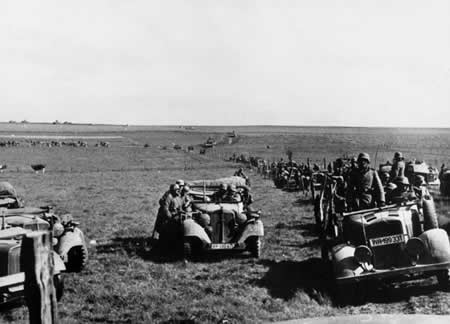
The German OKW (military high command) is increasingly agitated at the panzer divisions heading toward the channel without waiting for the infantry. Many of the top generals are infantry officers who do not understand or appreciate fluid battles. In addition, and more importantly, Hitler gets nervous and throws tantrums about the danger of armor advancing beyond the infantry. General Jodl notes in his diary that Hitler is “nervous and irritable – terrified by success, fearful of a collapse.”
“The fate of our country and that of our allies and the destiny of the world depend on the battle now being fought.” Thus begins a general order to all troops issued this evening by General Maurice Gustave Gamelin, supreme Allied commander. Taken in conjunction with the communiqué issued from General Headquarters tonight, it reveals the situation as tragic. “Today the German attack developed on a massive scale,” the communiqué stated, “not only in Belgium but in the region of Avesnes and Vervins. On those fronts the enemy engaged the greater part of his heavy tank divisions. The battle took the form of a veritable melee.”
The Dash to the Channel by General Guderian’s XIX Corps and General Hoth’s forces, led by General Erwin Rommel’s 7th “Ghost” Panzer Division, is proceeding at full speed.
At 4 a.m. Erwin Rommel’s 7th Panzer Division captured the village of Avesnes-sur-Helpe. Rommel’s lines of communication with his superior, General Hermann Hoth, and his headquarters were cut. Disobeying orders and not waiting for the French to establish a new line of defense, he continued to advance northwest to Avesnes-sur-Helpe, just ahead of the 1st and 2nd Panzer Divisions. As fortune would have it, the French 5th Motorized Infantry Division had set up its overnight bivouac directly in Rommel’s path, leaving its vehicles neatly lined up along the roadsides. Rommel’s tanks dashed right through them. Their slow speed, overloaded crews and lack of any means of communication in battle undid the French. The 5th Panzer Division joined in the fight. The French did inflict significant losses on the division but they could not cope with the speed of the German mobile units, which closed fast and destroyed the French armor at close range. During this battle, the remaining elements of the 1st DCR, resting after losing all but 16 of its tanks in Belgium, were also engaged and defeated. The French unit retreated, with just three remaining tanks. The 1st DCR was effectively destroyed on 17 May. The Germans lost 50 out of 500 tanks in the battle.
Rommel presses forward throughout the day and reaches and seizes Le Cateau by evening. To do so, he must cross the Sambre River. The French helpfully have left a bridge there intact for him.
As of this date, Rommel claimed to have taken 10,000 prisoners and suffered only 36 losses. Guderian was delighted with the fast advance, and encouraged his XIX Korps, consisting of the 1st, 2nd, and 10th Panzer Divisions to head for the channel, continuing until fuel was exhausted. However, the success of his commanders on the ground began to have effects on Hitler who worried that the German advance was moving too fast. Halder recorded in his diary on 17 May that “The Fuhrer is terribly nervous. Frightened by his own success, he is afraid to take any chance and so would pull the reins on us… [He] keeps worrying about the south flank. He rages and screams that we are on the way to ruin the whole campaign.” Through deception and different interpretations of orders to stop from Hitler and von Kleist, the commanders on the ground were able to ignore Hitler’s attempts to stop the northern advance to the sea.
General Heinz Guderian, exploiting a loophole in his orders allowing reconnaissance in force, reached the Oise River south of Guise. Commander Paul Ludwig Ewald von Kleist ordered the German advance halted and held a tense meeting with Heinz Guderian, berating him for disobeying orders by advancing aggressively instead of waiting to secure his flank. Guderian offered to resign his command and was ordered to turn it over to next senior general in his corps. When Gerd von Rundstedt learned of what had happened he intervened to allow Guderian to keep his post, and a compromise was reached in which Guderian would be allowed to pursue a “reconnaissance in force.” Guderian resumed advancing anyway while misleading his superiors about his location. His troops reach Maubeuge by evening.
Panzer spearheads of German 4th Army and 12th Army reach Maubeuge and St Quentin.
The one-day Battle of Montcornet was fought when the 4e Division cuirassée under Colonel Charles de Gaulle attacked the Germans at the strategic village of Montcornet. The French successfully drove off the Germans but were then counterattacked by Stukas and had to withdraw to avoid being encircled. The French 4th Armored Division launched a 200-tank counterattack at Montcornet, France; the French forces saw initial success, capturing 500 prisoners, but the momentum quickly waned. Guderian seized upon the opportunity and launched his own counterattack in France, driving the French back several kilometers.
As shown in several actions, the French tanks are of high quality. More investment in them and less in the Maginot Line might have made more sense in the pre-war years. While strong, however, they have the odd weakness of having a limited range. Many French tanks are rendered useless to operations when they simply run out of gas while assembling for battle.
In Belgium, British Expeditionary Force commander General Lord Gort, fearful of being surrounded, ordered his troops to fall back to the Scheldt River; this move allowed German General Reichenau to capture Brussels.
The German 6th Army captured Brussels. Troops of the German 6th Army under command of Colonel General Walter von Reichenau entered Brussels. The capital of Belgium is now occupied. The Allies evacuate Antwerp and the islands of Walcheren and Beveland, but the Germans are not yet ready to occupy them. The Belgian government has moved to Ostend.
The British and French forces in Belgium have fallen back to positions behind the Dendre River. French, British, and Belgian armies continue to withdraw towards the coast.
Meanwhile, Dutch resistance to the German invasion comes to an end with the evacuation, by French destroyers, of the survivors of the Franco-Dutch forces in Zeeland and on the islands of Walcheren and Beverland.
General Tiedemann is the new military commander of Amsterdam. He tells the Mayor that “If the Jews don’t want to see us, we don’t want to see them.”
Erwin Rommel was awarded the 1939 clasp to his Iron Cross Second Class medal.
Trains poured into Paris today bringing refugees from Belgium and the north. There were so many that nothing could be done for many of them and they are still waiting. Twenty-five thousand reached the Gare de l’Est alone. The Gare du Nord received so many that they could not even be estimated. There are no words to describe. such a plight as that of these poor humans, driven from their homes at an instant’s notice with only a few belongings and having walked till they dropped and then suffering the terrible hazard of being machine-gunned by airplanes and finally having traveled by slow stages packed in railroad carriages, and some even in freight cars, halting on the way for hours at a time. All efforts to handle them tonight proved ineffective. Among them were many sick and wounded.
Twelve RAF Blenheim bombers from RAF No. 82 Squadron attack advancing German columns near Gembloux, Belgium. Eleven of the planes are shot down by Luftwaffe Bf-109 fighters.
The Royal Netherlands Navy Gerard Callenburgh-class destroyer HNLMS Philips Van Almonde was scuttled on her slipway at Vlissingen, Zeeland to prevent capture by approaching German forces.
The French Navy (Marine Nationale) auxiliary minesweeper Mardyck caught fire and was beached and abandoned at Breskens, in Zeeland, southwestern Netherlands.
The French 11th Destroyer Division on patrol off Dunkirk was attacked by German bombers. Torpedo boats Cordeliere (Capitaine de Fregate H.A. J. Robinet de Plas) and Melpomene (Capitaine de Corvette P. A. M. Bonny) were badly damaged. Torpedo boat Flore, in company, escaped serious damage and escorted her two damaged sisters to port.
Elements of German 2nd Mountain Division are attacking toward Mo in Norway. The Germans of 2nd Mountain Division attack the allies at Stien, some 3 miles (4.8 km) west of Mo i Rana. They mount a frontal assault under Generalleutnant Valentin Feurstein. The main German assault is stopped, but a flanking effort using skis comes down behind the defenders on the Dalselva River using Schmeisser machine pistols. The Allies withdraw.
Cruiser HMS Effingham grounded on the Faksen Shoal off Bodø, Norway, between Briksvaer and Terra Islands. She was seriously damaged and ultimately declared a total loss. She had been bound for Bodø with 1,020 troops, 10 Bren Gun Carriers, and 130 tons of supplies. HMS Cairo, HMS Coventry, HMS Echo and HMS Matabele took off the crew. She was finally destroyed by gunfire to prevent her capture by the Germans on 21 May 1940. Effingham was built by the Portsmouth dockyard and was launched as a heavy cruiser on 08 Jun 21. She was extensively modernized in 1937 and was re-armed as a light cruiser. Her two funnels were trunked into one and unraked, which gave her an appearance remarkably similar to that of Leander-class light cruisers. She was a unit of the 12th Cruiser Squadron at the outbreak of war and served in the Northern Patrol as part of a raider interdiction effort.
When it became apparent that German raiders were already at sea, Effingham was reassigned to one of the hunting groups being formed, as she was one of the few ships in the Northern Patrol with good endurance. This was the precise task for which she had been designed as a heavy cruiser 25 years earlier. Afterwards, she was assigned as an ‘ocean escort’ for North Atlantic convoys. In November 1939, she transported £2 million in gold to Halifax. Effingham returned to the North Sea in April 1940 for the Norwegian Campaign, where she narrowly avoided an attack by U-38. She was primarily engaged on fire support missions around Narvik until May but was running reinforcements to Bodø when she grounded. Although the rock was charted, the fact that the navigator’s track was plotted directly over the pinnacle rock went unnoticed. The ship was exactly on course when she struck; a slight deviation to either side of the track would have been sufficient to avoid the danger.
Meanwhile, with the rendezvous of HMS Furious and HMS Glorious at hand, Vice-Admiral Wells instructed HMS Glorious to send off one of the Walrus amphibians of 701 Squadron to communicate with him. It arrived at 1500, and then flew on to Harstad at 1700 hours.
During the early hours of the day HMS Ark Royal steamed to seaward to place herself in position to cover a troop convoy enroute to Norway. After reaching 68.08 N, 07.00 E, four fighter patrols were dispatched between 1510 and 2200 hours but the only excitement was caused when HMS Coventry decided to fire on her supporting aircraft!
The British 147th Infantry Brigade arrives in Reykjavik, Iceland, as an occupation force, to forestall any Nazi moves against that island.
4,000 troops of the Canadian Army arrive in Iceland to relieve the British marine force that had occupied the island on May 10.
Winston Churchill’s new win-the-war government was said by a reliable source today to be seeking a “new and more friendly approach” to improvement of relations with Soviet Russia. Inclusion of the Labor and Liberal parties in the new cabinet was said to have paved the way for abandonment of the so-called “stiff-necked” attitude toward the U.S.S.R., credited to former Prime Minister Chamberlain and most of his Conservative regime. A softening of press attacks already has been noted. Russian Ambassador Ivan Maisky saw Lord Halifax, foreign secretary, on Thursday, and it is understood they discussed problems raised by British contraband control principally delays in shipping and how to shorten them.
Reynaud calls for a thousand U.S. pilots to join the French Air Force immediately.
The Journal officiel de la République française published a decree allowing chaplains for Muslims in the French Army.
While nothing startling happened in Italy today, there have been a number of minor developments to drive home further the feeling that Italian intervention in the European war is not very far off. The Senate held a session in the morning full of genuine war fervor. The Minister of Finance, Count Paolo Thaon di Revel, presented what amounts to a war budget and admitted a deficit for this year of more than 26,000,000,000 lire. Premier Mussolini’s own newspaper, in a highly significant editorial, as good as told the nation that it was about to enter the conflict. The Stock Exchanges had a singularly black day; the great successes claimed by Germany on the French front provided a temptation of the first magnitude for the Fascist leaders.
Negotiations are under way between the Holy See and the Italian Government for an understanding with regard to publication of the Osservatore Romano, according to Vatican circles today. However, there is little hope that an agreement can be reached.
Russia is putting pressure on all the Southeast European countries and indirectly on the belligerents for maintenance of the Balkan status quo, usually reliable diplomatic quarters reported tonight.
RAF Bomber Command dispatches aircraft to attack Hamburg, Bremen, and Cologne overnight.
German oil storage facilities in Bremen and Hamburg were destroyed by the RAF.
RAF Bomber Command dispatches aircraft to attack various targets.
The British cargo ship Saint Kearan collided with the French ship Explorateur Grandidier (France) in the Firth of Clyde and sank north west of Girvan, Ayrshire.
Convoy SA.41 of one steamer arrived at St Malo from Southampton.
Convoy FN.173 departed Southend, escorted by destroyer HMS Walpole. The convoy arrived at the Tyne on the 19th.
Convoy MT.68 departed Methil, escorted by sloop HMS Londonderry. The convoy arrived in the Tyne later that day.
Convoy FS.173 departed the Tyne, escorted by sloop HMS Londonderry. The convoy arrived at Southend on the 19th.
Convoy SL.32 departed Freetown escorted by armed merchant cruiser HMS Dunvegan Castle. On the 30th, sloop HMS Aberdeen and on the 31st, sloop HMS Folkestone joined the convoy. The convoy arrived on 3 June.
The War at Sea, Friday, 17 May 1940 (naval-history.net)
Allied troops were embarked on Light cruiser EFFINGHAM to be landed at Bodø.
Light cruiser EFFINGHAM along with anti-aircraft cruisers CAIRO and COVENTRY and destroyers MATABELE and ECHO departed Harstad for the landings.
En route on the 18th at 2000, light cruiser EFFINGHAM ran aground at 23 knots on Faksen Shoal between Bricksvaer and Terra in 67 17N, 13 58E and was wrecked. Anti-aircraft cruiser COVENTRY brushed ground and ruptured a fuel tank. Destroyer MATABELE also went aground, but was gotten off with much damage to her hull.
After the troops and crew were removed from EFFINGHAM by destroyer ECHO, destroyer MATABELE torpedoed EFFINGHAM. The troops were taken back to Harstad and did not arrive at Bodø until the night of 19/20 May when Destroyers FIREDRAKE and WALKER delivered the first contingent.
Destroyer MATABELE departed Harstad on the 20th and arrived in the Clyde on the 23rd. She went on to Falmouth arriving on the 24th for repairs from 27 May to 18 August. On 29 August 1940 she arrived back at Scapa Flow for operations.
On 21 May, light cruiser EFFINGHAM was shelled and torpedoed by destroyer MATABELE, en route to the Clyde, to insure her demise.
Minelayers TEVIOTBANK and PLOVER arrived at Scapa Flow from the Humber, escorted by destroyer SABRE and armed patrol yacht BREDA.
Anti-submarine trawler CAPE NYEMETSKI, escorting trawler SPINDRIFT (captured German trawler JULIUS PICKENPACK, but identified as POLARIS), departed Scapa Flow for Liverpool, arriving on the 20th.
Anti-submarine trawlers KING SOL and LOCH MONTEITH departed Scapa Flow escorting cable ship MONARCH to Rosyth.
British Captain H. Hickling relinquished his command of Force W (the three “Fleet Tenders” – dummy ships) and Captain H.N. M. Hardy DSO Rtd of Fleet Tender “C” assumed command.
Norwegian steamer TORGTIND (298grt) was sunk by German bombing off Batland, Helgeland.
Destroyer WILD SWAN arrived at Dover from London after repairs.
The French 11th Destroyer Division on patrol off Dunkirk was attacked by German bombers. Torpedo boats CORDELIERE (Capitaine de Fregate H.A. J. Robinet de Plas) and MELPOMENE (Capitaine de Corvette P. A. M. Bonny) were badly damaged.
Torpedo boat FLORE, in company, escaped serious damage and escorted her two damaged sisters to port.
Dutch minelayers MEDUSA and DOUWE AUKES arrived at Dover.
Dutch auxiliary minesweepers No. 8 (trawler DIRKJE, 234grt), No. 7 (trawler CLAESJE, 229grt), AMSTERDAM (241grt), BLOEMENDAAL (242grt), and MARIA R. OMMERING (216grt) arrived in the Downs.
The Dutch ships sailed for Portsmouth the next day.
French auxiliary minesweeper MARDYCK (tons) was beached at Breskens after a fire and was abandoned on the 17th.
Three destroyers of the 7th Destroyer Flotilla joined the Commander in Chief, Nore, at Harwich.
Destroyers JAVELIN and JACKAL departed Scapa Flow at 1830/14th to run over the DG range at Inchkeith before proceeding on the 15th.
Destroyer JAGUAR departed Harwich on the 15th on patrol where she was joined on patrol by destroyer JACKAL, coming from Rosyth. Both ships arrived back at Harwich on the 17th.
Destroyer JAVELIN went directly to Harwich arriving on the 16th.
Light cruiser FIJI was completed. She was prepared for trials in the West Indies and departed the Clyde on 4 June for Bermuda.
Submarine depot ship MAIDSTONE was designated to replace depot ship CYCLOPS at Rosyth.
Depot ship MAIDSTONE departed Portland on the 19th escorted by destroyer WORCESTER. She arrived in the Clyde on the 20th escorted by destroyer VANOC and WORCESTER.
Destroyer VANOC was detached on the 21st to relieve destroyer HESPERUS with a convoy returning from Norway.
The depot ship departed the Clyde at 0945/22nd escorted by destroyers ZULU and MAORI and arrived at Scapa Flow at 1835/23rd.
At 1715/24th, MAIDSTONE departed Scapa Flow with destroyer VANSITTART. En route, VANSITTART obtained a submarine contact at 2042 in 58-14. 5N, 2-28W and MAIDSTONE continued on alone.
The contact was later assessed to be a wreck.
Both MAIDSTONE and VANSITTART arrived safely at Rosyth on the 25th.
French submarine CALYPSO departed Harwich to dock at Lowestoft.
Submarine PORPOISE arrived at Rosyth.
The submarine was docked on the 18th to repair her asdic dome.
Submarine CLYDE arrived at Dundee.
Sloop LONDONDERRY struck a wreck in 55-13-06N, 10-18-41W at 1645.
There was no damage to the sloop.
French submarine CIRCE reported she was involved in a collision with submarine LA SYBILLE while diving in the North Sea.
Submarine SYBILLE was not damaged.
Convoy SA.41 of one steamer arrived at St Malo from Southampton.
Convoy FN.173 departed Southend, escorted by destroyer WALPOLE. The convoy arrived at the Tyne on the 19th.
Convoy MT.68 departed Methil, escorted by sloop LONDONDERRY. The convoy arrived in the Tyne later that day.
Convoy FS.173 departed the Tyne, escorted by sloop LONDONDERRY. The convoy arrived at Southend on the 19th.
Convoy SL.32 departed Freetown escorted by armed merchant cruiser DUNVEGAN CASTLE.
On the 30th, sloop ABERDEEN and on the 31st, sloop FOLKESTONE joined the convoy. The convoy arrived on 3 June.
Today in Washington, President Roosevelt devoted most of the day to the national defense program, disclosing new aspects, including meeting of Cabinet officials with plane manufacturers on Monday and plans for locating plane factories in the safer Midwest. He pressed for early action on next year’s relief program, attacking opposition criticism and asserting that the defense program does not make the relief plan any less necessary. He canceled all vacation plans because of the emergency.
The Senate was not in session. Chairman Harrison of the Finance Committee, after conferring with the President, said that the question whether to finance the defense program with taxes or borrowing would go over to the next regular session in January.
The House debated the relief bill. Its Military Affairs Committee heard army officials on the new defense program and postponed to Monday a further meeting. The House adjourned at 6:35 PM, E.S.T., until noon Monday.
U.S. President Franklin D. Roosevelt announced plans for the recommissioning of 35 more old “flush deck” destroyers of World War I to meet the requirements of fleet expansion and the Neutrality Patrol. National defense preparations were begun by government agencies today on a scale unapproached since the World War. In response to President Roosevelt’s preparedness message calling for an impregnable America, first steps were taken toward proposed far-reaching undertakings, such as construction of airplane and munitions factories in the Middle West, out of reach of possible quick bombing raids.
The President followed his request to Congress for a goal of 50,000 first-line fighting planes by calling a conference of aviation industry leaders with army, navy and Treasury officials to be held in the office of Secretary Morgenthau Monday morning. Earlier in the day he disclosed plans to recommission thirty-five more World War destroyers for emergency patrol duty at a cost of $6,000,000.
As the executive and legislative branches gave evidence of the “partnership” for which the President appealed in his $1,182,000,000 national defense message yesterday, the preparedness campaign brought the following developments:
- The House Military Affairs Committee began hearings on the President’s defense program envisaging an army nucleus of 750,000 regulars and 250,000 reserves, fully equipped for active service by June 30, 1941.
- Military authorities shaped plans calling for a $300,000,000 outlay to bring actual aircraft production up to 30,000 planes a year as quickly as possible under a program specifying a number of factories between the Allegheny and Rocky Mountains capable of producing a hundred planes a month, the government to build the plants and rent them on a “fixed-fee basis.”
- House leaders organized a drive for modification of the Walsh-Healey Act to permit the President to waive forty-hour week limitations governing shipbuilding to speed up the present expansion program.
- Mr. Roosevelt made known plans to call to Washington soon several recognized industrialists to speed industrial mobilization required to carry out his unprecedented peacetime defense program.
- The White House placed its stamp of approval on plans of Colonel Frank Knox, Chicago publisher, to sponsor the creation of a chain of aviation training camps throughout the country to supplement the military and naval training facilities.
- The Navy Department considered proclaiming all industrial navy yards, air bases and fields as restricted areas and sought ways and means of increasing the number of its skilled mechanics from 75,000 to 150,000 or 200,000 men. The President’s defense plan included the placing of the navy’s expansion program on a twenty-four-hour basis instead of eight hours as at present.
Congress rushed into immediate, but somewhat confused, action today to convert into reality President Roosevelt’s national defense recommendations of yesterday. On both sides of the Capitol the message and its implications were the principal topic of conversation and committees began their studies or issued calls for meetings for the first of next week. The Senate was not in session, but a subcommittee of the Appropriations Committee heard General George C. Marshall, Chief of Staff, and some of his assistants set forth the broad objectives of the plan. which the President has in mind. Brigadier General Lorenzo D. Gasser of the general staff gave similar testimony before the House Military Affairs Committee.
The members of these committees, however, came away from these hearings without too clear an idea of what the emergency program is expected to accomplish, some of them said later. The War Department officials, it was stated, had come to the meetings without a detailed analysis of the proposals in terms of men and guns, their statements consisting of amounts of money to be spent under various headings, as described by Mr. Roosevelt in his message.
The government plans to advance more than $300,000,000, if necessary, to bring aircraft production to 30,000 planes a year as quickly as possible and to assure the productive capacity of 50,000 planes annually, requested yesterday by President Roosevelt. Many new factories are foreseen in the nation’s Midwest.
American aircraft manufacturers awaited yesterday clarification of President Roosevelt’s plan before going to work on the problem of producing 50,000 planes a year and building up the country’s air forces to 50,000 war planes from the present 5,000.
The factories of the automotive industry, most of them located in Michigan, are ready for any service in carrying out the national defense program.
With the qualification that the matter must be taken out of politics, Herbert Hoover, former Republican President, and District Attorney Thomas E. Dewey, candidate for the Republican nomination for that office, endorsed yesterday President Roosevelt’s proposal for the expenditure of $1,182,000,000 for national defense.
Alfred M. Landon pledged support tonight to President Roosevelt’s newly “announced efforts to strengthen the nation against attack,” but criticized the Administration as “tragically late” in its defense policies.
With the authorization of President Roosevelt, Colonel Frank Knox, publisher of The Chicago Daily News and Republican Vice Presidential nominee in 1936, stated here today that a civilian group would be formed to cooperate with the government in training 10,000 pilots at volunteer camps this Summer in the nine army corps areas. Colonel Knox discussed the project in a White House conference yesterday with the President. The training camps will be opened about July 1, Colonel Knox said, and will be designed primarily to accommodate 10,000 college students who have been receiving preliminary training through the Civil Aeronautics Authority. “What we are undertaking,” Colonel Knox said, “is not to replace any of the present activities, but to extend and increase them. We can turn out airplanes rapidly, but not top pilots, and we need at least two pilots for each plane.”
With the status of national defense of the United States assuming mounting importance, industrial and financial leaders yesterday raised the question as to what had become of the report of the War Resources Board, submitted to the President in preliminary form on October 18 and in final form on November 3. Time is of the essence with respect to industrial preparedness, it was said in these circles. Financing of the necessary armaments program has relatively little importance, it was explained, in contrast to the urgent problem of liberating industry from trammeling conditions and adjusting “bottlenecks” which might seriously delay or wreck efforts to change industry to a wartime basis. The War Resources Board report is believed to deal with this aspect of preparedness. It has not only been withheld from the public at large, it was asserted, but no committee of Congress and no member of Congress has been able to obtain a copy or a digest of the report since its submission to President Roosevelt.
Allied supplies are moving from the Port of New York without any delay due to shortage of ship tonnage, it was declared last night by an official spokesman of the British Ministry of Shipping. He said cargo conditions were better than in any period since the war began last Fall, and that there was no prospect of a ship shortage.
Representative Dies, chairman of the Committee to Investigate un-American Activities, told the House in an hour’s speech today that subversive, Communist, Nazi and Fascist forces within the United States were a greater danger to the country than any foreign foe.
Oregon Democrats gave President Roosevelt a sweeping 6 to 1 push toward a third term nomination tonight in preliminaries returns from his primary contest with John Nance Garner, vice-president. In a comparatively light vote, 620 precincts out of the state’s total of 1,693 counted 26,196 for the president and 4,265 for Garner. The victor will gain 10 delegates pledged to the national convention. Senator Charles McNary received a strong favorite son pledge for the Republican nomination.
All-American Comics #16 was published (cover date July), featuring the first appearance of Green Lantern.
Major League Baseball:
Chicago’s Stan Hack, is struck by a foul line drive off the bat of teammate Hank Lieber and suffers a concussion. Hack was the runner at 3rd base and in foul territory when he was struck. The Cubs top the host Giants, 4–0, with Claude Passeau outdueling Hal Schumacher. Passeau allows just 2 singles, both by Joe Moore.
A terrific play by Peewee Reese and an eyelash decision by Umpire Beans Reardon for the final out saved a ball game for John Whitlow Wyatt and the Dodgers at Ebbets Field yesterday, the Dodgers taking the series opener from the Cardinals, 4–3, before a ladies’ day crowd of 17,962. The result enabled Brooklyn to remain a half game behind the pace setting Reds.
Ival Goodman cracks an 11th inning grand slam over the right-field wall to pace the Reds to a 7–2 victory over the Phillies in Philadelphia. Frank McCormick’s 2–run home run in the 8th tied the score.
The Yankees downed the White Sox, 6–1, as Joe DiMaggio hit his first home run of the season, young Marvin Breuer flashed some fancy pitching and the down-trodden Yankees took a fall out of a jinx and the White Sox with one and the same motion at Comiskey Park today.
Cleveland rolls over the Senators, 18–1, scoring 10 runs in the 1st inning, in a wild game which provided southpaw Al Milnar his fourth straight victory.
St. Louis Cardinals 3, Brooklyn Dodgers 4
New York Yankees 6, Chicago White Sox 1
Washington Senators 1, Cleveland Indians 18
Chicago Cubs 4, New York Giants 0
Cincinnati Reds 7, Philadelphia Phillies 2
With grimly determined faces the members of the new Canadian Parliament, at its second session today, heard a statement from Prime Minister W. L. Mackenzie King of the grave situation on the battle front in Europe and applauded demands for immediate action which broke through all party lines. The calls for quick action came from both sides of the House of Commons.
R. B. Hanson, the leader of the Conservative Opposition, asked the Prime Minister at the start of the session if he had any statement to make in view of the serious situation in Europe. “The situation is serious, but not considered critical.” Mr. King said after giving a summary of the government’s war news. Amid cheers Mr. Hanson offered the Prime Minister assurance of “our whole-hearted support in any measures he may desire the House to take at this time.”
All 21 American republics have approved a joint declaration protesting German invasions of neutral countries Uruguayan officials said today, later adding specifically that the United States had agreed to its terms. Foreign Minister Alberto Guani, of Uruguay, declared the United States signified “unreserved adhesion” to the text of the declaration.
The Venezuelan Government orders Navy to seize and disable German merchant vessels Durazzo and Sesostris.
A communiqué from Chinese headquarters today announced that Chinese forces had recaptured Tsaoyang, Hupeh Province, after what was described as the “bloodiest struggle” of the Japanese campaign in Northern Hupeh and Southern Honan. The Japanese were reported to have suffered 7,600 casualties at Tsaoyang. Their forces were said to be retreating to the bases at Chunghsiang and Suihsien from which they launched the northward drive nearly three weeks ago. The Chinese claim to have taken a large amount of military equipment at Tsaoyang. Earlier reports stated that the 150,000 Japanese who had started the Hupeh-Honan campaign had been cut into small units in the fighting in the mountainous plateau region and their organization shattered, except for 20,000 who had been surrounded at Tsaoyang.
[Ed: This communiqué is wildly inaccurate. The Chinese at Tsaoyang (today Zaoyang) are in deep trouble; their commanding general, Chang Tze-chung (Zhang Zizhong), was killed yesterday.]
Battle of Tsaoyang-Ichang: the Japanese 11th Army retakes Tsaoyang.
The Japanese-American issue over the Netherlands Indies is considered no longer acute, as a result of the recent interview between the Japanese Ambassador to Washington, Kensuke Horinouchi, and United States Secretary of State Cordell Hull, and the newspaper Asahi editorially today exhibits a remarkable change of tone in discussing it. The sharp notes of alarm sounded last week lest Japan’s military supplies should he interfered with are no longer heard and the claim of superior responsibility for peace in the South China Sea is quietly dropped. Asahi admits that United States trade interests in the Netherlands Indies is as important as Japan’s, and, still more significantly, agrees that the United States is concerned about the protection of the Philippines and Guam.
Asahi urges the United States to reconsider its blunder in abrogating the trade treaty in an effort to prevent the Japanese and the British from reaching an agreement in Tientsin, and declares that the abrogation has only hardened the Japanese determination that “if the United States entertains the idea of restraining or punishing Japan, retribution will come swift and sharp. Japan hopes that the United States will conduct its foreign policy with a level head.”
Dow Jones Industrial Average: 124.2 (-6.23)
Born:
Alan Kay, computer scientist, pioneered work on object-oriented programming and windowing graphical user interface design, in Springfield, Massachusetts.
Reynato Puno, Chief Justice of the Supreme Court of the Philippines, in Manila, Philippines.
Lou Kirouac, NFL guard, tackle and kicker (Atlanta Falcons), in Manchester, New Hampshire.
Naval Construction:
The Royal Navy Hunt-class (Type II) escort destroyer HMS Blankney (L 30) is laid down by the John Brown Shipbuilding & Engineering Company Ltd. (Clydebank, Scotland).
The Royal Canadian Navy patrol vessel (armed yacht) HMCS Raccoon (S 14) is commissioned. Her first commanding officer is Lieutenant Commander John Lewis Diver, RCNR.
The Royal Navy Dragonfly-class river gunboat HMS Locust (T 28) is commissioned. Her first commanding officer is Lieutenant Ackroyd Norman Palliser Costobadie, RN.
 History Diaries