Greece and Turkey opened talks today on issues that brought the neighbors and Aalantic alliance members close to war less than a year ago. The Foreign Ministers of the two countries met at the Turkish Embassy for the first round of negotiations on the Cyprus problem and a more recent conflict over oil rights in the Aegean Sea. Dimitrios Bitsios of Greece and Ihsan Fabri Caglayangil of Turkey will move their talks to the Greek Embassy tomorrow. The talks, the first ministerial contact between the two countries in nine months, will pave the way for a meeting between Premier Konstantine Karamanlis of Greece and Premier Suleyman Demirel of Turkey in Brussels later this month.
French President Valery Giscard d’Estaing and Premier Jacques Chirac will visit China next year to set up a joint Franco-Chinese committee to boost trade, Chirac said in Paris. His announcement came as China’s vice premier, Deng Xiao-ping left for Peking after a week’s visit to Paris.
Political tensions between East and West Germany increased this week as the result of the drowning of a 5‐year‐old boy last Sunday in a river along the border dividing Berlin. The tough stances taken by both sides in the incident — in which a Turkish boy, Cetin Alert, drowned in the Spree River as East German border guards prevented West German police divers and firemen from entering the river — indicated the problems involved in relations between the two nations and pointed up the lack of progress in settling such questions as who should aid victims in border accidents.
The boy, who lived with his family in West Berlin, had fallen into the water from the western embankment that is part of the borough of Kreuzberg in the American sector. A fire rescue team rushed to the scene, but at the same time East German guards drew up in a boat, barring the Westerners from making a rescue attempt. Two hours later, with many Berliners watching, East German divers brought up the boy’s body from the river bed. On Wednesday, Chancellor Helmut Schmidt’s Government in Bonn told the East Germans that efforts to improve relations between the two nations had been impaired by East Germany’s action, which the Government said put politics above the saving of a child’s life. The Spree River is in East Berlin at the point where the boy drowned.
Radiation from Soviet microwave tracking stations beamed at missile bases in the northern United States might be causing heart disease and cancer in border hamlets in Finland, Washington columnist Jack Anderson said. The Soviet station is located on the eastern shore of Lake Ladoga. One town, Ilomantsi, has the highest rate of cardiac disease of any place in the world, Anderson said. Two other communities, Koitsanlahti and Parikkala, have shown inexplicable increases in cancer, he said.
The Soviet government announced a limited amnesty of women prisoners, the second blanket reprieve this month. The Presidium of the Supreme Soviet granted the latest amnesty in recognition of 1975 as International Women’s Year and “guided by principles of humaneness,” the government newspaper Izvestia said. The decree does not apply to those convicted for “especially dangerous state crimes” or those considered repeaters. The earlier amnesty affected prisoners, male and female, who served honorably in World War II and was timed to the celebration of the victory over Nazi Germany 30 years ago.
A desperate message in a bottle found by a fisherman on a Brittany beach has disclosed the sinking of a Soviet fishing ship with all hands aboard last February in the North Atlantic. As many as 100 crewmen were believed to be aboard the 3,700ton fishing and refrigerating vessel. The apparently authentic message — written in Russian on a torn page from a logbook — said: “Note from the captain. February 23, 1975. (Illegible name). At 0300 we had a hole 2 meters by 1.5 meters. Sent SOS at 0310. The ship sank at 0420. Crew cannot be saved. Lifeboats swept away by a wave. Crew condemned to die. Ship sank at 50 degrees 20 minutes north, 21 degrees 10 minutes west. Captain of BMRT 783. (Illegible signature).”
The Shah of Iran said that he expected the price of oil to rise again later this year because worldwide inflation was cutting the purchasing power of the oil-producing countries. The Shah, who was completing a three-day visit to Washington, made the statement in a news conference. A State Department official who had met the Shah said it was clear that the Iranians “want a price increase and they’ve begun talking it up big.”
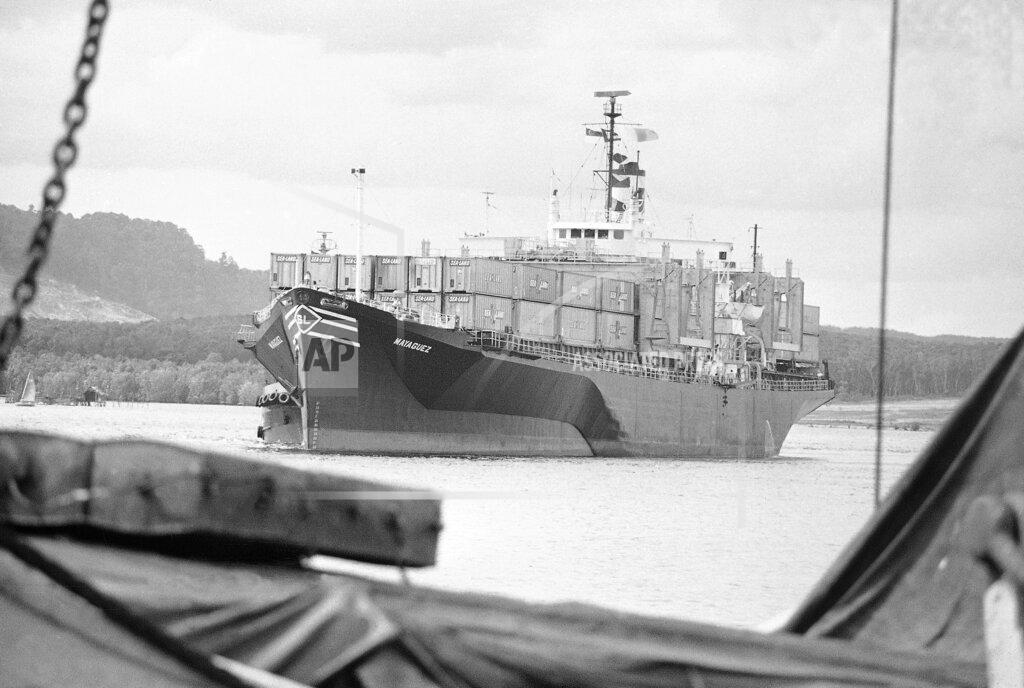
The Cambodian Government spokesman charged in a communiqué issued in Paris today that the Mayaguez incident was a “blatant provocation” used as a pretext by the United States to “execute a pre‐established plan” to destroy Cambodian ports and economic facilities. The 400‐word communiqué was signed by Hu Nim, the spokesman for the Royal Government of Cambodian National Union, and was dated Phnom Penh, May 16. The delay in issuance was a result of difficulties in Phnom Penh’s communications with its mission in France. The communiqué said that to demonstrate “our goodwill and to live in peace… the Cambodian Royal Government decided to free the Mayaguez and its entire American crew, even though this ship had manifestly violated territorial waters, had taken part in espionage and provocative activities.”
Charles Miller, the captain of the Mayaguez, the American freighter that was released by the Cambodians Thursday in the midst of a United States air, sea and land assault, said that he and his crew were aboard a fishing boat that was strafed and tear-gassed by American planes. He had brought the ship into Singapore, and he answered reporters’ questions on the pier alongside the ship. The session with the press was arranged by the ship’s owner, Sea-Land Service of Menlo Park, New Jersey, whose executives wished to demonstrate that the Mayaguez was not a “spy ship.” Captain Miller told reporters: “I don’t blame the pilots. They were only trying to keep us out of Sihanoukville. They wanted us to return to the vessel.”
Leaders of the Provisional Revolutionary Government met privately in the presidential palace here today after a week of presenting themselves to the people at victory celebrations. Diplomatic sources believe the leaders will soon announce a full Cabinet to take over from the military administrative committees that have run the country since the communists took power on April 30. There have been persistent suggestions that the South Vietnamese Third Force neutralists who supported neither the South Vietnamese communists nor the Government of President Nguyễn Văn Thiệu, will be given portfolios, if only for show. Leaders present at victory celebrations included the chairman of the National Liberation Front, Nguyễn Hữu Thọ, President Huỳnh Tấn Phát of the revolutionary government, Foreign Minister Nguyễn Thị Bình and Defense Minister Trần Nam Trung.
The United States Embassy in Vientiane lost contact with American officials of the Agency for International Development and their dependents who are being held by students in the south-central Laotian city of Savannakhet. The Americans may number about 14. In addition to seizing the A.I.D. compound, and taking over the Laotian government offices in the city, the students took over the American agency’s radio transmitter with which the Americans had been sending messages to the embassy in Vientiane. There was no word from Savannakhet today.
Thailand formally expressed indignation that the United States had used a Thai base in the rescue of the merchant ship Mayaguez from Cambodian forces, while 3,000 demonstrators marched on the United States Embassy in Bangkok. The Thai Foreign Minister informed the United States charge d’affaires that Thailand planned an immediate review of “all aspects of cooperation and commitments” between the two countries, specifically the agreement under which the United States has been permitted the use of bases in Thailand, which played an important role in the Indochina war.
The South Korean National Assembly convened today for a four‐day special cession expected to endorse President Chung Hee Park’s defense and internal security measures in the wake of Communist victories in Indochina. The New Democratic party, the chief opposition group, agreed earlier in the week to give support to the policies, reflecting fear of a North Korean invasion. Japan’s Kyodo news service reported that North Korea had accused South Korean troops of “military provocations” near the demilitarized zone and warned that this would bring “serious results.” Kyodo said a North Korean broadcast reported that South Korean troops had fired machine guns twice at North Korean soldiers, but it made no mention of casualties.
Opposition political leaders in Seoul expressed shock and anger today at the revelation that the Gulf Oil Corporation had contributed $4‐million to President Park Chung Hee’s Democratic Republican party prior to the 1971 elections. “Very shocking,” said Kim Dae Jung, the New Democratic party candidate who lost to Mr. Park in 1971 and who now is undergoing a long-drawn‐out trial on charges of “spreading falsehood” because he asserted that Mr. Park’s party spent $100‐million in the closely contested election. News of the revelation of Gulf Oil’s contributions by Bob R. Dorsey, the company’s chairman, in testimony yesterday before a Senate subcommittee in Washington was not published in South Korea. Many editors felt that publication would violate last Tuesday’s presidential decree banning reports officially regarded as detrimental to national unity.
Bob R. Dorsey, chairman of the Gulf Oil Corporation, may have been technically correct yesterday when he testified before a Congressional committee that the $3‐million his company gave to South Korea’s governing party in 1971 might have won the election for President Park Chung Hee. But politically it is impossible to single out one contribution and say that it made the difference. It was the totality of the political apparatus and the money collected from South Korean, American, Japanese and perhaps other foreign sources to pay for it that won the election.
About 30 writers, scholars and other intellectuals began a 48-hour hunger strike in Tokyo to protest the prosecution of dissident poet Kim Chi Ha of South Korea. The poet will go on trial Monday on charges of supporting North Korea. A death penalty could result. In Kyoto, Japan, about 150 persons attended a “Save Kim Chi Ha” rally and in nearby Osaka about 500 watched a performance of one of his dramas. The 34-year-old poet, known for his satirical pieces criticizing government corruption, was given a life sentence last year for involvement in an alleged anti-state student plot, but was freed under a clemency order. He was arrested again in March of this year for writing an anti-government article.
Honduras authorities in Tegucigalpa filed criminal charges against the Tela Railroad Co., a United Brands Co. subsidiary, for allegedly bribing a former economy minister, Abraham Bennaton Ramos, with $1.2 million to have a banana export tax reduced. An official announcement said Bennaton Ramos is also being prosecuted. A special investigating committee said its inquiries had unearthed enough evidence to prove that United Brands, a U.S. firm, actually did make the bribe to keep down the banana tax. The scandal sparked a bloodless coup April 25 and the overthrow of President Lopez Arellano.
The Organization of American States today elected Alejandro Orfila of Argentina as its Secretary General. He was chosen on the seventh ballot in a series of votes that began on Wednesday. He succeeds Galo Plaza Lasso of Ecuador for a five‐year term at the head of the 24‐member organization. According to a report from United Press International the O.A.S. made a key decision Saturday that virtually assures that the 11‐year trade embargo against Cuba will be lifted this year. Delegates to General Assembly voted to end the 1964 ban as soon as the Rio treaty under which sanctions were imposed can be reformed at a conference in July. The United States abstained in voting on the declaration, which passed by a 14 to 4 vote.
The Ethiopian Provisional Military Government has announced the nationalization of all private aircraft companies, privately owned light planes and four foreign‐owned supermarkets. A statement yesterday said the “transfer to public ownership” of the aircraft companies and planes had been ordered because “some of the light aircraft have been used to smuggle out of the country currency and foreign nationals who have made their fortunes in Ethiopia.” The planes will be taken over by the Ethiopian Airlines to expand domestic services.
The military rulers of Madagascar announced today an amnesty for some of those charged in connection with the assassination last February of Richard Ratsimandrava, who was President and Premier. Announcing the amnesty, Information Minister Richard Andnamaholison said proceedings against other persons directly implicated in the assassination and in plots against the Government were going ahead. The amnesty is expected to apply to about 200 persons.
Portugal’s chief representative in Angola has accused the Popular Movement for the Liberation of Angola of distributing arms to civilians and children in an indiscriminate manner. General Antonio Silva Cardoso was quoted by the Lisbon weekly Expresso today as having said that the present situation in the West African territory could lead only to chaos. From 500 to 1,000 people are estimated to have died in fighting between the Popular Movement and the Zaire‐based National Front for the Liberation of Angola in the Angolan capital of Luanda earlier this month. The National Front attributed the fighting to indisciplined, hastily armed youths.
The decision that urban Africans are to be allowed 30‐year leasing rights to properties in black townships surrounding white cities instead of being forced to rent on a month‐to‐month basis is a significant step in the South African Government’s softening of its apartheid policy. Coming at a time when Prime Minister John Vorster is striving to win friends in hostile black Africa, it amounts to official acknowledgment that some blacks are permanent residents of “white” South Africa rather than belonging in their rural so‐called homelands. This acceptance, which runs counter to traditional apartheid theory, will inevitably increase demands that the black townsman, who has virtually no control over his affairs, be given some form of political rights.
President Ford relaxed with a round of golf at the Burning Tree Country Club in Bethesda, Maryland, after completing one of his most exhausting and momentous weeks in office. He will deliver what aides described as a major philosophical address today at the University of Pennsylvania’s commencement in Philadelphia. They said Mr. Ford would probably not speak at length about his decision to use military force to recover the freighter Mayaguez and its crew from Cambodia. The aides indicated that the speech would be upbeat and designed to build up American pride after the successful rescue operation. The President planned also to visit a reception in Philadelphia for Senate Republican leader Hugh Scott before returning to Washington.
Secretary of State Henry Kissinger, who has been under fire in Washington, was received with a mixture of enthusiasm, respect and curiosity last week during a four‐stop visit to the Middle West. His two speeches during the trip, which included stops in St. Louis, Jefferson City, Kansas City, and Independence, Missouri, were warmly received. Only once during the trip, which the Secretary reportedly made to shore up his political position in Washington and to demonstrate his popularity, was he met with hostility, when a group of demonstrators espousing a variety of causes paraded outside his hotel in St. Louis. “The reason I’m doing this,” said Mr. Kissinger at the outset, “is to give the people a sense that the government has a foreign policy and that they should have confidence in it.” He also told newsmen privately that his target was “cult of withdrawal” that has been springing up among isolationists since setbacks in Indochina.
Byron De La Beckwith, the white supremacist once accused in the 1963 ambush killing of civil rights leader Medgar Evers, was convicted in New Orleans of transporting a ticking time bomb into the state. Police had said at the time of his arrest they believed he had been heading for the home of a prominent Jewish leader to plant the bomb. The jury of five black women deliberated 35 minutes before convicting him. In Louisiana, a jury has only five members if the alleged crime is not punishable by death or life imprisonment at hard labor. Beckwith, who faces a maximum $1,000 fine and five years in prison, was freed on a $10,000 bond to await sentencing. Beckwith, 50, was tried twice in connection with the slaying of Evers. Each trial resulted in a hung jury and he was released.
A Supreme Court decision barring the award of attorneys fees to citizens’ groups that win lawsuits establishing their rights has sent a shock wave through the profession of public interest law. Unless Congress intervenes, the ruling handed down this week threatens to cut off millions of dollars in potential support funds for lawyers and firms that specialize in consumer, environmental and civil rights lawsuits against government and industry. Dividing 5 to 2, the Supreme Court rejected the broad theory that litigants who win public interest cases are acting as “private attorneys general,” and are thus entitled to have the losers pay their legal costs. The majority said this could be done only when Congress has explictly authorized the practice.
Public health and military doctors, satisfied that the sudden influx of Vietnamese refugees posed no public health threat to Americans, are intensifying efforts to treat the personal medical needs of the Vietnamese and to protect them from infections that often become epidemic among people living in crowded, drab conditions. Last night 18,306 Vietnamese refugees, who are awaiting security clearances to enter the country, slept on cots—16 to a tent—at the northwest corner of the Camp Pendleton Marine base. About one‐third were under the age of 15 years.
A new law, not yet widely known except among political technicians and professionals, seems likely to jar the American political process out of its accustomed tracks once again. This is the 1974 campaign-financing rules, which basically reorganizes completely the way campaigns for federal office are financed and, consequently, the way they are conducted. It will bring a number of major changes.
A former Air Force master sergeant was sentenced to 10 years at hard labor after pleading guilty to espionage charges, including that in 1971 he had copied and attempted to transmit classified military documents to representatives of the Soviet Union. Raymond G. DeChamplain, 44, was freed from custody pending review of his court-martial at Richards-Gebaur Air Force Base near Kansas City, Missouri. At a 1971 court-martial he had been sentenced to 15 years. A military review court suspended that conviction.
Royalties of $14,999 he received last year from the sale of medallions, watches and other such items by his campaign organization were legal, Governor George C. Wallace said in Montgomery, Alabama, following publication of a New York Times story reporting the payments. Wallace, paralyzed from the waist down by an assassin’s bullet three years ago, said the royalties “have been placed in a medical account which is set up and approved by the Government Accounting Office and judged clearly within the confines of the campaign finance law.” A campaign spokesman said the sale was limited and that the items were not being offered now.
A police intelligence cooperative association that exchanges information among its member agencies about organized crime has dropped the Houston Police Department from its rolls in the aftermath of public disclosures about the Houston agency’s alleged involvement in illegal wiretapping. The national chairman of the Law Enforcement Intelligence Unit, Ray Henry, notified the Houston Police Chief, Carroll Lynn, on January 27, that his department had failed to win reinstatement in the association but did not specify the reasons. Mr. Henry declined this week to say why the police department’s reinstatement request had been rejected, but listed a number of possible factors, including the current city and federal grand jury inquiries in Houston into alleged unauthorized wiretapping by the Houston police.
Illegal aliens entering the United States from Mexico are increasing the danger of Americans contracting tuberculosis, according to Dr. John A. Wiggins Jr., chairman of the state’s Tuberculosis Advisory Committee. Mr. Wiggins says the influx of between 10 million and 12 million illegal Mexican aliens has kindled an outburst of tuberculosis in this country with a type of the disease that is more difficult to detect and control than Americans have known in the past. The problem is particularly serious in South Texas along the Mexican border, says the physician. There, the incidence of tuberculosis is more than double the national average for the United States—36.4 cases per 100,000 population compared with 14.8 cases nationally. Dr. Wiggins estimates the perhaps as many as one in every thousand people illegally entering this country from Mexico may be carrying an active tuberculosis germ.
Harvard University is “still very much in the ball game” as the site of the John F. Kennedy library, Charles U. Daly, Harvard vice president, said. After 10 years of negotiations with Harvard and Cambridge officials, the Kennedy Library Corp. said Thursday it was actively pursuing only two sites, the Boston and Amherst campuses of the University of Massachusetts. Cambridge community groups have opposed the Harvard site because of the increased tourist traffic it would bring. But Daly said, “We are going to continue to work with the city and the community to try and arrive at a point where we can make clear, in writing, that the scholarly portions of the library” would be welcome.
Non-metropolitan areas are growing faster than metropolitan areas, according to Census Bureau surveys, made since the 1970 Census, that show a surprising shift in population in the United States, This is the first time this has happened in the 20th century and perhaps the first time in the Republic’s history. This new rural growth seems to be due to several reasons, including the spread of manufacturing to remote areas and the migration of retired people to places once inhabited by woodsmen and hardscrabble farmers.
The “Wild Man of the Green Swamp (Florida)” was captured by sheriff’s deputies in Sumter County, Florida after surviving on his own for eight months. First sighted in September, he had eaten armadillos, snakes, turtles and alligators. Identified as Hu Tu-Mei of Taiwan, a mentally ill man who had escaped from a Tampa hospital, the “Wild Man” hanged himself in jail two days later.
Singer Mick Jagger (31) punches a restaurant window, needs 20 stitches for repairs.
10CC releases “I’m Not in Love.”
Filbert Bayi of Tanzania broke the world record for running the fastest mile, held by Jim Ryun for almost eight years (June 23, 1967). Bayi, who led the race in Kingston, Jamaica, from start to finish, bested Ryun by a tenth of a second, covering the distance in 3:51.0; less than three months later, on August 12, John Walker of New Zealand would break Bayi’s mark.
100th Preakness: Darrel McHargue aboard Master Derby wins in 1:56.4. Fighting off a closing bid by the heavily backed favorite, Mrs. Robert Lehmann’s Master Derby scored an upset victory today in the $216,600 Preakness Stakes. Under a cagey ride by his regular jockey, Darrel McHargue, Master Derby enjoyed the margin of a length over John L. Greer’s Foolish Pleasure in the 1 3/16‐mile race for 3‐year‐olds. Frank McMahon’s Diabolo was next in the field of 10. Foolish Pleasure won the Kentucky Derby two weeks ago, with Master Derby fourth. A record crowd of 75,216 attended the program, which enjoyed extensive promotion as the 100th running of the race. Despite the fact that Master Derby had won the Blue Grass Stakes April 24, a fine criterion for a horse’s potential in subsequent races, the customers here showed an amazing lack of faith in the Kentucky‐bred. The payoff on the winner was $48.80, $16 and $7.20 for $2 across the board.
Major League Baseball:
In Montreal, Johnny Bench and Ken Griffey hit homers in the 10th inning as the Reds beat the Expos, 5–3. Griffey, the first batter up in the 10th, tagged a reliever, John Montague, for his first home run of the season and one out later Bench walloped his sixth.
In Philadelphia, the Phils score 3 runs in the bottom of the 9th to win, 9–8, and pin the loss on the Braves Phil Niekro. For the 3rd game in a row, Gene Garber is the winning pitcher. He ties the National League mark last done by Mike Marshall in 1974. The Phillies scored once on an Atlanta error and tied the score, 8‐8, on Ollie Brown’s single. Then Dave Cash singled home the winning run. The hit made a winner of Gene Garber (4‐2), who has won the Phillies’ last three games.
At Chavez Ravine, the Dodgers edge the Pirates, 4–3, when Joe Ferguson, pinch hitting for starter Andy Messersmith (6–0) drives in the winning run in the 10th. The Bucs get on the board early when Manny Sanguillen steals home on the front end of a double steal.
A five-run uprising in the seventh inning, plus some strong relief pitching by Harry Parker, lifted the New York Mets to their fifth straight victory tonight, a 6–4 triumph over the bedraggled Houston Astros at the Astrodome.
Ted Simmons drove in four runs in the third inning with a leadoff homer and a bases‐loaded triple and added a fifth R.B.I. with a single in the ninth as the St. Louis Cardinals routed the San Francisco Giants 17‐2 today. Bob Forsch was the winning pitcher on a sevenhitter. Nine Cardinals had at least one hit, one R.B.I. and scored a run in the 23‐hit attack on four Giant pitchers. The loss went to a rookie, Pete Falcone, who was knocked out in St. Louis’s seven‐run third inning.
Steve Huntz broke a 1–1 tie with a two‐run single in the seventh, sending the San Diego Padres to a 4–1 victory over the Chicago Cubs tonight before a standing‐room “Helmet Night” crowd of 49,599 the largest ever to see a baseball game here.
Suppose Catfish Hunter loses to the Oakland A’s today. What, then, are the Yankees to do? Hunter, the multimillionaire who might justifiably go on strike for more money, is the only Yankee pitcher to win a game in a month of May that has been anything but merry for the New Yorkers. George Medich, who hasn’t won since April 22, tried last night, but all he succeeded in doing as Oakland won, 6–1, was take over the home‐runs‐allowed leadership among Yankee pitchers. Two homers by Billy Williams and one by Reggie Jackson sent Medich’s total soaring to nine, one more than Pat Dobson has allowed. The homers also sent the Yankees plummeting to their 10th loss in the last 12 games. Hunter, of course, has those two victories, plus the first one the team gained this month.
Rod Carew cracked a two‐run double in the eighth inning today to drive in two runs and give the Minnesota Twins an 8–7 victory over the Milwaukee Brewers. Carew’s hit, his second game‐winner in three games, scored Sergio Ferrer, a pinchrunner, and Steve Braun, and came off the Milwaukee relief ace, Tom Murphy.
Lee Stanton, Dave Chalk and Bruce Bochte drove in two runs apiece, leading the California Angels to a 6‐3 victory over the Baltimore Orioles tonight before a record regular‐season Baltimore crowd of 48,042. The Orioles gave away free Jackets to youngsters The crowd saw a wild argument in the fifth inning when one umpire signaled that California’s Tommy Harper had hit a tie-breaking three‐run homer and another umpire overruled him and called it a foul ball.
John Mayberry capped a three‐run second inning tonight with a two‐run home run that led the Kansas City Royals to a 5‐3 victory and their third straight triumph over the Boston Red Sox. George Brett opened the second inning with a walk and circled the bases to score when both Rico Petrocelli, the third baseman, and Rick Miller, the left fielder, misplayed a sharp ground ball by Fran Healy, is ho ended up at second on the play Mayberry followed with his fourth home run of the season to make the score 4‐1.
Ken Henderson’s three‐run homer highlighted a seven-run first inning that led the Chicago White Sox to a 10‐1 rout of the Cleveland Indians tonight. Jun Kaat posted his sixth victory against one loss.
Willie Horton belted a two‐run homer in the fourth and John Hiller made his fifth save of the year tonight as the Detroit Tigers posted a 6–4 victory over the Texas Rangers.
California Angels 6, Baltimore Orioles 3
Kansas City Royals 5, Boston Red Sox 3
Cleveland Indians 1, Chicago White Sox 10
New York Mets 6, Houston Astros 4
Pittsburgh Pirates 3, Los Angeles Dodgers 4
Milwaukee Brewers 7, Minnesota Twins 8
Cincinnati Reds 5, Montreal Expos 3
Oakland Athletics 6, New York Yankees 1
Atlanta Braves 8, Philadelphia Phillies 9
Chicago Cubs 1, San Diego Padres 4
St. Louis Cardinals 17, San Francisco Giants 2
Detroit Tigers 6, Texas Rangers 4
Born:
Per Svartvadet, Swedish NHL centre and left wing (Atlanta Thrashers), in Solleftea, Sweden.
Scott Seabol, MLB pinch hitter, third baseman, and second baseman (New York Yankees, St. Louis Cardinals), in McKeesport, Pennsylvania.
Laura Voutilainen, Finnish pop singer, born in Jyväskylä, Finland.
Cheick Kongo, French mixed martial artist and kickboxer (31 MMA wins, 21 kickboxing wins), in Paris, France.
 History Diaries